
NOMOS Glashütte Club Campus Neomatik 39 Watch Review (2020)
The NOMOS Glashütte Club Campus Neomatik 39 is housed in a 39.5 mm stainless steel case. It sports a California dial and features the German brand’s slender, automatic movement, the Calibre DUW 3001 and is intended for a young audience.

Life is a series of moments
As the years pass, we experience a series of moments that punctuate our lives, ultimately imbuing our memoirs with colour and texture. The first day at school, receiving our first bike, going to ‘big school’, having our first kiss and leaving home are just a few of the landmarks we assign to memory, ready to recount later in life.
The inaugural NOMOS Club Campus Collection was released in 2017
Perhaps one of the most important landmarks in any person’s life is transitioning from full-time student to tax-paying worker. In 2017, NOMOS Glashütte having identified this important stage in life, released a range of student-themed models, the Club Campus collection.
Since releasing the inaugural Club Campus watches, NOMOS, no doubt buoyed by sales success, has enlarged this family of models, including some endowed with its highly acclaimed Neomatik calibres.
The brand from Saxony recently sent me the NOMOS Glashütte Club Campus Neomatik 39 for a few days of ‘hands-on’ evaluation. With my studious daughter on hand, I also canvassed her opinion in order to supplement my own.
NOMOS Glashütte Club Campus Neomatik 39 – dial
At first glance, the dial of the NOMOS Glashütte Club Campus Neomatik 39 appears simple, augmenting the ease of read-off. However, after the briefest association, subtle details make their presence known. For example, the watch features a California dial, where the indexes comprise Arabic numerals in the northern hemisphere of the dial and Roman numerals in the southern portion of the dial. The numerals appear on most of the even-numbered hours, but batons are employed for odd-numbered hours.

The epidermis of the dial is described as ‘white silver-plated’, but its appearance proves far more complex when viewed in the flesh. A sign of a superb dial is when it plays with light and effervesces with a myriad of shades depending on its position. During my tenure as a NOMOS test pilot, I have witnessed the dial appear cream, silver and white. At the same time, I have observed the indexes morph from dark blue to amethyst, to aubergine, to black and to mauve. In addition, the indexes are framed with a fine copper-toned border. The skilful play with different hues enriches the overall aesthetic.
The hour and minute hands are rhodium-plated, silver-toned and lined with Super-LumiNova. The small seconds display, positioned at 6 o’clock, is recessed, sitting beneath the main epidermis of the dial.
NOMOS Glashütte Club Campus Neomatik 39 – case
The stainless steel case measures 39.5 mm in diameter and is of the bipartite variety. Despite the NOMOS’s highly polished case readily sparkling, the watch quietly converses with the world. Indeed, this watch could never be accused of raucous behaviour.
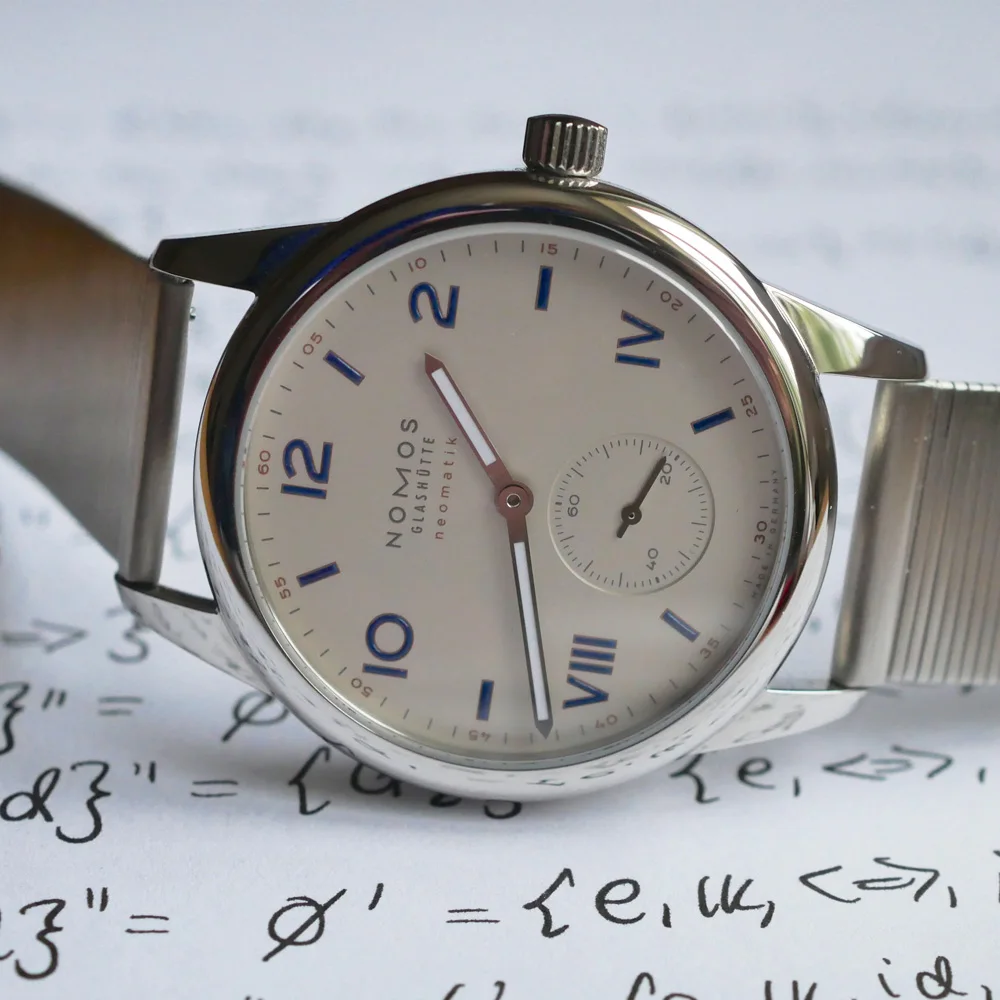
The NOMOS Glashütte Club Campus Neomatik 39 is supplied on a fine, intricate metal bracelet. It is presented in a satin finish and proves even more understated than the case. Conversely, the buckle is highly polished, exhibiting a tasteful soupçon of brilliance. Despite the blend of different case treatments, everything coexists in harmonious concert.
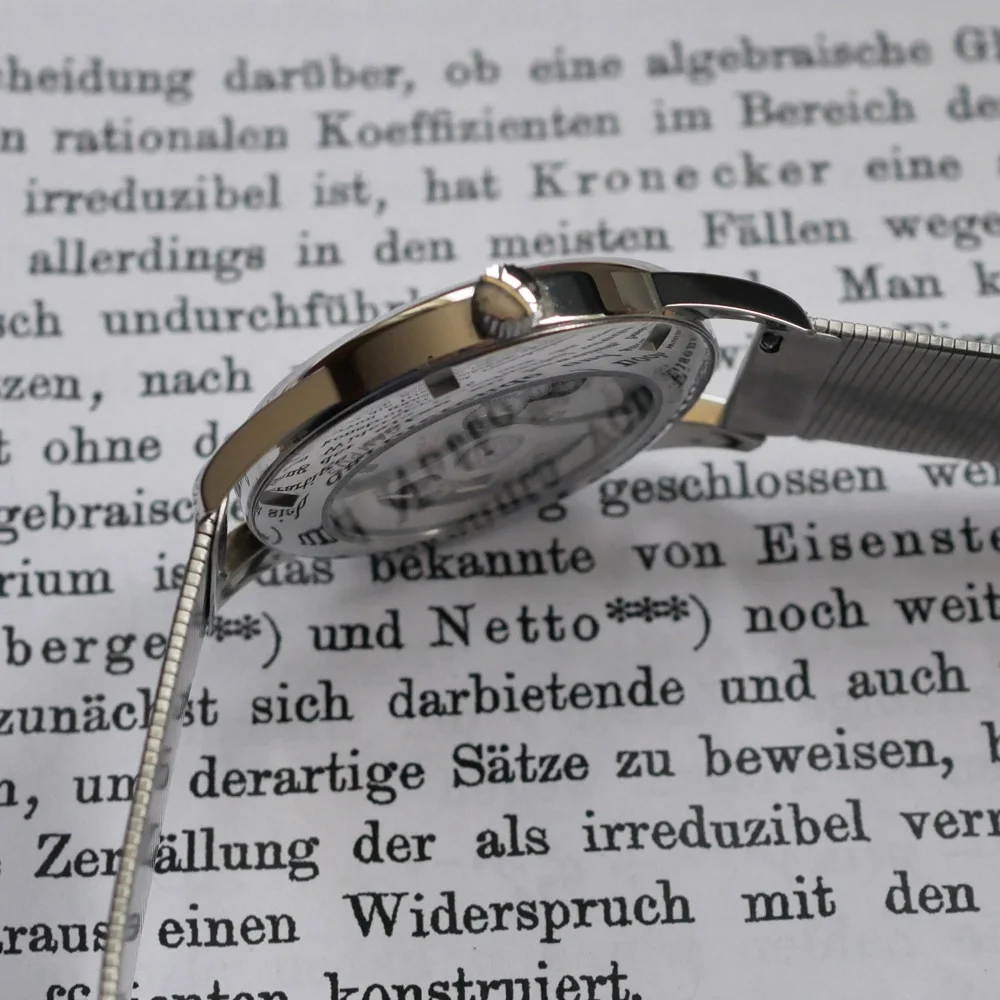
At the heart of this watch is a svelte movement, measuring a mere 3.2mm in height. A key benefit of this extraordinary slimness is the movement doesn’t need much house room, a quality reflected in the timepiece’s slender height of 8.4 mm.
Having worn the NOMOS Glashütte Club Campus Neomatik 39 for a number of days, its modest case diameter, slender waist and ultra-flexible bracelet pamper the wrist wonderfully.

The German watch brand offers this model with a solid case back. This can be personalised with an engraving, a service NOMOS provide for no additional cost. However, my press loan came with a sapphire crystal case back, an available upgrade, attracting a small premium.
NOMOS Glashütte – a desire for independence
Many watch brands, especially those operating within this price segment, procure movements from third parties. However, NOMOS Glashütte is a ‘Manufacture’, crafting its own in-house calibres. In Switzerland, there are several ‘Manufactures’ making in-house movements. Often these are high-end brands offering timepieces at commensurately high-end prices. This is not to disparage such companies, but for many young people embarking on a new career, parting with a five or six-figure sum for a watch proves unrealistic.
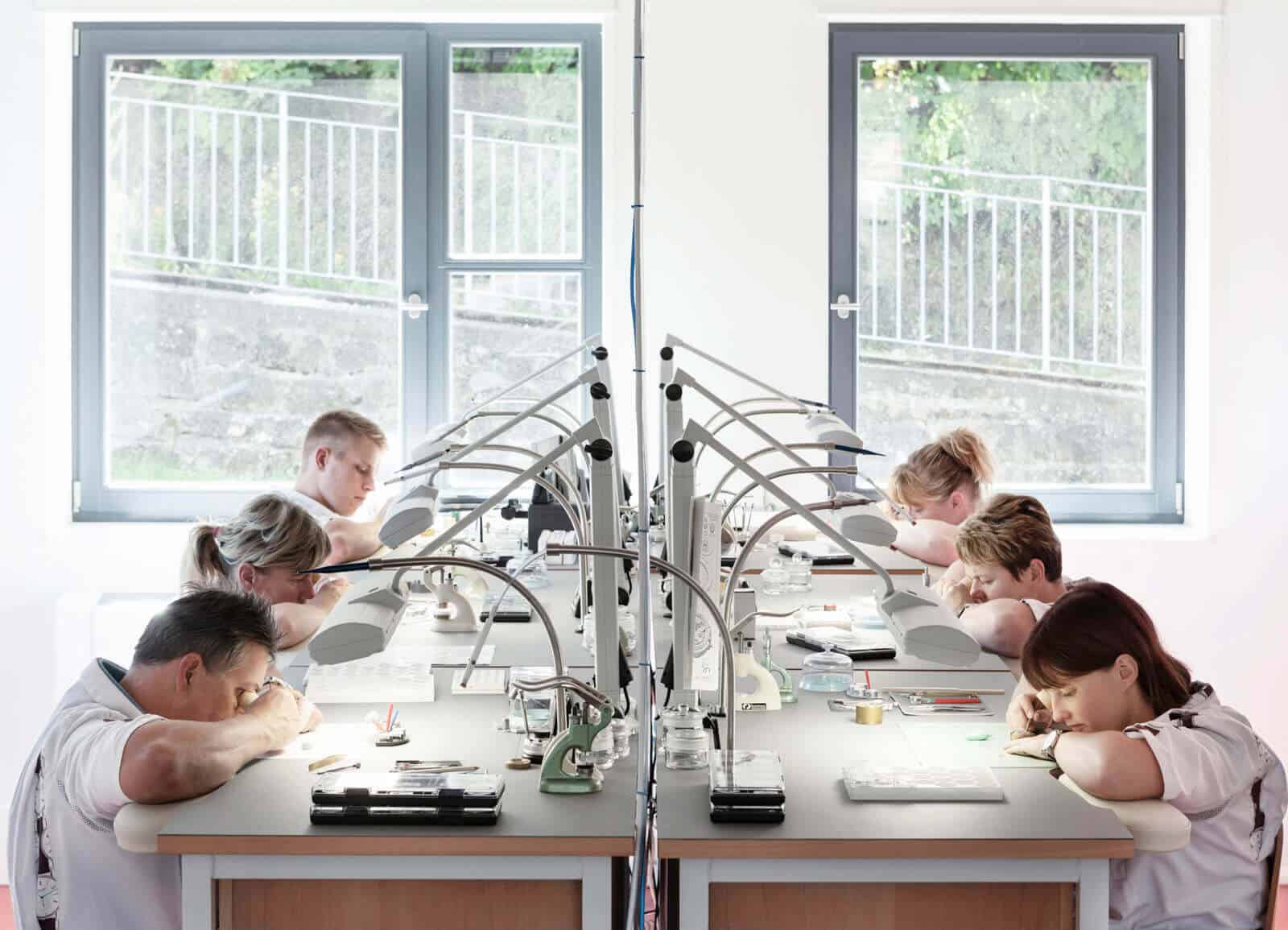
Image: Copyright: NOMOS Glashütte
The bulk of Manufactures make most movement components but source the escapement and regulating organ from third-party specialists. While several specialists make suitable parts, the majority of the watch industry is dependent on one large company. Several years ago, NOMOS Glashütte, eager to be the master of its own destiny, decided to make its own escapement and regulating organ.
The purpose of the escapement and regulating organ
All mechanical watches contain a mainspring. This is tensioned either by rotating the crown or, if the watch is automatic, with the natural motion of the wrist. When the mainspring is tensioned, the energy has to be released in small doses. If the mainspring unwound without any hindrance, the energy would cause the hands to rotate rapidly in a short period and then stop. Moreover, such excessive energy could prove harmful to delicate parts within the watch.

Image: Copyright: NOMOS Glashütte
The energy from the mainspring is transmitted through a collection of wheels, termed the ‘gear train’, reducing the energy into a manageable dose. This energy ultimately serves the escapement.
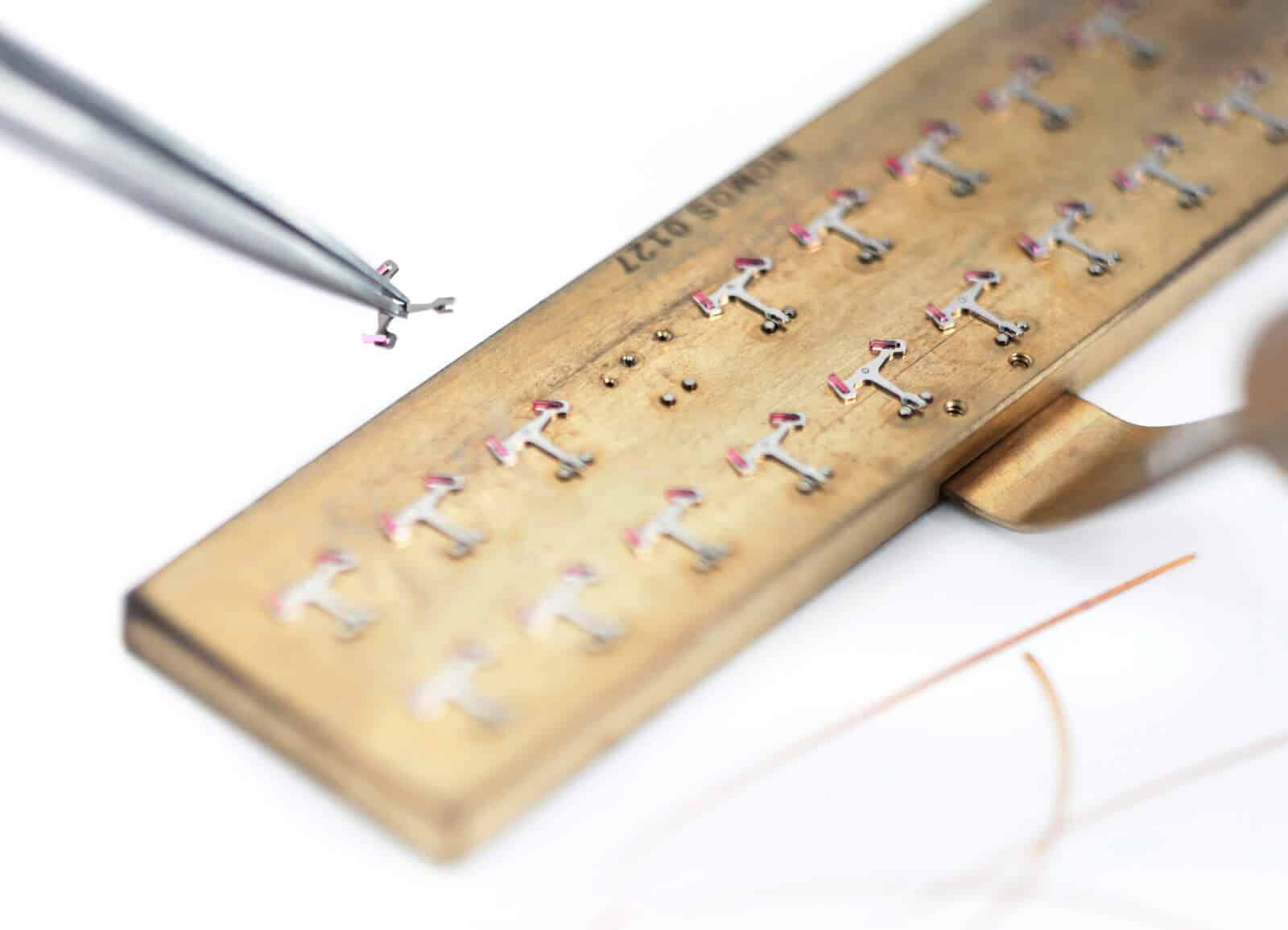
Image: Copyright: NOMOS Glashütte
The escapement consists of the escape wheel, pallet lever and roller. It sends an impulse of energy to the balance. The balance behaves like a child’s swing moving backwards and forwards, with just a slight push, or ‘impulse’, the momentum of the swing is maintained at a steady rate.
All mechanical watches need a balance consisting of a balance spring, balance wheel and anti-shock system. As the balance spring ‘breathes’, the balance wheel oscillates to and fro at a predetermined frequency. The oscillating balance wheel moves the pallet lever which momentarily unlocks the escape wheel. This in turn allows the gear train to move a small amount, ultimately causing the hands to advance as desired. It is the combination of the escapement and regulating organ which controls the flow of time.
NOMOS swing system
Several years ago, NOMOS Glashütte expended much effort designing an in-house gear train. The order, angle and number of teeth on each wheel have a significant bearing on the efficiency of the gear train. Ideally 100% of the power from the mainspring, housed within the ‘barrel’, would arrive at the escapement. Unfortunately, no system is this efficient, however, the German brand did achieve 94.2% efficiency compared to an industry average of approximately 80%. This efficiency provides additional benefits in terms of movement design, something I will return to later.
My reason for mentioning the in-house gear train is that it demonstrates NOMOS’s desire not only to be independent but also to deliver technical advancement. However, the brand’s ‘swing system’ was a far bigger undertaking. The swing system is the term NOMOS Glashütte uses to describe the escapement and regulating organ. It is the most critical part of a wristwatch. Each component must collaborate as a team, optimally working together to deliver precision.
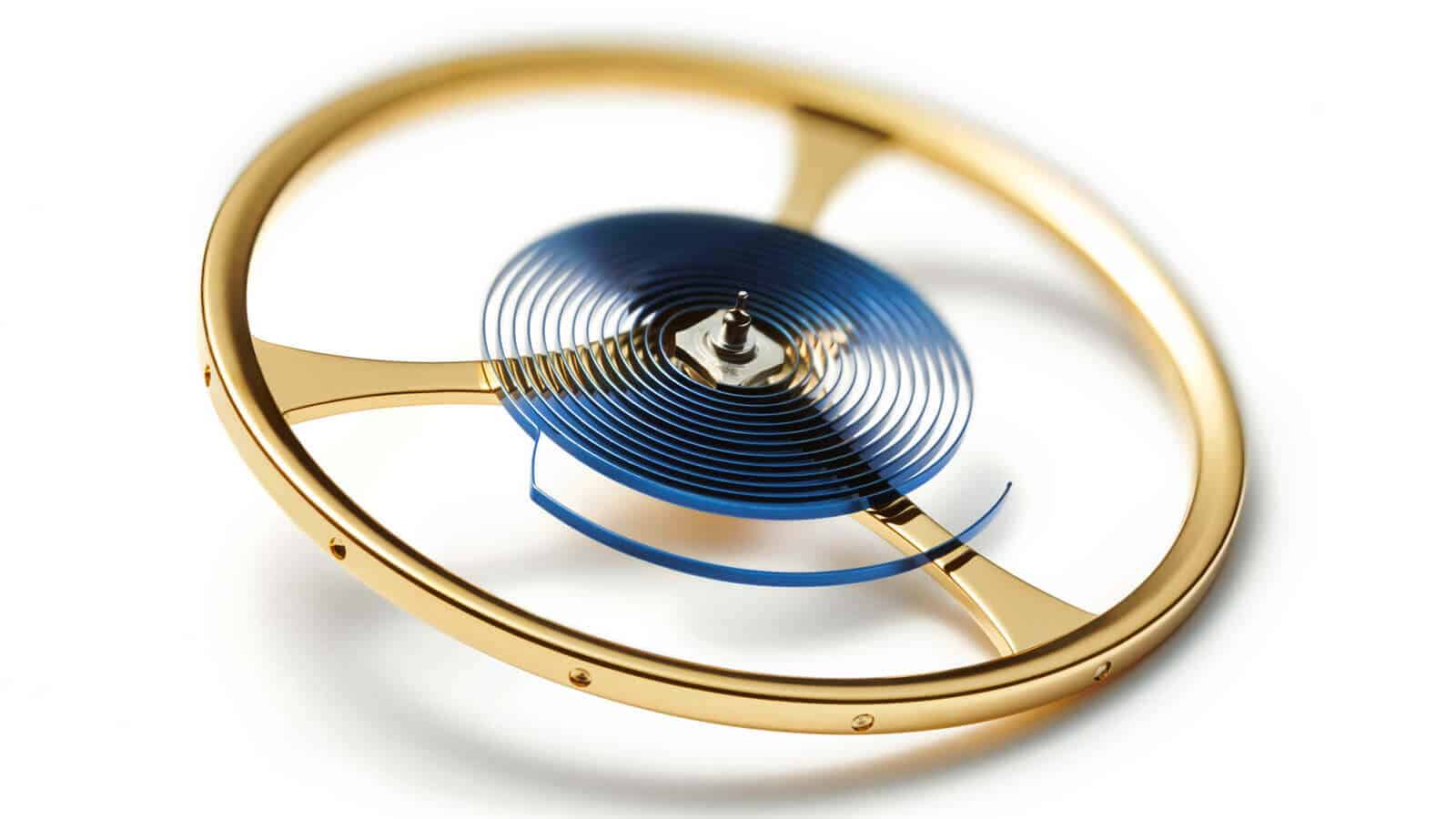
Image: Copyright: NOMOS Glashütte
The balance spring is made of an alloy, presented in a distinctive shade of blue. All producers of balance springs remain tight-lipped as to the composition of their alloy as it is a closely guarded trade secret. The alloy has to be made into a wire which is drawn over a series of rollers and passes through a number of dies. This process takes several days.
The objective is to ensure the diameter of the wire remains uniform. The wire is then rolled into a flat ribbon, cut into lengths, coiled and then baked. Again, the baking time and temperature are shrouded in secrecy. The tolerances when making a balance spring are expressed in nanometres (1 mm = 1,000,000 nm). A small variance can lead to the watch gaining/losing several seconds per day.
Making the balance work
Ultimately, the balance spring has to be paired with the balance wheel. There are always minute variances between balance springs and likewise balance wheels. The two components have to be sorted into one of 20 different classes in order to find the optimum pairing.
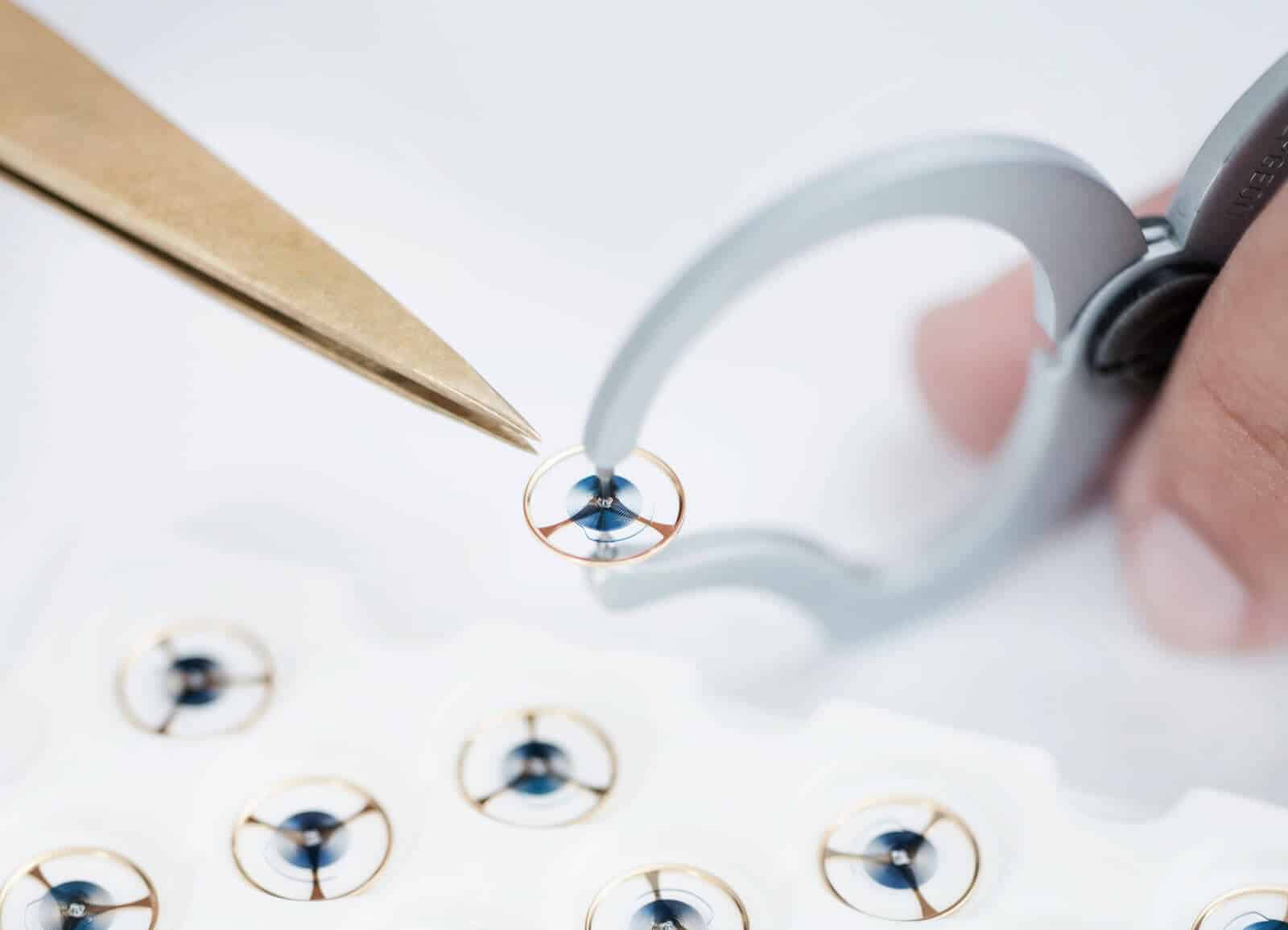
Image: Copyright: NOMOS Glashütte
The balance wheel, fitted with balance spring, then requires poising. This is similar to having new tyres fitted to a car and the garage adding small weights to the rim of the wheel to avoid unwanted vibration. In terms of watchmaking, an infinitesimal amount of material is removed from the underside of the balance wheel. This ensures that the moment of inertia is constant throughout.
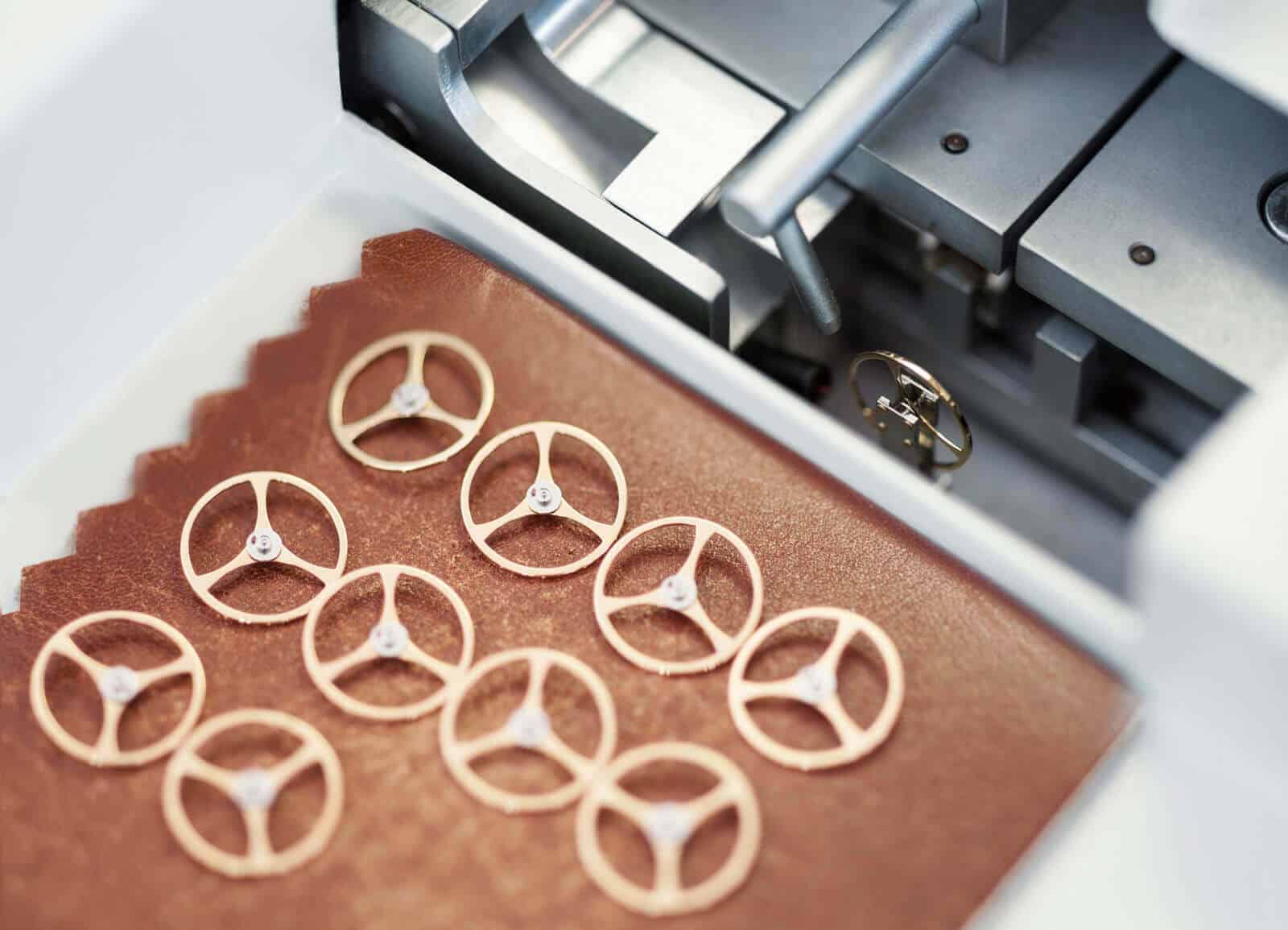
Image: Copyright: NOMOS Glashütte
The watchmaker has to ensure the balance spring breathes concentrically in order to deliver precision. Moreover, the balance wheel should remain parallel to the base plate when oscillating, effectively free of wobble.
Lastly, when the movement is fully assembled, it is regulated to ensure it delivers precision. A small lever affixed to the balance, termed a raquette, moves backwards and forwards, adjusting the ‘effective length of the balance spring’ increasing/decreasing the rate accordingly.
NOMOS Glashütte Club Campus Neomatik 39 – Calibre DUW 3001
In 2015, NOMOS Glashütte launched the Calibre DUW 3001. Unusually, the automatic calibre was slimmer than many hand-wound movements, measuring just 3.2mm in height. While other movements share the same slender torso, they often prove less precise or very expensive.
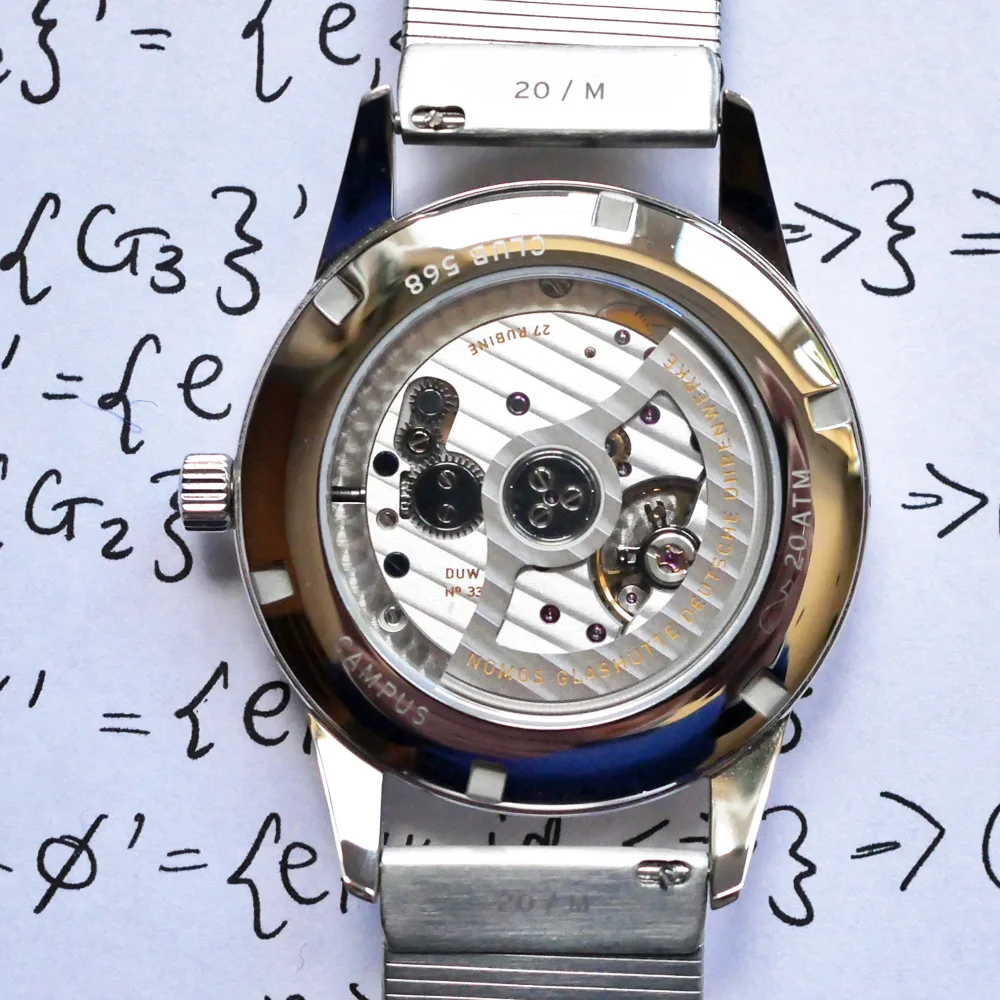
To make this slim movement NOMOS positioned individual parts in close proximity while ensuring they didn’t impede each other. Special ultra-thin parts were used made of a special material. Once again, the German brand remains tight-lipped as to its composition, no doubt keen to retain its competitive edge.
Another slimming technique NOMOS has employed relates to the ratchet wheel. This sits upon the barrel and is only half the depth usually seen elsewhere in the watch industry.
A benefit of the highly efficient gear train mentioned earlier, is that the mainspring does not need to be as powerful. This allowed NOMOS to use a flatter mainspring, again mitigating the height of the movement. As previously mentioned, the svelte profile of the NOMOS Glashütte Club Campus Neomatik 39, a benefit of the slender movement within, confers superb wearer comfort.
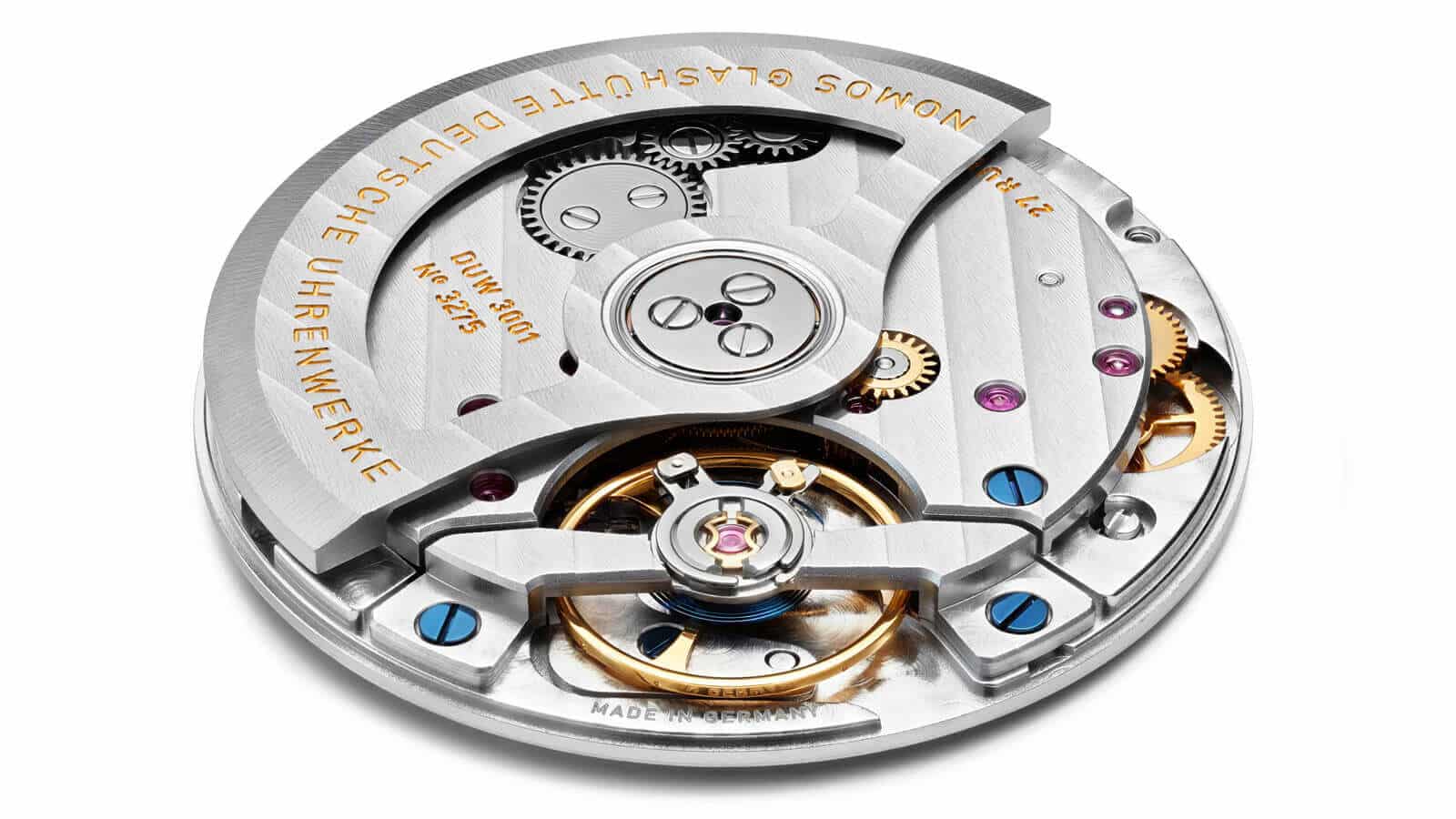
Image: Copyright: NOMOS Glashütte
Despite the modest price of this watch, the movement is attractively presented. The three-quarter plate and the openworked oscillating weight are embellished with Glashütte ribbing and engraved golden text. Perlage, sometimes termed circular graining, adorns the base plate and thermally blued screws abound. NOMOS has upheld fine watchmaking practise and delivered impressive refinement seldom seen at this price point.
NOMOS Glashütte Club Campus Neomatik 39 – closing thoughts
Consistent with other NOMOS watches, the Club Campus Neomatik 39 embraces the principle of ‘form follows function’. The dial of this watch imparts information effortlessly with no risk of confusion.
The California-style dial is playful, youthful and highly legible. However, consistent with all NOMOS watches, the dial, indeed the whole watch, exhibits a wonderful timeless appearance.
By equipping this model with the Calibre DUW 3001, the watch case is slender and unobtrusive. It does not feel heavy or cumbersome and the crown does not inhibit free movement of the wrist. The bracelet is thinner than some leather straps and readily encircles the wrist as if it were a second skin.

Sometimes in life, the beauty of an object is restricted to the exterior alone, however, the NOMOS Glashütte Club Campus Neomatik 39 possesses much inner beauty. The Calibre DUW 3001 is rich in virtue and the product of substantial investment and technical know-how. It is self-winding, obviating the need to wind the watch each day, is highly precise and encompasses exquisite finishing.
The NOMOS Glashütte Club Campus Neomatik 39 makes a compelling case for acquisition. Whether this watch is bought as a gift or selected as a suitable timepiece for a young professional, its virtue is beyond question.
Lastly, if this feature whets your appetite and you are a tad older than the intended audience, remember, you are never too old to wear this NOMOS!
Further reading
Technical specification
- Model: NOMOS Glashütte Club Campus Neomatik 39
- Reference: 765
- Case: Stainless steel; diameter 35 mm; height 8.4 mm; water resistance 20 atm (200 metres); sapphire crystal to front and exhibition case back (optional upgrade)
- Functions: Hours; minutes; small seconds
- Movement: Calibre DUW 3001; self-winding movement; 27 jewels; power reserve 43 hours.
- Strap: Stainless steel bracelet
- Price: £2,600 including VAT – with exhibition case back (RRP as of 1.5.2020)