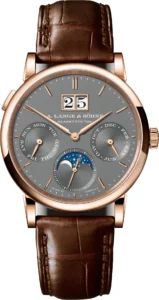
A. Lange & Söhne Saxonia Annual Calendar Watch Review
At Watches & Wonders 2026, Tino Bobe (Director of Manufacturing) and Anthony de Haas (Director of Product Development) stood on stage and presented the A. Lange & Söhne Saxonia Annual Calendar. Although humorous at times, their keynote speech clearly demonstrated why the brand from the Ore Mountains is very serious about crafting fine watches.

Watch complications
For many horophiles, watch collecting begins with the purchase of a simple two-hander – hours, minutes and nothing else. But as curiosity and knowledge grow, collectors invariably begin to explore the world of complications.
Beyond the mere indication of hours and minutes, there are numerous horological curiosities available, from the comparatively simple GMT to the mind-boggling intricate minute repeater, often termed a ‘high complication’. Since 1990, A. Lange & Söhne, the German marque based in Glashütte, has created a vast body of work, from two-handers to its masterpiece, the Grand Complication. This latter watch, released in 2013, features ‘a grand and small strike, a minute repeater, a perpetual calendar and a rattrapante-chronograph function with flying seconds.’ Having developed 77 Manufacture calibres since 1990, each of varying complexity, A. Lange & Söhne’s mechanical virtuosity is nothing short of breathtaking.
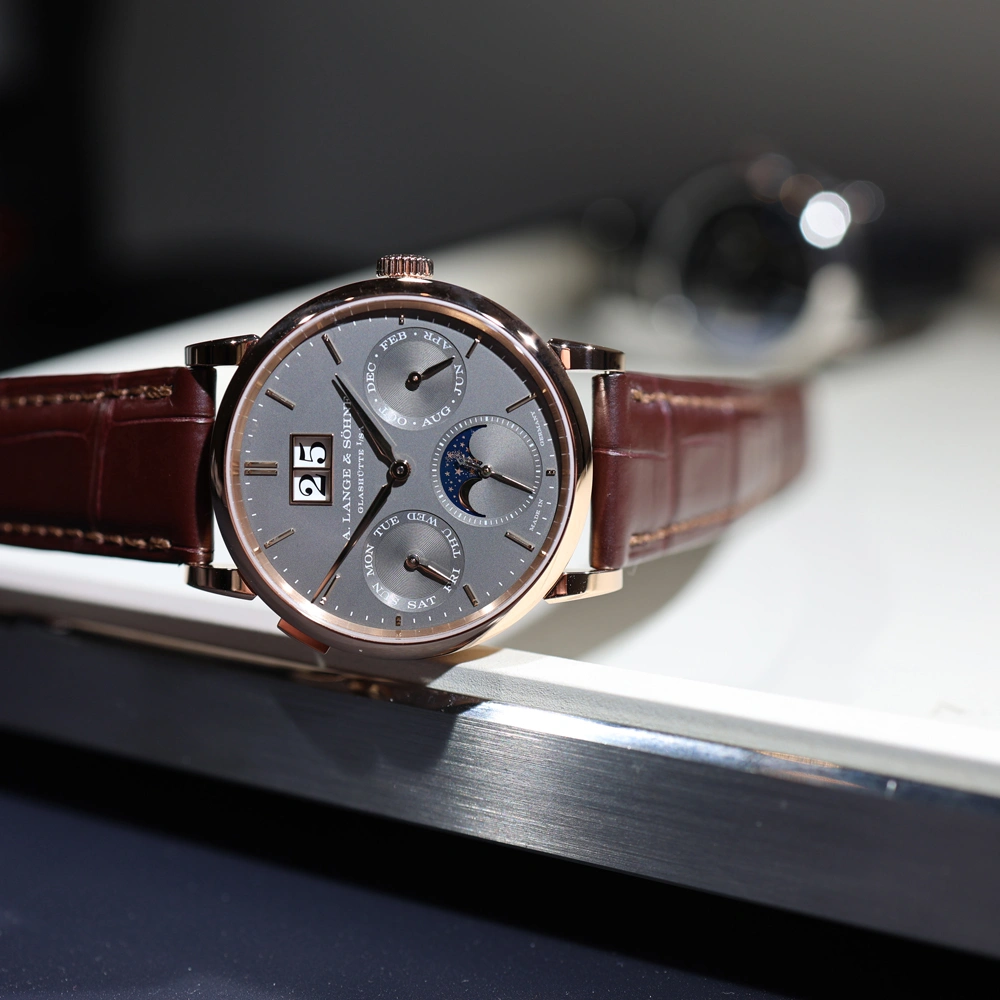
A. Lange & Söhne Saxonia Annual Calendar – are complexity and compactness mutually exclusive?
The problem with creating watches that brim with complexity is that they tend to contain additional movement components and, by default, they can prove a tad large. However, at Watches & Wonders 2026, A. Lange & Söhne dispelled this theory, unveiling a complicated watch that’s more diminutive than many two-handers.
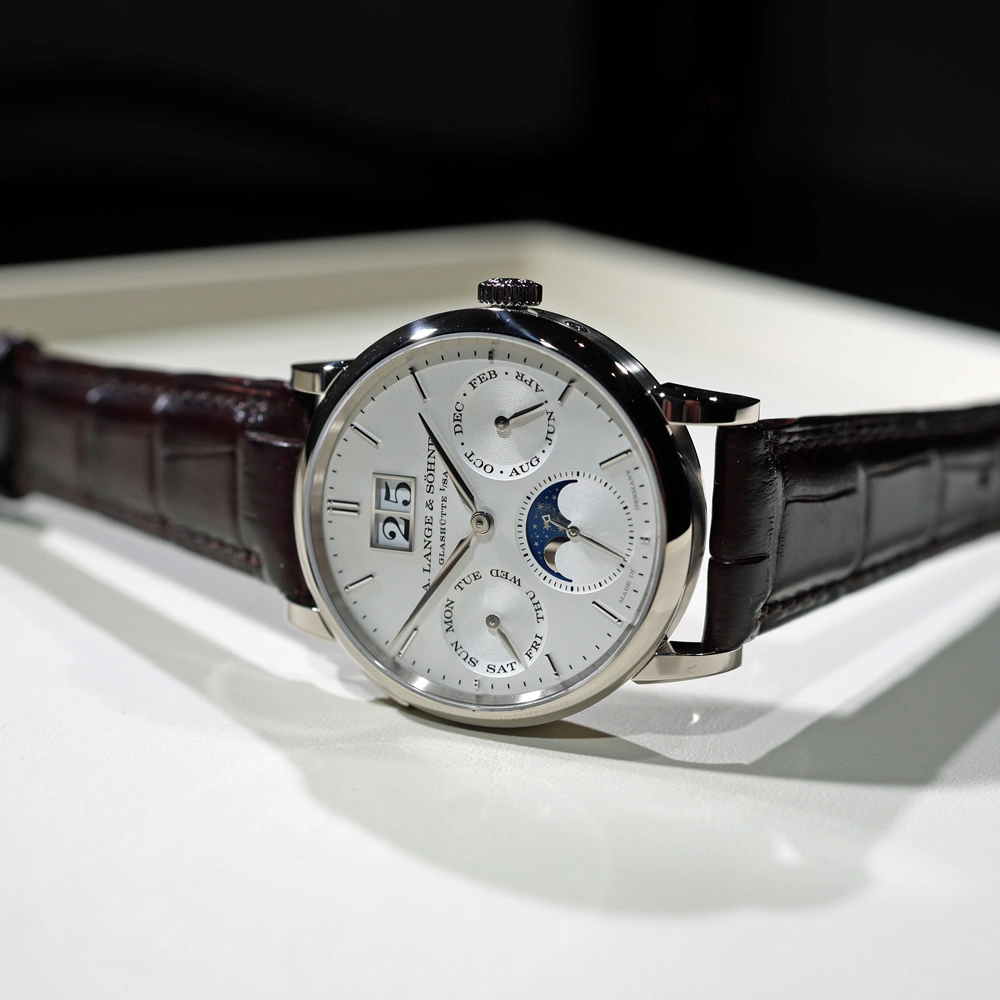
The A. Lange & Söhne Saxonia Annual Calendar features an intricate movement, the Lange manufacture calibre L207.1, comprising 491 parts yet measuring a mere 36.04 mm in diameter and just 9.8 mm in height.
With my interest suitably piqued, I contemplated whether the Manufactory had eschewed some customary Lange elements in its quest for compactness. There was nothing else I could do – a hands-on evaluation was necessary. I wanted to know, are complexity and compactness mutually exclusive?
Calendar complications
Beyond the simple indication of a date using a single disc, there are several options for function fiends. A ‘complete calendar’ or ‘triple calendar’ displays the date, day, month and, in some instances, the moon phase. It requires the wearer to manually correct the date five times per annum when the month has fewer than 31 days ie February, April, June, September and November.
An annual calendar introduces an additional layer of complexity. It has the mechanical capacity to recognise those months with 30 and 31 days, automatically advancing the date disc as appropriate. An annual calendar only needs to be adjusted once a year, at the end of February, a month consisting of 28 or 29 days.
The perpetual calendar (a high complication) is the ultimate calendar complication. Employing a cam, the movement can recognise the length of the month, irrespective of whether it has 28, 29, 30 or 31 days and automatically advance to the 1st day of the next month when appropriate. Assuming the mainspring(s) is always tensioned, the date will not require manual correction until 2100. A perpetual calendar also features a leap-year indicator.
While A. Lange & Söhne has much experience producing perpetual calendar mechanisms (11 at the time of writing this article), this additional complexity inevitably increases the component count, swelling case dimensions. Moreover, due to the additional intricacy of the movement, it is usually more expensive than an annual calendar.
A. Lange & Söhne Saxonia Annual Calendar – dial
The Saxonia Annual Calendar is offered in two variants, an 18-carat white gold case with a solid silver argenté dial or an 18-carat pink gold case with a solid silver grey dial. Both options are eminently beautiful, albeit I personally favour the 18-carat white gold reference, appreciating its monochromatic appearance. Irrespective of which housing and dial ensemble is selected, the execution and layout are the same.
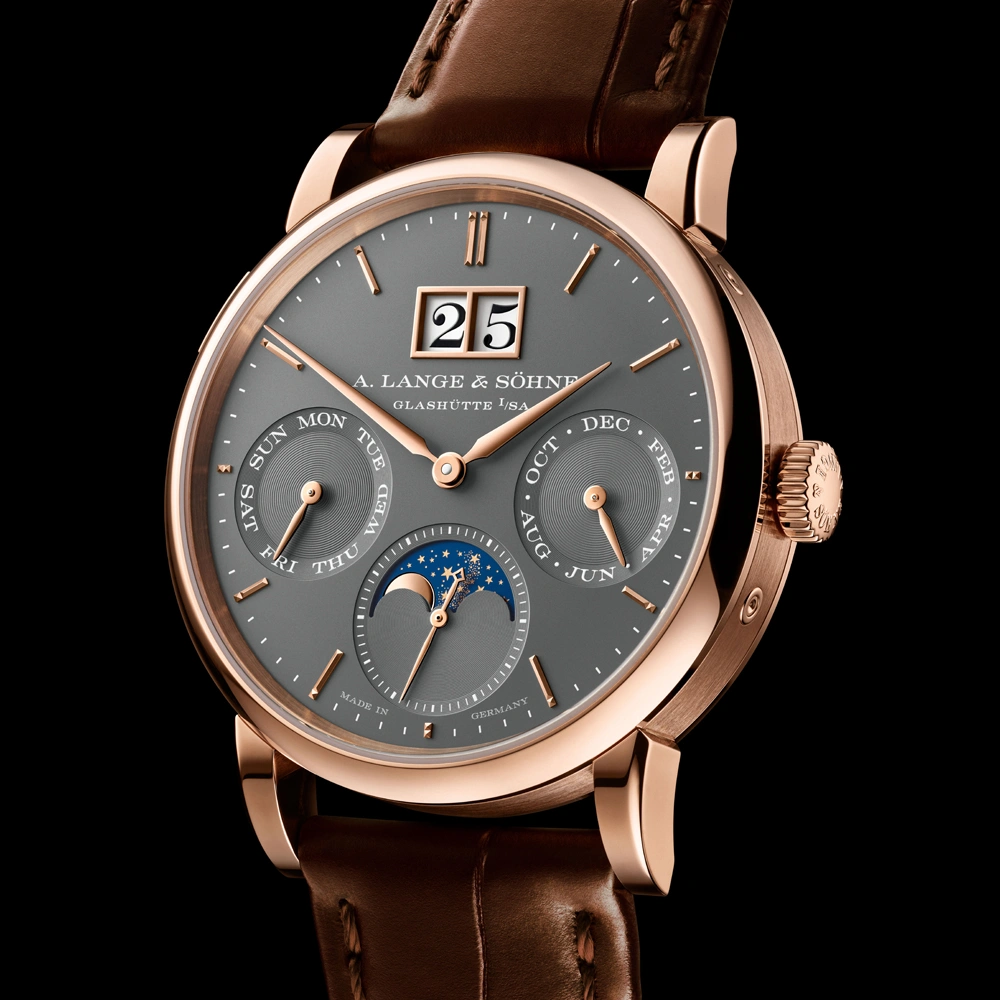
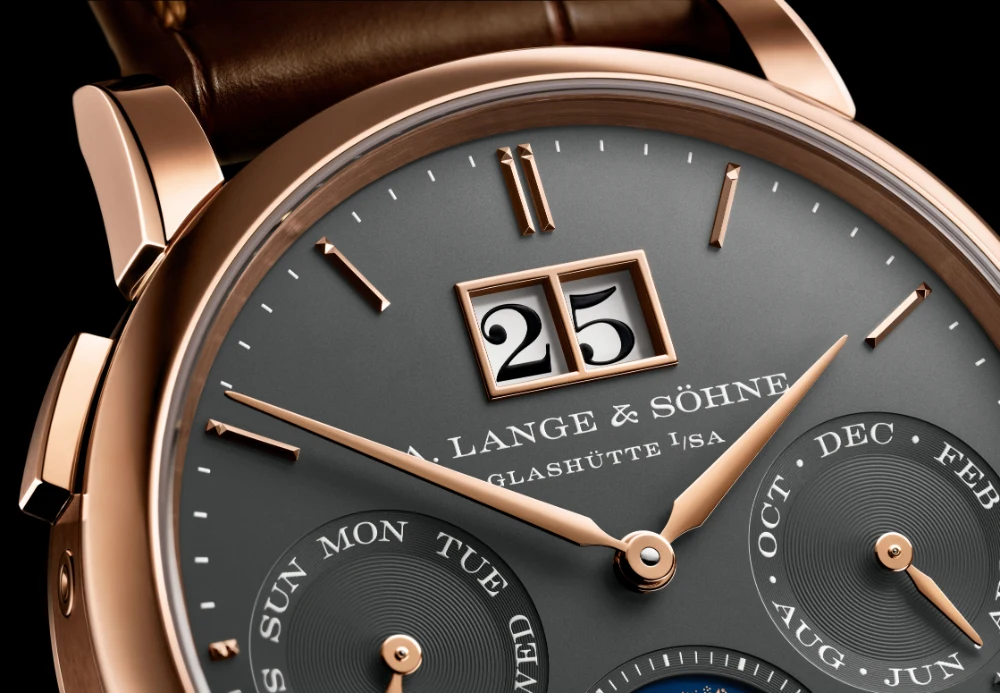
Lancet-shaped hour and minute hands impart meaning, wonderfully enunciating the prevailing time. Each hour is denoted with an applied faceted index incorporating a v-shaped cut, a detail that seems to ensnare light, aiding read off. Crisp markings, positioned in between each index, further augment readability.
Back in 1994, when A. Lange & Söhne was revived, the company released its inaugural collection, comprising four models, three of which were endued with a patented outsize date. Employing two discs, one for tens and the other for units, the outsize date complication presents information in a highly lucid format. Over the years, the Manufactory has crafted several watches equipped with the widescreen date display. Upholding a Lange tradition, the new Saxonia Annual Calendar also features an outsize date, located just below noon.
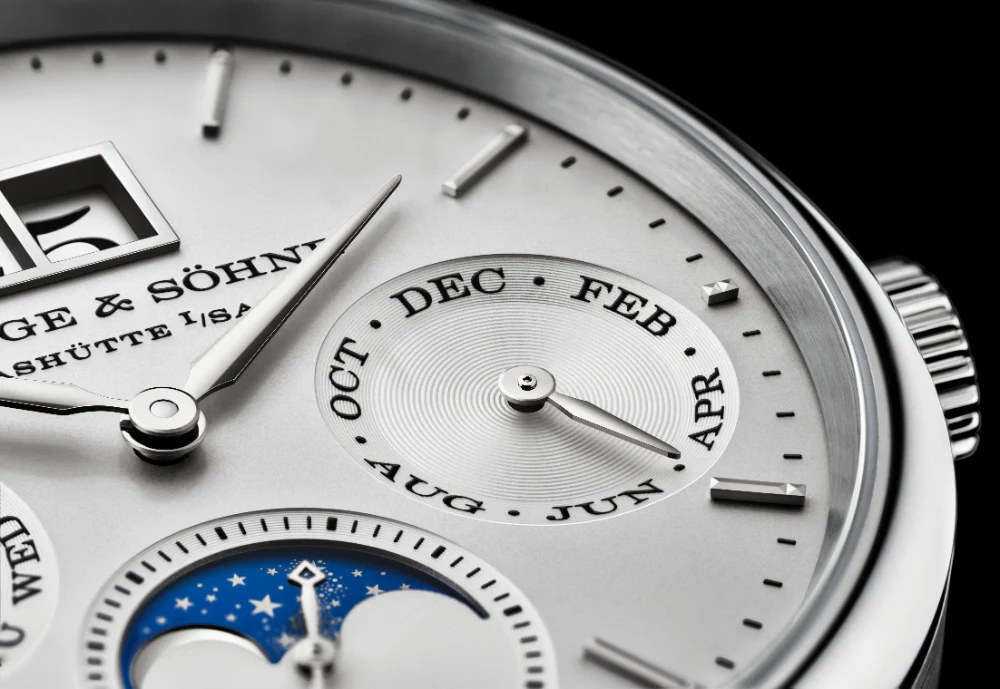
At 3 o’clock, a lone hand circles above a snailed (aka azurage) subdial. Slightly recessed, the track is marked with the even-numbered months, presented in three-character form with intervening months denoted with a succinct circle. Positioned opposite, a month display subscribes to the same design language.
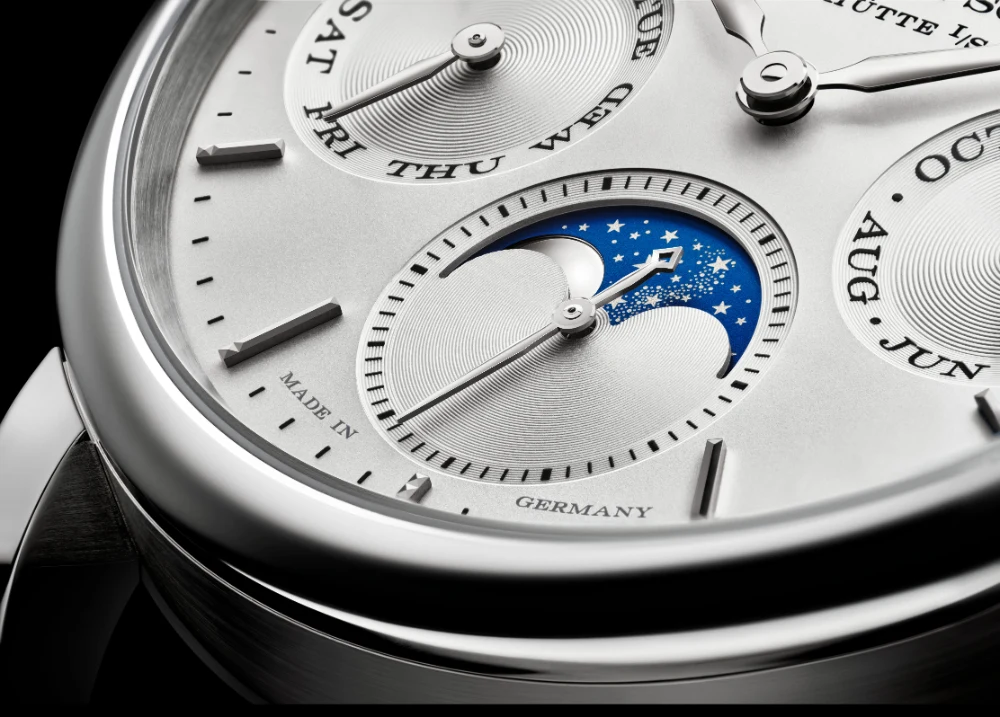
A moon phase indication resides at 6 o’clock, comprising a lunar disc formed of 18-carat gold and ‘treated with a deep-blue coating process and with 428 stars,’ providing a sublime, miniature representation of the Milky Way. The moon phase only requires correction by one day after 122.6 years. The subdial also plays host to a small seconds display, fringed with a neat track. Close examination of the subdial’s surface reveals it is adorned with azurage; however, unlike the subdials at 3 and 9 o’clock, the concentric rings are finer.
A. Lange & Söhne Saxonia Annual Calendar – case
Beyond the choice of material and the overall dimensions previously discussed, there is more to say about the Saxonia Annual Calendar’s housing.
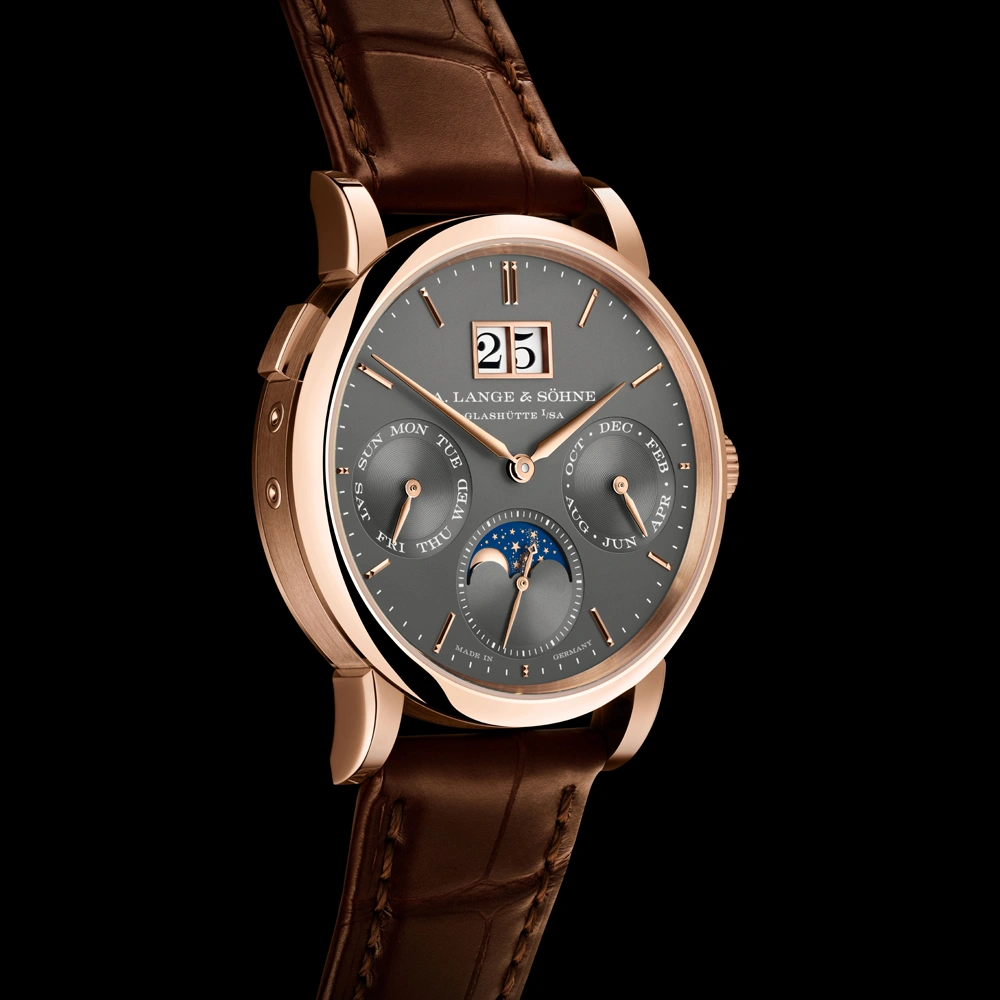
Despite the case measuring a modest 36.0 mm in diameter, the dial area remains generously proportioned. This can be attributed to the slender bezel which frees up precious space for the various dial indications. Furthermore, the fineness of the bezel is repeated with the lugs which are svelte, sleek and tapered, characteristics that heighten the sense of elegance.
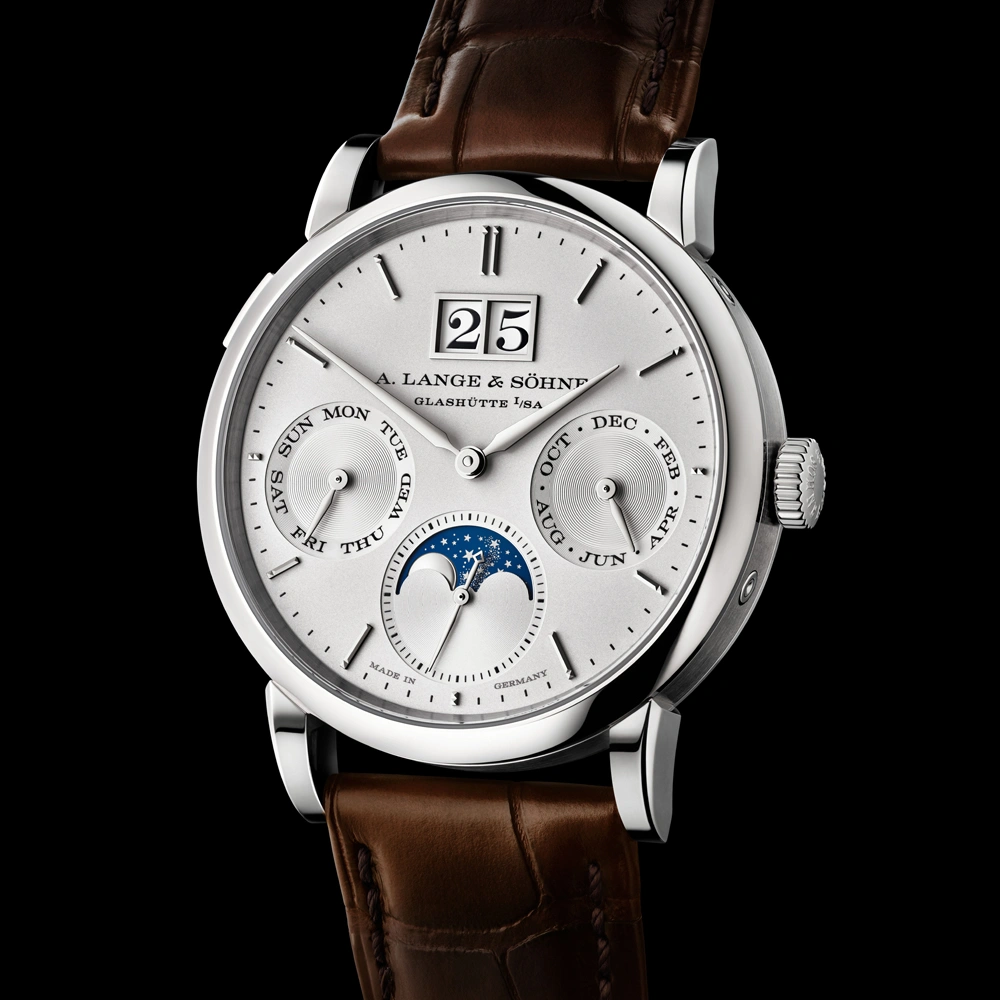
Like a chef balancing different flavours when creating a dish, Lange has juxtaposed brushed and polished surfaces throughout. This masterful use of contrasts enlivens the appearance of the Saxonia Annual Calendar but without ever appearing outré. The bezel and lugs are highly polished, while the caseband and caseback (save for sapphire crystal) are brushed. But the blend of finishes is more nuanced than this summary may suggest, with tasteful soupçons of gleaming gold, nestling among brushed surfaces. For instance, look at the area between the vertical flanks of the case (caseband) and the brushed circlet of gold framing the sapphire crystal to the rear – it’s angled and polished. This may sound a small detail, but it confers eye appeal, albeit it does heighten production costs. Indeed, when I look at these small details, I’m reminded that perfection is seldom achieved in haste or without incurring expense.
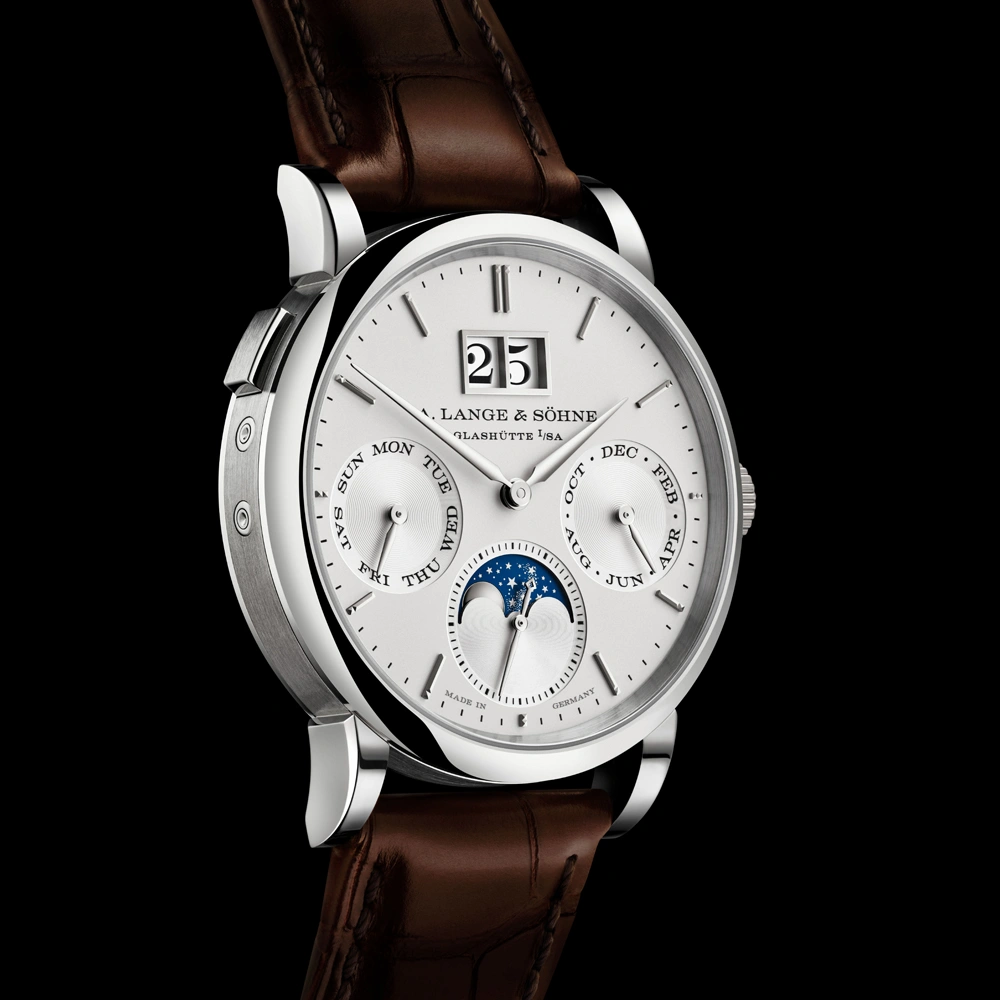
The Saxonia Annual Calendar has been designed with ease of use in mind. A series of individual correctors, unobtrusively gracing the flanks of the case, provide the means to adjust each individual calendar indication. Alternatively, all calendar indications can be advanced collectively with the pusher located at 10 o’clock.
Both white gold and pink gold references are supplied on a hand-stitched alligator leather strap, fitted with a prong buckle in matching gold.
Lange manufacture calibre L207.1
The product of four years development, the Lange manufacture calibre L207.1 harnesses all the brand’s know-how amassed over 25 years. A complex arrangement of 491 parts, the complicated movement measures just 30.4 mm in diameter with a height of 5.7 mm. At this juncture, it would be reasonable to assume that the watch is hand-wound, eschewing the bulk of an oscillating mass; however, the calibre L207.1 is self-winding, making the Saxonia Annual Calendar ideally suited to daily wear.
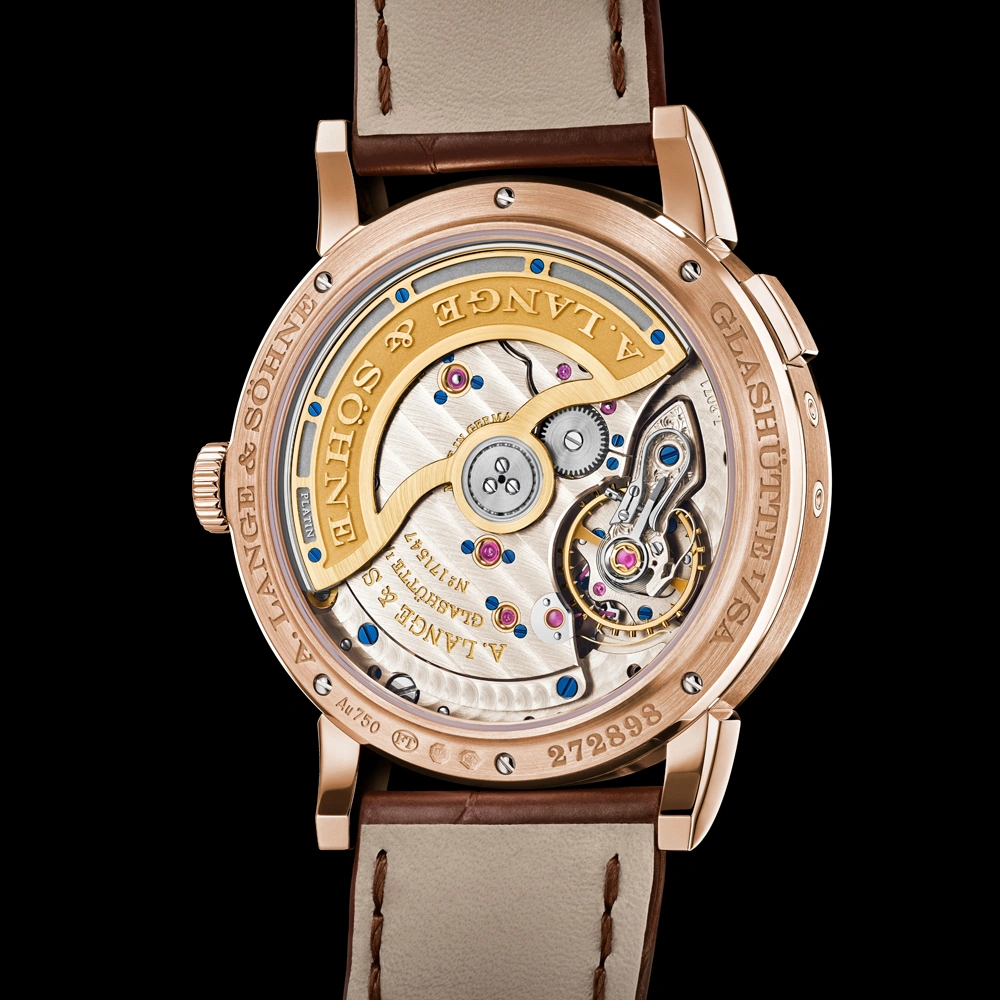
The golden rotor is partially openworked and features a platinum mass affixed to its outer edge using thermally blued screws. This platinum mass, the bulkiest part of the self-winding mechanism, runs in a channel encircling the three-quarter plate, termed a ‘trottoir’, mitigating movement thickness.
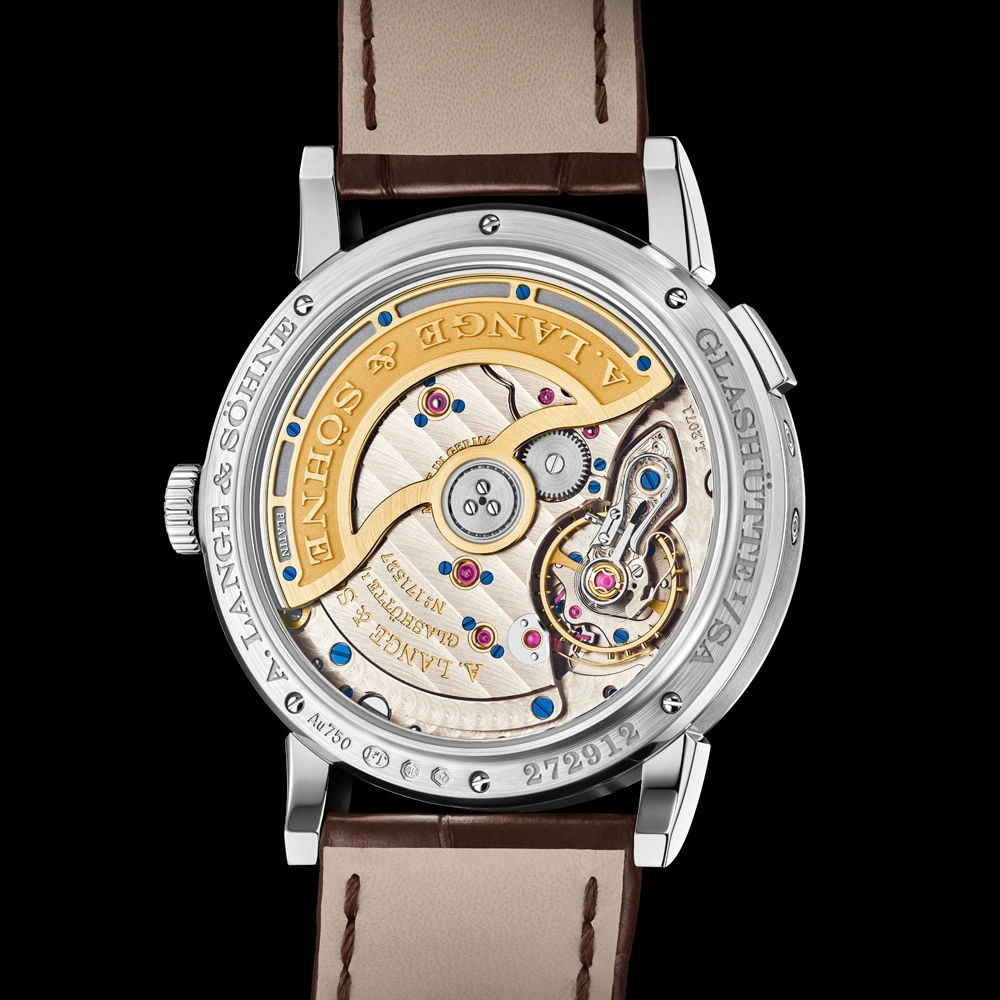
Langephiles will smile with delight when appraising the calibre L207.1. The mainplate is adorned with perlage and the movement features a three-quarter plate. Unlike many Swiss practitioners of Haute Horlogerie who favour using multiple bridges, Lange prefers to use a three-quarter plate as it offers a more stable form of construction. However, by adopting this approach, the assembly of the movement requires more skill on the part of the watchmaker, eg when fine-tuning the end shake of each pivot within the accompanying jewels.
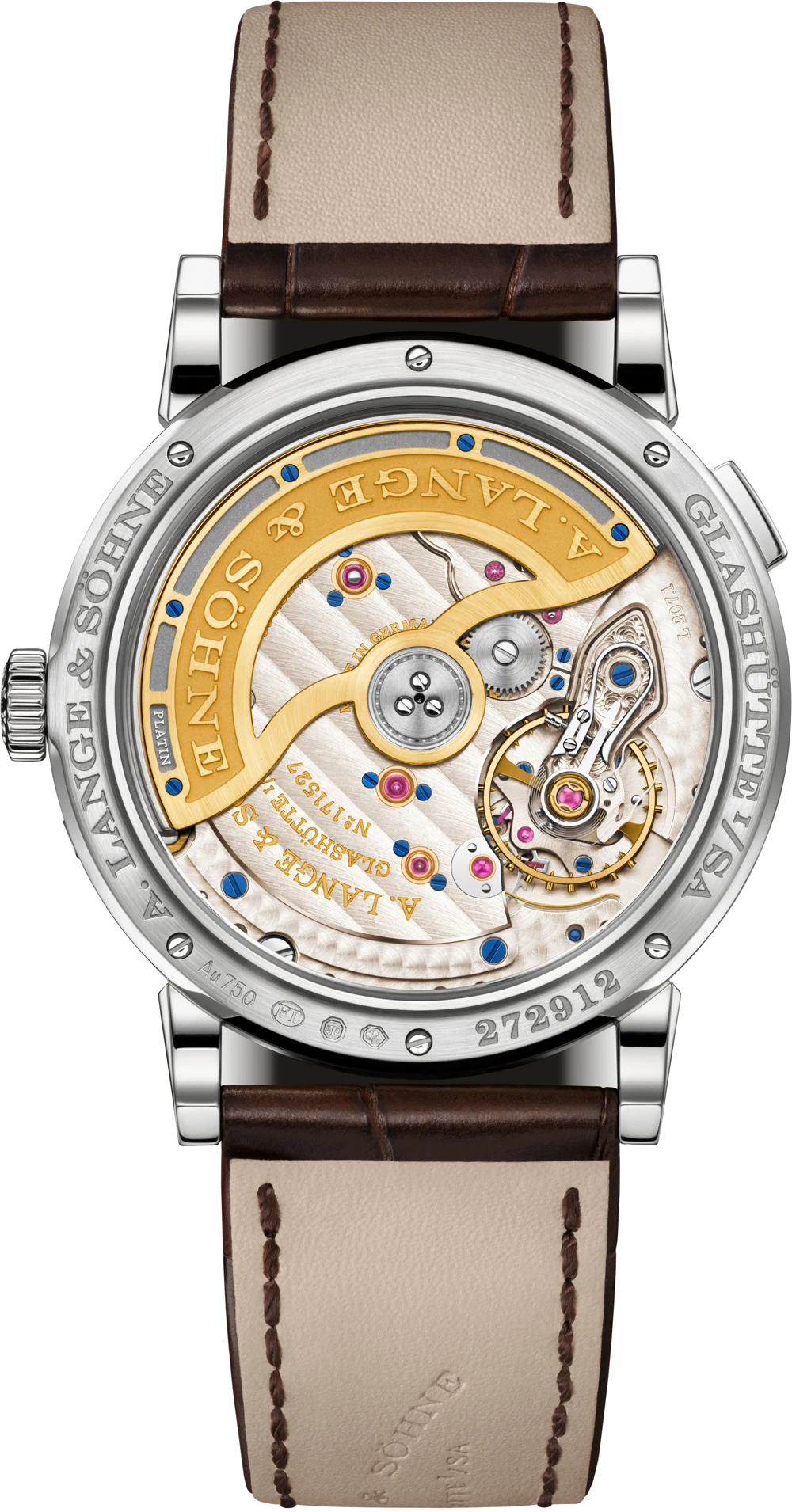
The three-quarter plate is adorned with Glashütte ribbing, engraved golden text, anglage and polished jewel sinks. Blued screws punctuate the movement, each the product of careful heating using a flame, a process that confers a wonderous shade of cornflower blue. The addition of three screwed gold chatons upholds watchmaking traditions and adds an additional dose of colour to the movement.
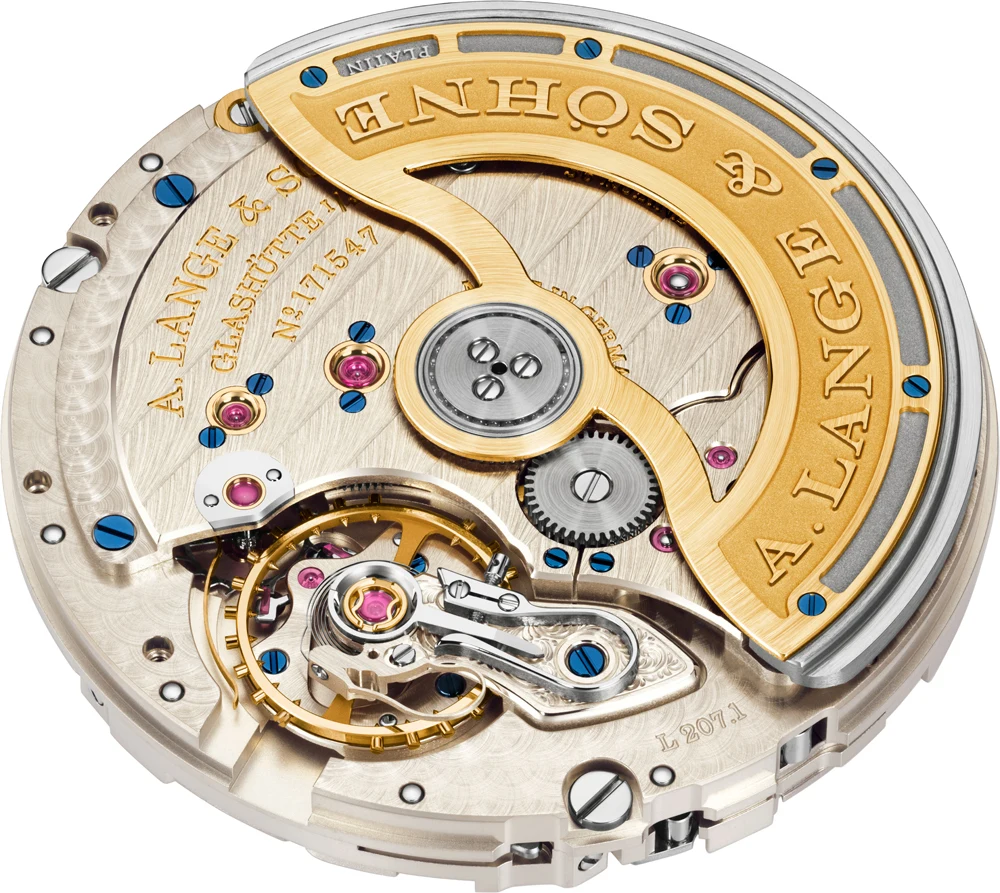
Handcraftsmanship is a defining pillar of the Lange brand. The movement is equipped with a hand-engraved balance cock, endowed with a floral motif and is fitted with a traditional whiplash spring with a micrometer screw. A closer look reveals the upper surfaces of the whiplash are mirror-polished, the result of painstaking handwork using diamantine paste and a tinplate.
Lange repeatedly respects traditions. For instance, the calibre L207.1 is fitted with a classic screw balance, where timing screws are tightened/loosened to alter the rate. Incidentally, the balance spring is produced in-house at the brand’s Manufactory, a rare expertise usually outsourced to third parties.
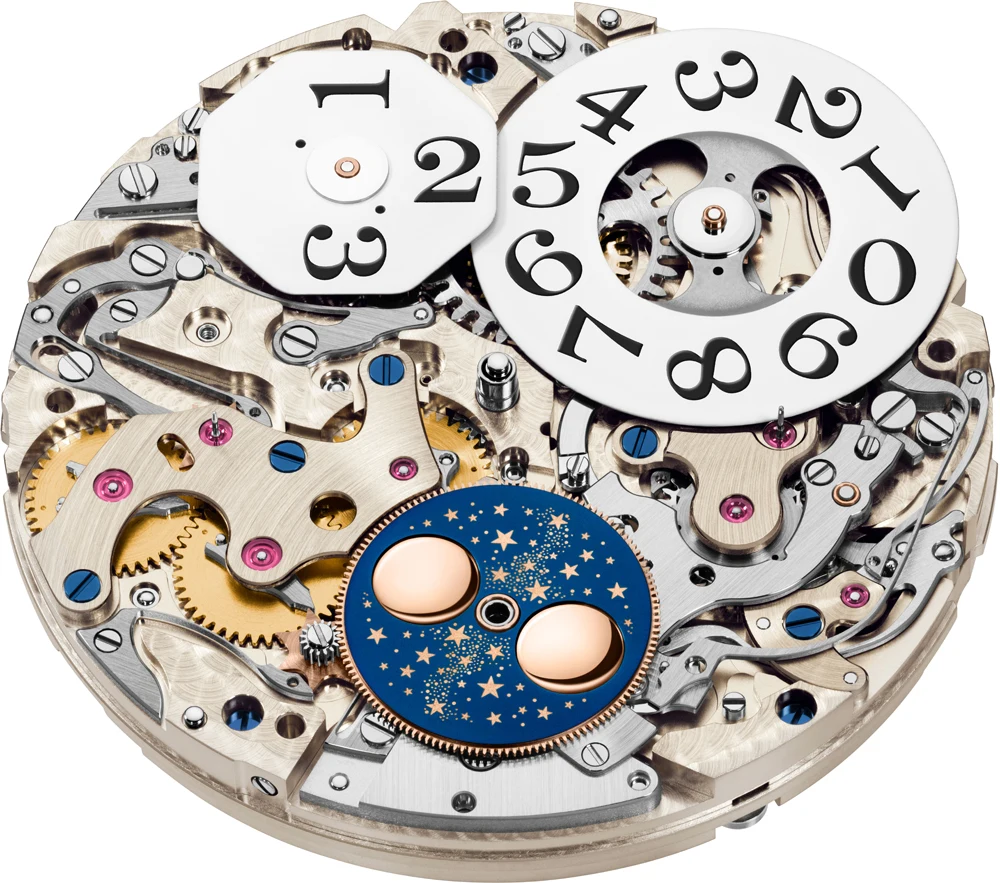
Lastly, bearing in mind the movement’s modest dimensions, it is impressive that the mainspring is large enough to provide up to 60 hours of autonomy when fully wound.
Closing remarks
At Watches & Wonders 2026, A. Lange & Söhne launched just two new models, the Saxonia Annual Calendar and the Lange 1 Tourbillon Perpetual Calendar “Lumen”, when many exhibiting brands released numerous novelties. However, it is when you consider the extensive research and development that goes into the making of one new reference, four years in this instance, that you begin to understand why the German marque is unable to flood the market with a plethora of new models. Moreover, as the watches are handmade, the brand’s production is naturally limited.
Indeed, that extensive research and development process has resulted in the creation of a watch that brims with calendar-virtuosity, features exalted hand-finishing, offers the convenience of automatic winding and presents various dial indications in lucid form, while still measuring just 36.00 mm in diameter and 9.8 mm in thickness. Are complexity and compactness mutually exclusive? Based on this timepiece, I would suggest not.
Further reading
https://www.alange-soehne.com/
Technical specification
- Model: A. Lange & Söhne Saxonia Annual Calendar
- Reference: 331.026E
- Case: 18-carat white gold, diameter 36.0 mm, height 9.8 mm, sapphire crystal to the front and transparent caseback.
- Functions: hours, minutes, small seconds with stop seconds function, annual calendar with Lange outsize date, day of week, moon and moon phase
- Movement: Lange manufacture calibre L207.1, self-winding movement, frequency 21,600 vph (3 Hz), contains 56 jewels, power reserve 60 hours when fully wound, 491 components
- Strap: reddish-brown hand-stitched alligator strap with gradient colour paired with a prong buckle in 18-carat white gold
- Price: €65,000 (RRP as of 8.5.2026)
- Model: A. Lange & Söhne Saxonia Annual Calendar
- Reference: 331.033E
- Case: 18-carat pink gold, diameter 36.0 mm, height 9.8 mm, sapphire crystal to the front and transparent caseback.
- Functions: hours, minutes, small seconds with stop seconds function, annual calendar with Lange outsize date, day of week, moon and moon phase
- Movement: Lange manufacture calibre L207.1, self-winding movement, frequency 21,600 vph (3 Hz), contains 56 jewels, power reserve 60 hours when fully wound, 491 components
- Strap: reddish-brown hand-stitched alligator strap with gradient colour paired with a prong buckle in 18-carat pink gold
- Price: €65,000 (RRP as of 8.5.2026)