
Delma Heritage Chronograph LE Watch Review
The Delma Heritage Chronograph LE captures the allure of the Midland chronograph of 1946. It is endowed with a plethora of period-inspired details and will inevitably seduce onlookers with its bi-compax layout and old radium luminescent treatment.

Delma watch
As a proud European, I appreciate the continent’s vibrant tapestry of cultures, languages and history. Indeed, history has led to present-day customs and has influenced the cuisine and architecture that we appreciate today.
With the passage of time, products have a tendency to improve, however, sometimes we look back at a beautiful object of yesteryear, appreciating its period design, and feel a desire to rediscover its forgotten charms.
Delma was founded in Lengnau in 1924. Today, the family-owned company continues to operate in Lengnau, a German-speaking town and home to some other well-known watch brands, including Carl F. Bucherer and Rado.
Throughout its history, Delma has made a diverse range of watches, including chronographs. Indeed, in 1946 the Swiss marque released its first chronograph under the name ‘Midland’. The popularity of the inaugural ‘Midland’ persuaded the firm to release further chronographs over the years.
Now, the Swiss company, celebrating the 75th anniversary of the Midland, has released the Delma Heritage Chronograph LE, a watch that brims with 1940s charm.
Delma Heritage Chronograph LE – dial
The Delma Heritage Chronograph LE is available in three case variants: stainless steel, yellow and rose gold PVD. The case material determines the colour of a model’s dial. The steel model features a black sunray brushed dial, while the gold PVD variants have a silver sunray brushed dial. While all three options are attractive, I am especially drawn to the yellow gold PVD case as its tones exhibit a bewitching period charm. Hereafter, I will focus primarily on this reference.

Delma has selected blue syringe-style hour and minute hands lined with old radium Super-LumiNova. Incidentally, the indexes on the steel variant are treated with C3 SuperLuminova, producing a green emission in dim light.
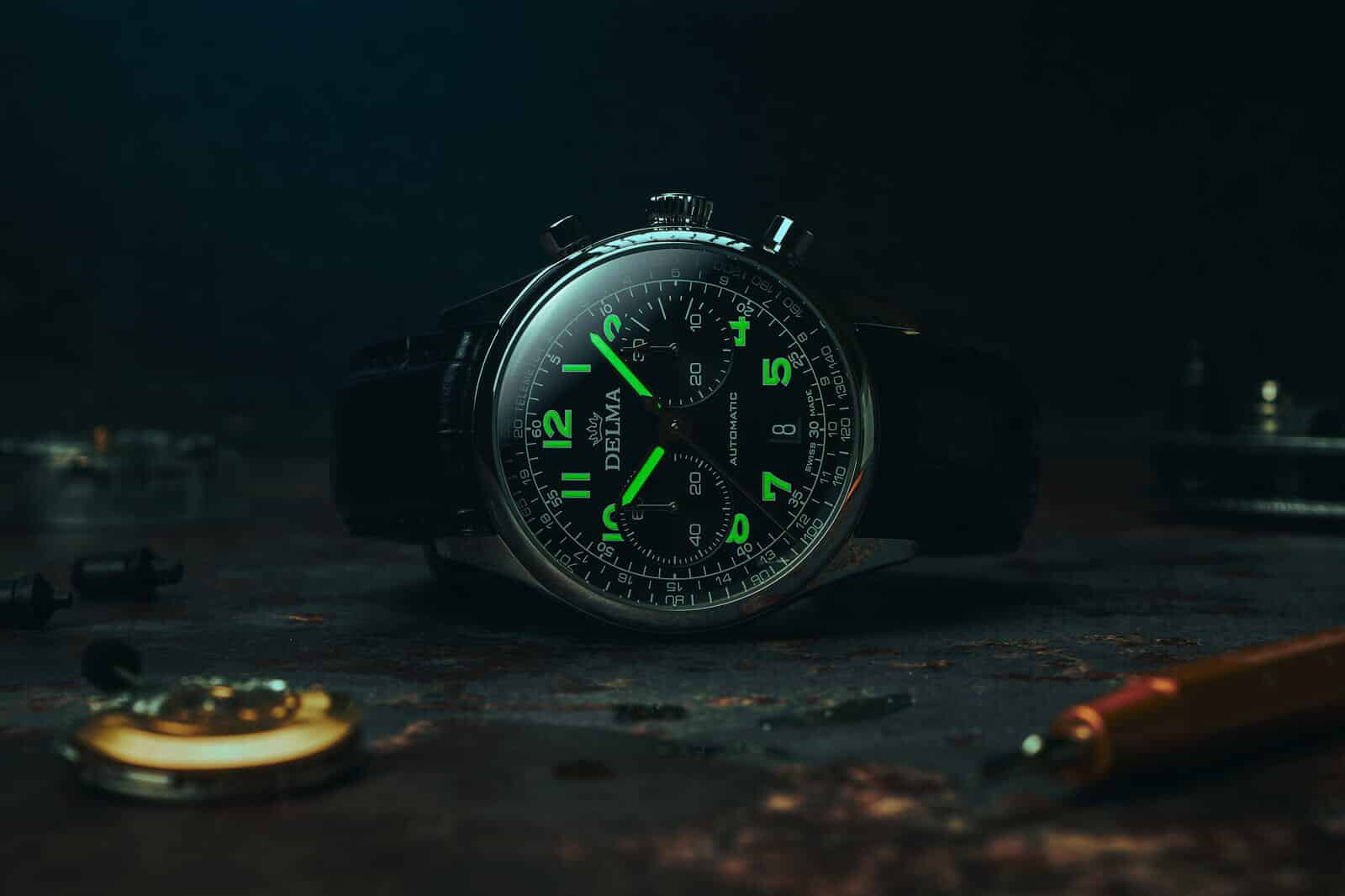
The hours are denoted with fulsome Arabic numerals, except where other dial elements assume precedence, eg the counters and the date. Some horophiles may take issue with the counters ‘eating’ some of the remaining indexes, however, this doesn’t diminish my affection for the Heritage Chronograph LE.
Like many watch obsessives I have a predilection for bi-compax chronographs, appreciating the symmetry this layout confers. The counters comprise of a 30-minute register at 3 o’clock and a small seconds display at 9 o’clock. Close examination of the 30-minute counter reveals a delightful detail. Three elongated lines are positioned at 3, 6, and 9 minutes, a feature found on the original 1946 watch. The markings are a reminder of the payphone era when further coins needed to be inserted after each 3-minute period had elapsed.
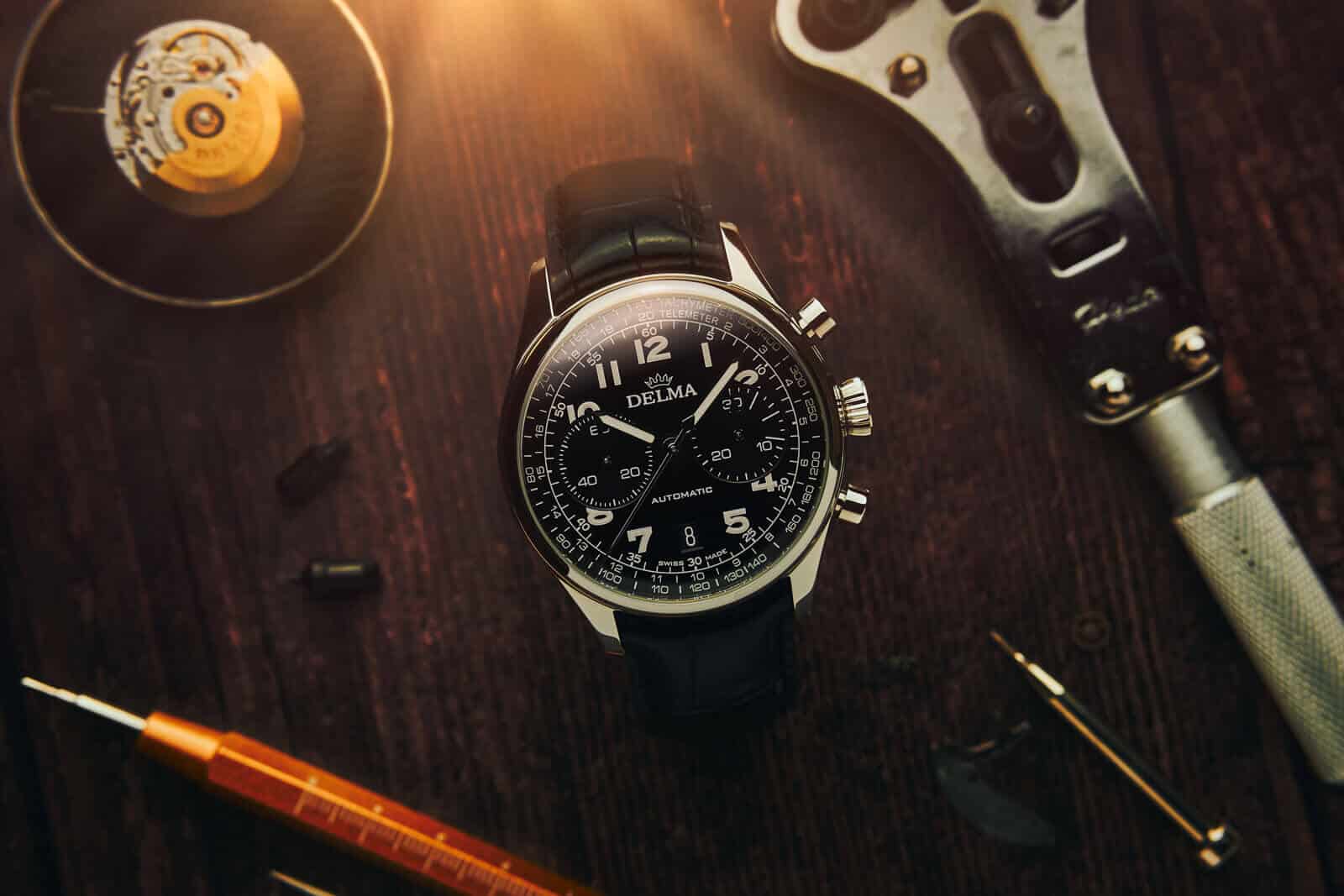
The date is presented at 6 o’clock via a trapezoidal aperture. Delma has presented the date in black numerals upon a silver-toned disc, matching the main dial epidermis. The steel model features a black date disc, concordant with the main dial epidermis. This may sound like a minor aspect, but it shows an attention to detail often only found on costlier watches.
A central chronograph seconds hand interfaces with two scales encircling the perimeter of the dial, a tachymeter and a telemeter. The tachymeter allows the wearer to ascertain the speed of an object over a known distance, eg it can be used for determining the speed of a car covering a measured kilometre.
The telemeter is used to calculate the distance of the wearer from a visual event, sometimes used for military purposes. For example, if enemy forces fired a large gun, the chronograph could be actuated and thereafter, as the bomb landed, the chronograph could be stopped. By looking at the central chronograph seconds hand in conjunction with the telemeter scale, the artillery could ascertain their relative distance from the enemy, allowing them to return fire with extraordinary precision.
Delma Heritage Chronograph LE – case
Despite the Delma Heritage Chronograph LE upholding the design codes of yesteryear, the Maison has not stuck doggedly to the past in all respects. As many readers will know, watches of yesteryear had a tendency to be smaller than their modern-day counterparts. This particular timepiece measures 43 mm, sating the desires of today’s watch buyer. Personally, I find this to be a very agreeable size, offering much wrist presence as well as sufficient space for the dial indications to breathe.

The original model of 1946 was housed in an 18-carat yellow gold case. Today, Delma is known for delivering high quality at keen prices. Its chosen price segment precludes solid gold, however, the brand has sought to replicate the appearance of the original reference by suffusing surfaces with gold PVD. This treatment delivers superior wear characteristics when compared to plated gold surfaces and it also retains its colour for much longer.

Usually, I favour rose gold, but in this instance, the yellow gold PVD variant wins my seal of approval, courtesy of its period-correct looks. The case is fitted with a domed sapphire crystal, again subscribing to a vintage aesthetic, enticing light to flood the dial plane.
Another concession to present-day tastes is the fitment of an exhibition caseback. While some purists may dislike this detail, many will appreciate the opportunity to view the self-winding movement housed within.
Delma Heritage Chronograph LE – movement
The original Midland chronograph of 1946 was equipped with a hand-wound movement. While many horophiles adore manual watches, enjoying the daily ritual of winding the mainspring, others will favour the day-to-day practicality of an automatic watch. Delma has chosen to target this latter group by equipping the Heritage Chronograph LE with the automatic Sellita SW510, a cam-actuated chronograph movement.

Sellita, the Swiss movement specialist, is based in La Chaux-de-Fonds, the nation’s watchmaking capital. It is the biggest independent, family run supplier of mechanical movements in Switzerland and is known for making reliable, quality movements for keen prices. By using Sellita, Delma has been able to offer an impressive watch for a comparatively modest sum.
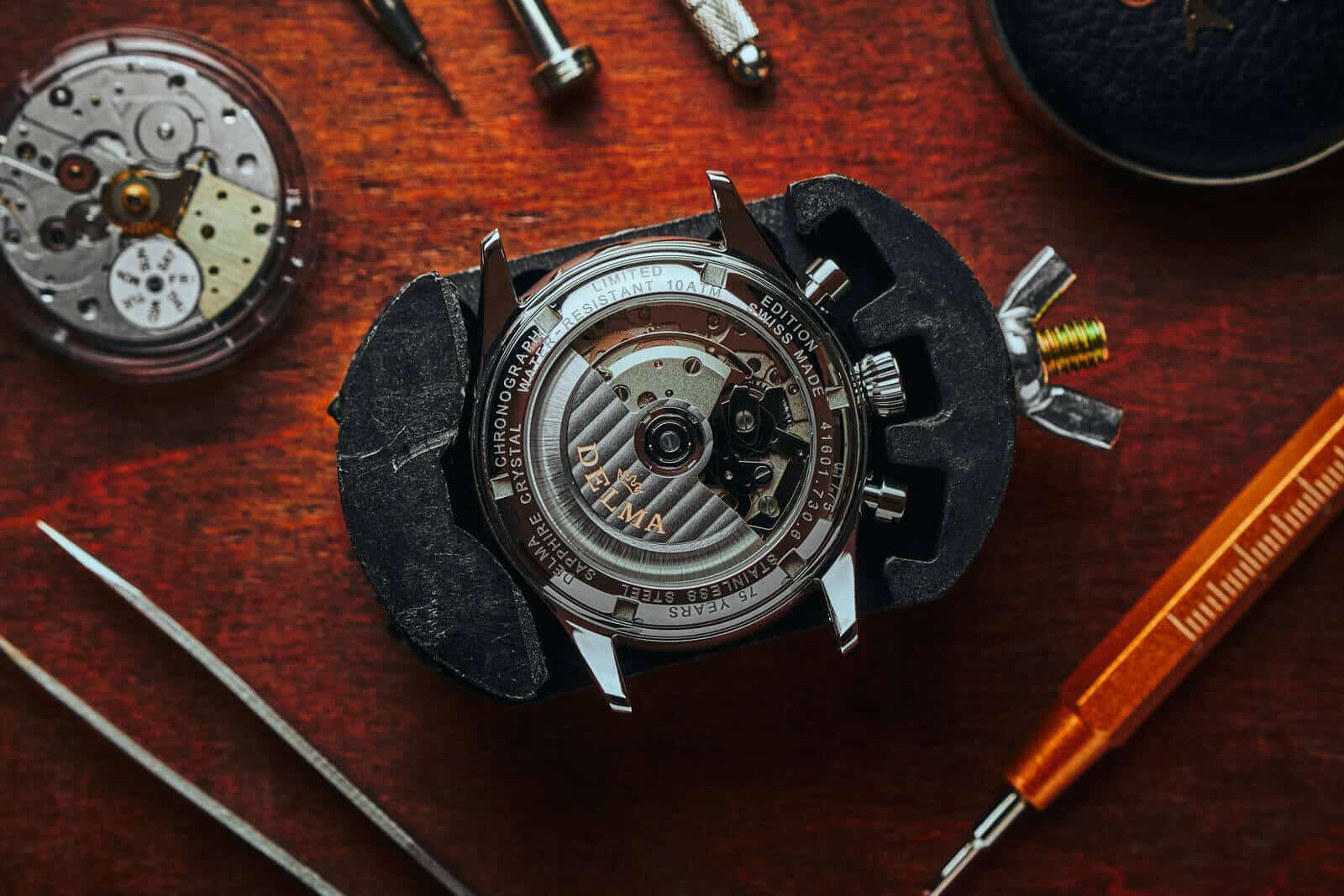
The balance of the Sellita SW510 has a frequency of 28,800 vph (4 Hz) and the movement is equipped with 27 jewels. Assuming the mainspring is fully wound, the watch will run autonomously for 48 hours. The oscillating mass is adorned with Côtes de Genève motif.
Delma Heritage Chronograph LE – closing remarks
In summary, the dial of the Delma Heritage Chronograph LE proves both attractive and practical. Indeed, it delivers readability with a high quotient of vintage charm. The Swiss brand has expended much energy on subtle refinements such as the colour-coordinating date disc, the trapezoidal date aperture, the old radium luminescent treatment and the inclusion of tachymeter and telemeter scales.
The size of the case will suit the majority of today’s wearers. I accept some prospective purchasers may yearn for a 40 mm case and this may be an option for the brand to consider for the future, however, the case is the optimal size for me and I suspect legions of other potential wearers. While the steel and rose gold PVD options are attractive, the yellow gold PVD is perfectly on point and contributes to the vintage character of the watch.
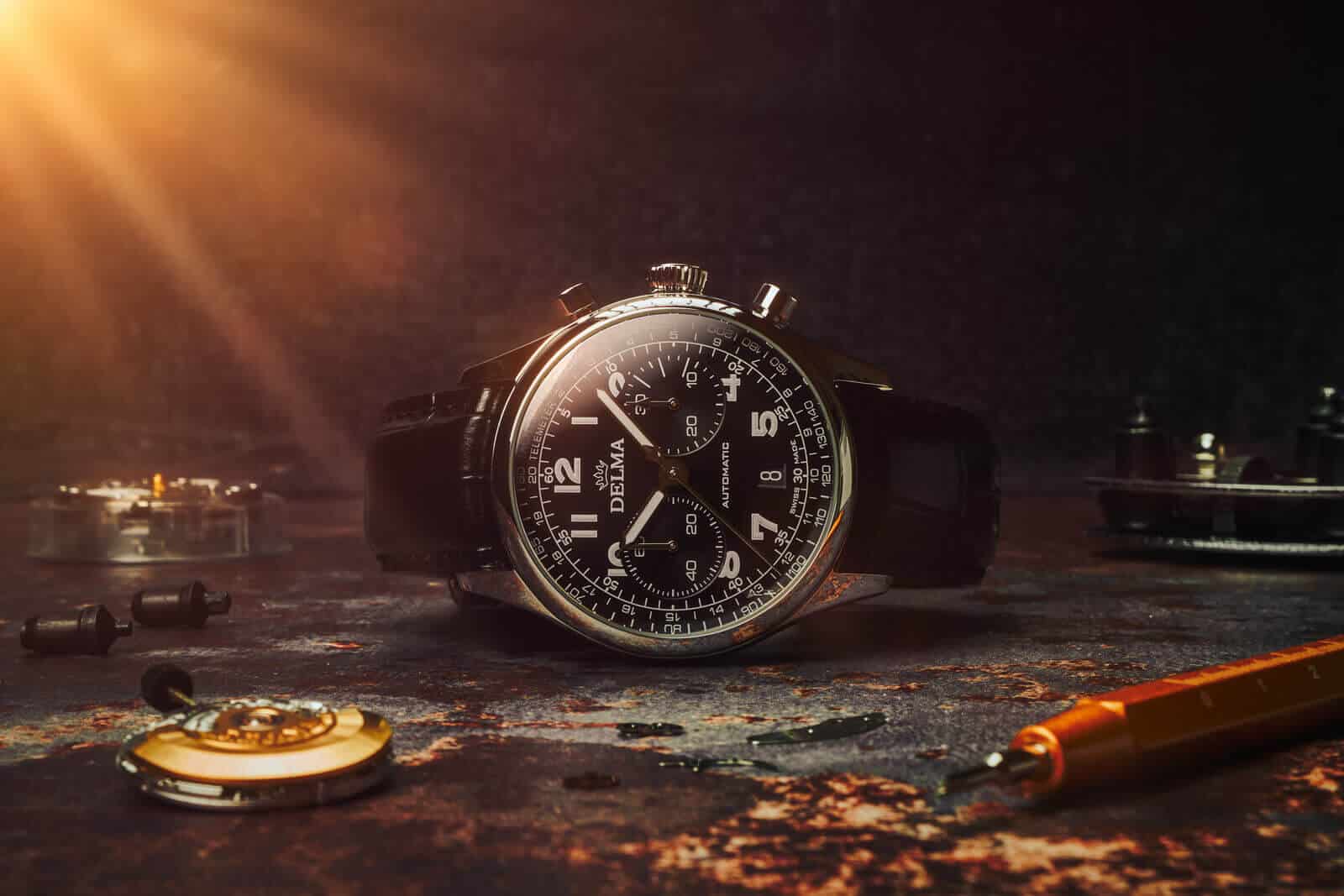
The Sellita SW510 proffers reliability, affordable servicing costs and precision. Moreover, this movement allows Delma to deliver an impressive watch for a very agreeable price. The close attention to detail reinforces the model’s impressive quality-price ratio.
Delma has been resident in Lengnau for nearly 100 years and it has produced numerous styles of watches during its lifetime. Its long history and impressive back catalogue have allowed the firm to rediscover and sympathetically reproduce the Midland of 1946. The resultant timepiece is charmingly retro but perfectly suited to modern-day life. Indeed, based on this new model’s many attributes, Delma looks destined to prosper for many years to come.
Further reading
Technical specifications
- Model: Delma Heritage Chronograph LE
- Reference: 41601.730.6.032 (steel); 42601.730.6.062 (yellow gold PVD); 43601.730.6.062 (rose gold PVD)
- Case: Steel, yellow or rose gold PVD; diameter 43 mm; height 15.7 mm; water resistance 10 ATM (100 metres); sapphire crystal to front; exhibition case back.
- Functions: hours; minutes; small seconds; date; chronograph; tachymeter scale; telemeter scale
- Movement: Sellita SW510; automatic movement; 27 jewels; power reserve 48 hours.
- Strap: Black 3D calf leather strap, interchangeable with Quick Release System.
- Buckle: Colour coordinating leather strap with butterfly deployant clasp
- Price: £2250 (steel); £2350 (yellow gold PVD); £2350 (rose gold PVD) – (RRP as of 12.4.2021)
- Limited Edition: 75 pieces per model