
F.P.Journe Tourbillon Souverain Watch Review
In this feature, Angus Davies looks at the history of the F.P.Journe Tourbillon Souverain, from the making of Monsieur Journe’s first wristwatch to the present-day model with its ingenious vertical cage. In addition, Angus contrasts the work of Breguet and François-Paul Journe.

Breguet’s legacy
Abraham-Louis Breguet was born in Neuchâtel, however, he came to prominence in Paris, producing clocks and watches for aristocrats, royalty and affluent clientele. Despite the passage of time, he is widely considered the most accomplished watchmaker in history.
His talents were not merely one-dimensional. Indeed, Breguet was an aesthete, designing watches that continue to confer eye appeal nearly 200 years since his passing (1747 – 1823). Many of the aesthetic elements he conceived (such as his eponymous hands and peerless guilloché dials) have since been imitated by others.
Breguet was also incredibly capable when sat at his watchmaker’s bench. In an era when there were no CAD systems or CNC machines, he employed deft hands and simple tools to create incredible exemplars of fine watchmaking.
A lack of business acumen often hinders the progress of some very accomplished watchmakers, even today. However, such issues did not seem to afflict Breguet, he clearly had a sound understanding of commerce and enjoyed much success.
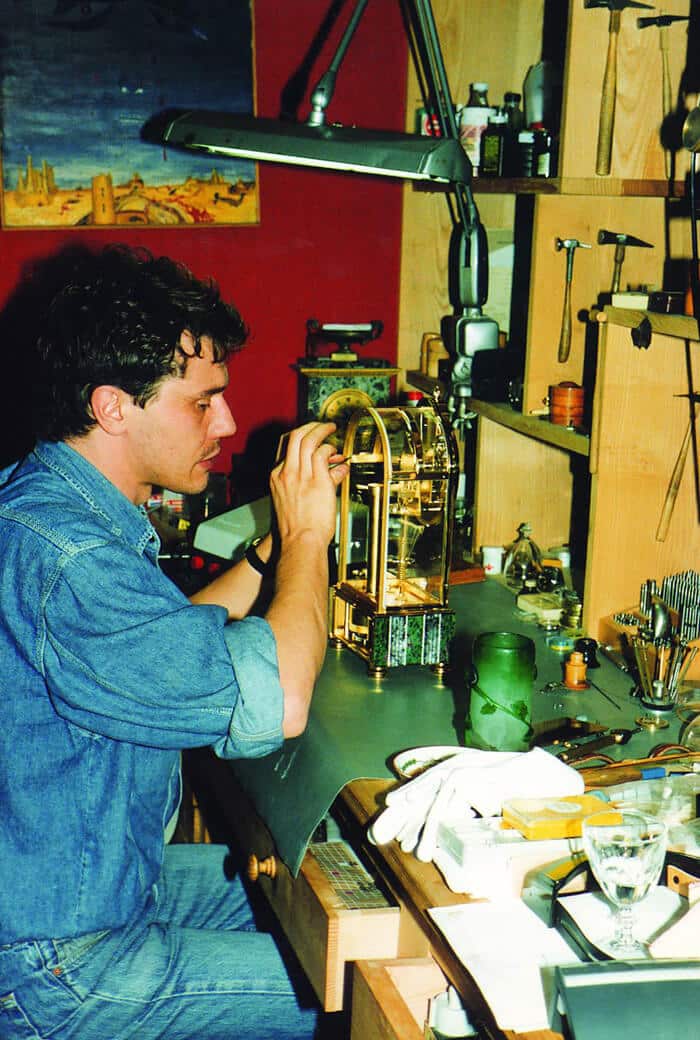
Image – François-Paul Journe, working on a clock (the early years)
His marketing shrewdness led to the ‘souscription watch’. This ingenious idea invited would-be owners to express their interest in a watch by paying a 25% deposit at the point of ordering. Thereafter, they would settle the balance on delivery. This idea eased cashflow, facilitated expansion and provided an incentive for clients to complete a transaction.
Finally, Breguet was an innovator. Indeed, his creativity was breathtaking. For example, he invented the pare-chute, a shock protection device that mitigated the risk of damage to the balance wheel pivots. Another example of his incredible creativity is the Breguet overcoil. This describes a hairspring where the outer curve is raised upwards and its curvature is reduced. By incorporating this detail, the hairspring breathes with greater concentricity, thereby delivering superior isochronism.
But perhaps Abraham-Louis Breguet is best known for inventing the ‘tourbillon’. He recognised the position of a pocket watch heavily influenced its behaviour. In particular, he believed that gravity would adversely affect the operation of the regulating organ. His solution was to place the whole of the escapement, including the regulating organ, within a cage that rotated 360° once over a period of one, four or six minutes.
Designed for a pocket watch that would be held in a vertical position, either in a waistcoat pocket or on a nightstand, the tourbillon was a remarkable demonstration of Breguet’s ingenuity and skill. His invention was patented in 1801.
François-Paul Journe – the heir apparent
Today, most horophiles would agree that no one has been able to surpass Breguet’s brilliance. Indeed, it is highly unlikely that there will ever be another watchmaker of his calibre.

However, in the modern era, François-Paul Journe is widely considered the finest watchmaker of his generation. Interestingly, he shares much in common with Breguet despite being born some 210 years later.
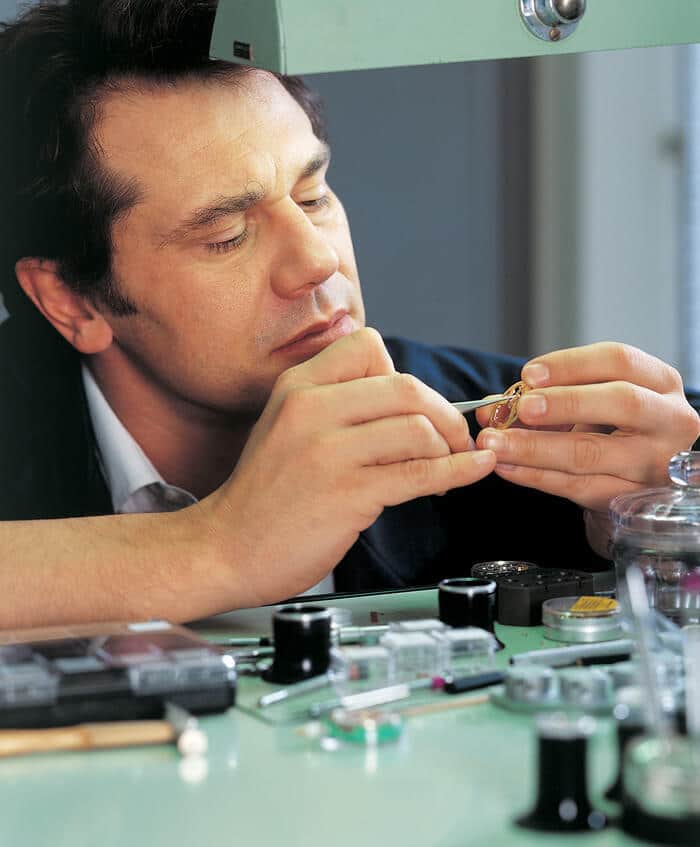
Like Breguet, Journe is an aesthete, an accomplished watchmaker, a shrewd businessman and an inventor. When François-Paul Journe released his first serially produced watch in 1999, he applied the Latin words ‘Invenit et Fecit’ to the dial. The term means ‘invented and made’, a motto he has lived by ever since. Throughout his career, François-Paul Journe has invented and then made numerous groundbreaking expressions of Haute Horlogerie.
François-Paul Journe – from Marseille to Geneva
François-Paul Journe was born in Marseille (1957) and spent his early years working with his uncle in Paris, honing his watchmaking skills. It was here that he began restoring priceless clocks and watches as well as making unique pieces for private clients.
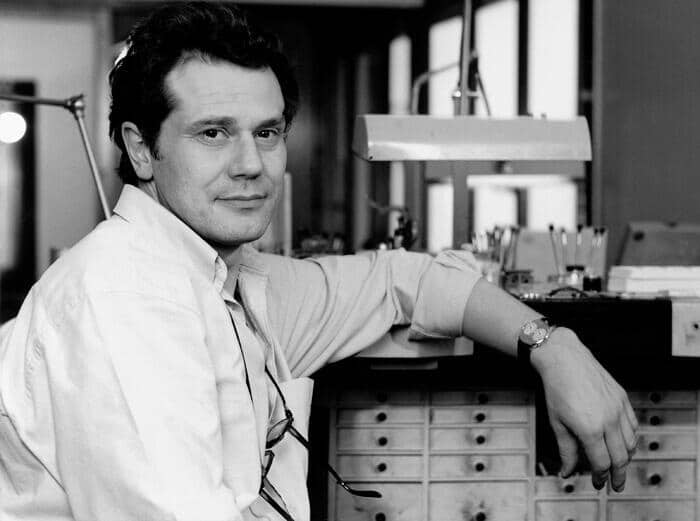
In 1996, Monsieur Journe moved to Geneva where he opened his own workshop. Four years later (2000), he moved to the Maison’s present-day location on Rue de l’Arquebuse in the heart of the Swiss city.

Image – F.P.Journe, Rue de l’Arquebuse
Today, Journe’s work is beloved by watch aficionados, collectors, as well as prestigious auction houses around the globe. However, like many watchmakers, even those blessed with an inordinate amount of talent, Monsieur Journe had to work hard to achieve the revered status he enjoys today.
Pre Montres Journe
In 1978, at just 20 years of age, the ambitious Journe began work on a pocket watch featuring a tourbillon and spring detent escapement, all painstakingly crafted by hand. He finished the watch after five years of endeavour (1983) and, no doubt, a vast amount of patience. Today, the watch is part of F.P.Journe’s private collection.
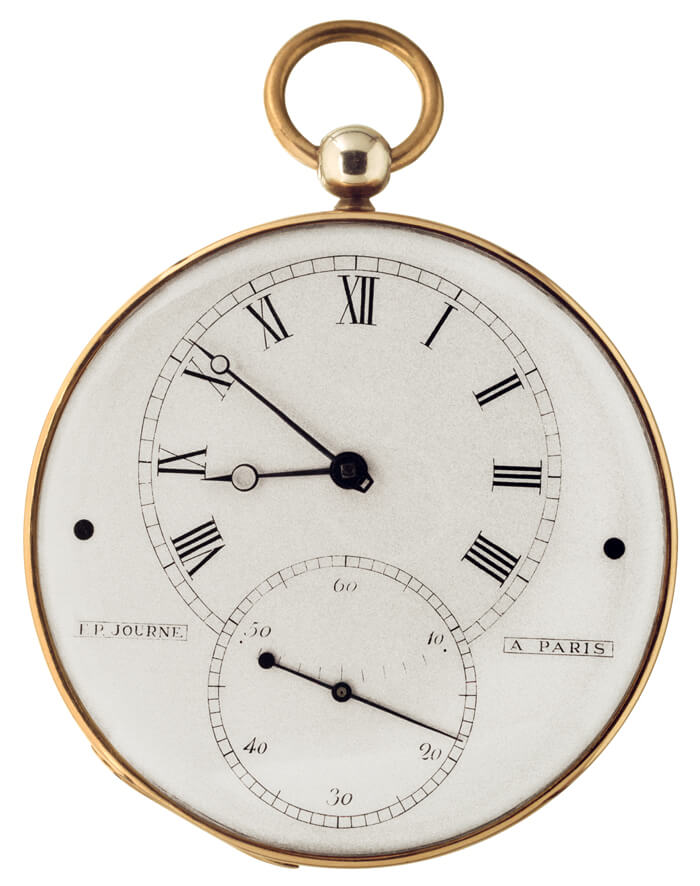
Image – First pocket watch by François-Paul Journe featuring a tourbillon and detent escapement
Monsieur Journe realised that a watch equipped with a tourbillon would prove more popular if presented in wristwatch form. At the time, tourbillon watches were produced in very low numbers. It was only after Journe released his innovative Tourbillon Souverain of 1999 (see later) that the so-called whirlwind found favour with other high-end Maisons. While the tourbillon could never be described as mainstream, there are now far more examples available than there were back in early 1990s.
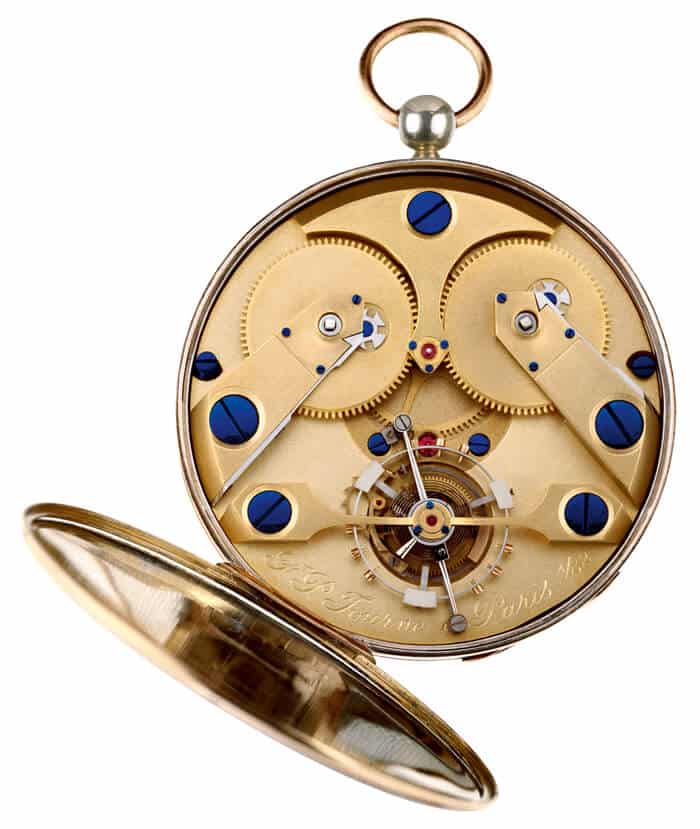
Image – First pocket watch by François-Paul Journe featuring a tourbillon and detent escapement
In 1991, Journe completed his first tourbillon wristwatch, signed F.P.Journe 11/91. This watch was equipped with a tourbillon and, once again, entirely crafted by hand. François-Paul Journe, mindful of the potential problems inherent with a tourbillon, equipped his 11/91 watch with a remontoir d’égalité (see later). This was the first time a wristwatch was equipped with both a tourbillon and remontoir d’égalité.

Image – First tourbillon wristwatch signed F.P.Journe 11/91
F.P.Journe Tourbillon Souverain – a souscription watch
In the early 1990s, François-Paul Journe was making unique watches for private clients as well as undertaking projects for a number of large brands, including Cartier, Piaget, etc.
In 1993, Journe made two additional examples of the first tourbillon wristwatch. Additional collectors expressed interest in his 11/91 watch, but Journe did not wish to produce further one-off creations. His dream was to make a small series of wristwatches, but unfortunately, he lacked the necessary funds to make it a reality. François-Paul Journe told his friend, Camille Berthet about his predicament. Berthet suggested to Journe that he consider making a souscription watch. It was a case of history repeating itself, albeit in this instance Journe requested a 50% deposit, twice the amount demanded by Breguet!
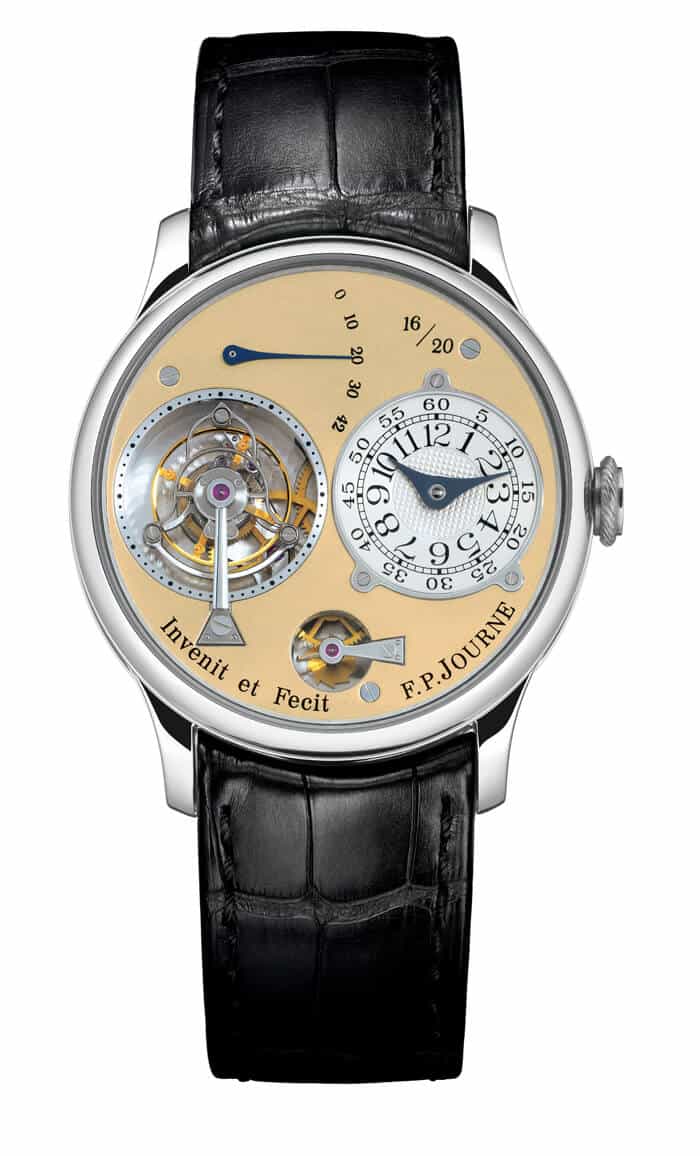
Image – Tourbillon Souverain – souscription watch, limited to 20 pieces (1999)
Having established his eponymous brand in 1999, Journe produced 20 pieces, each signed ‘F.P.Journe Invenit et Fecit’. Named the ‘Tourbillon Souverain’, this was the first watch produced by Montres Journe. It featured a rhodium-plated movement, an off-centre hour and minutes display (positioned adjacent to the crown), a remontoir d’égalité (note the aperture at 6 o’clock), a large tourbillon cage, that also served as a running seconds display and, lastly, a power-reserve indicator. Today, examples of this watch are much sought after with pristine examples fetching eye-watering sums at auction. In 2021, Sotheby’s in Hong Kong sold an example (13/20) for 15,905,000 HKD (approximately £1.674 M at the time of writing).
F.P.Journe Tourbillon Souverain – rationale for a tourbillon
Equipping a pocket watch with a tourbillon makes much sense because it is held in a vertical position. However, when a watch is affixed to the wrist, it will be subject to an array of positions, negating the benefits of a tourbillon.
There is also the matter of power consumption. The additional energy needed to rotate the tourbillon cage will often cause the amplitude to drop, impairing precision. For this reason, the combined mass of the tourbillon cage, escapement and regulating organ must be kept to an absolute minimum. Quite simply, the greater the mass, the greater the power consumption.
The size of the tourbillon cage often necessitates using a smaller balance wheel, again adversely affecting chronometry. It is also widely accepted that the balance must have a frequency of at least 3Hz in order to deliver a high degree of precision.
Journe ameliorated the impact of a fluctuating energy supply serving the balance by equipping his wristwatch with a remontoir d’égalité (see later).
At this juncture, the aforementioned points may cause a cynical reader to question the rationale for choosing a wristwatch equipped with a tourbillon. Well, a tourbillon bestows an enchanting animated performance, especially when positioned front of house. Moreover, the finest tourbillons showcase the exalted craftsmanship that is only synonymous within the highest echelons of fine watchmaking.
F.P.Journe Tourbillon Souverain – remontoir d’égalité
F.P.Journe has released several iterations of the Tourbillon Souverain over the years and each version has featured a tourbillon coupled with a remontoir d’égalité. Furthermore, they have all been equipped with a hand-wound movement incorporating a single barrel.
After the watch is wound, the mainspring is fully tensioned. Force or energy from the mainspring is transferred via the gear train to the escapement and eventually the regulating organ. Clearly, all hand-wound watches consume energy, necessitating the wearer to wind the crown, ideally on a daily basis. However, if the force serving the regulating organ is presented on a piece of graph paper, the plotted line should remain as flat as possible from when the mainspring is fully tensioned to when it is fully relaxed.
In reality, with most watches, the force serving the regulating organ will drop, shown with a plotted line on a graph tapering downwards. This will inevitably cause the amplitude of the balance to drop, causing the watch to run faster. Furthermore, by equipping the movement with a tourbillon, the weight of the cage will heighten energy consumption, again adversely affecting the amplitude.
For the aforementioned reasons, François-Paul has equipped all versions of his Tourbillon Souverain with a remontoir d’égalité. This mechanism features an additional wheel, positioned between the fourth wheel of the gear train and the escapement. Equipped with a short-duration spring, the wheel pulses a uniform dose of energy to the escapement every second. This spring is very different to a regular mainspring which is made to harness vast amounts of energy, often delivered over a number of hours or even days ie not seconds.
Basically, a constant force device mitigates any fluctuation in amplitude, enhancing rate stability. It is the issue of rate that can blight the ownership experience with some lesser tourbillons.
F.P.Journe Tourbillon Souverain – (Reference T) – 1999-2003
The Tourbillon Souverain (Reference T) is widely considered the first production wristwatch from Montres Journe. Where the original Tourbillon Souverain was limited to 20 pieces and sold using Breguet’s souscription technique, the Reference T was sold in the normal way (ie paid for at the time of delivery). The model was not limited per se, however, by its very nature, the protracted creation of each watch inevitably restricted the number of examples produced. Indeed, over a four-year period, it is estimated only 258 pieces were produced.
Measuring 38mm in diameter with a thickness of 9.90mm, the modest dimensions of the Reference T may seem surprising, especially considering the extraordinary complexity of its movement. The hand-wound, Calibre 1498 was visible via a sapphire case back. When the mainspring was fully wound, the lone barrel could deliver 42 hours of autonomous operation. The movement on this model was rhodium plated. The watch was available in two case options: platinum or 18K 6N gold. As per its forebears, the watch featured an off-centre dial for the hours and minutes.

Image – Tourbillon Souverain Reference T with a ruthenium dial – first ‘Limited Series’ (2001)
In 2001, Montres Journe unveiled a version of the Reference T with a ruthenium dial, this was the first ‘Limited Series’. The idea was to create watches that would appeal to collectors craving ‘innovative and exclusive models’. The Ruthenium Collection Limited Series was housed in a 40mm platinum case and limited to 99 numbered pieces.
F.P.Journe Tourbillon Souverain with a deadbeat seconds (Reference TN) – 2003 – 2018
Since François-Paul Journe established Montres Journe and released the Reference T, he has been prolific, releasing several new models, including the Chronomètre à Résonance (2000), the Octa Chronographe (2001), Octa Réserve de Marche (2001) and Octa Calendrier (2003), etc. When Montres Journe ceased producing the Reference T, there was a gap of one year before the Reference TN was released.
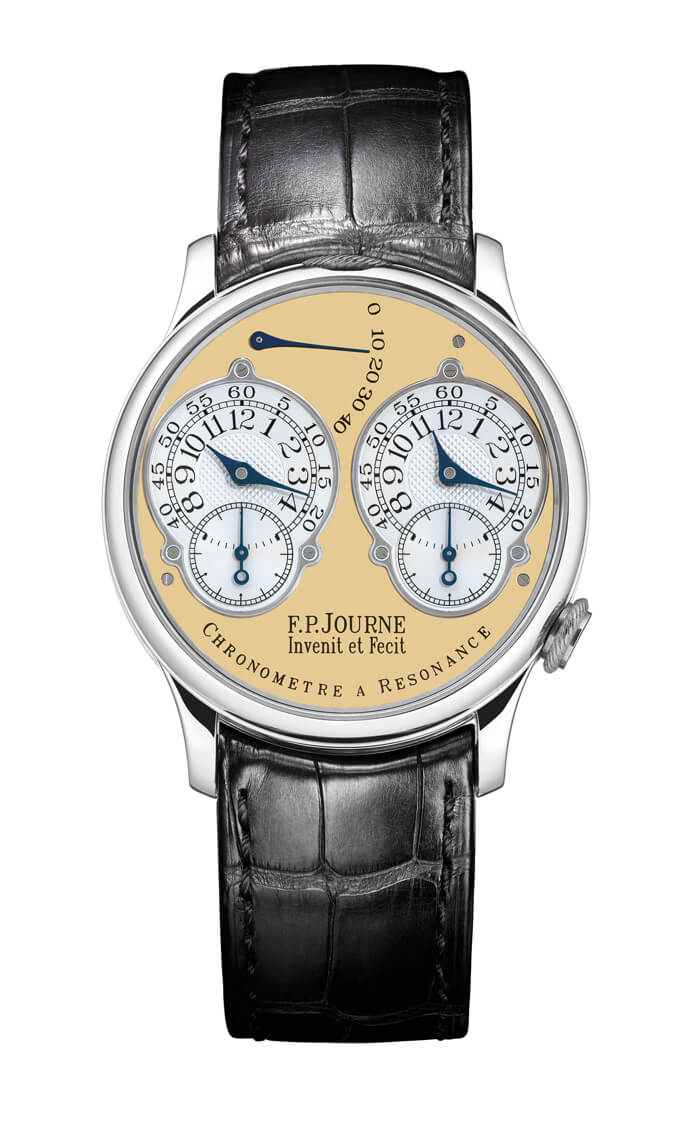
Image – Chronomètre à Résonance (2001)
Consistent with its predecessors, the Reference TN paired a tourbillon with a remontoir d’égalité. In addition, the model also featured a deadbeat seconds, a complication made possible by the remontoir d’égalité and its pulsing action. With a regular mechanical watch, the seconds hand will take several steps per second, the number determined by the frequency of the balance. A dead-beat seconds advances once per second, moving after a second has elapsed.
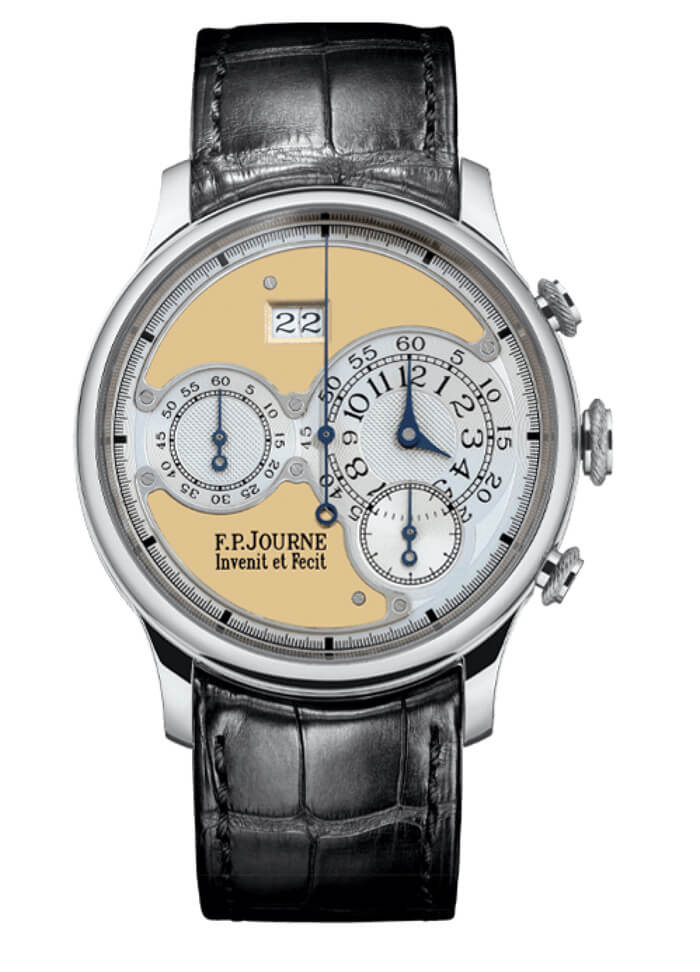
Image – Octa Chronographe (2001)
The dial layout on the Reference TN was significantly different to the Reference T. The hand for the power-reserve display was repositioned to 12 o’clock, granting a more symmetrical appearance to the dial. The patented screwed steel frame was redesigned. The seconds track, which previously encircled the aperture for the tourbillon, was removed, providing a cleaner aesthetic. Furthermore, a new, discrete small seconds display was introduced at 6 o’clock. These subtle changes clearly illustrate Journe’s relentless quest for perfection.
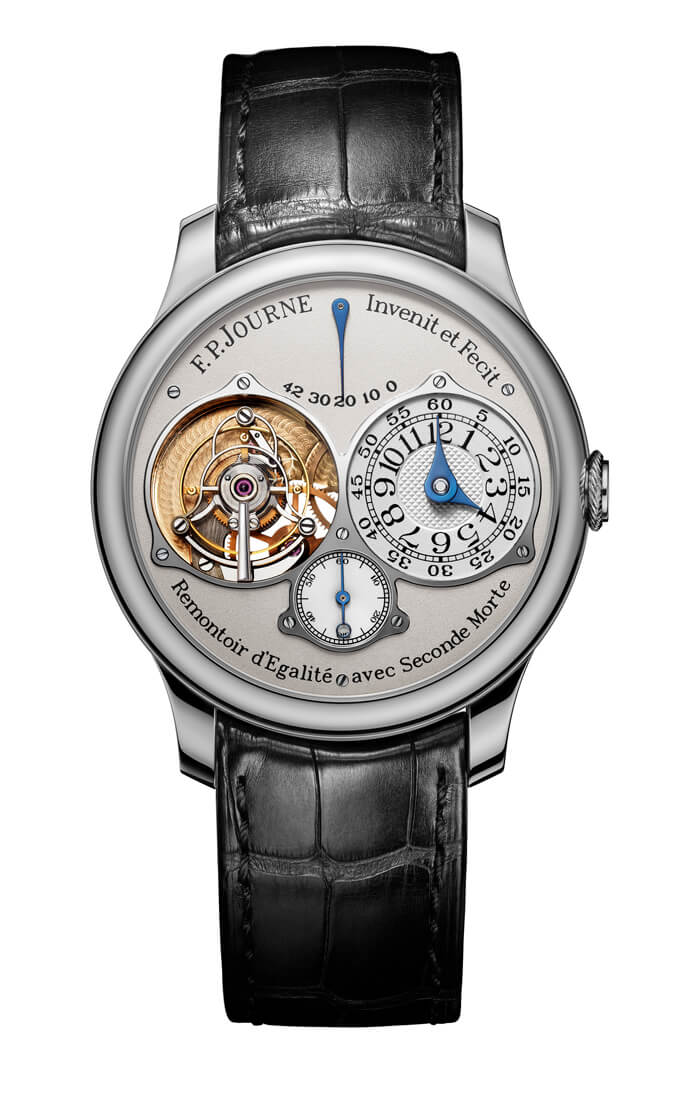
Image – Tourbillon Souverain Reference TN
The advent of the new Calibre 1403 for the Reference TN proved another significant landmark in the company’s journey. The movement was no longer rhodium-plated brass, but instead was made of 18K rose gold. This latter material is the least reactive metal, hence it will never corrode or tarnish. Furthermore, gold reinforced Journe’s reputation for making luxury watches. Although the movement featured a deadbeat seconds, the height of the watch remained unchanged at 9.90mm.
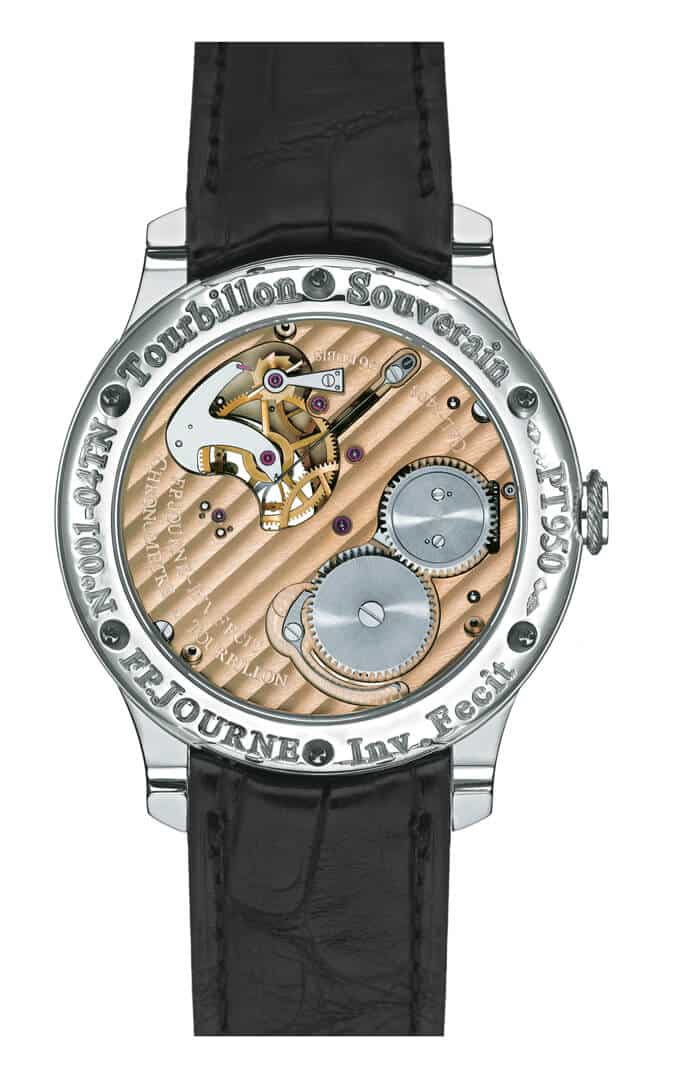
Image – Tourbillon Souverain Reference TN
Throughout its reign, the Tourbillon Souverain sired several limited edition models and in some cases unique pieces, including the Tourbillon Titanium (Reference TT) of 2007/8, and the Tourbillon Souverain Bleu for Only Watch (a unique piece made for the Charity in 2015), to name but a few.
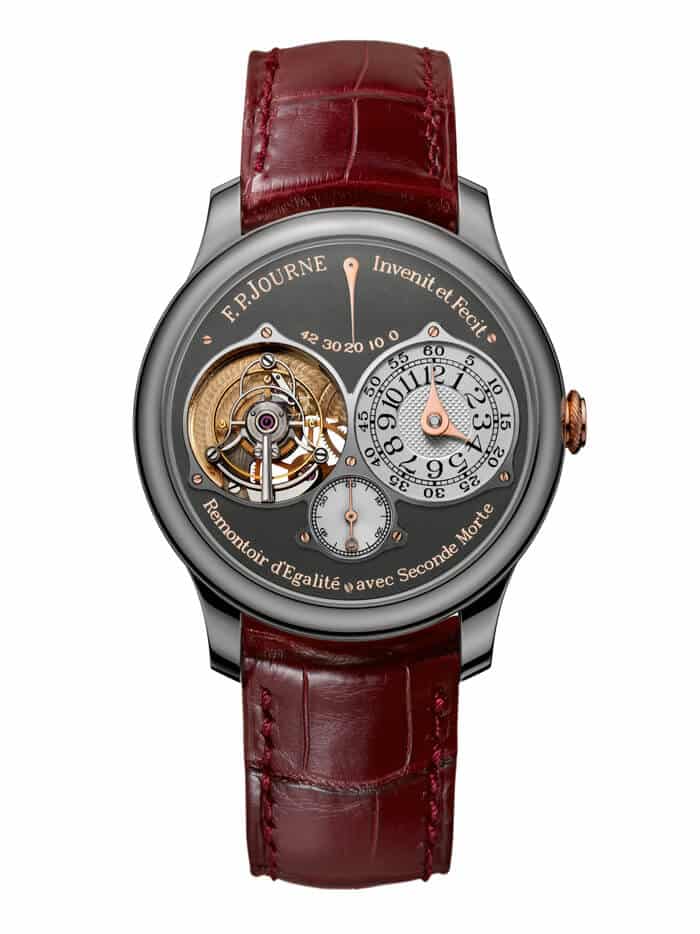
Image – Tourbillon Titanium Reference TT (2007/2008)

Image – Tourbillon Souverain Bleu for Only Watch (2015)
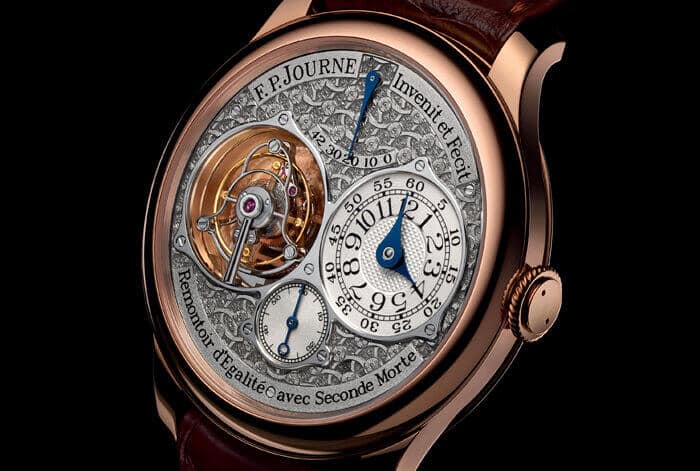
Image – Hand engraved Regency Boutique Exclusive (2016)
F.P.Journe Tourbillon Souverain Reference TV – a new dimension (2019)
In 2019, coinciding with the 20th anniversary of the Reference T being released, Monsieur Journe surprised the watch-collecting community by unveiling a wholly new Tourbillon Souverain, the Reference TV.
Whereas, previous iterations of the Tourbillon Souverain positioned the cage parallel to the main plate (ie horizontally aligned), the 2019 release was different. The tourbillon cage on this newer model was positioned perpendicular to the main plate (ie vertically aligned).
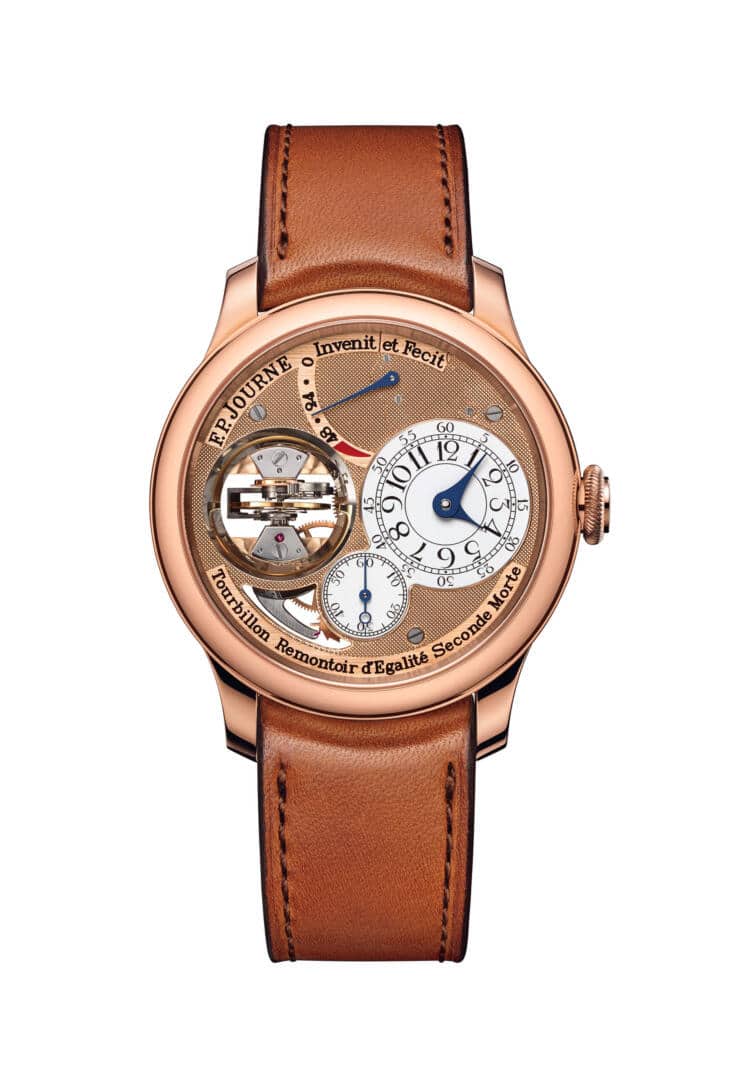
Image – Tourbillon Souverain (Reference TV)
One of Monsieur Journe’s notable characteristics is that he pays close attention to the minutiae. With a classic tourbillon, where the tourbillon is parallel to the main plate, there is no friction between the two balance pivots and the jewel bearings when the watch is flat. However, when placed on its side, there is friction.
With the vertical tourbillon, there is a subtle difference. François-Paul Journe explains ‘In the case of the vertical tourbillon, there is friction with the pivots in the same balance wheel, whether the timepiece is set down flat on a table or placed on its side due to the presence of the deployant buckle. This constant state of friction ensures that the watchmaker tasked with the fine-tuning of the piece can achieve consistency in the oscillation rate of the balance wheel, whether the piece is flat or on its side, a necessary requirement if the high chronometric quality is to be targeted’.
The 2019 version of the Tourbillon Souverain, like the Reference TN, features a remontoir d’égalité and a dead-beat seconds. However, with the advent of this model and its new movement, the Calibre 1519, the power reserve has increased to 80 hours and the tourbillon cage rotates 360° every 30 seconds.

Image – Tourbillon Souverain (Reference TV) – Black Label
While the Tourbillon Souverain remains a highly desirable member of the Maison’s portfolio, based on past experience, it won’t remain in its present guise forever. Indeed, Monsieur Journe’s unwavering quest for perfection will no doubt see him invent and make new versions of this legendary model in the future. Invenit et Fecit.