
Breguet Tradition Tourbillon 7047
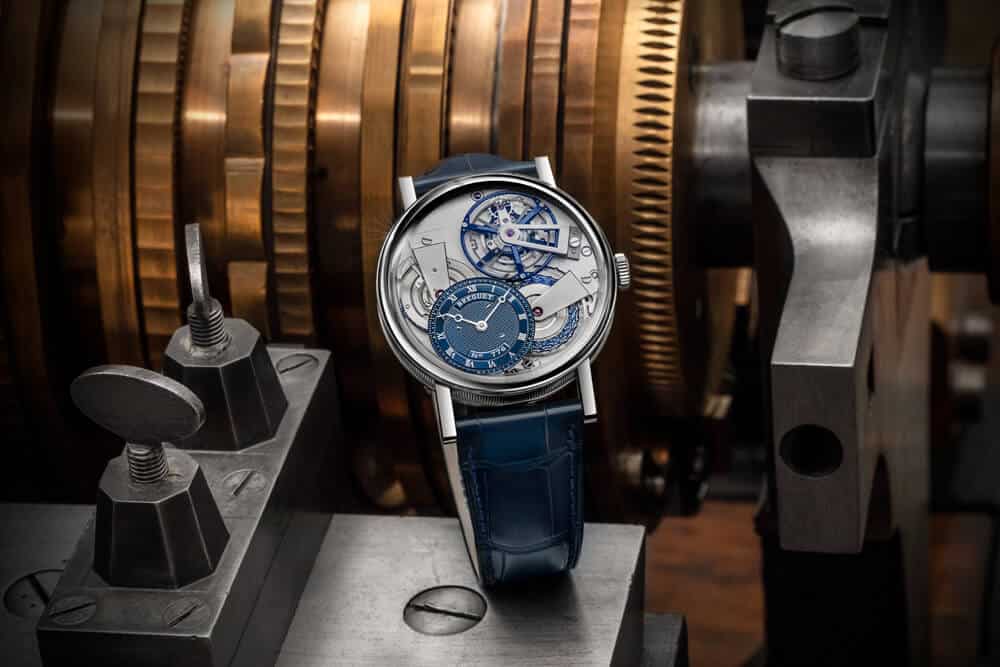
The Breguet Tradition Tourbillon 7047 was recently released on the 221st anniversary of Abraham-Louis Breguet filing his patent for his ingenious mechanism, the Tourbillon (26th June 1801). Featuring a fusée and chain, this model also includes cutting-edge technology while upholding the timeless styling synonymous with Breguet’s Tradition collection.
Abraham-Louis Breguet (1747-1823)
In the late 18th century, Abraham-Louis Breguet (1747-1823) lived and worked in Paris. Originating from Neuchâtel, the legendary watchmaker will forever be known for his aesthetic prowess and extraordinary commercial acumen. However, Breguet’s skill set extended to other areas of business and horology, most notably ‘chronometry’.
Ferdinand Berthoud (1727-1807)
When Breguet arrived in Paris, he would have known of Ferdinand Berthoud (1727-1807), the celebrated clock and watchmaker of the time. Berthoud, coincidentally another son of Neuchâtel, expended much time creating increasingly precise and sophisticated marine chronometers for the French Royal Navy.
Marine Chronometers
From the early part of the 17th century, the safe navigation of seas using marine chronometers assumed vital importance to both the British and the French. For those clockmakers able to produce highly precise marine chronometers, used to determine longitude, the financial rewards were huge.
During this period, Arnold, Berthoud, Harrison and Le Roy were four luminaries operating in, what at the time was viewed as the forefront of horology. Interestingly, Berthoud and Pierre Le Roy (1717-1785) became engaged in a public spat over which was the best type of escapement most suited to a marine chronometer.

Constant Force Escapement (1798)
While Breguet was known to abhor such pettiness, he was interested in ‘chronometry’, a term used to describe the science of accurate time measurement. For example, in 1798, Breguet patented a constant force escapement.
When the mainspring is fully tensioned within a pocket watch or wristwatch, there is an abundance of power which is transferred via the gear train to the escapement and, ultimately, the balance. As the mainspring relaxes, the amount of power reaching the escapement drops, causing the amplitude of the balance wheel to fall, thereby making the watch run faster. A constant force escapement smooths the power or torque curve, delivering a uniform force to the escapement and regulating organ, culminating in superior rate stability.
The Tourbillon (1801)
Breguet is probably best known for inventing the Tourbillon, a mechanism designed to counter the adverse influence of gravity on the regulating organ. The legendary watchmaker came up with the ingenious idea of placing the escapement and the regulating organ within a rotating cage. As the cage rotated, over a set period (typically one, four or six minutes), the positional errors usually encountered cancelled one another out. Breguet enhanced chronometry by employing his incredible ingenuity and filed his patent for the Tourbillon on the 26th of June 1801.
Breguet Tradition Tourbillon 7047 – celebrating the creation of the Tourbillon (26th June 1801)
Recently, the modern-day House of Breguet chose to celebrate the great man’s invention. On the anniversary of Abraham-Louis filing his famous patent, the luxury marque released the Breguet Tradition Tourbillon 7047. This new model acknowledges Abraham-Louis Breguet’s ingenious mechanism but distils it for today’s discerning watch collector.
Upholding the design language of other Tradition models, the Breguet 7047 unites the worlds of ‘heritage and modernity’ in a harmonious, highly wearable format. The watch also unites a Tourbillon with a fusée and chain, a mouthwatering combination for any self-respecting horophile.

Fusée and chain (15th century)
The fusée and chain is another form of constant force device. In terms of its composition, it differs from Breguet’s invention (patented in 1798), but the concept of serving the regulating organ with a uniform dose of energy remains the same. Interestingly, the fusée and chain mechanism dates back to the 15th century.
A chain is coiled around a cone-like device termed a fusée. When the barrel is fully tensioned, the chain fully encircles the fusée nearby. The shape of the cone is designed to match the torque characteristics of the mainspring.
Initially, when the mainspring is fully tensioned, there is no shortage of power or force, hence the barrel pulls the chain from that part of the cone where the circumference is smallest. As the mainspring becomes increasingly relaxed and the available force decreases, the fusée (cone) turns more easily, effectively compensating for the reduced energy within the barrel.
By incorporating this type of constant-force device, the movement delivers superior rate stability. But, what exactly does this mean? Basically, once the movement is regulated and running at, say +2 seconds per day, it will potentially run at this rate for longer, irrespective of the amount of energy held within the barrel.
A contemporary Tradition since 2005
As stated earlier, the Breguet Tradition Tourbillon 7047 perpetuates the design language of the first Tradition model, the 7027. Introduced in 2005, this model featured an off-centre hour and minute display which was adorned with Clous de Paris guilloché and paired with elegant Breguet hour and minute hands. The 37mm case sported slender lugs and the brand’s beloved caseband fluting. So far, so traditional.
The 7027 differed from many of its contemporaries, displaying numerous components, usually positioned to the rear of the watch, and showcased them front of house. Furthermore, the traditional finishes of perlage and Côtes de Genéve were set aside in favour of a ‘peened’ look.
Since the release of the 7027, the brand has gone on to release further Traditional models, some equipped with different functions or incorporating gems, but all upholding the style of the original 2005 model.
Breguet Tradition Tourbillon 7047 – a new classic
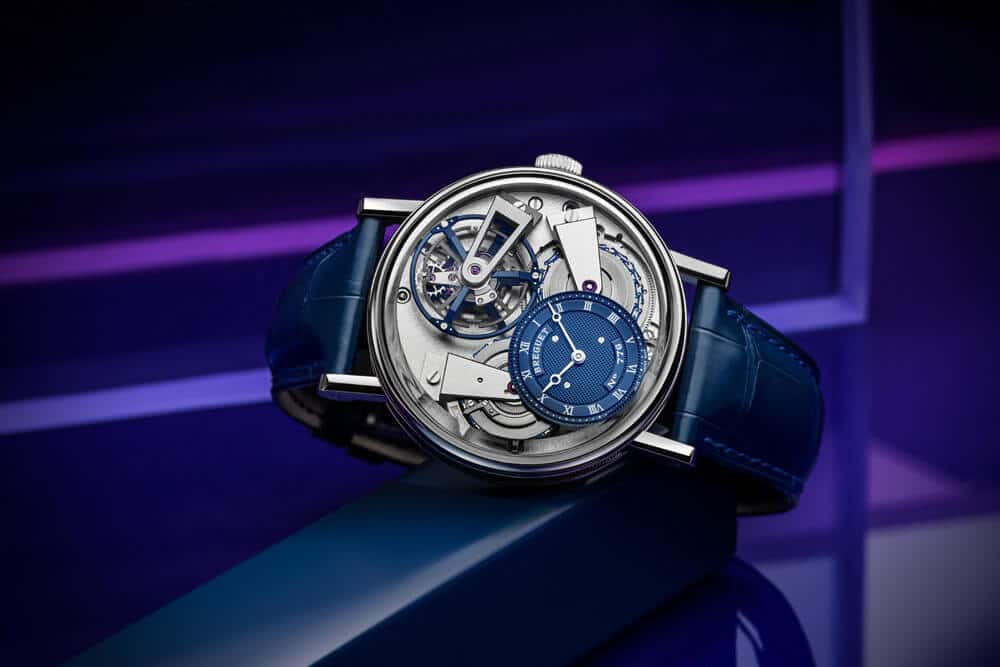
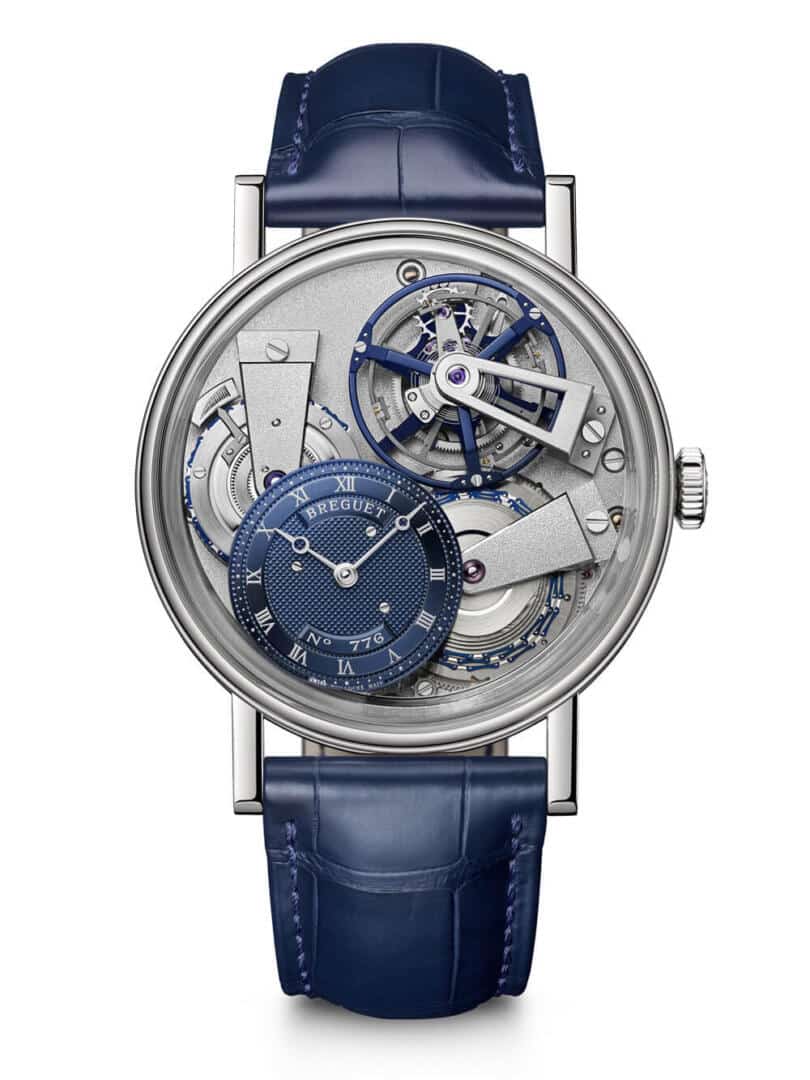
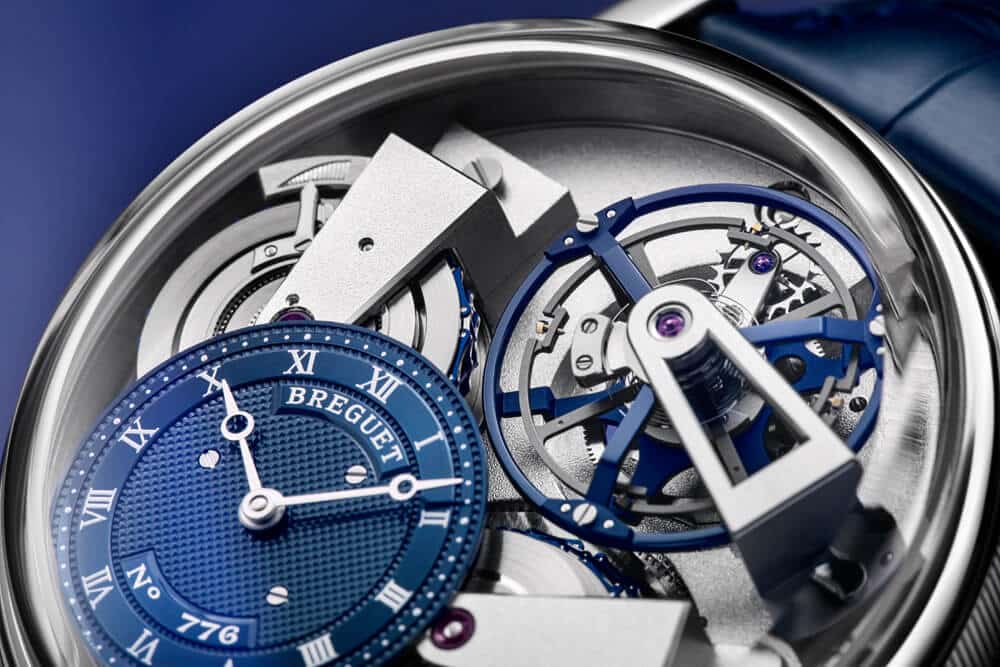
The Breguet Tradition Tourbillon 7047 is a post-dated classic. It subscribes to the styling of other members of the Tradition collection, but with the addition of a fusée and chain and a Tourbillon. Once again, the hours and minutes are presented on an off-centre dial, albeit on this occasion, located in the southwest region of the display.
The off-centre dial is secured with three silvery screws and features Clous de Paris guilloché. Roman numerals along with Breguet hour and minute hands should cause most connoisseurs to salivate with desire. Three cocks secure the fusée and barrel (peened finish) and the tourbillon cage wheel (brushed finish). The latter cock is beautifully appointed with flawless chamfering extending to the crisp internal angles, a telling sign of painstaking hand craftsmanship.
Blue hues abound with the off-centre dial, chain, cage and alligator strap all presented in various shades of cobalt, exhibiting a wonderfully sumptuous and eminently sophisticated appearance.
Breguet Tradition Tourbillon 7047 – Calibre 569
The Breguet Tradition Tourbillon 7047 is equipped with the Calibre 569, a hand-wound movement incorporating a free-sprung balance. The rate is altered by adjusting the timing screws set in the rim of the balance wheel. This form of regulation, when compared with an index-regulated balance, is less susceptible to positional influence and proffers superior rate stability. Breguet has also set the timing screws in-board, mitigating air turbulence, thereby enhancing precision.
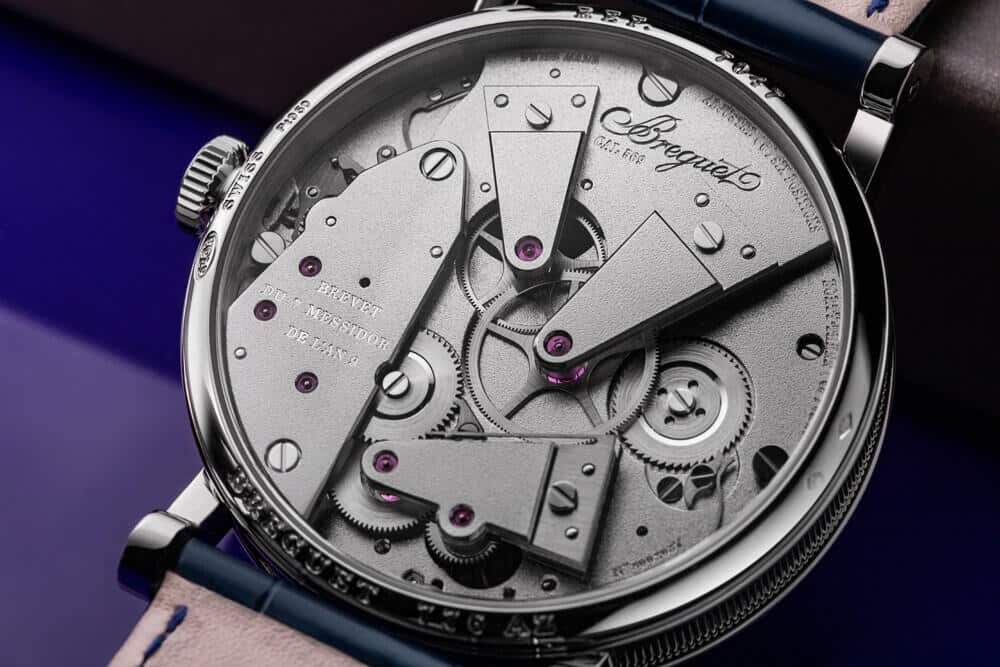
The hairspring features a Breguet overcoil, causing it to breathe more concentrically, enhancing isochronism.
Breguet has not been afraid to embrace innovation either where it confers advancement. Both the horns (part of the pallet lever) and the hairspring are made of silicium (silicon). This glass-like material is very light and friction-free. Moreover, it isn’t liable to corrosion and is not susceptible to the influence of temperature or magnetism. It is this impressive inventory of benefits that has led the brand to employ the cutting-edge material.
The balance is fitted with a sliding stud cap, providing a trained watchmaker with the means to easily correct any beat error. The Calibre 569 has a frequency of 18,000 vph (2.5Hz) and contains 542 components, of which 43 are jewels. Assuming it is fully wound, the movement will run autonomously for 50 hours.
Breguet Tradition Tourbillon 7047 – closing thoughts
Throughout his life, Abraham-Louis Breguet was an innovator. Instead of accepting the status quo, he continuously explored new ideas, eager to improve chronometry, rate stability and reliability. When conceiving the Breguet Tradition Tourbillon 7047, the brilliant minds at the Manufacture have clearly thought about the same three criteria. This modern-day timepiece employs an impressive combination of ingenuity, craftsmanship and new materials to advance standards within the esoteric sphere of Haute Horlogerie.
It may be 221 years since Breguet filed his patent for the Tourbillon, but his legacy continues to shine brightly today. Would Abraham-Louis have made the 7047 if he were still alive today? Nobody knows, but one thing is certain, this latest watch is more than worthy of bearing the name of the greatest watchmaker of all time.
Further reading
Technical specifications
- Model: Breguet Tradition Tourbillon 7047
- Reference: 7047PT/1Y/9ZU
- Case: Platinum; diameter 41 mm; height 16 mm; water resistance 3ATM (30m); sapphire crystal to the front and exhibition case back.
- Functions: Hours; minutes; fusée tourbillon
- Movement: Calibre 569; hand-wound movement; frequency 18,000 vph (2.5Hz); power reserve 50 hours.
- Strap: Midnight blue alligator leather strap paired with a triple-blade platinum folding clasp.
- Price: £182,100 (RRP as of 20.9.2023)