
Vicenterra AstroLUNA Aventurine
The Vicenterra AstroLUNA Aventurine is the brainchild of Vincent Plomb, ‘creator and constructor of watches’ and produced in the Swiss Jura. Blessed with a bewitching dial formed of aventurine, a high-end case made of Grade 5 titanium and a Vaucher movement, this GMT model brims with refinement. Mark McArthur-Christie examines the composition of this sublime souscription watch.

Image – 43.5mm case
Chatting to non-experts
It’s only when you have a conversation with a non-watch person that you realise how truly barking we watch people are. A recent exchange went like this:
Friend: You like your watches, don’t you? I’m thinking about something special for my 50th – you know, as a bit of a treat. What do you think I should get?
MMC: Well, it depends on what you like, really. A chronograph? A diver? World timer? How about a…
Friend: Hang on – I just fancy a nice watch. I’d no idea it was so complicated!
MMC: Great – you want something complicat.. Ah, that’s not what you meant, was it? OK, well how much do you want to spend?
Friend: It’s a big birthday – maybe eight or nine?
MMC: Fantastic! If you went vintage you could maybe pick up a gold 1803 Datejust for a little over nine thou…
Friend: Are you nuts? That’s more than my car! I meant eight hundred!
MMC (chastened): Have you thought about a Seiko?
Sadly, nowadays even six figures won’t get you much when it comes to top end watches, let alone snaffle a proper astronomical complication in a limited edition watch from a tiny Jura-based maker. At least, you’d think so. But take a look at this… the Vicenterra AstroLUNA Aventurine.
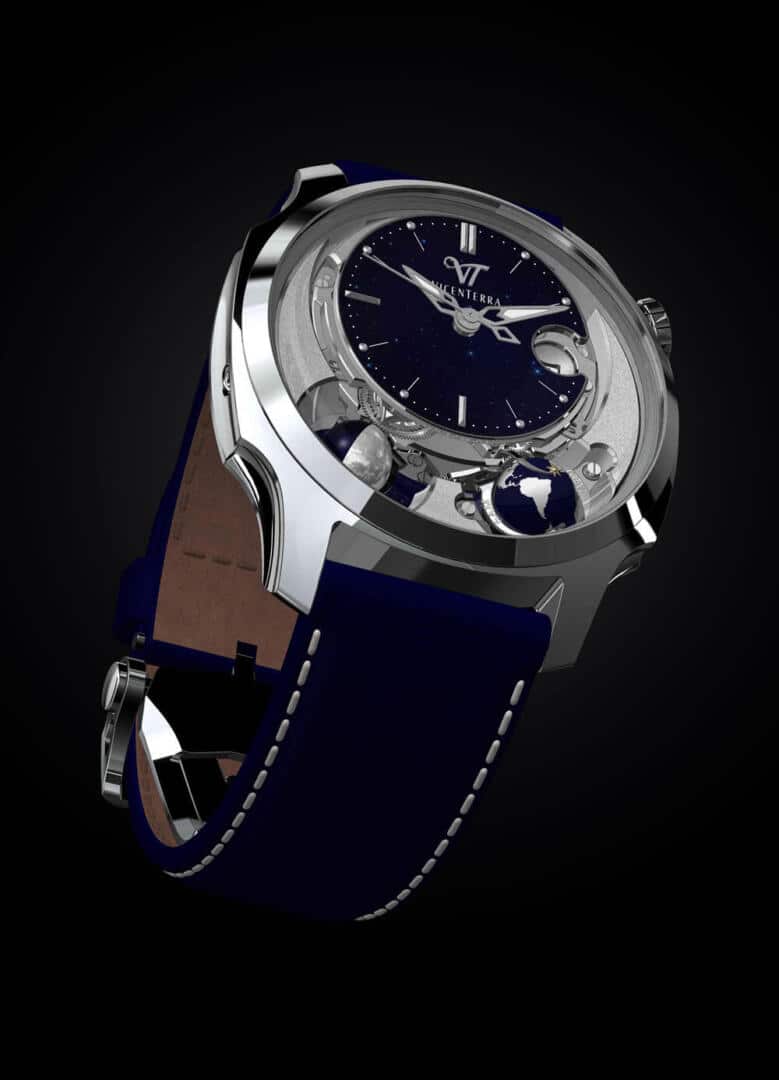
Image – 43.5mm case
Vaucher Manufacture Fleurier Seed 3000 movement
The long and short of it is for £12,000 you get a titanium-cased Vaucher Manufacture Fleurier Seed 3000 movement with an in-house astronomical complication and a level of finishing that would make a lot of makers weep. Oh, and there are only going to be 99 of them. That calibre alone – without the complication – cost around five million CHF to develop and you can find it in watches costing more than ten times the price. So, in our crazy Watch World, £12k is a bit of a bargain.

Image – 43.5mm case
Unless you have a bit of a thing for astro complications, Vicenterra may not be a familiar name. Founded by Vincent Plomb in the mid-2000s, his first watch left the bench in prototype form back in 2008. This was the rather lovely GMT-III. With a titanium or gold case and an ETA 2892 movement at its heart, Plomb added his own 21-jewel module that gave you the usual hours, minutes and seconds but also a day/night complication, a retrograde date and a terrestrial globe for GMT. How much? CHF 9,100 – just about enough for a round of coffees at your favourite Geneva watch fair.

Now, at this point you might be thinking “Meh. Standard movement with a bolt-on module.” And often in cases like this, you’d be right. But not here. Characterising Vicenterra’s offerings as bolt-ons is a little like referring to the W124 Mercedes E500 as ‘standard taxi with a bolt-on big engine’. The level of finishing is way above the price and Plomb is focusing on the sort of movement adaptations that make his watches properly interesting.
Souscription watch
Plomb is a smart businessman too, drawing on one of Breguet’s commercial ideas – the souscription. Under this model, you initially subscribe to buy a watch, thus providing the seed capital to allow the firm to order materials and start manufacture.
Vicenterra AstroLUNA Aventurine – Grade 5 titanium case
So what do you get for your £12,000? Well, you get a choice, for a start. The AstroLUNAR comes in two different cases. Both are presented in polished Grade 5 titanium (so easy to type, so hard to do) but in very different styles. There’s a classical, elegant round case or, if you fancy something a bit more fittingly ‘out there’ for an astro watch, there’s a flying-saucer style option too. Plomb says, keeping to the celestial theme, “Two years of lunar travel were necessary to create this original design.” The classical case comes in at just under 42mm in diameter and the ‘disco volante’ is 43.5mm. Both have the crowns neatly tucked away, protected by a lug at 2 o’clock.
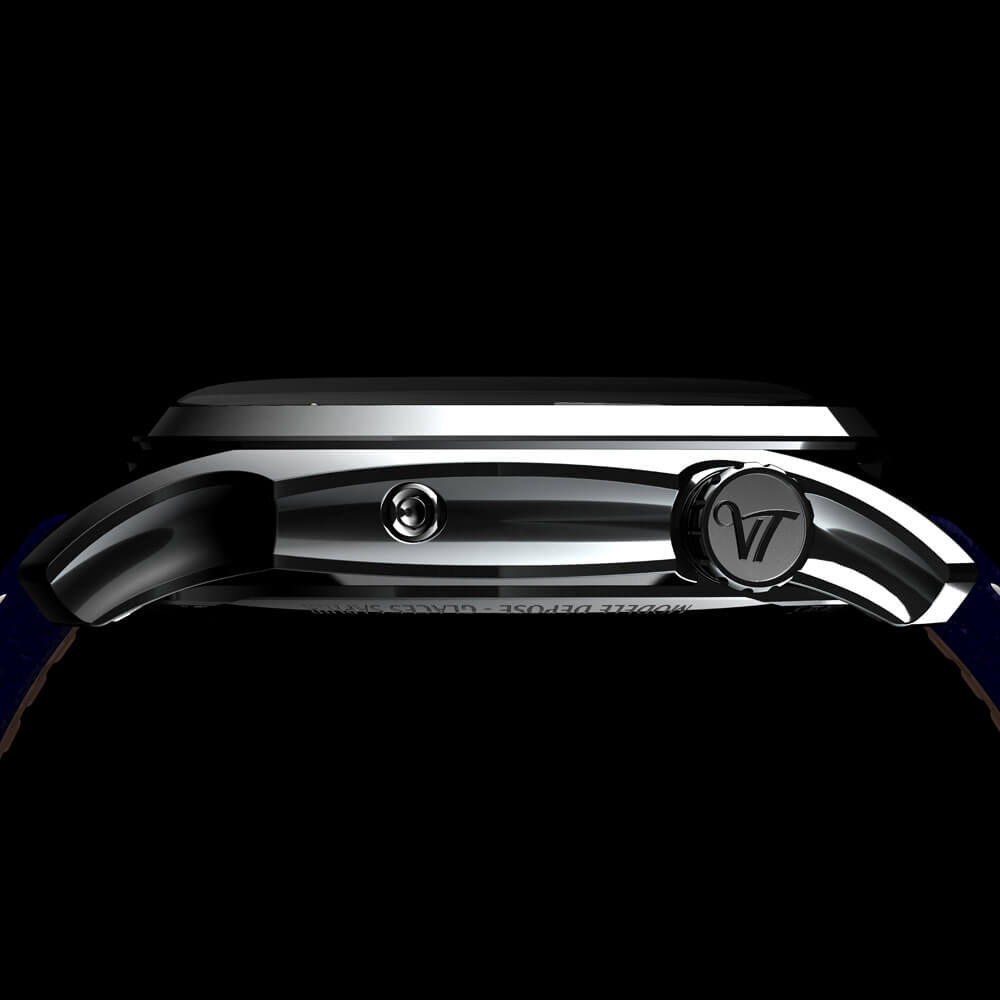
Image – 43.5mm case
The crown position makes even more sense when you see how Vicenterra has mounted the movement in the case. There’s almost a watch within a watch as the movement and dial fill the top two thirds with the astronomical complication mechanism taking up the remaining space. And look at that movement finishing! There’s circular graining on almost anything that moves; the date bridge and motion-work bridge too. The bridges get Geneva striping and they’re hand-bevelled. The different finishes have a knack of taking a lot of weight away from the movement mounting when you look from the dial-side. Without them, the whole thing could have been pretty slabby.
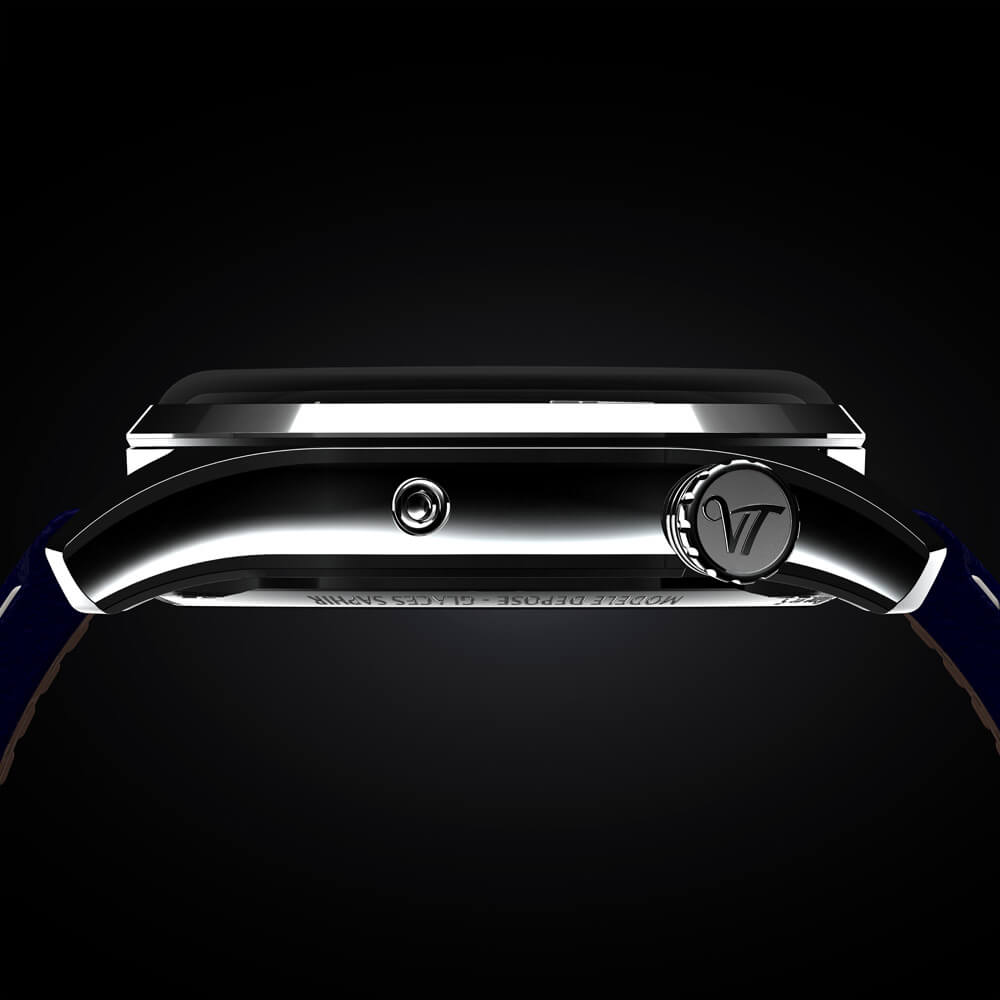
Image – classic version
The astro module gets similar care with alternating rough machining and sunburst colimaçonné decoration, the Earth and Moon bridge are brass with satin rhodium plating and hand-bevelled. If you can see a screw, it’s polished. If you can’t see it I suspect it’s also polished. Even the tungsten winding weight has been customised.
Vicenterra AstroLUNA Aventurine – a propensity to sparkle
Despite all the high-end finishing, there’s a lightness of touch here – this isn’t a watch that takes itself too seriously. You can see the Earth globe from both the front and rear of the watch, while the caseback is engraved, appropriately, “a l’autre bout du monde’ and “…et dans les étoiles…” You really do get stars too – both on the dial and the back – thanks to Vicenterra’s use of aventurine glass rather than just ordinary quartz crystal. Aventurine is made with tiny metallic particles trapped inside the molten glass. When the light hits them, they sparkle. And the hefty sapphire box crystal makes sure plenty of light reaches both dial and case interior.
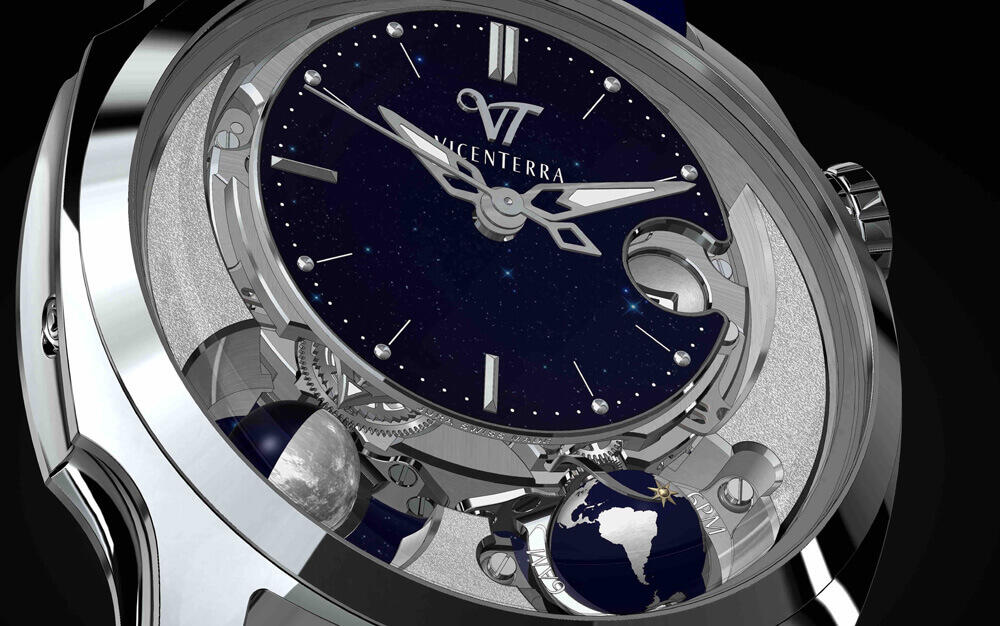
Image – 43.5mm case
Despite all this celestiality, setting the Moon and Earth spheres is far from an Atlassian task. As you’d expect, the crown at 2 o’clock takes care of the hour, minute, second and date functions. You set the Earth globe to one of its 24 independent positions with a simple push of the recessed button at 4 o’clock and the Moon likewise with the 8 o’clock button. Not that you’ll have to do it too often; the lunar sphere rotates once every 29.53125 days so you should only need to correct it once every 126 years. Best to make a note in your diary.
Impressive attention to detail – best appreciated through a loupe
When you look closer at both Moon and Earth, you get some sense of the care and work that has gone into this watch. They’re painted individually and by hand by the same miniaturist. The Moon even glows at night with its coating of Super-LumiNova paint. The Earth’s oceans are in dark blue with the continents picked out in silver. The mapping – and it’s fair to call it that – is so detailed you can even see the tiny Falkland Islands in the South Atlantic. Likewise, the Moon’s seas are easily visible – well, they are if you have a loupe. Plomb explains how things work practically; “Thanks to the small solid gold sun representing its zenith, as well as the 6AM & 6PM sapphire markers, you can locate at a glance the places on earth where it is night, where it is noon, and when it is 6AM or 6PM.”
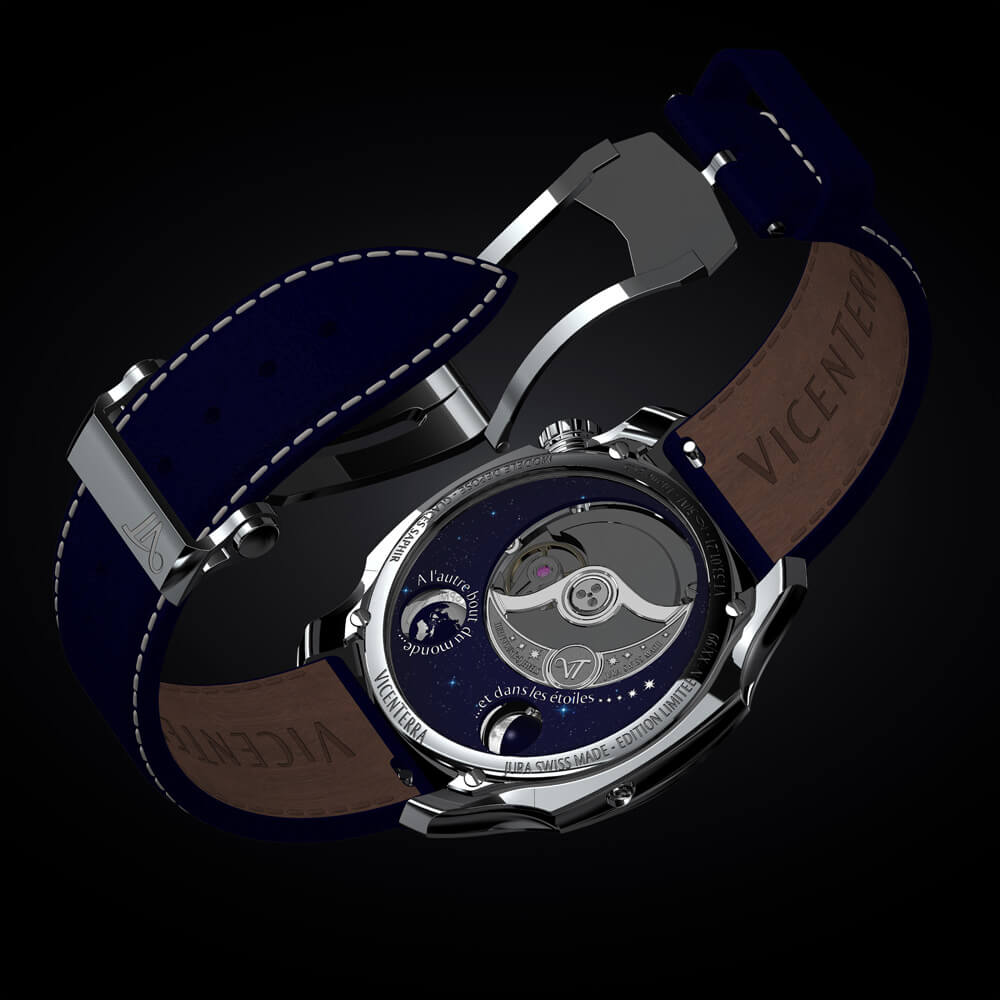
Image – 43.5mm case
Road tested by Loïc Minaudier
Although Vicenterra AstroLUNA Aventurine is water resistant to just 50m, earlier GMTs have proved they can take a beating. Paris Dakar motorcyclist Loïc Minaudier wore his GMT 3 when he rode in the 2017 Rally Raid Dakar. To get a sense of what riding the 9,000km Dakar is like, climb inside your nearest industrial tumble drier wearing full motorcycle kit, set it to ‘max’ and stay there for ten days. It’s a hell of a test for any watch, let alone a timepiece equipped with a complex astronomical complication.
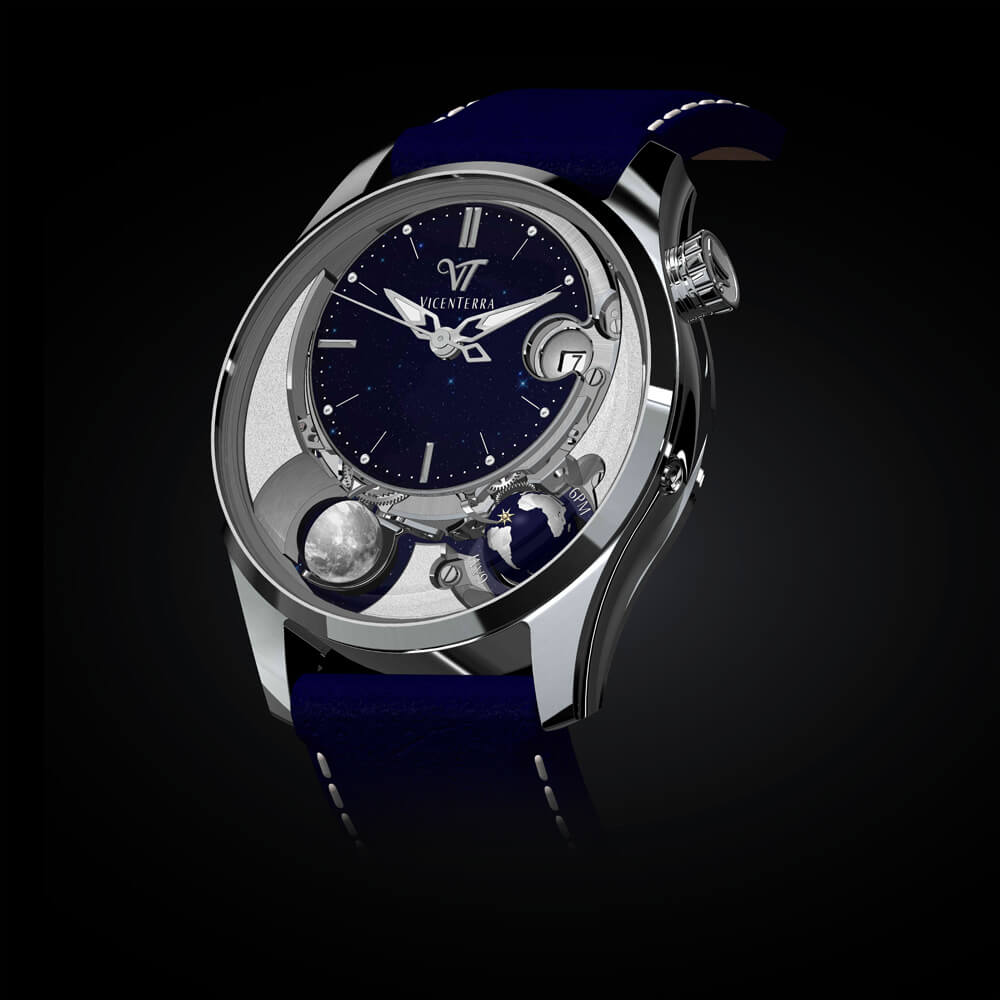
Image – classic version
Whether you plan to strap your AstroLUNA on before you cross South America on a motorcycle or simply before nipping out for dinner, it’s a remarkable watch. Not only for its price but also for the quality of its design, engineering and watchmaking. It’s a long way from ‘down the back of the sofa’ money, but even at twice the price, it would cause other makers to pause for thought.
Further reading
Technical specifications
- Model: Vicenterra AstroLUNA Aventurine
- Case: Grade 5 titanium, classic version – diameter 41.5 mm, regular model – 43.5mm, height 13.5mm (both case options), water resistance 5ATM (50m); sapphire crystal to the front and exhibition case back.
- Functions: hours, minutes, centre seconds, date, three-dimensional GMT, permanent Day / Night
- Movement: Vaucher Manufacture Fleurier Seed 3000 movement with Vicenterra module, automatic movement, frequency 28,800 vph (4Hz), 28 jewels, power reserve 50 hours
- Strap: blue calf leather strap paired with Grade 5 titanium buckle with folding stainless steel blades
- Price: CHF 13,500 excluding taxes (RRP as of 7.12.2022)