
F.P.Journe Remontoir d’Égalité
The F.P.Journe Remontoir d’Égalité first appeared in a pocket watch in 1983 and it subsequently appeared in the prototype of the legendary Tourbillon Souverain (1991). It also formed part of the Echappement Bi-axial Haute Performance (EBHP) system, employed on the Chronomètre Optimum for the first time in 2012. The remontoir d’égalité ensures the power from the barrel(s) serving the escapement is consistent, thereby conferring superior rate stability. Angus Davies looks at François-Paul Journe’s relationship with this constant force device and his relentless quest for superior chronometric performance.
Introducing power to the mainspring
The mechanical watch is a complex instrument, an assemblage of numerous components, many working in a choreographed sequence, repeatedly. Sometimes these parts are solely dedicated to the indication of hours and minutes, while on other occasions they are combined with one or sometimes several complications. However, every mechanical watch requires power in order to fulfil its timekeeping duties.
Aside from altering the hours, minutes and sometimes other indications, the crown is used to energise the mainspring. Indeed, on a hand-wound movement, the mainspring is tensioned solely by rotating the crown. However, an automatic movement features an oscillating mass that rotates with the merest suggestion of wrist motion. This oscillating mass (or rotor), in combination with a dedicated train, tensions the mainspring, albeit the wearer can still energise the watch by manually winding the crown.

Image – Calibre 1300.3 – 18 K rose Gold (automatic movement)
Transferring the power from the mainspring via the gear train
Having tensioned the mainspring (on this occasion, let’s assume there is just one), there is a vast amount of pent-up power. The mainspring, housed within the spring barrel, wants to unfurl and relax. However, if it is allowed to unleash its power unchecked, it would initially release a colossal force causing the hands to rotate uncontrollably and potentially damaging numerous parts before ultimately returning to a relaxed state. Therefore, the power within any mechanical watch has to be managed.
The barrel features teeth around its leading edge which engage with the great wheel (centre wheel), which in turn rotates the third and fourth wheels in sequence. This arrangement works like a series of step-down transformers, each reducing the available voltage, or in this instance, the power from the barrel. Ultimately, the fourth wheel transmits power to the escape wheel.
Swiss lever escapement – controlling the flow of time
The escape wheel is an essential part of a Swiss lever escapement. The escapement prevents the mainspring unwinding uncontrollably, thereby managing the flow of time, ensuring the indications only display accurate information.
As the escape wheel rotates, its motion is subjected to a repeated cycle of locking and unlocking, causing it to advance in predetermined steps. The escape wheel provides an impulse to the pallet lever which in turn connects with an impulse pin that pushes the balance wheel. The balance wheel, with the hairspring at its centre, oscillates to and fro at a consistent rate, acting like a pendulum. As the balance wheel rotates, the pallet lever moves, releasing the escape wheel, thereby allowing the gear train to advance a set amount before the locking/unlocking process begins anew.
The need for constant force
With most mechanical watches, there is often an abundance of power when the mainspring is fully tensioned, however, with time this power begins to wane.
If the unregulated force from the barrel is shown on a graph along the y-axis (see the graph below) and the available power within the barrel is expressed in hours, shown on the x-axis, it reveals three things. Initially, there is probably too much power, but then the plotted values form a horizontal line where the force is ideal, ‘the working range’, and then finally, the force sharply tapers downwards with an inevitable loss in rate stability. Ideally, the power arriving at escapement should be uniform.
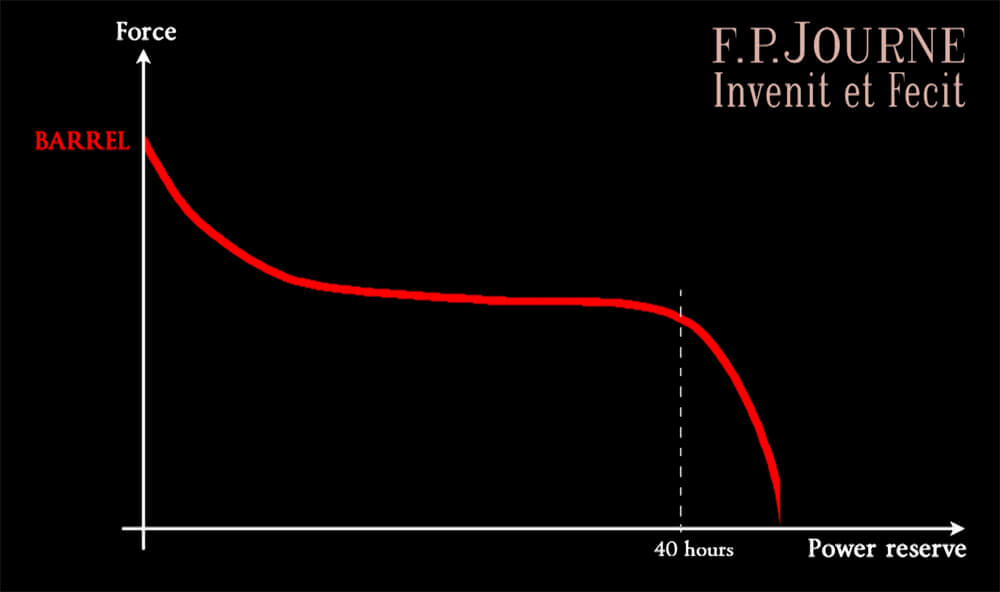
Prior to being installed within the movement, the balance wheel, with its hairspring fitted, must be poised to ensure it runs true. Thereafter, the balance wheel is installed within the watch and the movement is regulated by altering the effective length of the hairspring, courtesy of a raquette. Alternatively, if the watch is fitted with a variable-inertia balance, the rate is altered by adjusting timing weights located on the spokes or rim of the balance. This is fine when the mainspring is fully wound, however, as the mainspring becomes increasingly relaxed, the impulse pushing the balance wheel begins to diminish. As a consequence, the arcing trajectory of the balance wheel reduces (the amplitude). When the amplitude drops, the balance wheel oscillates more quickly. For a watch to be effectively regulated, the rate should ideally remain stable.
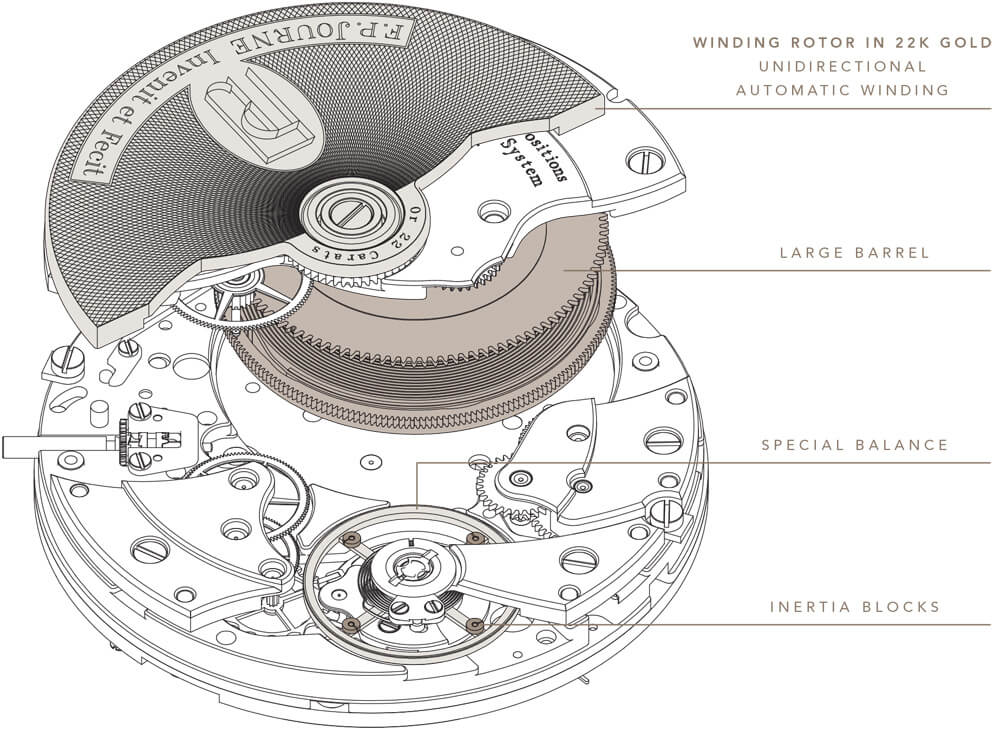
Image – Calibre 1300.3 – 18 K rose Gold (automatic movement)
The optimum amplitude of a balance falls within a prescribed range eg 270° – 310°. Bearing in mind that the balance wheel can only rotate so far, if the mainspring yields too much power, it can cause the impulse pin to force the horns against the banking pins, potentially causing damage to the impulse pin and/or the pallets. This is referred to as ‘banking’ and, once again, it can influence the amplitude of the balance, again adversely effecting rate stability.
Is rate stability the same as accuracy?
Strictly speaking, rate stability is different from accuracy. If a movement is regulated to +20 seconds per day and remains at +20 seconds until the mainspring is exhausted, the rate is clearly stable. However, if the rate of the watch is set to +20 seconds per day, it is certainly not very accurate.
A watchmaker may regulate a movement in six different positions and set the close to ± 0 seconds per day. This would deliver a high level of precision and assuming the rate stability is high, the watch would deliver consistent accuracy while it remains within the aforementioned ‘working range’.
Using constant force to deliver rate stability
So, if rate stability is important, how do we achieve it? I’ve listed a few types of system that have been used over the years.
Fusée and chain transmission
A fusée and chain transmission employs a cone, termed a fusée, and a chain connected to the barrel. As the mainspring unwinds, the barrel rotates, pulling the chain encircling the fusée. When the mainspring is fully tensioned, brimming with power, it pulls the chain for the narrowest part of the fusée where the torque needed to rotate the cone is greatest. As the mainspring becomes increasingly relaxed it pulls the chain from the widest part of the cone where less torque is needed to rotate it. A drive wheel at the base of the fusée transmits this constant force to the gear train.
Silicium
One form of constant force escapement that made the headlines a few years ago was a mechanism that featured a buckling blade made of silicium. The idea came from holding a train ticket between forefinger and thumb and flexing it. As the blade buckled backwards and forwards it delivered a uniform pulse of power to the balance. However, François-Paul Journe has regularly voiced his concerns about using silicium, a glass-like material, due to its inherent fragility. Moreover, Monsieur Journe has expressed concerns about the availability of replacement parts in years to come. Indeed, when creating a watch it is important to him that it can be repaired in 200 years time and this another reason why Monsieur Journe has said on several occasions that he would never countenance the idea of using silicium.
The remontoir d’égalité
François-Paul Journe, a man who has spent much of his life in the pursuit of superior chronometry, prefers the remontoir d’égalite as a means of delivering a consistent supply of power to the escapement.

Image – the remontoir d’égalite employed within the Tourbillon Souverain TN (2003)
In 1991, Monsieur Journe unveiled his first tourbillon wristwatch, signed F.P.Journe 11/91. This was the first example of a wristwatch featuring both a tourbillon and a remontoir d’égalite. This unique combination became a trademark of Journe, albeit one could argue the son of Marseille has many trademarks, including the Chronomètre à Résonance, Répétition Souveraine, Octa Calibre….

Image – First tourbillon wristwatch signed F.P.Journe 11/91 (1991)
The remontoir d’égalite employs an additional, or intermediate, wheel, positioned between the fourth wheel of the gear train and the escapement. Using a short duration spring, the intermediate wheel delivers a uniform pulse of power to the escapement every second. Unlike a regular mainspring that’s designed to harness lots of power, the short duration spring blade releases its energy over a comparatively short period.
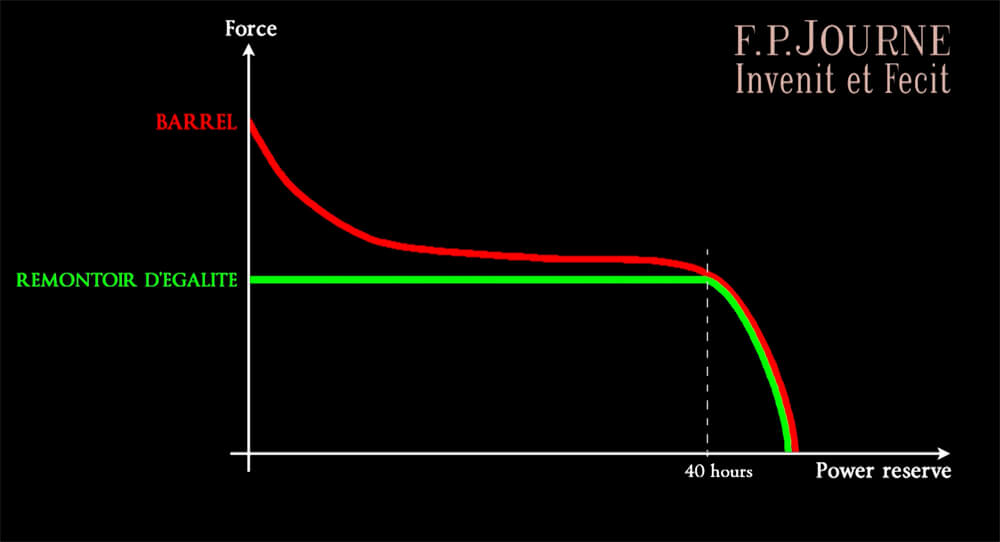
This approach mitigates any fluctuation in amplitude, culminating in superior rate stability. Monsieur Journe recognised that many tourbillons on the market suffer from poor rate stability, hence he has equipped every example of the Tourbillon Souverain with this constant force device, including the latest expression of this model fitted with a vertical tourbillon (calibre 1519).
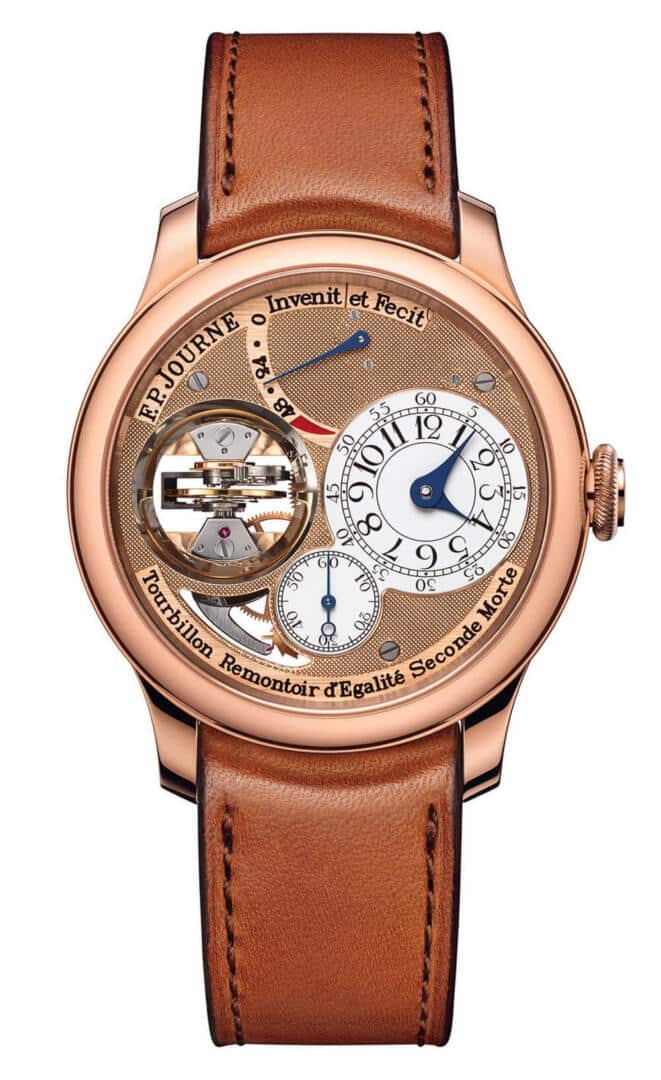
Image – Tourbillon Souverain (Reference TV) (2019)
Incidentally, from 2003, each version of the Tourbillon Souverain has been fitted with a dead-beat seconds, a complication that causes the seconds hand to advance with a discrete gait after a second has elapsed. The ‘natural deadbeat seconds’ device is mounted on one of the wheels of the remontoir d’égalite and functions without impairing the precision of the watch.

Image – the remontoir d’égalite employed within the Tourbillon Souverain TV (2019)
The Chronomètre Optimum – the Calibre 1510
In 2012, F.P.Journe unveiled the Chronomètre Optimum, another model equipped with a remontoir d’égalite. In this instance, the Maison chose to make the remontoir from titanium, a lightweight metal that consumes less energy when rotating.
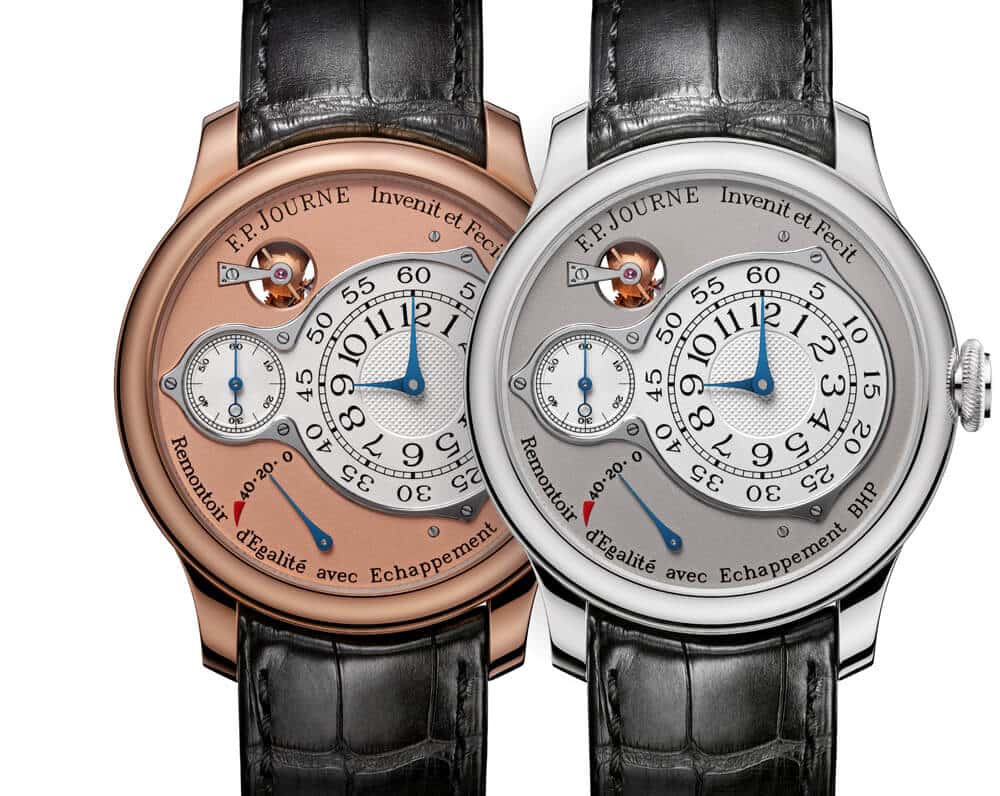
Image – Chronomètre Optimum featuring the Calibre 1510 (2012)
Journe also recognised that by using two barrels, containing two comparatively supple mainsprings, the power serving the gear train would be more stable than using one barrel alone. This approach was often employed on marine chronometers, horological instruments which needed to be highly precise.

Image – Chronomètre Optimum featuring the Calibre 1510

Image – Copyright © F.P.Journe – technical drawing of the ‘Echappement Bi-axial Haute Performance’ (Patent EP 2 487 546 A1) and remontoir d’égalité (Patent EP 1 528 443 A1)
In addition, Journe looked closely at the escapement, creating a hybrid of two systems: Breguet’s natural escapement and the Swiss lever escapement. Unlike Breguet’s natural escapement, the Journe system, the ‘Echappement Bi-axial Haute Performance’, is self-starting. Unsurprisingly, this mechanism was patented by Journe.
A problem that afflicts most watches is they require lubricants which inevitably deteriorate and dry out. Some brands use silicium components as they are friction-free, obviating the need for lubricants, however, as I pointed earlier Monsieur Journe is averse to this modern-day material, primarily because of its fragility.
Instead of having one escapement wheel, the Echappement Bi-axial Haute Performance (EBHP) system distributes the force between two wheels, reducing friction. Moreover, by employing an escapement devoid of lubrication, the movement can operate for 50 hours without loss of amplitude (the power reserve is 70 hours).
Journe also equipped the hairspring with a Phillips curve, improving isochronism and, by default, accuracy.
When will it end?
For centuries, scientists and horologists, including today’s watchmakers, have sought to make mechanical instruments which deliver superior chronometry. In the 18th century, John Harrison (1693-1776), an English clockmaker, invented the marine chronometer, an instrument used for navigating the seas. It was essential such instruments were precise as a lack of accuracy could lead to grave consequences.
Likewise, on the opposite side of the English Channel, Ferdinand Berthoud (1727-1807) was perfecting highly precise marine chronometers for the French Royal Navy. This period was similar to the 20th century Space Race with two superpowers seeking supremacy, albeit back in the 18th century, the goal was to precisely determine longitude at sea.

By equipping successive versions of the Tourbillon Souverain with the remontoir d’égalite as well as releasing the Chronomètre Optimum endowed with the EBHP system, François-Paul Journe has demonstrated he has an unwavering desire to advance the performance of his mechanical watches.
I suspect, there is a drawer in Monsieur Journe’s office containing drawings and prototypes of new mechanisms that promise even superior rate stability and chronometric performance. One thing is certain, the pursuit of horological advancement will never cease.