
Breguet Classique Quantième Perpétuel 7327
The Breguet Classique Quantième Perpétuel 7327 is an automatic wristwatch of the highest order. It honours Abraham-Louis Breguet and his ‘Perpétuelle’ watch of 1780, a pocket watch that featured an oscillating weight ‘à secousses’, a detail many horophiles now take for granted. This modern-day Breguet Classique harnesses all of the Maison’s exceptional talents and is endowed with a glorious guilloché dial. US-based Meehna Goldsmith shares her thoughts.

Watches and leap years
I can barely keep track of the hours in a day, let alone confidently remember the date and day of the week. “What’s the date today?” Someone, usually me, will ask, “Is it the 4th? The 6th?! When did that happen?” Odds in Vegas are better than me knowing when the next leap year arrives.
Certainly pinpointing the time, day, date, moonphase and where we are in a leap year cycle at any given time isn’t difficult. In fact, it’s just a device and internet connection away. But that’s beside the point. You can get from point A to B in a Kia Rio, but wouldn’t you rather take the trip in a Jaguar E-Type?

The perpetual calendar is a piece of mechanical witchery. While many ooh and ahhh at the whirl of a tourbillon, or the delicate choreography of the split seconds chronograph, I admire the subtle sophistication of the perpetual calendar. Not showy or brash, the perpetual calendar goes about its business with a minimum of motion and fanfare. You know the saying, “still waters run deep”? That’s the perpetual calendar; if you don’t stop to examine and contemplate, you will miss how sublime the mechanics really are.
Perpetual calendar
The English horologist Thomas Mudge takes credit for inventing the earliest pocket watch with a perpetual calendar in 1762. The complication was so hard to execute that it didn’t appear again until 1864, when Patek Philippe presented a pocket watch with the function. Still, the trick to miniaturise all those moving parts from a pocket watch into a wristwatch remained out of reach until decades later. Then, in 1927, Patek Philippe delivered the first perpetual calendar in a wristwatch, made to order for a wealthy collector. Breguet followed with their own rendition of a perpetual calendar wristwatch in 1929. So, when it comes to perpetual calendar wristwatches, Breguet belongs to the old guard.
Breguet Classique Quantième Perpétuel 7327
Breguet possesses one of the most enviable archives in the business from one of horology’s renowned superstars, Abraham-Louis Breguet. During the 1780s, Breguet presented his perpétuelle watches fitted with an oscillating weight. On these popular models, he often included a calendar mechanism. In addition, he began experimenting with his first guilloché silvered dials, which became a signature of the brand. Paying tribute to these historical pieces, Breguet offers the Classique Quantième Perpétuel 7327, a 21st century reinterpretation of the perpetual calendar framed in either 18K white or 18K rose gold.
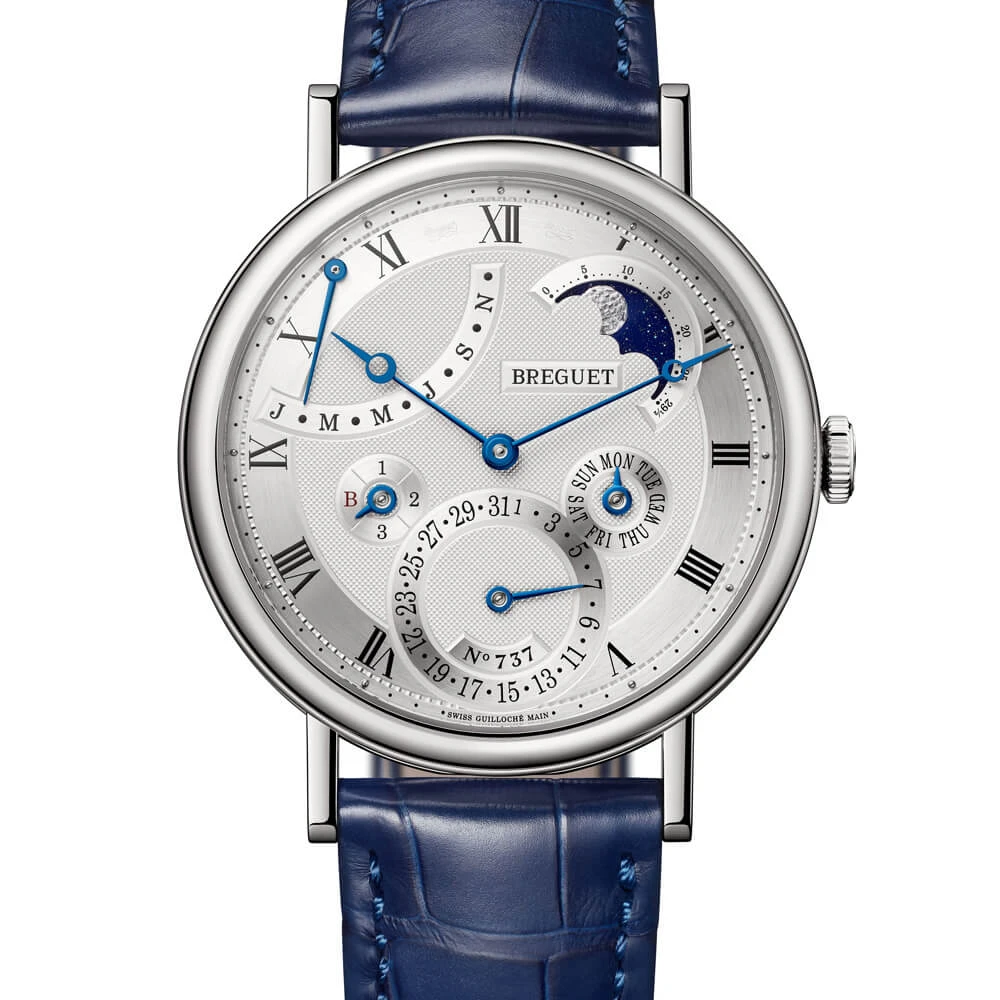
A perpetual calendar accomplishes the incredible feat of noting the day, date, day of the week, time, leap year cycle and moonphase without the need for correction before the 1st of March 2100. At that point, an adjustment of one day will keep you on track until 2200, and the same again at 2300. If the watch is kept continually running, of course. Let’s really think about what that means: a perpetual calendar complication ‘remembers’ 1,461 days. I can’t recall what I did this morning let alone what I’m supposed to do after lunch, tomorrow or even a week from now. When put in this perspective, the perpetual calendar is truly an incredible achievement.
Calibre 502.3.P
For the Breguet Classique Quantième Perpétuel 7327, the Maison selected the Calibre 502, equipped with an additional calendar mechanism. In total, the movement comprises more than 294 parts. Even with the addition of the mechanism, the 502.3.P movement remains one of Breguet’s thinnest, at just 4.5mm thick. The open barrel and off-centre rotor were design choices made to keep the profile as svelte as possible. Fully wound, the rhodium-plated automatic movement will run autonomously for 45-hours.

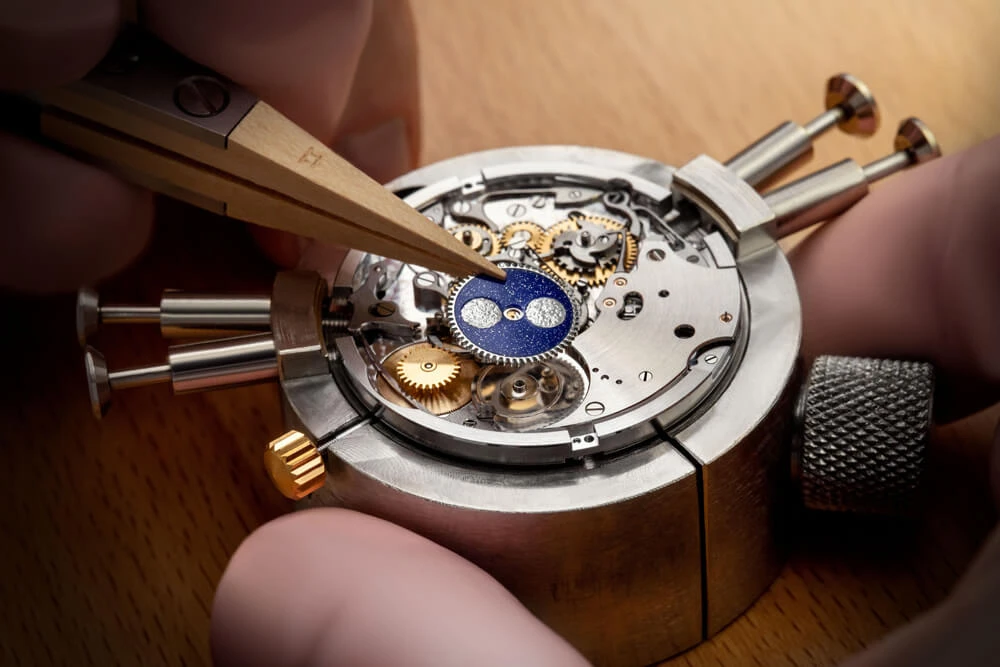
While Breguet honours horological tradition, it is also at the vanguard of cutting-edge of technology. The majority of balance springs on the market are composed of metal alloys, whose length can fluctuate due to magnetic fields and temperature changes, potentially impairing precision. Instead, this movement incorporates a flat silicon balance-spring and an inverted straight-line escapement with silicon horns. Unlike metal, silicon is resistant to corrosion and non-reactive to magnetic fields, theoretically making it a construction that offers more precise timekeeping.
Guilloché dial
Equally, if not more important than the movement, are the aesthetics and layout of a perpetual calendar. If the dial is cluttered worse than a kindergartner’s room, then the whole purpose of the complication is defeated. I certainly don’t want to go on an eye-straining treasure hunt to find out if it’s Thursday or not.

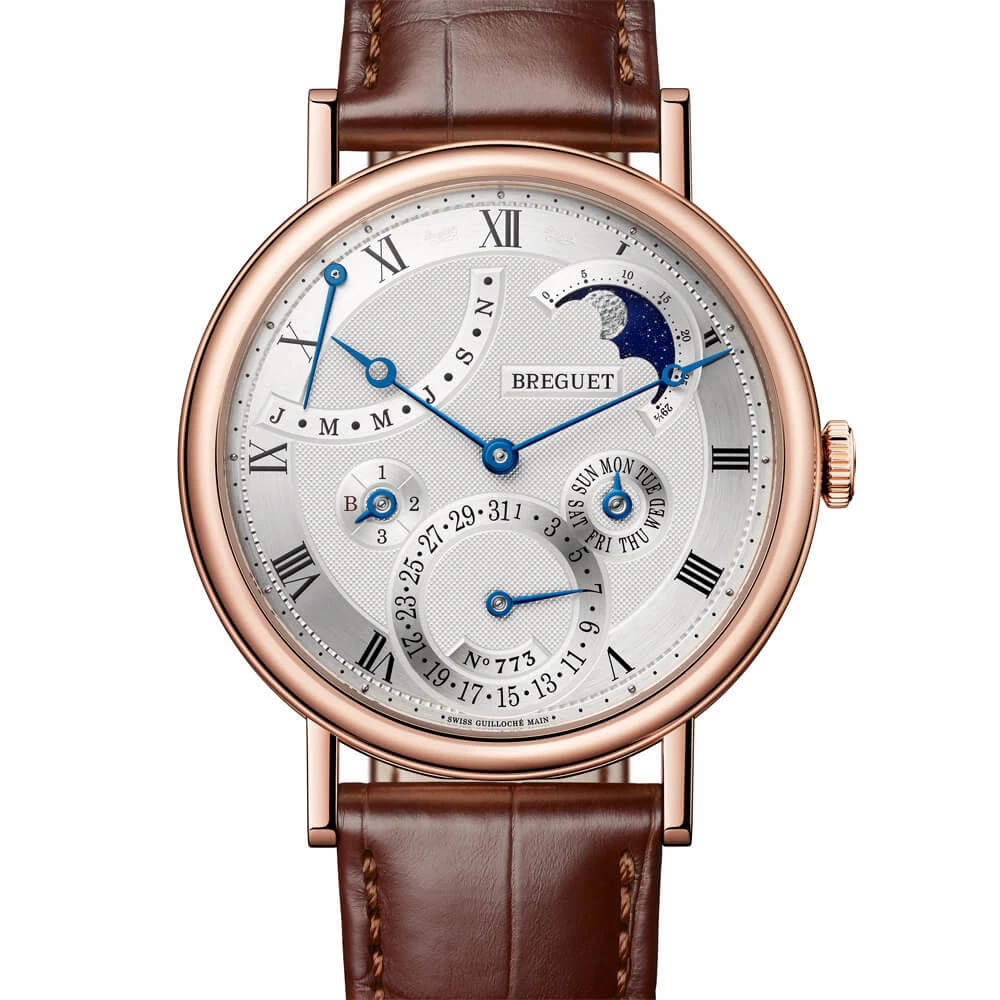
The Breguet Classique Quantième Perpétuel 7327 is a neoclassical study in balance and elegance. The top half of the silvered gold dial features a retrograde months of the year swooping between 10 and 12 o’clock, balanced out by the moonphase arcing around 1 and 2 o’clock. The bottom half is a trio of circles representing the day of the week, date and leap year cycle. The whole composition is anchored by those handsome Breguet numerals in black lacquer encircling the dial. Adjustments for the indications are easily and quickly done with a corrector stylus: ‘the day at 4 o’clock; the different moon phases between 4 and 5 o’clock, the date at 6 o’clock and finally the month and the year at 9 o’clock. The time is set via the crown located at 3 o’clock’.

Just as a cake isn’t complete until it’s frosted, neither is a Breguet watch ready to be delivered until it’s decorated. The gold rotor, seen through the sapphire case back is hand-engraved on a rose engine with a circular barleycorn pattern, while the bridges feature Côtes de Genève and chamfered edges. The dial also holds a bevy of delights, from the Clous de Paris hobnail pattern turned by hand on a rose engine, and moon phase with its hand-hammered surface, to the spangly blue lacquer of the star-studded sky. Fans of the brand will recognise the traditional eccentric ‘moon’ tip watch hands in blued steel, and spot the ‘secret’ Breguet signature between 11 and 12 o’clock, as well as between 12 and 1 o’clock. Abraham-Louis first introduced this in 1795 as an anti-counterfeiting measure.
Breguet Classique
The Classique Quantième Perpétuel 7327 comes in a perfectly sized 39mm case. While the 18K white gold model is paired with a midnight blue strap, the rose gold model is complemented with a brown strap – both presented on folding clasps.

I honestly think the Breguet Classique Quantième Perpétuel 7327 is one of my favourite perpetual calendars on the market. With its gorgeous curves, different decorating techniques and clean layout, it demonstrates Breguet at its finest. Gazing into the dial gives a lovely snapshot of time. Proving that almost 100 years later this longstanding producer of perpetual calendar wristwatches is still very much one of the best exponents of Haute Horlogerie.

Further reading
Technical specifications
- Model: Breguet Classique Quantième Perpétuel 7327
- Reference: 7327BB/11/9VU (18-carat white gold) / 7327BR/11/9VU (18-carat rose gold)
- Case: diameter 39 mm; height 9.13 mm, water resistance 3ATM (30m), sapphire crystal to the front and exhibition case back.
- Functions: hours, minutes, perpetual calendar (day, date, retrograde month, leap year), moon phases
- Movement: Calibre 502.3.P, self-winding movement, frequency 21,600 vph (3Hz), power reserve 45 hours
- Strap: blue/brown alligator leather strap with matching folding clasp
- Price: £73,100 (RRP as of 10.5.2023)