
Laurent Ferrier Classic Moon Watch Review
The Laurent Ferrier Classic Moon was recently launched at Watches & Wonders 2024. Perpetuating the Maison’s reputation for crafting exquisite expressions of Haute Horlogerie, this latest model unites an annual calendar with a moon phase and imparts meaning in an intelligible and elegant format. Mark McArthur-Christie shares his observations about this fine watch, crafted in Geneva, once home to John Calvin.

Laurent Ferrier Watch
In Geneva’s Parc des Bastions stands the appropriately solid Reformation Wall. At its centre is John Calvin, flanked by fellow heavyweight theologians Theodore Beza, Guillaume Farel and cheery old John Knox.
It’s doubtful any of these men would have approved of the goings on at Plan les Ouates, just a 20 minute ride away on the No 18 tram. In fact, given Calvin’s view that “…everything which our mind conceives, meditates, plans and resolves is always evil…” one can see him struggling a bit with the concept of Haute Horlogerie. Yet, ironically, Calvin – known for being perpetually short of time and incapable of meeting almost any deadline – could have used a good watch.

Laurent Ferrier Classic Moon – two references
One wonders what he’d have made of Laurent Ferrier’s latest offering. Almost everything about it – from the price to the materials it’s made from – would no doubt have caused Monsieur Calvin to have a full-on meltdown. It’s a shame, as the new Classic Moon might have gone a little way to persuading him that not all man’s works are quite so intrinsically sinful. Although it’s not technically ‘the Classic Moon’ as, like Mars, Laurent Ferrier has two – one in stainless steel, the other in 18ct gold.

Laurent Ferrier Classic Moon in steel
First, the stainless steel-cased watch offers a petrol blue dial with an opaline finish you’ll see on other Classics from LF. The date numerals around the dial edge are picked out in pastel blue – a blue-on-blue that’s easier to read than you might think – with a centrally-mounted date pointer and a colour-matched chemin de fer. The exception is the last day of the month (well, the ones ending in ‘31’) where Laurent Ferrier has used something closer to an azure blue.
Handswise, as you’d expect, you get narrow spears for hours and minutes and a simple baton for seconds. On the blue-dialled model, all three – hours, minutes and seconds – are white-lacquered, white gold. The hands work well with the slim, white Roman numerals marking the hours. I’ve often wondered why one would go to all the trouble of sourcing and making a gold hand and then painting it. Answers on a postcard…
This version gets a dark grey, hand-sewn nubuck strap lined with Alcantara. The pin buckle is stainless steel, matching the case.
Laurent Ferrier Classic Moon in 18K 5N red gold
The gold cased watch is very different in feel, with a vertically brushed, satin silver dial. The minute track and date markers here are in petrol blue with the date pointer and 31st picked out in cherry red. Again, narrow spear hour and minute hands with a baton seconds, but this time in Ruthenium-treated white gold.
Here, you get a calf strap, also hand-stitched and Alcantara lined, with an 18k red gold pin buckle.
Laurent Ferrier Classic Moon – different and similar at the same time
Despite the only differences being dial and hand colours, they’re poles apart in terms of style. The ‘classic’ Classic is the gold cased watch. The way the case and dial work together – and that standout red date pointer – are pure old-school Geneva. The stainless watch with its petrol blue dial and azure blue pointer, by contrast, gives a far more modern feel.

Interestingly, in both cases, it’s the date pointer’s colour that really clinches the tone of the design. This is despite the minute track typography being common to both versions. The font is thoroughly contemporary with open 6s and 9s.

Laurent Ferrier Classic Moon case
The two watches share the same case design – 40 mm diameter and just under 13 mm thick – with slim, curved lugs that snug the watch down on your wrist. If ‘pebble case’ isn’t a horological term, it should be. The rounded, smoothed Classics are certainly candidates for it. More smooth edges when it comes to the crown – an onion crown that matches the case design.
Sharing the case edge with the crown are two recessed pushers. Practically, you correct the day display with the pusher at 10 and the second corrector between 8 and 9 allows you to set the moon phase complication – more of that later.
The pushers won’t see a lot of action thanks to the movement’s annual calendar complication. You’ve nothing to do for most of the year as the calendar copes happily with 30 or 31 day months. The only work on your part happens each year on the 1st March, when you’ll need to set the watch depending on the number of days in February. You can keep track of the days of the week and the month in the two bevelled edge windows at the top of the dial. You can’t blame predestination for turning up late now, Mr Calvin.
Laurent Ferrier LF126.02 calibre
Flipping the pebble over, there’s a sapphire case back so you can enjoy the movement; the new LF126.02 calibre.
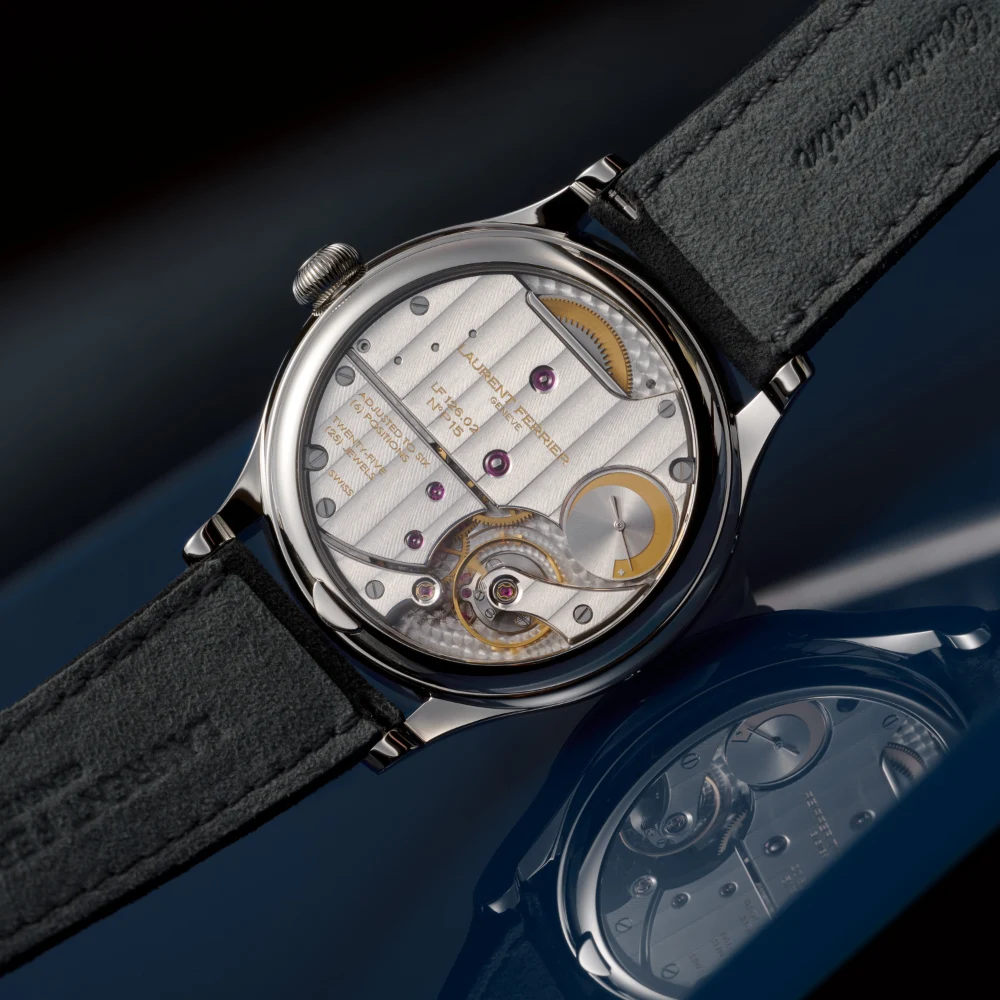
If you’re accustomed to expressions of Haute Horlogerie, the LF126.02 calibre may come as a bit of a surprise. Rather than the more usual blizzard of bridges and edges there are just two large movement bridges, a balance cock and a small escapement micro-bridge. This isn’t to say you’re getting stinted on finishing, mind. Each bridge is decorated with Rhodium-treated Côtes de Genève. The main plate is circular grained, the edges and interior angles are hand-bevelled and polished, as is each recessed screw head.
Visually similar to the Maison’s LF 126.01 calibre (both movements have annual calendar complications), the new movement (with 266 components) gets two more jewels and 30 more parts. The firm has revised and improved more than 20 components as well. The new movement is just over 31.5 mm diameter and 6.3 mm thick and the balance beats at a brisk 21,600 vph (3 Hz).
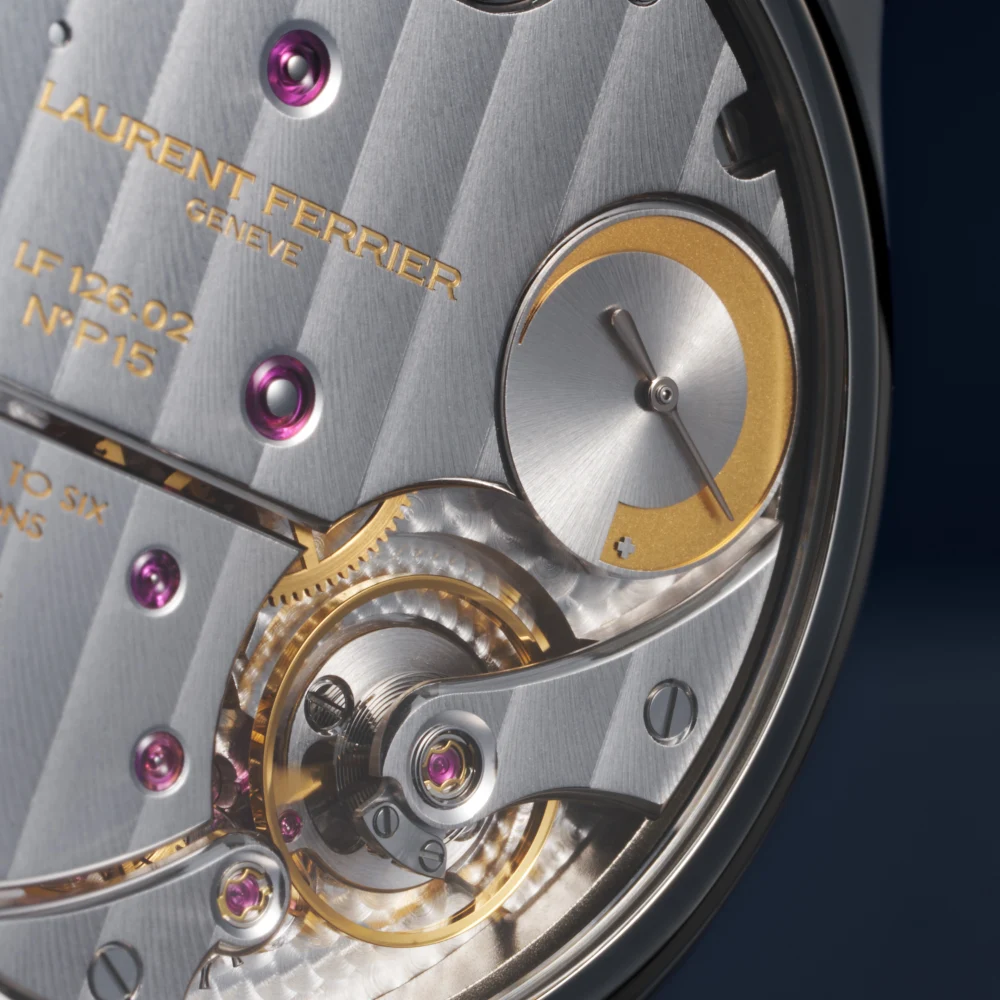
Like it’s predecessor, the LF126.02 calibre has an 80 hour power reserve and, as you can see from the absence of a rotor, you have to put the winding effort in yourself. That’s going to be a pleasure with the proper-sized, onion crown, the long-blade ratchet pawl (you can just see it at the top of the movement) and the satisfaction of watching the power indicator work its way around its sub-dial on the movement’s large barrel bridge. In fact, the whole thing has that tactile, meshing-of-cogs sense you get from winding a serious, top-end pocket watch.
Then, at the base of the dial, we’ve saved the best until last. If you’ve already seen a few Laurent Ferrier Classics, you’ll spot that the small seconds display now has an extra job – housing the moon phase complication.
Laurent Ferrier Classic Moon – the moon phase complication
There’s something gloriously daft about a moon phase complication. Unless you’re in the habit of hanging out in observatories or you’re Professor Brian Cox, you almost certainly don’t need one and, even then, there’ll be an app. But that’s exactly what makes them wonderful. They’re a sort of horological Everest; you do it for no other reason than because it’s there and you can. Chapeau, Laurent Ferrier; we need much more of this snook-cocking at utility.
Laurent Ferrier hasn’t gone down the easy route for its first watch with a moon phase complication. Rather than simply using a basic precious metal disc, they’ve chosen to make it from aventurine glass and translucent enamel. The finishing alone is enough to give you watchmaking kittens.

It would have been simple(ish) to stamp a brass disc, paint on a moon or two, mount it on the pinion and be home in time for tea and medals. But no. At the centre of the small seconds dial is the dark blue Aventurine moon disc. The moon and the stars are hand-engraved before the details are filled with hand-applied white paint. Another seriously steady hand then has the job of filling the moon and stars with Super-LumiNova before high temperature firing the disc. You’d think after that you’d let the craftsman call the job a good ‘un and slope off to the nearest bar. Nope. They then engrave the lume coating (bear in mind how friable lume is) to dig minute (as in ‘small’ rather than a new astronomical complication) craters on the moon’s surface. The disc then gets a translucent petrol blue enamel applique. One suspects that a really close look would probably reveal Neil Armstrong’s footprints.
On top sits the running seconds hand – a miniature baton pointer in white-lacquered or ruthenium-treated white gold (depending on which Classic you’ve chosen). The lunar phases of the Northern Hemisphere are opposed to the Southern Hemisphere moon, as indicated by the N and S markers between the small second markers.
All that work in an area considerably smaller than an old ½ penny coin. Making a moon phase ain’t easy. Adding it to an existing movement without turning it into a tuna tin is even harder. Laurent Ferrier has not only done it but produced two very different, equally elegant watches with dissimilar characters, both of which belie the level of watchmaking technology inside each case.
Laurent Ferrier Classic Moon – closing remarks
As well as the statues on the Reformation Wall, one of the tenets of Calvinist thought is inscribed. It simply says ‘Post Tenebras Lux’ or ‘after darkness, light’. Maybe, as well as sorting out his timekeeping, perhaps a decent watch might finally have persuaded Calvin about the goodness of the works of man.
Further reading
Technical specifications
- Model: Laurent Ferrier Classic Moon
- Reference: LCF039.R5.G3N (18K/750 5N red gold)
- Reference: LCF039.AS.C1WC (stainless steel)
- Case: diameter 40 mm, height 12.90 mm, water resistance 3 ATM (30 metres), sapphire crystal to front; exhibition caseback.
- Functions: hours, minutes, small seconds, pointer date, annual calendar, moon phase, power reserve zone indicator on the movement side
- Movement: Calibre LF126.02, hand-wound movement, frequency 21,600 vph (3 Hz), 25 jewels, power reserve 80 hours.
- Strap: dark grey Nubuck or Brown Calf, hand-sewn, tone-on-tone Alcantara lining
paired with a pin buckle in stainless steel or 18K/750 5N red gold - Price: 18K/750 5N red gold – 80,000 CHF (excluding tax) – RRP as of 18.5.2024
- Price: stainless steel – 70,000 CHF (excluding tax) – RRP as of 18.5.2024