
Aventi Enygma Opal PMT Watch Review
The Aventi Enygma Opal PMT is the latest creation from the high-end watch brand known for embracing new materials, avant-garde design and high complications. Angus Davies explores the composition of this model and discovers a mesmerising multi-faceted timepiece suffused with numerous specks of everchanging colour.

The evolution of materials
Archaeological excavations suggest that humankind began making tools and weapons from bronze around 3300 BC. It was discovered that bronze, an alloy of tin and copper, was far harder and more durable than copper alone. Throughout the world, various civilisations began using bronze at different times. For example, Greece started using bronze before 3000 BC, while the British Isles began using the alloy circa 1900 BC.
In 1791, William Gregor, a son of Cornwall, a clergyman and keen mineralogist discovered titanium. This chemical element is light, strong and non-magnetic. Later, scientists discovered that titanium could be alloyed with other elements to deliver additional benefits. For example, Grade 5 titanium is an ‘alpha-beta alloy’ composed of 90% titanium, 6% aluminium and 4% vanadium. This latter alloy is much stronger than pure titanium, while remaining incredibly light.

The history of opals
There are references to opals dating back to the Romans. Its name is derived from the Latin word Opalus. In fact, in 77 AD, Gaius Plinus Secundos, also known as Pliny the Elder, referred to opals in his written works ‘Naturalis Historia’. Opal stones were discovered in Australia in the late 1880s and are now considered the country’s national stone. Indeed, Australia is the largest source of opals today. Opals are the product of a complex geological interaction between water and silica-rich materials, occurring in stable zones almost free of tectonic activity.
Formed of silica spheres, opals refract light and exhibit a myriad of hues. Indeed, it is the size, uniformity and arrangement of the silica spheres that influence how they appear. So far, so desirable. However, opals are not particularly robust. On the Mohs scale, opals have a low Mohs hardness of 5.5 – 6.5 (diamond has a Mohs hardness of 10), making them susceptible to damage. The risk of breakage is further heightened when cutting and polishing opals.

Opal PMT – a new generation
Eager to capture the beauty of opals, especially their everchanging appearance, Aventi has conceived its own case material, Opal PMT. Formed of 80% silica and 20% proprietary polymer, Opal PMT – Polymer Matrix Technology – is a fascinating substance.
Similar to the marriage of tin and copper or the idea of adding aluminium and vanadium to titanium, Opal PMT proves far stronger than natural opal, overcoming its inherent fragility. Moreover, due to the composition of the material, the appearance of each case will be slightly different, conferring a degree of individuality often lacking with many mass-produced items.
However, beyond the allure of the chosen case material, the Aventi Enygma Opal PMT delivers a prepossessing appearance as well as an array of wearer benefits. Allow me to elaborate.
Aventi Enygma Opal PMT dial
Like its sibling, the Aventi A15 Wraith Saphite™ Ice Blue, the dial of the Enygma A18-01 Opal PMT is openworked, affording views of the movement below. However, its appearance is very different to its older brother. The dial is what Aventi calls a Stardust Dial – a skeletonised, luminescent white plate covered in BGW9 Super-LumiNova that accentuates the multicoloured flecks gracing the Opal PMT case. The white plate emits a vivid cyan colour in dim light.

The dauphine-shaped hour and minute hands are formed of sapphire crystal and outlined in matching Super-LumiNova. A tourbillon, located in the lower region of the dial, rotates 360° every minute and uses a luminescent hand, positioned above the cage to indicate the running seconds.

A minute track frames the dial, aiding assimilation of the indications. Throughout the dialscape, Aventi has combined black and white tones while simultaneously introducing soupçons of cheery red. Beyond the upper dial plate, the wearer is indulged with views of the escapement, regulating organ, motion works, keyless works, etc. I suspect this visual spectacle will pique the interest of many self-respecting horophiles.

Aventi Enygma Opal PMT case
It is very clear that within the corridors of Aventi’s HQ, the word ‘ordinary’ is seldom heard. The brand doesn’t countenance the idea of perfunctory design or plain styling. This is manifest in the Opal PMT case. Beyond its cutting-edge composition, the case features . All the edges and facets have been precisely machined and painstakingly polished. The making of this precious housing is clearly very protracted – almost one year from its inception, as it somehow replicates what nature does in 30 million years. A feat so complex and labour-intensive that the company can make only 10 cases per year.

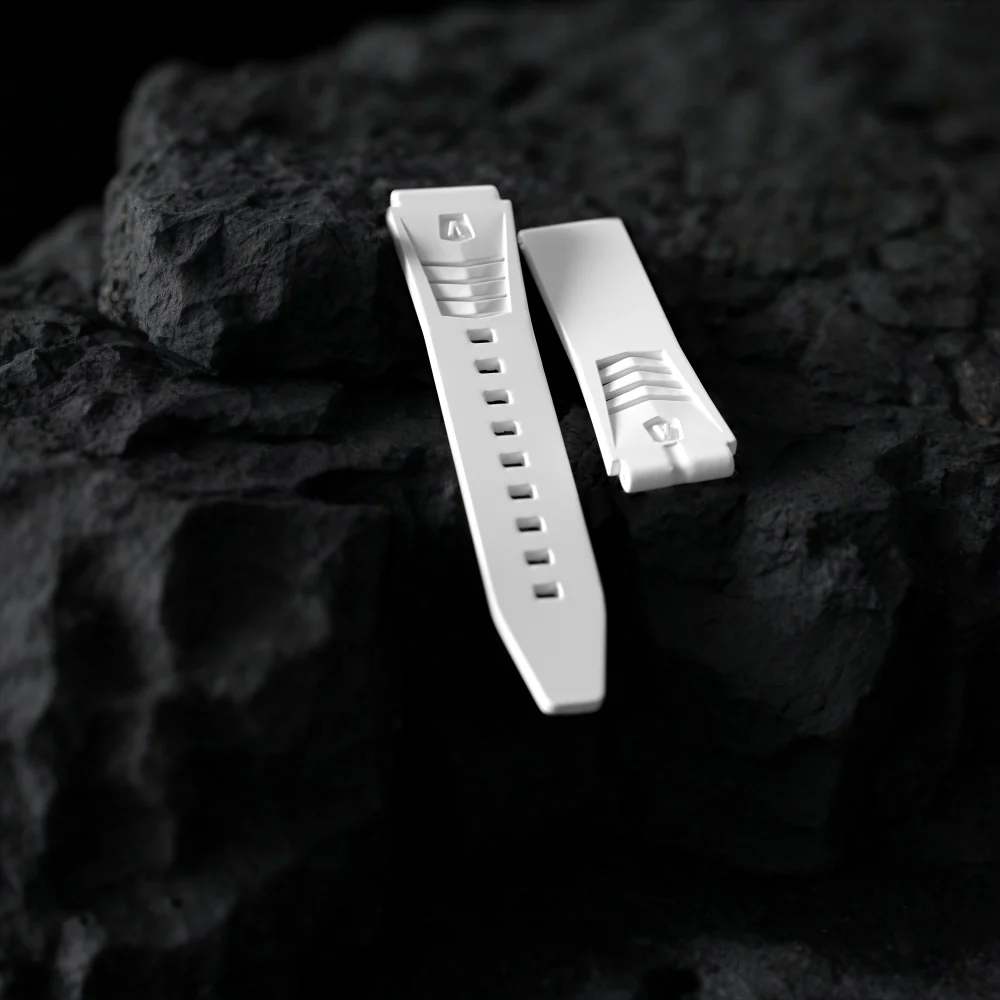
Measuring 44 mm x 49 mm, with a thickness of 14.5 mm, the Aventi Enygma Opal PMT case is generously proportioned, conferring extraordinary wrist-presence. However, while the watch is no shrinking violet, it wears smaller than its stated dimensions would suggest, courtesy of the ergonomic strap design. Formed of fluorocarbon-based synthetic rubber (FCR), the strap is integrated into the case, sidestepping the use of conventional lugs. The strap features vents to aid cooling and affixes to the wrist with a black DLC clasp.

Part of the charm of this model is the way it juxtaposes the opaque appearance of the Opal PMT case with the transparency of the sapphire crystals, positioned front and rear. Moreover, the see-through design of the dial and movement indulges the wishes of those horological voyeurs keen to see naked components usually hidden from view. While this watch may polarise opinion with its bold, neoteric styling, it could never be described as boring. Quite simply, this is a timepiece for affluent freethinkers who subscribe to a nonconformist approach to life.
Aventi GT-01S caliber – Grade 5 titanium
When it comes to a nonconformist approach, the Aventi GT-01S caliber also breaks with convention. Indeed, the regular diet of circular-grained mainplates, rhodium treated brass and Côtes de Genève is set aside for a decidedly different execution.
The mainplate echoes the shape of the case as horological etiquette dictates. Aventi could have made life easier by using a circular movement but this would be considered bad form (pun intended). The movement is made of the aforementioned alloy, Grade 5 titanium. This alloy is corrosion resistant, lightweight, non-magnetic and very strong; all useful attributes when making watches.
The main benefits of making the mainplate and bridges from Grade 5 titanium is that they are stiff and free of flex. This rigidity mitigates any unwanted play in the gear train which could impair efficiency or compromise reliability. While using this material makes much sense, it does come with a couple of disadvantages. Firstly, Grade 5 titanium is far costlier than brass. Secondly, it is far more challenging to machine.
Milling Grade 5 titanium using a CNC (Computer Numerical Control) machine is more protracted due to its hardness. For example, milling the alloy creates much friction, wearing out CNC tools more readily, heightening costs. Also, when milled, Grade 5 titanium can generate much heat that can adversely affect the alloy and may even lead to fires. To avoid this happening, milling speeds are significantly reduced which obviously extends production time, again increasing costs.
Despite the additional expense and technical obstacles, Aventi has chosen to use Grade 5 titanium, evidently keen to capitalise on the benefits it affords.

Aventi GT-01S caliber – finishing
The mainplate and bridges are adorned with traditional perlage; however, rest assured the presentation of this form of circular graining is unequivocally modern and unquestionably Aventi. Once the overlapping pearls are applied to the surfaces of the mainplate and bridges, they are suffused with DLC, imbuing the parts with a stealthy appearance. Upholding fine watchmaking practise, the movement features blued screws.

Aventi GT-01S caliber – tourbillon
The Aventi Enygma Opal PMT is equipped with one of the most coveted high complications, the tourbillon. This mechanism was patented by Abraham-Louis Breguet in 1801.
Breguet identified that gravity adversely affects the behaviour of the escapement and regulating organ. His solution was to place both the escapement and regulating organ within a rotating cage, ameliorating any positional errors. As mentioned earlier, the cage fitted to this movement makes one full revolution (360°) every 60 seconds.

Tourbillons are incredibly complex to assemble, heightening the risk of human error as well as increasing production costs. In this instance, the number of components used within the model’s tourbillon has been reduced to just 18 parts. By adopting this simplified approach, Aventi states that it ‘leads to heightened precision and reduced susceptibility to assembly-related variations that can affect the performance of tourbillons in conventional watches’.

Aventi has also designed the Enygma Opal PMT. While some tourbillons need to be handled with kid gloves, the movement within this watch is shock-resistant to 5000 G and can tolerate magnetic fields up to 2000 Gauss.
Aventi GT-01S caliber – more highlights
The Aventi GT-01S caliber is able to run autonomously for over 100 hours. In addition, the watch has a stated accuracy of ± 4 seconds per day, a figure that can even embarrass some chronometers.
With most watches, the rate is altered using an index-regulated system. Moving the index, towards or away from the stud, alters the effective length of the hairspring, making the watch run faster or slower.

However, the Aventi GT-01S caliber is endowed with a variable-inertia balance (aka free-sprung balance). With this type of regulation system, the length of the hairspring is fixed and the rate is altered by moving inertia weights fitted to the balance wheel (see the C-shaped masselottes fitted to the spokes of the balance wheel). This approach delivers superior precision and, should the watch be subjected to a shock, is less likely to need remedial regulation.
Aventi Enygma Opal PMT – closing thoughts
There is much wisdom in respecting traditions and upholding tried and tested craftsmanship; however, as history has shown, there is also virtue in experimentation and innovation.
Aventi has looked beyond regular case materials such as stainless steel and gold, electing to embrace new compositions that deliver something fresh and characterful. Indeed, the Aventi Enygma Opal PMT is a striking watch that wears a different suit of clothes, making it stand out from the crowd. The case material delivers the bewitching appearance of opal but without its inherent fragility. Furthermore, similar to Haute Cuisine, the Aventi not only looks good, it is packed with flavour and cooked to perfection. The movement is modern, yet encompasses some flourishes of traditional watchmaking know-how, while the tourbillon and variable-inertia balance grant an impressive degree of precision. Quite simply, this watch delivers both style and substance in abundance.
The luxury marque has demonstrated there is much wisdom underpinning its pursuit of innovation, leaving me to ponder, what’s next for the brand that has already brought us Saphite™, Tyamine™ and now Opal PMT?
Further reading
Technical specifications
- Model: Aventi Enygma Opal PMT
- Case: Opal PMT; dimensions 44 mm x 49 mm; height 14.5 mm; water resistance 5 ATM (50 m).
- Functions: Hours, minutes; small seconds on tourbillon
- Movement: Calibre GT-01S; hand-wound movement; frequency 21,600 vph (3 Hz); power reserve 105 hours
- Strap: Polar White FCM rubber strap with black DLC clasp
- Availability: by allocation only