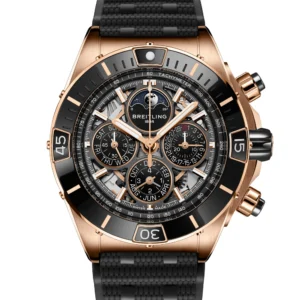
Breitling 140th Anniversary Limited Editions Watch Review
The Breitling 140th Anniversary Limited Editions comprise three references: the Premier B19 Datora, the Navitimer B19 and the Chronomat B19. All models feature the new Breitling Manufacture Caliber B19, a self-winding movement endowed with a chronograph and a perpetual calendar. Angus Davies explores the watch brand’s rich history and its expertise in making chronographs before examining the composition of each new release.

Image – Breitling 140th Anniversary Limited Editions
Breitling – 140 Years of Firsts
The watch industry employs vast numbers of young marketing professionals. Highly motivated and fuelled on brightly coloured energy drinks, these effervescent individuals have a predilection for hyperbole, sometimes employing superlatives with total abandon.
Once upon a time, I was one of these young marketing professionals, hence I’m privy to the tricks of the trade. Indeed, as a cynical fiftysomething I can see beyond mere puffery and discern whether said superlatives are justified or not.
Breitling, the Swiss watch brand, was founded in 1884 and its achievements are many. There is little reason for amplification, Breitling’s history is punctuated with genuine achievements, something the brand has chosen to mark this year with its ‘140 Years of Firsts’ celebrations.

Image – Breitling Heritage Exhibition
Breitling – precision timekeeping instruments since 1884
Returning to 1884, Léon Breitling opened his inaugural atelier in Saint Imier, a small Swiss town nestling between the mountains of Chasseral and Mont-Soleil. From the outset, the eponymous company focussed on measuring time, crafting a series of pocket chronographs. These precise timekeeping instruments featured a variety of measurement scales, indicating speed (tachymeter scale), heart rate (pulsometer scale) and distance/sound (telemeter scale).

Breitling – Vitesse pocket watch (1906)
A company that has always been at the vanguard of chronograph technology, Breitling created the ‘Vitesse’ pocket watch in 1906. Capable of measuring speeds up to 150 km/h, the timing instrument was used by the Swiss police force and was instrumental in the issue of the nation’s first speeding tickets.
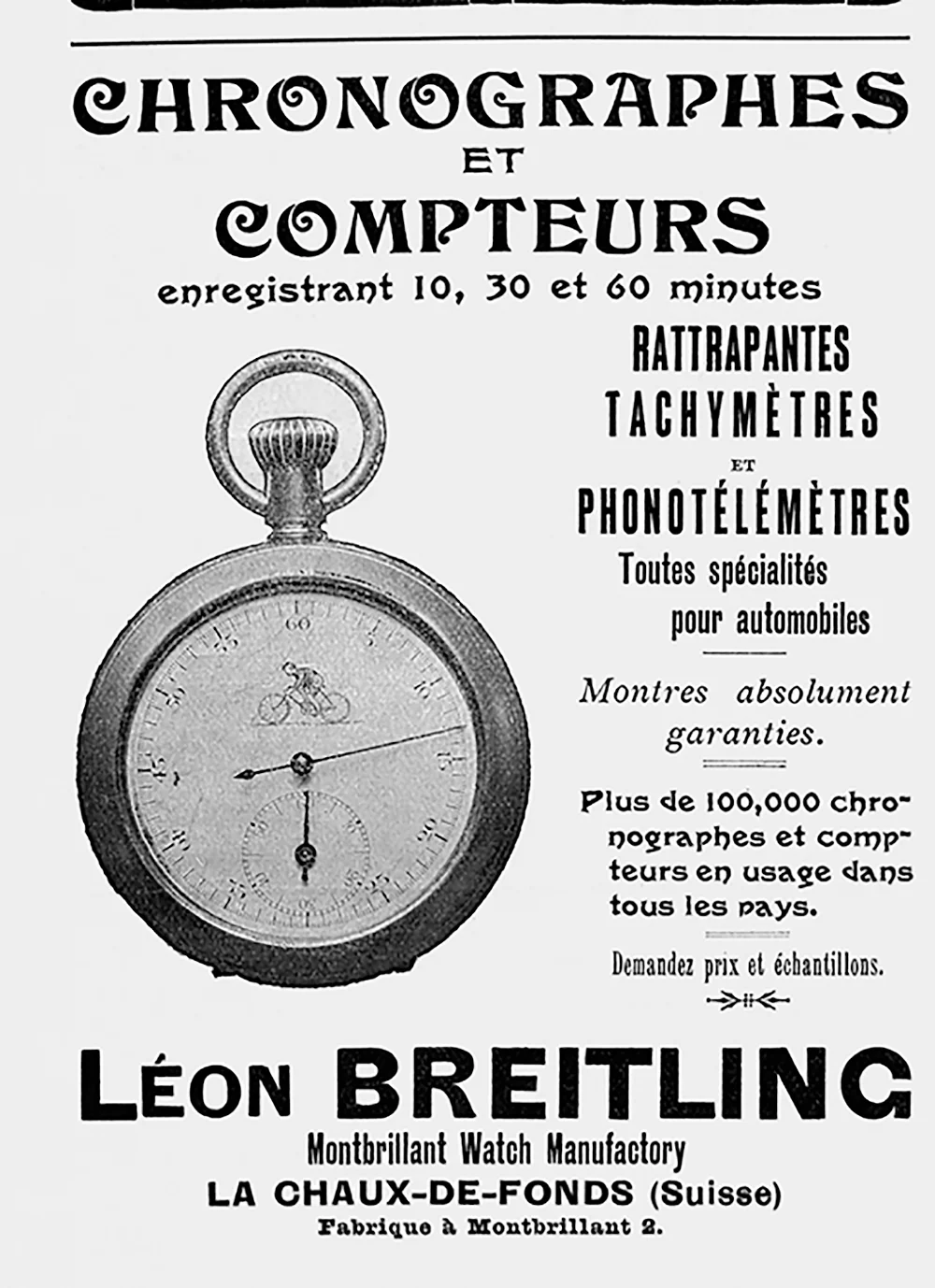
Image – Breitling advert (circa 1910)
First wrist-worn chronograph (1915)
Following in his father’s footsteps, Gaston Breitling joined the family business in 1914. Recognising the widespread switch from pocket watches to wrist watches, he launched the first wrist-worn chronograph (1915) with an independent pusher at 2 o’clock; an idea Breitling patented. This pusher allowed the wearer to start, stop and reset the chronograph mechanism. The crown at 3 o’clock remained independent, used for energising the mainspring and adjusting the time indications. Highly intuitive to use, Gaston’s invention was groundbreaking at the time.

Image – one of the first chronographs with an independent pusher at 2 o’clock (circa 1915) – created by Gaston Breitling
Willy Breitling takes the helm (1932)
In 1932, Willy Breitling took over the reins of the family business, succeeding his father, Gaston, who passed away in 1927.
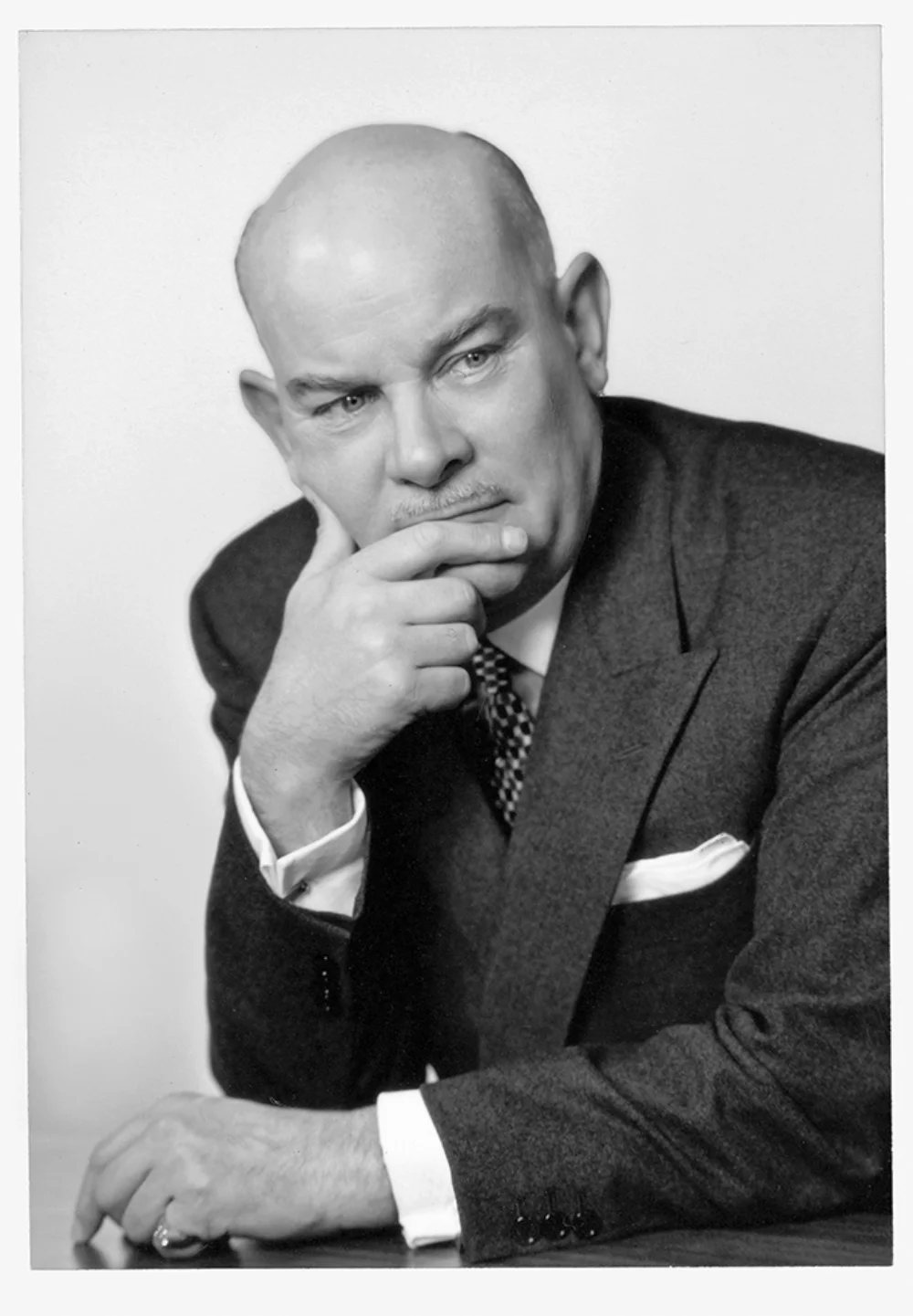
Image – Willy Breitling
Willy was only 19 years of age when he assumed control of the company. Two years later, in 1934, he invented a wristworn chronograph with a second independent pusher at 4 o’clock. This latter pusher reset the chronograph mechanism and provided the blueprint for future chronographs that most brands continue to use today.

Image – Breitling Premier Duograph Ref.762 fitted with the Caliber Venus 179 (1943)
Back in the late 1960s, several brands were engaged in the watchmaking equivalent of the ‘space race’, namely, to create the first self-winding chronograph. Breitling, Buren, Dubois-Dépraz and Heuer formed an alliance to develop an automatic chronograph calibre under the codename ‘Project 99’. Despite being rivals, Willy Breitling and Jack Heuer enjoyed a good working relationship, something that no doubt expedited the development process. In 1969, Project 99 was completed. Breitling rebranded the pioneering calibre as the ‘Chrono-Matic’, while Heuer named the movement the ‘Caliber 11’. This seminal work led several rival brands to create their own automatic chronograph movements; however, Breitling and its partners are often cited as being the first.
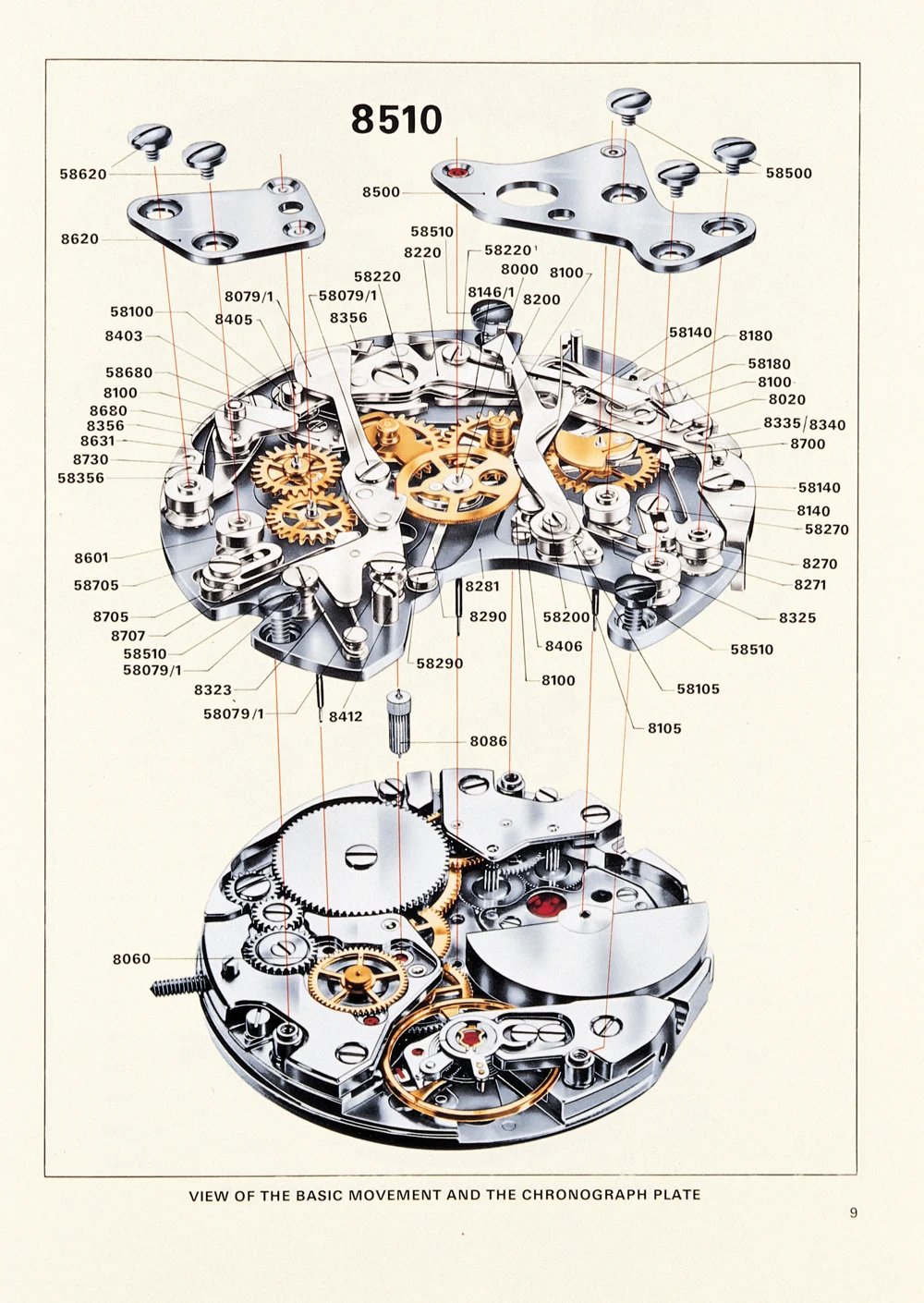
Image – an exploded view of the Breitling Caliber 11 Chrono-Matic (1969)
Breitling Manufacture Caliber 01 (2009)
Creativity clearly coursed through the veins of all three generations of the Breitling family, manifest with the company’s numerous inventions and patents. In 1979, Willy Breitling passed the baton to a new owner, Ernest Schneider. Although ownership of Breitling changed, the brand’s innovative spirit remained undiminished. Indeed, in 2009, Breitling unveiled its ‘first in-house-developed movement, the Breitling Manufacture Caliber 01’, a horological powerhouse that continues to attract widespread praise.
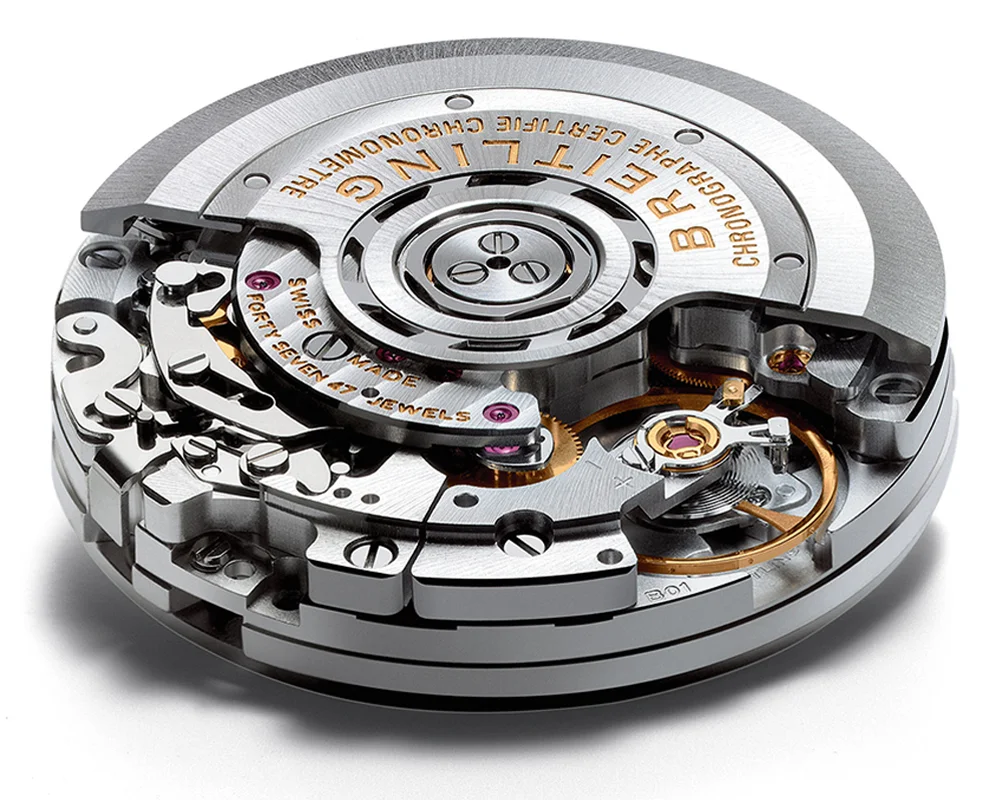
Image – Breitling Manufacture Caliber 01 (2009)
Produced at the Breitling Chronométrie, an ultra-modern facility in La Chaux-de-Fonds, the Breitling Manufacture Caliber 01 brims with attributes. Termed a ‘fully integrated chronograph movement’, the Caliber 01 was designed to be a chronograph from the outset. Its composition is optimised for the purpose of indicating the prevailing time and measuring elapsed periods.
A ‘modular’ movement comprises a base movement with a separate chronograph module positioned on top. When the chronograph is actuated, it tends to quaff energy, creating so-called ‘drag’, reducing the amplitude of the balance and, by default, affecting the precision of the watch.
A fully integrated movement is less prone to drag, culminating in superior precision. In addition, the Breitling Manufacture Caliber 01 features a column-wheel and vertical clutch, widely considered the optimal specification for a chronograph.

Image – Breitling HQ in Grenchen
The column-wheel controls the start, stop and reset to zero functions and can be seen rotating when the pushers are pressed. This component prevents the chronograph being reset while it is running, a scenario that could harm the gear train (the wheels between the barrel and the escapement).
The vertical clutch transfers energy from the gear train to the chronograph mechanism. Unlike its horizontal counterpart, the vertical clutch is always ‘in mesh’ with the gear train, mitigating drag. Moreover, when actuated, the central chronograph seconds hand commences its journey without hesitation or stuttering.
One of the delights of owning a chronograph is that it is one of the few complications that allows the wearer to interact intimately with the movement. An endearing characteristic of the column-wheel and vertical coupling pairing is the silky-smooth pusher action the arrangement confers. It is this smile-evoking slickness that differentiates the Breitling Manufacture Caliber 01 from some ordinary rivals.
A watch containing the Breitling Manufacture Caliber 01 is also subjected to the independent scrutiny of COSC (Contrôle Officiel Suisse des Chronomètres), culminating in ‘chronometer’ certification. This involves the watch being evaluated over a 15-day period at different temperatures and in various positions. The minimum requirements for chronometer certification are strictly laid down by COSC. For example, over the first 10 days of testing, the ‘average daily rate’ must be -4 to +6 seconds per day.
Lastly, the Breitling Manufacture Caliber 01 has a prodigious power reserve of 70 hours. Assuming the mainspring is fully tensioned, the watch can be removed from the wrist on a Friday evening and it will still be ticking away at 8 beats per second on Monday morning.
Breitling Manufacture Caliber B19 (2024) – a new era
As part of its 140-year celebrations, the Swiss marque has just unveiled a new self-winding chronograph movement, the Breitling Manufacture Caliber B19. Once again, the movement features the über-desirable column-wheel and vertical clutch pairing. The movement is also COSC-certified, providing independent assurance of its timekeeping capabilities. However, the new movement is not merely a carbon copy of the Breitling Manufacture Caliber 01, on the contrary, the Breitling Manufacture Caliber B19 walks on virgin snow, taking its own route to horological greatness.

The new Manufacture movement unites a chronograph, a speciality of the house, with a perpetual calendar, widely considered a ‘high complication’. Other high complications include the tourbillon, split-seconds chronograph (aka the ‘rattrapante’) and the minute repeater. High complications sit at the summit of mechanical watchmaking and necessitate much expertise to bring to fruition.
But what is a perpetual calendar?
Before I answer this question, it may be helpful to provide an insight into calendar watches, explaining the various types available and pointing out the differences between them.
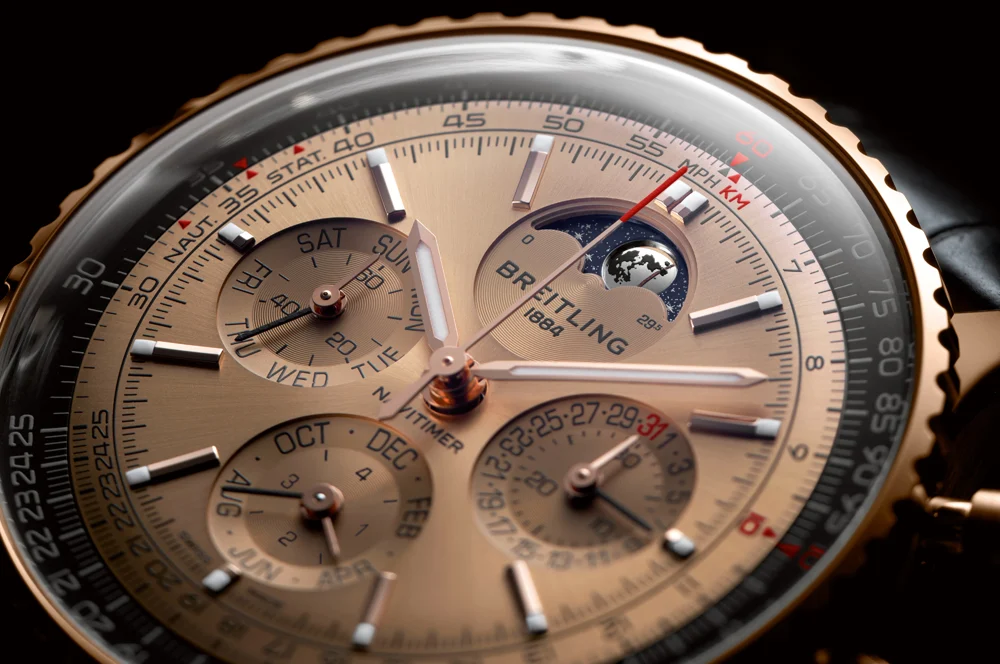
Image – Breitling Navitimer B19 Chronograph 43 Perpetual Calendar 140th Anniversary – Ref RB19101A1H1P1
The origins of time measurement began with the observation of heavenly bodies and, by default, the creation of calendars based on lunar, solar and stellar cycles.
Beyond a simple date indication, often located at 3 o’clock, the ‘complete calendar’ (aka ‘full calendar’) offers added functionality. Typically, a complete calendar indicates the day, date, month and moon phases. Following a month with fewer than 31 days, the wearer must manually advance the date to show ‘1’.
An ‘annual calendar’ displays a complete or partial calendar. However, it has the mechanical intelligence to recognise those months with 30 days and advance the date to ‘1’ automatically. The only time when the wearer needs to manually correct the date is on the 1st of March, as February has fewer than 30 days.
Invented by English watchmaker, Thomas Mudge (circa 1762), the perpetual calendar is the ultimate calendar watch. Employing a cam, the perpetual calendar can identify those months with 28, 29, 30 or 31 days and advance to ‘1’ accordingly. Assuming the watch is kept fully wound, the date will not require manual correction until 2100 at which point it will need to be advanced by one day to stay in line with the Gregorian calendar (2100 is not a leap year).
The new Breitling Manufacture Caliber B19 displays an array of calendar functions, including the day, date, month, moon phases and leap-year. Complementing this inventory of functions, the movement also powers additional indications pertaining to the indication of hours, minutes and seconds as well as chronograph-related features (see later).

Image – Breitling Premier B19 Datora 42 140th Anniversary – Ref RB19401A1B1P1
Other technical details
The perpetual calendar is a module that sits atop an integrated chronograph movement. At this juncture, based on my earlier comments, you may wonder whether this could cause the dreaded drag. Rest assured, it doesn’t because unlike the notable thirst of a chronograph module, the perpetual calendar module consumes very little energy. Indeed, this latter module continuously sips energy which has negligible impact on the rate stability of the movement, a fact reflected in its COSC-certification.
Equipped with one barrel, the Breitling Manufacture Caliber B19 has an impressive power-reserve of 96 hours.

Unlike most calibres that feature an index-regulated balance, this new movement is endowed with a variable-inertia balance, a means of regulation beloved by watch aficionados. But why? Allow me to explain.
At the heart of the regulating organ, the inner coil of the balance spring is affixed to the ‘balance staff’ and the outer coil is connected to the ‘stud’. The balance spring passes through two ‘curb pins’ positioned on the index (aka raquetterie). By moving the index towards or away from the stud, the watchmaker can alter the effective length of the balance spring, causing the movement to run faster or slower.
With a variable-inertia balance, the length of the balance spring remains constant. The rate is adjusted by altering the balance wheel’s moment of inertia. This is done by tightening / loosening timing screws affixed to the rim of the balance wheel. This approach allows for more precise setting of the rate, is less susceptible to positional influence and, should the watch be subjected to a shock, it is less likely to need remedial regulation.
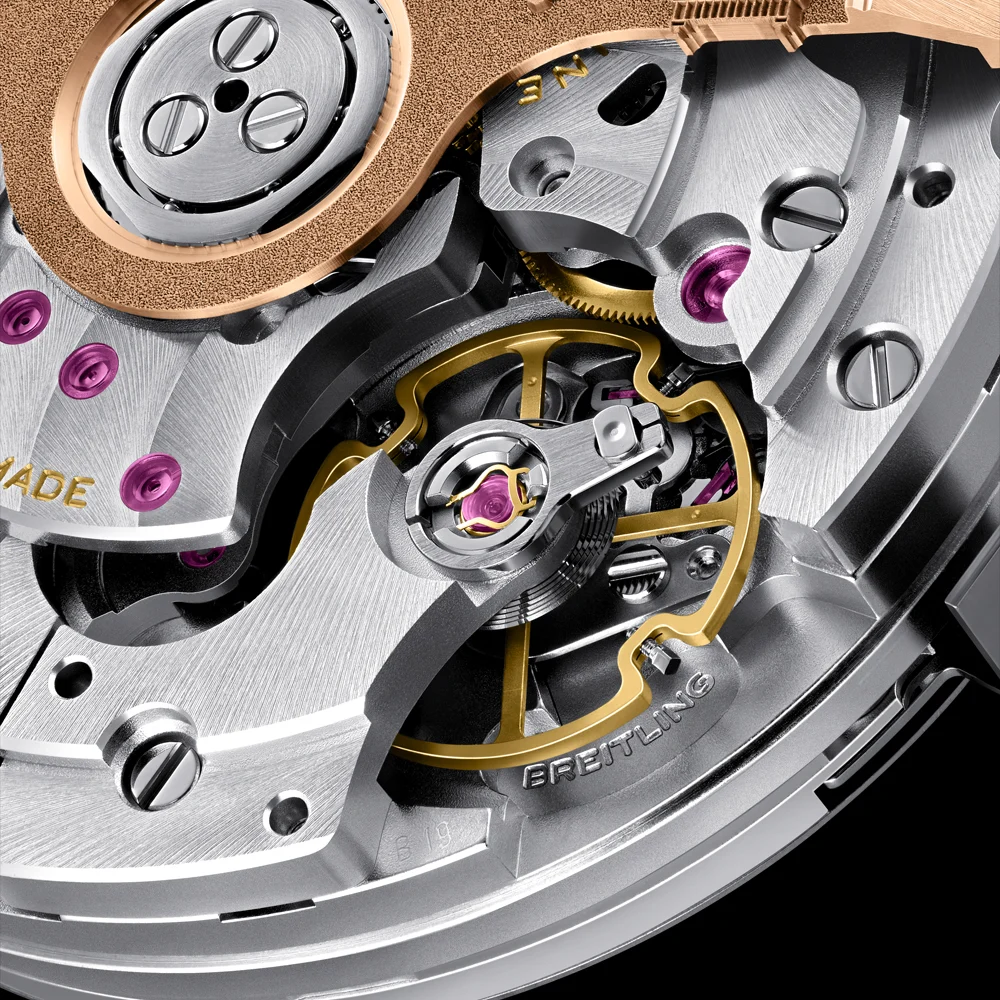
Breitling has also incorporated another subtle refinement, namely the rim of the balance wheel incorporates small recesses that play host to the timing screws. As the balance wheel oscillates to and fro, the ‘in-board’ timing screws create less air perturbation, augmenting precision.
Finishing (finissage)
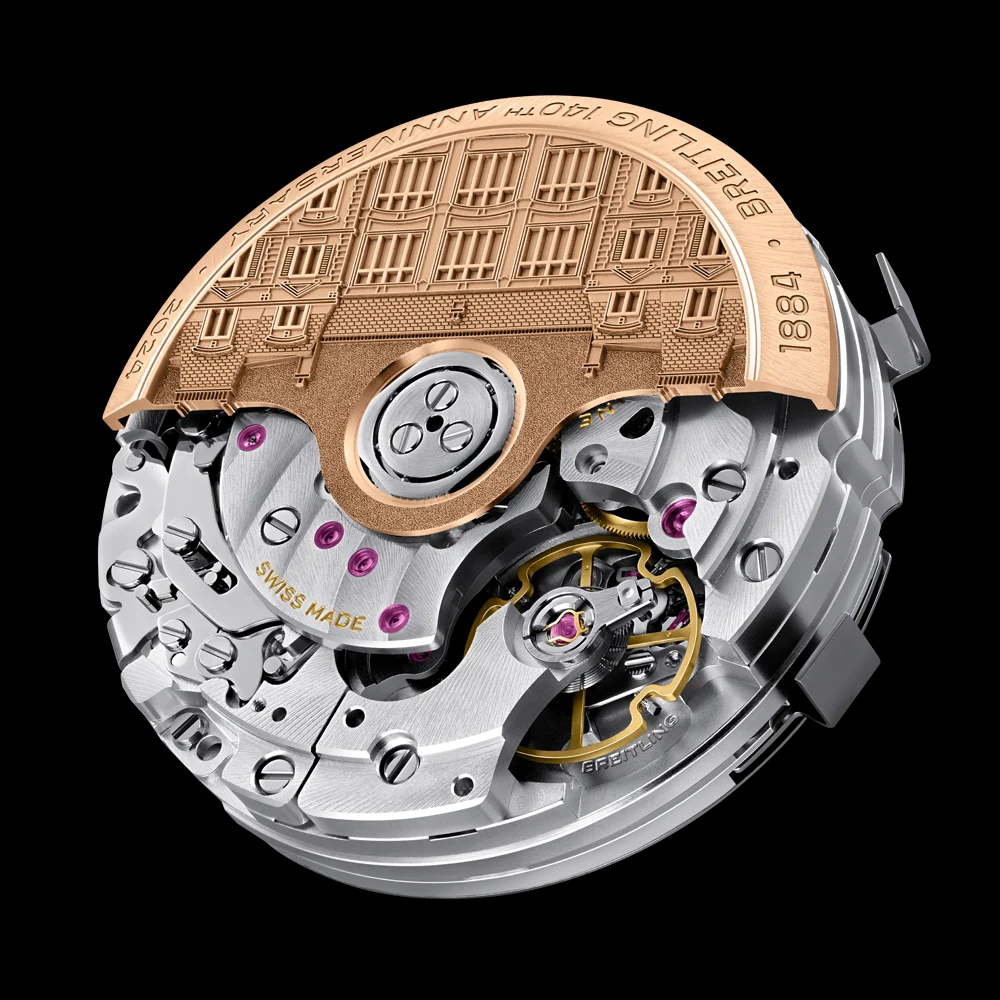
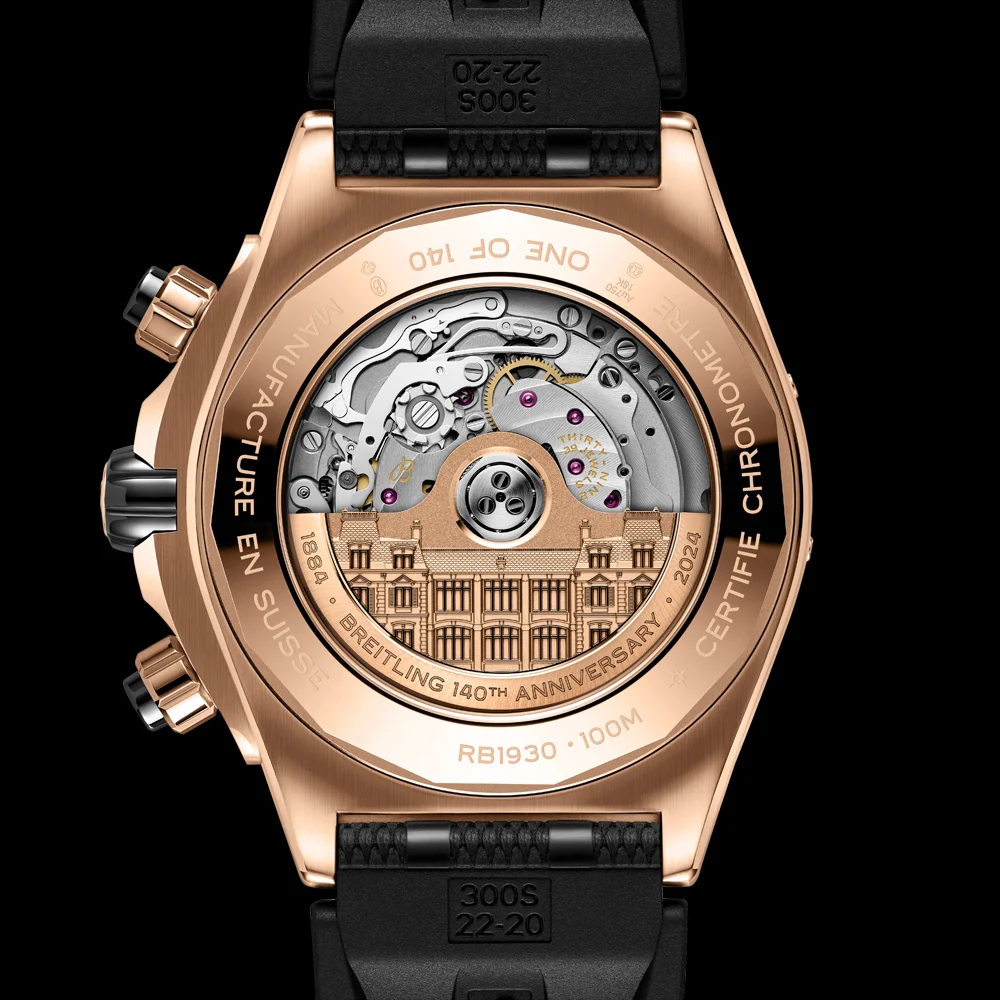
The Breitling Manufacture Caliber B19 is beautifully appointed with an array of refined finishes. The automatic device bridge is adorned with circular Côtes de Genève, while the remaining bridges are embellished with colimaçon. Moreover, the screws and sinks are highly polished.
In 1892, Léon Breitling relocated his business from Saint Imier to the famous ‘huge factory town’ of La Chaux-de-Fonds. The company’s new home, the Montbrillant Manufactory, located at 3 rue de Montbrilliant was a grand building. It featured large expansive windows that drank in light, helpfully illuminating the watchmakers’ workbenches. The solid gold oscillating weight within the Breitling Manufacture Caliber B19 is intricately engraved with a depiction of this period building. Incidentally, the west wing of the building, described as a ’villa-style home’, housed three generations of the Breitling family.

Image – Breitling Navitimer B19 Chronograph 43 Perpetual Calendar 140th Anniversary – Ref RB19101A1H1P1
Breitling 140th Anniversary Limited Editions – three models, one movement
The Swiss company has created three Breitling 140th Anniversary Limited Editions, each fitted with the Breitling Manufacture Caliber B19, but all exhibiting their own unique style. With a rich heritage spanning 140 years, Breitling’s archives positively overflow with former classics, no doubt providing much inspiration for the company’s design team. In this instance, the new ticking trinity consist of the Premier (first released in 1943), the Navitimer (1952) and the Chronomat (1983).

Image – Breitling 140th Anniversary Limited Editions
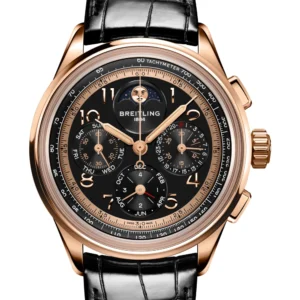
Breitling Premier B19 Datora 42 140th Anniversary – Ref RB19401A1B1P1
Housed in a 42 mm, 18-carat red gold case, the Breitling Premier B19 Datora 42 140th Anniversary exudes period charm. The retro-vibe is accentuated with the curved/glassbox sapphire crystal and the square pushers. Back in the 1940s, the shape of the pushers proved an interesting departure from the usual round items, helping to endow the Premier with a distinctive mien. Breitling has tastefully endued the case with a seemly blend of polished and brushed surfaces. Moreover, a series of lines span the length of the caseband, bestowing a nuanced charm.
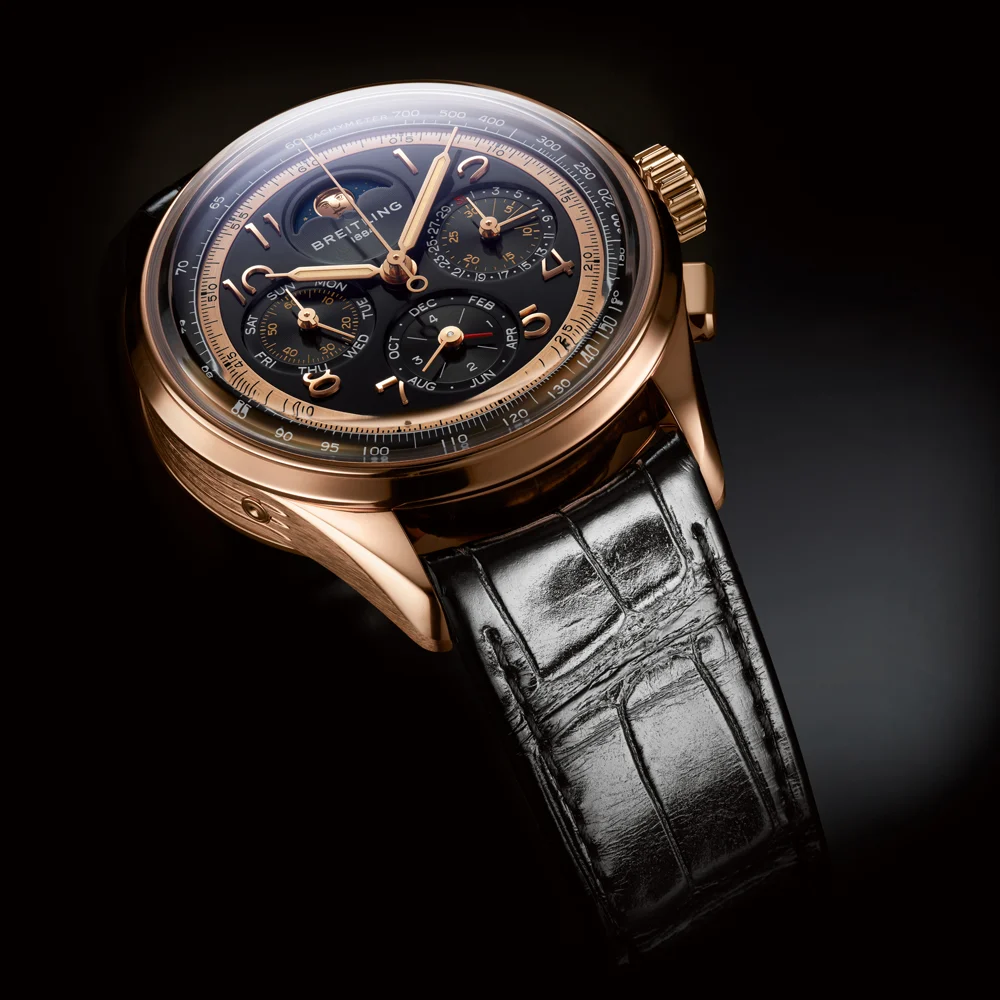
Golden syringe-type hour and minute hands clearly impart meaning day and night, courtesy of Super-LumiNova treatment. The applied indexes are presented in golden Arabic form. The central chronograph seconds hand features a circular openworked counterweight and converses with a golden track featuring 1-second and ¼ -second markings. Beyond the golden track, a tachymeter provides a user-friendly means of calculating the speed of an object over a known distance.

The dial’s epidermis is punctuated with four snailed counters. The subdial at 3 o’clock plays host to a 30-minute chronograph register and a pointer-date display. A month and leap-indicator reside at 6 o’clock, while the subdial at 9 o’clock is home to a day indication and a small seconds display. Lastly, the subdial at noon is home to a moon phases display and proclaims the luxury marque’s name and year of incorporation.
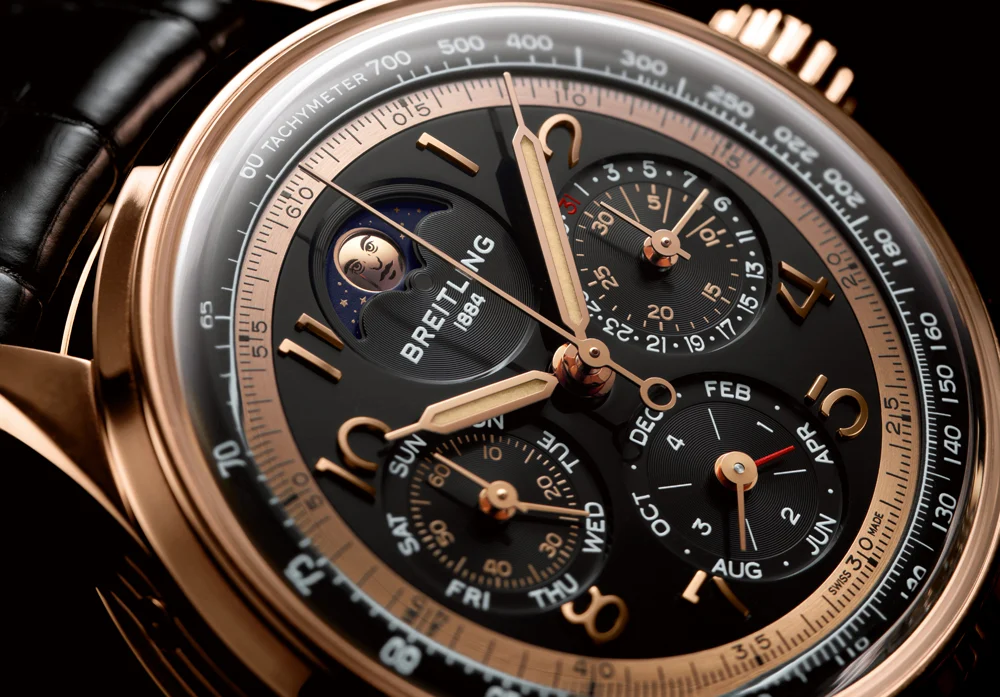
Despite displaying much information, the sparing use of different colours, along with the intelligent use of texture and depths, ensures all indications prove simple to read.

Breitling Navitimer B19 Chronograph 43 Perpetual Calendar 140th Anniversary – Ref RB19101A1H1P1
The watch industry has a propensity to overuse the terms ‘iconic’ and ‘legendary’, but when it comes to the Navitimer the words are justified. Designed for pilots, the Navitimer Ref.806 was the ‘first wristwatch flight computer’. Equipped with a circular slide rule, the watch could be used to ‘perform all flight calculations’.

Image – Breitling Navitimer from 1954 bearing the AOPA logo
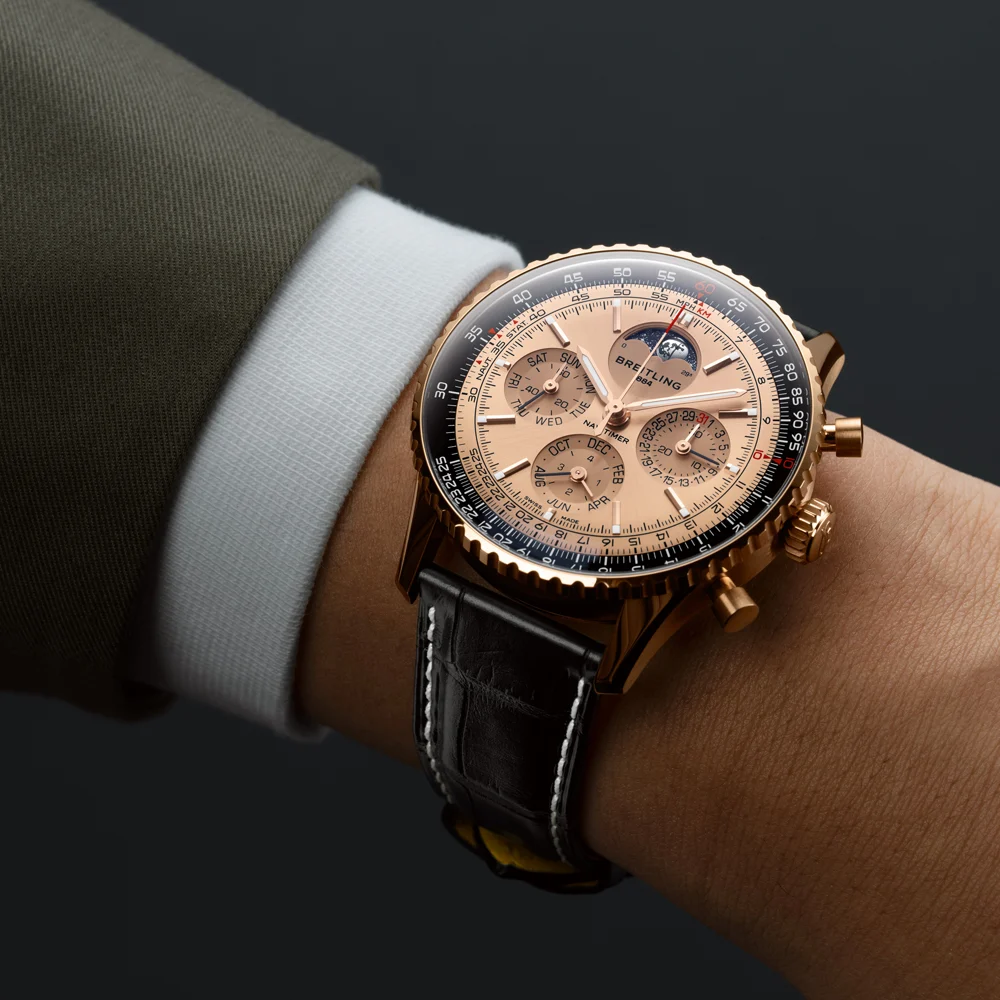
New for 2024, the Breitling Navitimer B19 Chronograph 43 Perpetual Calendar 140th Anniversary shares much in common with its antecedent of 1952, but with some obvious differences. Firstly, this latest model is housed in an 18-carat red gold case, measuring 43 mm. Put simply, the iconic Ref. 806 has been to Swiss finishing school and now exhibits an unprecedented level of refinement. Indeed, not only is the watch encased in noble metal, but it now features the Breitling Manufacture Caliber B19, an in-house movement that delivers extraordinary functionality. With its engraved oscillating mass, visible via the sapphire caseback, this new movement has the bearing of a horological aristocrat.
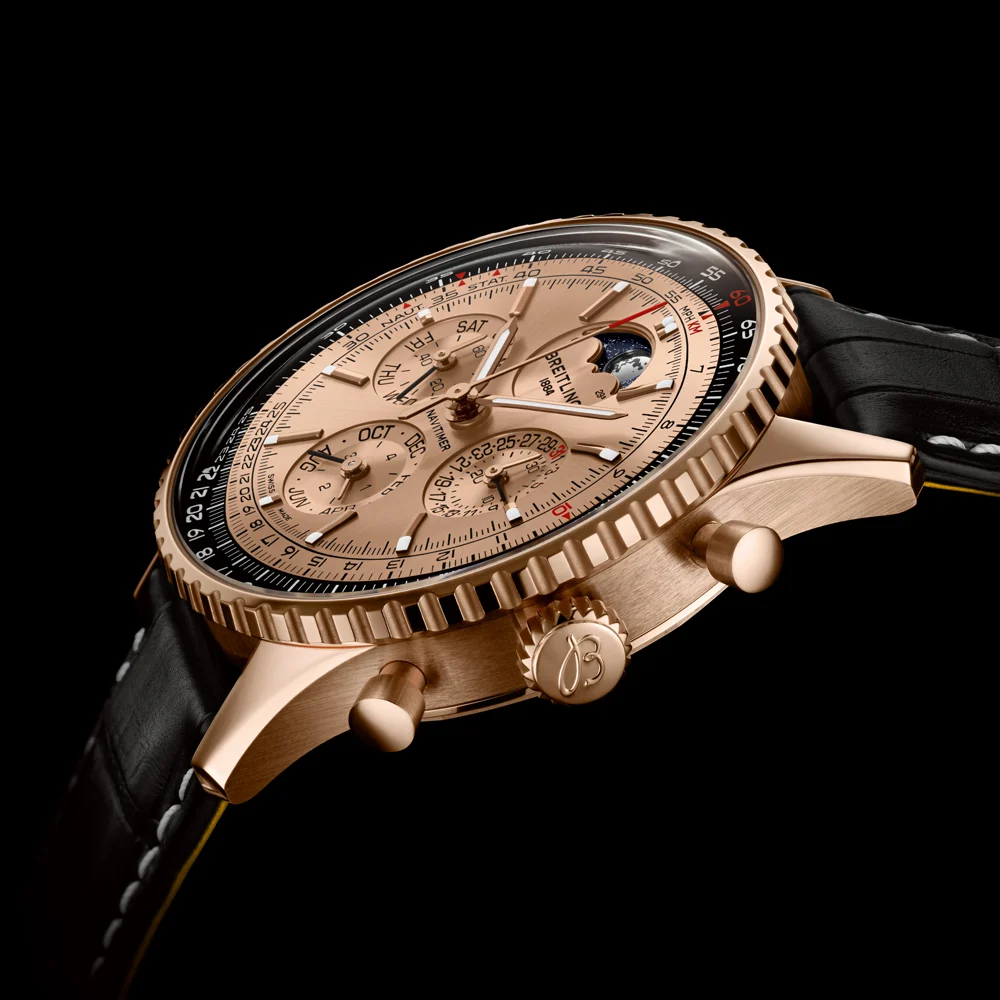
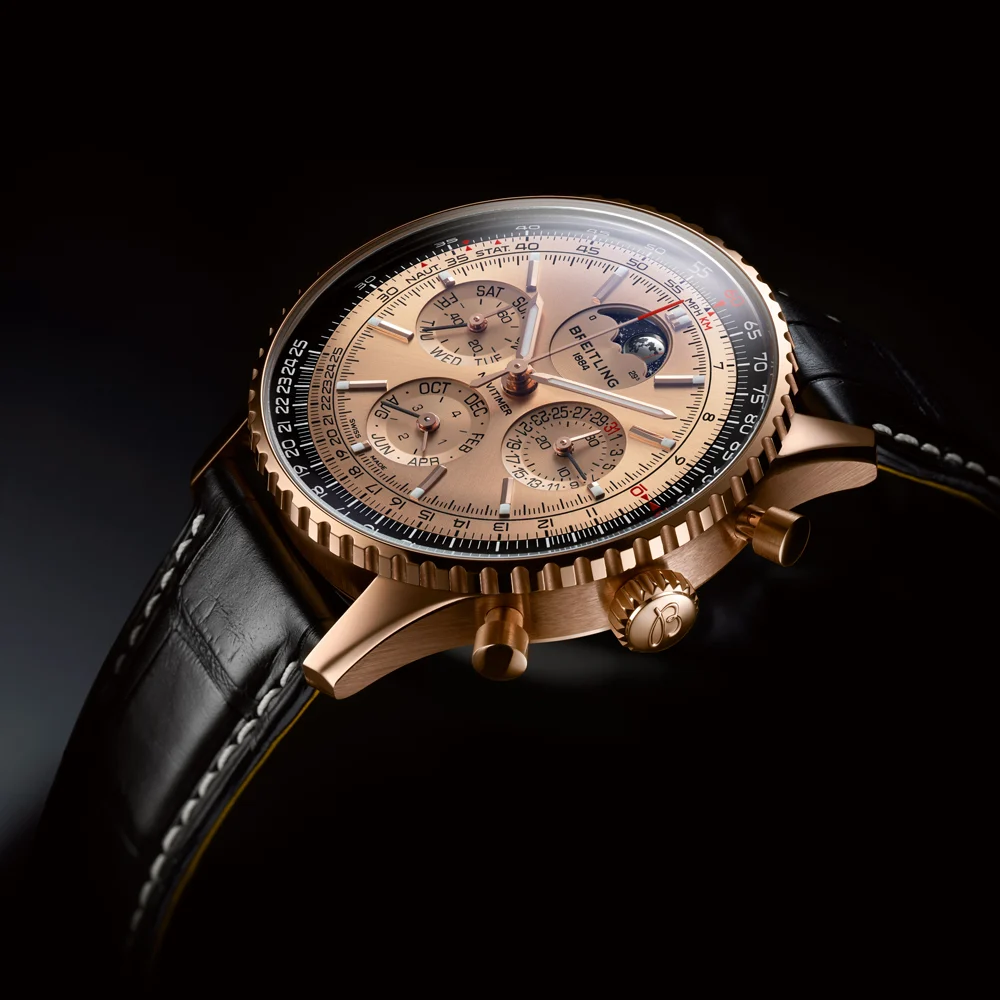
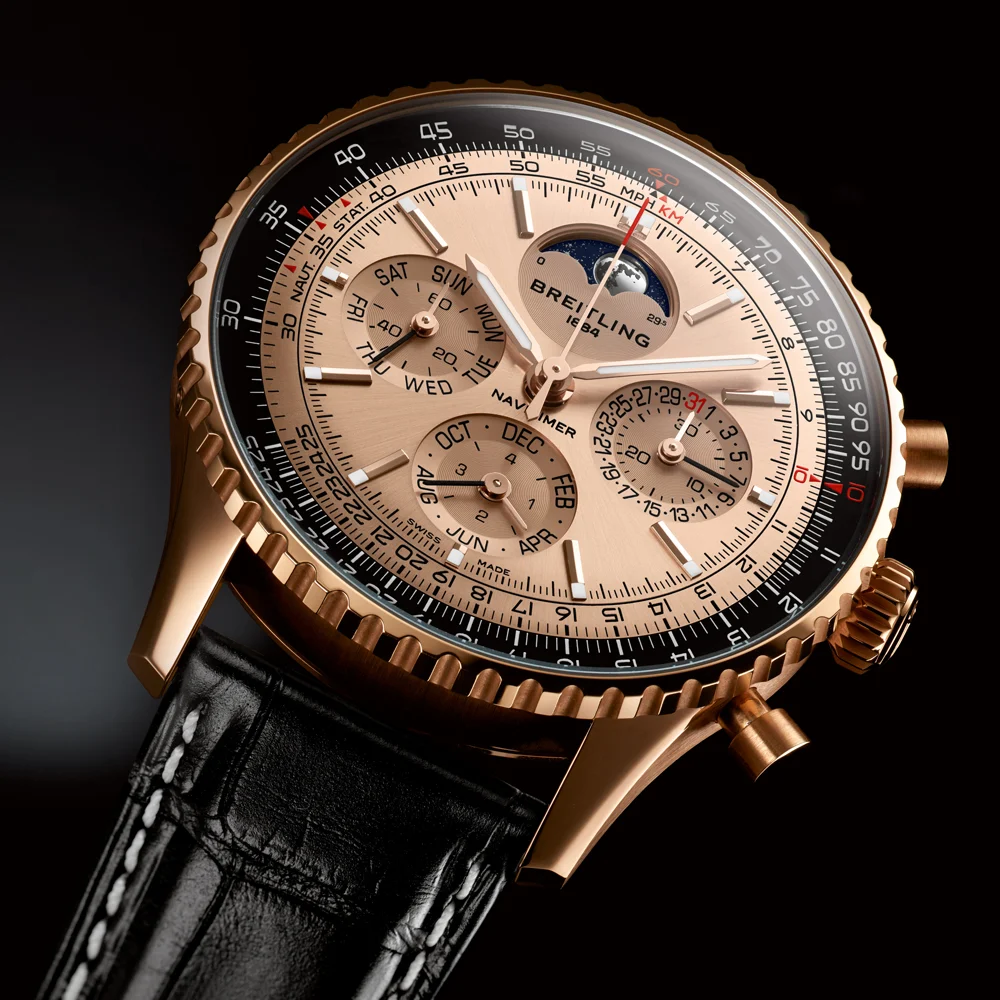
The arrangement of the dial indications is the same as the Premier B19 Datora 42 140th Anniversary, albeit the watch looks very different. The dial, formed of 18-carat red gold, is enriched with a sunray motif that wonderfully toys with light. Luminescent hour markers dot the minute track framing the central area of the dial. Two scales sit beyond the minute track: an inner scale in a golden hue and an outer scale in black that’s rotated using the knurled bezel. The relative position of the inner and outer scale to one another is used to perform an array of calculations. The tachymeter scale found on the Premier B19 is set aside on the Navitimer B19 in favour of the slide rule.
Breitling Chronomat B19 44 Perpetual Calendar 140th Anniversary – Ref RB19301A1G1S1
When compared with the Premier and the Navitimer, the Chronomat is a younger model, but no less virtuous. Launched in the 80s, the Chronomat was born in the wake of the so-called ‘quartz crisis’. The arrival of these latter battery-powered upstarts during the 70s threatened to supplant mechanical movements and nearly decimated the Swiss watch industry. At the time, quartz was billed as the future as it was both cheaper to produce and more precise.
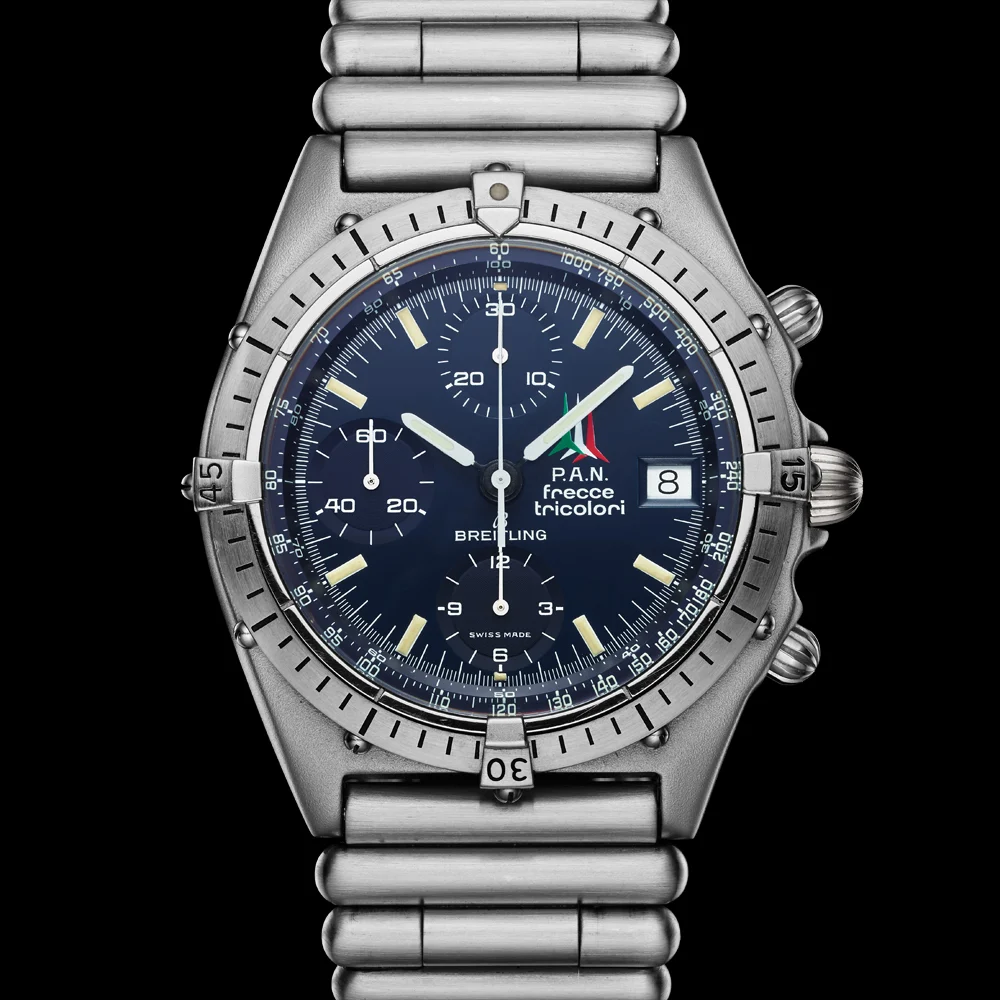
Image – Frecce Tricolori (1983)
In 1983, despite the popularity of quartz watches, Breitling boldly launched a mechanical watch featuring the tried and tested Swiss lever escapement, the Chronomat. Originally created for the Frecce Tricolori, the famous Italian aerobatic team, the Chronomat was put on public sale in 1984 and immediately proved a box-office sensation.
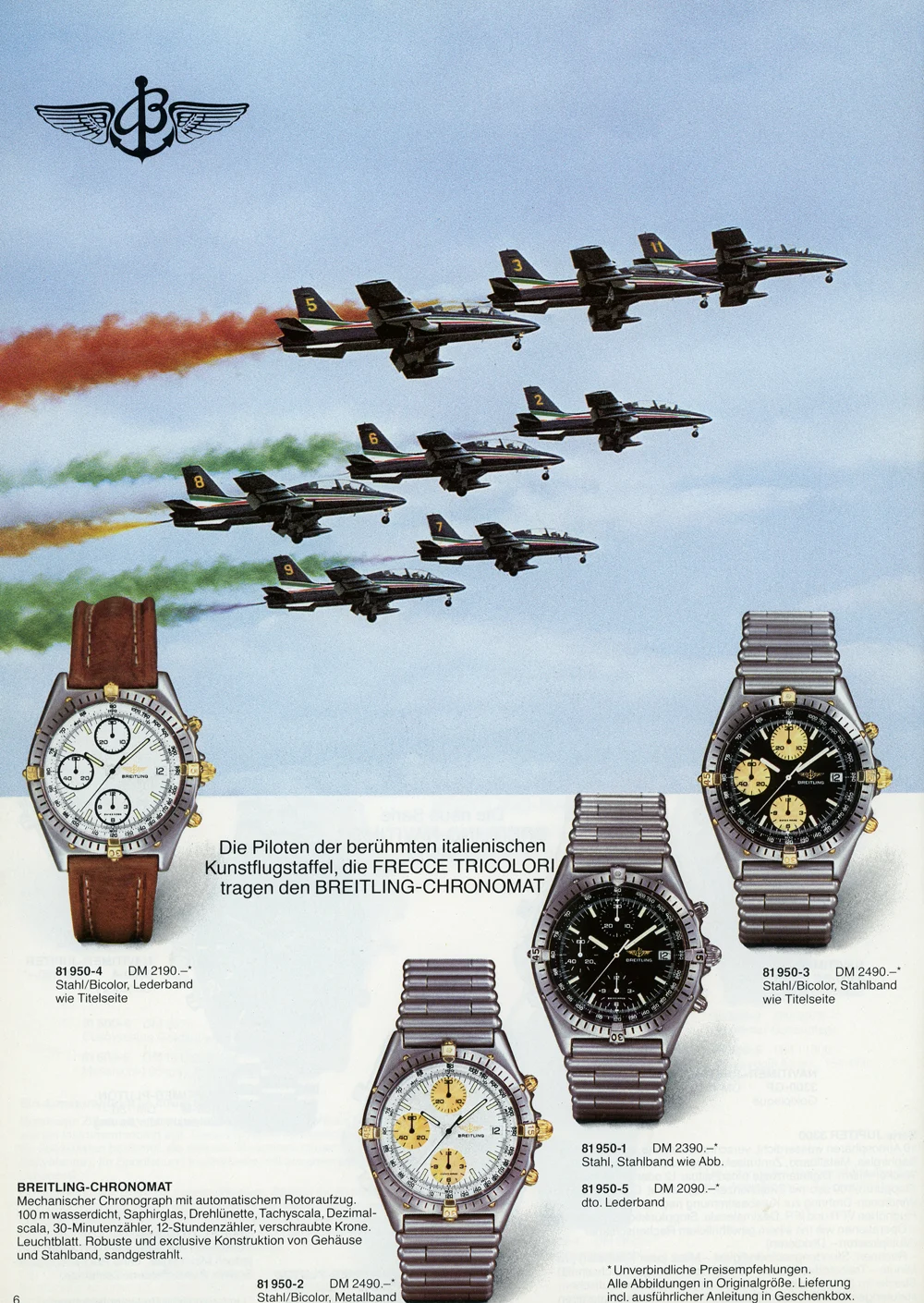
Image – Breitling catalogue from 1987 showing the Chronomat
Featuring the now-legendary rider tabs on its bezel, the watch looked different from its contemporaries. In addition, the model was paired with a Rouleaux bracelet formed of tube-like sections. Breitling, a company that has repeatedly shown an unwavering quest for advancement, relaunched the Chronomat in 2020. Fresh-faced and contemporary, the latest generation Chronomat collection still retains some of the beloved design codes of the inaugural 1983 design.
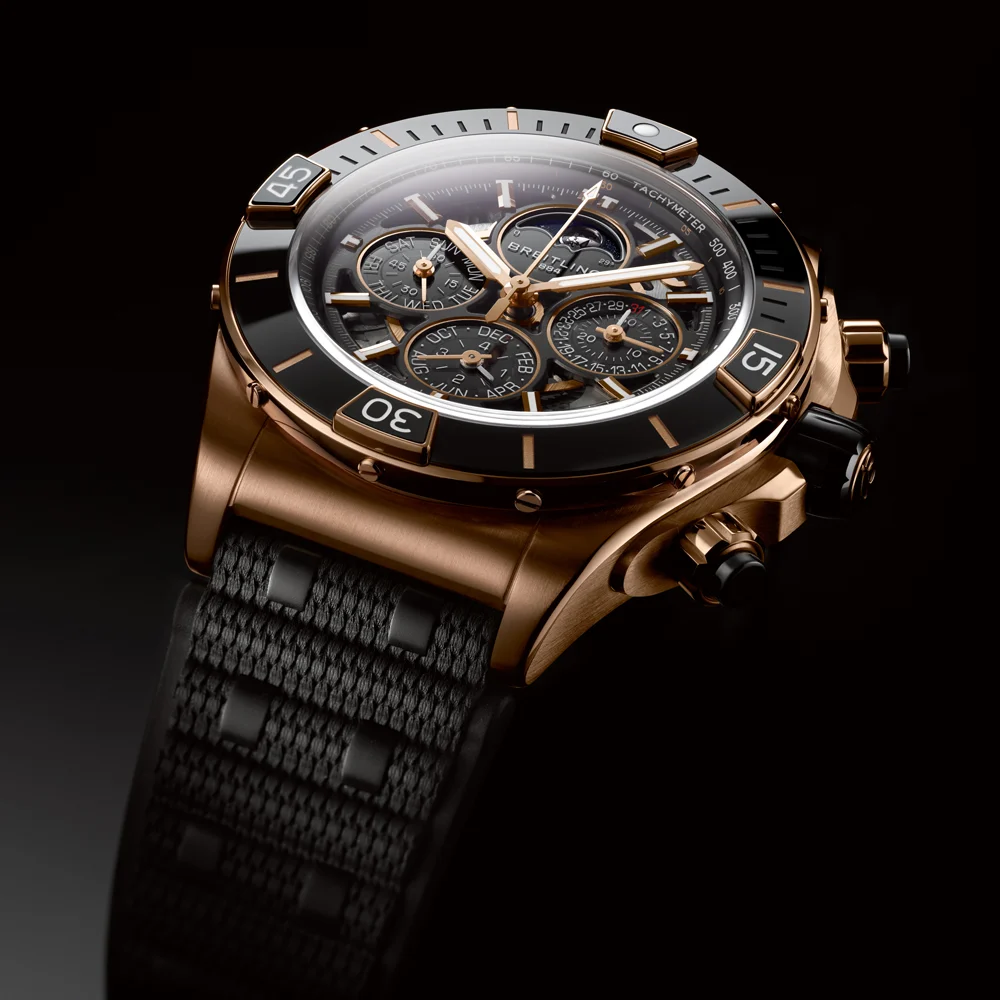
Image – Breitling Chronomat B19 44 Perpetual Calendar 140th Anniversary – Ref RB19301A1G1S1
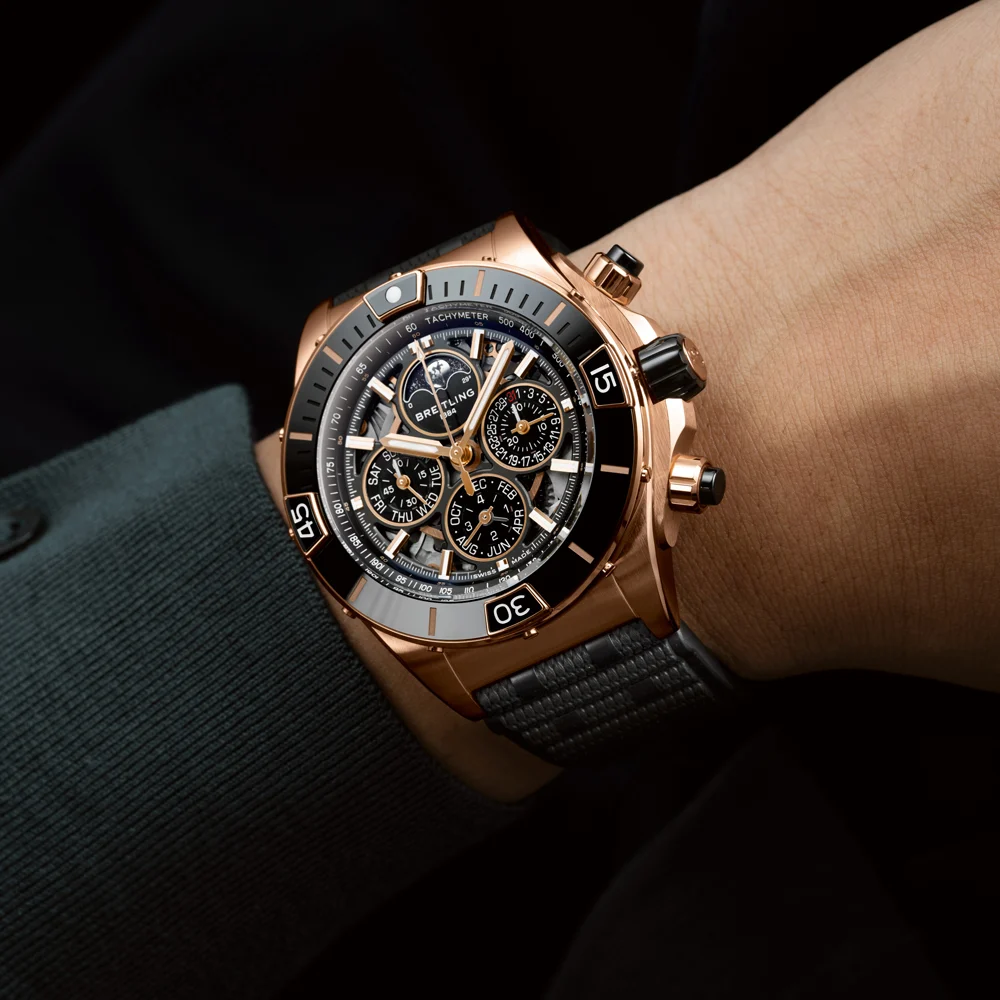
The Breitling Chronomat B19 44 Perpetual Calendar 140th Anniversary is unapologetically neoteric. Housed in a generously proportioned 44 mm, 18-carat red gold case, the model sports a matching unidirectional bezel with a black ceramic insert. Marked with golden inserts, the famous rider tabs are presented in relief and marked with luminescent numerals, save for the rider tab at noon which features a circular index.

The crown and pushers are formed of 18-carat red gold and incorporate black ceramic accents. The black torso of the crown’s grip nestles between the broad shoulders of a protector, imbuing the watch with a sense of robustness. Breitling has reimagined the Rouleaux bracelet of the 80s, presenting the Chronomat B19 on a textured, black rubber strap.
Once intended to be a cockpit instrument, the Chronomat has transitioned from a utilitarian tool watch to a supremely handsome exemplar of fine watchmaking. The watch eschews a conventional dial to reveal some of the perpetual calendar components below.
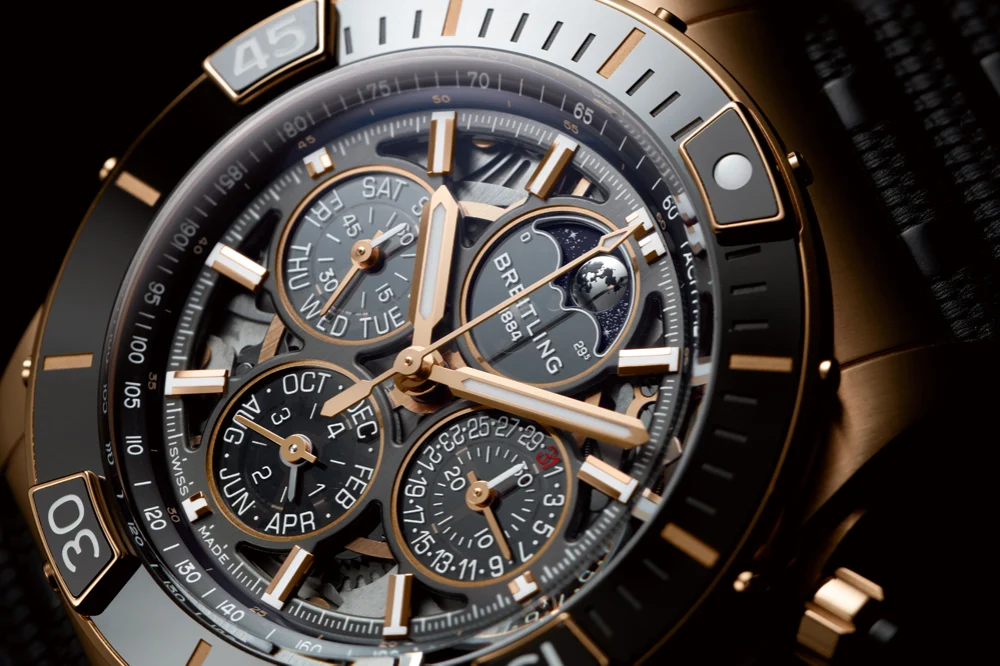
Sometimes termed an ‘openworked’ or ‘skeletonised’ dial, the horological vista has a light grey cast and is dominated by four, black subdials. The arrangement of the subdials, and the various indications presented, are identical to those gracing the Premier B19 and the Navitimer B19; however, the persona of the watch is quite different.
The hour and minute hands, along with the indexes, are lined with Super-LumiNova aiding readability in dim light conditions. A problem that can afflict some openworked dials is that the indications can become lost in a sea of exposed movement components. Thankfully, no such issues afflict the dial of the Breitling Chronomat B19 44 Perpetual Calendar 140th Anniversary. Each black counter is solid and confers contrast, aiding lucidity. Golden hands and white markings collaborate to impart meaning free of ambiguity, while a golden circlet frames each subdial delineating them from the openworked backdrop.
Lastly, a tachymeter scale nestles on a flange encircling the dial, completing the Chronomat B19’s impressive inventory of functions.
Breitling 140th Anniversary Limited Editions – closing remarks
Since 1884, Breitling has seen much change. Witnessing mankind embrace new forms of transport, from horse-drawn vehicles to space exploration, the Swiss marque has been a constant and dependable companion to those professionals working in associated trades. Indeed, it has provided the means to measure elapsed periods of time for aviators, astronauts, balloonists, etc, while simultaneously indicating the prevailing hour.
Breitling has never accepted the status quo, continuously pursuing horological advancement, inventing and patenting mechanisms for the benefit of professionals and horophiles alike. The company has also become synonymous with making highly precise timing instruments, often certified as chronometers by COSC. Quite simply, the company’s résumé makes impressive reading.
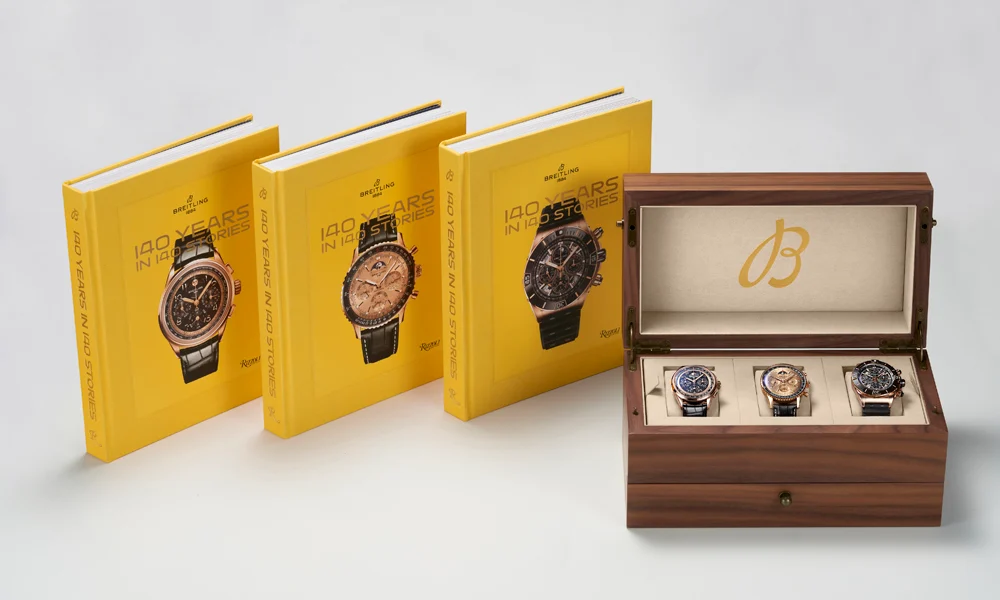
Image – Breitling 140th Anniversary Limited Editions
So, the next time you hold a chronograph in your hand, irrespective of the name on its dial, take a moment to contemplate the origins of the pushers gracing the right flank of the case and remember, Breitling was first. In fact, the brand born in Saint Imier has been first on numerous occasions over the last 140 years. The Breitling Manufacture Caliber B19 may be Breitling’s ‘first exclusive perpetual calendar chronograph movement’, but I suspect it won’t be its last.
Further reading
Breitling 140th Anniversary Limited Editions – technical specifications
- Model: Breitling Premier B19 Datora 42 140th Anniversary
- Reference: RB19401A1B1P1
- Case: 18 k red gold, diameter 42 mm, height 15.6 mm, water resistant to 10 bar (100 metres); sapphire crystal to front and exhibition caseback.
- Functions: hours, minutes, small seconds, chronograph, perpetual calendar
- Movement: Breitling Manufacture Caliber B19, self-winding movement, frequency 28,800 vph (4 Hz), power reserve approximately 96 hours.
- Strap: black alligator leather strap with an 18k red gold folding buckle
- Price: £48,000 (as of 29.8.2024)
- Limited Edition: 140 pieces
- Model: Breitling Navitimer B19 Chronograph 43 Perpetual Calendar 140th Anniversary
- Reference: Ref RB19101A1H1P1
- Case: 18 k red gold, diameter 43 mm, height 15.62 mm, water resistant to 3bar (30 metres); sapphire crystal to front and exhibition caseback.
- Functions: hours, minutes, small seconds, chronograph, perpetual calendar
- Movement: Breitling Manufacture Caliber B19, self-winding movement, frequency 28,800 vph (4 Hz), power reserve approximately 96 hours.
- Strap: black alligator leather strap with an 18k red gold folding buckle
- Price: £48,000 (as of 29.8.2024)
- Limited Edition: 140 pieces

- Model: Breitling Chronomat B19 44 Perpetual Calendar 140th Anniversary
- Reference: RB19301A1G1S1
- Case: 18 k red gold, diameter 44 mm, height 15.35 mm, water resistant to 10 bar (100 metres); sapphire crystal to front and exhibition caseback.
- Functions: hours, minutes, small seconds, chronograph, perpetual calendar
- Movement: Breitling Manufacture Caliber B19, self-winding movement, frequency 28,800 vph (4 Hz), power reserve approximately 96 hours.
- Strap: black rubber Rouleaux-inspired strap with an 18k red gold folding buckle
- Price: £48,000 (as of 29.8.2024)
- Limited Edition: 140 pieces