
Perrelet Weekend Skeleton Watch Review
The Perrelet Weekend Skeleton is a rare sight in watchland, courtesy of its in-house skeleton calibre that affords unhindered views of numerous parts. Moreover, this automatic, openworked watch is made using cutting-edge production techniques, democratising a hitherto expensive horological genre while at the same time delivering impressive performance and reliability.

Perrelet watch
Many young dreamers imagine a future of mega mansions, hypercars and superyachts. Inevitably, with the onset of adulthood, these aspirations are set aside. Indeed, for most mere mortals, grandiose ideas are soon quashed on receipt of the very first pay slip. Horophiles are not immune to this sad reality.
Timepieces formed of noble metals, often festooned with gems and brimming with complications, may be ultra-desirable, but for most watch-loving-obsessives they are financially unobtainable. Likewise, skeleton watches crafted using traditional methods are, by virtue of their protracted creation, very expensive.
Thankfully, Perrelet has democratised the skeleton watch by releasing an obtainable option that promises style, reliability and quality, all delivered in a refreshingly affordable form. Allow me to elaborate.
Skeleton watches first invented in 1760
Skeleton watches eschew a conventional dial to reveal the movement. Often presented in filigreed form, an openworked movement allows light to pass through its intricate structure, bestowing a becoming transparency.
This expression of horology dates back to 1760, when André-Charles Caron, a French watchmaker, created the very first skeleton pocket watch. During the 19th century, the skeleton watch enjoyed a renaissance with examples being displayed at exhibitions by prestigious companies wishing to showcase their horological expertise.

Skeleton watches – the traditional approach
The traditional approach for making a skeleton watch involves using a ‘regular’ movement and making openings in the mainplate, bridges, balance cock, etc. Using the mainplate as an example, the process of skeletonization begins with drilling a series of small holes, perforating its surface. This allows the watchmaker to insert the blade of a small handsaw, allowing them to carefully cut the metal.
Great care is needed when cutting the mainplate. For example, the blade must always be perpendicular to the mainplate as slanted angles would compromise its appearance. Likewise, the artisan must take care not to remove material near jewel beds, screws or areas supporting the gear train as to do so may affect precision, impair reliability or even prevent the watch from working.
Once the surfaces have been cut, all traces of sawing need to be removed using a series of files of varying coarseness. Thereafter, edges are bevelled and surfaces are decorated with elaborate patterns, in some instances with images of animals or floral scenes. At this juncture, everything sounds highly desirable; however, not everything in the garden is rosy.

Skeleton watches – a cautionary tale
I recall a friend of mine telling me about the time he studied watchmaking in Switzerland. Tasked with openworking a movement, he spent every waking hour intricately sawing, filing, bevelling and polishing a hand-wound brass calibre. Feeling pleased with his handiwork, he presented his masterpiece to his lecturer who examined it closely with a loupe to his eye. The lecturer eventually proclaimed, “It’s very beautiful….but alas, very weak” as he simultaneously placed the movement at the edge of his desk and bent it.
The moral of this story is that when removing extraneous material from a movement, due consideration must always be given to torsional rigidity. A movement that flexes is not suitable for use in a watch, a lesson my friend learnt many moons ago.

Perrelet Weekend Skeleton – cutting-edge know-how
As I hope I have already demonstrated, skeletonising a movement using traditional methods not only requires much time but also an inordinate amount of skill, factors which are often reflected in the price.
However, Perrelet has just unveiled a new addition to its Weekend collection, the Perrelet Weekend Skeleton, which sets aside traditional techniques, instead using cutting-edge know-how.
By using technology intelligently, Perrelet has made skeleton watch ownership more accessible. Moreover, as I will go on to explain, this modern-day approach delivers additional benefits.

Perrelet Weekend Skeleton – front of house
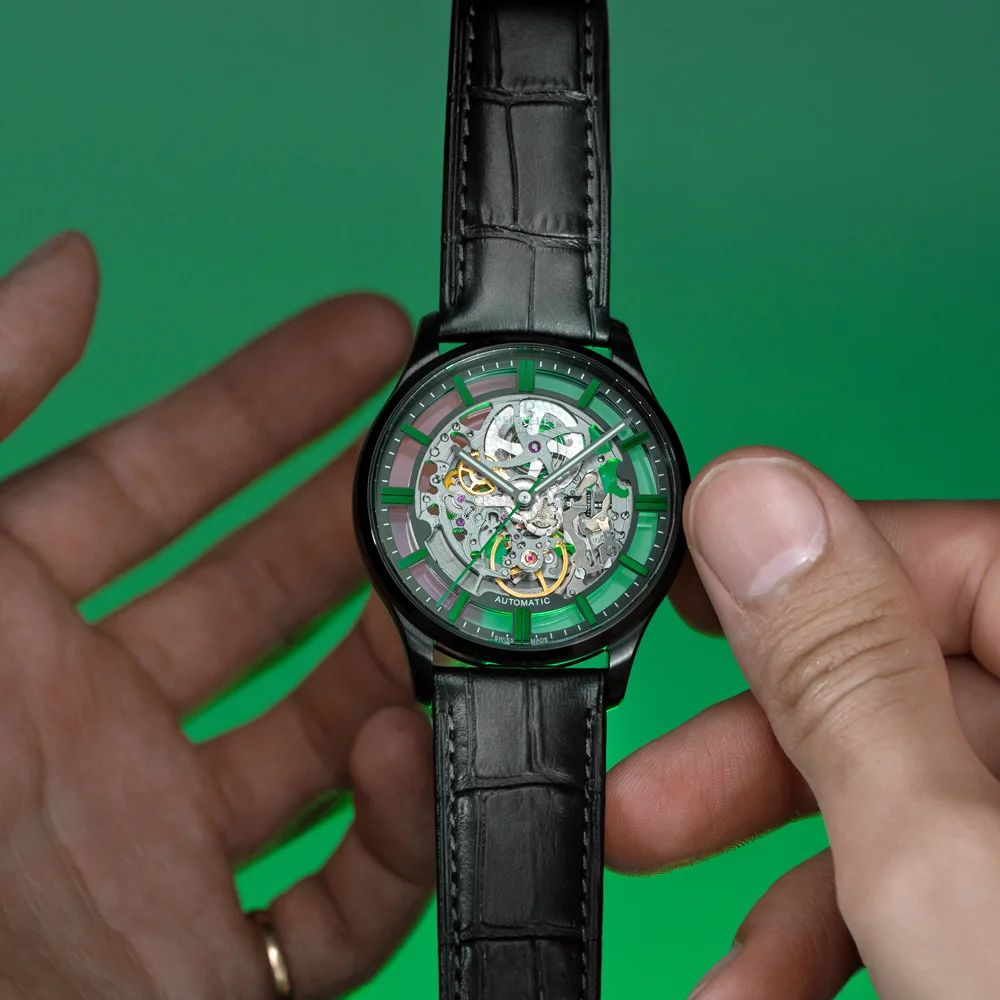
The Perrelet Weekend Skeleton indulges the wearer with glorious views of the new in-house calibre, the Perrelet P-351-SQ. Measuring 25.60 mm in diameter, this automatic movement resides at the centre of the display, occupying a significant area of dial estate. This central area is framed with a clear openworked circlet punctuated with coloured indices. Prospective purchasers have a choice of black, blue or green indices. Lastly, a minute track frames the dynamic scene.
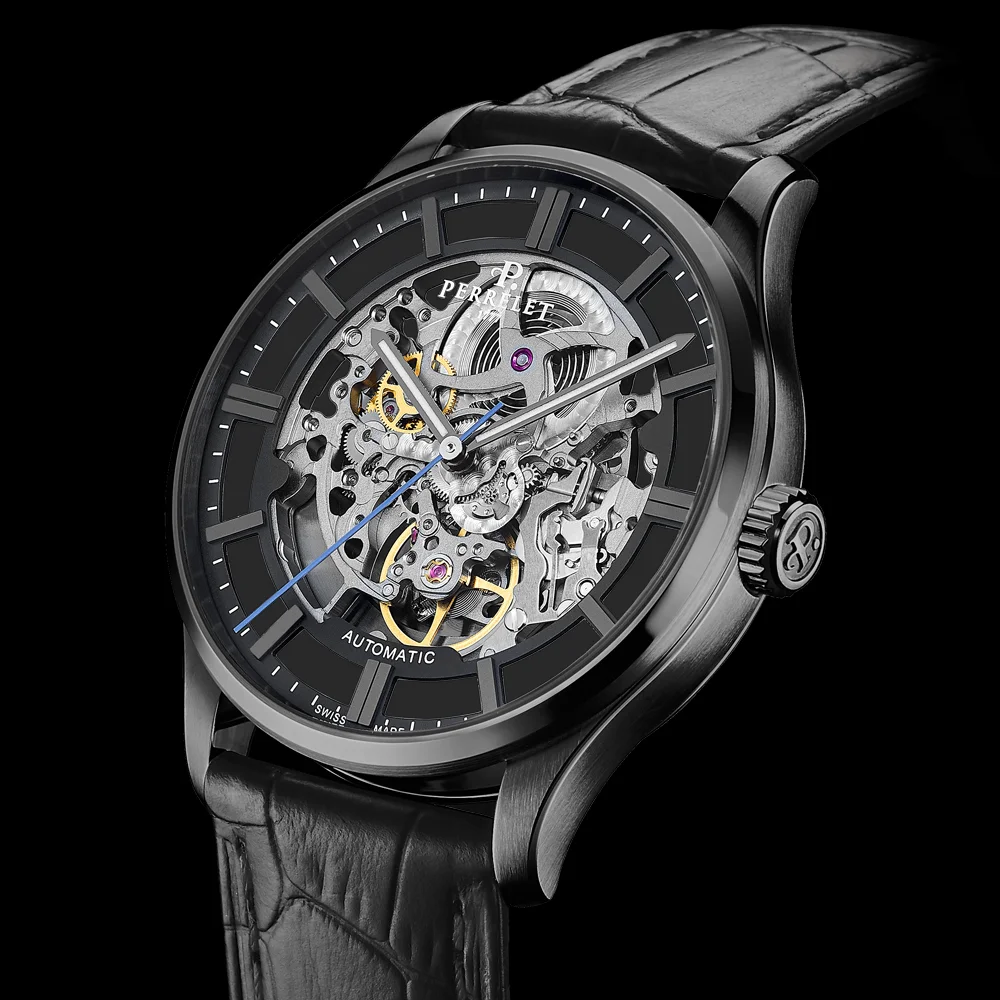


Luminescent, rhodium-plated, baton-style hour and minute hands articulate the prevailing time. A colour coordinating fine centre seconds hand completes the inventory of functions. By suffusing the movement with anthracite NAC coating and endowing it with a microbeaded finish, Perrelet has introduced contrast, thereby optimising readability.
Perrelet Weekend Skeleton – case
Formed of stainless steel, coated in matt black PVD, the case plays a deferential role to the dial and movement ensemble. Indeed, its understated appearance is intentional so as not to detract from the fascinating mechanical scene, presented centre stage.
Measuring 39.5 mm in diameter with a modest thickness of 9.61 mm, the case dimensions will suit a broad array of wrist sizes.
Calibre Perrelet P-351-SQ
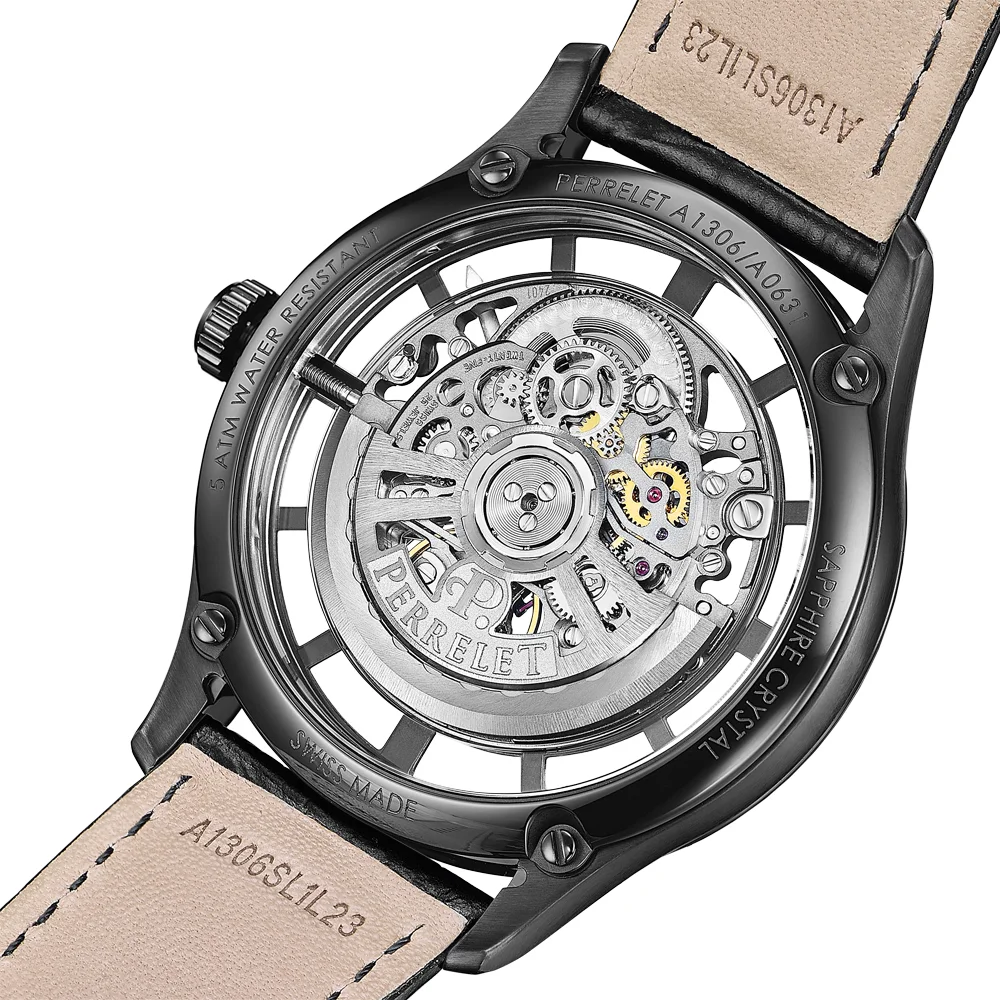
But ultimately, all roads lead back to the calibre Perrelet P-351-SQ, the star of the show. The anatomy of the movement is fully disclosed, revealing many secrets usually hidden from view. For instance, the balance is visible to the front and rear of the watch and can be seen oscillating to and fro, breathing in metronomic fashion. Both the top and underside of the barrel are openworked granting sight of the mainspring in various states of tension. The keyless works can be seen flitting from winding the barrel to hand adjusting duties merely by pulling the crown. The ratchet wheel and the oscillating mass are also openworked. Indeed, wherever you choose to look you will see pared back metal parts.

This brings me back to the cutting-edge know-how employed in the making of this movement. The mainplate and bridges have been designed using CAD (Computer Aided Design) where tolerances are measured in microns and the loads on movement components have been precisely calculated. Thereafter, these parts are milled using CNC, stamping, etc to a level of precision unobtainable using traditional methods. While this approach is faster, providing useful cost savings, it also ensures the movement is free of flex, guaranteeing performance and reliability.
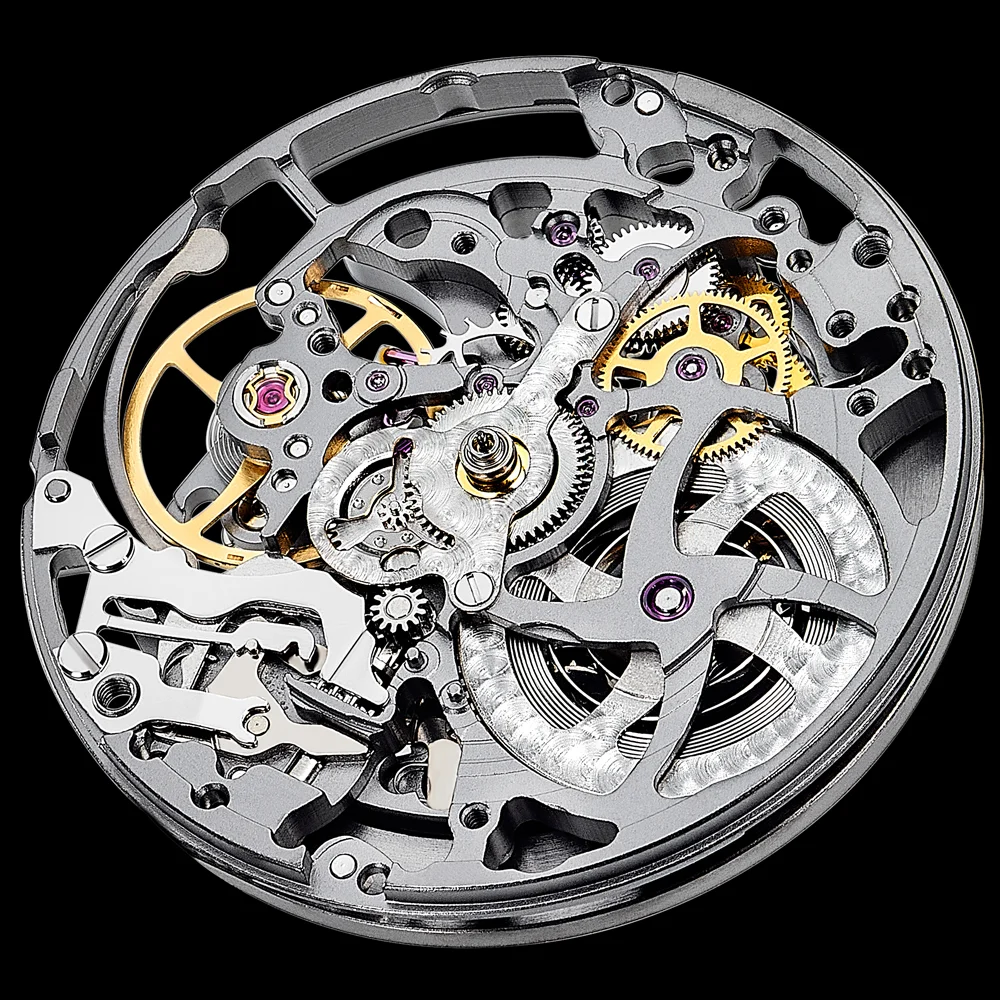
Perrelet has clearly embraced modernity but has also respected some traditions. For example, the movement is enlivened with sections of circular-graining, a historical form of decoration also termed ‘perlage’. Furthermore, as mentioned earlier, the Maison has endowed this model with an automatic movement, a nod to the brand’s founder, Abraham-Louis Perrelet (1729-1826). He invented the pedometer, a device that inspired the making of the first self-winding movement.

An automatic skeleton watch is a rare sight in watchland as the presence of an oscillating mass usually impairs the coveted front to rear views; however, in common with most Perrelet models, the rotor on this watch is openworked. In addition, the brand has ensured the transparent hour track remains free of visible obstructions. The resultant Weekend Skeleton offers the convenience of a self-winding movement while still delivering the desired mechanical nudity all ‘skeleton-lovers’ crave.
Perrelet Weekend Skeleton – closing remarks
With the release of this new model, the Bienne-based brand has enlarged its Weekend collection, a suite of models it first unveiled in 2019. Building on its impressive patrimony, the Weekend Skeleton is endued with an automatic movement, respecting Monsieur Perrelet’s legacy, while delivering wearer convenience.
The hour track is clear, save for the succinct indices that span the minute track and movement. It’s a delightful detail that reinforces the pellucidity theme.
A problem that afflicts some skeleton watches is the indications sometimes appear lost in an intricate labyrinth of movement parts. However, the Weekend Skeleton sidesteps such issues by positioning rhodium-plated hour and minute hands above an anthracite NAC coated movement. The resultant tonal contrast ensures everything is eminently legible.
However, where the Weekend Skeleton breaks new ground is by delivering the aesthetic joy of skeleton watch ownership at a price that won’t break the proverbial bank. It does so by using technology to deliver product excellence, consistency and value. I wonder whether Perrelet might consider branching out into making mega mansions, hypercars and superyachts?’
Further reading
Technical specification
- Model: Perrelet Weekend Skeleton
- Reference: A1306/1 (black PVD steel case/black indices)
- Reference: A1306/2 (black PVD steel case/blue indices)
- Reference: A1305/3 (black PVD steel case/green indices)
- Case: stainless steel with matt black PVD coating, diameter 39.5 mm, height 9.61 mm, water resistance 5 ATM (50 m), sapphire crystal to the front and exhibition case back.
- Functions: hours, minutes, centre seconds
- Movement: Perrelet in-house calibre P-351-SQ, self-winding movement, frequency 28,800vph (4Hz), 25 jewels, power reserve (fully wound) = 42 hours
- Strap: black calf leather strap with alligator motif and grey stitching, equipped with a black PVD steel buckle adorned with the Perrelet logo.
- Price: €1,950 (RRP as of 8.11.2024)