
Guebly Prologue Watch Review
The Guebly Prologue is the brainchild of Adnane Kerd, a former collector turned watchmaker who has lavished much time and love on this high-end timepiece, something that is manifest with a loupe. Mark McArthur-Christie, horophile and unabashed petrolhead, provides an overview of this ultra-refined titanium watch.
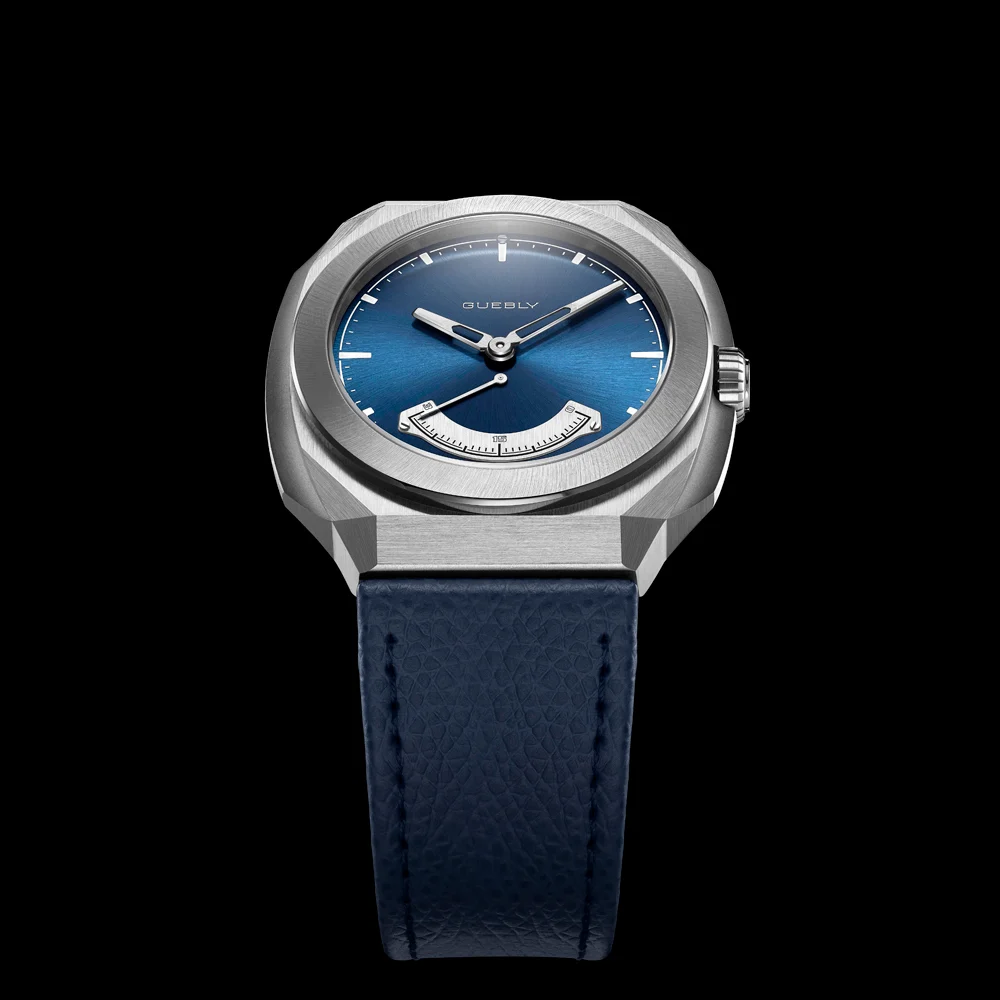
Guebly watch
At a casual glance, an X350 Jaguar XJR looks as though it belongs in the carpark at the local golf club, perhaps with a furled, malacca-handled umbrella on the rear seats and a box of tissues gracing the parcel shelf. Use it to waft, weekly, to Waitrose and you can almost smell the tin of travel sweets. But plant your right foot and that 4.2-litre supercharged V8’s 400lb ft of torque will fling you from the morning ferry at Ouistreham to Chez Philippe in Geneva in time for lunch, all without disturbing your enjoyment of Miles Davis at 155 mph.
There’s a lot to be said for understated engineering like this, undermining the odd expectation and doing something apparently simple, very, very well. It’s what Adnane Kerd and his hand-picked team have done with the inaugural Guebly watch, the Prologue. This impressive team includes Voutilainen & Cattin in Saignelégier (who looked after the dial and case) and Olivier Mory, Horocraft SA (a company owned by Sylvain Pinaud), Charles Zuberhave, Nathalie Jean-Louis and Luca Soprana (the specialists behind the movement).
From the front, it’s a simple three hander, albeit with a retrograde seconds to give the game away a little. But under the sapphire caseback is the horological equivalent of the XJR’s jewel of a V8, although a lot better-looking. But more of that later – let’s start with the bodywork.
Guebly Prologue – case
Like the XJR, the Guebly Prologue is a lot lighter than it looks, thanks to its case cut from a block of Grade 5 titanium. If you were to guess at the size, you might opt for 40 mm, perhaps 39 mm. It’s actually 42 mm (just over 10.5 mm deep), but the cinched-in case sides, integrated lugs and chamfered edges make it seem – and wear – smaller.
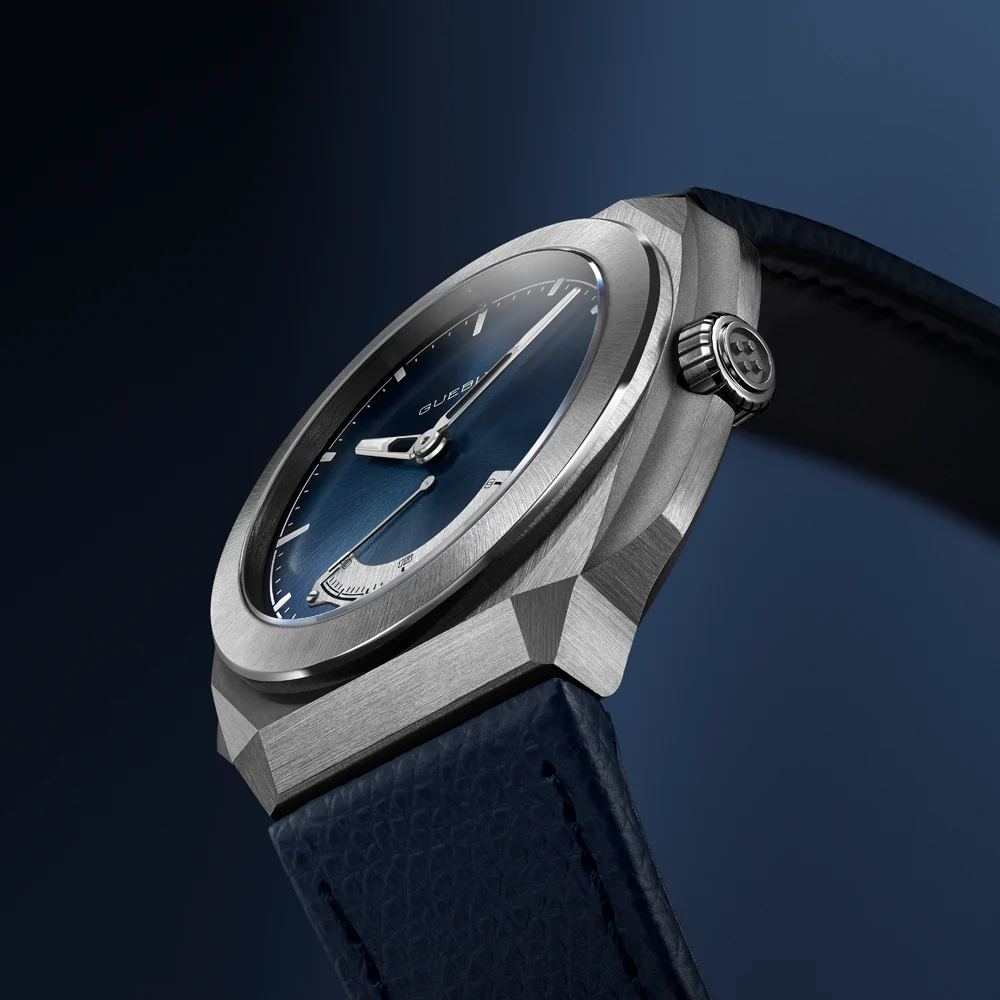
The recessed crown also helps reduce the visual size. It’s comfortable too, with a concave caseback and a concave sapphire crystal to match.
It’s good to see titanium turning up more often as the material for Haute Horlogerie casemaking. It doesn’t have the intrinsic value of gold or platinum, but its strength, lightness and corrosion resistance make it a far more rational engineering choice. It’s also a thoroughly aesthetic option; titanium is far better at dealing with the sort of scratches everyday wear dishes out. That’s because of the way the metal oxidises, with its ability to create an oxide layer that ‘heals’ light surface marks. You can wear a titanium watch without the same trepidation about scratches an 18ct gold case might give you – and also without worrying it might attract the wrong sort of attention.
That’s not to say the case is in any sense utilitarian. You can get a sense of how much work has gone into making this apparently ‘simple’ case by zooming in on the point where the multifaceted lugs and case side meet. You’ll see how the straight-grained flank of the bezel edge sits adjacent to a high polish bevel, then a different grain of straight brushing graces the upper surface, once again, changing direction. Just look at the way each different face is finished – graining in different directions as well granular caseband sections.
The round bezel has been hand-polished, sandblasted, straight grained, hooped, pearled and snailed on both the inner and outer surfaces. There aren’t many finishing options left after that. The titanium crown gets sandblasted, each face of those notches is satin-finished and then its tip is mirror-polished. When was the last time you saw that much thought, effort and, to put it bluntly, sheer ability – going into a bezel, case and crown? You could put a case like this on a plinth in a gallery and people would pay to see it. Despite all this, if you’d rather just wear it – after all, that’s what it’s designed for – you’ll be fine getting your watch wet. You get all that sculptural quality and a practical case you can swim with down to 10 ATM of pressure.
All this would be challenging enough to achieve on a stainless steel case. Achieving it with titanium is a 10 espresso job and needs the sort of skill that usually necessitates uncomfortable midnight conversations about the price of one’s immortal soul.
Guebly Prologue – dial
This is a watch where the specifications really don’t come close to telling the whole story. Look at that dial – the specs say ‘Blue colour, appliqués and hands in titanium, hour and minute indications at the centre, retrograde appliqué in titanium.’
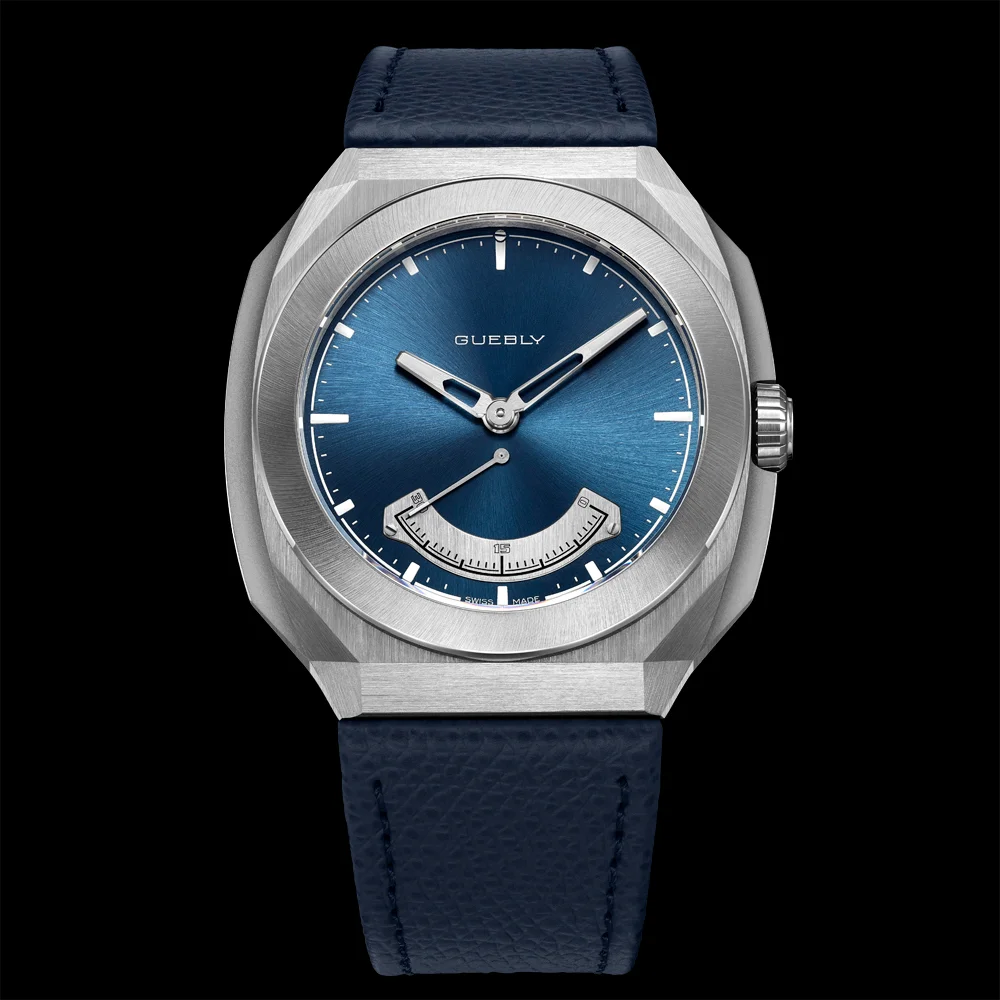
That may be the best case of under-promising and over-delivering I’ve seen for a while. For a start, the colour took a year of testing and trialling to get right. And it doesn’t cover the dial printing process either. Adnane Kerd explains,
My inspiration for the design came from period watch faces. I didn’t want to make a dial with added indexes, but I’ve always liked the “décalque” or pad printing as can be found on old Rolex and Patek Philippe dials. It’s a detail that makes the fine workmanship stand out a little bit more. When you look at this beautiful décalque, it’s just perfect, but at the same time also imperfect because it’s handmade, and that gives the watch its soul.”
The dial is screwed in three places (at both ends of the retrograde sector and at noon with visible screws) and even its underside has been given a pearled finish. The appliqué retrograde seconds scale is, like the case, titanium and secured with two of those screws. But it’s not laser-etched. That would have been too easy for Kerd and his team. Instead, it’s pad-printed by hand. Pad-printing titanium is challenging enough with a smooth surface, but this one is brushed.
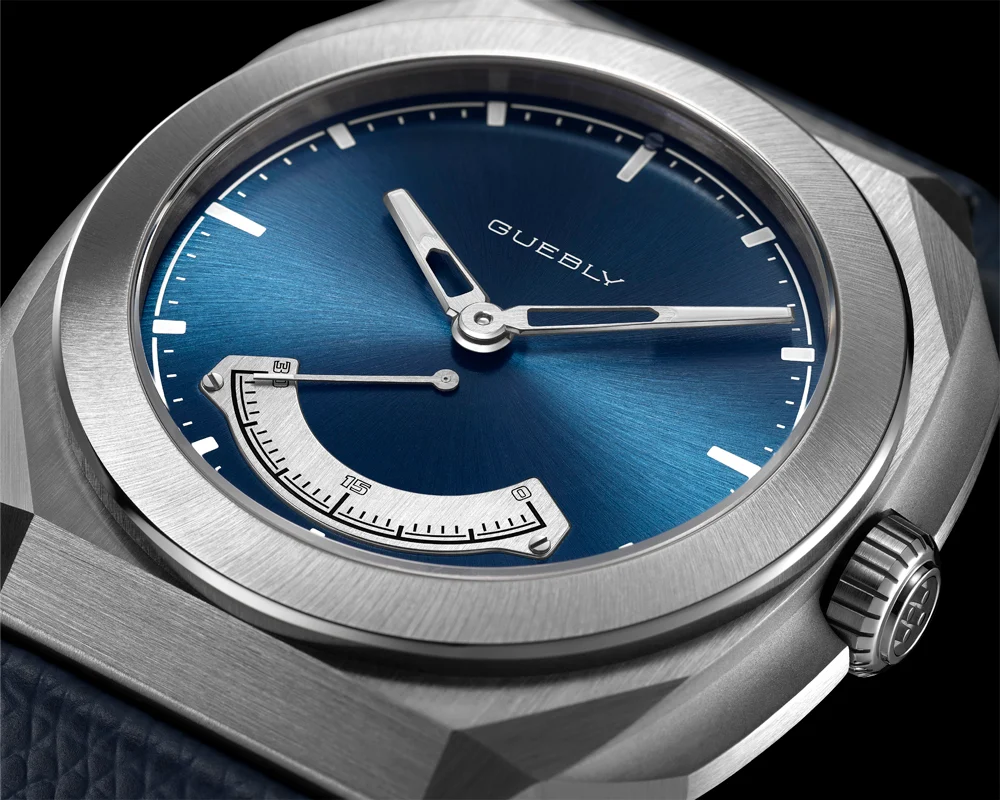
The retrograde seconds hand runs along the tracks of a 120-degree scale and at the end of each 30 second period, it jumps back to the start.
Guebly Calibre 21.31
Then there’s the movement, the Calibre 21.31. As Adnane explains, “for the construction we started with Olivier Mory and the tasked Horocraft SA ( a company owned by Sylvain Pinaud ) with the fabrication of the baseplates and bridges”. The finishing was completed by Nathalie Jean-Louis et Luca Soprana. Titanium is again the metal of choice for the mainplate and bridges, with all the machining and finishing challenges that it brings. Guebly say the level of decoration “…exceeds even the stringent requirements of the Poinçon de Genève, the Geneva Seal.” You can see from the images that the top edges of each bridge are brushed, chamfered and polished and their centres are grained.
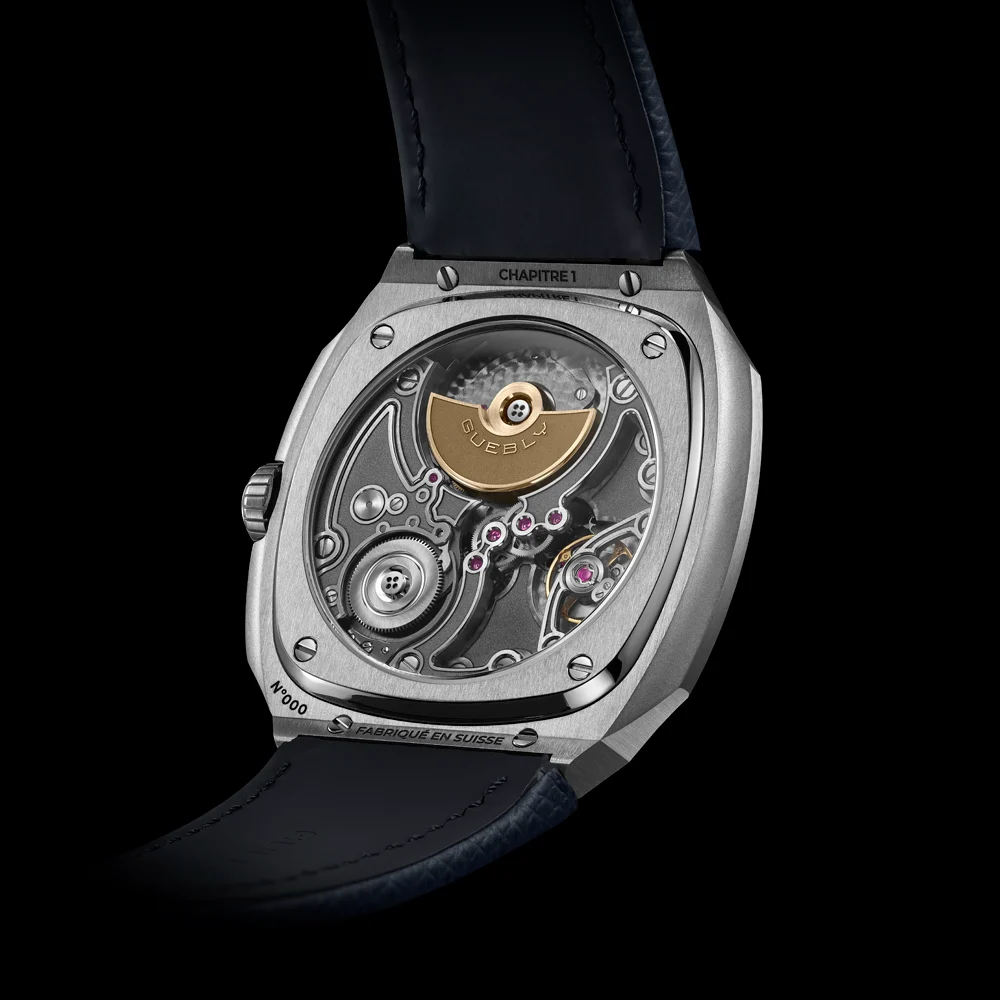
The 215 component movement is powered by the gold micro-rotor, running on tiny steel ball bearings and held with a neat – and secure – four hole screw. The same type of fastener holds the double-snailed barrel (polished gear teeth too), and even the click spring is grained with bevelled, polished edges.
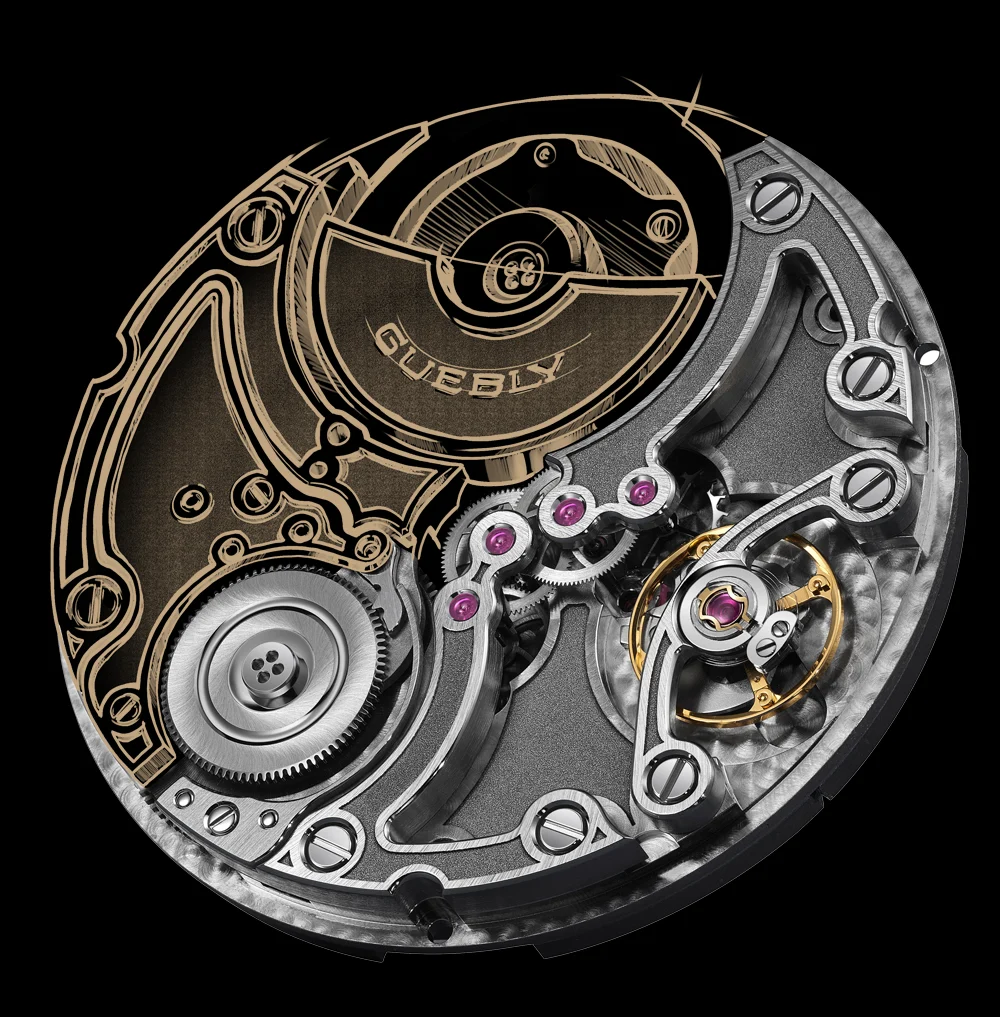
It’s not just a delight to look at, the whole thing keeps the balance spinning for 70 hours without any winding or movement. The variable inertia balance is worth a mention in its own right. That’s partly because it’s finished to within a fraction of an inch of its life, but also because it’s made by perhaps the most creatively and aptly named Swiss horological business – Atokalpa. I can’t think of a better name for a company that makes escapements and balances.
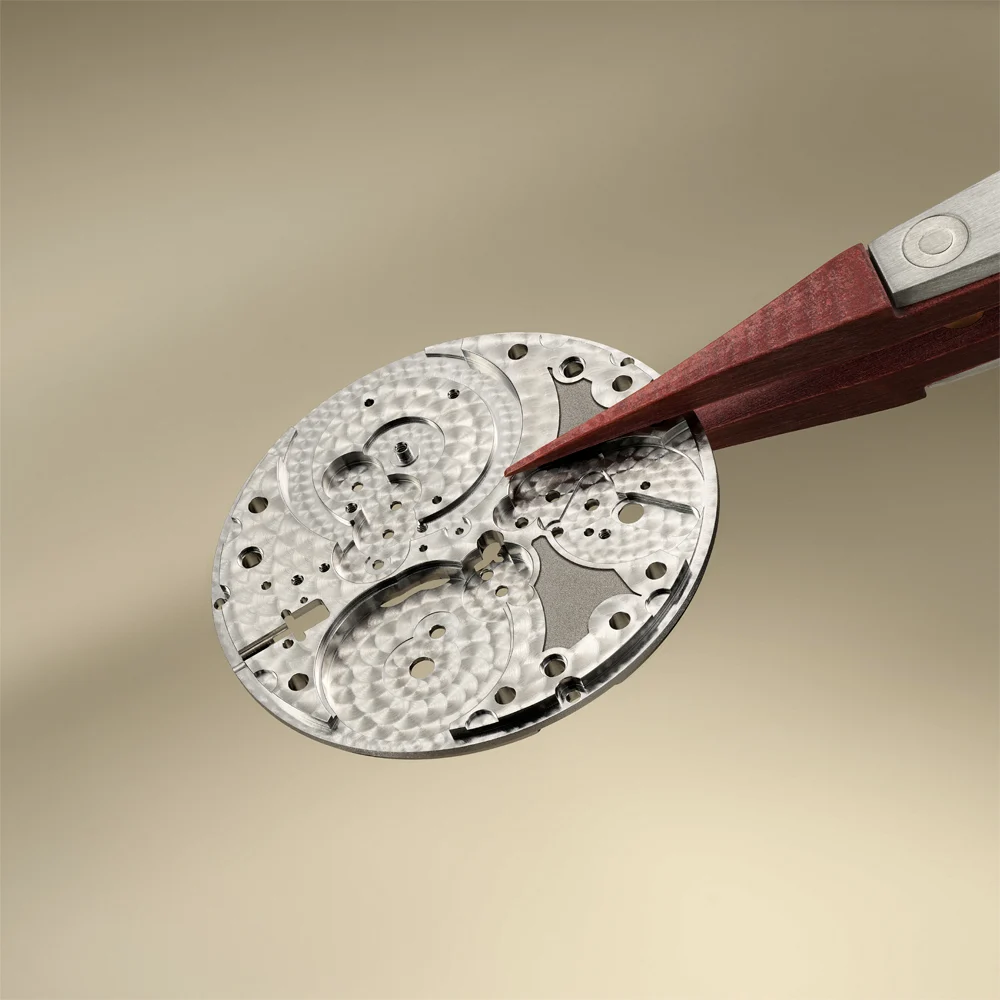
Image above – mainplate
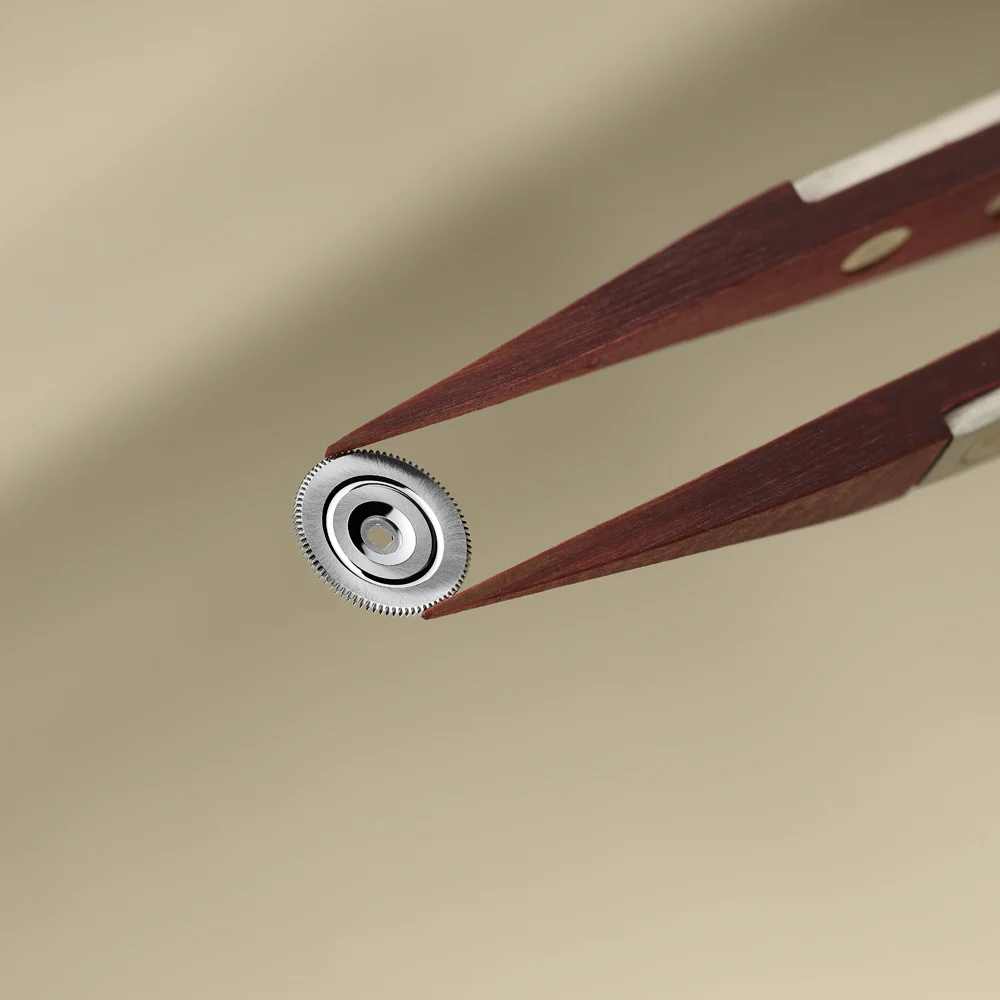
Image above – ratchet wheel
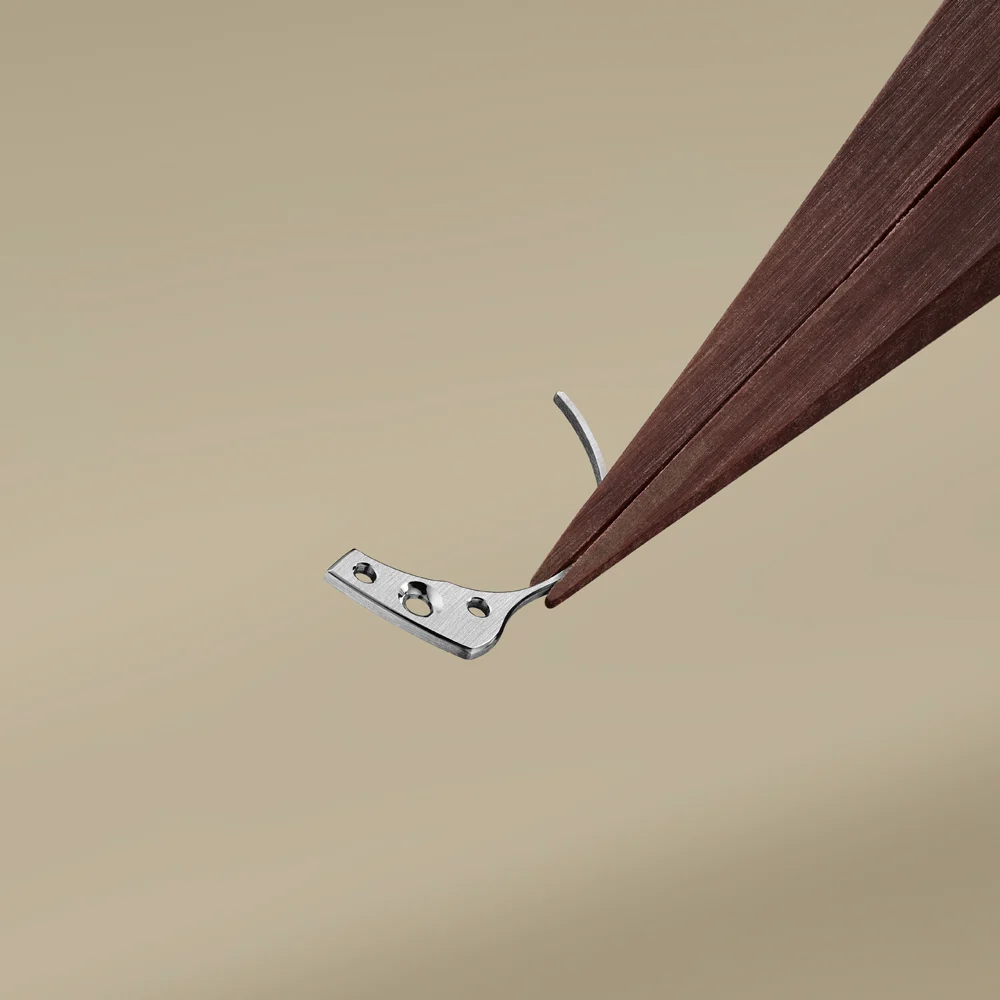
Image above – click
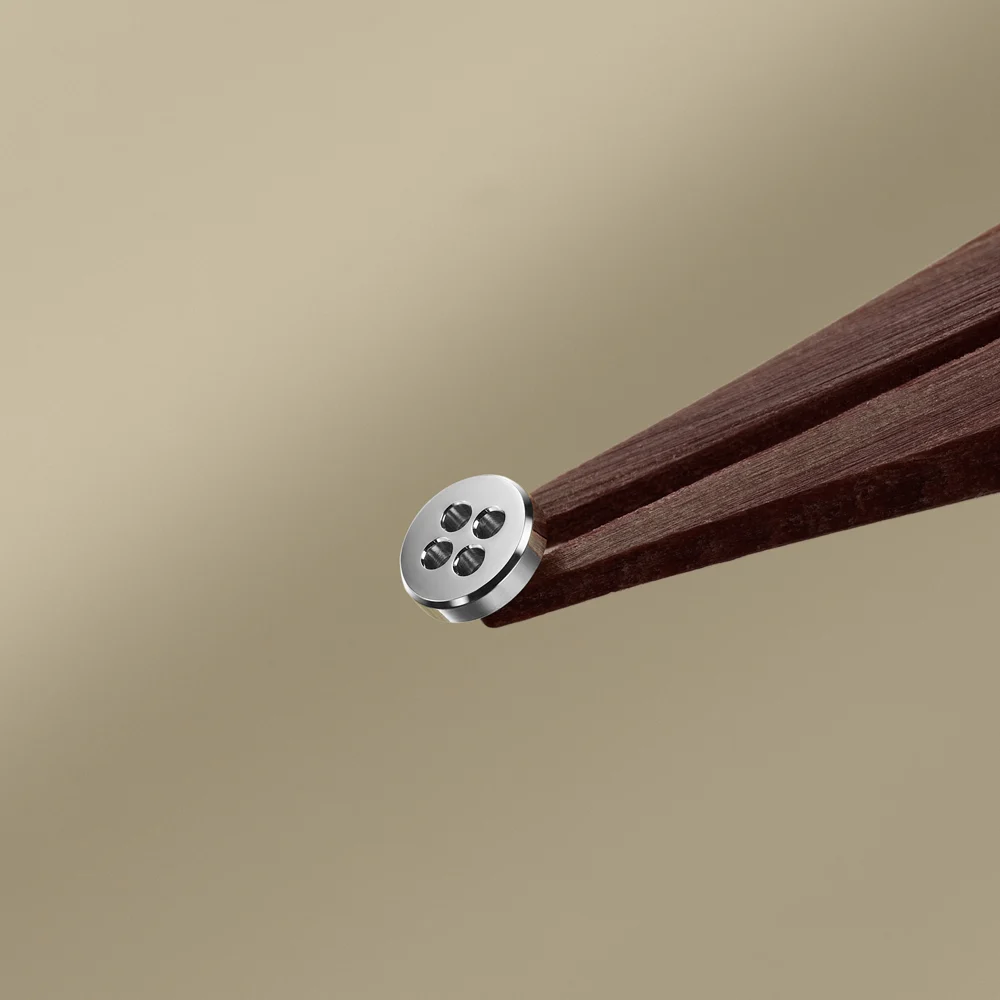
Image above – four hole screw for ratchet / micro-rotor
It’s a little hard to see the going train, hidden as it is behind those titanium bridges, but focus in and you might spot that the gear spokes are curved and spiral grained, giving them a sense of extra movement. All done by hand. Again. In fact, the screws in the movement are exclusive to Guebly and all hand-polished and chamfered to a perfect finish. This is a frankly scary – in a good way – level of focus and obsession.
Guebly Prologue – closing remarks
Guebly doesn’t have the weight of a corporate marketing department behind it nor an established brand; the advertising budget’s gone into producing the watch, not funding cocktail parties. That means the Prologue has to stand on its own merits. Fortunately, the hours of planning, design, work, sheer damn craft and love that have gone into it mean it has more than enough attributes to succeed. This is the sort of watch you’ll buy if quality means more to you than hype. And even at CHF 38,900, it should prove a great deal cheaper to run than a supercharged Jaguar.
Further reading
Technical specifications
- Model: Guebly Prologue
- Case: Grade 5 titanium, diameter 42 mm, thickness 10.56 mm, water resistance 10 ATM (100m), sapphire crystal to the front, exhibition case back.
- Functions: hours, minutes and retrograde seconds
- Movement: Calibre 21.31, self-winding movement, frequency 28,800 vph (4 Hz), 35 jewels, power reserve approximately 70 hours.
- Strap: blue grained calf leather with blue rubber lining, velcro closure and Grade 5 titanium buckle
- Price on application
- Limited Edition: 15 pieces