
NOMOS Gold Watches – an overview
Recently, NOMOS released five new gold watches; three Tangente references and two Ludwig models. Since it was founded in 1990, the Glashütte-based watch brand has gained a reputation for crafting attractive, well-made and reliable timepieces. Moreover, by embracing the ideals of the Deutsche Werkbund, NOMOS repeatedly creates watches that deliver an impressive quality/price ratio. Angus Davies asks, “Can the German brand democratise the gold watch?”
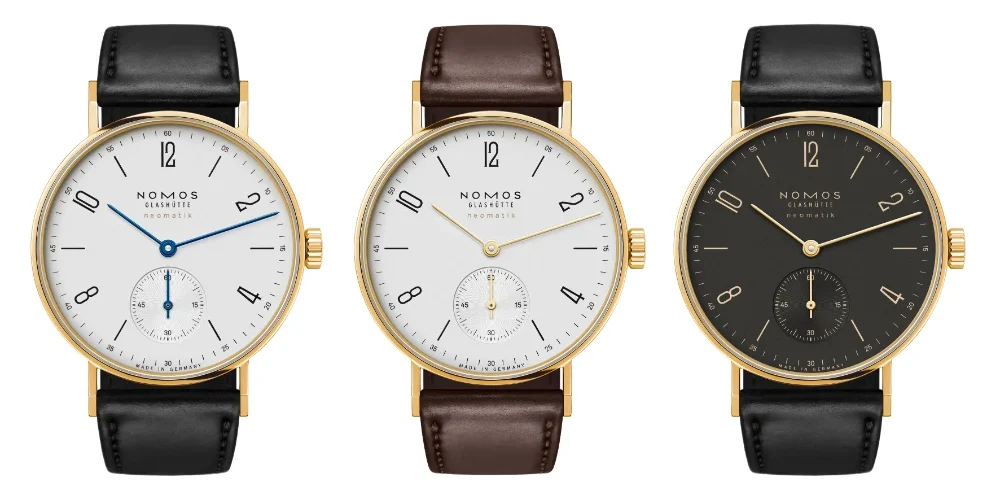
Image – Tangente Gold (Ref 161, Ref 162 & Ref 163)
NOMOS Glashütte seit 1990
The story of NOMOS Glashütte began in 1990 when Roland Schwertner chose to establish a watchmaking business in the former DDR. He set up shop just two months after the fall of the Berlin Wall, establishing his fledgling firm in Glashütte. The town, nestling within the Ore Mountains, has a long history of watchmaking dating back to 1845, when Ferdinand Adolph Lange opened his inaugural workshop with just 15 apprentices.
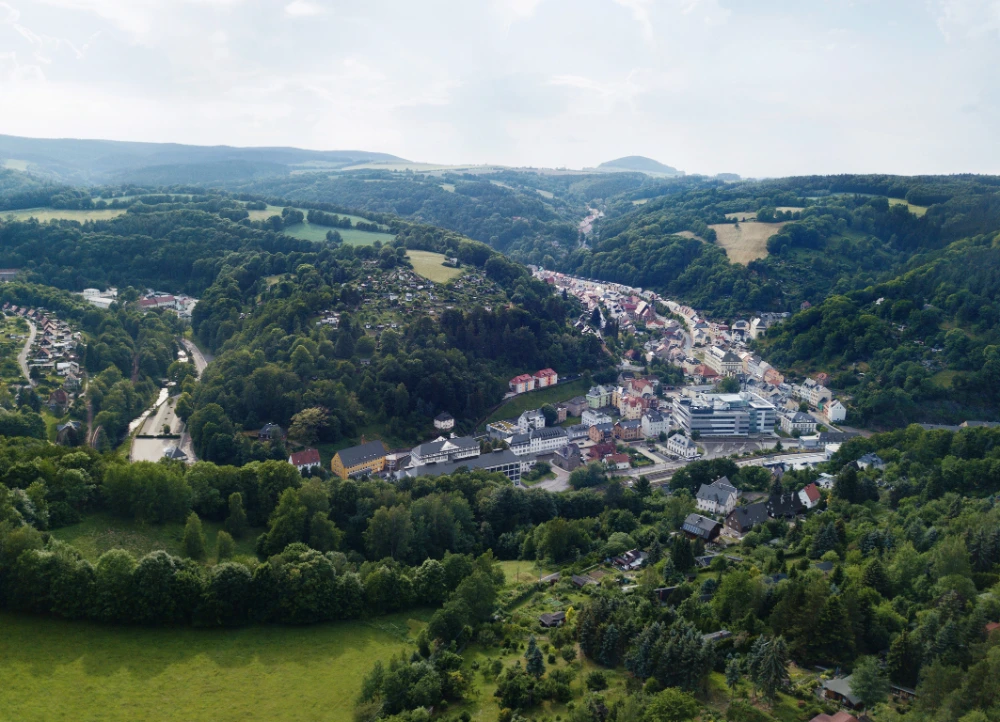
Image – Glashütte viewed from above
Back in the 19th century, Glashütte attracted other horological luminaries, such as Julius Assmann (1827-1886) and Carl Moritz Grossmann (1826-1885), and soon became the epicentre of fine German watchmaking, leading to global recognition. Both WWII and the subsequent emergence of the DDR had a detrimental effect on the town’s watch industry, with many illustrious brands disappearing. Thankfully, since the reunification of Germany, the picture-perfect watchmaking town has enjoyed a renaissance.
Schwertner was not a watchmaker by trade. On the contrary, he had a background in IT and photography. However, at the age of 38, armed with an MBA, he had a vision for a new German watch brand. Interestingly, NOMOS’s first premises were once home to Ferdinand Adolph Lange’s workshop, the birthplace of Glashütte’s watchmaking industry.

Image – Roland Schwertner (2021)
In 1992, NOMOS released its inaugural collection comprising four models, namely Ludwig, Orion, Tangente and the Tetra. All the models were designed by Susanne Günther, a graphic designer who was known to Schwertner. Her design influences included Bauhaus, the Deutscher Werkbund and the Ulm School; styles that were intended to be timeless, destined to retain aesthetic relevance for decades to come.
Deutscher Werkbund
Founded in Munich in 1907, the Deutscher Werkbund (German Work Foundation) united the worlds of art, craftsmanship and industry. It set out to foster collaborations between artists, architects, designers and industrial producers.
With an emphasis on functionality and quality, due consideration was specifically given to durability and the ‘honesty of materials.’ Rather than focus resources on crafting bespoke or individual items, emphasis was placed on standardisation. Bridging craft and industrial production, the Deutscher Werkbund promoted modern, practical, minimalist yet attractive designs that were suitable for serial production. One of the founding principles of the Deutscher Werkbund was to create products and buildings that were quintessentially German, imbued with notable quality and distinctive, unfussy styling.
Bauhaus, the legendary school of design, architecture and applied arts was founded by Walter Gropius in 1919. It was heavily influenced by the Deutscher Werkbund. The Ulm School of Design was established in 1953 by Inge Scholl, Otl Alcher and Max Bill and sought to develop socially minded designers who subscribed to modernist principles. Together, Bauhaus, the Deutscher Werkbund and the Ulm School have all influenced the design and construction of each NOMOS model. Today, NOMOS Glashütte is a member of the Deutscher Werkbund and arguably its influence casts the longest shadow.
The brand’s approach to design has gained widespread approval from both watch aficionados and design experts. Indeed, ‘as of September 2025, the brand has won over 175 international prizes and awards for watchmaking and design.’
Made in Glashütte
Beyond its prepossessing visage, a NOMOS watch also has an inner beauty. Moreover, the brand has always sought to be independent and immune to the vagaries of third-party suppliers. In 2005, it created its first in-house movement, the Alpha calibre (now called the calibre DUW 4001). Since then, the company has been prolific, creating a suite of manual and automatic movements. It currently produces 13 in-house calibres (as of September 2025).

Image – NOMOS train station
In 2014, after seven years of research and having invested €11 million, NOMOS released its own ‘swing system’ (a term the brand uses to describe the escapement and regulating organ). Most watch brands call upon the services of a specialist supplier, mindful of the technical complexity of such components, but NOMOS, once again, showed that it preferred the notion of independence.
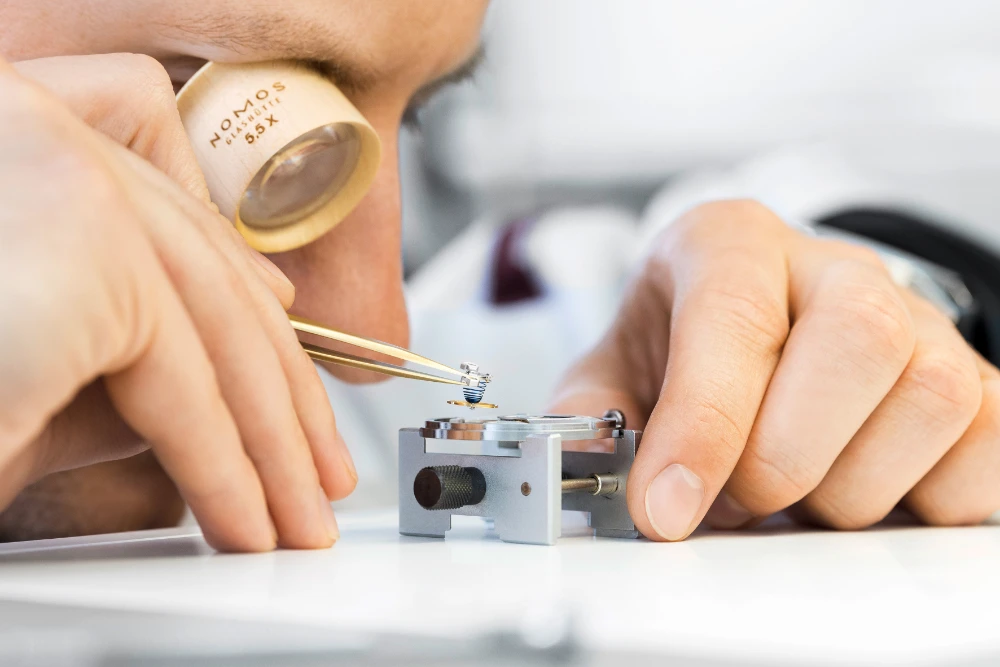
Image – the balance wheel
Today, Glashütte is a designation that has become a byword for watchmaking excellence. In 2022, legislation was passed relating to watches bearing the name Glashütte. Termed the Glashütte regulation, at least 50% of its ‘essential manufacturing stages’ must take place in Glashütte. This latter term refers to ‘the manufacturing and casing of the movement and the final inspection of the watch.’
NOMOS gold watches – introduction
Since it was founded, NOMOS has democratised luxury. As mentioned earlier, it has subscribed to the ideals of the Deutscher Werkbund, placing much emphasis on the importance of design, craftsmanship and quality. The brand has also adopted an egalitarian approach to business, conceiving watches that unite German quality with affordability.
NOMOS Lambda & Lux models
I confess that I was somewhat surprised when NOMOS unveiled the Lambda and Lux models back in November 2013. These exquisite watches are housed in 18-carat gold cases and feature hand-wound movements. Hand-engraved balance cocks, gold chatons and swan neck regulators are just some of the highlights found on these über-refined models. Made for purists, these beautiful watches are expertly crafted, demonstrating the German brand’s in-house expertise.
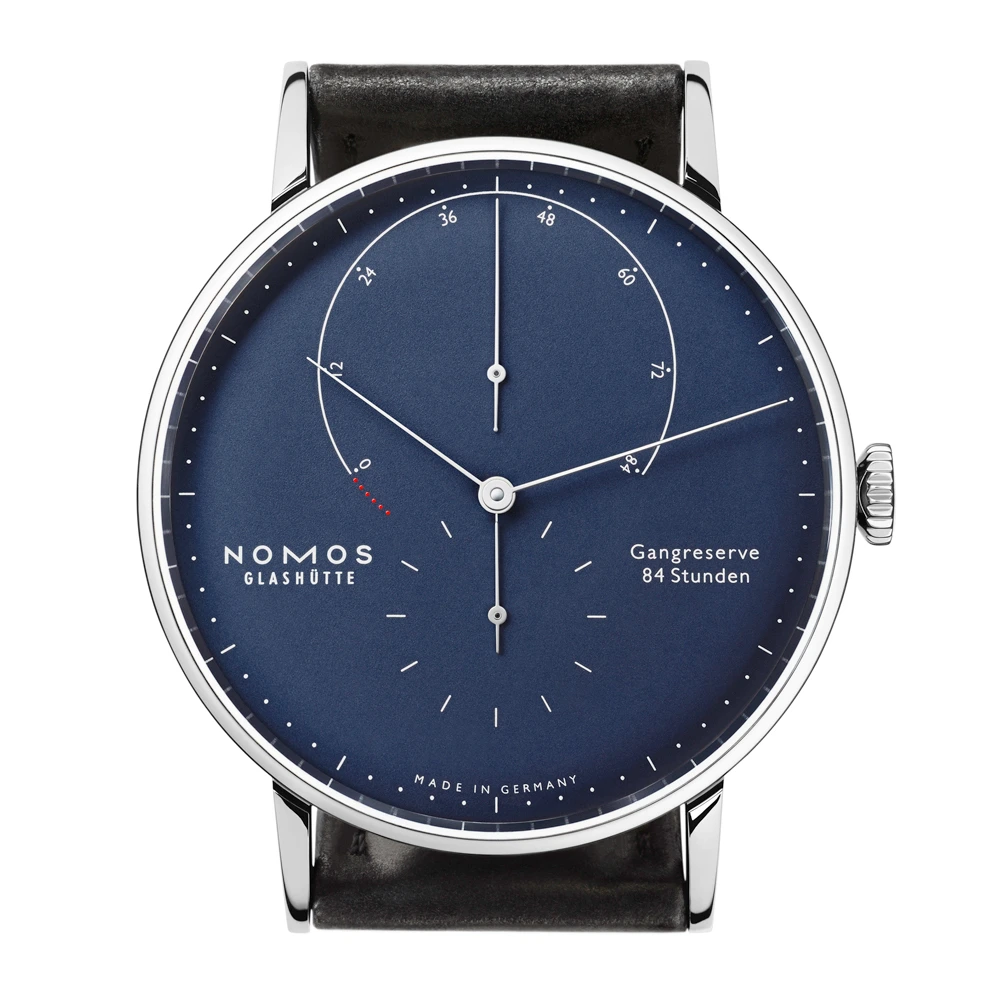
Image – Lambda deep blue Ref. 935
However, the specification of each movement (Calibre DUW 1001 and Calibre DUW 2002) with their ultra-refined finishing, coupled with the scarcity of gold, places these models in a higher price segment than core NOMOS watches. At this juncture, I have to add that the Lambda and Lux still prove more accessible than rival watches from Haute Horlogerie’s old guard, but nevertheless they will forever remain aspirational products for most regular horophiles.
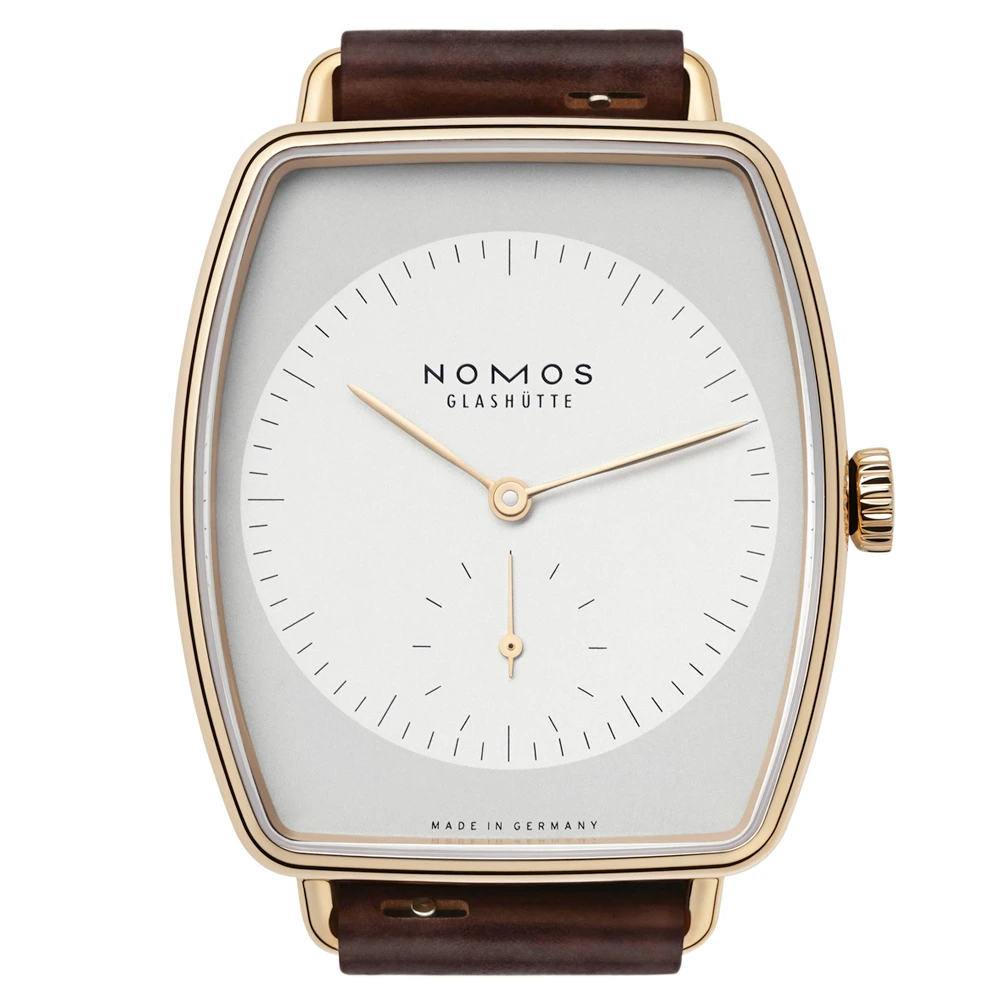
Image – Lux Hermelin Ref. 940
NOMOS Metro rose gold neomatik 39
In 2017, NOMOS unveiled a version of Metro housed in a rose gold case and equipped it with its tried and tested Calibre DUW 3001, a self-winding movement. Upholding NOMOS tradition, this watch is highly legible, stylish and features an in-house movement. While the Calibre DUW 3001 lacks some of the finesse of the movements found within the Lambda and Lux models, it remains incredibly attractive. Some of the refinements include thermally blued screws, Glashütte ribbing, perlage and a stop-seconds mechanism.
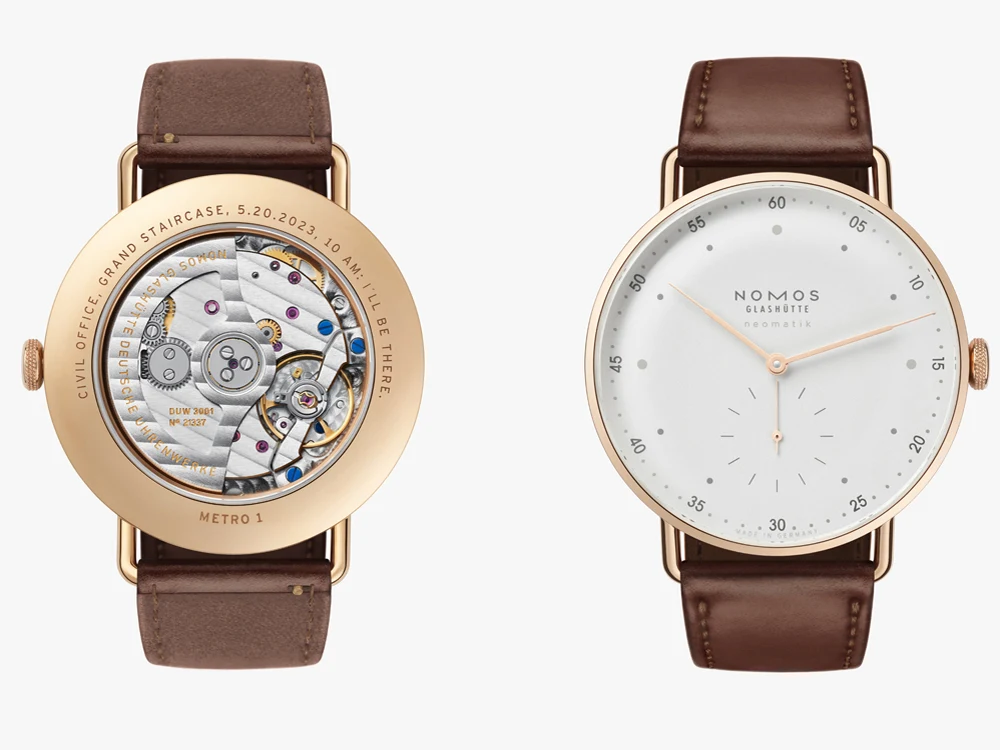
Image – Metro rose gold neomatik 39 Ref. 1180
This 18-carat gold watch is keenly priced at £10,000 (RRP as of 16.12.2025), a remarkable figure considering that 24-carat gold (99.9% fine gold) is currently trading for approximately £102 per gram.
NOMOS Metro rose gold 33
NOMOS released Metro rose gold 33 in 2019. This watch is endowed with the in-house Calibre DUW 4001, a hand-wound movement, again employed in various steel models. Measuring 33 mm in diameter, the smaller dimensions of this mean less gold is needed for its case, a factor that is reflected in a lower retail price of £8,800 (RRP as of 16.12.2025).
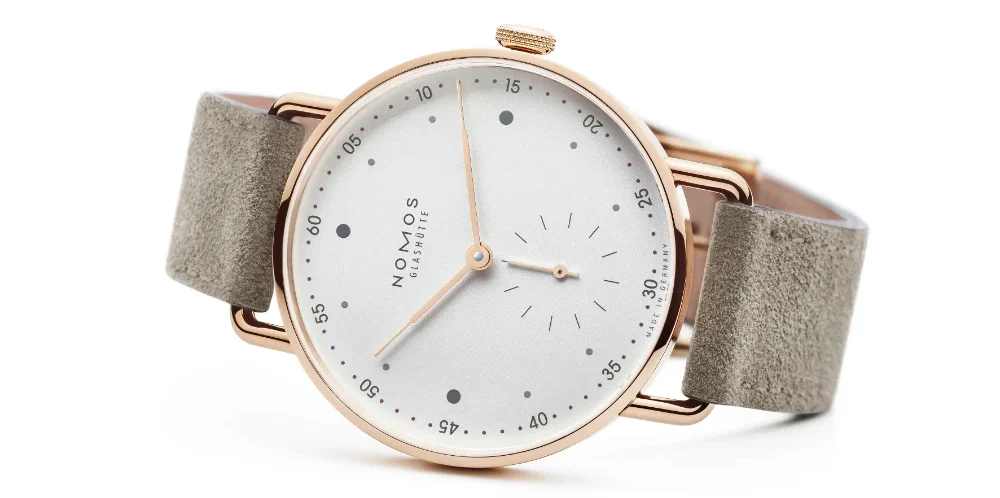
Image – Metro rose gold neomatik 33 Ref. 1170
NOMOS gold watches – an allure that endures
By releasing said Metro models in gold, NOMOS showed that it could create timepieces housed in noble metal that still proffered an extraordinary quality/price ratio. It achieved this feat, not by plating steel cases with a thin layer of gold or by using cheaper 9 or 14 carat gold, but by utilising existing movements, thereby achieving economies of scale. Rest assured, all NOMOS’s gold models are encased in solid, 18-carat gold.
The composition of gold
Survey the watch scene and you will notice that most purveyors of Haute Horlogerie use 18-carat gold (75% fine gold). Pure gold (99.99% fine gold) is unsuitable for watch cases as it is too soft, hence its pristine appearance will soon be marred by dents and scratches. In order to make it suitable for watches, pure gold is alloyed with other elements to both enhance its robustness and modify its appearance. For example, 18-carat 2N yellow gold (75% fine gold) is alloyed with copper (9-10%) and silver (15-16%). Alternatively, the composition of 18-carat red gold 5N (75% fine gold) includes copper (20-21%) and silver (4-5%). When producing 18-carat white gold (75% fine gold), the noble element is alloyed with various white metals such as palladium, nickel, silver or zinc (making up the remaining 25%).
Movements
It is worth reiterating that NOMOS use the same movements in the gold Metro timepieces as the equivalent models housed in steel. This allows the brand to enjoy economies of scale, thereby achieving efficiencies, sharing some of the savings made with the end consumer. It’s an approach that is aligned with the founding principles of the Deutscher Werkbund where standardisation facilitates the production of stylish and functional, quality products.
The demand for gold
Over the last 50 years, the demand for gold has increased exponentially. As a store of value, it is a trusted means of payment and is often considered a ‘safe place for funds’, particularly during periods of economic uncertainty. While some horophiles have selected a gold timepiece for its intrinsic worth, others have simply fallen for the noble metal’s appearance and the reassuring heft it provides when worn.
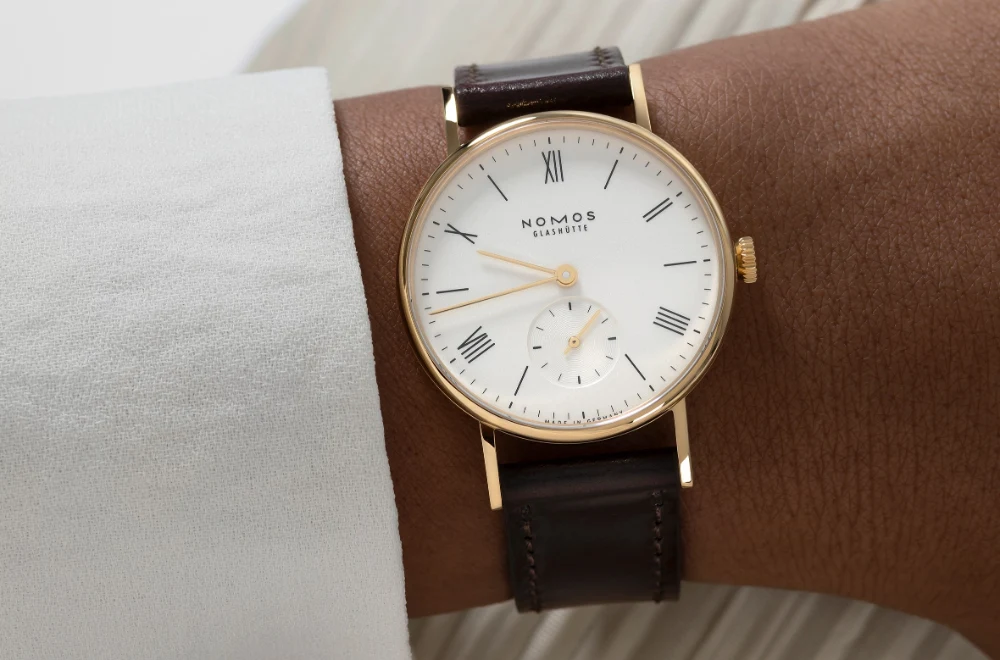
Image – Ludwig gold 33 Ref. 210
Since 2013, NOMOS has expanded its portfolio of gold watches, offering models in a variety of styles and sizes. In recent times, the brand has released the Ludwig 33 (2022) and the Tangente rose gold neomatik – 175 Years Watchmaking Glashütte (2023). Now, the brand from Saxony has released an additional five gold models.
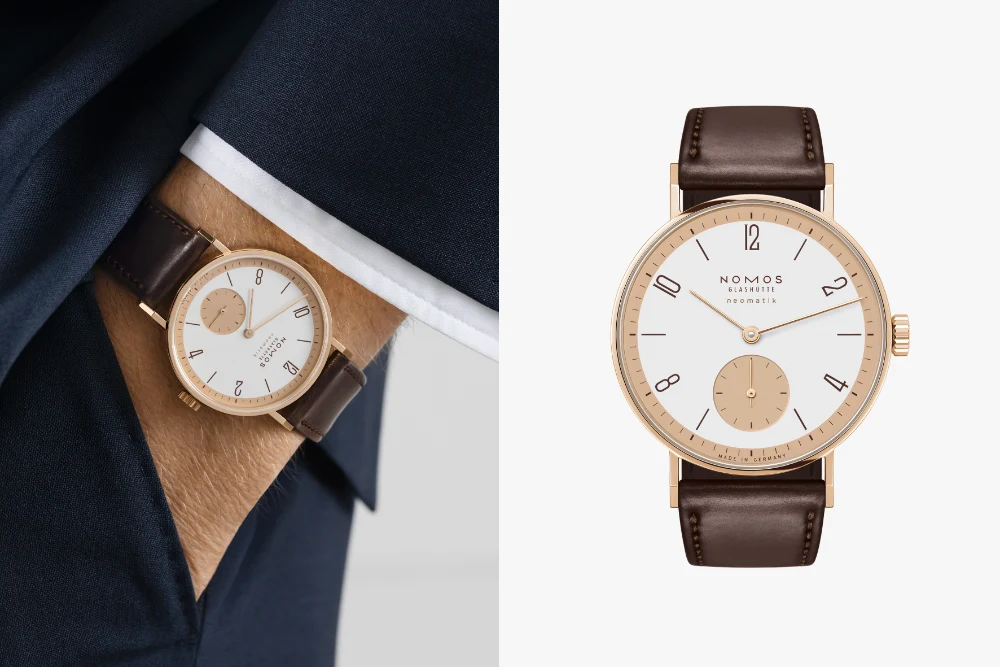
Image – Tangente rose gold neomatik – 175 Years Watchmaking Glashütte Ref. 160.S1
New NOMOS gold watches (2025)
The Tangente gold neomatik is offered in three dial variants: white silver-plated dial with blued hands (Ref. 161), white silver-plated dial with golden hands (Ref. 162) and ruthenium dial with golden hands (Ref. 163). Each version measures 35 mm in diameter, is fitted with the Calibre DUW 3001 and priced at £9,800 (RRP as of 16.12.2025).
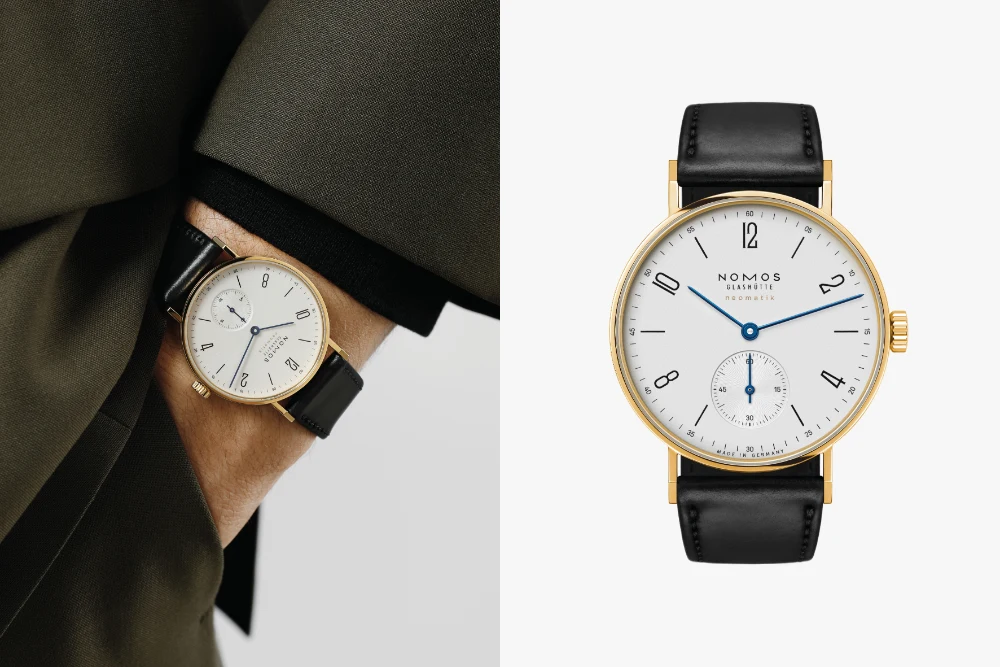
Image – Tangente neomatik gold Ref. 161
NOMOS has also released two versions of the Ludwig, once again, both are presented in a 35 mm gold case. Prospective purchasers can choose from a white silver-plated dial with blued hands (Ref. 211) or a white silver-plated dial with golden hands (Ref. 212). The Calibre DUW 4001 (formerly the Alpha movement) sits at the heart of each watch. Both references are keenly priced at £8,700 (RRP as of 16.12.2025).

Image – Ludwig gold Ref. 211 (left) and Ludwig gold doré Ref. 212 (right)
Closing remarks
NOMOS has travelled a long way in a comparatively short time. It has become a successful brand, uniting timeless aesthetics with refined and dependable movements. By adopting the ethos of the Deutscher Werkbund, it has shown that a watch can be attractive, well-made and represent good value. It’s an approach that has worked well and, according to the brand, ‘No other German manufacturer produces more mechanical watches than NOMOS Glashütte’; an impressive achievement, considering the company is only 35 years old.
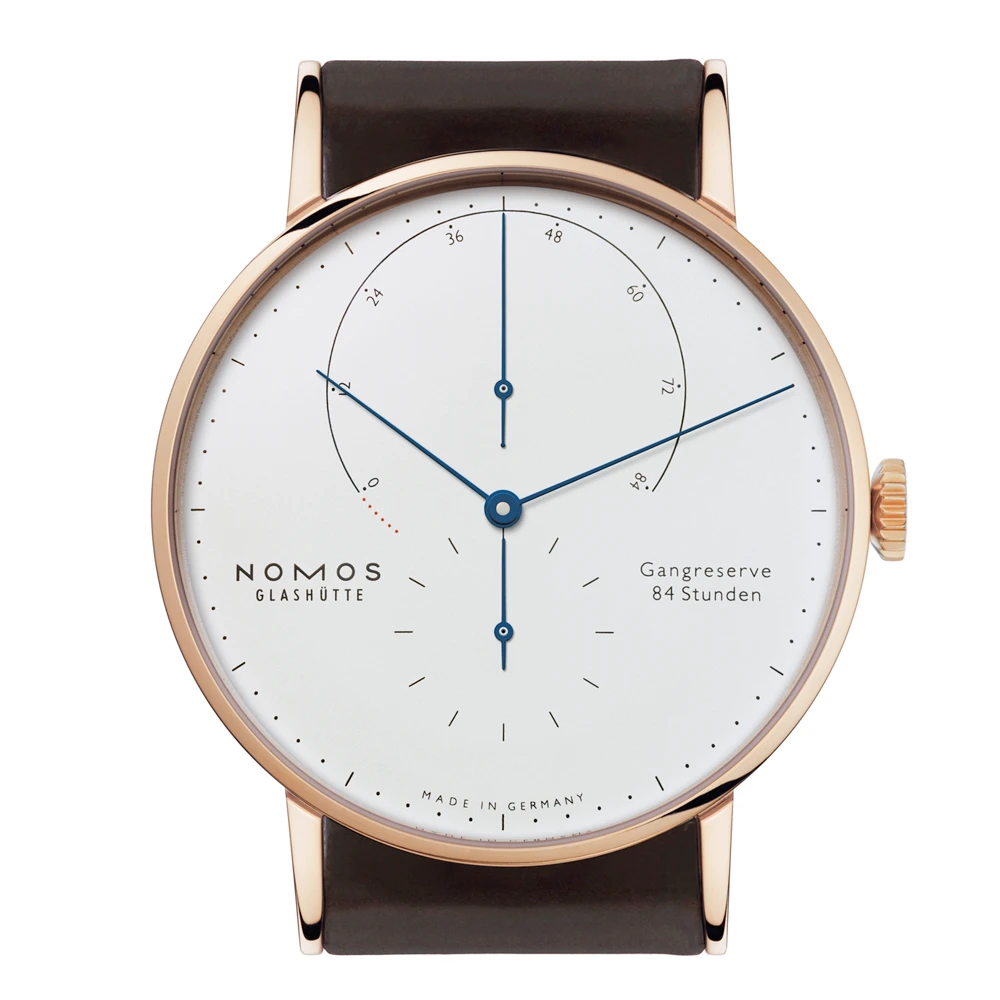
Image – Lambda 39 Ref. 953
Back in 2013, when I first saw the Lambda, I immediately fell under its spell. With its fine blued hands, chaste white dial, gorgeous hand-wound movement and rose gold case it stands comparison with watches from some of Switzerland’s most prestigious Maisons. However, the high quotient of hand craftsmanship and the amount of gold used in its construction still prevent it from being ‘accessible’ to most people.
As previously stated, NOMOS has a remarkable track record of democratising luxury by embracing the ideals of the Deutscher Werkbund; however, there is no escaping that the price of gold is determined by the open market, a factor not even NOMOS can fully address. Nevertheless, by using the same movements found in its steel models, NOMOS has made many of its gold models more accessible to a larger audience. What’s next for the German brand – acquiring its own gold mine?
Images – copyright: NOMOS Glashütte