
Seiko Prospex Marinemaster 1968 Diver’s Reinterpretation 300 m Watch Review
Back in 1968, Seiko was at the vanguard of professional divers’ watches. The Seiko Prospex Marinemaster 1968 Diver’s Reinterpretation 300 m in High Contrast Black (SLA079J1) captures the period look of the original and offers peerless readability, robustness and precision. Moreover, the model is not afraid of getting its hair wet. US-based Marcus Henry shares his observations.
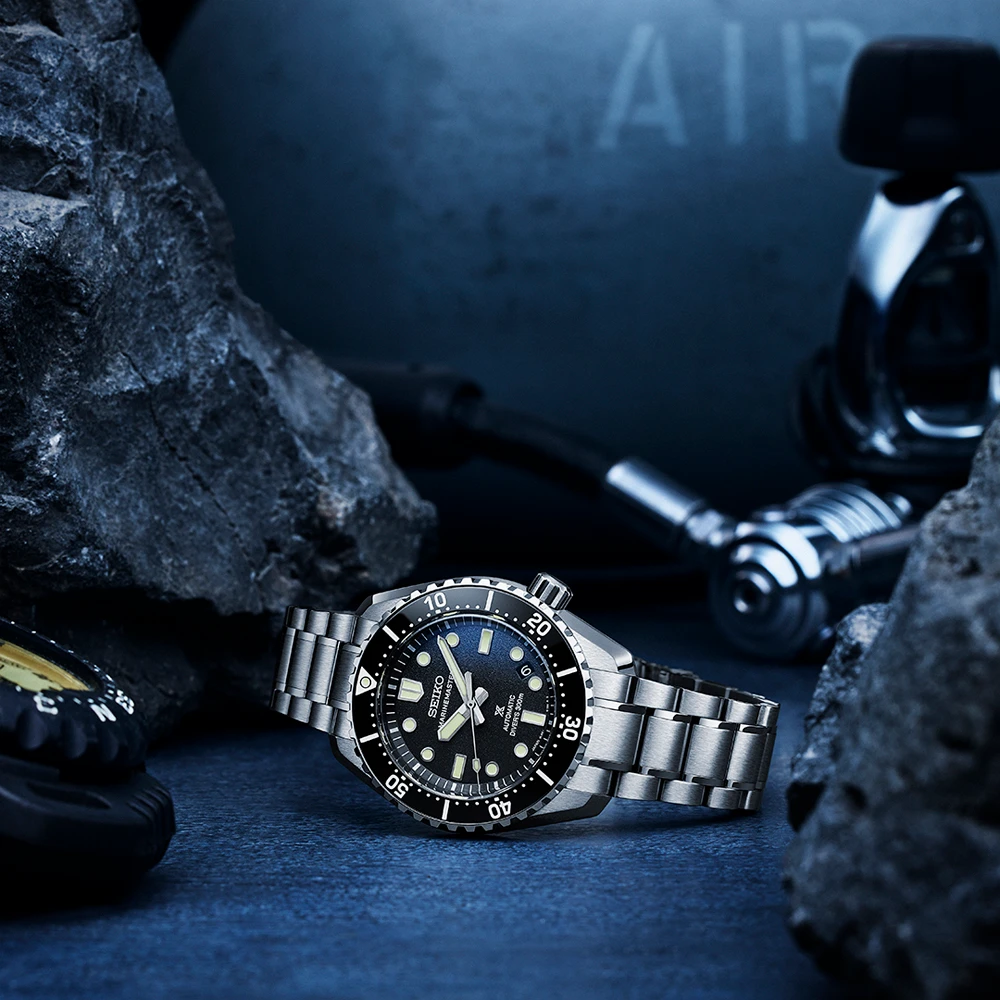
The first Japanese-made dive watch (1965)
In 1965, Seiko released the first Japanese-made dive watch with a maximum water resistance of 150 m. The following year, it was selected for the 8th Japanese Antarctic Research Expedition. The brand pushed the performance envelope further when, in 1968, it unveiled a watch that was water-resistant to 300 m and equipped with a 5Hz movement. Thereafter, the brand continued to innovate, patenting new ideas. The company’s expertise in making subaquatic watches made it a popular choice for professional divers and adventurous enthusiasts alike.
Seiko Prospex Marinemaster 1968 Diver’s Reinterpretation 300 m – introduction
Now, that beautiful and powerful 300 m dive watch from the past has been reimagined. Based on an iconic design and crafted in ‘High Contrast Black’ for maximum visibility, this new edition is one of my favourite releases of the summer. Seiko has a legacy worth celebrating and this is one of the best ways to do it.
The Japanese marque also offers a near-identical model, the Seiko Prospex Marinemaster 1968 Diver’s Reinterpretation 300 m in High Contrast Monochrome SLA077J1, equipped with a white dial. However, for many Seiko traditionalists, black is likely to be their preferred choice.
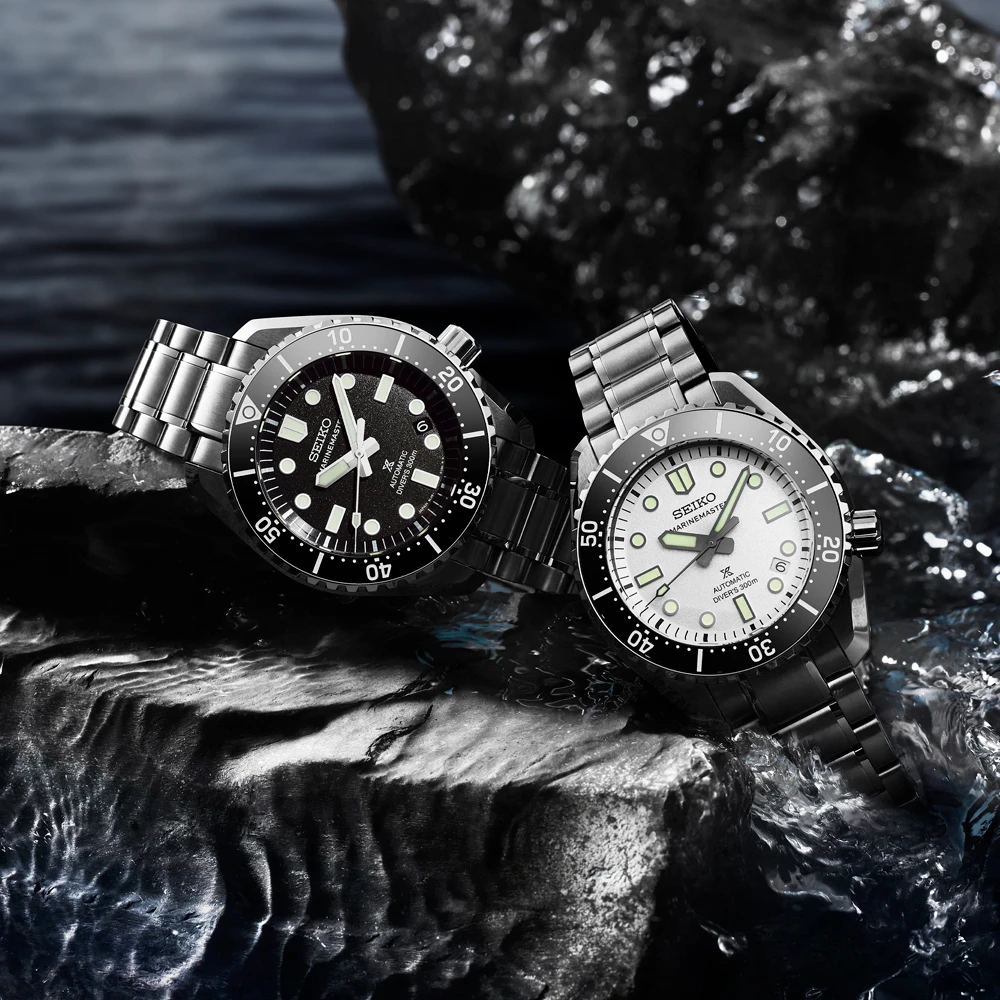
Seiko Prospex Marinemaster 1968 Diver’s Reinterpretation 300 m – dial
The black dial of the Prospex Marinemaster 1968 Diver’s Reinterpretation 300 m is endowed with a ‘subtle sand-like pattern’ for maximum light absorption, aiding readability. For professional divers, legibility is essential; hence Seiko has applied a liberal application of Lumibrite to the hands, indexes and bezel.
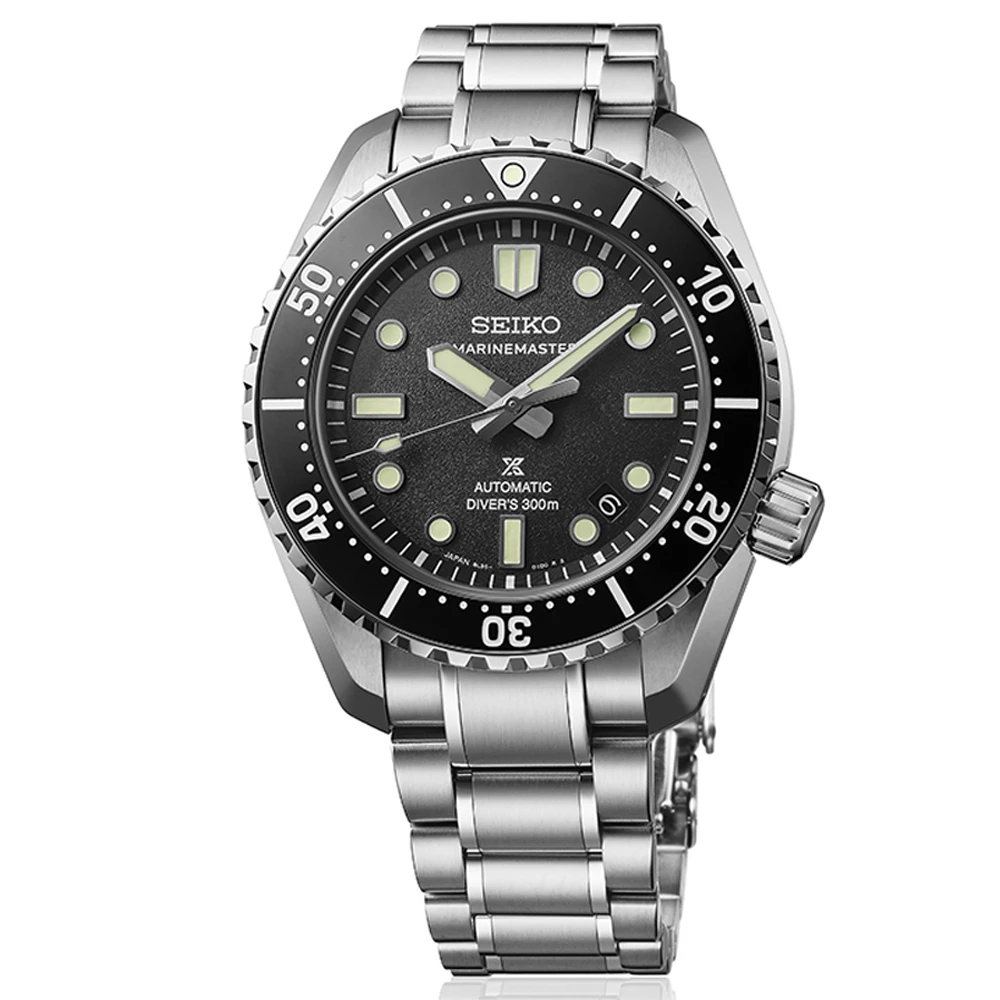
The hour and minute hands are broad and beautifully faceted. Rectangular indexes are positioned at 3, 6 and 9 o’clock, while the baton at noon is double-width. All remaining hour values are marked with a circular lume plot.
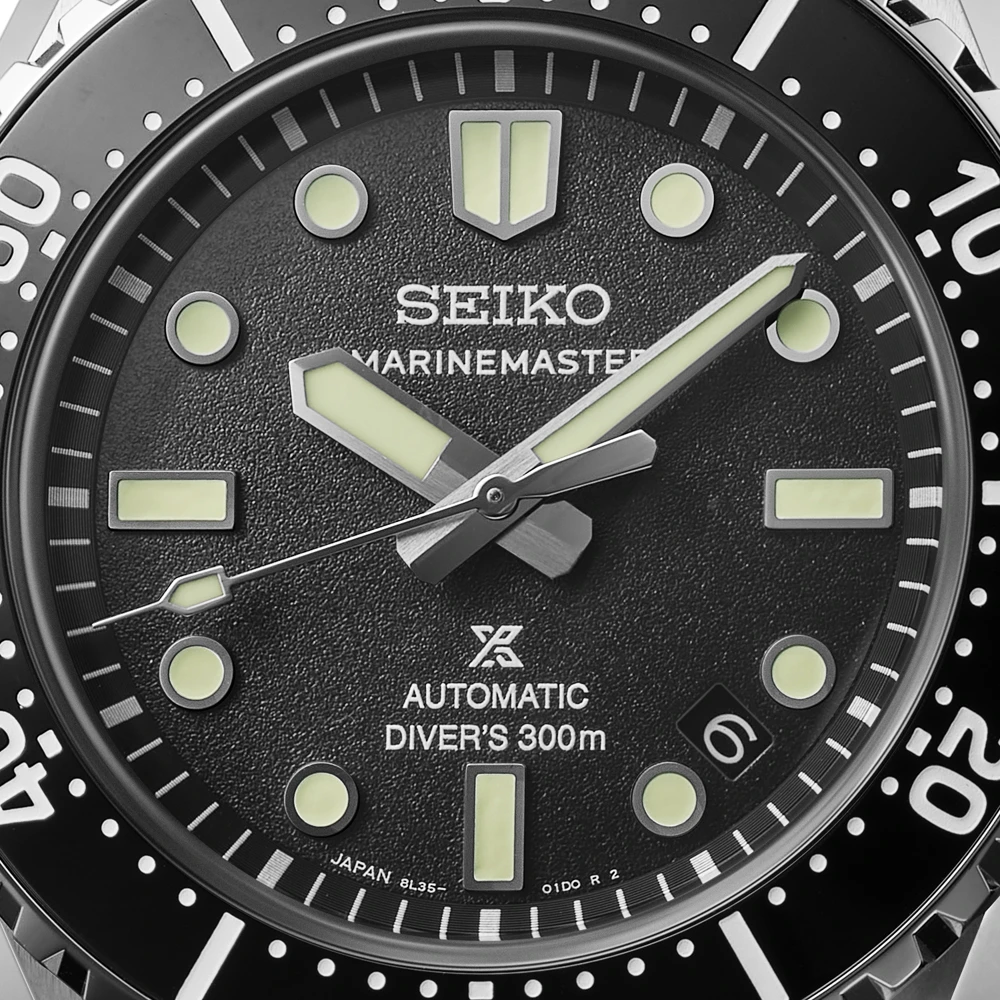
Although the dial is designed to deliver maximum utility, it does not forgo style. Rather than opting for a two-tone white-on-black palette, Seiko has used off-white lume for the hands and indexes. This softens the Marinemaster’s appearance and pays tribute to the vintage reference that inspired its creation. Other design choices show a similar level of marrying functionality and aesthetic charm. Text has been kept to a simple sans serif typeface, but with good kerning and even layout.
Seiko Prospex Marinemaster 1968 Diver’s Reinterpretation 300 m – case
Clocking in at an ample 42.6 mm in diameter and 13.4 mm in thickness, the Marinemaster is sufficiently large that its indications are easy to read. Conversely, despite being a robust, professional divers’ watch, it remains very wearable. Seiko has equipped the model with a dual-curved sapphire crystal featuring an anti-reflective coating on the inside, again augmenting readability.
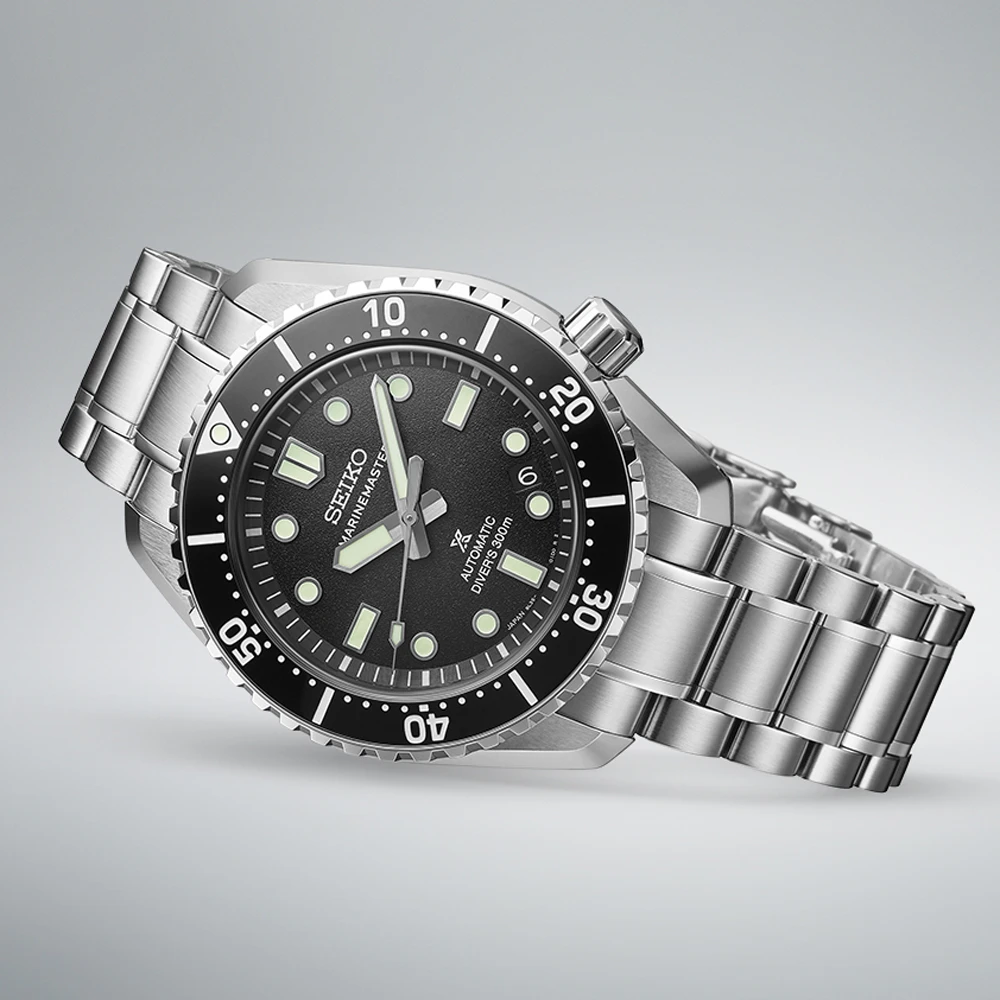
Rather than the crown being located at 3 o’clock, Seiko has positioned it at 4 o’clock. This allows the wrist to flex more readily and avoids any annoying gouging that you sometimes encounter with various other divers’ watches. The screw-down crown lessens the risk of water ingress and contributes to the model’s impressive 300 m water resistance.
Upholding divers’ watch convention, the Marinemaster is fitted with a unidirectional bezel. This feature harks back to a time when divers wore a dedicated wrist-worn depth gauge, carried a waterproof chart and had a divers’ watch strapped to their wrist. The bezel, marked with a count-up scale, is used to calculate the safe ascent to the surface, ensuring enough time is spent at a specific depth and for a sufficient period. Failure to monitor the ascent correctly can lead to decompression sickness. These days, most professional divers use a wrist-worn electronic dive computer, albeit some still like to have a mechanical watch as a back-up. The reason the bezel is unidirectional is that, if it is accidentally rotated, the indications will not adversely affect the dive.
The majority of wearers will never fully exploit the professional capabilities of the bezel; however, as any desk diver will attest, rotating it during tedious meetings can prove cathartic. Seiko has also followed divers’ watch convention by equipping the triangular index on the bezel with a circular, lumed plot.
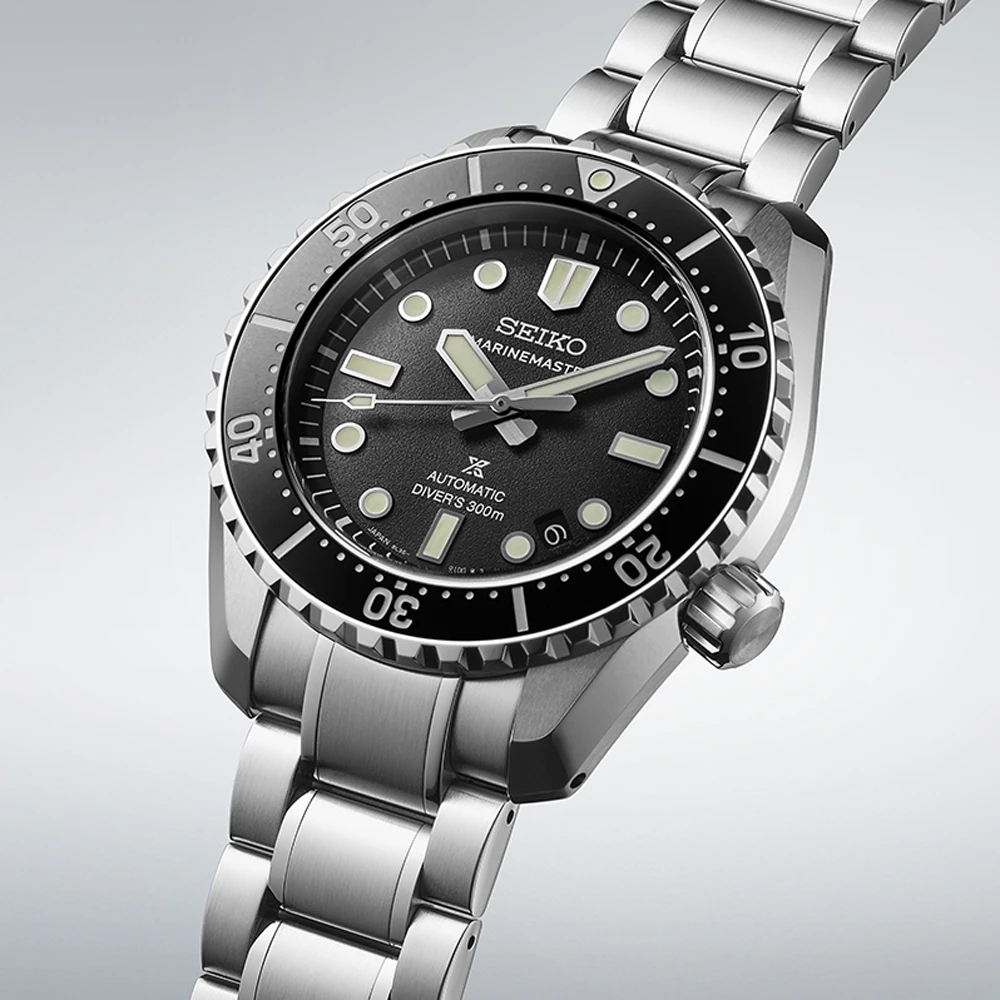
The Marinemaster is suffused with a gorgeous blend of finishes. The upper lug surfaces are brushed, while adjacent angled facets are highly polished. This juxtaposition of contrasting finishes serves to heighten the visual appeal of the case. The watch is presented on an equally practical steel bracelet fitted with a ‘three-fold clasp with secure lock, push-button release with extender’. While unquestionably practical, Seiko has not abandoned style. The central row of the three-row bracelet incorporates two crisp strips of high-gleam metal, adding to the overall allure of the watch.
Seiko Prospex Marinemaster 1968 Diver’s Reinterpretation 300 m – movement
Beating under the hood is Seiko’s in-house caliber 8L35, an automatic movement with a 50-hour power reserve. The Marinemaster is crafted at Seiko’s Shizukuishi Watch Studio, a location where some highly desirable Grand Seiko models are also made. The Japanese brand states the calibre is accurate to +15/-10 seconds per day. Unlike most European watches, the balance wheel and hairspring are produced in-house, standing testament to the company’s remarkable know-how. Seiko has also equipped the caliber 8L35 with its proprietary Diashock, a shock protection system that boosts the stability of the balance if subjected to impacts. Finally, the caliber 8L35 has been adorned with some lovely finishing. Broad stripes, similar to Côtes de Genève in appearance, grace the rotor and the bridges below.
Conclusion
Seiko’s vintage-inspired release of their ground-breaking 1968 professional dive watch beautifully captures the spirit and performance of the original. Readability and contrast, alongside elevated design touches such as the off-white indices and contrasting polishing, imbue this Marinemaster with notable refinement. Seiko has created a new classic. Keenly priced at £2580, it will prove an elegant companion, irrespective of where your explorations lead.
Further reading
https://www.seikoboutique.co.uk/
Technical specification
- Model: Seiko Prospex Marinemaster 1968 Diver’s Reinterpretation 300m
- Reference: SLA079J1
- Case: stainless steel, diameter 42.6 mm, thickness 13.4 mm, water resistance 30 ATM (300 metres), sapphire crystal to front, solid caseback
- Functions: hours, minutes, seconds, date
- Movement: Caliber 8L35 automatic, frequency 28,800 vph (4 Hz), 26 jewels, power reserve approximately 50 hours
- Strap: three-fold clasp with secure lock, push-button release with extender
- Price: £2,580 (RRP as of 17.7.2026)