
Emmanuel Bouchet Complication One Fusion In-depth Feature
The inaugural Emmanuel Bouchet Complication One was released in 2014. Last year, in the autumn of 2025, the independent watch brand released four ‘new or updated versions’ of the model in gold, titanium and sapphire. Mark McArthur-Christie focuses on this latter version, the ‘Fusion’, but begins by talking about the man behind its creation and the mechanical virtuosity underpinning watchmaking’s Mozart.

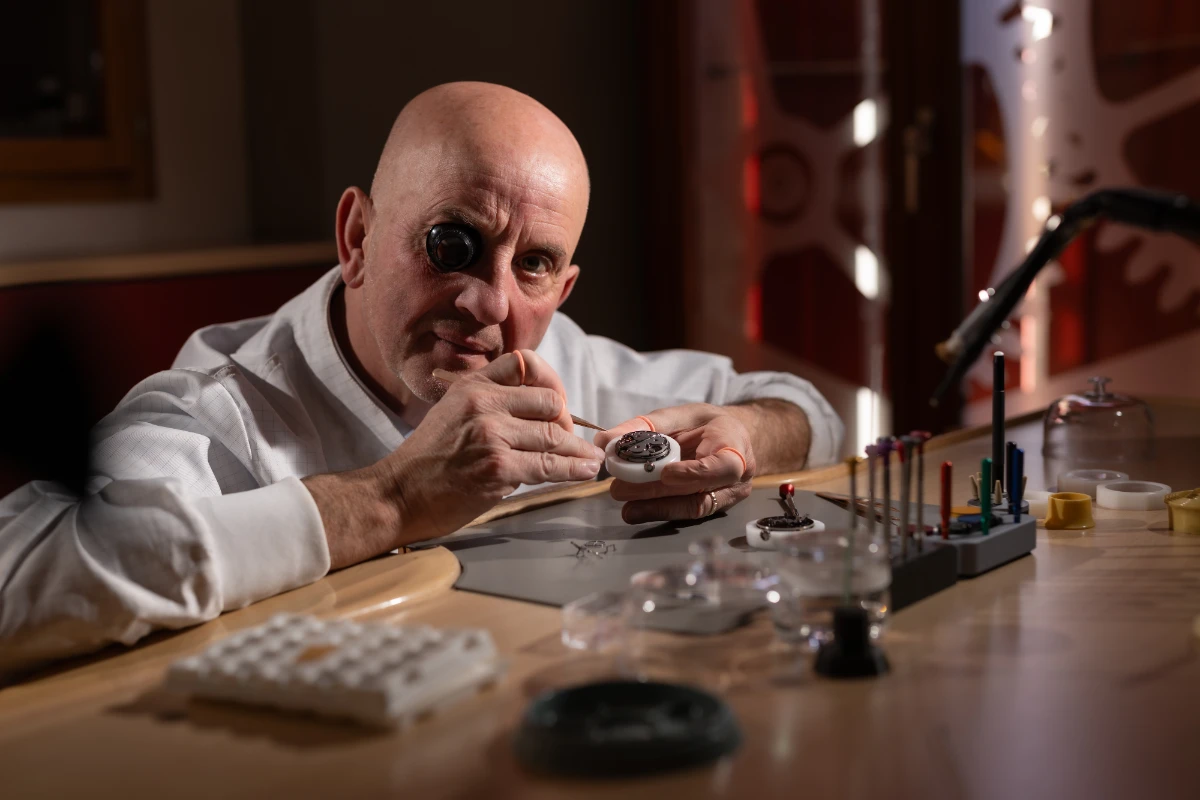
Image – Emmanuel Bouchet
Emmanuel Bouchet – a different approach
If you have any Mobius 9010 in your veins, it’s hard to forget the feeling of picking up your first haute horlogerie watch. Looking at a third wheel and marvelling at how long it took to hand-bevel the edges, then polish or grain it – all for a single gear. Seeing the way light reflects from a black-polished screw head and puzzling over how the watchmaker managed to install it without a single toolmark. You never lose the wonder – or the sheer joy – this sort of craftsmanship brings, but that first hit of craft, beauty and function is special.
One gets the sense that, for some firms, haute horlogerie finishing, noble as it is, is the destination. But listening to Emmanuel Bouchet, it’s clear that it isn’t the objective; it’s just the price of admission.
“Yes, my watches are finished to a high standard, but it’s the watchmaking itself I’m interested in.”

In other words, the value of a watch is more in the mechanical innovations it contains than the way it’s decorated. The innovations within the mechanism should be more of a reason to smile than the anglage, striping or polishing.
With some watchmakers, it would be tempting to dismiss this as marketing speak – as an attempt to take the same old mechanical concepts and warm them over a bit. “Oh what a lovely tourbillon…” You can’t do that with Emmanuel Bouchet simply because the watches he produces justify his words.
Emmanuel Bouchet Complication One Fusion – two escapements
Take his sapphire-cased Complication One Fusion. The EB63F movement powering the watch uses twin barrels and two escapements, each constructed differently and oscillating at different frequencies: 21,600 vph (3Hz) and 240 vph (0.33 Hz). Apart from the running seconds, everything on the dial side is a jump function – hours, retrograde tens of minutes, minutes and a day/night indicator, That’s a matter of a few minutes to write, a great deal longer to understand – and an entirely different proposition to design, prototype, develop and put into production.
Monsieur Bouchet explains, “For me, my passion is more about the mechanism. When watchmakers worked in the past, they innovated mechanically. I find today there is not so much innovation and I believe we could go much further. Yes, I want to do high level decoration but even more I want to work on the mechanism and push the boundaries, not remain with what’s already been done.”
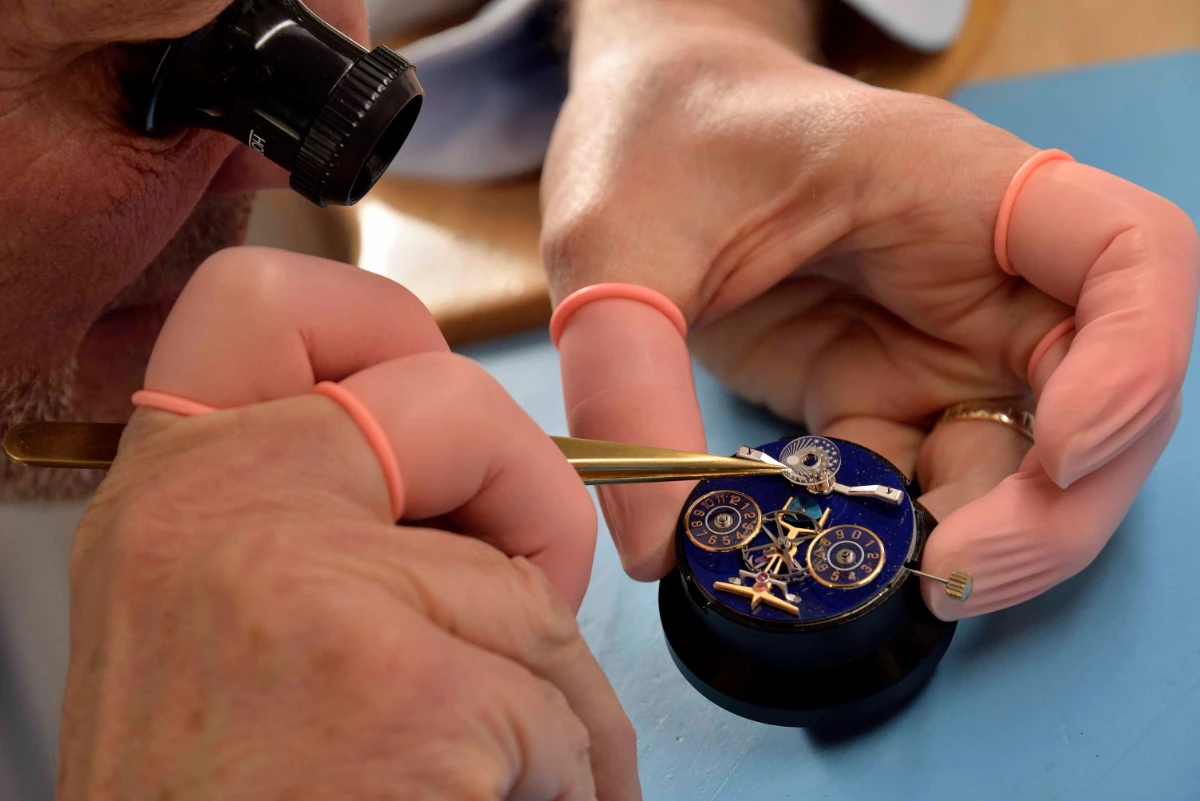
Image – fitting day/night disc
In some people this would feel like pretence. With Bouchet, it feels utterly natural and the focus of an innovative, questing mind. He wouldn’t go out and buy a gleaming, stainless steel La Marzocco for his morning coffee, he’d simply design and make his own machine.
Much of his work comes from a desire to make people see time differently – as a finite, precious resource. In the case of the Complication One Fusion, that means deliberately slowing time down to the point where you can see it passing. That’s hard to do when you start with an existing engine, so back in 2016 Bouchet developed the movement which is the ancestor of the EB63E – the EB1963 (named for the year of his birth).
Aurélie Picaud, Managing Director of Emmanuel Bouchet, explains, “He worked from an idea and philosophy of time to the design of the movement and then to development and production. When Emmanuel relaxes, he thinks of mechanisms – constantly. One idea follows another idea – there’s no way he will ever be able to realise all of them!” So, a little like Mozart simply writing down what he already heard in his head, Monsieur Bouchet produces movements he can already see.
This ability to conceive movements in abstract is remarkable when you see the EB63E in the metal – and it needs some explanation.
Emmanuel Bouchet Complication One Fusion – two barrels
Starting at the back, you’ll spot the twin barrels powering the movement; what is less obvious is that they power two completely different escapements.
You can see the conventional balance wheel and escapement through the sapphire caseback. It’s anchored not at two points, but three, for stability, under a skeletonised, polished balance bridge. The balance itself uses a spring designed and developed by M. Bouchet; he partnered with component specialist Atokalpa to produce it – drawing and forming your own balance springs would be utterly ruinous. Balance spring technology and metallurgy is emphatically a black art, best left to specialists.
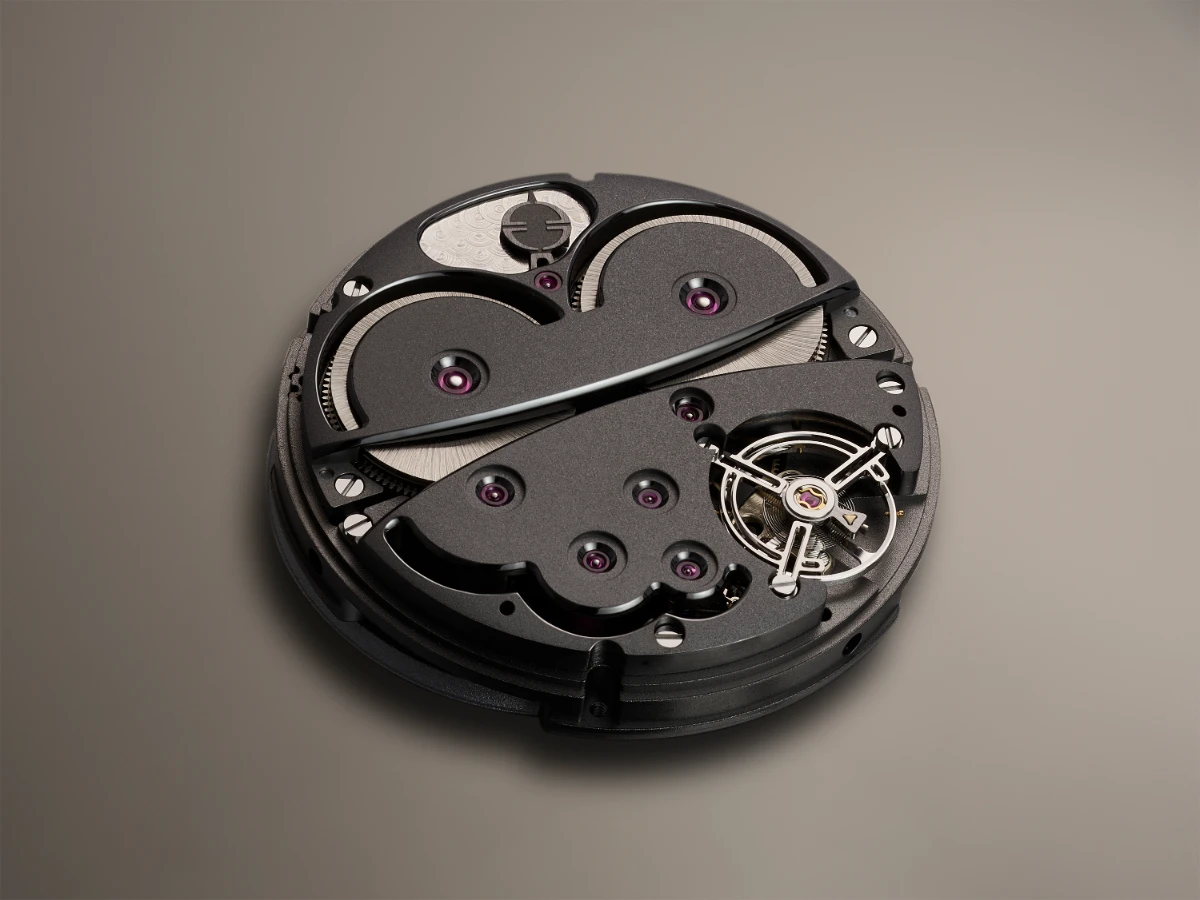
Image – Emmanuel Bouchet Calibre EB63 with two barrels clearly visible
Turn the watch over and there’s what looks like another escapement. But this one is completely different. For a start, it’s not beating at 21,600 vph like its fellow on the other side of the movement. This one runs at a Légion étrangère-like marching speed of 240 vph, or one tick every 15 seconds.
Emmanuel Bouchet Complication One Fusion – torque is everything
This dialside escapement takes power from its own barrel. It needs to, because this escapement distributes the power for the Fusion’s time display functions. Not one to make things easy for himself, M. Bouchet has built a watch where every time display element, with the exception of the running seconds at 12 o’clock, uses a jumping complication.
Practically, with a jump hand watch, torque is everything. The watchmaker needs to find a way to store and impart the torque needed to snap each hand round precisely with every unit of time it measures. A movement with conventionally rotating hands is much easier to drive – it simply needs a steady source of torque that’s easily regulated by a gear train and passed on to the hands. A jump hour has to deal with storing and then imparting a series of explosive impulses. The favoured way is through a cam or a star wheel transmitting power to a lever that stores and releases it, flipping the hand or, more usually, time display disc, forward.
This erratic power delivery also has a tendency to knock timekeeping for six, so jump hours are often not the most accurate of watches. Bear in mind we’re talking about jump hour watches here. M. Bouchet has developed something a great deal more complicated than a simple jump hour.
Emmanuel Bouchet Complication One Fusion – Reuleaux Triangle
The inherent inaccuracy above is not the case with the Fusion, thanks to the escapement M. Bouchet has utilised. The ‘conventional’ escapement on the rear of the movement uses a conventional (well, moderately so) design to distribute frequency – the ability of the watch to keep accurate time. The dialside escapement distributes frequency AND power. And it does it by using a Reuleaux Triangle – a triangle formed by the intersection of three circles and creating, in effect, a constant width curve.
If you’re fond of innovations in automotive engineering, you’ll recognise this as the same concept from the spinning rotor in German engineer Felix Wankel’s rotary engine.
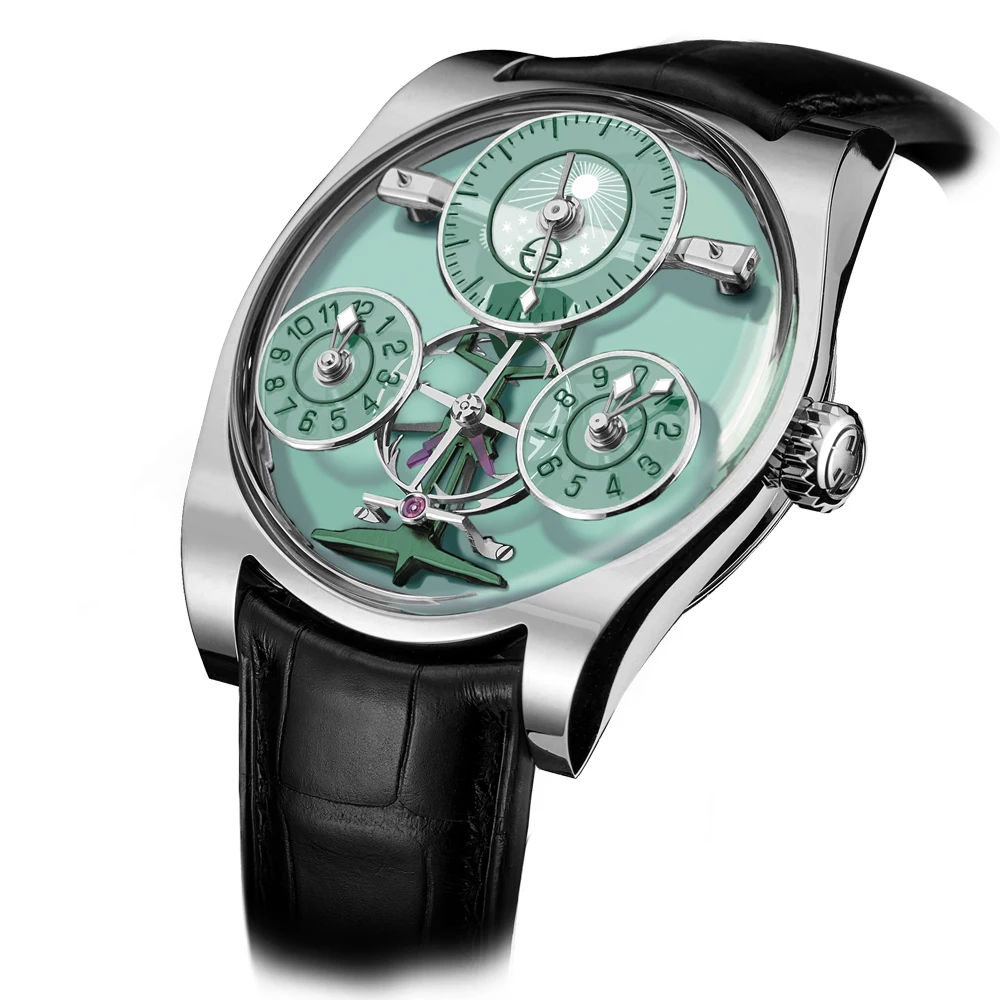
Image – Emmanuel Bouchet Complication One Aleph
The two escapements draw power from separate sources, so neither interferes with the other’s operation. As a result, timekeeping isn’t compromised in the way it often is in conventional jump-function watches. The Reuleaux triangle solves the problem of the conventional escapement being disturbed by the slower, dial-side escapement which stores and releases energy in a fundamentally different way.
The triangle rotates, passing power through the dialside anchor which stores and then releases it in four-times-a-minute bursts – a bit like a remontoire. These bursts provide the power for not just a jumping hour, but a jumping tens of minutes hand and a minute hand – oh, and a jumping day/night indicator disc.
Emmanuel Bouchet Complication One Fusion – indications
This all sounds complicated to read on the dial and, to be fair, it needs a bit of practice. If the hour hand points to six, the tens of minutes hand (the ‘decimal’ hand) is on five and the minute hand indicates nine, it’s 6:59, or a minute to seven. A minute later, the decimal hand snaps back to zero (a retrograde – M. Bouchet snuck that in too), the hour hand advances a step and it’s 7:00. You read the hours to the left of the dialside central escapement, minutes and tens to the right.
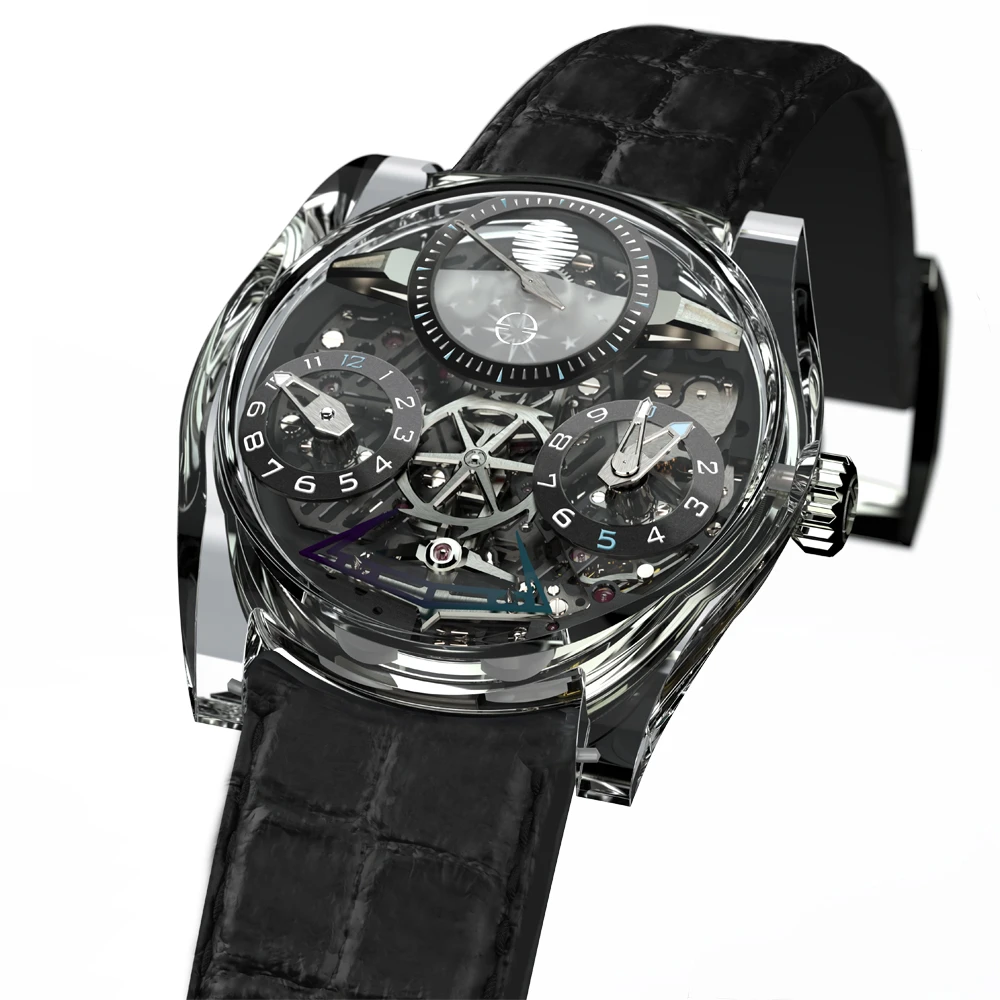
Image – Emmanuel Bouchet Complication One Fusion
This isn’t a watch you can read at a quick glance, but that’s the whole point. You have to slow down to its four-beats-a-minute pace and interact with it.
M. Bouchet explains, “To me, this division of time in five different levels – day and night, hour, 10 minutes, minutes and seconds – is the perfect way of symbolising the present through movement. The second is the smallest increment in quotidian timekeeping and night or day the largest. To combine these two on the same subdial symbolises that even the largest thing is made up of tiny parts that are all equally important.”
The master watchmaker says when he talked to colleagues in the industry about the project, the universal response was that it was ‘impossible’! It was too much of a technical, design and manufacturing challenge. This, one suspects, was like suggesting to Amadeus that writing the C Minor Mass would be impossible when he’d already written it in his head.
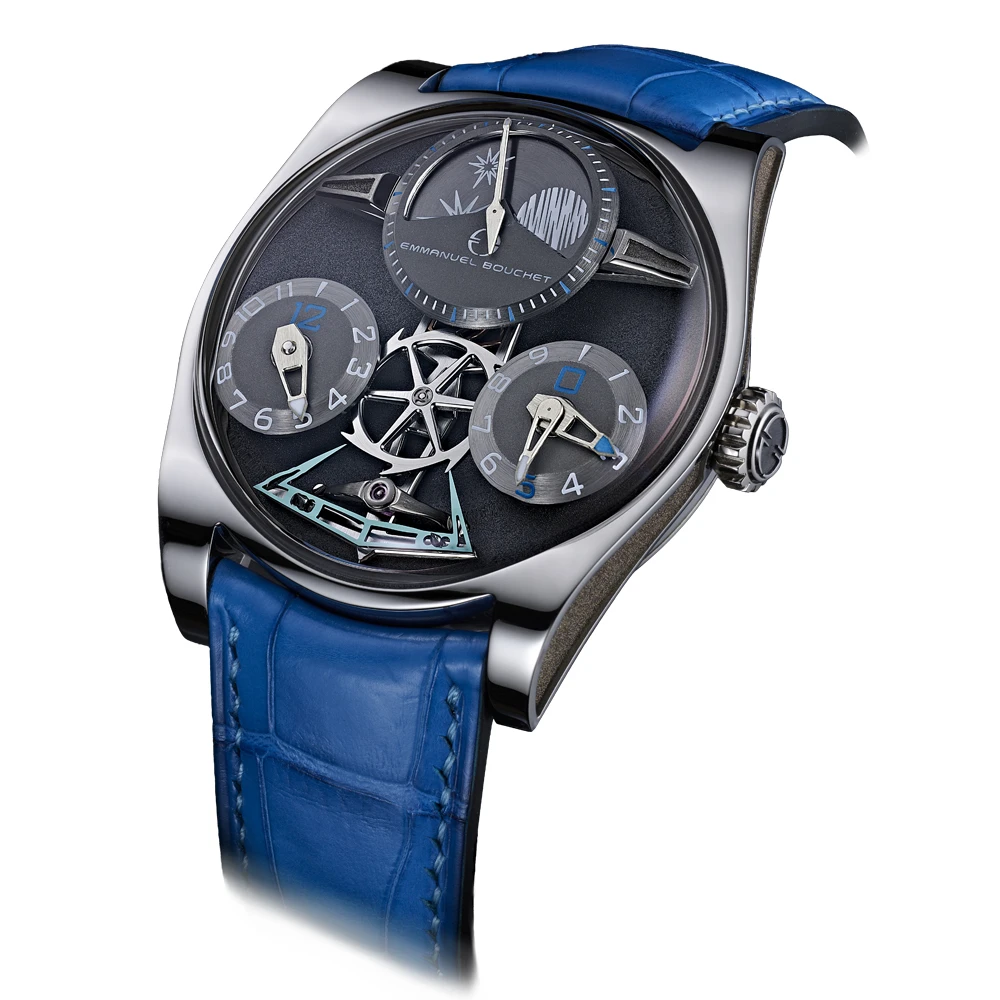
Image – Emmanuel Bouchet Complication One Contrast
As you can see, the project wasn’t just possible, it was possible with some added innovations.
For example, the Reuleaux Triangle as a means of transferring power completely eliminates the escapement’s angle of recoil. In most escapements, there’s a 0.5 to 1.5 degree backward motion of the escape wheel each time one of its teeth locks with a pallet jewel. Because the Fusion’s Reuleaux triangle always holds the dialside anchor at all three points of its contact as it moves it, there’s no backward motion. Quite simply, a more efficient and accurate escapement with less wasted power and friction.
Closing remarks
As M. Bouchet explains, “It’s about taking risks and pushing the mechanical art’s boundaries.” Looking at the Emmanuel Bouchet Complication One Fusion, ‘mechanical art’ seems apt indeed.
Even the case of the Fusion is an unconventional sapphire block that is cut, both with machine milling and hand grinding, polished and sized. This process takes 2 to 3 months and involves a solid month of work.
Given it’s sapphire (the dials are titanium and sapphire) and even M. Bouchet isn’t about to start trying to cut sapphire threads, how does the caseback screw in? It uses a 1 mm threaded gold insert that’s cut and then fixed with adhesive into the sapphire.
The last words are probably best left to the Fusion’s creator: “I want to slow you down. I want to deconstruct and expand time. But is it art? That I leave for you to decide. All I know is that life is just a moment, a passing hour, a fleeting day in a forever faster-moving world.”
Further reading
https://www.emmanuelbouchet.com/
Technical specification
- Model: Emmanuel Bouchet Complication One Fusion
- Case: sapphire crystal, diameter 44 mm, height 11.20 mm, water resistance 3 ATM (30 metres), sapphire crystal to front, exhibition case back.
- Functions: seconds shown on central dial, minutes and tens of a minute (right dial), hours (left dial) and day & night indication (central dial)
- Movement: In-house designed movement EB63F, hand-wound movement, frequency 21,600 vph (3 Hz), 67 jewels, power reserve 55 hours
- Strap: hand-stitched leather strap and paired with a double pin buckle in 18-carat white gold
- Price on application
- Limited Edition: 5 pieces