
Slim d’Hermès Squelette Lune 39.5 mm Watch Review
The Slim d’Hermès Squelette Lune is endowed with a 39.5 mm case, available in either DLC-treated titanium or platinum, and features a ‘double moon phase at 6:00’. This lithesome timepiece, free of unnecessary bulk, reveals many components front of house and exudes grace from every angle. Angus Davies looks at the model in detail and explains the importance of a flex-free movement.

“You can never be too rich or too thin”
Wallis Simpson, the Duchess of Windsor, reputedly quipped, “You can never be too rich or too thin.” In an age of political correctness, her comments may seem insensitive; however, there is no escaping that a healthy bank balance affords greater choice and being able to see one’s toes is also desirable.
These days, we avoid passing comment on someone’s physical appearance, mindful not to offend, but generally speaking obesity is a function of poor diet and inactivity. There’s no way to sugarcoat this fact and, if you did, some gym-dodgers would eat it!
My point is that svelteness is becoming. A flat stomach, one chin and, generally speaking, a toned physique is healthy and generally looks better. Wallis Simpson, often seen wearing Christian Dior or Givenchy, was said to be 5’2″ (1.57 m) and weighed approximately 99 lbs (45 Kg). Blessed with a lean silhouette, she appeared taller than she really was. A 20th-century haute couture icon, her slightness of build contributed to her elegant appearance.
However, is a svelte profile appropriate for a watch? And can a watch be too thin? In recent years, some watch brands have rushed to create the thinnest timepiece, but on occasion the results have appeared almost malnourished. Indeed, it would seem this limbo-dancing approach to getting lower is the sole objective and can potentially come at the expense of both style and substance.
A few months ago, I cradled the Slim d’Hermès Squelette Lune in my hands, admiring its intricate form. It is slender and elegant yet sufficiently thick to be horologically healthy. Allow me to elaborate.

Image – copyright Joel Von Allmen
Slim d’Hermès Squelette Lune 39.5 mm – case
Measuring 39.5 mm in diameter with a thickness of 8.8 mm, the Slim d’Hermès Squelette Lune will suit most wrists, both male and female. Shrewdly, the luxury marque has skilfully avoided excessive dimensions or diminutive proportions, traits that sometimes leave a watch vulnerable to changing tastes. When I strapped the model to my wrist, I also found its modest thickness meant it neatly rested on my arm and didn’t annoyingly protrude.
The Slim d’Hermès Squelette Lune is offered in two case variants, DLC-treated titanium or ‘full polished 950 platinum’. Each metal is complemented with contrasting elements. When presented with a choice, I immediately gravitated towards the platinum option, drawn to its liberal use of blue tones, albeit the DLC-treated titanium and vert d’eau ensemble is also very attractive.
Slim d’Hermès Squelette Lune 39.5 mm – skeleton
Unlike the majority of watches that come equipped with a dial, the Slim d’Hermès Squelette Lune favours an openworked design with numerous movement components freely shown. Skeleton watches first appeared in the 18th century, when André-Charles Caron created a pocket watch with a pared-back movement.

Image – copyright Joel Von Allmen
Watchmakers in yesteryear, keen to reveal components in various states of motion, adapted conventional movements. They would openwork the bridges and mainplate, often with a series of handsaws and files. Unfortunately, this would often compromise the integrity of the movement, causing it to flex, potentially impairing precision or jeopardising reliability.
Today, high-end brands such as Hermès use CAD (Computer Aided Design) to create a clean-sheet blueprint. This modern-day technology allows engineers to design the mainplate and bridges with due consideration to torsional rigidity, therefore creating a flex-free movement. Thereafter, the components can be precisely milled using CNC (Computer Numerical Control) to tolerances measured in microns (1 micron = 0.001 mm).

Image – copyright Joel Von Allmen
Designed from the outset to be a skeleton movement, the extra-thin Manufacture Hermès H1953 calibre features a gorgeous filigreed structure optimised for both beauty and strength.
Slim d’Hermès Squelette Lune 39.5 mm – indications
The Slim d’Hermès Squelette Lune is not endowed with numerous complications; instead, it merely indicates the hours, minutes and ‘double moon phase at 6:00’. In my opinion, this was a wise decision as too many complications could potentially mar the appearance of the intricate filigreed movement.
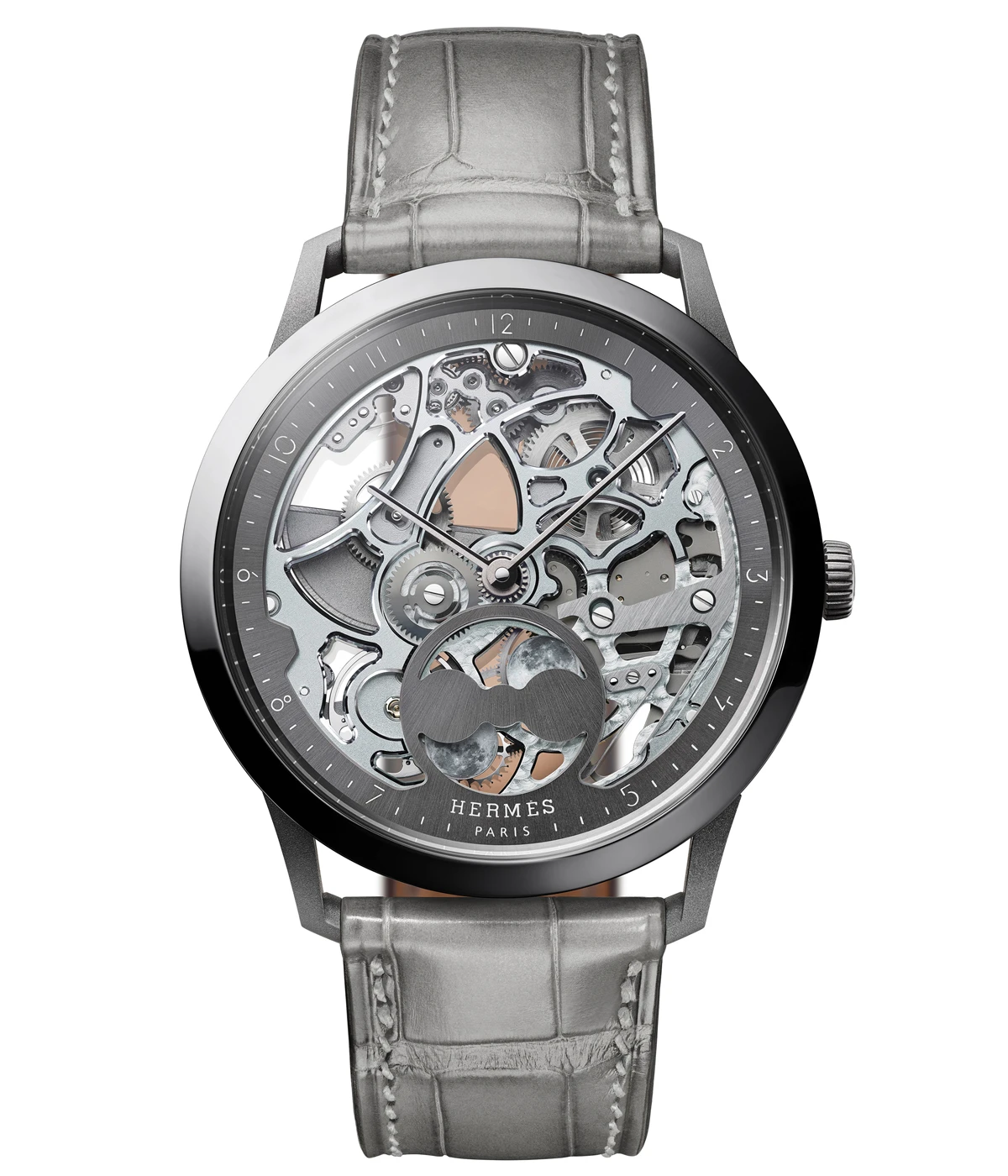
Image – copyright Joel Von Allmen
The rhodium-plated baton-type hands are fine and graceful but remain simple to read. They point towards a blue minuterie that’s adorned with a sunray motif and endowed with crisp white markings. In addition, each hour is denoted with Arabic numerals, executed in the brand’s distinctive typeface. Interestingly, the framework for the moon phase display is integrated within the minuterie, contributing to the overall sense of cohesion.
Hermès has taken the unusual step of equipping the watch with a ‘double moon phase’, simultaneously displaying the lunar cycle for the Northern and Southern hemispheres. Each depiction of the moon is photorealistic, further heightening visual allure.
Slim d’Hermès Squelette Lune 39.5 mm – movement components
The pièce de résistance is undoubtedly the openworked movement. Its intricate arrangement of arcing lines, punctuated with exposed components, seductively draws the wearer’s eye. Indeed, should you look beyond the hand-chamfered, bead-blasted bridges you will find the barrel sans cover, revealing its mainspring in various states of tension.
A micro-rotor resides in the north-easterly region of the dial, harnessing energy from the natural motion of the wearer’s wrist, tensioning said mainspring. Hermès belongs to a small number of brands able to equip a watch with a micro-rotor. The technical challenge is to create sufficient inertia from a small oscillating weight to energise the mainspring; however, the luxury marque has repeatedly achieved this, having created several models featuring a diminutive rotor. By employing a micro-rotor, rather than a full-size rotor, Hermès has been able to reduce the thickness of the case, optimise the see-through characteristics of the movement and still provide the convenience of automatic winding.

Image – copyright Joel Von Allmen
Another delightful sight that awaits the wearer can be found near 6 o’clock. When both moons are in darkness, the owner can see the fourth wheel and escape wheel in motion, granting a fascinating spectacle.
Lastly, comprising 178 components, the extra-thin Manufacture Hermès H1953 is beautifully decorated. In addition to the aforementioned finishes, discerning eyes will also see perlage, graining and mirror-polished screws.
Closing remarks
With some skeleton watches, the hour and minute hands can become lost, seemingly merging into a filigreed backdrop. Thankfully, no such problems afflict the Slim d’Hermès Squelette Lune. The faceted baton-type hands gleam with the merest suggestion of light, capturing the wearer’s attention, conversing in clear tones. Another factor contributing to the model’s lucid indication of time is the intelligent use of blue hues on the minute track and the tasteful application of the sunray motif, both details which aid readability.
The moon phase is one of the most poetic complications, inviting the wearer to look to the heavens and witness the enchanting cycle of waxing and waning. However, Hermès has taken this further by depicting the moon as seen in both the Northern and Southern hemispheres, each of which is presented in photorealistic form.
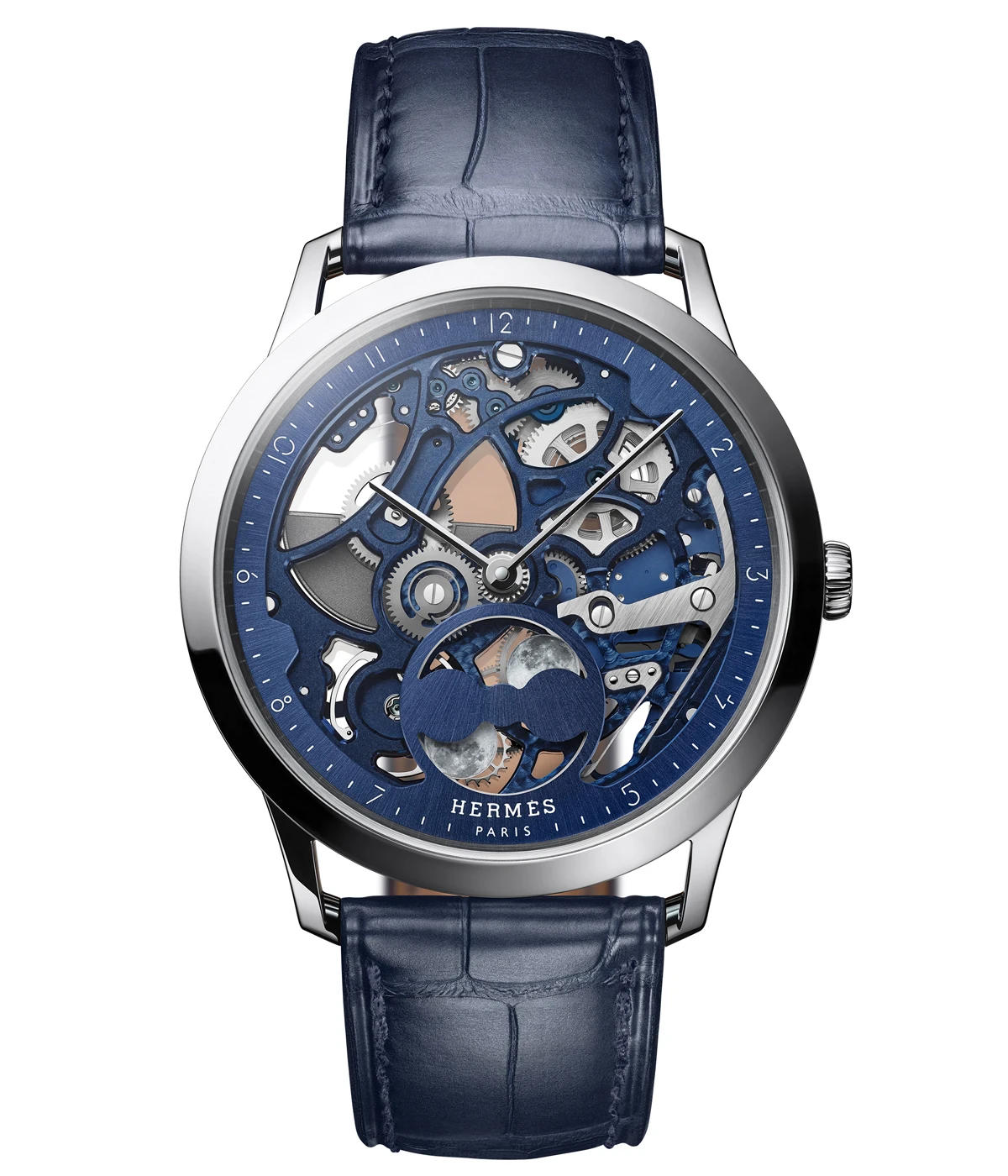
Image – copyright Joel Von Allmen
Svelteness is a recurring theme throughout, from the fine hour and minute hands to the modest thickness of the case. Measuring 39.5 mm in diameter, the watch will look at home on both male and female wrists.
But ultimately, I return to Wallis Simpson’s comment that, ‘you can’t be too thin’. In my opinion, there are several examples of watches that are too thin, don’t exude a sense of luxury and, unfortunately, appear emaciated. Thankfully, Hermès has judged everything to perfection, skilfully engineering a flex-free movement that exudes grace from every angle. The model’s torso is beautifully formed, its face is most becoming and, reassuringly, slim but wholesome. Quite simply, this watch is not too thin.
Further reading
Technical specifications
- Model: Slim d’Hermès Squelette Lune 39.5 mm
- Case: DLC-treated titanium with anthracite DLC-treated titanium bezel or polished 950 platinum, diameter 39.5 mm, thickness 8.8 mm, water resistance 3 ATM (30 metres), sapphire crystal to front, exhibition case back.
- Functions: hours, minutes, double moon phase at 6:00
- Calibre: Manufacture H1953 movement, self-winding movement, frequency 21,600 vph (3 Hz), 29 jewels, power reserve 48 hours, 178 components
- Strap: colour-coordinating alligator and calfskin options paired with a folding clasp (matching the case).
- Price – DLC-treated titanium with alligator strap: £20,130 (RRP as of 30.7.2026)
- Price – DLC-treated titanium with calfskin strap: £19,980 (RRP as of 30.7.2026)
- Price – platinum with alligator strap: £34,040 (RRP as of 30.7.2026)
- Price – platinum with calfskin strap: £33,890 (RRP as of 30.7.2026)