
URWERK UR-1001 Amadeus Watch Review
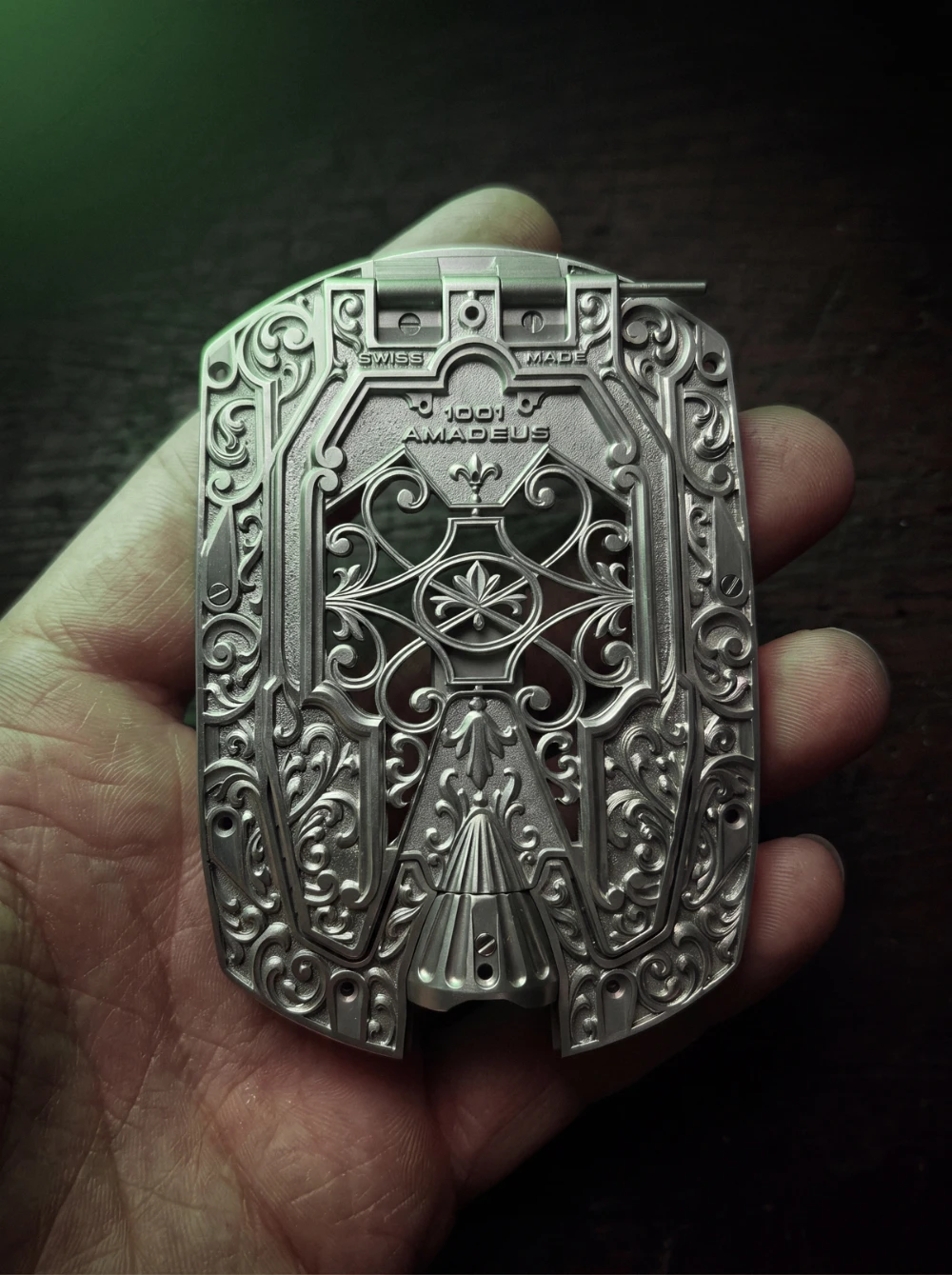
The URWERK UR-1001 Amadeus is a unique pocket watch that transcends the mere indication of hours and minutes. Its vast display ‘encompasses all scales of time’, including ‘the seconds, minutes, hours, days and nights, months, years, centuries and even millennia’. The model’s case is formed of titanium and has been painstakingly engraved by Florian Güllert, culminating in a gloriously intricate baroque composition. Mark McArthur-Christie, an avid fan of URWERK, examines this artisanal creation and what it tells us about time itself.
Beyond plastic chairs
In 1520 (or thereabouts), William Bromflet – or, more likely, another of the group who became known as The Ripon School of Carvers – started work on seats in the chancel of Beverley Minster. These were misericords, flip-up seats that enabled the secular canons of the Minster to perch, rather than stand unsupported, through the many and long offices.
Nowadays, they’d get their choice from a set of identical stacking factory-moulded plastic chairs and like it. But in 1520, when craftsmanship in everyday things was the norm for the wealthy, they got William and his family ornamenting their perches.
The Family Bromflet carved everything from a dog being played like a set of bagpipes to dancing bears, and a fox preaching to geese – where the geese end up hanging the fox. The latter was a rebusic poke at the opposition – the Dominicans or ‘hounds of Christ’ – preaching to a lay congregation and their subsequent response.
It must have taken that team of skilled craftsmen months of planning, sketching, probably plenty of laughing and mick-taking, and fine, careful carving to create all 70-odd seats. The costs must have been considerable too. William was getting six pence a day, with his colleagues on either the same or slightly less. So the project had an entire team of skilled craftsmen drawing proper sixteenth-century wages.
In other words, a group of people cared enough to commission – and produce – something beautiful simply because they could. Having Athelstan as their patron must have helped, mind.
You might have thought this way of thinking died out with mass production, one-to-ones and the spreadsheet-fondling misery that is value engineering. Not a bit of it. Visit Geneva’s Place du Bourg-de-Four (appropriately the site of a medieval marketplace) and enter URWERK’s atelier and you’ll see it alive and kicking – although with better coffee.
URWERK UR-1001 Amadeus – Florian Güllert
In an industry where all too often the most exciting thing is a different shade of blue (or green last year) for a dial, URWERK’s watchmakers do something unusual. They make extraordinary watches, but that’s only half the point. They do so with a level of skill, technique and ability that is obsessive. It’s proper ‘just because we can’ watchmaking.
The UR-10.01 movement powering the Amadeus debuted in 2011, so it’s been around a while. But what the firm has done here is take the case and hand it to engraver Florian Güllert with a brief that was presumably, ‘You know our hugely restrained and conventional Zeit Device? The one with the titanium case the size of a mobile phone? Yeah, that one. Just how completely and utterly baroque do you think you could make it?’
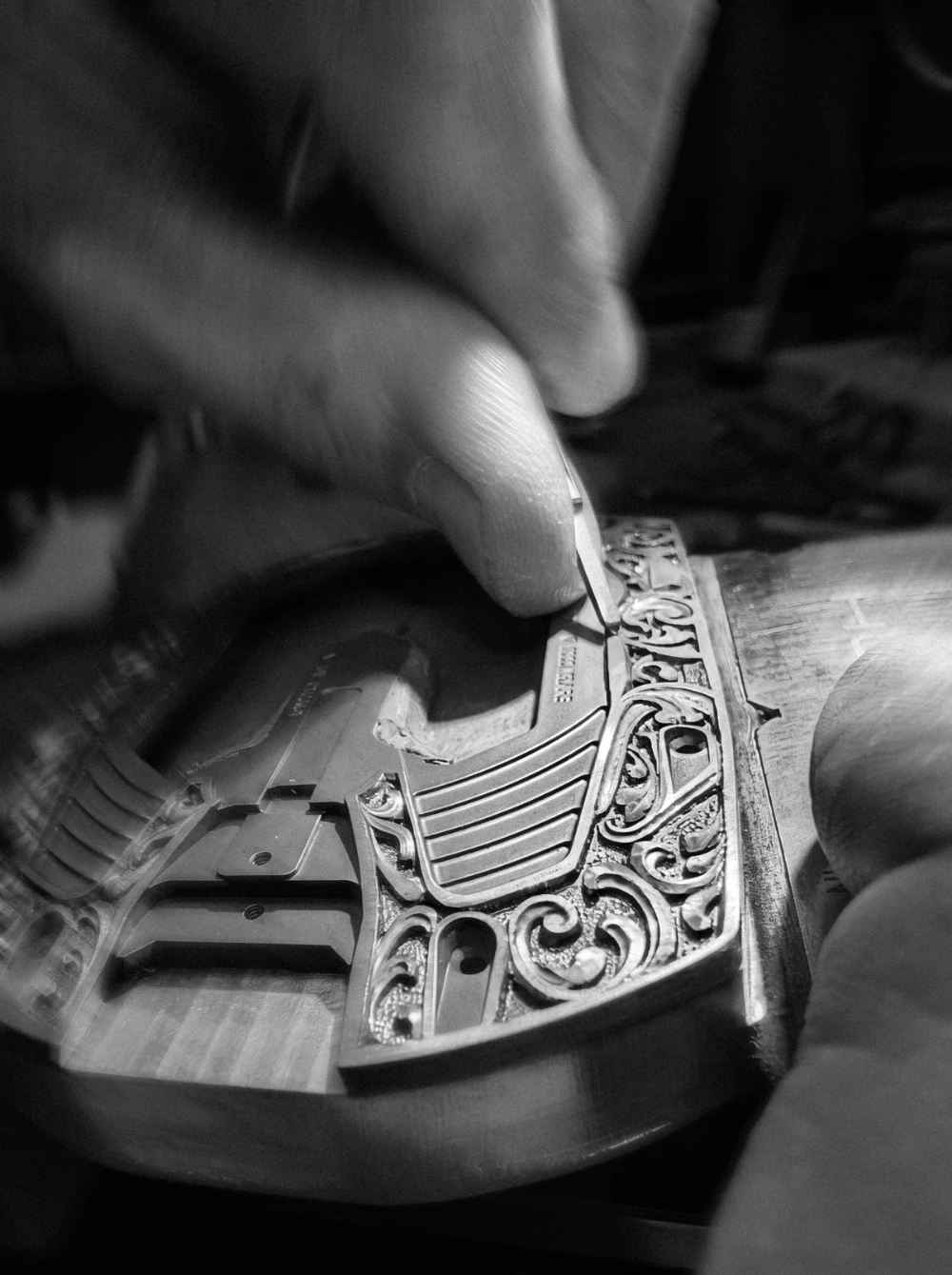
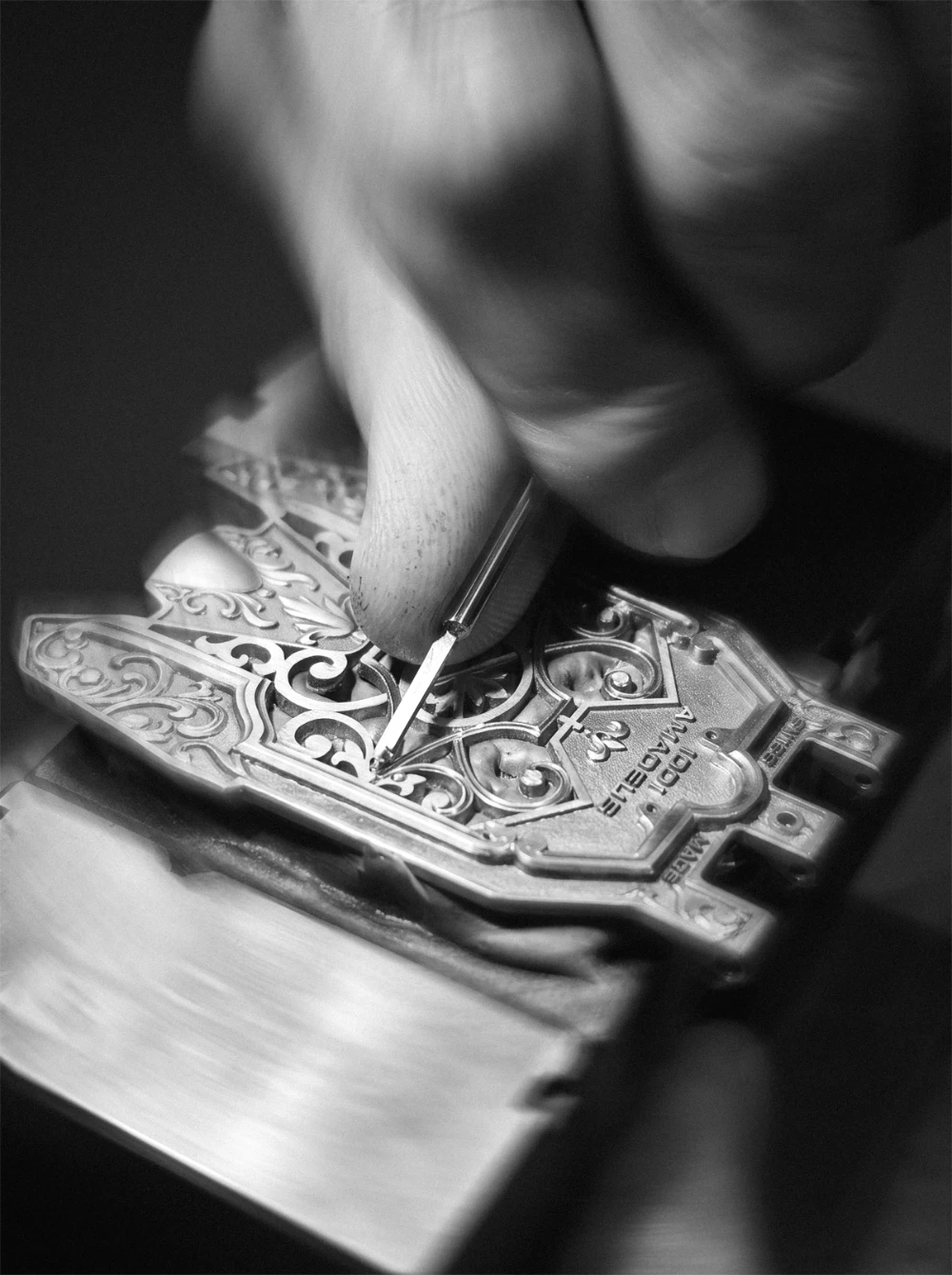
Florian Güllert outlines how he did it: “First, I had to rough-cut the material using a laser. This was a new process for me. Titanium is particularly demanding and it was a matter of preparing the raw material for hand-finishing. It was only then that my task really began.”, he explains. “The project took nearly three months or around 500 hours of work, including the design phase, yet the most demanding part was undoubtedly engraving the caseback of the UR-1001. I pushed baroque inspiration to its absolute limit, playing with thick and thin strokes as well as voids. It was a wonderful challenge to tackle.”, he concludes.
One imagines the commission was probably only a wonderful challenge in retrospect. Titanium is an absolute swine to work with, even with hand tools and the low frictional heat they create. Calling it ‘particularly demanding’ undersells it by some measure. It’s tough, springy, gummy, heat-retentive and exceptionally good at punishing a cutting edge. In other words, everything you don’t want a carving medium to be.
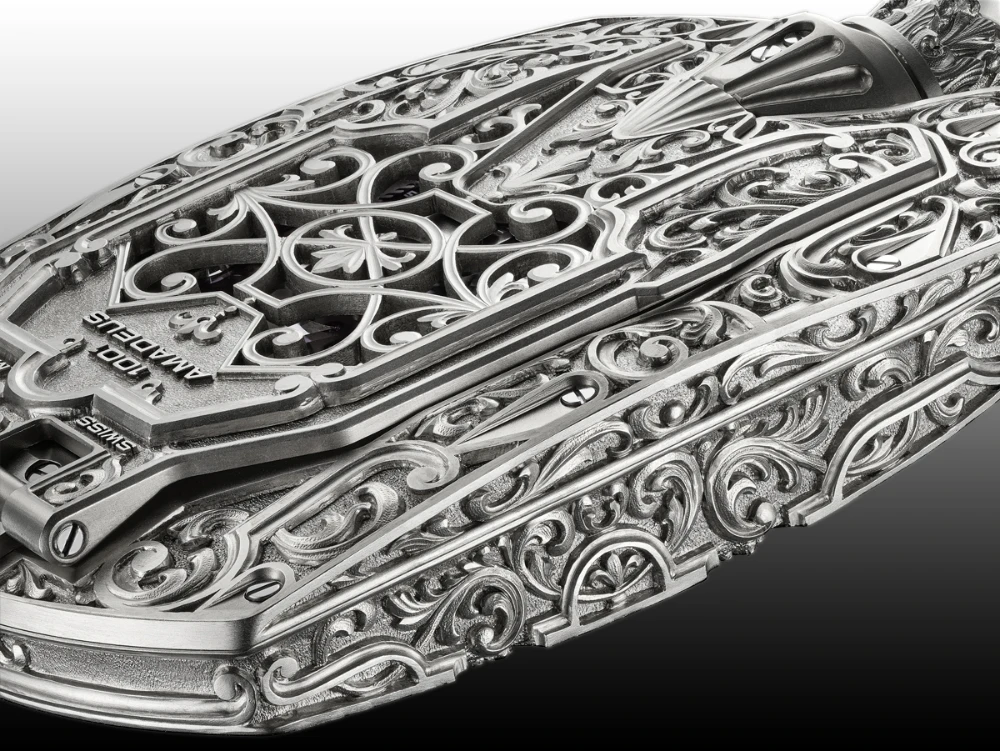
But just look at what Güllert has achieved. The work resembles the lock of a top-end shotgun. That’s hardly surprising, given his background as a gunsmith and stockmaker in Ferlach. It’s also intensely human – a rarity in watchmaking today – and you can feel the hand of the craftsman in every curve, edge and stippled background. The carving goes across the case’s joins too, seamlessly. There’s even humour here – see the winding crown? It really is a proper crown complete with heraldic pearls and acanthus leaves.
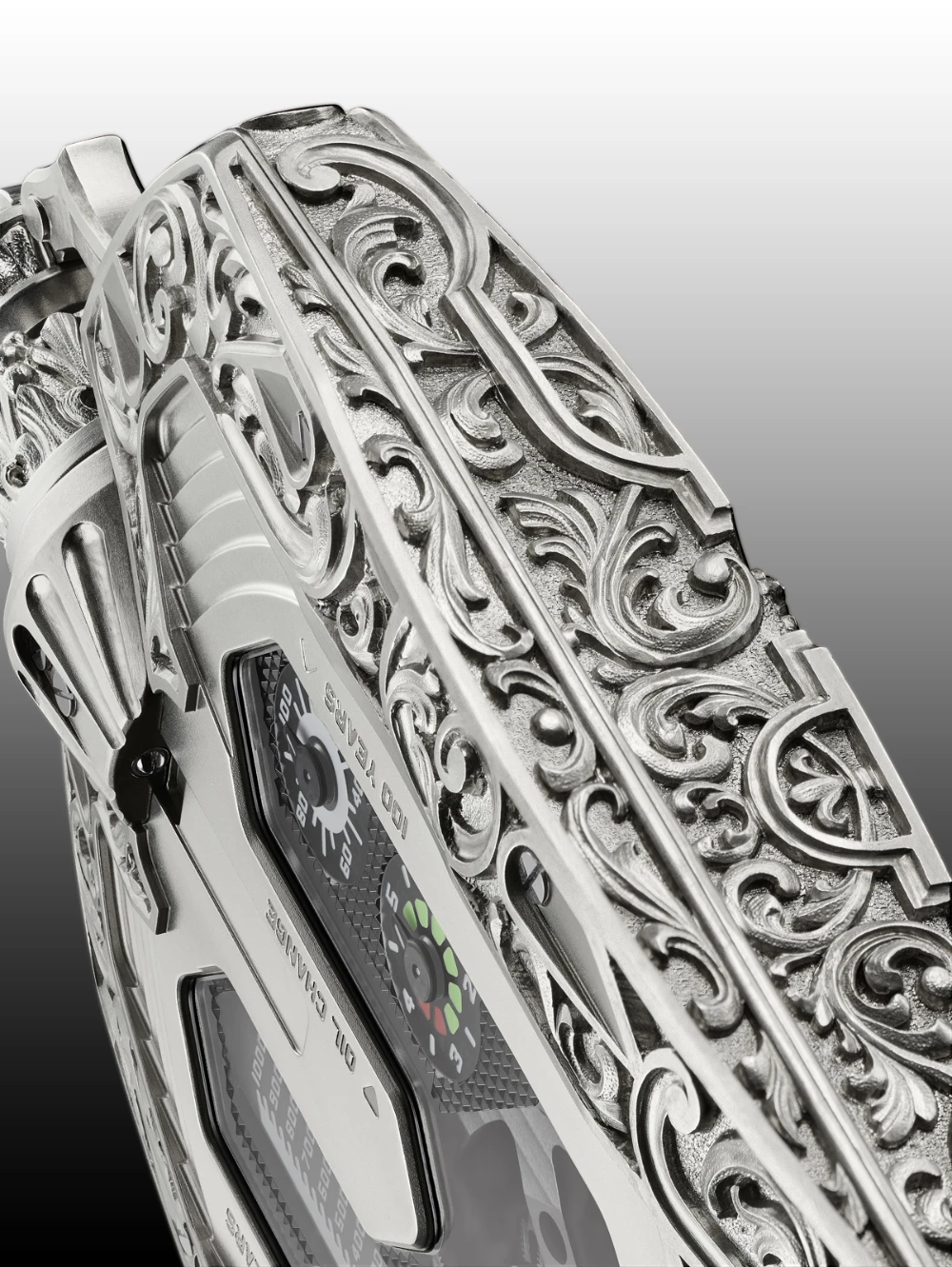
This is work that’s beautiful at a glance, but see it through a loupe and a whole, more detailed and complex world opens up. Indeed, a closer look gives you a far clearer sense of the hours of craft, patience and sheer damn skill that have gone into the Amadeus.
This isn’t Güllert’s first venture into Watchworld. He’s produced beautifully delicate decoration for JLC Reversos and some boggling movement scrollwork with Rebecca and Craig Struthers on their Project 248. If you have the opportunity, take a look at the octopus engraving he did in 2023 on a Panerai Radiomir Bronze or the hand-cut lettering on Greubel Forsey/URWERK’s Naissance d’une Montre 2. Apparently the latter required Güllert to turn his phone off and eschew coffee for ten days. Not hard to believe.
URWERK UR-1001 Amadeus – UR-10.01 movement
Now, the movement. First up, we need to get a bit of confusion around the designation out of the way. If you’re the sort of person who knows your URWERKs, you’ll be expecting the Amadeus’ UR-10.01 movement to feature things like two barrels, ‘Windfänger’, 44 jewels and a 43-hour power reserve. Nope. To paraphrase a certain Jedi (UR-102 anyone?), this is not the movement you are looking for.
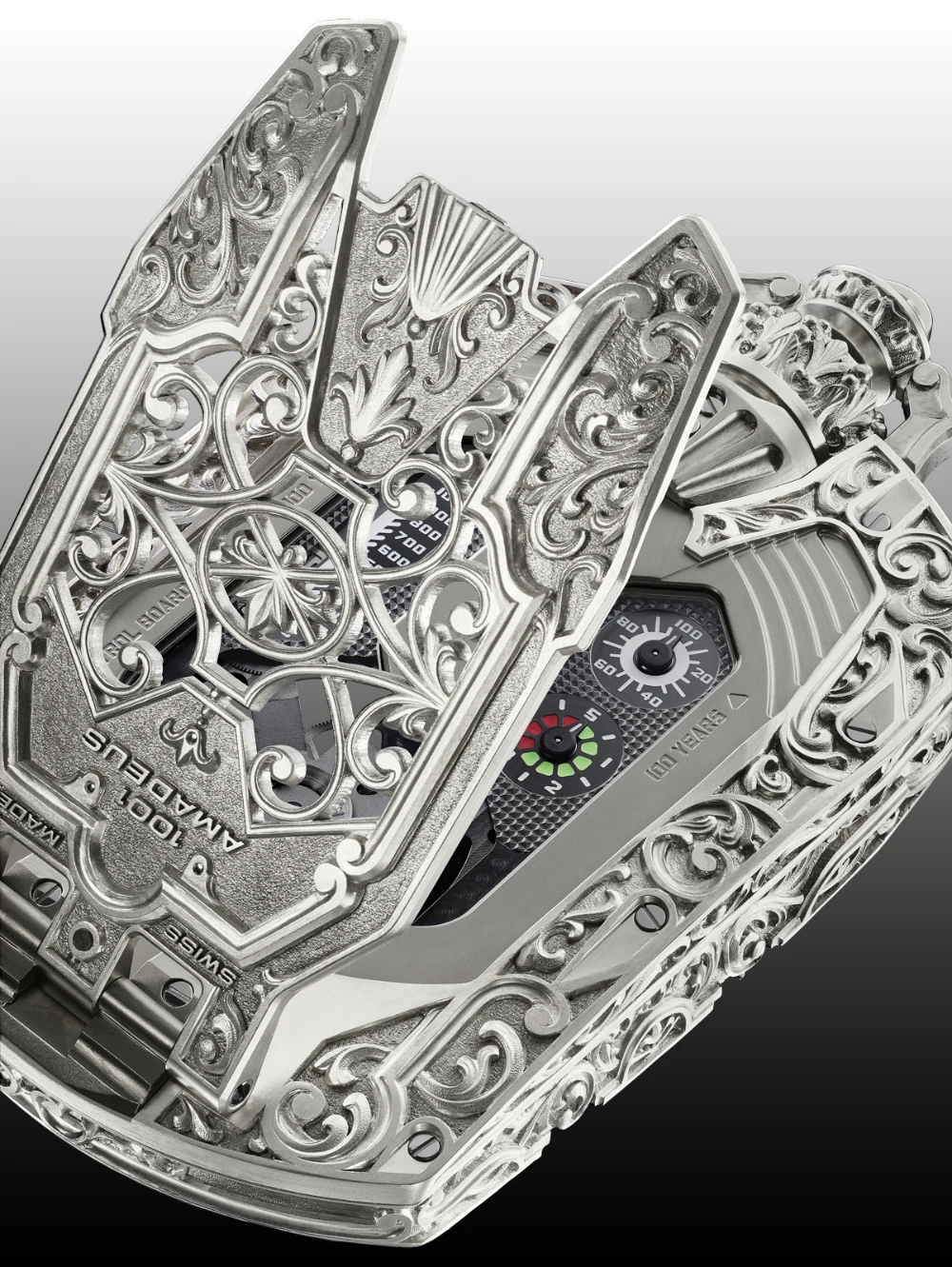
Confusingly, the UR-10.01 in the Amadeus has very little to do with the UR-10.01 that powers the firm’s SpaceMeter. That’s because the Amadeus’ UR-10.01 first saw the light of day back in 2011, powering the Zeit Device and, later, the appropriately named wrist-mounted Titan. The UR-10.01 in the SpaceMeter came later but used the same reference number. You’d not find whimsy like that in a business that had made little tin gods of spreadsheets and Teams meetings.
Now that’s out of the way.
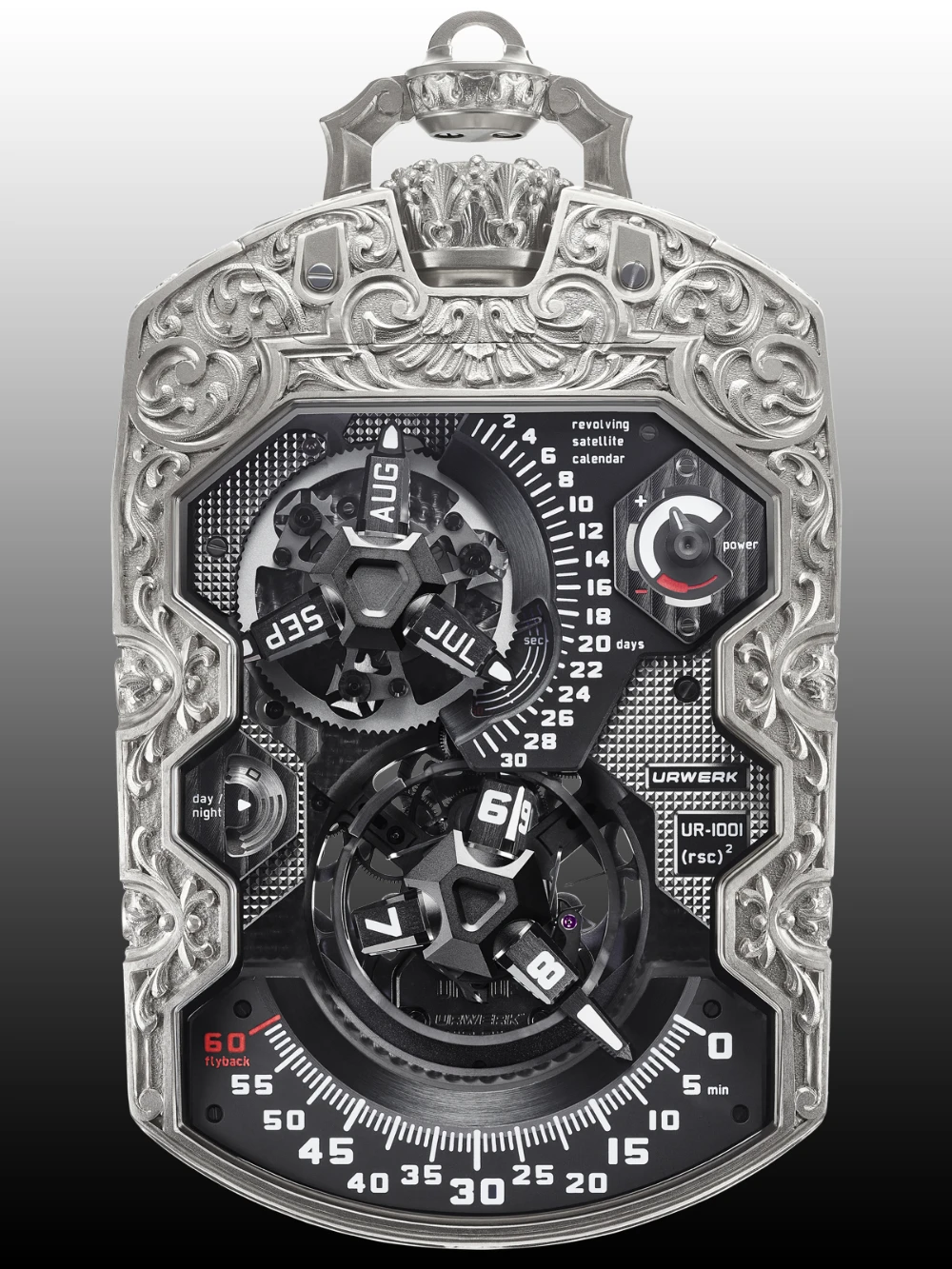
At the heart of the UR-10.01 is a solitary barrel with a 39-hour power reserve. That may not sound like much nowadays, but when you realise what it has to push, it’s remarkable. It’s driving a rotating satellite hours indicator, a retrograde minutes complication, a rotating satellite calendar displaying months and dates, a day/night indicator, its own power-reserve indicator (with a red zone when the tank is running dry), three second hand indicators showing 3 x 20 seconds across a 120° sector, an ‘oil change’ indicator, a 100-year time indicator and a linear time indicator covering 1,000 years. And breathe.
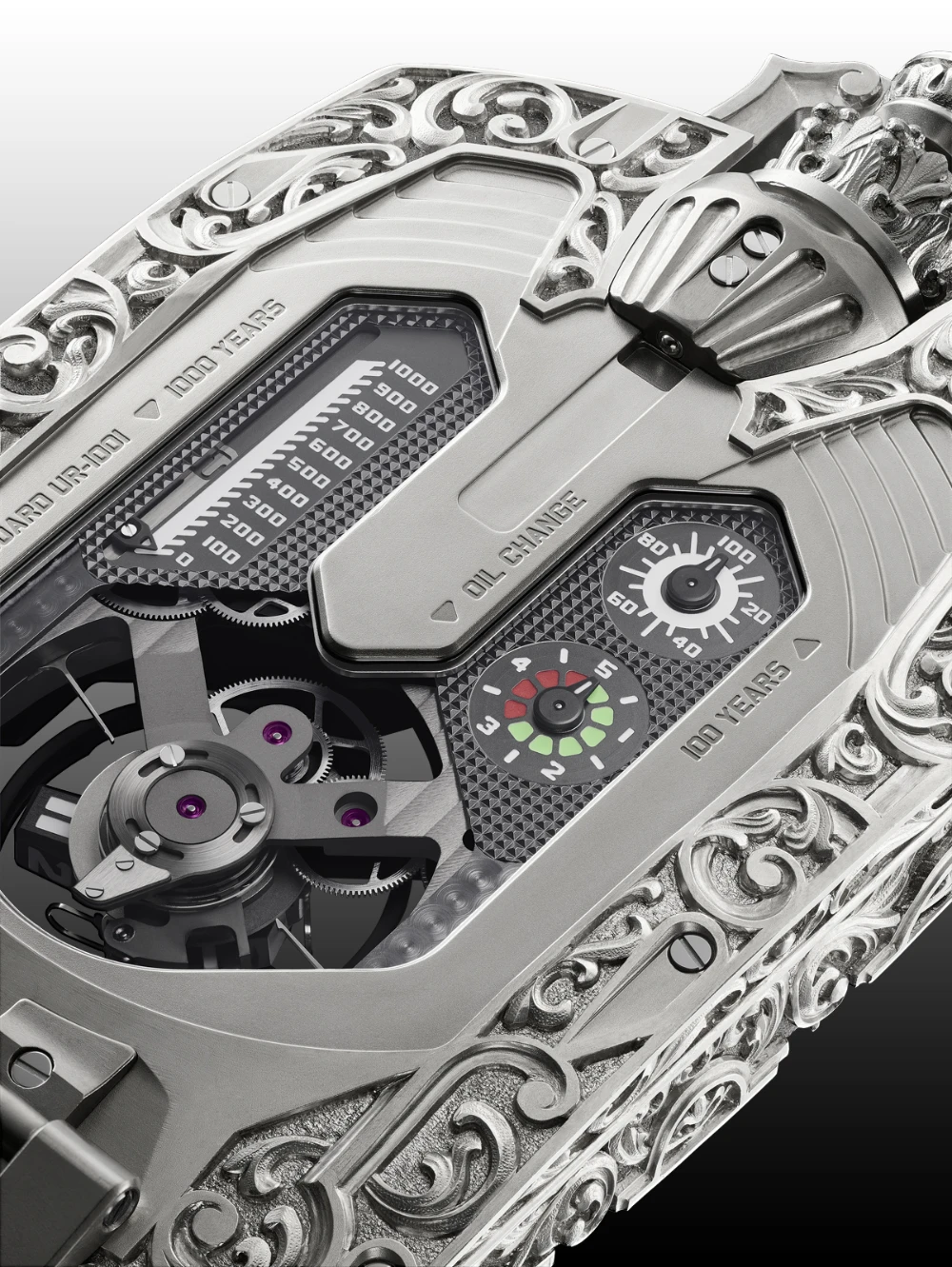
That satellite hour indicator at 6 has no upper bridge. Instead, it’s mounted on a moving ring underneath. This means you can see straight through to the retrograde mechanism. As well as looking after hours, the satellite also displays retrograde minutes on that elongated pointer.
There’s a neat bit of engineering with the retrograde minute spring. It’s a 6.5-turn coil measuring 174.4 mm x 0.1 mm x 0.3 mm, with a movable stud for adjustment. The length is the point – a long spring gives a flat torque curve, so the minute hand mechanism isn’t fighting the usual wildly varying load across its arc. It’s an elegant, quietly unglamorous and typically URWERK solution to the problem that makes most retrogrades misbehave.
URWERK UR-1001 Amadeus – dial
To the left as you look at the, well, what do we call it? Dial? Face? Perhaps ‘display’ is more appropriate. Anyway, to the left you can see the day/night indicator. Rather beautifully, it uses black Super-LumiNova for night, brushed white ruthenium for day and mixed stripes for twilight.
Just above it you have a month and date indicator, again carousel-mounted. It’s worth mentioning that not only do the two carousels themselves rotate, but the satellite arms spin too.
Turn it over and the timescale stretches absurdly. An oil-change indicator runs white for three years, red for the fourth and fifth, then resets when the watch is serviced. Beside it, a counter advances in five-year steps to 100 years and, as each century ends, sends a pulse to a linear 1,000-year display. And all of this is driven from that same single barrel, remember?
URWERK UR-1001 Amadeus – Zeit Device
The movement’s origin story is better than most press-kit folklore. Felix Baumgartner is quoted as saying, “Since we founded URWERK, we have developed new methods of displaying time. However, we were always constrained by the size of the wristwatch. With the Zeit Device we could allow ourselves carte blanche and created a larger playground for our imaginations… and then filled it with all of our complications and indications.”
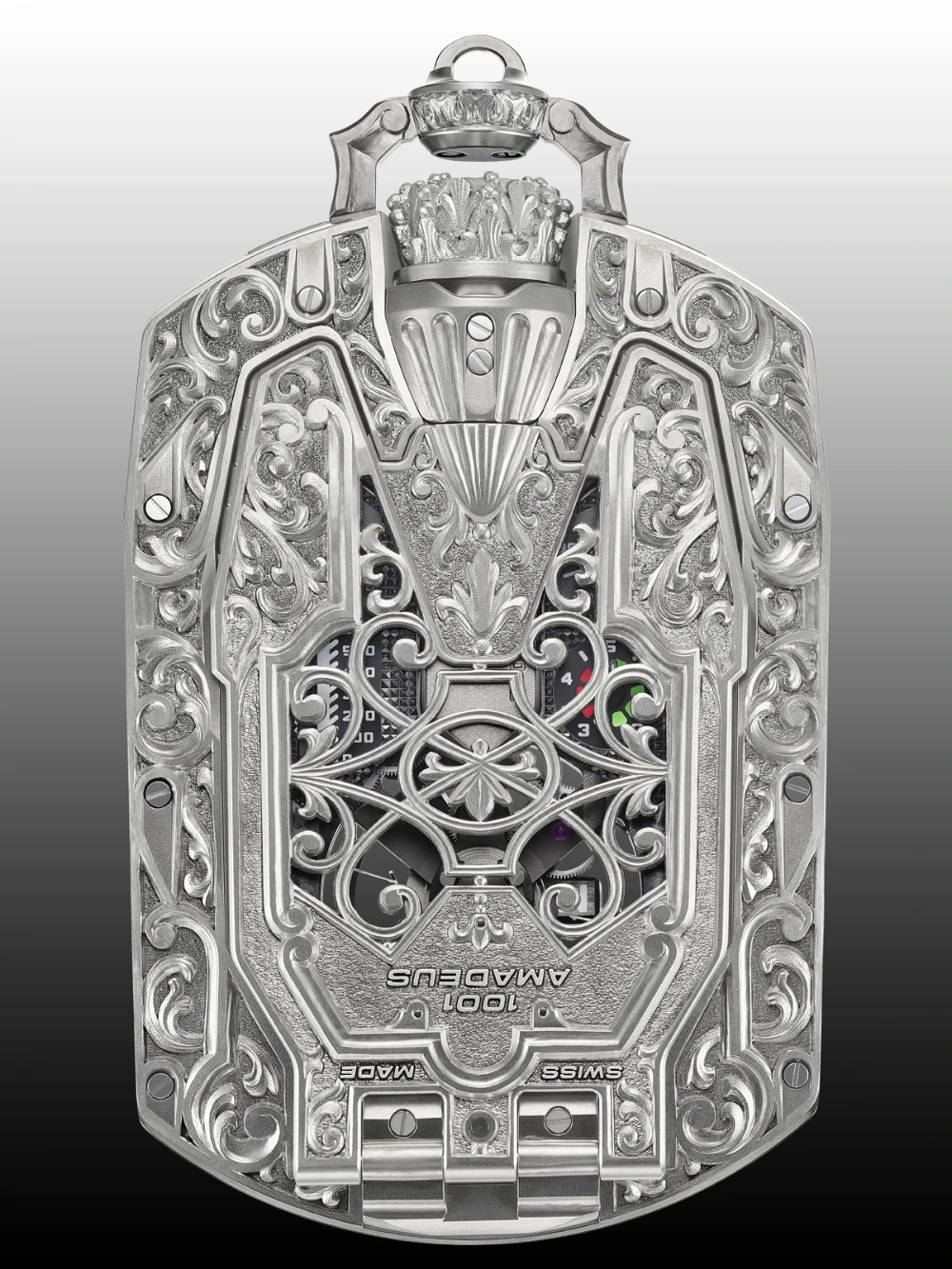
There’s a neat but unintentional touch here too. At 106 mm x 62 mm x 23 mm, the Amadeus is roughly mobile phone-sized, which fits the watchmaker’s philosophy well: one device traps you in the immediate, the other pushes you out to a millennium.
There’s another benefit to stretching time like this. There aren’t many better ways to stand implicitly behind the quality of your watches than to make one with a millennium indicator.
Closing remarks
Is the Amadeus an everyday watch? Well, unless you are at the narrow intersection of the steampunk and billionaire communities, probably not. Can you tell the time with the Amadeus at a glance? Not quite, although it’s a lot simpler than you’d think, once you get the hang of it.
So why would you buy it?
URWERK has always been less interested in what time it is than in how much of it has quietly gone past. In other words, the firm’s watches are less about telling the time and more about time itself.
You’d buy the Amadeus because you understand the thinking behind craft and things that have had care, love and intelligence invested in their creation. You want something from a watchmaker whose Geneva atelier – described by the firm’s Felix Baumgartner as having “700-year-old walls” – predates Beverley Minster’s misericords by around 200 years. And you’d buy it because you hate plastic stackable chairs and all they represent.
Further reading
Technical specifications
- Model: URWERK UR-1001 Amadeus
- Case: hand-engraved titanium, 106 mm x 62 mm x 23 mm, water resistance 3 ATM (30 metres)
- Functions: seconds, minutes, hours, days and night, months, years, centuries and millennia
- Movement: Calibre UR-10.01, self-winding movement, frequency 28,800 vph (4 Hz), 51 jewels, power reserve 39 hours
- Price on application
- One-of-a-kind creation