
Pequignet Paris Chrono BPM Watch Review
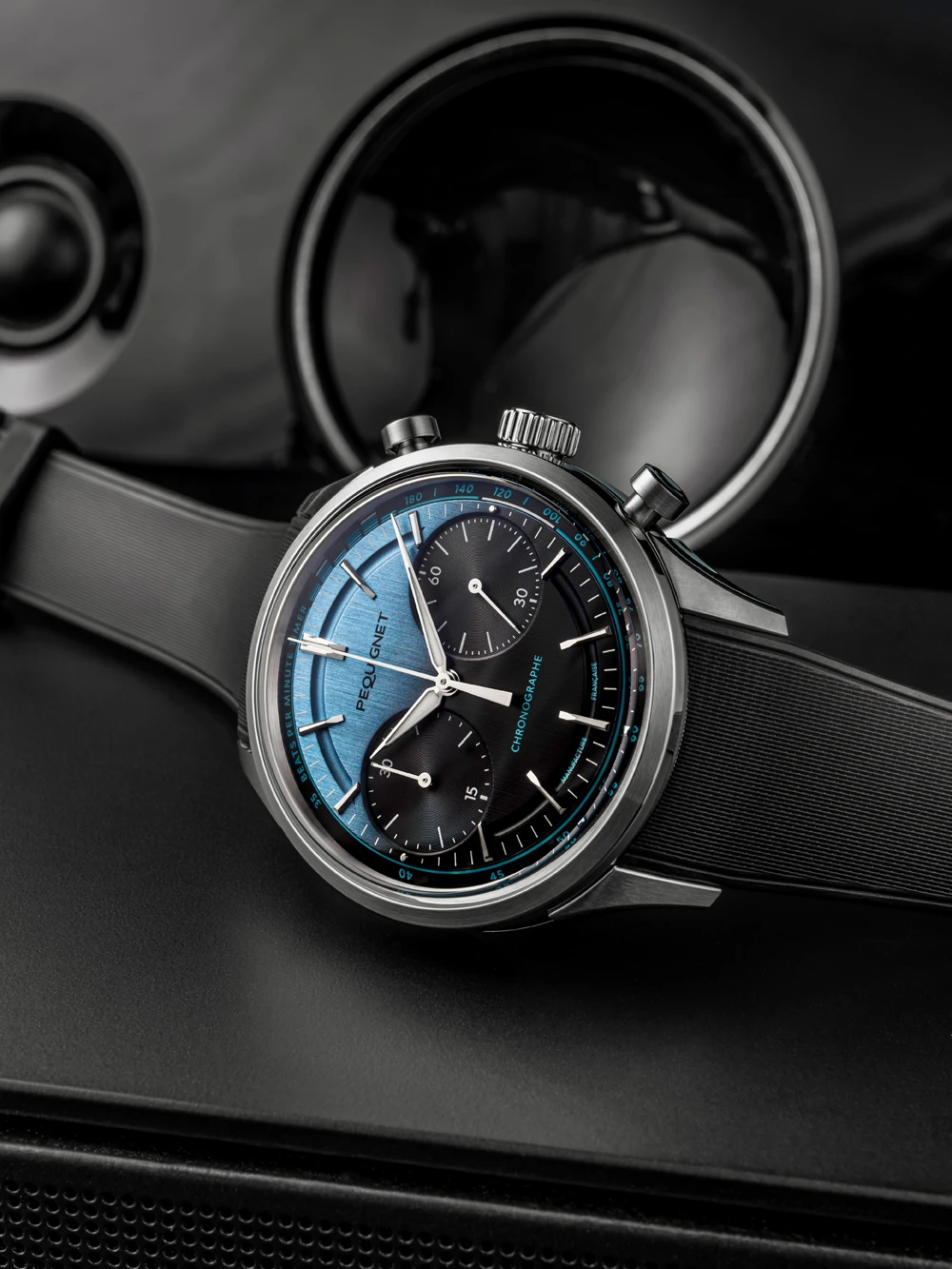
The Pequignet Royale Paris Chrono BPM is an eye-catching watch inspired by ‘French Touch’, a genre of music characterised by its ‘four-on-the-floor house’ rhythm. Based in the Franche-Comté, the Manufacture has always imbued its products with a distinctive regional flavour and this latest music-inspired watch proves no exception.
Music – a constant presence in our lives
From the annoying muzak played in shopping malls to the ‘old favourites’ we sing along to while driving to work – music is a constant presence wherever we choose to roam. The value of music is not limited to just an arrangement of notes or a few catchy lyrics – its worth lies in the feelings it evokes.
As a proud ‘northerner’, I look back fondly on the time I both studied and worked in Manchester. It was a period when I did not worry about interest rates or wars; life was a carefree existence. Local bands such as the Happy Mondays and The Stone Roses provided the soundtrack to my salad days. There was nothing banal about their work; every riff and lyric was skilfully crafted to penetrate the soul and engage with the human psyche.
French Touch
Impactful music is clearly not the preserve of ‘Madchester’, it takes many forms and can often be regional in character. In the 1990s, on the opposite side of La Manche, a new genre of electronic music emerged from Paris’ club scene – ‘French Touch’. Cassius, Daft Punk and Stardust were pioneers in this style of house music, employing signature disco and funk samples, filter and phaser effects and heavy basslines. Most notably, the music was characterised by its steady 4/4 time or ‘four-on-the-floor house’ rhythm.
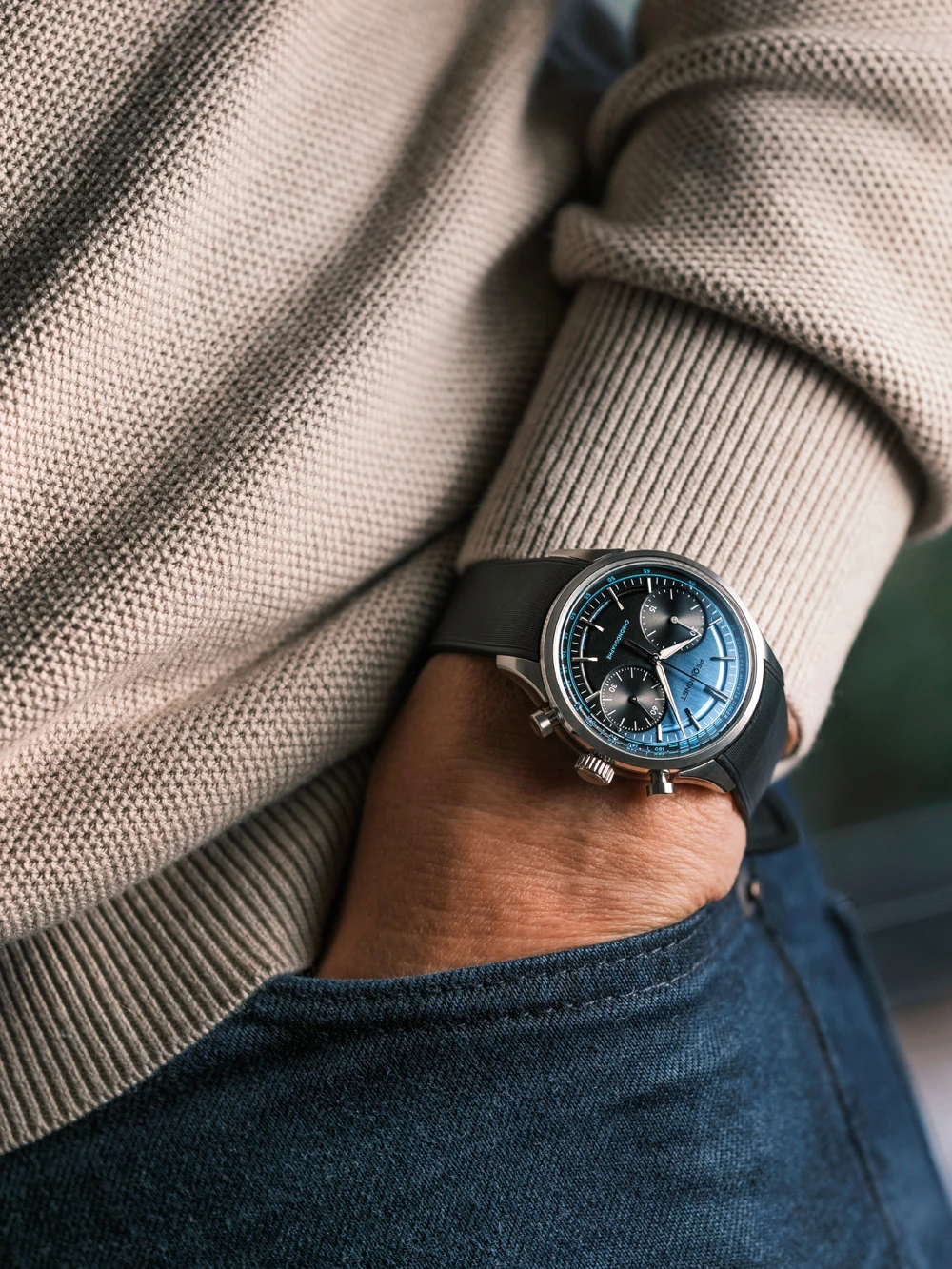
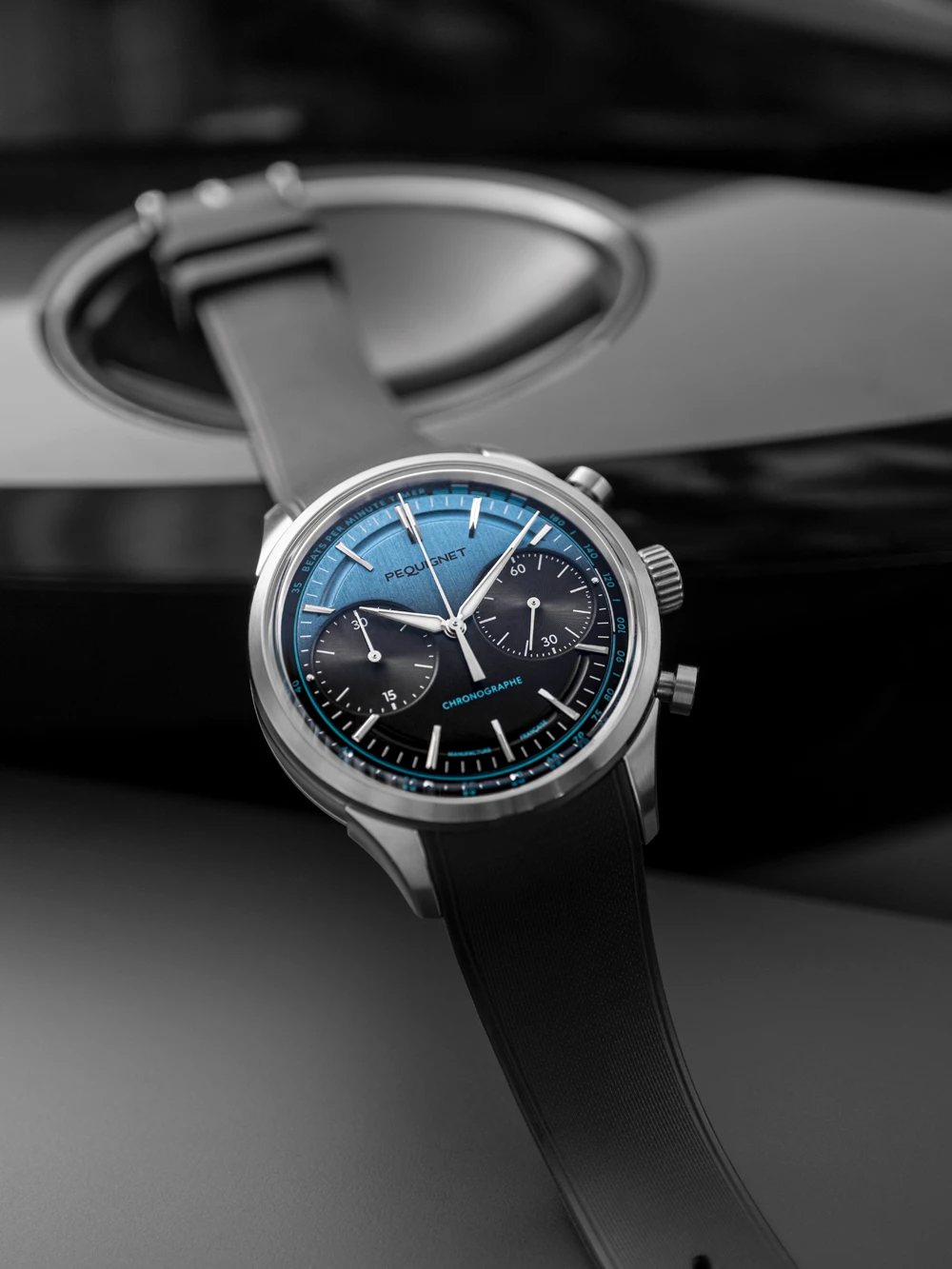
Pequignet has recently released a new model, the Royale Paris Chrono BPM, which pays tribute to French Touch with its graduated dial and its BPM scale hugging the edge of its display. Traditionally, a significant number of chronographs have featured a track, positioned on the rehaut, that’s used in conjunction with the central chronograph seconds hand to determine the pulse (pulsometer), the distance (telemeter) or the speed of an object (tachymeter); however, a watch designed to measure the tempo of a track – well, that is something refreshingly different. Allow me to elaborate.
Pequignet Royale Paris Chrono BPM – dial
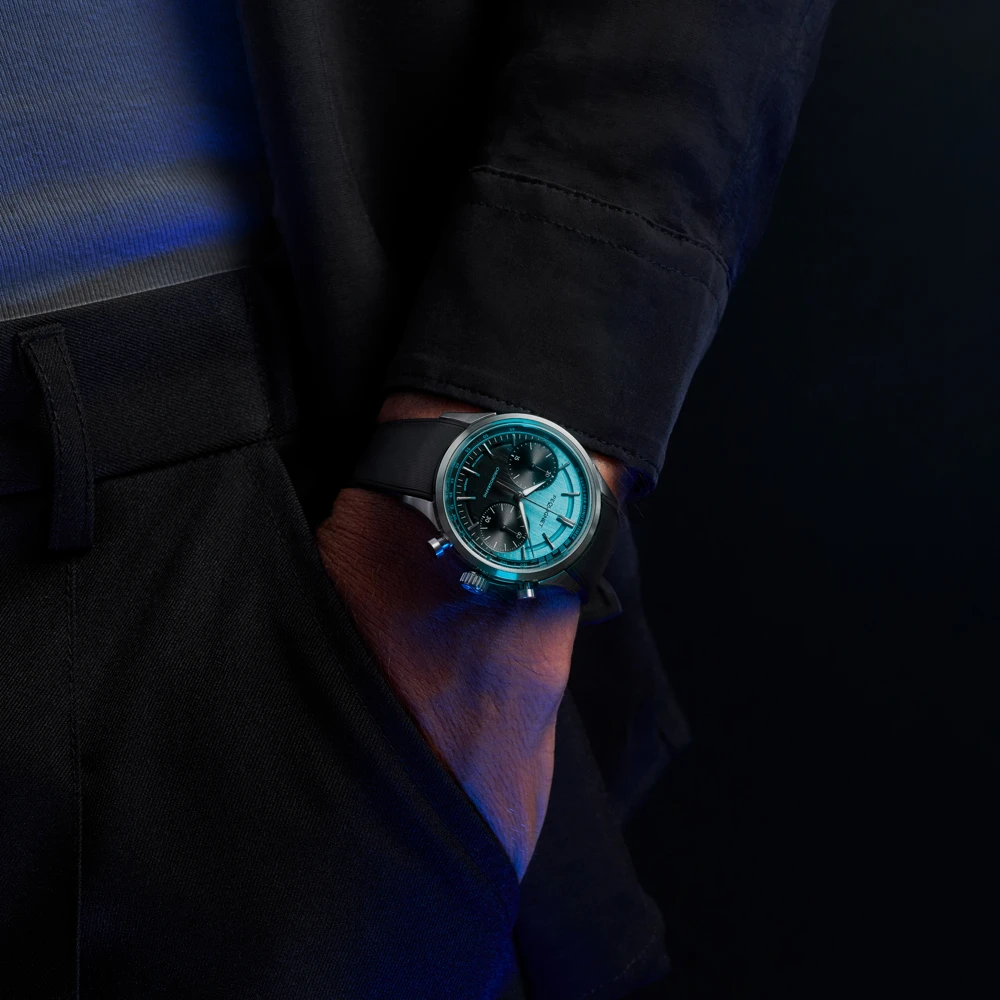
The dial of the Royale Paris Chrono BPM does not subscribe to convention, instead favouring two dominant colours – blue and black. The upper half of the dial is presented in a bewitching shade of electric blue, while the lower portion of the dial assumes a nocturnal appearance with its brooding black tones. The contrasting hues evoke thoughts of late-night revelry transitioning into early-morning optimism. The French marque has dressed the entire dial with a vertical brushed finish.
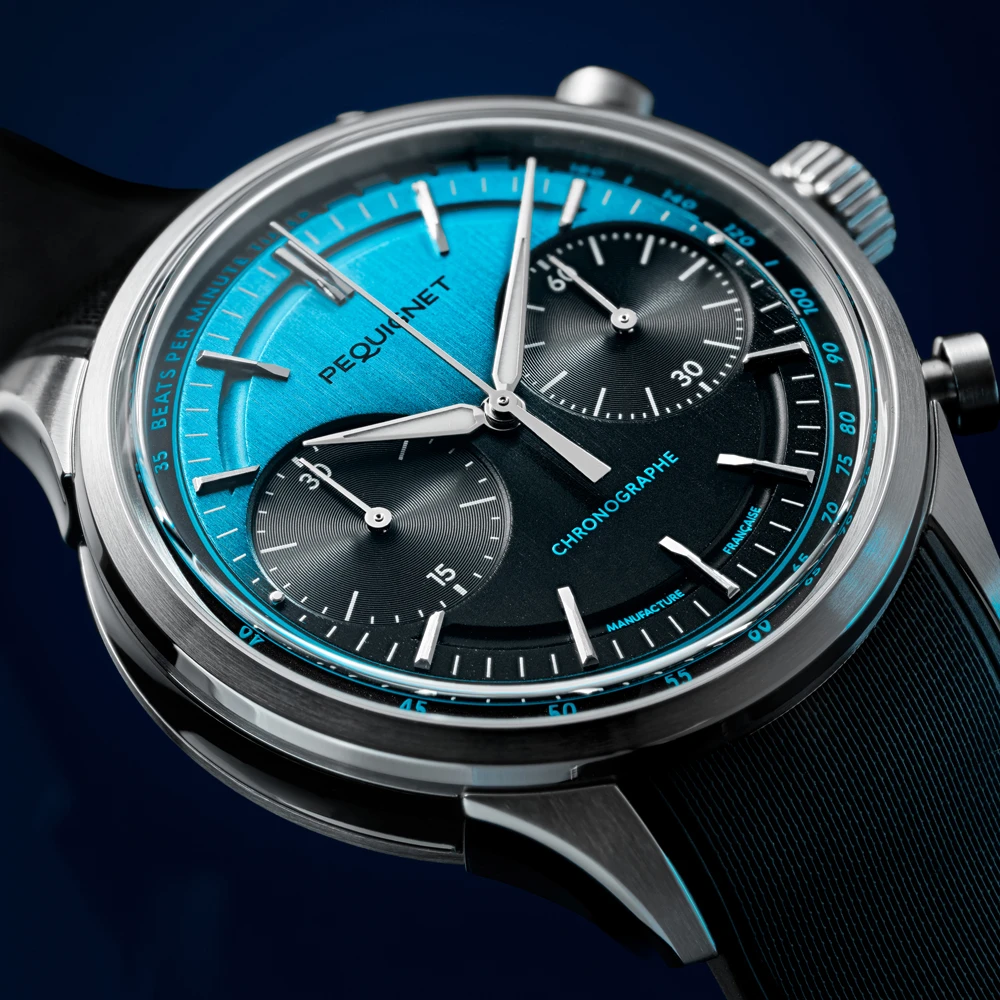
Two snailed registers punctuate the dial – a 30-minute chronograph register (left) and a small seconds display (right). The steel hour and minute hands are lined with luminescent fill and collaborate with faceted, intricately shaped indexes.
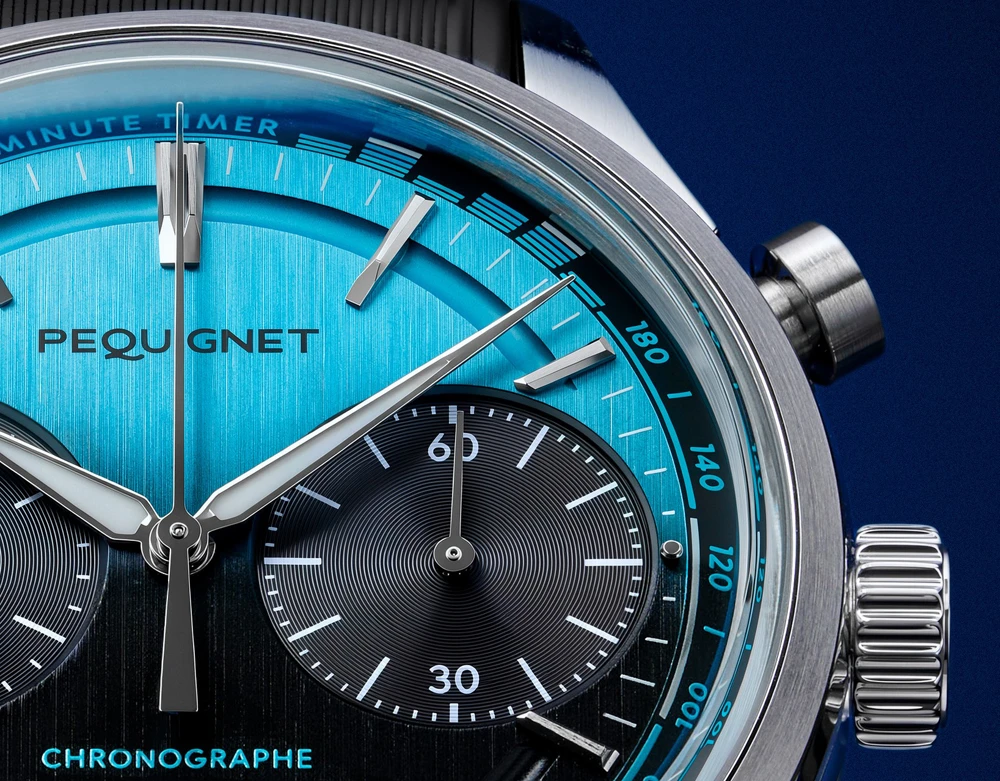
In 2025, Pequignet released the Royale Paris featuring a distinctive circular ‘gouge’ positioned adjacent to the indexes. The Royale Paris Chrono BPM shares this approach, introducing alluring depths to the horological landscape. The baton-type indexes span said trench, augmenting the visual appeal, while the addition of a glass box sapphire crystal further accentuates the complexity of the dial.
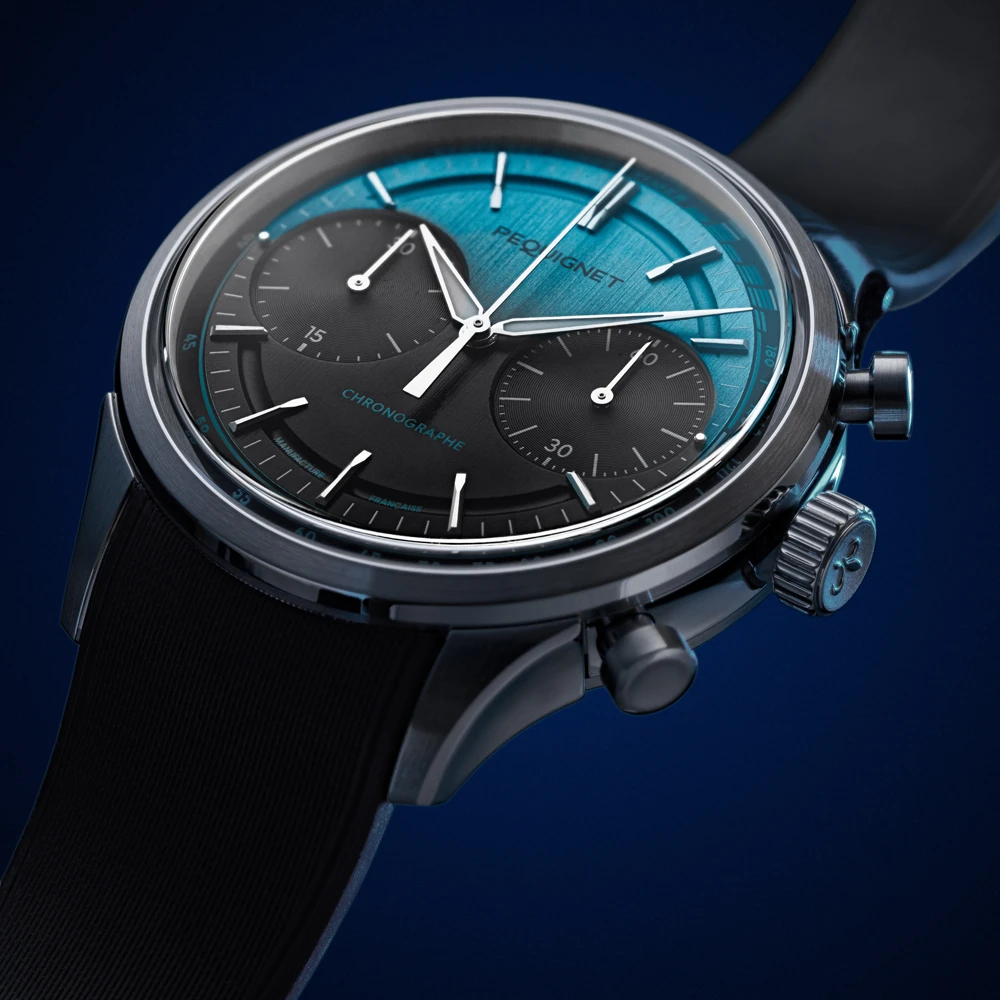
The ‘Beats per Minute’ scale, fringing the display, is unquestionably the headline act. Between 12 and 2 o’clock, the scale incorporates a colourful series of lines, resembling a stylised EQ spectrum analyser. Thereafter, light blue Arabic numerals indicate the number of ‘drum base kicks’, helping to identify the genre of music. For example, readings of 70 to 95 BPM may be indicative of 90s rap.
While crafted with a welcome hint of humour, the dial of the Royale Paris Chrono BPM performs its time-telling duties superbly. Indeed, Pequignet delivers style and lucidity in equal measure.

Image – Manufacture Pequignet in Morteau
Pequignet Royale Paris Chrono BPM – case
Measuring a neat 39.5 mm, the case is hewn from 316L stainless steel and unites satin-brushed and polished surfaces. Upholding fine watchmaking practice, the lugs are discrete elements which are subsequently affixed to the case. This provides two distinct benefits. Firstly, the lugs can be polished to a higher standard and secondly, should a lug become damaged, it can be replaced (I discussed this at length in my feature on the Calibre Royal).
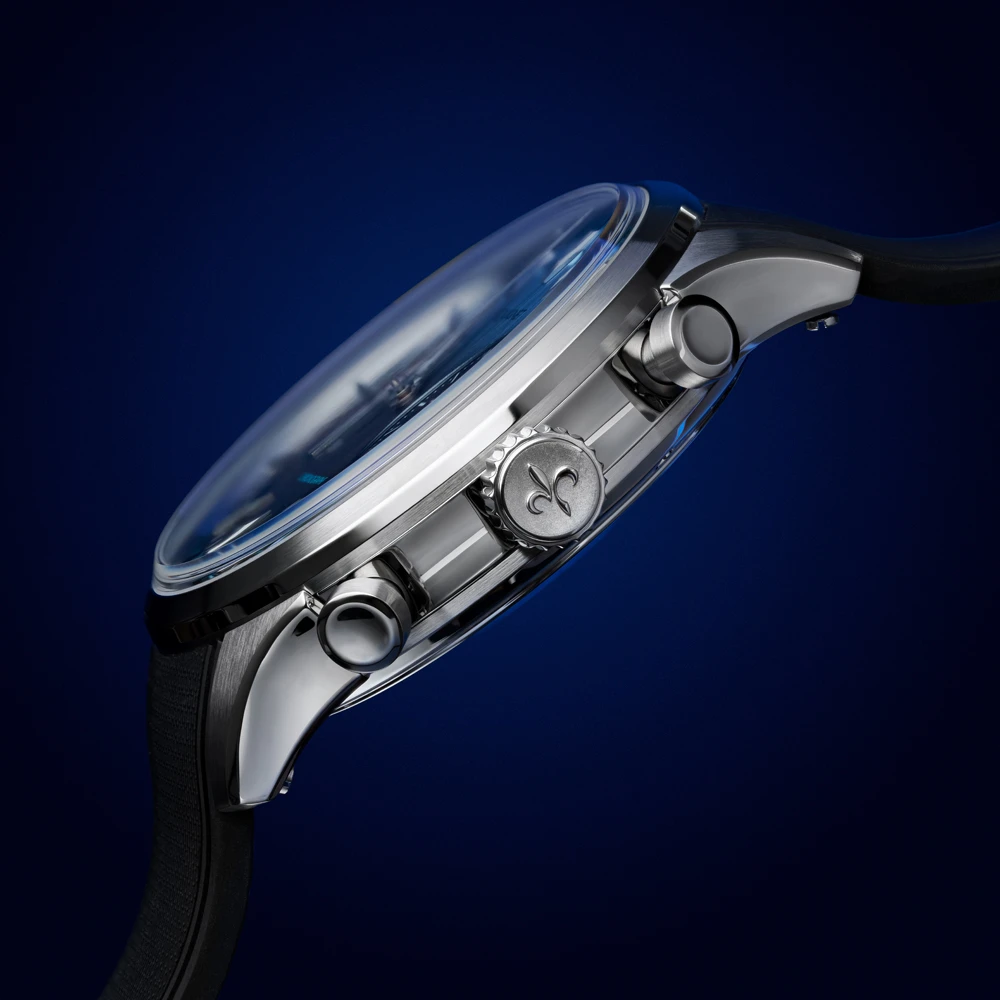
Pequignet has endued the vertical flank of the case with an intricate arrangement of lines. For instance, the carrure (case middle) is recessed, with both the bezel and caseback having a greater diameter, extending beyond the middle. It reminds me of a lady’s dress being nipped at the waist and introduces a charming note of nuance. The middle of the caseband features a line that bisects its form. Each chronograph pusher features a dimpled vertical facet and the crown is adorned with the fleur-de-lys, a further reminder of the model’s place of origin.
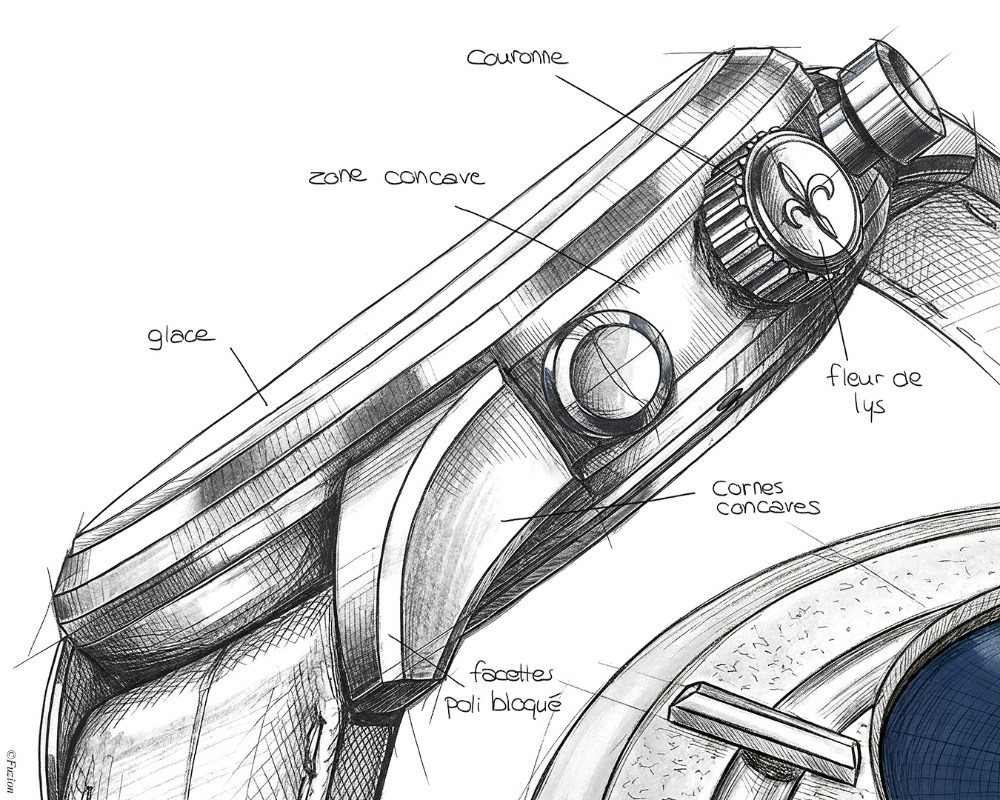
A tell-tale sign used to determine whether a chronograph is modular or integrated is to look at the position of the crown relative to the pushers. Usually, with a modular chronograph, the pushers sit higher than the crown; however, in this instance, Pequignet proves the exception as the crown and pushers are aligned with one another.
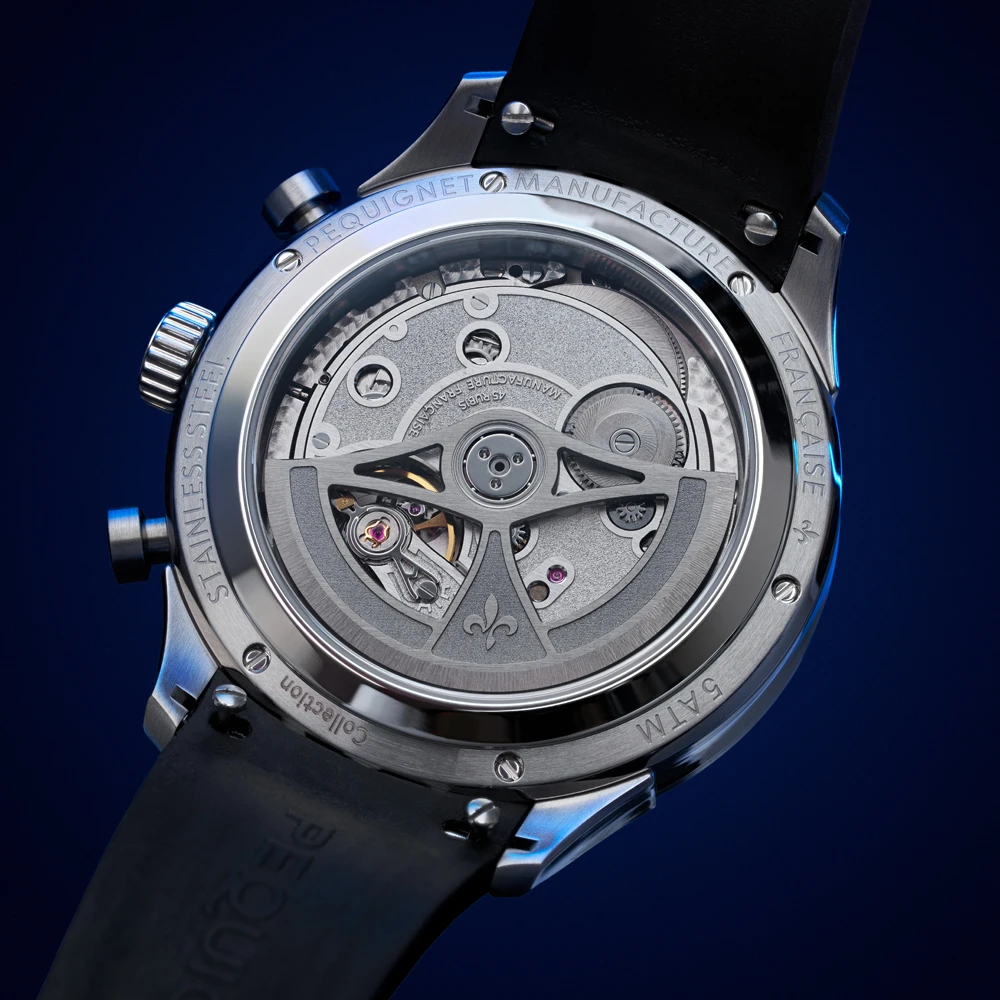
To the rear, the caseback is endowed with a pane of sapphire crystal, allowing the wearer to view the Calibre Initial movement. The Pequignet Royale Paris Chrono BPM is presented on a black Cordura strap which is interchangeable, allowing the owner to personalise the watch should the mood take them.
Pequignet Royale Paris Chrono BPM – movement
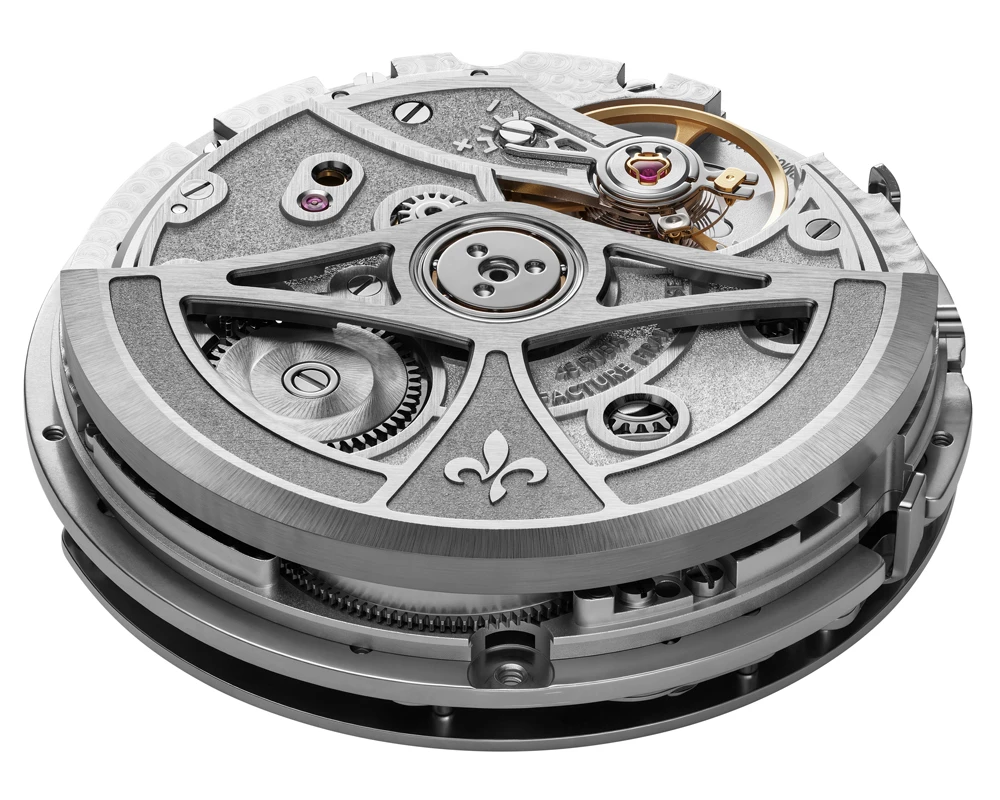
Beating at 4 Hz, a very apt frequency for a French Touch watch, the Royale Paris Chrono BPM is a modular movement. It comprises a base movement, the Manufacture’s Calibre Initial, with a Dubois Dépraz chronograph on top, hence its name – ‘Calibre Initial Chronograph’.
Back in 2014, when Pequignet began working on the design of the Calibre Initial, it always intended for the movement to be paired with a chronograph module and began working with Dubois Dépraz, a specialist in this field. As the brand explains, “They tested our Initial calibre inside and out before agreeing to host the additional module plate. The base of the movement is the same, but there are a few modifications to accommodate it. We were able to achieve this coupling because it was factored into the design from the very beginning; otherwise, it would have been nearly impossible.”
While I often wax lyrical about integrated chronograph movements featuring a column-wheel and vertical coupling, I found pressing the pushers of this modular cam-based movement delivered a surprisingly impressive, crisp pushpiece action. Moreover, Pequignet explains that it took this approach as the cam system is “robust, easy to maintain, and very reliable”.
The Calibre Initial is fitted with an openworked oscillating mass, affording superior views of the bridges and plate beneath. The rotor bears the fleur-de-lys emblem, presented in relief, and incorporates sandblasted and grained finishes. This form of finishing also extends to the bridges, imbuing the movement with a contemporary mien. Conversely, the mainplate is decorated with traditional perlage, consistent with fine watchmaking practice.
Closing remarks
Earlier this year, Pequignet released the Paris Royale Chrono, the Maison’s first Manufacture Chronograph. Offered in three dial executions, the model features two counters and a tachymeter scale framing the display. Eminently beautiful, the watch harnesses all of the mechanical attributes already outlined. While it subscribes to several horological norms, it also introduces some unusual touches, including the ‘gouge’ on the dial, the contrasting counters and, with the silver dial/blue counter option, a lovely denim jean-themed strap. I find this atypical approach to Haute Horlogerie endearing. The Manufacture doesn’t emulate Swiss watchmaking; it chooses its own path to greatness.
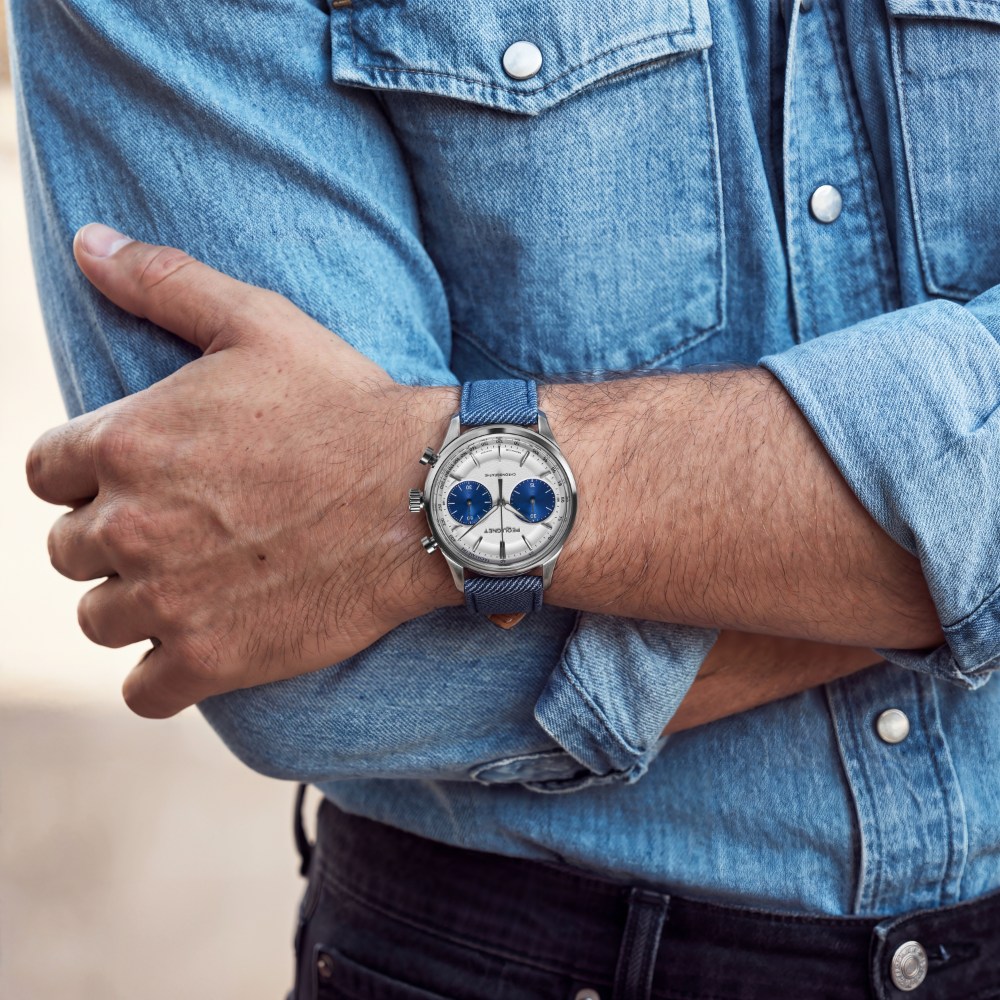
Image – Pequignet Royale Paris Chrono
Both the Paris Royale Chrono and the Royale Paris Chrono BPM share much in common, including their dial topography, case and the Calibre Initial chronograph movement. Measuring 39.5 mm in diameter, the case will suit the majority of wrists. However, it is the movement that proves a revelation. Indeed, contrary to the widespread belief that an integrated chronograph is far superior, there is no denying that this modular chronograph movement delivers a crisp pusher action; a tactile experience that doesn’t disappoint.
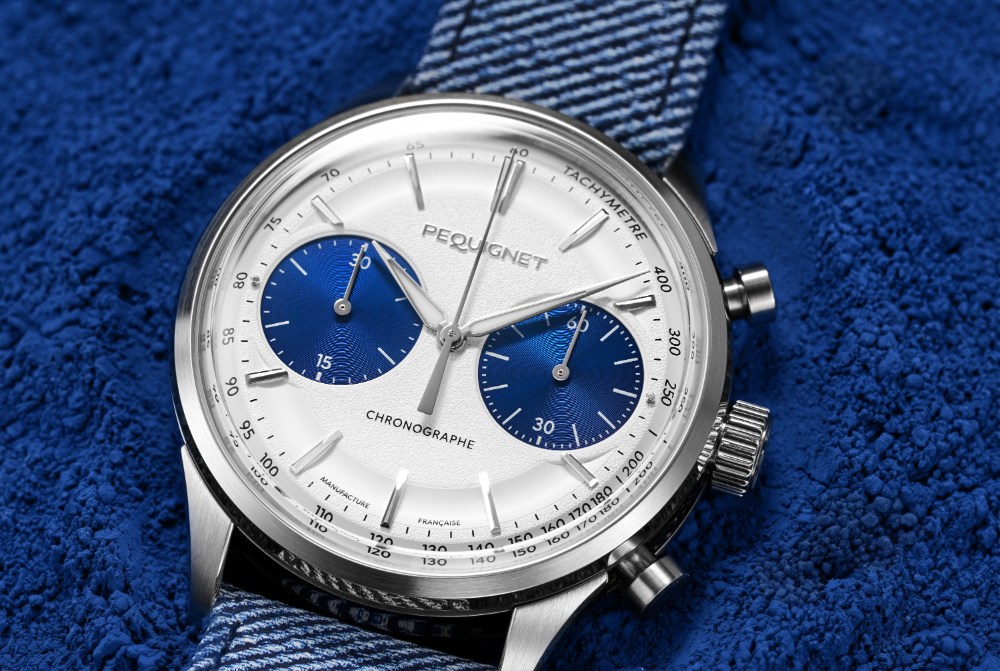
Image – Pequignet Royale Paris Chrono
But ultimately, in my opinion, all roads lead to the dial execution. In common with the Paris Royale Chrono, reading the hours and minutes on the BPM proves simple. Likewise, the combination of the central chronograph seconds hand and 30-minute chronograph register should fulfil most timing requirements. Then there is eye-catching horological canvas where electric blue melts into the blackness of night. It serves as a wonderful illustration of how Pequignet chooses to do things differently.
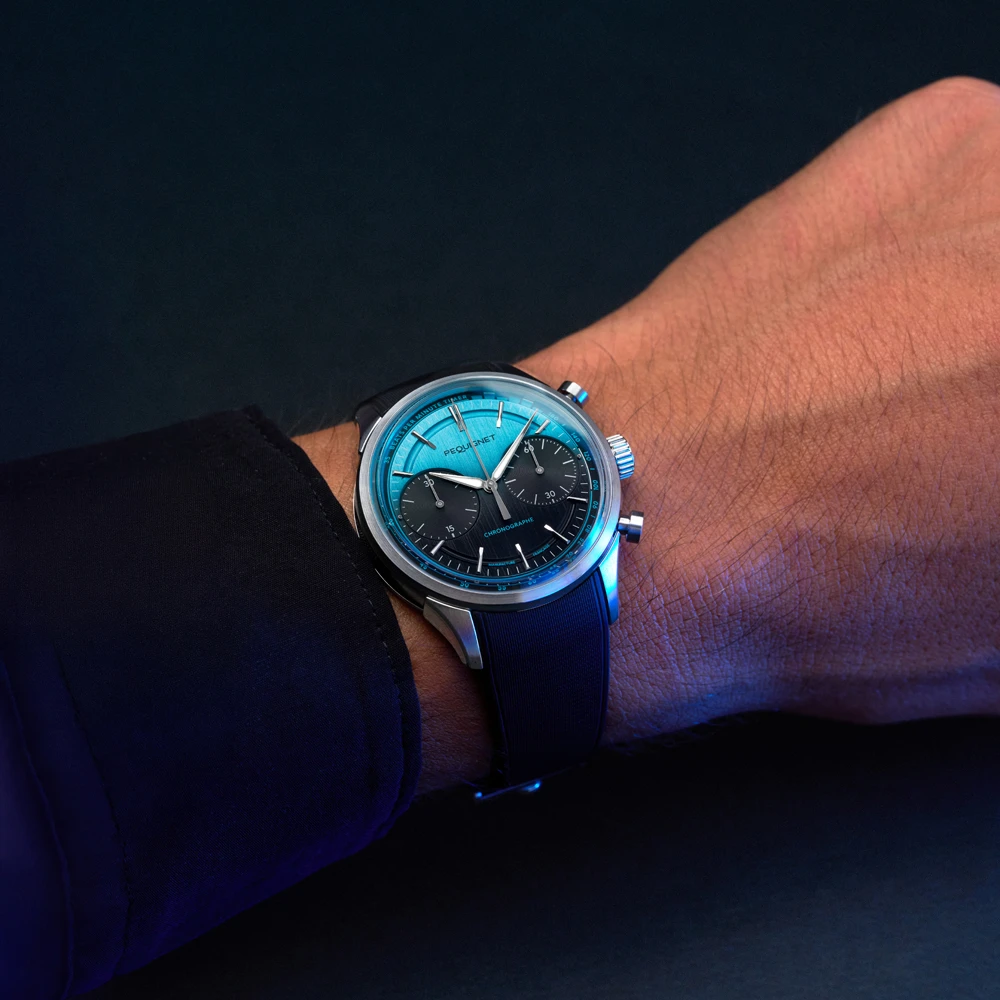
Furthermore, with the Pequignet Royale Paris Chrono BPM, the French luxury marque asks us to reconsider the role of the pulsometer. In this instance, the function is not used to establish the heart rate of an individual but instead the beat of the prevailing music. At first, the notion of measuring the heart rate seems more important until you pause and consider that many everyday devices such as a Fitbit or smartwatch now fulfil this role, providing a niche for the BPM.

Image – Franche-Comté
Whether you have a genuine need for a BPM scale on your watch is open to debate, but its presence is indicative of a brand that chooses not to follow Swiss or German marques, but instead prefers to march to the beat of its own drum.
Further reading
Technical specification
- Model: Pequignet Royale Paris Chrono BPM
- Reference: 9120343
- Case: stainless steel, diameter 39.5 mm, water resistance 5 ATM (50 metres), sapphire crystal to front, exhibition caseback.
- Functions: hours, minutes, small seconds, chronograph, BPM scale
- Movement: Calibre Initial Chronograph, self-winding movement, frequency 28,800 vph (4 Hz), 45 jewels
- Strap – black Cordura strap with an interchangeable strap system paired with a steel pin buckle
- Price – €6,950 including tax (RRP as of 27.10.2026)