
A. Lange & Söhne Datograph Perpetual Watch Review
Limited to 50 pieces, the new A. Lange & Söhne Datograph Perpetual (Ref. 410.136E) is endowed with a flyback chronograph, outsize date display and, as its name suggests, a perpetual calendar. However, unlike its forebears, the dial of this latest reference also features 11 baguette-cut diamonds and comes presented on a new five-row bracelet. Angus Davies provides an in-depth look at this über-desirable platinum watch from Saxony.
A. Lange & Söhne – the renaissance (1990)
With the fall of the Berlin Wall in 1989, Walter Lange earnestly sought to revive the family business his great-grandfather, Ferdinand A. Lange, had established in 1845. Walter had been forced to leave his native Germany in 1948, aged just 24, before A. Lange & Söhne was expropriated by the Soviet administration in what was then the Soviet Occupation Zone.
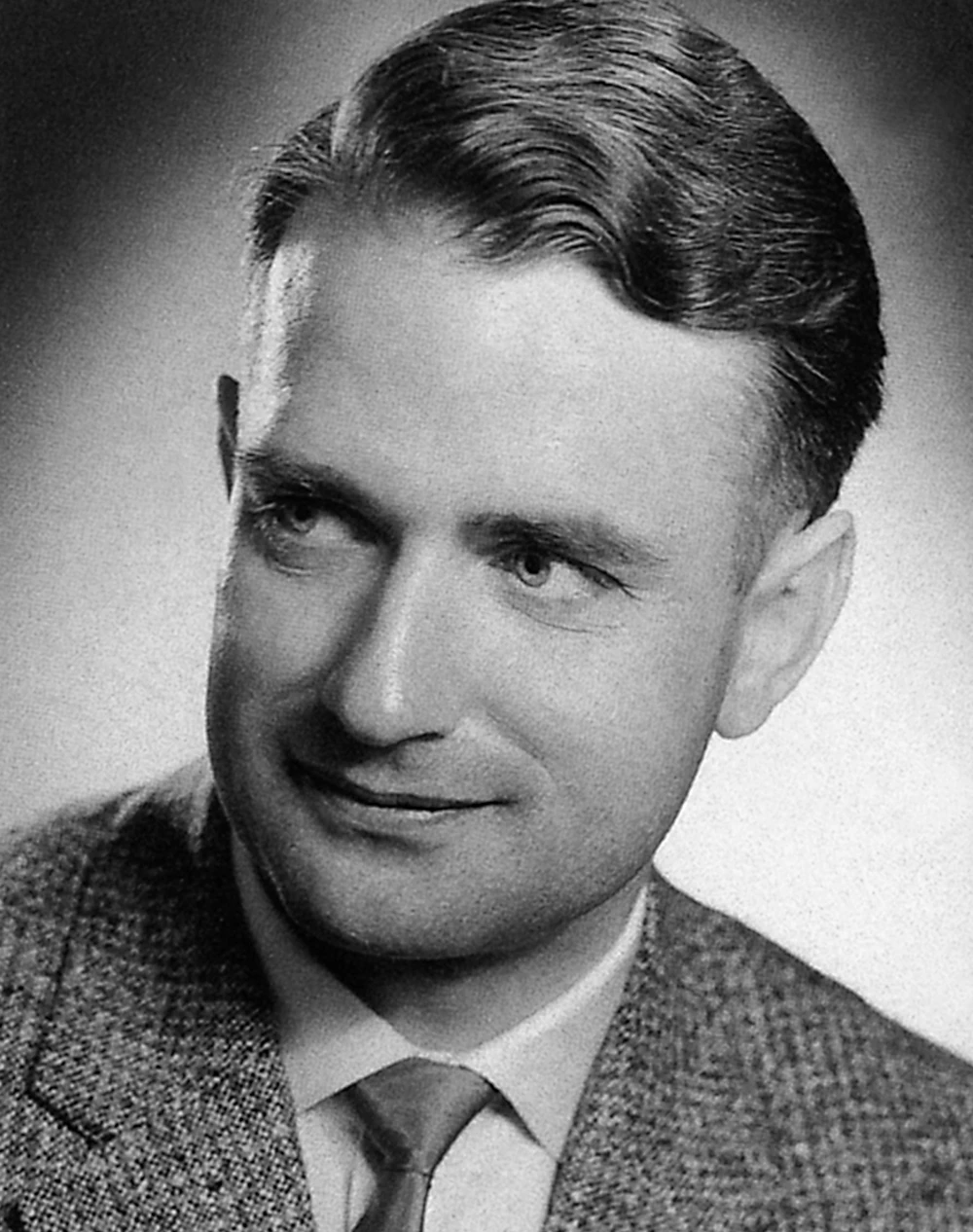
Above image – Walter Lange in 1954, age 30
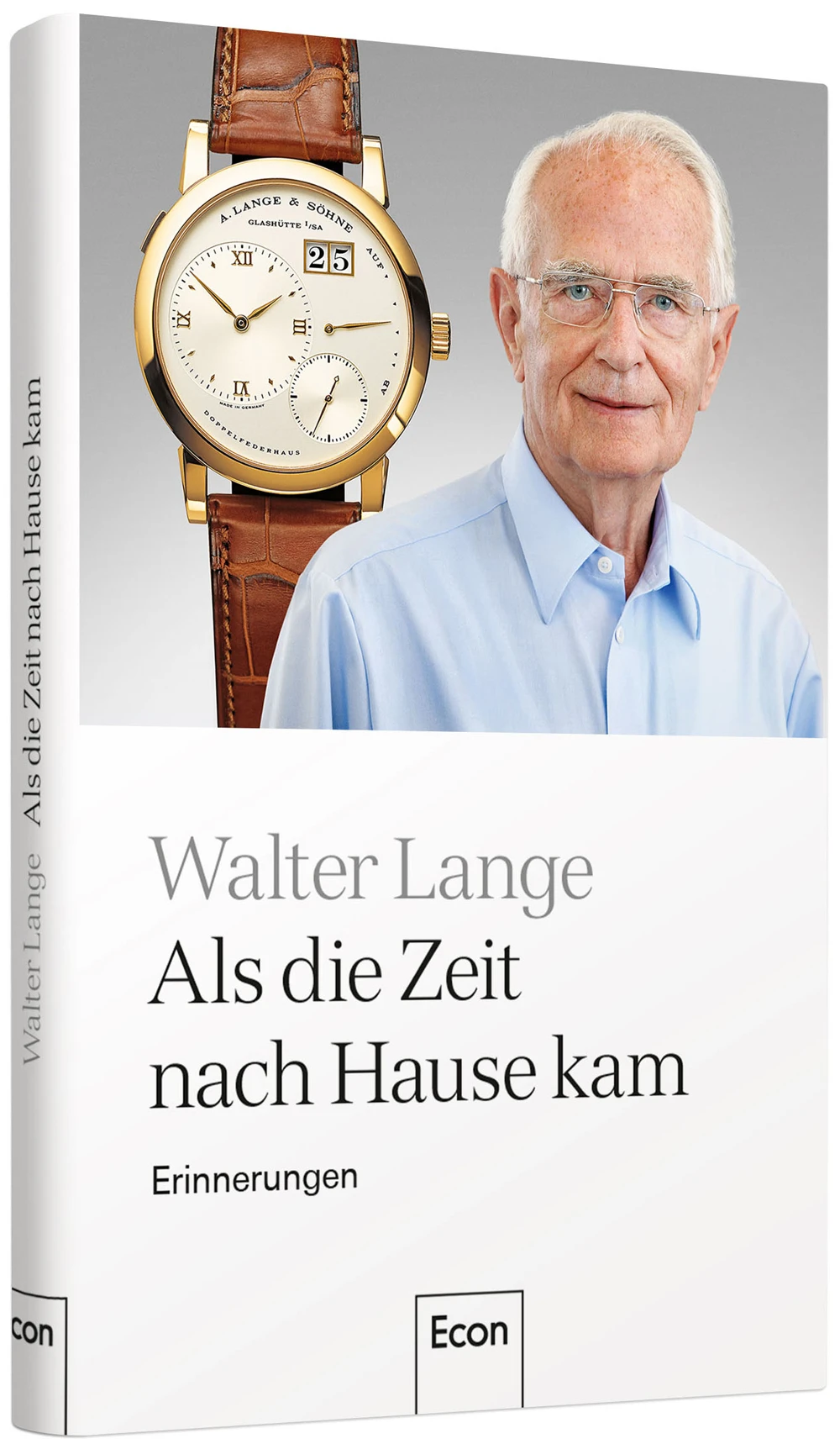
Above image – Walter Lange on cover of biography (2024)
Walter Lange never forgot Glashütte nor the Manufactory where successive generations of his family had once worked. In 1990, he registered ‘Lange Uhren GmbH’ and set about looking for premises and recruiting staff. Four years later, Walter stood on a stage with his business partner Günter Blümlein and Harmut Knothe, who subsequently became Managing Director and unveiled the revived company’s four inaugural models: the Saxonia, the Tourbillon ‘Pour le Mérite’, the Arkade and the Lange 1.
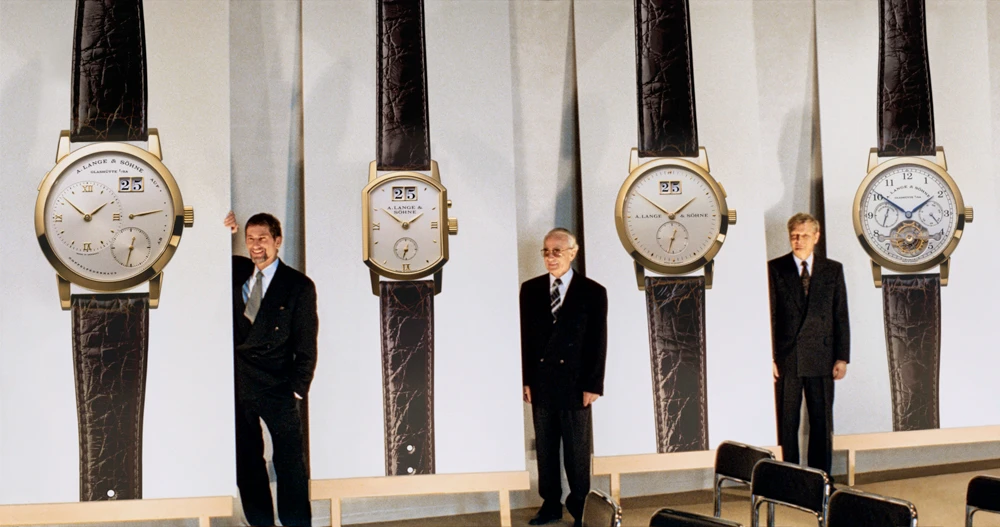
Image – the unveiling of Lange’s four inaugural models in 1994
With the advent of said four models, the reborn A. Lange & Söhne threw down the gauntlet to the established players within the Haute Horlogerie segment by offering a competitive blend of ageless styling, mechanical virtuosity and peerless finishing. These founding characteristics have remained. The German marque has occasionally revisited models such as the Saxonia and Lange 1, but the eye appeal of the inaugural references remains undiminished.
Datograph – a lesson in evolution
Following the release of the initial quartet and the warm reception they received from collectors and the press alike, the brand went on to release additional new models. For instance, in 1995, the firm launched its entry-level 1815 references and, some four years later at Baselworld 1999, Lange unveiled the now-legendary Datograph (Ref. 403.035).
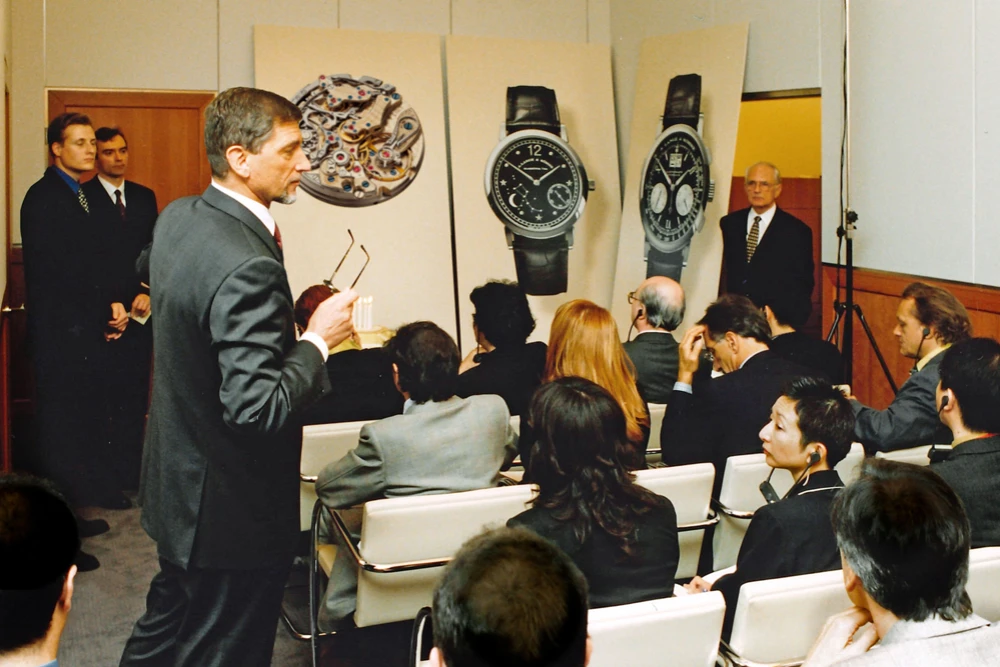
Image – the launch of the Lange Datograph (Ref 403.035) at Baselworld 1999
Housed in a 39 mm platinum case and endowed with a black dial, featuring an outsize date display, the model was devilishly handsome. But the highlight of the timepiece was undoubtedly its hand-wound movement, the calibre L951.1. At a time when the established watch industry procured third-party movements and modified them to suit, Lange chose to craft its own in-house Manufacture calibre. Made to the brand’s exacting requirements, the fully integrated movement featured a column-wheel, horizontal coupling, flyback function and a jumping minute counter.
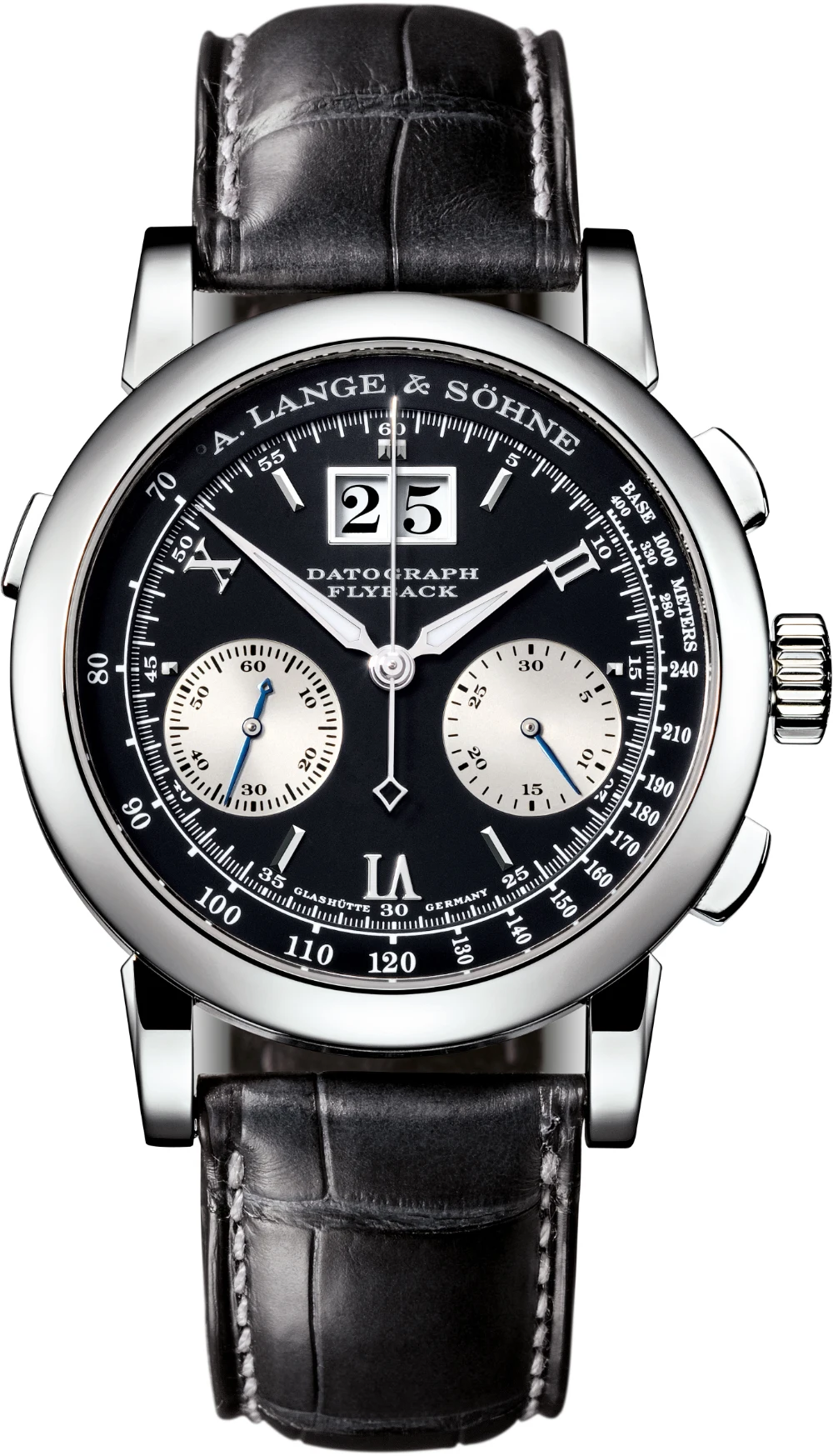
Image – the Lange Datograph (Ref 403.035)
Should you choose to dissect the Lange paradigm, you will discover a company driven by relentless progress. Indeed, its horological ambition saw the marque release the Double Split (Ref. 404.035) in 2004, a watch equipped with a double rattrapante that shared a strong likeness with the Datograph of 1999. To provide some context, a lone rattrapante is considered a ‘high complication’ such is the complexity of its associated mechanism. However, by comparison, a double rattrapante is a far rarer breed, seldom seen in the wild.
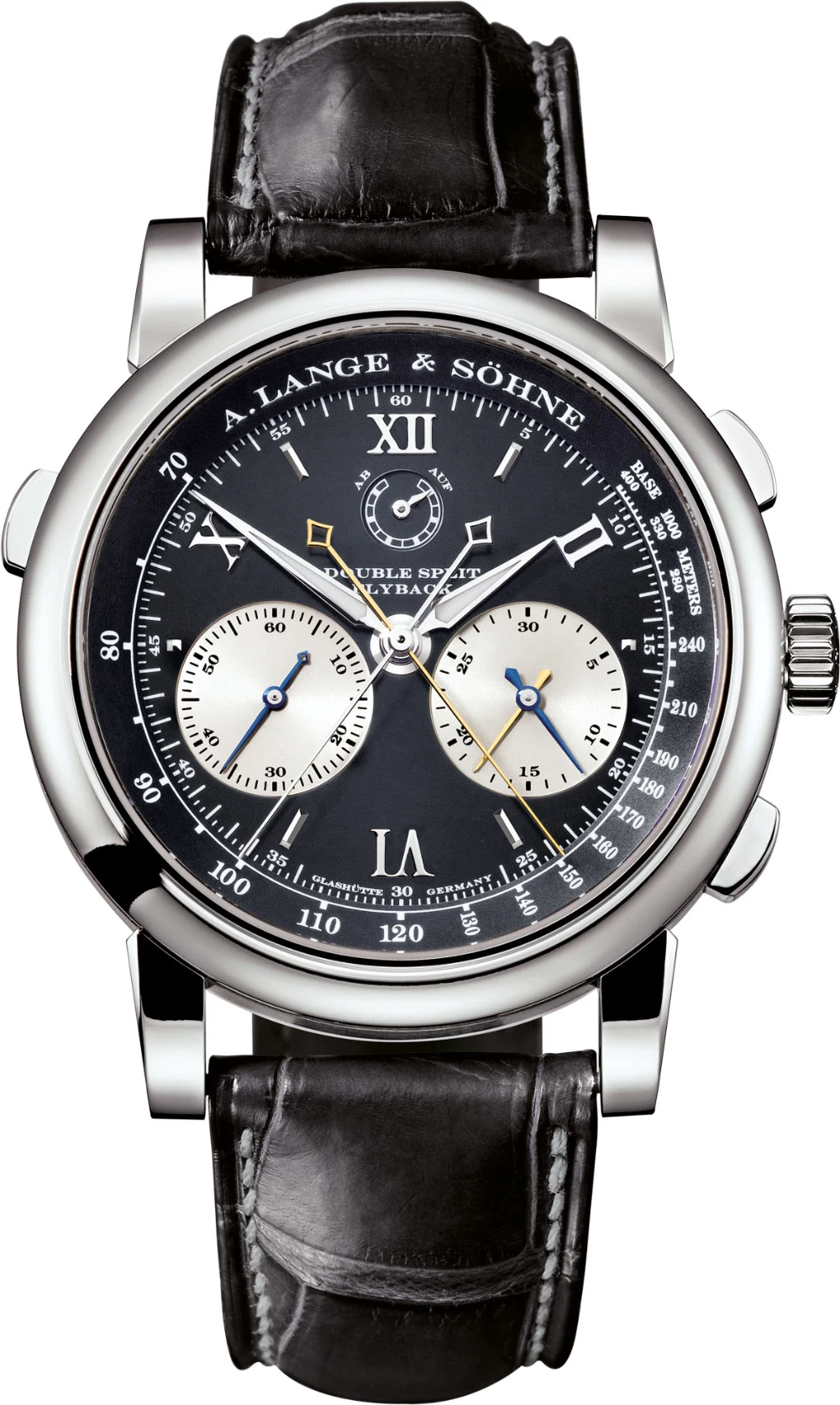
Image – the Lange Double Split (Ref. 404.035)
In 2006, A. Lange & Söhne unveiled the Datograph Perpetual (Ref. 410.025), a hugely ambitious creation combining a flyback chronograph with a perpetual calendar (widely regarded as one of the four high complications in Haute Horlogerie). The FHH (Fondation Haute Horlogerie) states that ‘a perpetual calendar watch is one which, in addition to the timekeeping indications, displays calendar functions such as the date, month and day of the week automatically and taking account of months with 28, 30 or 31 days, as well as leap years. Such models will nonetheless require correction in 2100, 2200 and 2300, which are exceptional years and not leap years, according to our Gregorian calendar.’
Examining Lange’s modi operandi, it tends not to discontinue models, but instead chooses to make small improvements, sometimes releasing references in alternative metals (usually precious) or adjusting the case dimensions a smidgen. This approach ensures that existing clients are not left owning a watch that suddenly appears passé. Moreover, it serves to demonstrate that a Lange watch is near perfect at the time of its unveiling.
For instance, back in 2012, the German marque launched the Datograph Up/Down (Ref. 405.035). Employing just a cursory glance, an observer may miss the discreet power-reserve indicator at 6 o’clock, but for Langephiles this addition augmented desire (if that’s humanly possible). However, beneath the skin, the model was equipped with the calibre L951.6 featuring an improved power reserve of 60 hours and an ‘oscillation system developed in-house’. The improvements were present; they were simply low-key.
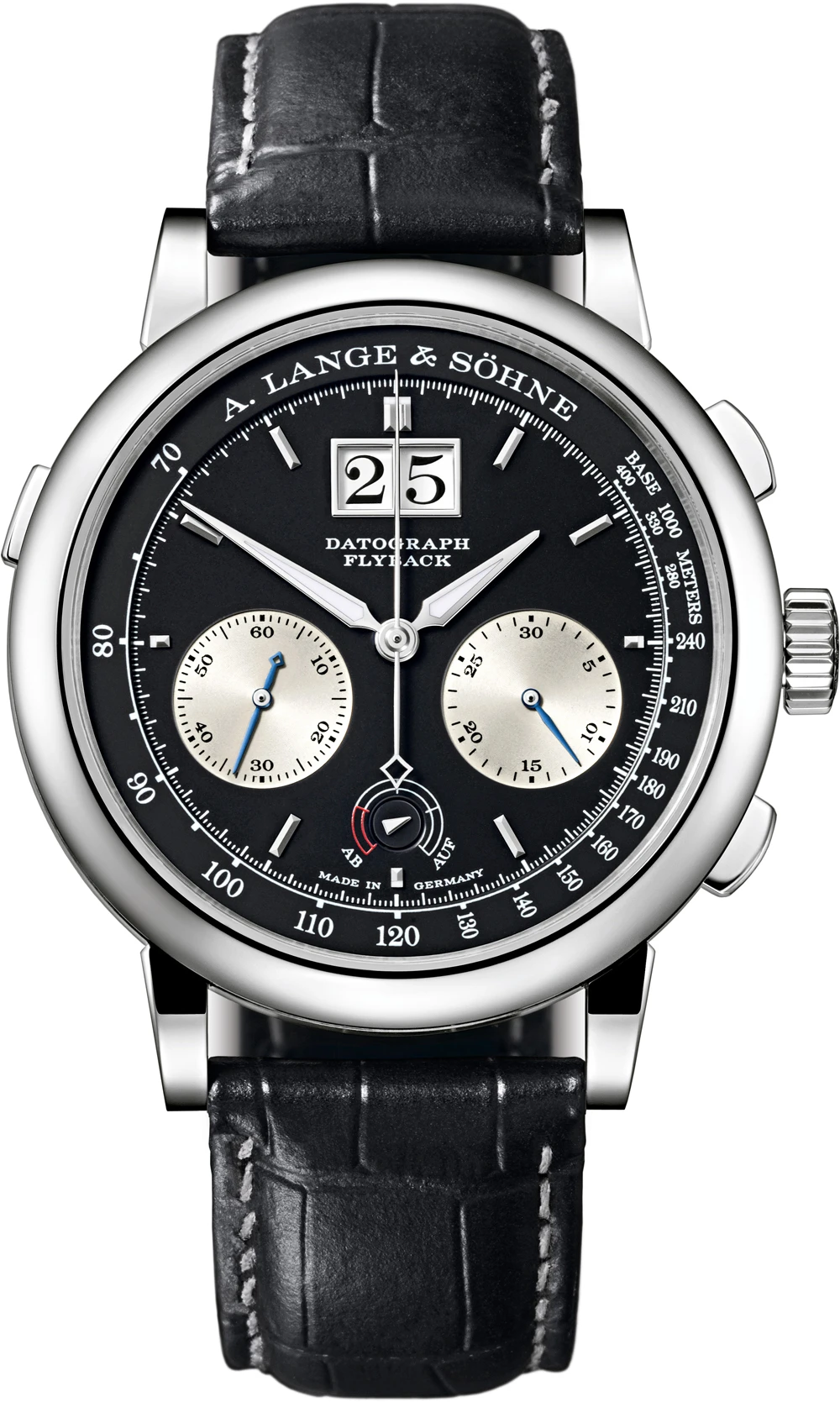
Image – Lange Datograph Up/Down (Ref. 405.035)
Where Lange overtly shows its creativity is when it introduces wholly new models featuring an unprecedented combination of complications, each brought together in the firm’s familiar and much-loved style. For example, in 2016, the brand from Saxony released the Datograph Perpetual Tourbillon (Ref. 740.036), uniting two high complications. Two years later, in 2018, the Triple Split (Ref. 424.038F) was introduced.
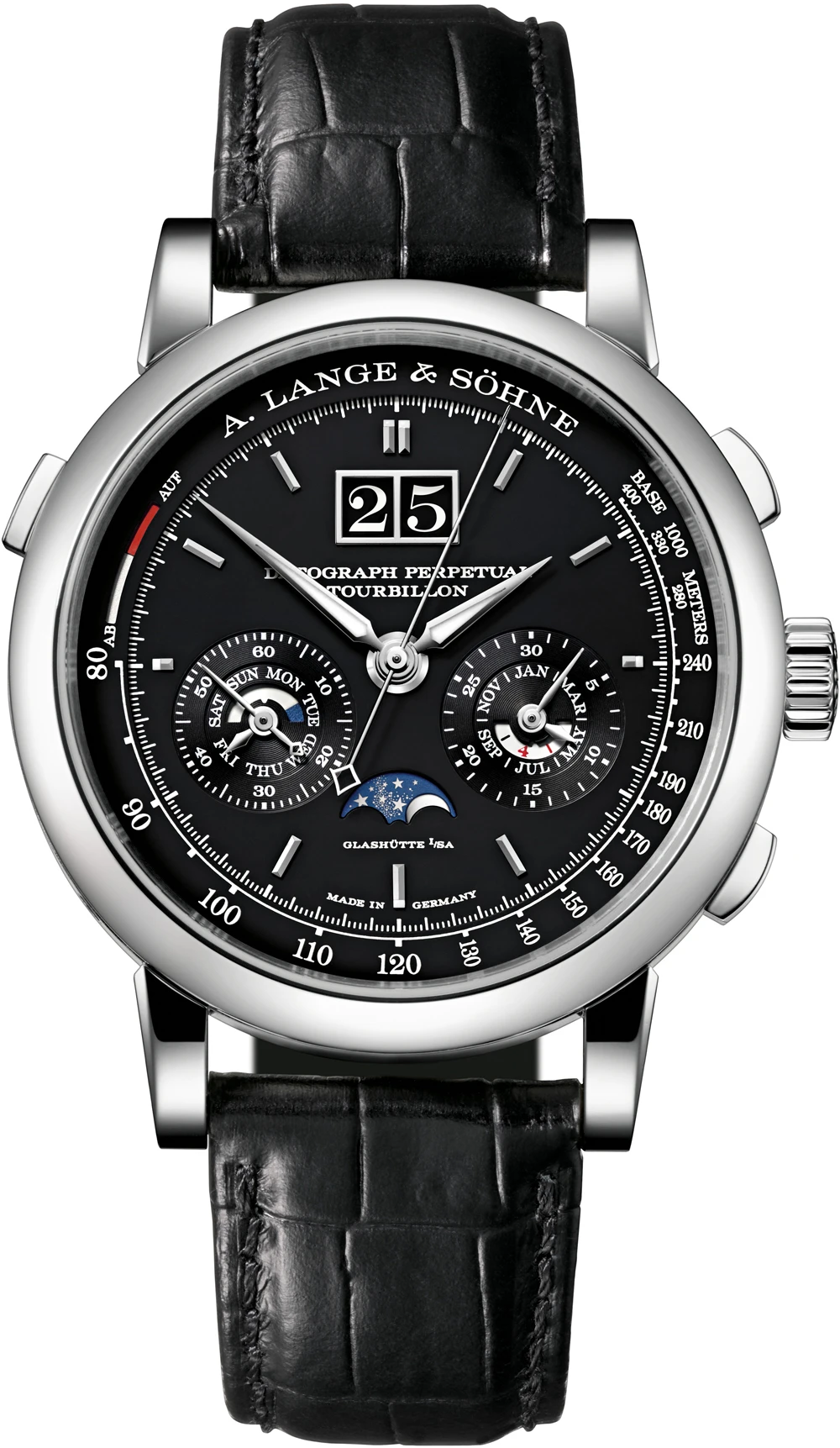
Image – Datograph Perpetual Tourbillon (Ref. 740.036)
The story of the Datograph is one of innovation, judicious changes to the habillage and subtle refinements to the movements. As you thumb the pages of this Sächsisch tale you will discover understated elegance and quiet confidence – a company defined by constant evolution and a dedicated quest for advancement.
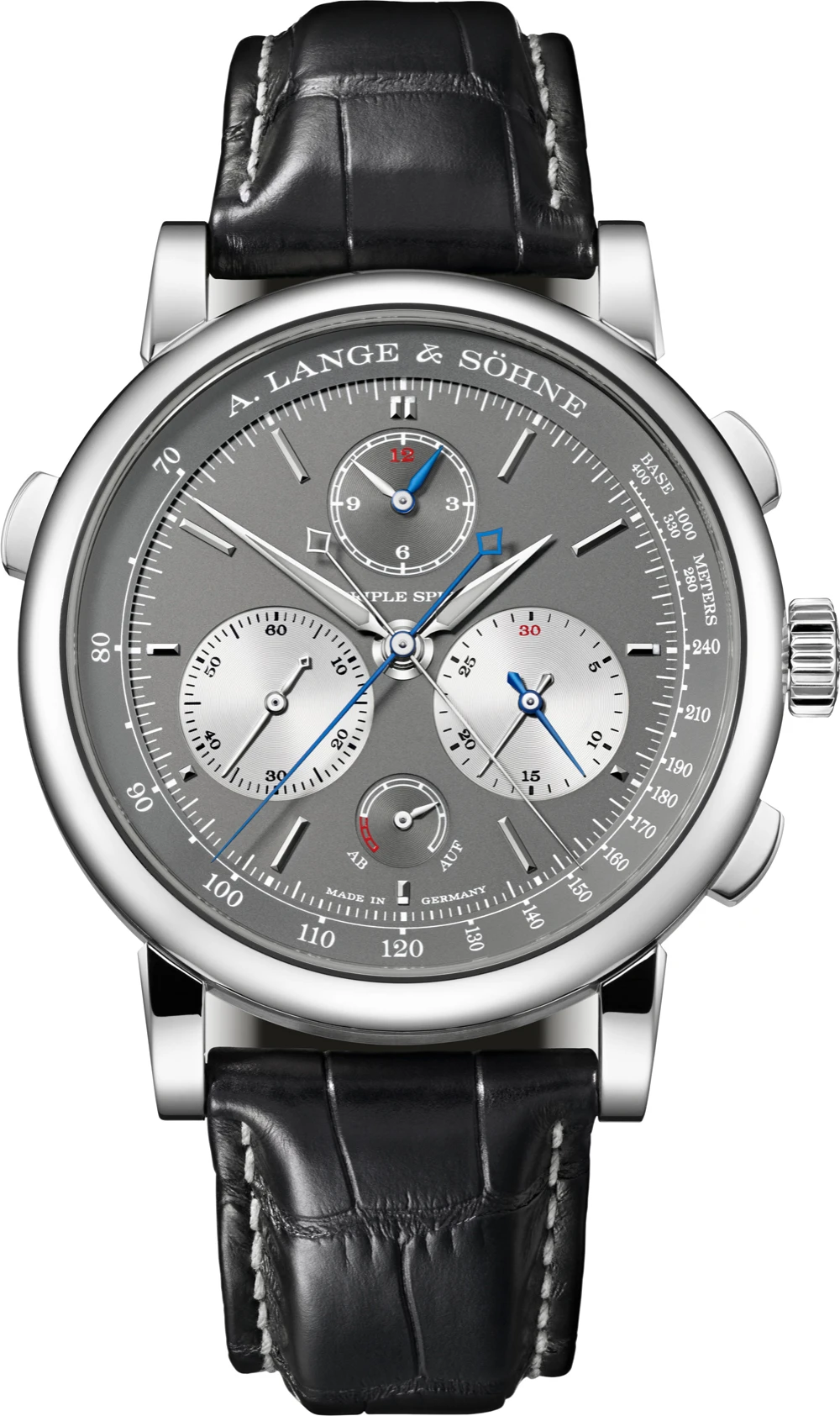
Image – Lange Triple Split (Ref. 424.038F)
Now, A. Lange & Söhne invites us to return to 2006 and rediscover the Datograph Perpetual, albeit with the addition of some new, exquisite features. Allow me to elaborate.
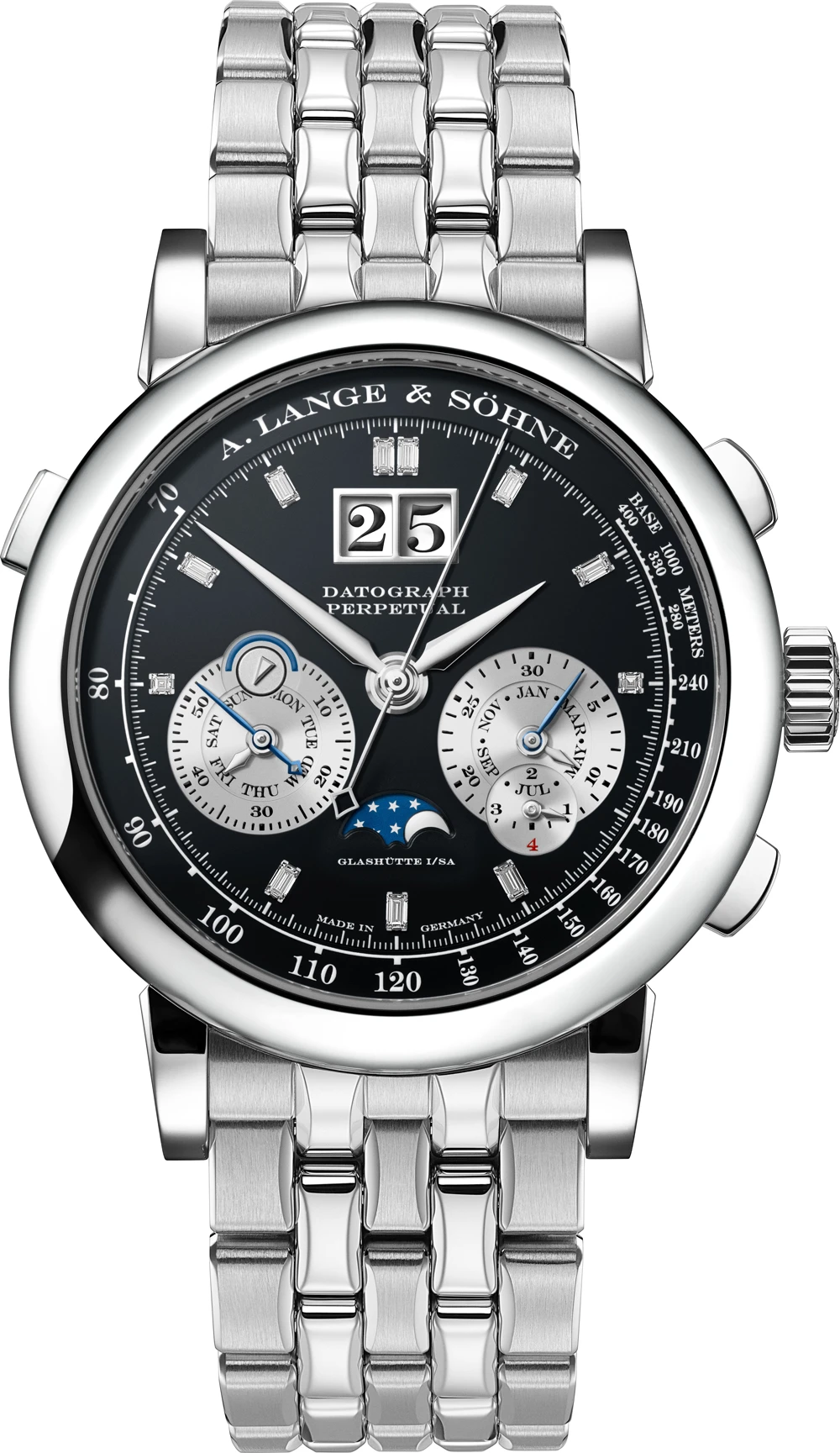
Image – Lange Datograph Perpetual (Ref. 410.136E)
A. Lange & Söhne Datograph Perpetual – dial
At first glance, the dial of the new Datograph Perpetual (Ref. 410.136E) looks very familiar. Dressed in black, its colourway replicates the look of the inaugural Datograph (Ref. 403.035) of 1999, demonstrating that style never goes out of fashion. The lancine-style hour and minute hands make a return appearance, albeit they eschew luminescent treatment, adopting an approach more befitting a dress watch.
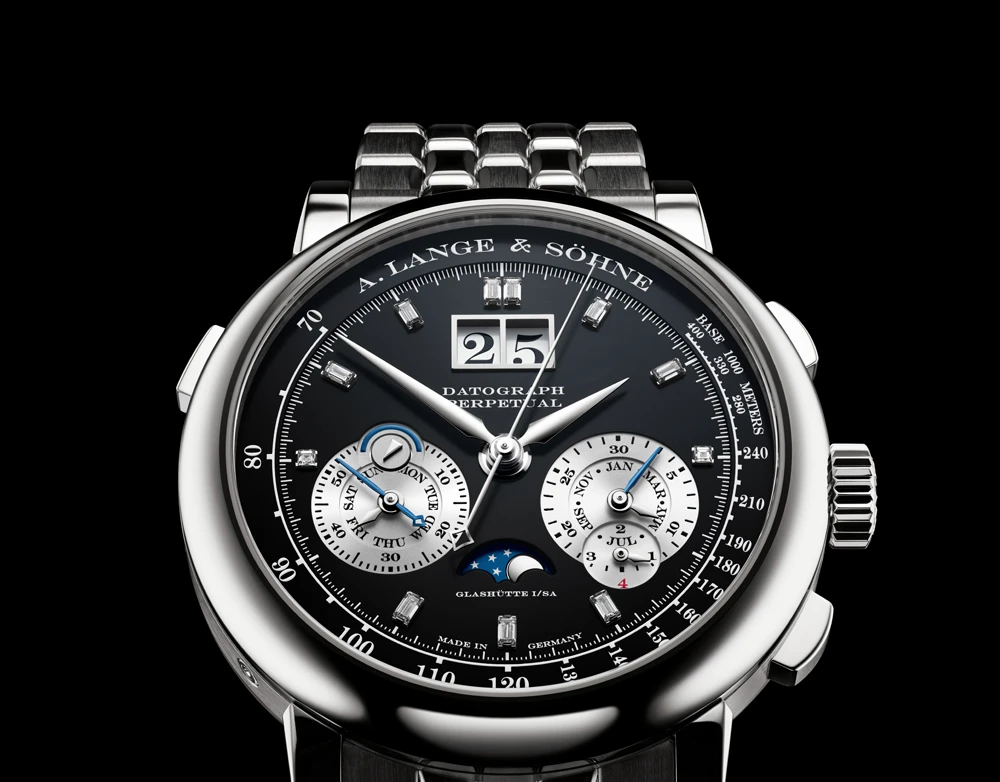
When Lange released the Datograph Perpetual (Ref. 410.025) in 2006, the model did not employ the Roman numerals of the Datograph (Ref. 403.035), instead it featured luminescent, faceted baton-type indexes. This latest model (Ref. 410.136E) denotes each hour with a baguette-cut diamond, save for 4 and 8 o’clock where the ‘rhodié-coloured auxiliary dials’ reside.
The elongated and svelte, central chronograph seconds hand reaches out towards a track that delineates the centre of the 925 silver dial from the tachymeter scale hugging the interior of the case. An openworked counterweight graces the central chronograph seconds hand, a detail, once again found on the inaugural Datograph.
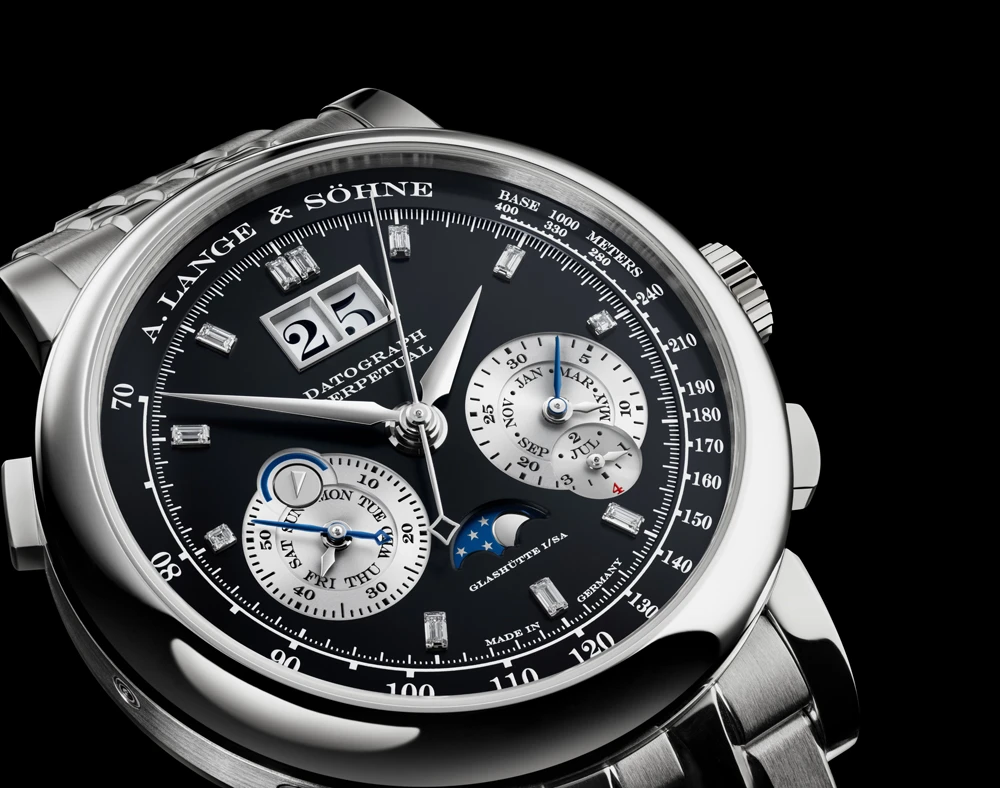
A watch endowed with a long inventory of indications can sometimes result in a congested display; however, Lange has always been highly skilled in creating dials that say much but in an intelligible way. The subdial at 4 o’clock is an intricate combination of two concentric tracks, a month indication at the centre, encircled by a 30-minute counter, with a smaller circular leap-year indicator overlapping its edge in venn-like style. The 30-minute counter is not the run-of-the-mill variety found on most watches, but a jumping indication that advances, one step at time every 60-seconds, aiding read off.
The subdial at 8 o’clock employs a similar design approach. The day of the week is shown on an inner track and is framed with a small seconds display. A day-night indicator sits in the northern hemisphere of the subdial, again subscribing to a venn-like design. In my opinion, the decision to position the leap-year indicator and day-night indicator asymmetrically augments eye-appeal. Both auxiliary dials are finely snailed, introducing a soupçon of texture.
At 6 o’clock, positioned between the silver-toned counters, sits a stylised depiction of the moon-phase. The crescent-shaped aperture reveals a solid-gold lunar disc featuring a circular moon surrounded by stars. Assuming the watch is kept wound, the high-precision moon-phase display will only deviate by one day after 122.6 years.
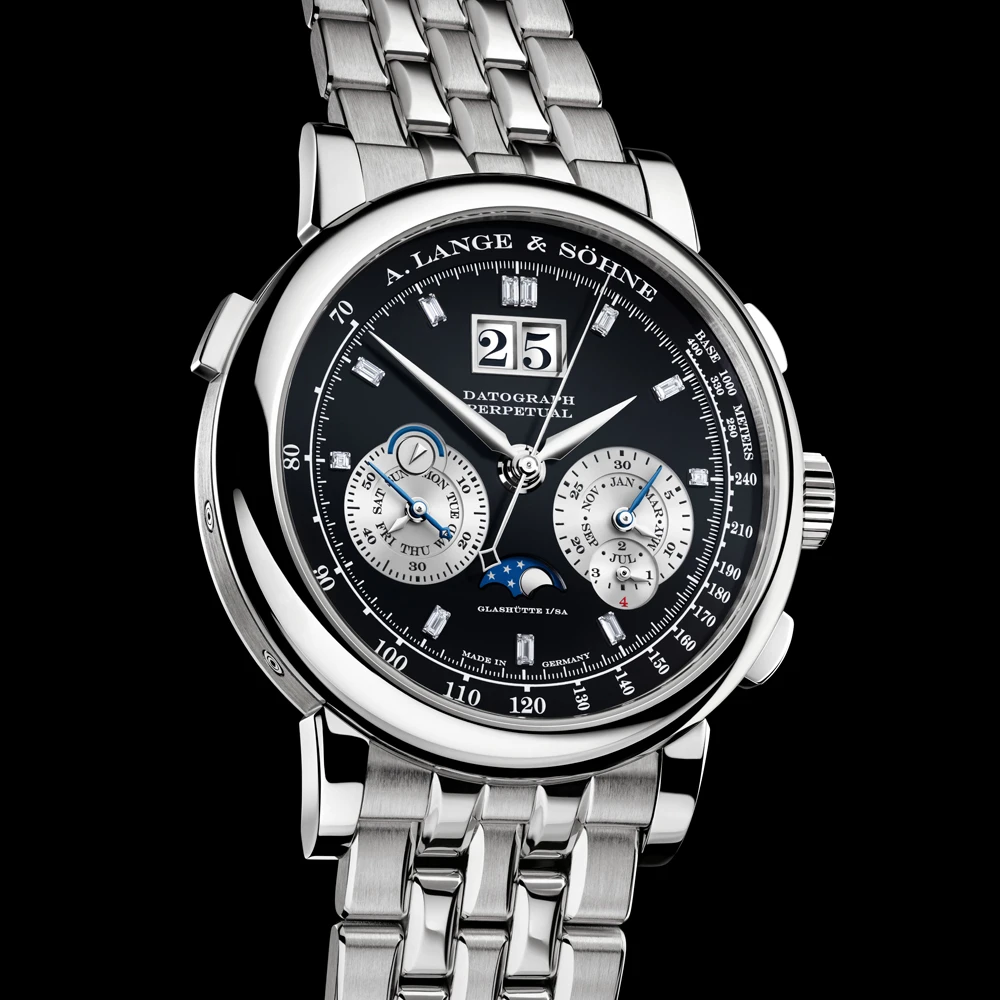
An outsize date display sits on high, positioned just below twin baguette-cut diamonds. Employing two discs to indicate the prevailing date, the approach delivers superior lucidity when compared with the ubiquitous single disc indication. Incidentally, the outsize date appeared on three of the four inaugural references of 1994, namely the Saxonia, the Arkade and the Lange 1, and has since become a signature of the brand.
Underpinning the design of each Lange dial is the brand’s sensitivity to geometric shapes. For example, in my recent feature on the A. Lange & Söhne Lange 1 Tourbillon Perpetual Calendar “Lumen”, I refer to the vertical and horizontal lines that bisect the dial indications.
On this occasion, the Glashütte-based firm employs another geometric form. In its press release, the brand points out that the characteristic Lange outsize date at 12 o’clock marks the tip of an equilateral triangle with the subdials positioned well below the central axis (east-west), adjacent 4 and 8 o’clock.
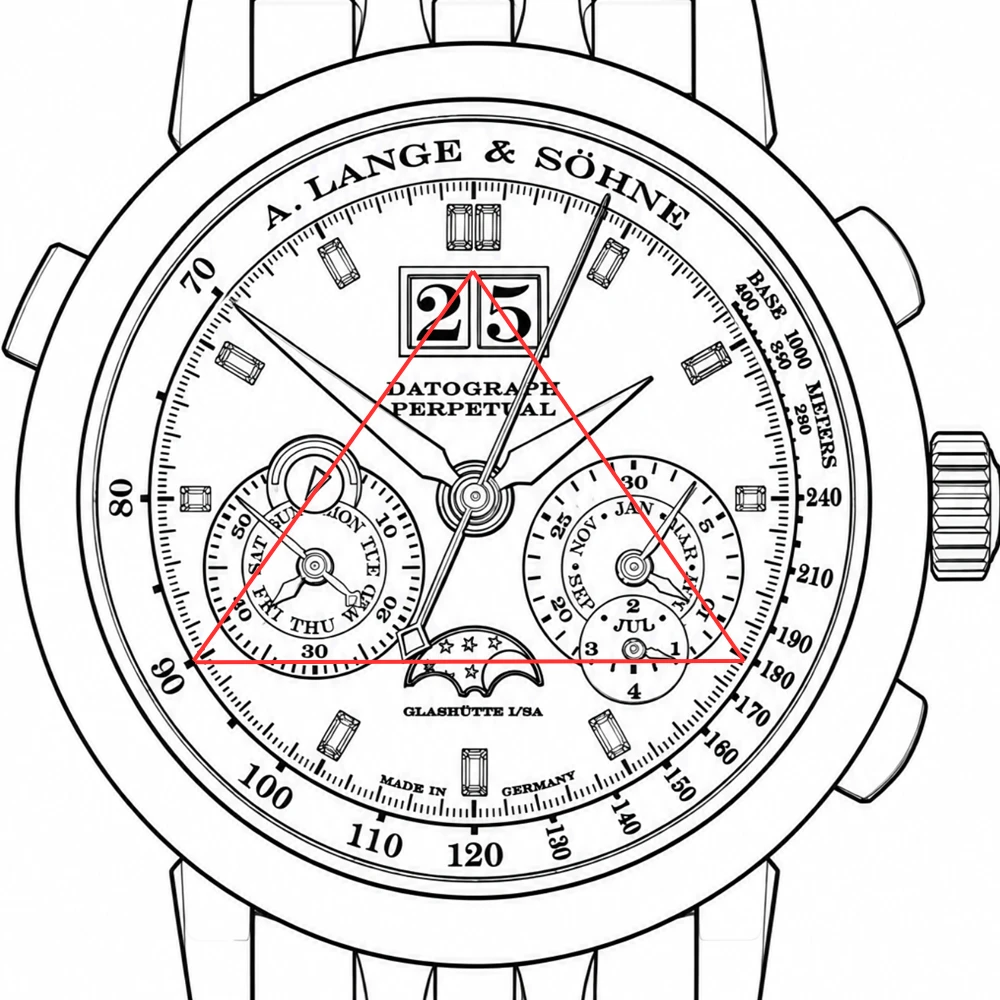
Reading Lange’s press release, I am reminded of the golden ratio, the Fibonacci sequence and the Vitruvian Man – nothing is accidental. Indeed, every line, angle and dial element has been carefully considered.
A. Lange & Söhne Datograph Perpetual – case
As most Lange devotees know, the Glashütte-based firm tends to house its models in noble metals (albeit some Odysseus references prove the exception). In common with the first Datograph of 1999, the case of the Datograph Perpetual (Ref. 410.136E) is formed of 950 platinum, a noble metal that is far scarcer than gold. The case of the new model is a smidgen larger at 41 mm in diameter; however, it remains a modest figure considering the additional complexity housed within.
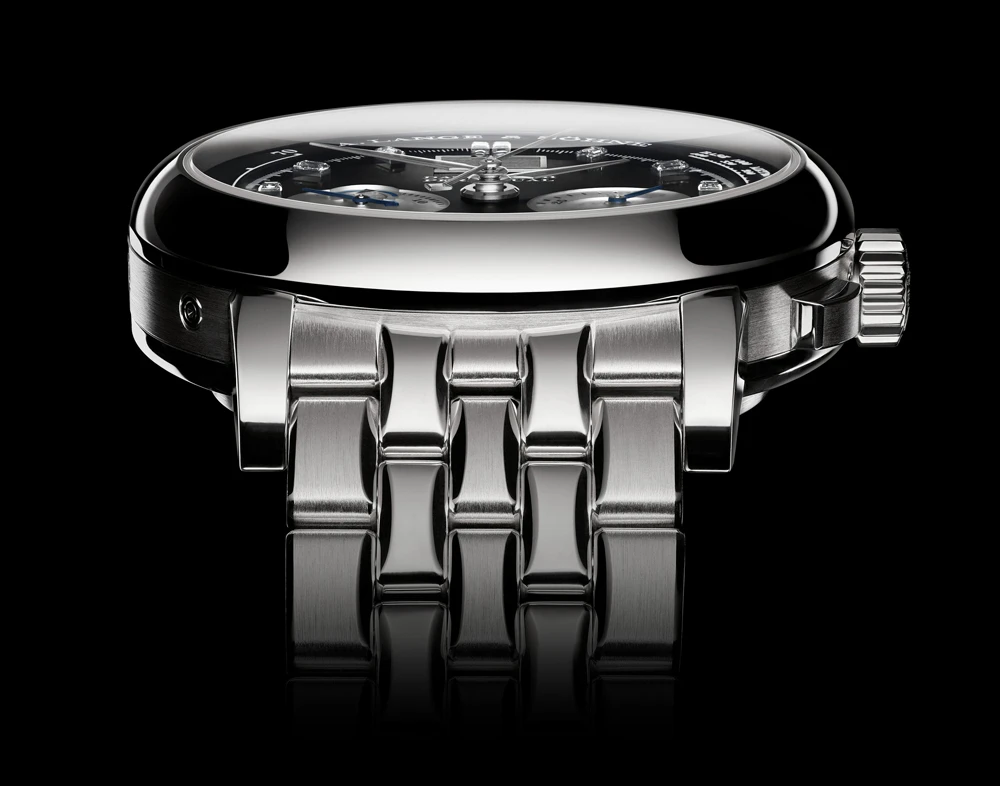
Platinum does not oxidise or tarnish, it’s resistant to several corrosive chemicals, including hydrochloric and nitric acids, it’s hypoallergenic and it possesses a reassuring heft. However, working with the metal presents several technical challenges that must be surmounted. Unlike gold, which can be cut relatively cleanly, milling platinum using a CNC (Computer Numerical Control) machine is more difficult as the metal tends to smear. Its ‘gummy’ nature necessitates frequent tool changes and requires working at lower milling speeds; factors which heighten production costs. Moreover, when compared with gold, platinum is significantly more difficult to polish, with machining marks proving especially time-consuming to remove. Put simply, platinum delivers many wearer benefits but it is arguably one of the most challenging materials to process.
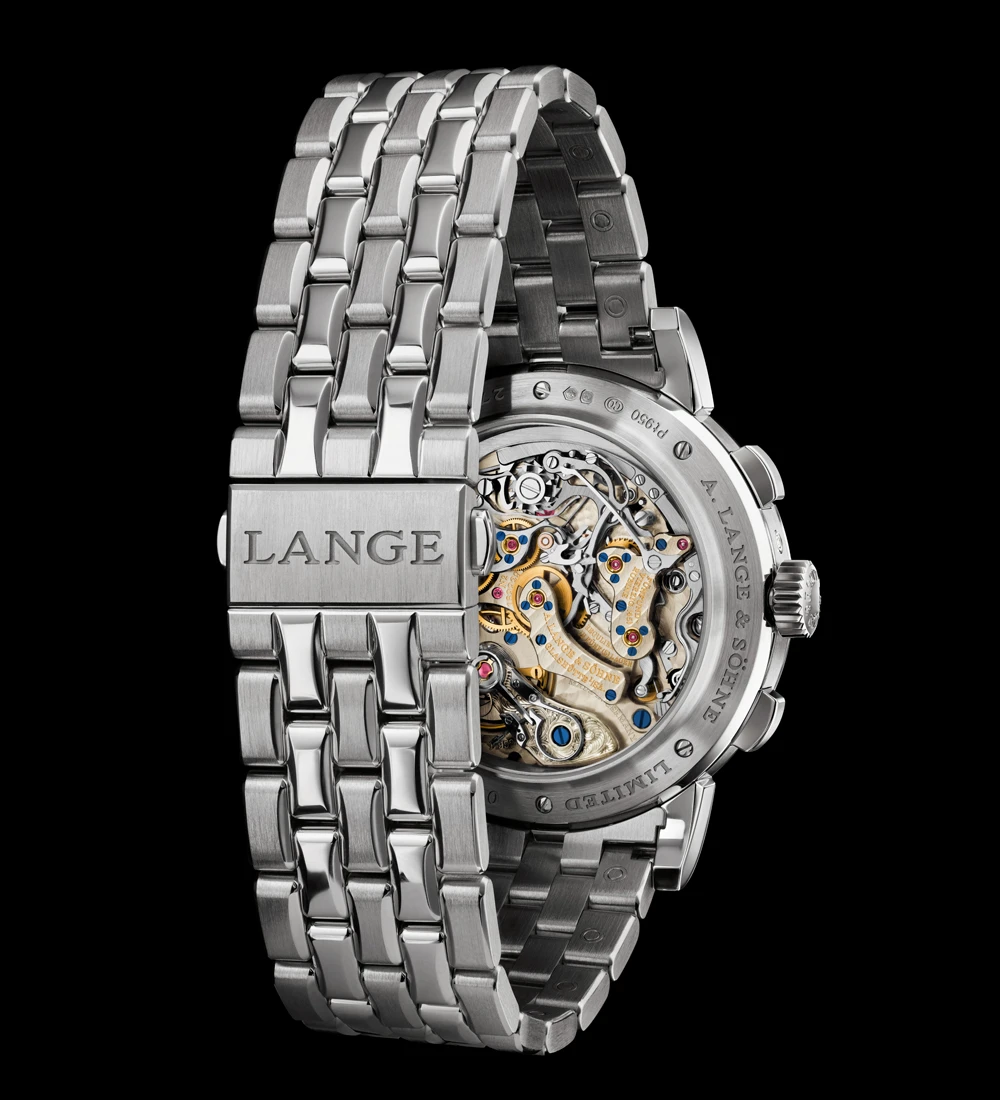
Exhibiting a lustrous, silvery-white hue, platinum is a metal that befits a Lange with its elegant restraint. The brand has chosen to present this reference on a five-row platinum bracelet that neatly integrates into the watch head. All links are slightly cambered on their upper surface and fringed with gleaming facets. The bracelet rows alternate between polished and matt, delivering nuanced contrast. When admiring the bracelet, one must remember that it is not formed of steel, but one of the most challenging metals to polish, hence the resultant bracelet is highly impressive.
A. Lange & Söhne Datograph Perpetual – manufacture calibre L952.1
The plates and bridges of the hand-wound manufacture calibre L952.1 are formed of untreated German silver (an alloy of copper, nickel and zinc). Usually watch brands favour rhodium-plated brass; however, German silver does not corrode, obviating the need for plating. Moreover, with time the alloy develops a becoming warm golden tone.
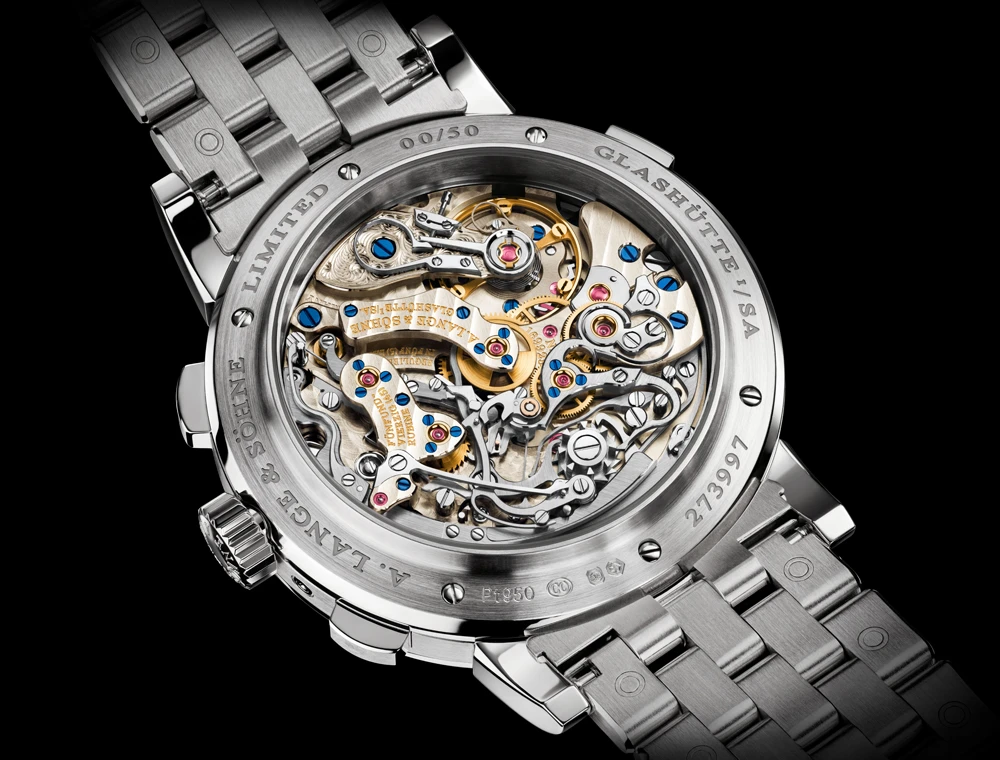
However, when assembling the movement, German silver requires the watchmaker to exercise much care in order to avoid marring its pristine appearance. For example, a fingerprint left on the metal will develop into an unsightly mark with time. Rest assured, once encased, the movement is protected from wayward fingers and exhibits an unparalleled beauty, much loved by purists.
Comprising 556 parts, the manufacture calibre L952.1 is a highly complex movement, visible through the exhibition caseback. The eyes are indulged with views of wheels, levers, rockers and bridges arranged at different heights, reminiscent of a cityscape. Constructed on several levels, comprising separate bridges, blocks and levers, the wearer can view the column wheel, the clutch and the rockers.
Artisanal craftsmanship is a characteristic common to all Lange models and the calibre L952.1 proves no exception. The balance cock is hand-engraved with an elaborate motif, the swan-neck is mirror polished and used to adjust the anchor symmetry (correcting any beat error). Unusually, the balance is equipped with an in-house hairspring and the balance wheel features inertia weights, positioned in-board, to precisely regulate the rate. The bridges are adorned with Glashütte ribbing and anglage. Forty-five jewels, four of which reside in screwed gold chatons, sit adjacent thermally blued screws, creating a scene populated with dots of vermillion red and cornflower blue. Excellence is omnipresent.
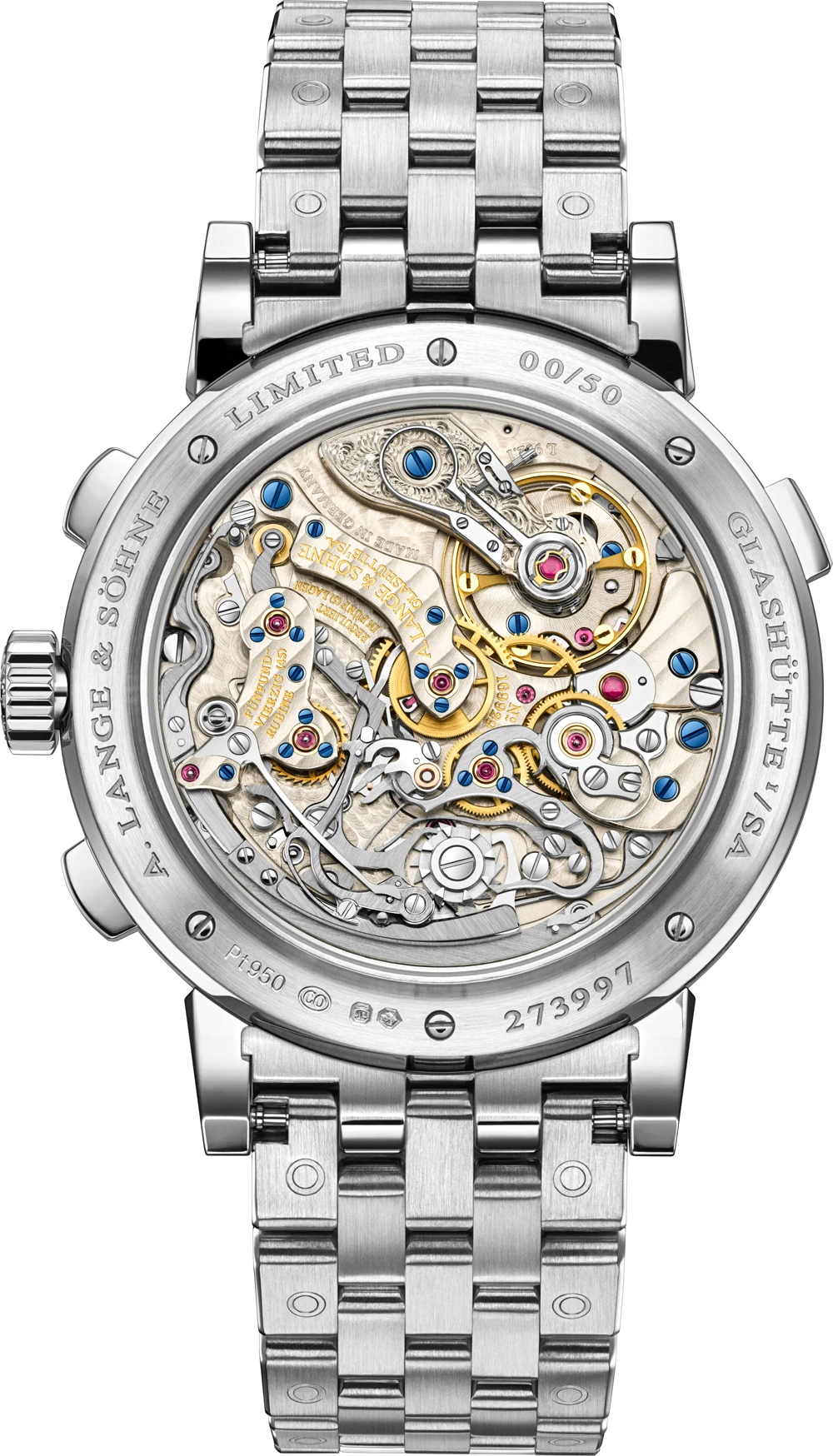
The movement features a column-wheel that orchestrates the three chronograph functions: start, stop and return to zero. In this instance, it is paired with a horizontal (lateral) clutch which causes a wheel mounted on a movable bridge to unite the fourth wheel of the gear train with the chronograph centre wheel. This is a classical approach and, unlike a vertical clutch, allows the wearer to observe the chronograph engaging and disengaging.
Other refinements include a flyback feature. When the chronograph is running, the wearer can press the pusher at 4 o’clock and in one action the central hand will halt, reset and restart. This feature is particularly useful when timing successive events.
Another attribute of the manufacture calibre L952.1 is the means to adjust all the calendar indications merely by pressing the pushpiece at 10 o’clock. If there is just one or two indications requiring adjustment, the wearer can press one of the unobtrusive correctors set within the caseband (using a suitable stylus). In its press materials, Lange also mentions that ‘a sophisticated safety mechanism prevents inadvertent actuation of the rapid-correction pusher’ (the pushpiece at 10 o’clock). This attention to detail is why Lange is held in the highest esteem.
The German marque does not state how long it takes to assemble the Datograph Perpetual, but it is safe to say we are talking several days. Therefore, it may come as a surprise to learn that having assembled the watch, the company then proceeds to dismantle it again. Allow me to explain why.
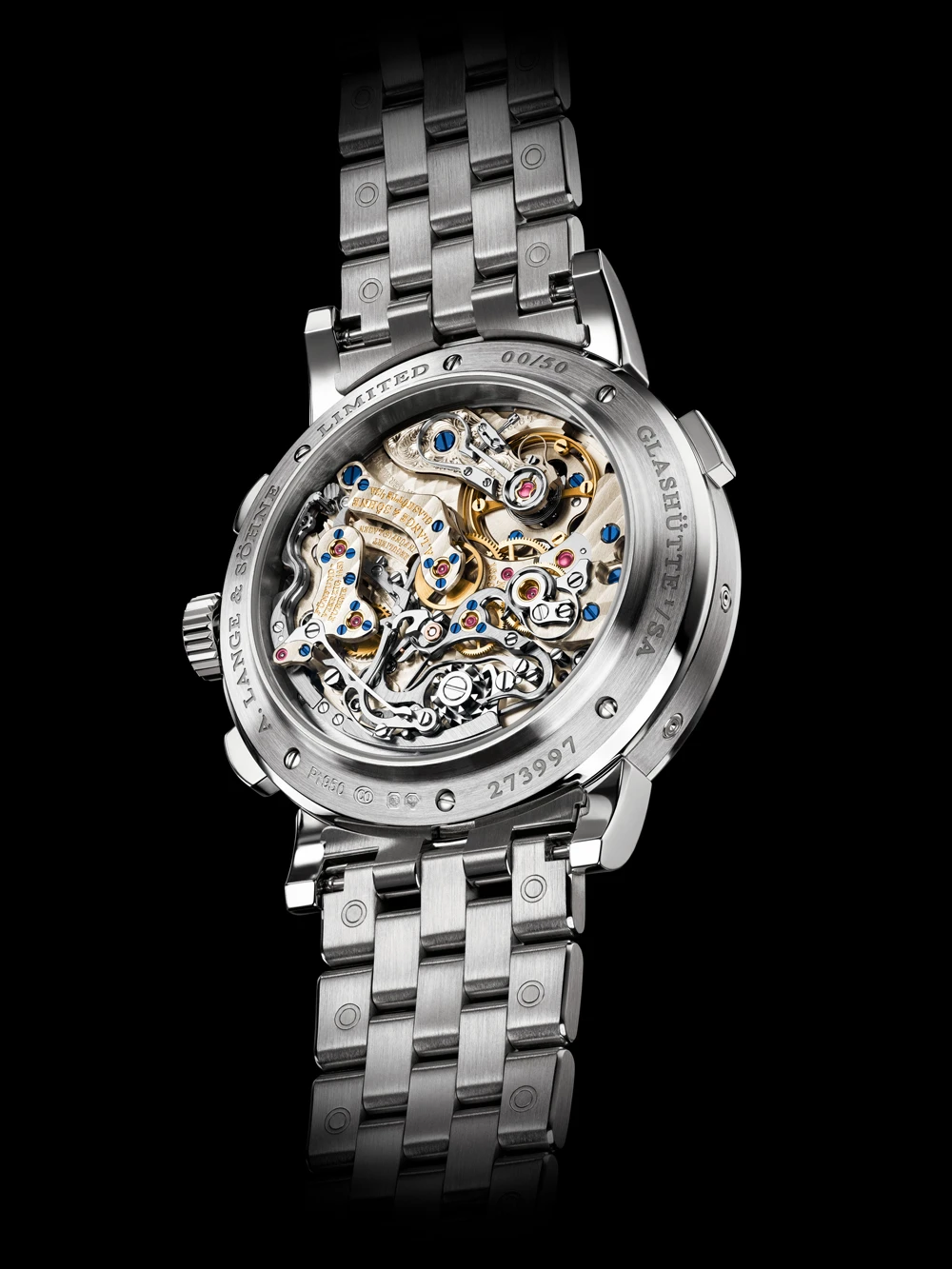
The purpose of the first assembly process is to check that the parts fit and work properly. The watchmaker will adjust the endshakes (the vertical play of an arbor or pivot within a jewel) and ensure all gears perfectly align. A consequence of using a three-quarter plate is the watchmaker must revisit each arbor, ensuring that all endshakes, collectively, are perfect.
Thereafter, the manufacture calibre L952.1 is dismantled, cleaned, decorated and engraved. Once decorated, the movement is assembled with new, pristine thermally blued screws, lubricated and regulated. Making a Lange movement is a protracted process, but perfection is seldom achieved in haste.
Closing remarks
When writing about Lange, it is incredibly difficult to mask one’s enthusiasm for the brand and its exalted products. The styling is wonderfully considered, with each dial element arranged geometrically to confer a harmonious composition. Mechanisms are engineered to the nth degree, delivering an enchanting blend of beauty, precision and reliability. Indications may be added with successive releases, yet lucidity is never sacrificed.
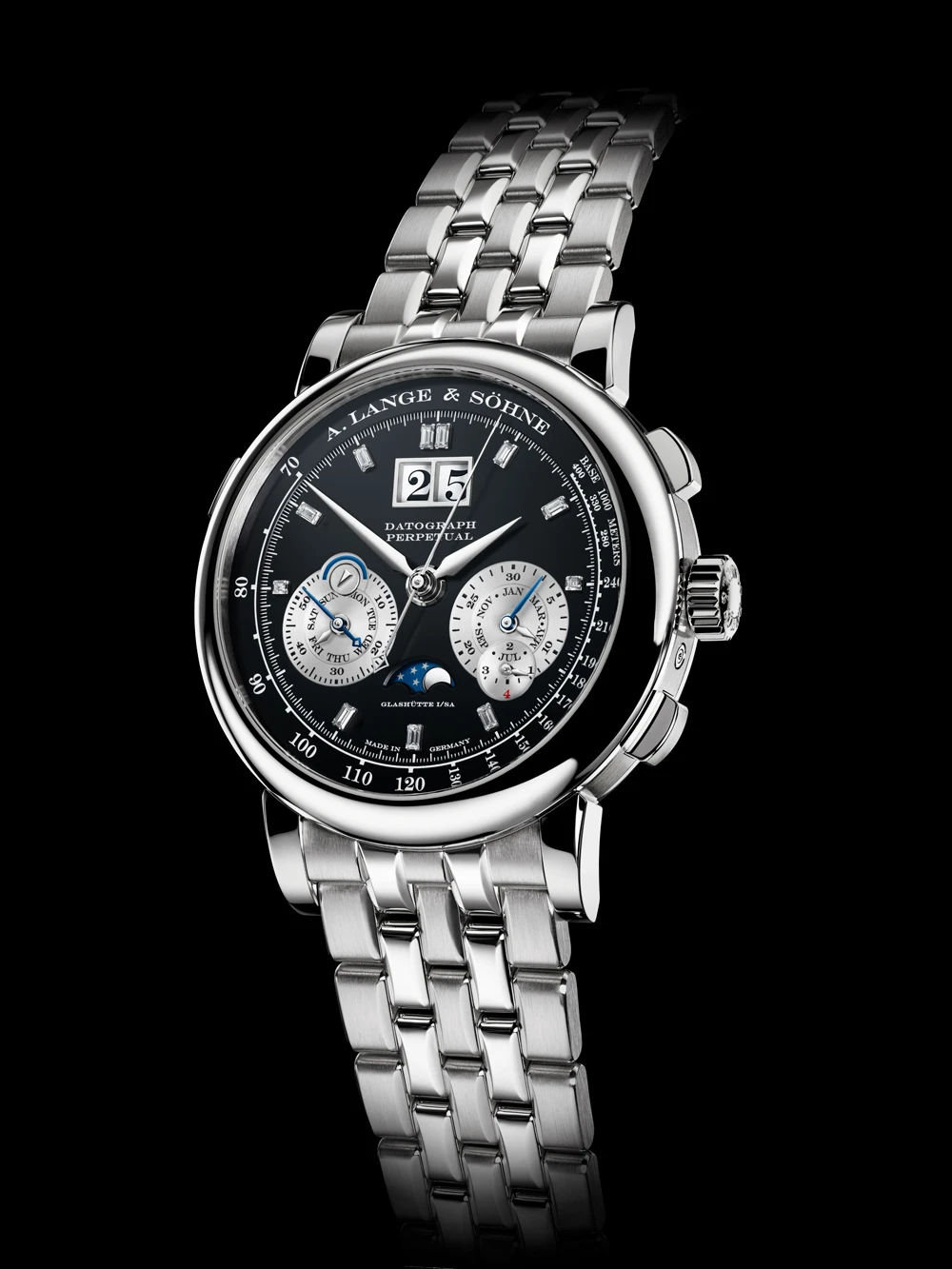
When I first heard about a Lange with diamonds on the dial, I was somewhat surprised; however, I should not have worried. The Datograph Perpetual is not a blingy, rainbow-coloured monstrosity, but rather a tasteful expression of Haute Horlogerie featuring the judicious application of 11 baguette-cut diamonds. This decorous creation says understated sophistication and demonstrates good judgement on the part of its wearer.
Lange has always understood that luxury is not about discarding a model every three years with something that is radically different, rendering former models passé. On the contrary, if you own a Datograph (Ref. 403.035) of 1999, you are incredibly fortunate – its allure remains undiminished.
The latest Datograph Perpetual (Ref. 410.136E) perpetuates a story that began in 1845 with new chapters being added each year. The Sächsisch tale is a real page-turner that purists will never tire of reading and will often prompt them to rediscover former classics of yesteryear.
Further reading
https://www.alange-soehne.com/
Technical specification
- Model: A. Lange & Söhne Datograph Perpetual
- Reference: 410.136E
- Case: 950 platinum, diameter 41 mm, height 13.5 mm, sapphire crystal to the front and transparent caseback.
- Functions: hours, minutes, small seconds with stop seconds; flyback chronograph with precisely jumping minute counter; tachymeter scale; perpetual calendar with outsize date, day of the week, moon and leap year; day/night indicator
- Movement: Lange manufacture calibre L952.1, manually wound movement, frequency 18,000 vph (2.5 Hz), contains 45 jewels, power reserve 36 hours when fully wound, 556 components
- Bracelet: 950 platinum paired with a quick-release deployant buckle in 950 platinum
- Price upon request
- Limited Edition: 50 pieces