
Chopard L.U.C 1963 Heritage Chronograph Prussian Blue Watch Review
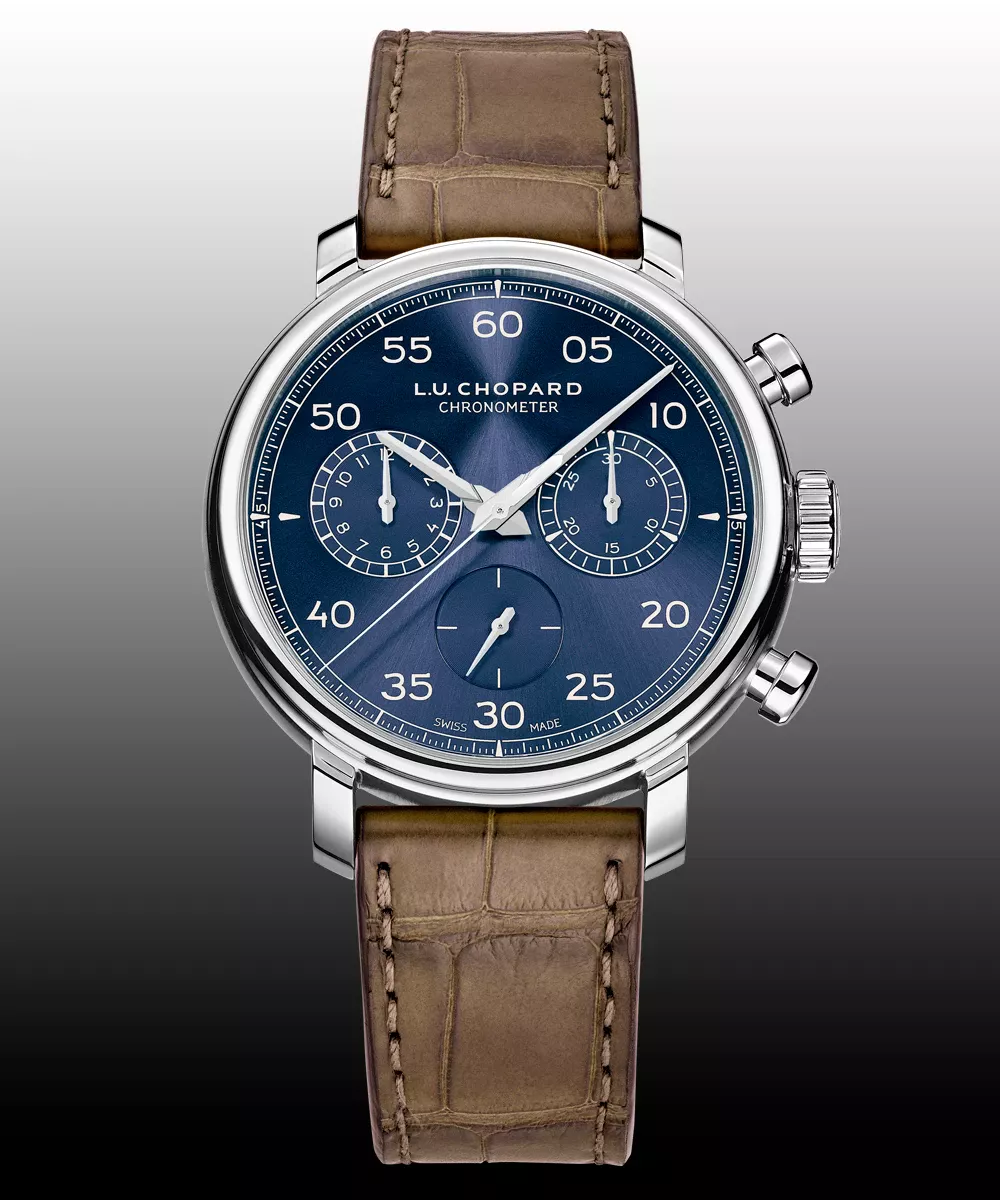
The recently-launched Chopard L.U.C 1963 Heritage Chronograph Prussian Blue is a beautiful example of Haute Horlogerie, housing an arrangement of wonderfully crafted mechanical components. Mark McArthur-Christie, watch obsessive and petrolhead, sees many similarities between this product of Fleurier and some vintage classic cars he has always yearned to own. Buckle-up for an interesting ride.
Watches and classic cars – the similarities are clear
Some cars you buy because they’re the obvious and logical choice – a thousand magazine reviews can’t be wrong. An example? The Porsche 911 2.7 RS. Others are a bit more left field rather than rational options, but they speak directly to your heart, like the Alfa Romeo 8C Competizione.
The Porsche is lighter, more precise and considerably less likely to immolate your wallet on a regular basis. The Alfa, meanwhile, has an engine, a shape and a character that render rational argument almost entirely irrelevant, mostly because you’ll be too busy drooling.
The same question applies to watches, high-end chronographs in particular. Plenty of influencers will tell you to make space in your watchbox for ‘the well-known greats’, but sometimes there are more interesting places to look. Which brings us to the new Chopard L.U.C 1963 Heritage Chronograph Prussian Blue.
Chopard L.U.C 1963 Heritage Chronograph Prussian Blue – introduction
Chopard is hardly a stranger to chronographs, largely thanks to the Mille Miglia – both the race and the watches. But when you think of Chopard at its best, I suspect you’re more likely to picture a restrained, three-handed L.U.C than a high-end chronograph. Which makes the 1963 Heritage a reminder that the firm’s technical abilities extend a lot further than classical dress watches.
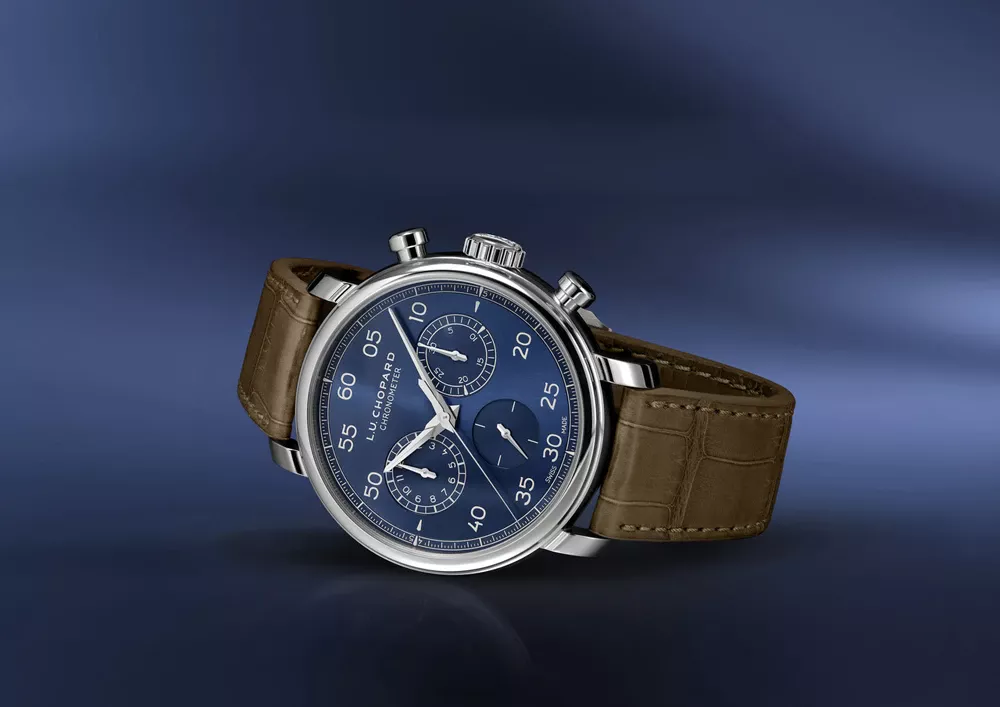
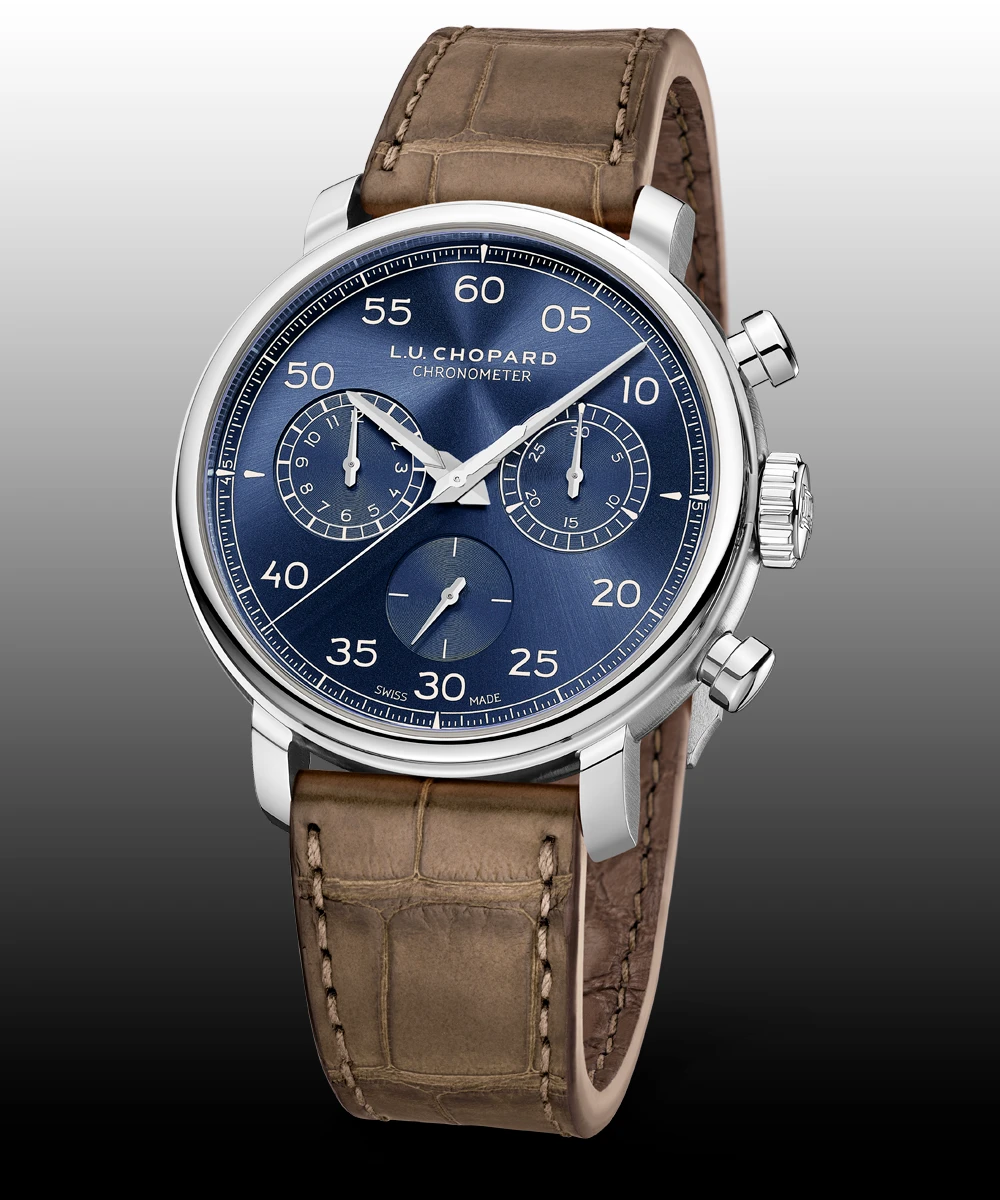
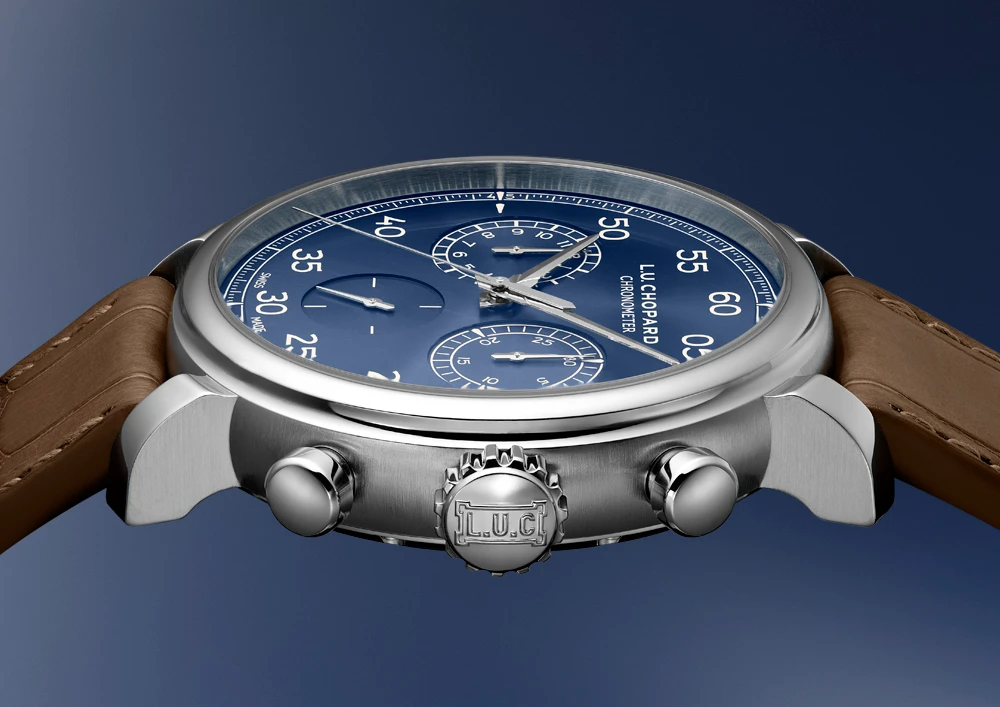
The new watches – all 25 of them in the limited run – are hardly shouty. There’s a restrained and simple triple register Prussian Blue dial and a fuss-free Lucent Steel 42 mm case. And that dial deserves a proper look. Yes, it’s all Prussian Blue, but look closer and you will see an off-centre sunburst motif emanating from below 12, just where the L.U. Chopard name sits. Rather than a different colour background, the chronograph registers contrast in texture.
There’s a neat piece of functional design there too. The running seconds at 6 o’clock is uncluttered – no seconds track around its edge. The chrono functions, though, all have tracks, making it simple to read an exact time measurement.
At 11.48 mm thick, the 1963 is slim even for something running a properly integrated chronograph movement. Admittedly, a 42 mm diameter is substantial for a classically-styled watch, but it’s no hockey puck and the overall effect is quietly handsome rather than flash.
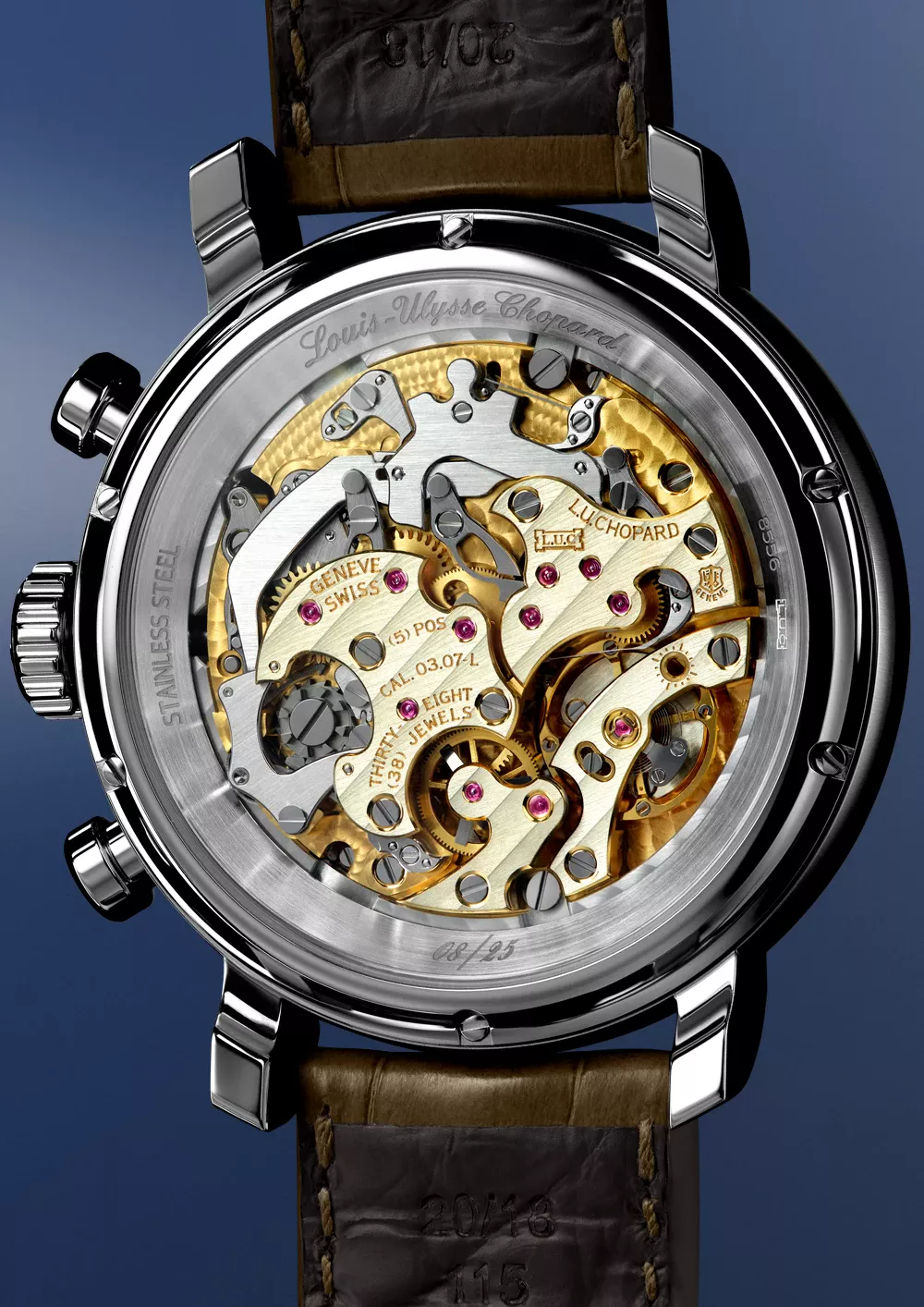
Chopard L.U.C 1963 Heritage Chronograph Prussian Blue – L.U.C Calibre 03.07-L
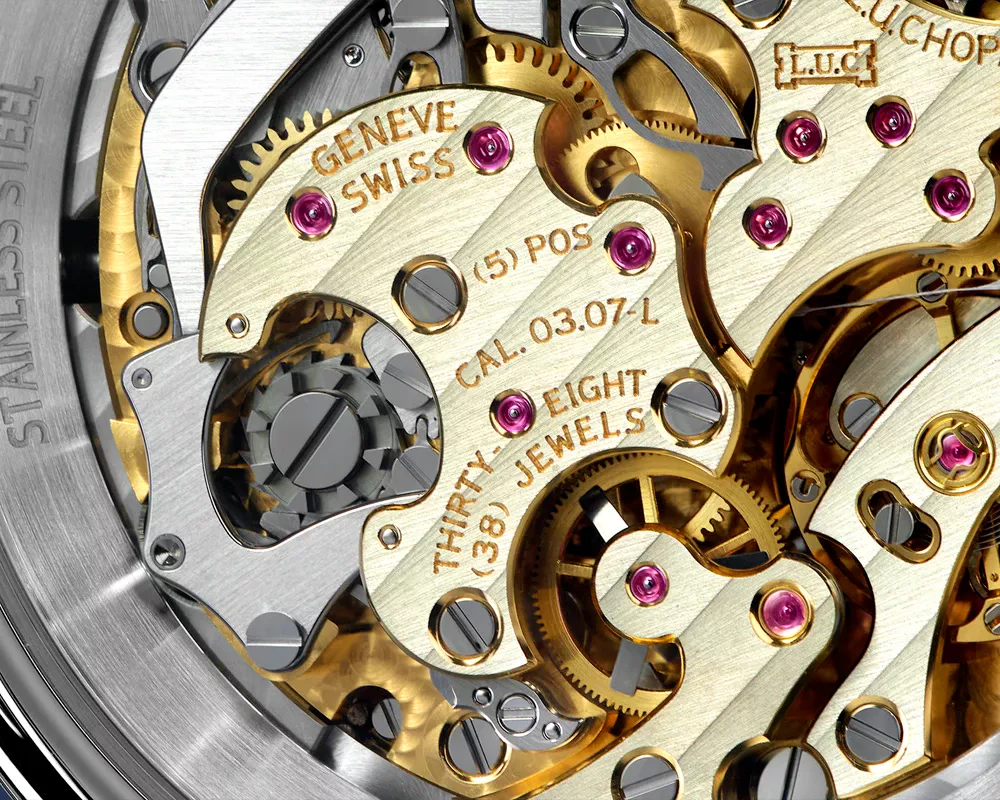
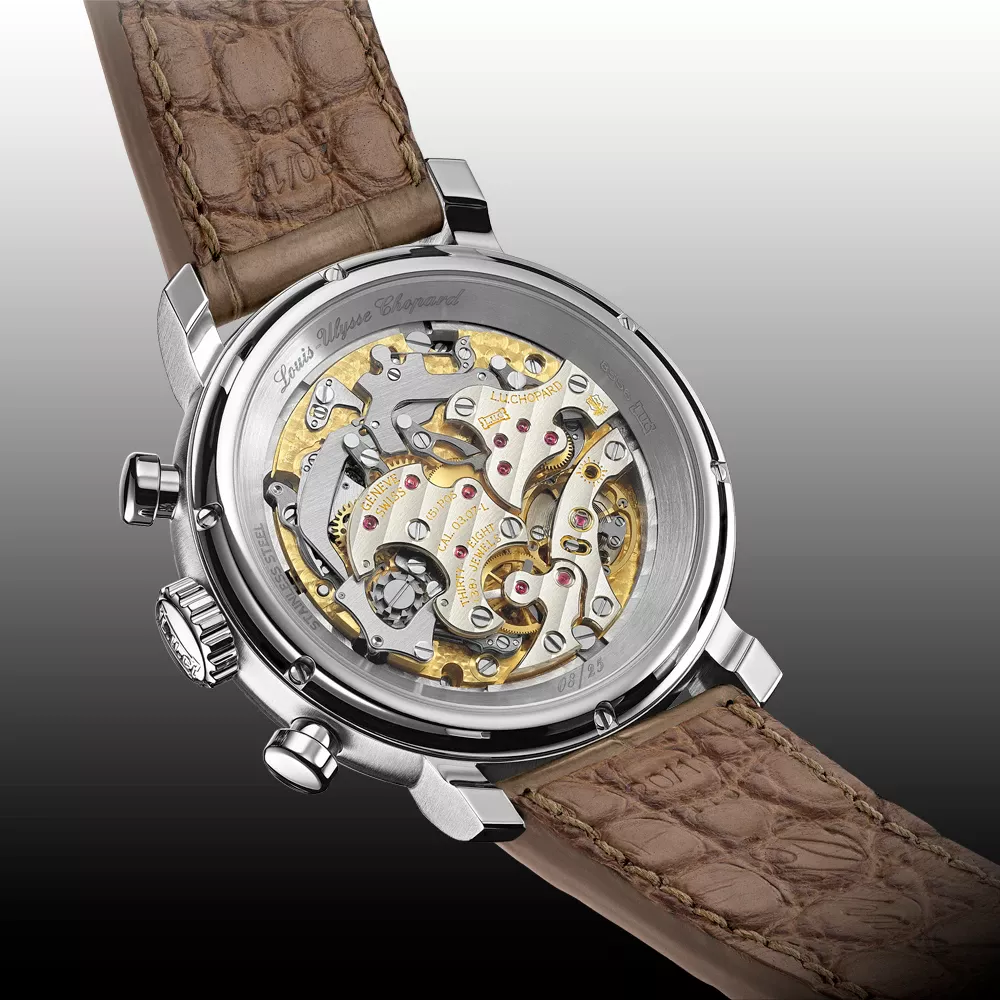
Behind the sapphire caseback is Chopard’s hand-wound L.U.C Calibre 03.07-L. To describe it simply as a flyback chronograph would be rather like describing the Alfa’s F136YC as an engine with eight cylinders. Its 283 components include plenty of good chronography things, like a column wheel, a vertical clutch and a flyback mechanism. The movement runs at 28,800 vph (4Hz) and will go for 60 hours between winds, not that winding a movement like this is exactly a chore.
Column wheel and vertical clutch
Column wheel and vertical clutch movements are a pleasure to use. Push the ‘start’ button and you snick the column wheel operating lever into action. It moves the column wheel on by one step, and the levers resting on it either drop into the gaps between the castellations or ride up onto them, depending on their job. That frees the clutch and the chrono seconds hand starts moving. Press again to stop and the column wheel moves on another step in the same direction, the levers change places again and the mechanism stops. The whole thing is simple in concept but requires skill and precision to bring to fruition.
The vertical clutch allows the gear train to be constantly meshed, so you don’t get any of the second hand stuttering you often see with some horizontal clutches.
It’s a lot of precision engineering to pack into a small space. The vertical clutch here is smaller than a drawing pin, yet controls the chronograph’s stop, start and reset functions. It looks a little like a drawing pin, too, but with a gearwheel and clutch at the top, connected by a pinion. When you stop the chronograph, a lever holds the clutch open. Push the ‘start’ button and the lever lets go, a spring closes the clutch and the chrono wheel – part of the clutch stack itself – starts turning with the rest of the movement.
Flyback function
Then there’s the flyback function. In a conventional chronograph, restarting a timing sequence involves stopping, resetting and starting the mechanism again. With a flyback, pressing the reset pusher while the chronograph is running snaps the hands back to zero and, as soon as you let go, they start timing again. Stop, reset and restart in a single press. Originally a handy navigation assistance feature for pilots, it’s equally appealing to anyone who just enjoys analogue technology. Quite how often you’ll need it when timing the Sunday roast is another matter.
Patented know-how
But Chopard hasn’t simply gathered together an impressive collection of established chronograph mechanicals, it has developed several solutions of its own. And then, because the firm’s people are not daft, patented them. These include the particular way in which the vertical coupling works, a mechanism that returns the small seconds hand to zero when setting the time, and a neat chronograph reset system.
It’s worth digging out the reset mechanism’s patent to explain how things work. To reset, you snick in the pusher – so far, so standard. But the pusher moves a lever which, in turn, pushes a slide in a straight line. The hammers turn on separate pivots and are linked to the slide, so moving the slide swings them. Each hammer has three arms – one rigid arm joined to the slide itself, one with a flexible section (Chopard, slightly confusingly, calls this ‘elastic’) which strikes the heart cam, and a third rigid arm that acts as a stop, so the sprung arm can’t bend too far.
The cleverness comes from the way the pivot sitting closer to the slide joint than the striking face allows a shorter movement of the slide to give the striking face more travel. That saving of a fraction of a measurement allows a smaller mechanism overall.
Neatly, the flex in the hammer arms also makes up for any manufacturing inaccuracies, so all three hands reset precisely. There’s less stress on the hand pivots during reset too.
It’s not a new patent (Chopard filed it in 2006), but it’s a typically quiet Chopard innovation. It’s the kind of engineering refinement that reveals itself when someone has thought very carefully about how a mechanism actually works. It’s also a reminder that genuinely interesting watchmaking often happens in places most owners will never see.
Finissage
That thought and care extends beyond the way the movement is engineered to how it’s finished. The calibre is quite the ‘finishing-fest’, with untreated German silver bridges, a gilded mainplate, Geneva stripes wherever you look, circular graining and polished bevels. The contrast between the gilded surfaces and the softer, silvery tones of the bridges gives the movement a depth and character that conventional rhodium-plated finishes just don’t manage.
There’s a lot of pleasure to be had from just peering at the smaller details: the treatment of the chronograph components, the anglage and the way the polished and grained surfaces work together.
It’s worth remembering that this level of finishing isn’t simply a matter of running a decorative tool across a bridge or setting up a CNC machine to do the job. Proper hand-bevelling, particularly where angles meet, requires the sort of skill, patience and judgement that takes years. It can result in a well-filled atelier swear box too. Rather wonderfully, all this work is for finishing that isn’t obvious until you examine the movement closely.
COSC and Poinçon de Genève
As you’d expect, the L.U.C 03.07-L has COSC chronometer certification. It also carries the exalted Poinçon de Genève. The former independently verifies its timekeeping performance under prescribed test conditions. The latter applies tear-inducing standards to the way the watch is built, finished and works. Poinçons are most definitely not given out with the cornflakes.
Neither certification will make a watch superior to every uncertified competitor. But together, they’re a pretty good indicator that Chopard’s claims are a long way from enthusiastic marketing puffery.
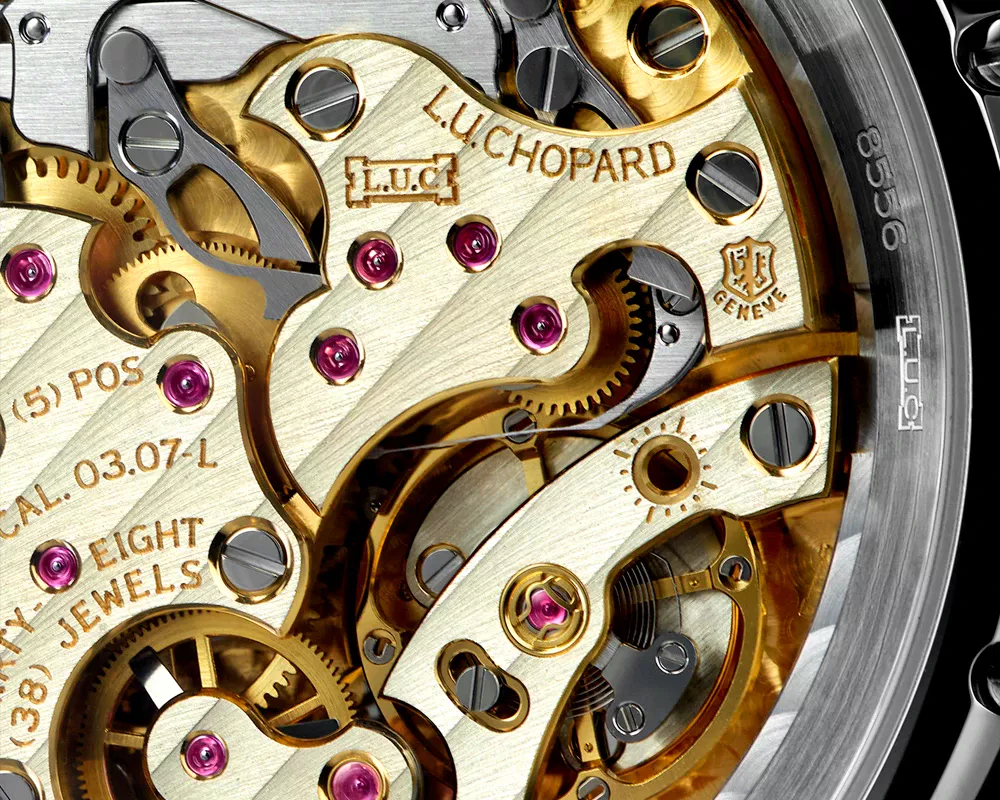
Image – Poinçon de Genève on bridge
Reassuringly mature
There’s another interesting aspect to this movement – it’s not new. We’ve already seen how it contains a mechanism Chopard filed a patent for twenty years ago. But the L.U.C 03.07-L first appeared in 2014, which was an evolution of the Manufacture’s first in-house chronograph movement, the Calibre 03.03-L (L.U.C 11CF), introduced in 2006.
At this point you might well ask, so what? But in the relentlessly novelty-obsessed world of horology, there’s a peculiar tendency to treat a movement’s age as a proxy for its obsolescence. Thank goodness mechanical engineering doesn’t work like consumer electronics. Nobody looks at a Busso V6 and complains that its underlying architecture dates back to the 1970s. Nor does the frankly extraordinary Ferrari Colombo V12 become less interesting because its origins lie in the 1940s. Quite the reverse. We admire engines like these because their engineering has stood the test of time.
We really should start applying the same principle to watch movements. A beautifully designed chronograph doesn’t suddenly become ready for the skip just because somebody has invented v2.0 and a silicon balance spring. Of course, genuine technical progress matters. Better materials, improved reliability, increased efficiency and more precise manufacturing all make a difference. But a good movement doesn’t become a bad movement just because it’s getting on a bit. A principle some of us might be, ahem, increasingly keen to defend.
Karl-Friedrich Scheufele – a passion for watches and classic cars
The automotive connection is particularly appropriate in Chopard’s case, because Karl-Friedrich Scheufele, the company’s co-president and the driving force behind Chopard Manufacture, has what could be described as ‘a bit of a thing for classic cars’.
His collection includes a 1929 Bentley and a 1974 Porsche 911 Carrera RS 2.7, but the car he says he’d keep above all the others is his Porsche 356 Speedster. Unsurprisingly, he’s also a long-standing participant in the Mille Miglia. Presumably, if he won, he’d have to present himself with a watch, which would rather take the shine off the achievement.
Scheufele once admitted that even his wife didn’t know quite how many classic cars he owned. An observation that will sound familiar to more than a few watch enthusiasts. Mind you, it’s a damn sight harder to hide a Bentley than another chronograph.
What makes his enthusiasm interesting, though, is that it extends beyond ownership to restoration, mechanical construction and craftsmanship. His affection for the 356 Speedster, which he spent considerable time and money restoring, suggests someone who absolutely gets the satisfaction of taking an already good piece of engineering and elevating it to its best possible condition.
Chopard L.U.C – a brand deserving your attention
All of which raises an interesting question. Why doesn’t Chopard always get the attention it deserves in discussions about serious watchmaking After all, the firm established its manufacture in Fleurier in 1996. Since then it’s spent three decades developing and refining some serious, top-end calibres. These range from relatively simple time-only movements to sophisticated chronographs, perpetual calendars and highly complicated chiming watches – the sort that win the odd Aiguille d’Or at Grands Prix d’Horlogerie de Genève. That’s hardly the CV of a manufacturer struggling to establish its technical, top-drawer watchmaking credentials.
Perhaps part of the problem is Chopard’s broader identity. For many people, the name still brings to mind jewellery, Happy Diamonds and the more accessible end of the company’s watch collections. There’s nothing wrong with that, but perhaps they obscure the extraordinary work taking place in Fleurier.
There’s also a definite conservatism among watch collectors. We know which names we’re supposed to admire, which movements are considered masterpieces and which manufacturers occupy the approved positions on horology’s Olympus – and if we don’t, yet another AI-generated post on Instagram will tell us.
The well-known firms all deserve their reputations, but their excellence doesn’t diminish everyone else’s achievements. Perhaps it’s time we became a little more adventurous.
Closing remarks
At £32,200 (RRP as of 13.11.2026), the L.U.C 1963 Heritage Chronograph Prussian Blue is hardly an inexpensive alternative to the established names. Nor should it be; its engineering and finishing put it firmly in serious Haute Horlogerie territory. The point of owning a watch like this L.U.C is that it is a considered purchase, selected for its inherent qualities rather than the familiar badge it wears.
Perhaps that’s why the Alfa Romeo comparison feels so appropriate. Today, we often think of Ferrari, Mercedes and Porsche when discussing motorsport, primarily because they now enjoy the most brand awareness. With Alfa, we sometimes forget the race-winning engineering brilliance behind the badge. Indeed, this is a marque that won Le Mans four times in succession and the Mille Miglia no fewer than eleven times.
There are parallels with the way in which people perceive Chopard L.U.C. Mention the name and people think of jewellery, elegant dress watches and perhaps the Mille Miglia collection. What they should also think of is a Manufacture capable of producing chronographs that can look the very best of Haute Horlogerie squarely in the eye.
The L.U.C 1963 Heritage Chronograph is a cracking reminder that popular comment and reality aren’t always the same thing. And that sometimes the most interesting choice is the one everyone else overlooks.
Further reading
Technical specification
- Model: Chopard L.U.C 1963 Heritage Chronograph Prussian Blue
- Reference: 168556-3003
- Case: Lucent Steel, diameter 42 mm, height 11.48 mm, sapphire crystal to front and exhibition case back
- Functions: hours, minutes, small seconds, small seconds zero-resetting, flyback chronograph, stop-seconds function
- Movement: Calibre 03.07-L, hand-wound movement, frequency 28,800 vph (4 Hz), 38 jewels, power reserve 60 hours, certified chronometer (COSC), Poinçon de Genève.
- Strap: Brown alligator leather strap with Lucent Steel pin buckle with L.U.C engraving
- Price: £32,200 (RRP as of 13.11.2026)
- Limited Edition: 25 pieces