
A. Lange & Söhne 1815 Rattrapante Perpetual Calendar Watch Review
The A. Lange & Söhne 1815 Rattrapante Perpetual Calendar is now available in an 18-carat white gold case paired with a becoming solid pink gold dial. Angus Davies, a self-confessed Langephile, looks at this sublime expression of Haute Horlogerie and asks a simple question, ‘Are all chronographs the same’?

Image – A. Lange & Söhne 1815 Rattrapante Perpetual Calendar
Mass-produced cars
In 1908, Henry Ford unveiled, what is widely considered to be the first mass-produced car, the Ford Model T. His intention was to make a vehicle that middle-class America could afford. Producing the cars on long production lines, allocating specific tasks to certain employees, maximised efficiency. By achieving economies of scale, Henry was able to produce a satisfactory product for a relatively affordable sum.
However, without wishing to diminish Henry’s achievements, the Ford Model T could never be compared with a Bugatti Royale (1927). While the Bugatti came later, its construction was very different. By virtue of its refined specification, Bugatti never mass-produced its cars. The firm did not subscribe to the ‘division of labour’ philosophy, albeit specialist operations were performed by highly trained craftspeople. Quite simply, Bugatti placed greater importance on product excellence rather than production volumes.
Mass-produced chronographs
While the Ford Model T and the Bugatti Royale are both termed ‘cars’, they share little in common. I’m reminded of this when I look at the ‘chronograph’. Once the preserve of fine watchmaking, today’s chronograph comes in a variety of forms, some mass-produced and others painstakingly crafted by the most accomplished watchmakers. Indeed, just like cars, not all chronographs are the same.
Cam-actuated chronographs
A cam-actuated chronograph featuring an oscillating pinion provides an affordable means of measuring elapsed periods. Cams are typically stamped in large numbers and movement assembly is performed on production lines. Both serviceable and accessible, these chronographs meet the needs of many horophiles.
Column wheel chronographs – lateral or vertical coupling?
But when it comes to Haute Horlogerie, the finest chronographs are endowed with a column wheel and either a lateral or a vertical coupling. All chronographs draw power from the gear train, on-demand, in order to power the chronograph mechanism. The column wheel is a rotating wheel endowed with fingers that collaborate with various levers in order to stop, start and reset the chronograph.
A lateral coupling (or horizontal clutch) meshes a stationery gear with a moving gear. This is delightful to observe and is often considered the traditional approach. Alternatively, with a vertical clutch, the gears are always in mesh, eliminating the momentary stutter typically found with lateral couplings, albeit they lack the same visual excitement.
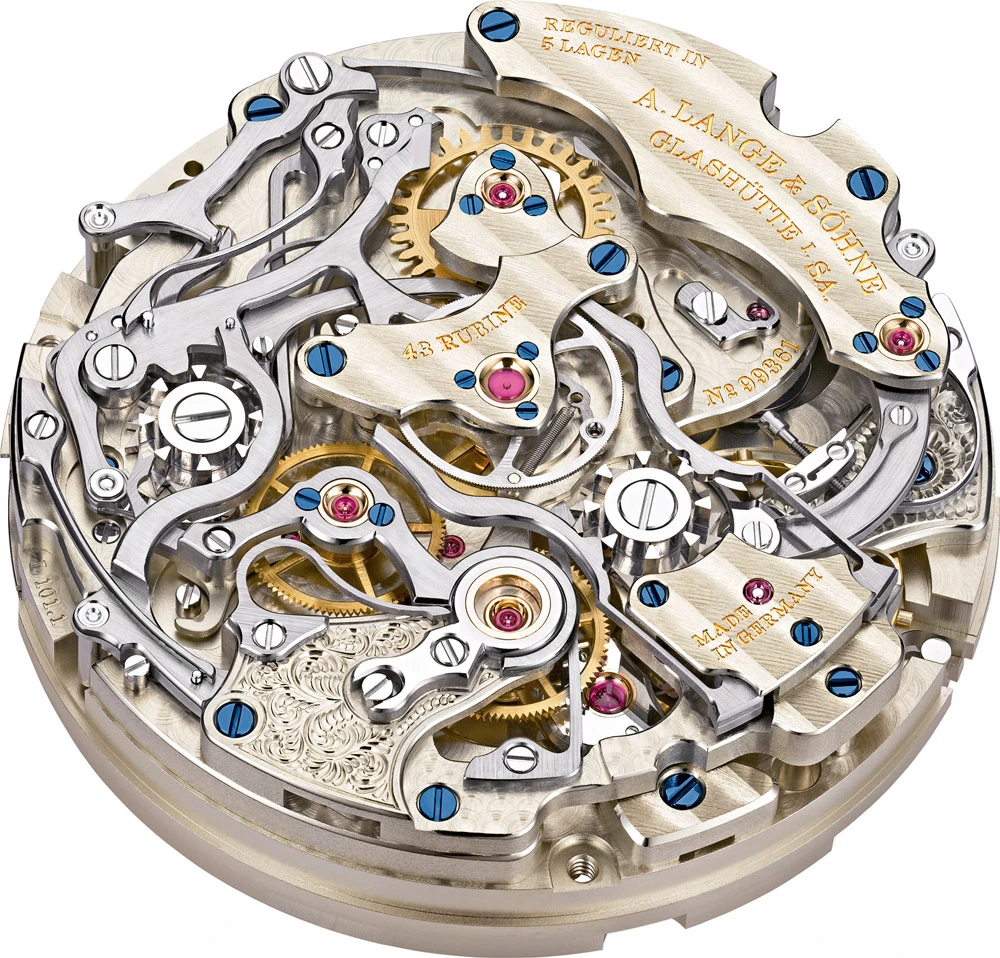
Image – A. Lange & Söhne 1815 Rattrapante Perpetual Calendar – Calibre L101.1
A. Lange & Söhne – masters of lateral and vertical couplings
A. Lange & Söhne has traditionally favoured the column wheel and lateral coupling arrangement. Some years ago, I asked Anthony de Haas, the company’s Director of Product Development, to explain why the firm favours the lateral coupling, considering the known issue with stuttering/hesitation. I still remember seeing a smile appear on his face and him saying, with his endearing Dutch accent, ‘We’ve done some special things’. And with just a few words, I felt reassured.
More recently, the German marque released the Odysseus Chronograph, a contemporary, self-winding chronograph featuring a column wheel and vertical coupling. It is clear that Lange has successfully mastered both forms of coupling.
What is a rattrapante?
At first glance, the A. Lange & Söhne 1815 Rattrapante Perpetual Calendar could easily be mistaken for a simple chronograph. However, a closer look reveals there is a third pushpiece, the split-seconds (rattrapante) pushpiece located at 10 o’clock.
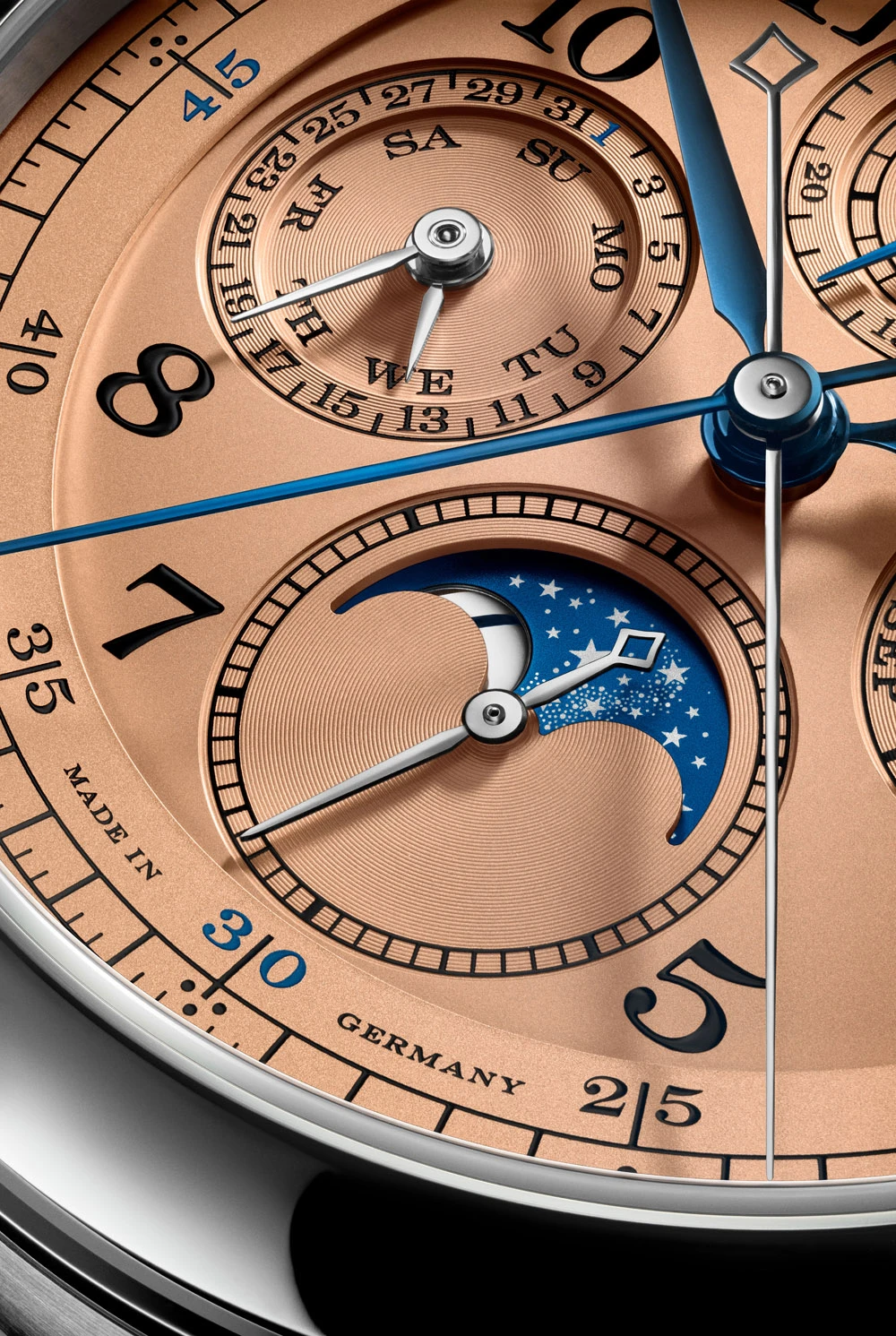
Image – A. Lange & Söhne 1815 Rattrapante Perpetual Calendar
The rattrapante hand is positioned above the central chronograph seconds hand (on some models it can be located below). When the pushpiece at 2 o’clock is actuated, the chronograph hand begins its journey and appears as if there is just one lone hand. However, press the split-seconds pusher and the rattrapante halts and the central chronograph hand comes into view. Press the split-seconds pushpiece again, and the rattrapante hand immediately catches up (rattraper) with the central chronograph seconds hand and continues its journey in tandem. This complication allows the wearer to measure intermediate times or splits.
A rattrapante is incredibly complicated. Extreme forces need to be managed to avoid levers being scarred, chronometry being adversely affected or, in some cases, the central chronograph hands bending after the reset to zero is activated. In addition, when the chronograph is running and the rattrapante is not in use, both hands must appear as one to avoid any parallax issue. To achieve this, the gap between both centrally positioned hands must be minuscule.
Perpetual calendar
Clearly not satisfied with making one of the most technically challenging complications, A. Lange & Söhne has chosen to engage in a further bout of self-flagellation. At the heart of the A. Lange & Söhne 1815 Rattrapante Perpetual Calendar sits the Calibre L101.1. Comprising 631 parts, the movement automatically takes into account the number of days in the month and correctly displays the prevailing date even in leap years. Assuming the watch is kept fully wound, the date will not require manual correction until 2100, at which point it will need to be adjusted in order to stay in line with the Gregorian calendar.

Image – A. Lange & Söhne 1815 Rattrapante Perpetual Calendar
A. Lange & Söhne 1815 Rattrapante Perpetual Calendar – dial
The A. Lange & Söhne 1815 Rattrapante Perpetual Calendar, with its solid pink gold dial, displays the day, date, month and leap-year on two counters positioned at 3 o’clock and 9 o’clock. In addition, the model features a combined moon phase indicator and small seconds display at 6 o’clock, while a power-reserve indicator and 30-minute chronograph register reside at noon.
Beyond its four symmetrically arranged counters, the German Manufactory has endowed this model with a plethora of beautifully considered details. For instance, the counters are snailed and recessed. Meanwhile, the restrained application of black and blue hues, along with the consistent use of railway tracks and crisp markings, serve to augment readability without marring the model’s genteel and refined appearance.

A. Lange & Söhne 1815 Rattrapante Perpetual Calendar – case
Housed in a 41.9 mm case, the comparatively modest dimensions of the 1815 Rattrapante Perpetual Calendar belie the mechanical complexity found within. The Glashütte-based brand has for some time offered this model in a variety of metals, including 18-carat pink gold and platinum. This particular version, reference 421.056FE, is encased in 18-carat white gold. In this instance, the chosen case material plays a deferential role to the dial, accentuating the dial’s bewitching pink complexion.
Appraising the case, Lange has appointed this model with a tasteful blend of polished and satin surfaces. To the rear of the case, a pane of sapphire crystal affords sight of the Calibre L101.1 beating within.

A. Lange & Söhne 1815 Rattrapante Perpetual Calendar – Calibre L101.1
I’ve already touched on some of the technical aspects that distinguish this movement as exceptional. However, I wish to point out some additional areas of note.
The movement is formed of German silver, a feature highly prized by purists. Typical of watches from this region, the movement features a three-quarter plate which, together with the bridges, is adorned with Glashütte ribbing and peerless hand bevelling. Additional refinements include thermally blued screws, circular-grained wheels, gleaming screws, perlage, mirror polishing, etc. Even the balance cock is hand-engraved to a glorious conclusion.

A. Lange & Söhne 1815 Rattrapante Perpetual Calendar – closing thoughts
Returning to my introduction, this Lange is the product of fastidious minds; a character trait common to everyone who works at the Manufactory. The 1815 Rattrapante Perpetual Calendar is not made on a production line but crafted in low volumes by skilled hands. Hugely talented watchmakers assemble, adjust, dismantle and reassemble movements. The tolerances are infinitesimally small when working at this exalted level. Artisans and finisseurs imbue parts with emotion and enduring joy.
Indeed, there are no economies of scale at Lange. The complexity of its products and the care it expends making its watches precludes shortcuts. Moreover, the scarcity of artisans, finisseurs and watchmakers capable of working at this über-level explains why aspiring Lange owners have to wait for their cherished timepiece.
As I have shown, Lange demonstrates that not all chronographs are the same.
Further reading
https://www.alange-soehne.com/
Technical specifications
- Model: A. Lange & Söhne 1815 Rattrapante Perpetual Calendar
- Reference: 421.056FE
- Case: 18-carat white gold, diameter 41.9 mm, height 14.7 mm, water resistance 3 ATM (30 m), sapphire crystal to the front and exhibition case back.
- Functions: hours, minutes, subsidiary seconds with stop seconds, rattrapante with minute counter, perpetual calendar with date, day of the week, month, moon phase and leap year, power-reserve indicator
- Movement: Calibre L 101.1, hand-wound movement, 43 jewels, power reserve 42 hours, components=631
- Strap: dark brown hand-stitched alligator leather strap paired with an 18-carat white gold deployant
- Price on application
- Limited: 100 pieces (boutique exclusive)