
New Armin Strom Dual Time GMT Resonance Rose Gold
The Armin Strom Dual Time GMT Resonance Rose Gold is the latest model to feature the Swiss marque’s patented clutch spring. Housed in a 39 mm case, the watch is much smaller than its antecedents of 2018 and 2019. Angus Davies suggests that sometimes miniaturisation can yield progress.

Image – Armin Strom Dual Time GMT Resonance Rose Gold
Armin Strom watch
‘Colossus’, the World’s first electronic computer, was developed by Tommy Flowers, a Post Office Engineer, during World War II. It went into operation in 1944, where it was housed at Britain’s wartime code-breaking headquarters, Bletchley Park. Reputedly weighing 5000 Kg and measuring more than 2 metres high, it could process 5,000 characters per second. Today, a modern laptop computer (the clue’s in the name), is capable of processing billions of characters per second. It’s fair to say that advancement comes in many forms, including the miniaturisation of once bulky objects.
Horology has also witnessed many changes over the years. In 1656, Christiaan Huygens (1629-1695), a Dutch mathematician and physicist, invented the pendulum clock. When a pendulum swings back and forth, the period of the swing remains the same, irrespective of the size of that swing (amplitude). This is referred to as isochronism. A pendulum is a simple oscillator and, working in conjunction with an escapement (a verge escapement in this instance), it is used to control the flow of time, causing the hands on a clock to move a predetermined amount.
It was the desire for smaller timekeepers that led to the creation of pocket watches. Again, Huygens’s brilliance came to the fore in 1675, when he invented the balance spring, a type of oscillator that sits at the heart of the balance within a watch. Swinging back and forth, the balance, when teamed with an escapement, controls the flow of time (sound familiar). Over the years, balance springs have continuously developed, becoming increasingly immune to the adverse influences of temperature and magnetism. However, most notably, the advent of the balance spring has allowed watchmakers to create ever-smaller timekeepers.

Image – Armin Strom Dual Time GMT Resonance Rose Gold
Resonance x timekeeping
During the 17th century, Huygens observed two identical pendulum clocks, suspended from a common beam, moving in sympathy. The period and amplitude were the same, albeit the clocks moved in opposite directions.
Antide Janvier (1751-1835), the royal clockmaker to Louis XVIII, explored this phenomenon and ultimately created ‘double pendulum clocks’ around 1780. Each pendulum was driven independently, moving in the opposite direction to its counterpart, cancelling external vibrations that could adversely influence precision.
Later, Abraham-Louis Breguet (1747-1823) created two clocks and a pocket watch based on Janvier’s invention. The pocket watch featured a double pendulum and two escapements. Once again, progress came in the form of miniaturisation.
The first wristwatch to employ resonance came in 2000 with the release of the Chronomètre à Résonance, invented by watchmaking genius, François-Paul Journe. Journe’s timepiece features two movements with both balance wheels positioned in close proximity and, according to the company, employs ‘acoustic resonance’ to transmit energy from one movement to the other, cancelling the negative influence of wrist motion and harmonising the rates of each balance.

Image – Armin Strom Dual Time GMT Resonance Rose Gold
Armin Strom Mirrored Force Resonance (2016)
In November 2016, Armin Strom, the independent Biel-based brand, unveiled its first resonance watch, the Mirrored Force Resonance. The watch features two independent balances, linked with a patented clutch spring. In common with Janvier’s double pendulum clocks, while the two oscillators (balances) commence their swing at different times, they eventually synchronise, moving in sympathy, albeit in opposite directions. Armin Strom’s unique movement delivers comparable precision to a tourbillon but with the benefit of superior rate stability.

Image – Armin Strom Mirrorred Force Resonance, winner of the reddot award in 2017
The release of the inaugural Mirrored Force Resonance proved a seminal moment for the watch firm, attracting much coverage in the media, thereby boosting brand awareness. Buoyed by the model’s success, Armin Strom has since released further models featuring its ingenious clutch spring, including the Dual Time Resonance, a watch equipped with two separate hour and minute indications (2018). Unlike a conventional GMT, this horological tour de force allowed the wearer to display two different times even when the offset is UTC ± 30 or 45 minutes. As much as I liked this watch at the time, I concede that for some it may have been too large (59 mm x 43.4 mm x 15.9 mm). The following year, 2019, the company released the Dual Time Resonance Sapphire, sharing the same dimensions.

Above image – Armin Strom Dual Time Resonance (2018), winner of the reddot award in 2019

Above image – Armin Strom Dual Time Sapphire (2019)
Armin Strom Dual Time GMT Resonance (2024 & 2025)
In 2024, Armin Strom unveiled a new Dual Time GMT Resonance, housed in a round, 18k white gold case. However, unlike its forebears, released in 2018 and 2019, this new generation model was comparatively diminutive. Measuring just 39.00 mm in diameter with a thickness of 9.05 mm, the proportions of the watch proffered universal appeal. At the time, my colleague Mark McArthur-Christie wrote an in-depth feature on this particular reference. Once again, miniaturisation had delivered advancement. In 2025, the luxury marque unveiled an animation of the Dual Time GMT Resonance, this time executed in steel.
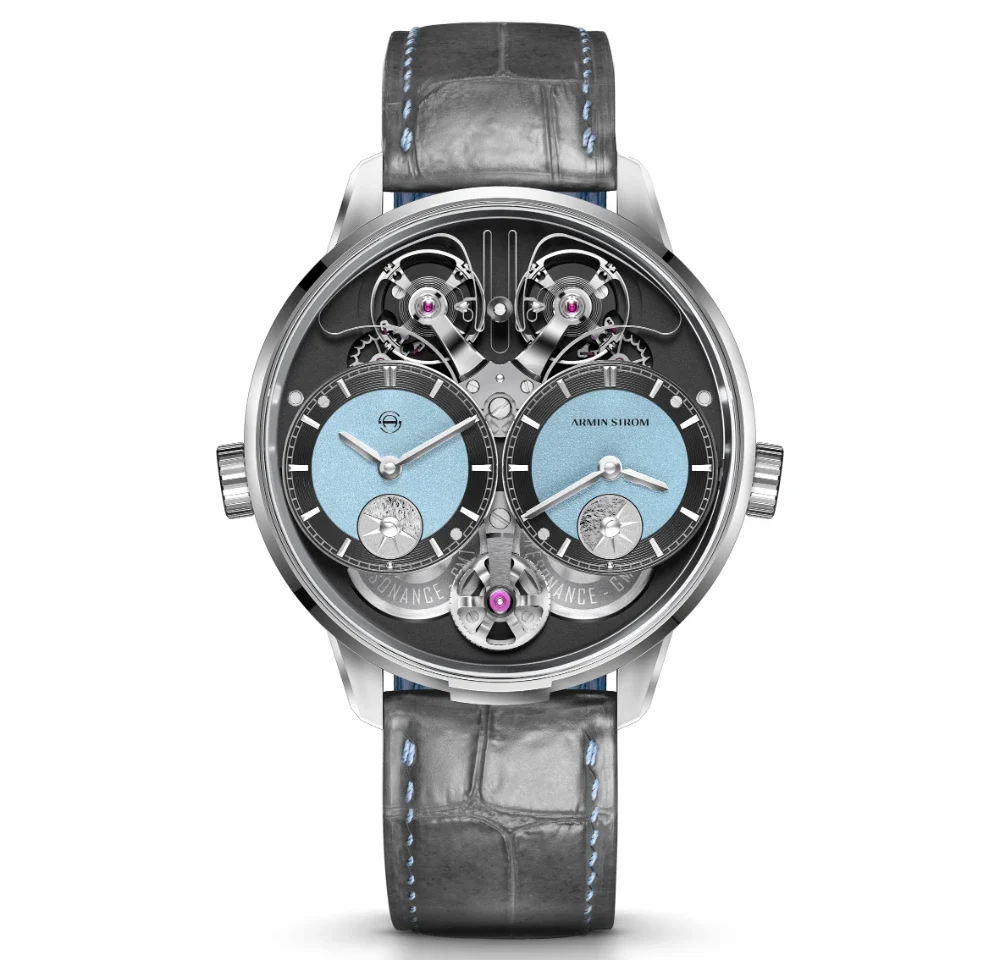
Image – Armin Strom Dual Time GMT Resonance in white gold (2024)
Armin Strom Dual Time GMT Resonance Rose Gold
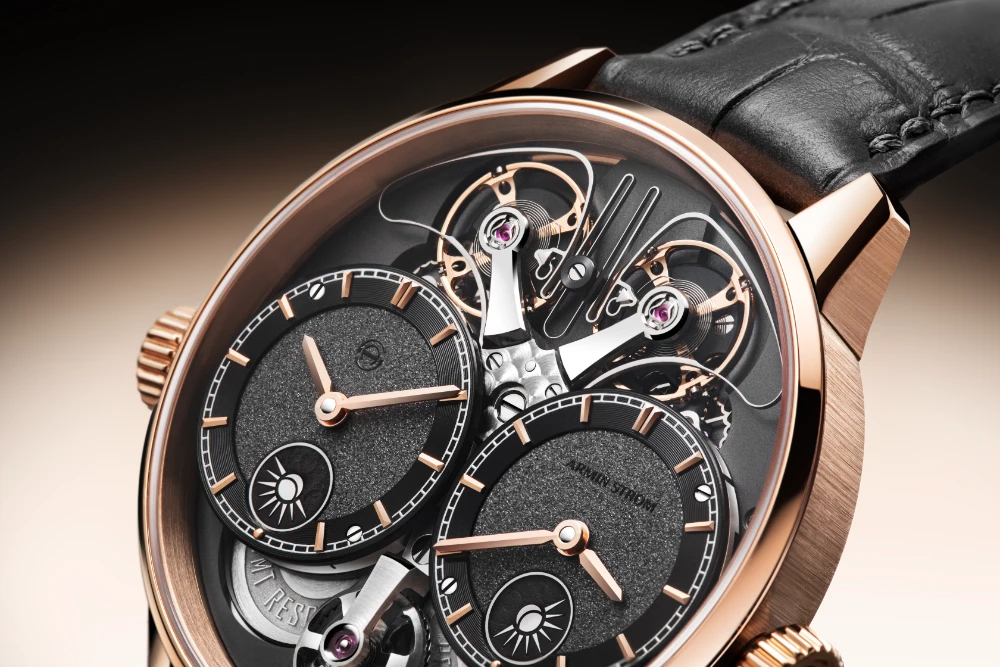
Surprisingly, while many brands are busily preparing for Watches & Wonders, Armin Strom has chosen to release a new variant of its twin balance horology, the Dual Time GMT Resonance Rose Gold. As the name of this watch implies, it is encased in 18K rose gold. It retains the same neat profile as the 2024 and 2025 releases; however, on this occasion, the watch sports black gold coloured grenage dials with azurage details and applied rose gold coloured indexes. The timepiece secures to the wrist with a matt grey alligator strap featuring grey stitching.

Closing remarks
Back in 2018, when the Manufacture released the first Dual Time Resonance, it was limited to just 8 pieces. The new Armin Strom Dual Time GMT Resonance Rose Gold is limited to 50 pieces, a figure that shows how the brand has grown exponentially, no doubt due to the success of its groundbreaking resonance clutch spring.

However, while Armin Strom has repeatedly walked on virgin snow, it has also followed others in recognising that miniaturisation can confer advancement. Interestingly, the titanium model of 2018 retailed for CHF 180,000 at the time of its launch, whereas the Armin Strom Dual Time GMT Resonance Rose Gold retails for much less at CHF 115,000. It seems progress takes many forms.
Further reading
Technical specification
- Model: Armin Strom Dual Time GMT Resonance Rose Gold
- Reference: RG25.DT.75
- Case: 18-carat rose gold, diameter 39.00 mm, height 9.05 mm, water resistance 5 ATM (50 metres), sapphire crystal to front, exhibition case back.
- Functions: two independent time displays, each indicating hour and minutes, day/night indicator
- Movement: Caliber ARF22, hand-wound movement, frequency 25,200 Vph (3.5Hz), 40 jewels, power reserve 42 hours, 231 components.
- Bracelet: matt-grey alligator strap with grey stitching – with 18-carat rose pin buckle
- Price: CHF 115,000 (RRP as of 12.2.2026)
- Limited Edition: 50 pieces