
Breguet Expérimentale 1 Watch Review
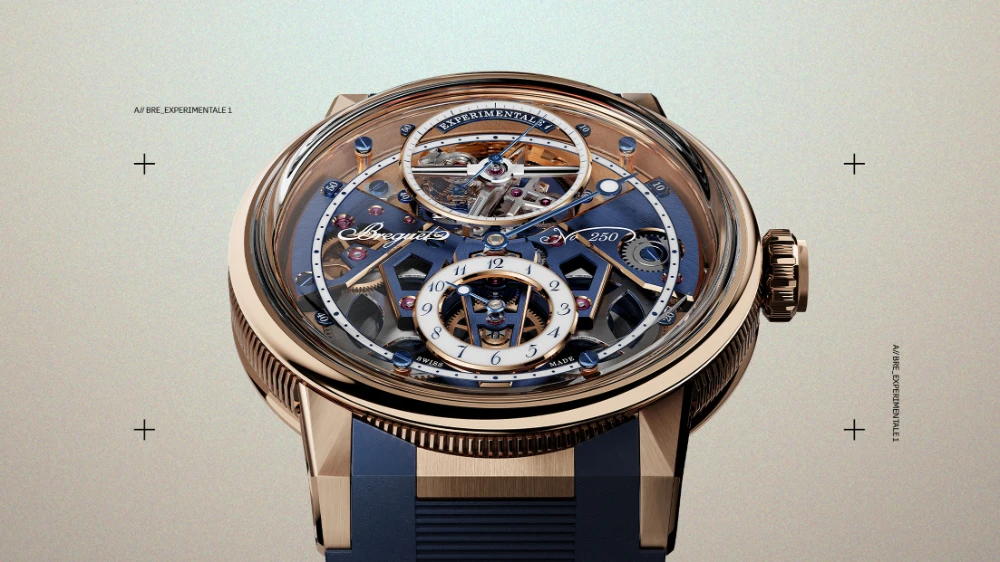
The Breguet Expérimentale 1 is a groundbreaking watch that supplants the ubiquitous Swiss lever escapement with a revolutionary constant-force magnetic escapement. Promising superior rate stability, incredible precision and better shock resistance, this contemporary expression of Haute Horlogerie is extraordinary. Fuelled by his Nespresso machine, Mark McArthur-Christie has expended many hours reading patent applications and distilling their contents in his quest to convey all the technical details of this horological tour de force.
Breguet – Gregory Kissling
There can’t be many scarier – or more exhilarating – jobs in Watchworld than getting the keys to 23, Place de la Tour. It would be easy to regard the Breguet tradition as a bafflingly complicated and beautiful glass-cased machine that must never be touched – just carefully maintained. At the same time, the sense of pressure to innovate with Monsieur Breguet’s name above the door is unavoidable.

Image- Gregory Kissling Breguet
So hats off to CEO Gregory Kissling for steering the new Expérimentale into port. There’s plenty to keep the traditionalists happy and enough new watchmaking developments to keep the European Patent Office busy.
It seems fitting that the man who describes the Moonswatch as ‘my baby’, and who also developed last year’s GPHG-winning Souscription watch, should be behind the Expérimentale. Its combination of traditional Breguet elements – case design, blued hands and hand finishing – with advanced technology, including a 10 Hz tourbillon and magnetic escapement, feels very much like his work.
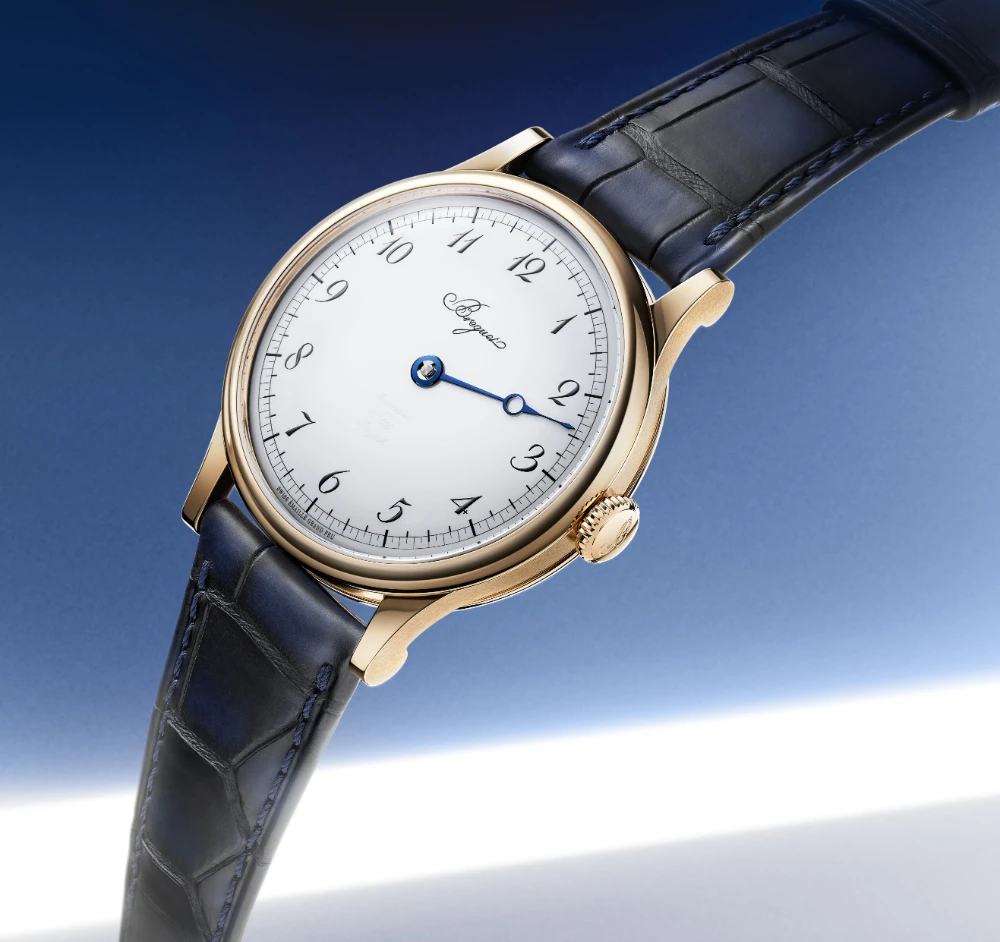
Image – Breguet Classic Souscription, winner of the ‘Aiguille d’Or’ at the GPHG 2025
Breguet Expérimentale 1 – magnetic escapement
Magnetic escapements are nothing new – prototypes were around in the 1930s – but a fully operational, production version is a remarkable step forward. Swatch Group filed the patent for it back in March 2020, so the tech could have just as easily ended up behind an Omega dial rather than within a Breguet case. One wonders what the internal process was that saw it find a home at Breguet.
Despite plenty of interesting watchmaking packed into the case, the Expérimentale’s escapement is the headline act. A conventional watch features an escapement and a regulating organ (balance wheel and balance spring). Normally, a traditional escapement comprises a mechanical pallet fork and geartrain, two parts that harness power from the mainspring to serve an impulse to the balance before unlocking the gear train, causing the hands to advance a pre-determined amount. This latest Breguet model does things a little differently.
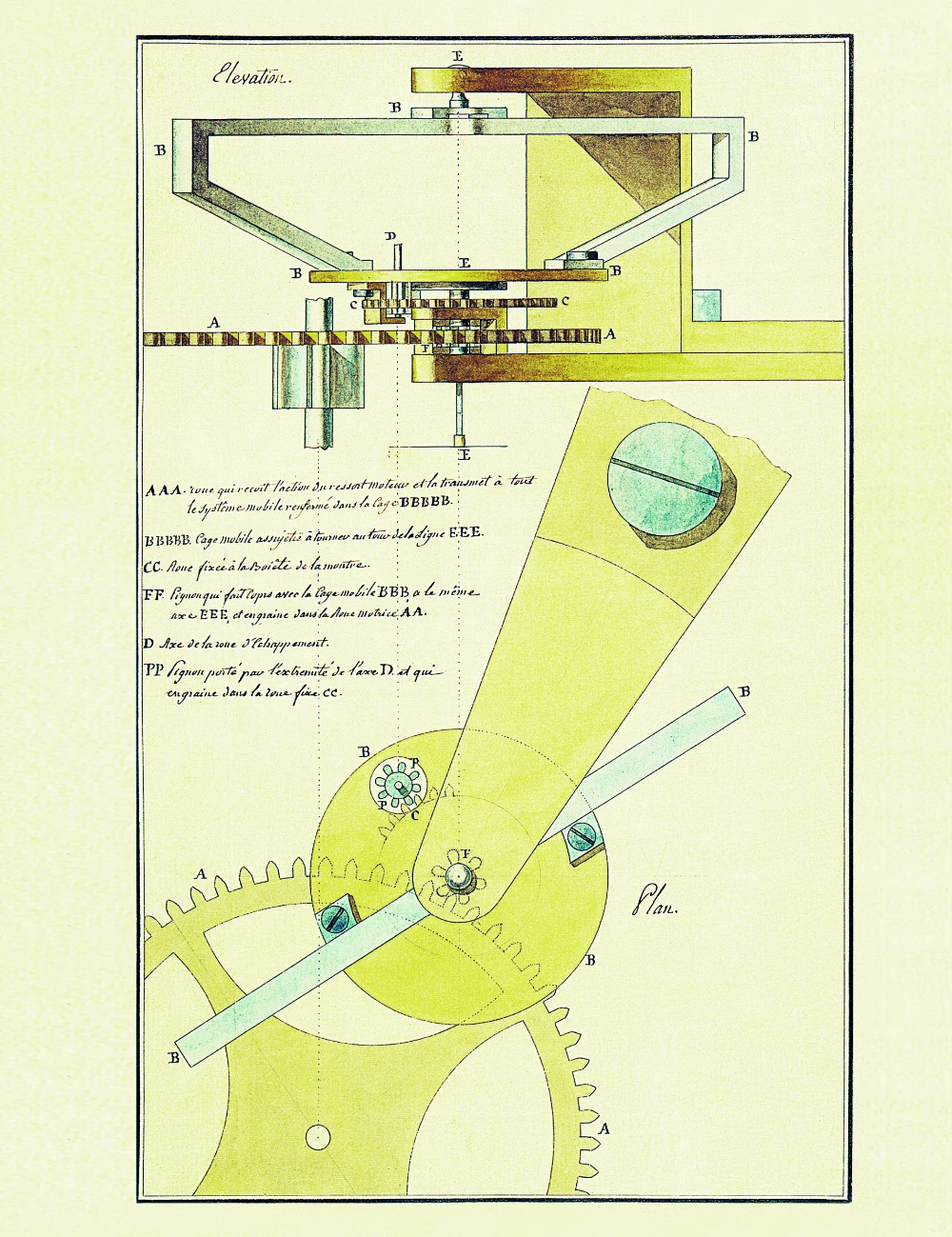
Image – original tourbillon patent
Breguet Expérimentale 1 – patented know-how
If you want a properly detailed, technical breakdown of how things work, European Patents EP3208667B1, EP3208667 and EP3882713 are the places to look (seriously – they’re well worth exploring). We’ve burned through enough espresso to run a power station understanding these lengthy documents, but here’s the distilled version of the patents, what’s new, what’s the same and how it all works.
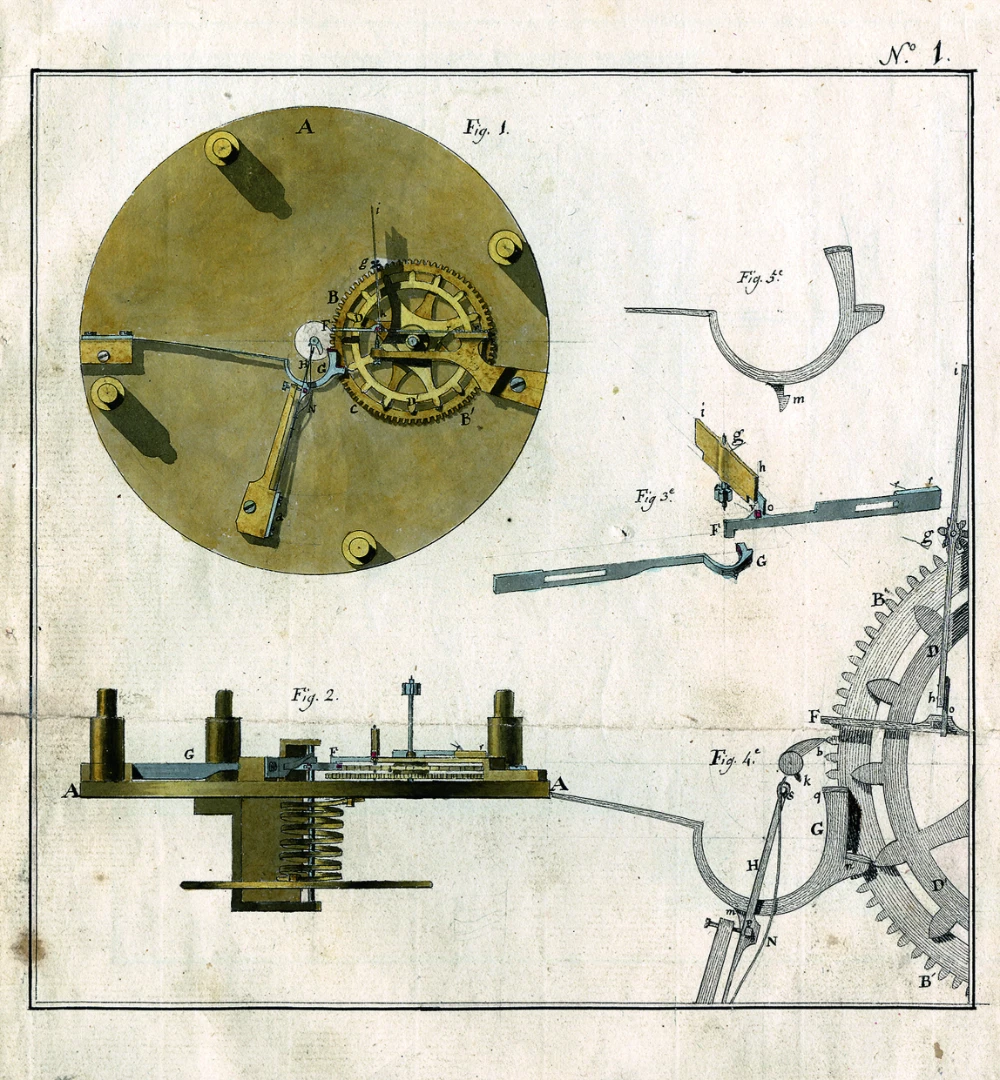
Image – original constant force patent
Breguet Expérimentale 1 – how does it work?
Unlike some early attempts at magnetic escapements, the Expérimentale still retains its balance wheel (free sprung), a silicon balance spring and a pallet fork. The difference is in the way the pallet fork (nickel phosphate-treated, no less) and the escape wheel operate.
The Expérimentale turns the traditional escape wheel into a magnetic, constant force escape system. It sandwiches an intermediate stop wheel (which is also intended to help with starting the movement from rest as well as absorbing shocks) between two titanium wheels with – wait for it – mirrored polarity, variable-width, ferromagnetic samarium-cobalt tracks around their rims.
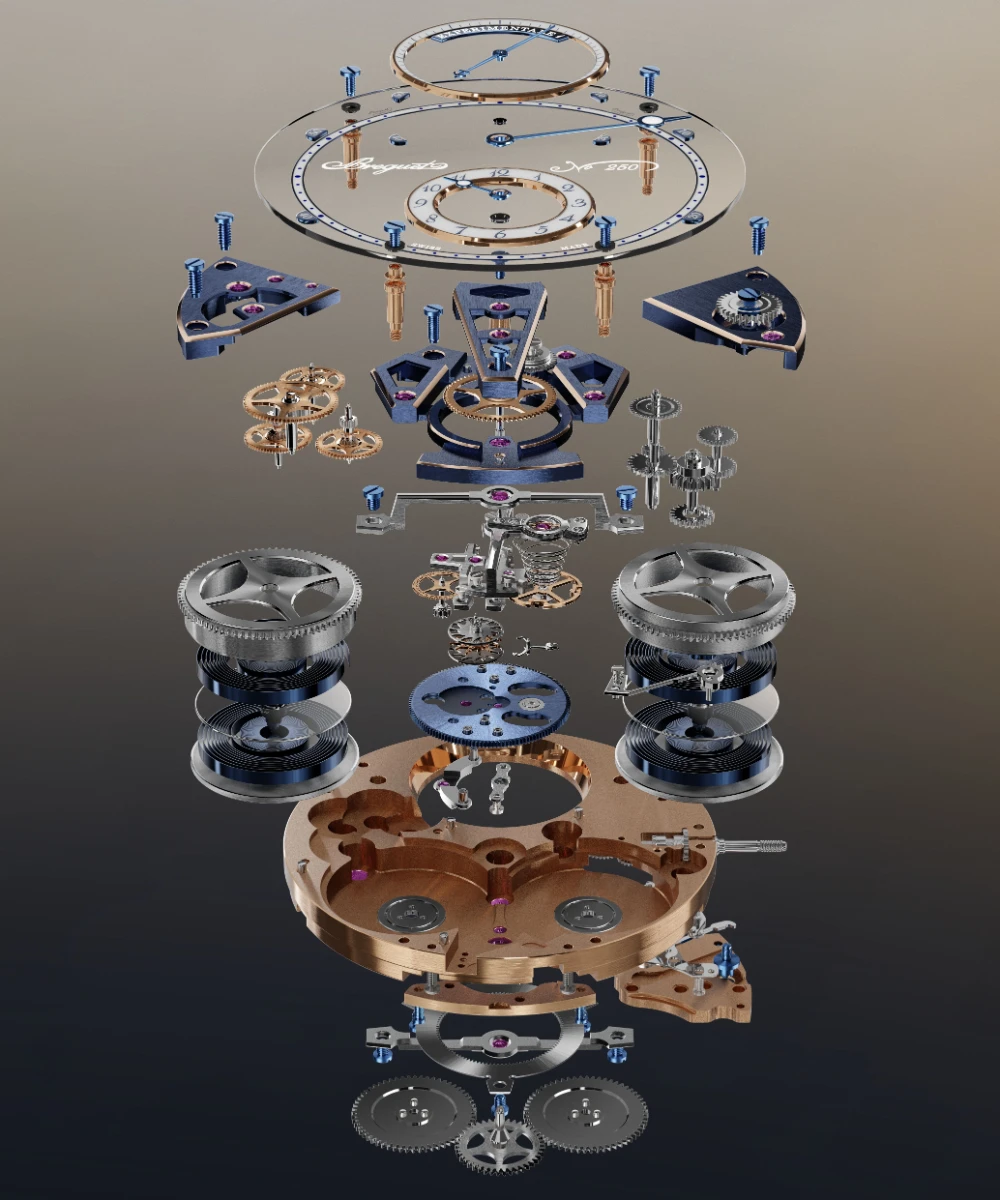
Samarium-cobalt works well because it’s resistant to corrosion, temperature stable and able to retain its magnetism for years – handy in a watch movement that depends on it. The three wheels are connected by a central, geared pivot.
This ‘wheel sandwich’ is linked, as usual, by the pallet fork to the balance, but instead of jewelled pallet stones, Breguet has used tiny samarium-cobalt magnets. These interact with the magnetic ramps on the escape wheels and, in the process, create a magnetically-controlled constant force escapement.
There’s none of the usual friction between the pallet stone and the escape wheel tooth as the impulse between the escape wheel and lever is magnetic, ie not through sliding contact. Locking still occurs mechanically via a stop wheel.
As power from the mainspring begins to turn the escape wheel ‘sandwich’, one of the pallets is held by the stronger magnetic force from one of the thicker parts of the variable-width, samarium-cobalt track on the outer wheels. Once the pallet is pushed by the balance wheel’s impulse pin, the magnetic field – there’s no physical metal to metal contact – springs it away from the escape wheel, just as the magnets you had as a child would repel as well as attract. As it moves, the wheel rotates and its partner pallet ‘stone’ moves into the magnetic field, stopping it.
The magnetic force imparted at the impulse gives the balance wheel the same clean push every time, no matter how much power remains with the barrels. Once the mainsprings have completely run down, the escapement simply stops because their torque can no longer overcome the magnetic pull.
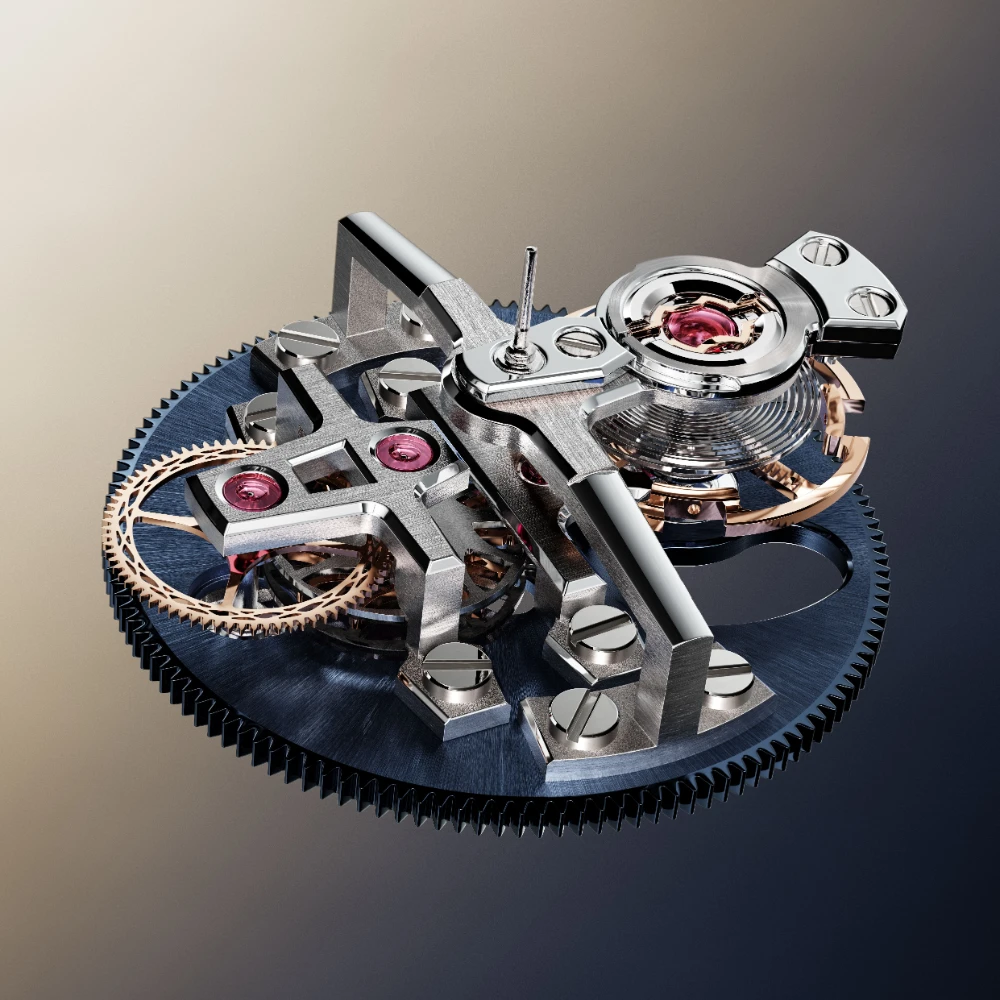
So far, so clever; a revolutionary production escapement that uses magnetism to deliver constant force to the balance and absorb shock. Clearly, this wasn’t impressive enough for Breguet, as the brand decided to mount the whole thing in a tourbillon cage and spin it at 10 Hz. Like you would.
For context, that’s 72,000 steps per hour. Modern balances – without tourbillons – often run at only 4 Hz or 28,800 beats per hour. A standard tourbillon – if that’s not too earthbound a term for such a celestial complication – will run at 2.5 Hz. The result? According to Breguet, “The 10 Hz tourbillon with magnetic escapement is therefore more stable and more accurate than most contemporary wristwatches.”
Breguet Expérimentale 1 – accuracy
The Expérimentale will be accurate indeed, but as we’ve pointed out more than once, a tourbillon in a wristwatch is like a speedometer on a bicycle; interesting but functionally pretty pointless. That’s because tourbillons were designed to decrease positional error in pocket watches that remained, by and large, in one, vertical position. Wristwatches are subjected to many positions and frequent motion, so they don’t really need the complication. But isn’t the very point of Haute Horlogerie to be irrational; to create beautiful things that are also functional, whether they’re useful or not?
The tourbillon mechanism in the Expérimentale is an engineering and finishing tour de force all on its own. Seventy-four individual parts from the hand-polished, brushed, stippled and chamfered jewelled retaining bridge to the polished, heat-blued screws – all in a mechanism 13.7 mm by 5.45 mm. For context, that’s smaller than a stack of three 5p pieces.
Then there’s the almost obligatory influence from The Master himself, both in terms of the regulator dial design and the twin mainspring barrels. There’s an upgrade from the model that influenced the new watch – No. 3448 from 1820 – with the two barrels holding four blued mainsprings between them – two in each – separated by a low-friction sapphire disc. Breguet says, “This double-sprung mechanism serves to optimise energy management in relation to the space available.”

Image – pocket marine chronometer Breguet No. 3448, sold in 1820 to the astronomer Alexis Bouvard
As well as all this hand-finished beauty, there’s some serious technology going on. The pallet wheel is made using a process called LIGA. Since you asked, that’s ‘Lithographie, Galvanoformung, Abformung’ – or electroforming technology. In essence, it involves blasting X-rays through a stencil to make tiny holes in a plastic substrate, using electroplating to deposit metal (in this case, nickel-phosphorus alloy) inside the holes and then melting away the plastic. It’s like the plastic equivalent of lost wax casting.
The result of all this art and tech? ‘The Expérimentale 1 wristwatch is certified by the Breguet hallmark in the “Scientific” category, meaning it has a guaranteed accuracy of +/- 1 second over a 24-hour period.’ Read it and bleep, quartz.
Breguet Expérimentale 1 – case
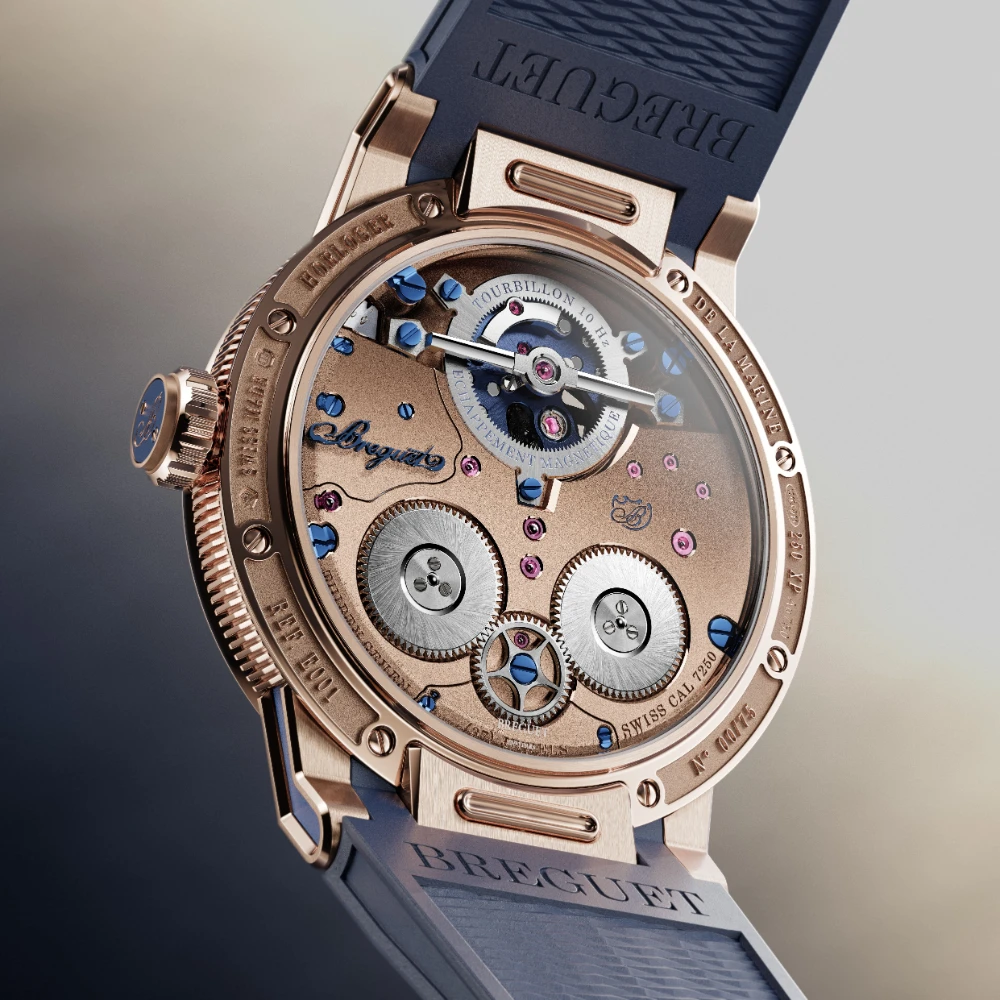
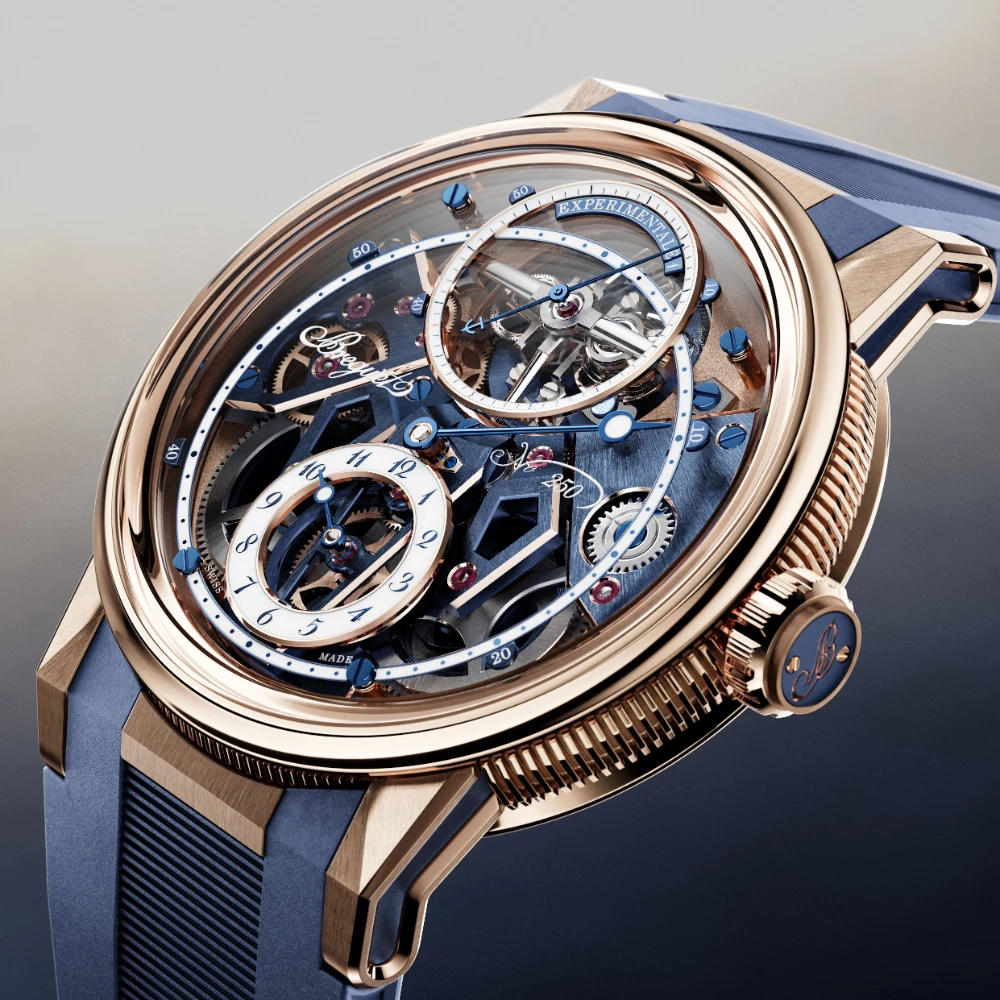
Comprising 54 components, the 18K Breguet gold case that houses all this cleverness measures 43.5 mm in diameter, so not quite in the ‘small and fashionable’ category, but neither is it a wristpuck. The broad bezel and recessed minute track help to slim it down visually, too. The case is just over 13 mm thick, which, given the movement it houses, isn’t excessive. Waterproof to 100 m too, handy if you decide to go scuba diving in your CHF 320,000 Expérimentale.
The traditional Breguet coin-edge is there, but the case has been modernised. This is not always a good thing, but here it works. The new, sharply angled lugs are hollowed-out and close-set with blue ALD-treated (a thin film of metal) gold inlays – much chunkier than the usually restrained and elegant Breguet lugs but hardly in G-Shock territory. The crown gets the same treatment, but with a sandblasted gold inlay.
Fitted with a blue rubber strap paired with an 18K gold pin buckle, the Breguet features a quick-release system, providing ‘tool-free interchangeability’. If you’ve ever taken a lump out of a watch case trying to change a strap, you’ll be grateful that, in this instance, all that is needed is a fingernail-push of a button.
The glassbox sapphire crystals front and back (double anti-reflective coated) give you a fine view of the movement and the regulator time display, another influence from No. 3448. Incidentally, this pocket marine chronometer was sold in 1820 to the astronomer Alexis Bouvard.
Abraham-Louis Breguet & Alexis Bouvard
As a side note, one can imagine Monsieur Bouvard enjoying a glass or two with Breguet. A remarkable mathematician and astronomer, Bouvard was born in a hut and dragged himself up from tending sheep in a field in Haute-Savoie to become a member of both the Academy of Sciences and a fellow of the Royal Society of London. He went on to prepare the astronomical ground for the discovery of the planet Neptune. Undoubtedly, the two men would have had plenty to talk about and much in common.
Breguet Expérimentale 1 – dial
Practically, this regulator design means a sapphire dial with hours at 6 o’clock, an offset minute track, supported on gold pillars, and a seconds track on the tourbillon. Each of these tracks is raised above the movement plates and exposed gears. The minute and second markers are neat, tiny, applied, blued semicircles. As well as the secret Breguet signature (not so secret nowadays) at 11 on the hour track and 1 on the minutes track, there’s enough Super-LumiNova to light up half of Paris.
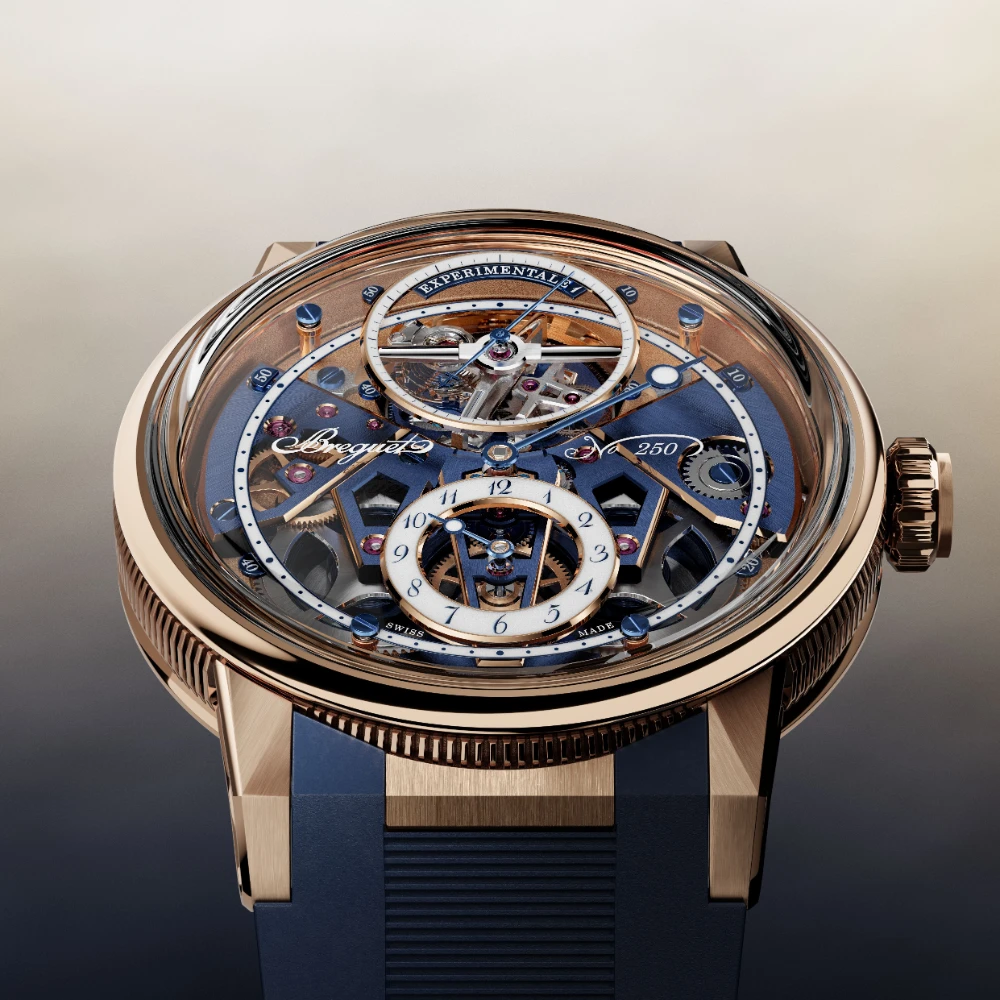
In fact, the lume may be the Expérimentale’s salvation when it comes to legibility. It’s glorious to see the openworked movement with its anglage, brushing, blued screws and blued 18K plates with gilt polished edges, but there’s a lot going on, hence it’s not the easiest Breguet dial to decipher in daylight. The influence of No. 3448 is absolutely there, but the earlier watch is easier to read. Drop the lights though and the background distraction fades, bringing up the chapter ring and tracks and making things a lot simpler.
This feels like a churlish criticism, though – you can read the time, it just takes a little doing. A positive view would be that it forces you to actually look properly and enjoy the movement and the watch itself.
Closing remarks
With the Expériementale, Breguet has pulled more rabbits from hats than a Las Vegas Penn & Teller show. It’s the first of a new line of updated designs for the Marine series. The watch is equipped with a new, serially-produced magnetic constant force escapement. Initially, the production will be limited to only 75 watches. There are four blued – blued, for goodness’ sake – mainspring barrels with sapphire separating discs – powering the watch. The escapement’s components are produced with the sort of micro-level techniques that would have had you burned as a witch not so long ago. It’s a beauty, both technically and aesthetically.
Looking to the past, it feels as though the firm has drawn inspiration from Breguet’s own échappement naturel – direct impulse to the balance, minimal friction and little or no need for lubrication. But the Expérimentale does away with the need for two escape wheels delivering impulse alternately, replacing them with modern technology. The Master would have nodded approvingly and probably sworn a little that he didn’t come up with the idea himself.
So what of the future for the Caliber 7250 and its new escapement? It’s starting life in a flagship watch, but the question is whether it’s the first of a series that will move mainstream or stay as a skunkworks for the maker. From the comments he’s made, it certainly sounds as though Kissling’s plan is to expand its use across the Breguet range. Given we have a regulator with the new escapement, how about a stainless steel Souscription next? Whatever the future brings, it certainly promises to be innovative and exciting.
Further reading
Technical specifications
- Model: Breguet Breguet Expérimentale 1
- Reference: 7235BH/0H/9V6
- Case: 18K Breguet Gold, diameter 43.5 mm, height 13.30 mm, water resistance 10 ATM (100 m); sapphire crystal to the front and exhibition case back.
- Functions: hours, minutes, seconds on tourbillon cage
- Movement: Calibre 7250, hand-wound movement, frequency 72,000 vph (10 Hz), 37 jewels, power reserve 72 hours.
- Strap: blue rubber with tool-free interchangeability paired with an 18K Breguet gold pin buckle. Fitted with an 18K Breguet Gold pin buckle
- Price: £324,400 (RRP as of 11.3.2026)