
Breguet Type 20 and Breguet Type XX Chronographs Watch Review
The Breguet Type 20 and Breguet Type XX Chronographs are the latest aviation-themed watches from the venerable Maison. Both models feature an exceptional 5 Hz movement, endowed with a column wheel and vertical coupling, and are finished to a supremely refined standard. But first, Angus Davies explains why he is a Breguet obsessive.

Image – Breguet Type 20 and Breguet Type XX
Celebrity culture
For many years I was the Marketing Director of a chemical company, however, in 2011, I embarked on a new career writing about watches. It’s a decision I have never regretted. To share my passion for horology, a relationship I consummated in my early 20s, is an absolute joy.
Occasionally in this role, I have been invited to meet brand ambassadors; those glamorous faces from the world of sport, music or the silver screen. Luxury watch brands love these famous individuals, hoping that a snatched paparazzi photo, featured in a magazine, will heighten the awareness of their brand. While many of the famous people I’ve met have been pleasant, at no stage have I ever been star-struck. On the contrary, my idols sit at a bench laden with screwdrivers, cloches and tweezers, often with a Witschi machine close at hand.

Image – Breguet Type 20 and Breguet Type XX
For the love of Breguet
The finest exponents of watchmaking possess a talent beyond my grasp. My hands incessantly tremble, my eyes are below par and my psyche is devoid of patience. Quite simply, I lack the requisite skills to be a successful watchmaker. I suspect it is for this latter reason that I virtually worship the finest practitioners of this esoteric domain.
However, my ultimate idol will forever be Abraham-Louis Breguet (1747-1823). Despite it being 200 years since his passing, no watchmaker has ever come close to matching his exceptional talent. Indeed, I very much doubt that anyone in the future will ever rival his genius.

The genius of Abraham-Louis Breguet
Born in Neuchâtel, Abraham-Louis moved to Versaille in 1762 and began an apprenticeship. Later, in 1775, he established his own business on Quai de l’Horloge, Paris. His capacity to invent was incredible. Most notably, Breguet conceived the tourbillon escapement, the pare-chute (a shock protection device) and his eponymous overcoil.
Today, components are made using state-of-the-art machines such as CNC, wire erosion and bar turning machines where tolerances are measured in microns. Despite Breguet never having this cutting-edge technology at his disposal, he crafted beautiful timepieces, all made to an exalted standard; a clear demonstration of his exceptional talent as a watchmaker.

Image – Breguet Type XX (2023)
Beloved by aristocrats and royalty, Breguet’s work was held in high esteem. His capacity to engage with affluent patrons led to him enjoying much financial success. He recorded the sales of his watches in detailed archives, a forerunner of what we now refer to as CRM systems. Aware of the threat of counterfeits undermining his brand, he conceived ‘the secret signature’, an authentication device applied to his dials. Furthermore, he came up with the idea of the souscription timepiece. This still remains popular today, especially among fledgling independent brands. This ingenious sales tool invites clients to pay a deposit at the time of ordering a watch, thereby providing the means to finance the making of said watch. Looking back at Abraham-Louis Breguet, his commercial acumen remains beyond question.

Image – Breguet Type 20 (2023)
Frequently described as an ‘aesthete’, Breguet regularly used guilloché, often expressed in an array of styles, to adorn watch dials. Likewise, the moon-tipped hands and the elegant numerals bearing his surname have stood the test of time. Indeed, they are often emulated but seldom surpassed in terms of form or function.
In my opinion, Breguet’s array of talents along with his business acumen will forever make him the greatest figure in watchmaking history.
Louis Charles Breguet – the famous aviator
The capacity to invent would appear to be genetic as Louis Charles Breguet (1880 – 1955), a French aviator, the great-great-grandson of Abraham-Louis Breguet, shared the same pioneering spirit. He built his first airplane in 1909 and set a speed record in 1911 for flying a distance of 11 kilometres. Over the years, he constructed his first hydroplane (1912) and subsequently designed and flew a ‘gyroplane’, the precursor of the helicopter. He famously produced military aircraft, including the Breguet XIX, a plane often used in anger during World War I.

Image – technical drawing for the instrument-panel Breguet Type 11 chronograph
A forerunner to Air France, Compagnie des Messageries Aériennes, was founded in 1919 by Louis Charles. His prowess for invention and his commercial acumen is clearly something he shared with his ancestor Abraham-Louis, suggesting there is an innate gift common to those who possess Breguet genes.

Image – instrument panel of the Breguet Br-1050 Alizé carrier-based anti-submarine warfare aircraft
Planes and watches
Over the years, the Breguet name has become linked to both the fields of aviation and horology. Indeed, Breguet, the prestigious maker of fine watches, was a leading producer of aviation cockpit instruments and pilots’ watches.

Image – order from instrument-panel chronograph for Concorde
It is easy to forget that in an era pre-dating fly-by-wire technology, pilots used watches to calculate flight times and fuel consumption as well as a means of navigation. While cockpit instruments were the primary source of information, the pilots’ watch served as a backup should the former fail. Moreover, chronographs were widely used in aviation, both fixed within the cockpit as well as in wristwatch form. During the 20th century, Breguet supplied its products for both civilian and military purposes. Indeed, Breguet famously supplied chronographs for use in Concorde, the Supersonic aeroplane capable of flying at Mach 2. It seems the brand’s expertise in making cockpit instruments and pilots’ watches is beyond reproach.

Breguet Type 20 – the birth of an icon
In 1949, the Centre d’Essais en Vol, part of the French Ministry of Defence, procured its first Breguet watch. Thereafter, the government department created a specification for pilots’ watches equipped with a chronograph. Consistent with all Breguet watches dating back to Abraham-Louis Breguet, the timepieces were recorded in the company’s archives. However, due to the sensitivity of their purpose, they were listed using numbers such as 1530, 1531, etc. It was not until 1953, that the name Type 20 was first used. Thereafter, a legend was born and Breguet’s chronograph was soon worn by aviators and watch aficionados alike.

Image – Breguet Type XX No. 1780 chronograph made in 1955. One of only three first-generation examples in gold
Breguet Type 20 or Type XX?
The model’s nomenclature is determined by its intended purpose, the military watches are referred to as the ‘Type 20’ while the civilian models bear the name, ‘Type XX’. However, unlike yesteryear, you do not need to fly a fighter plane to be able to purchase one of the military specification models.
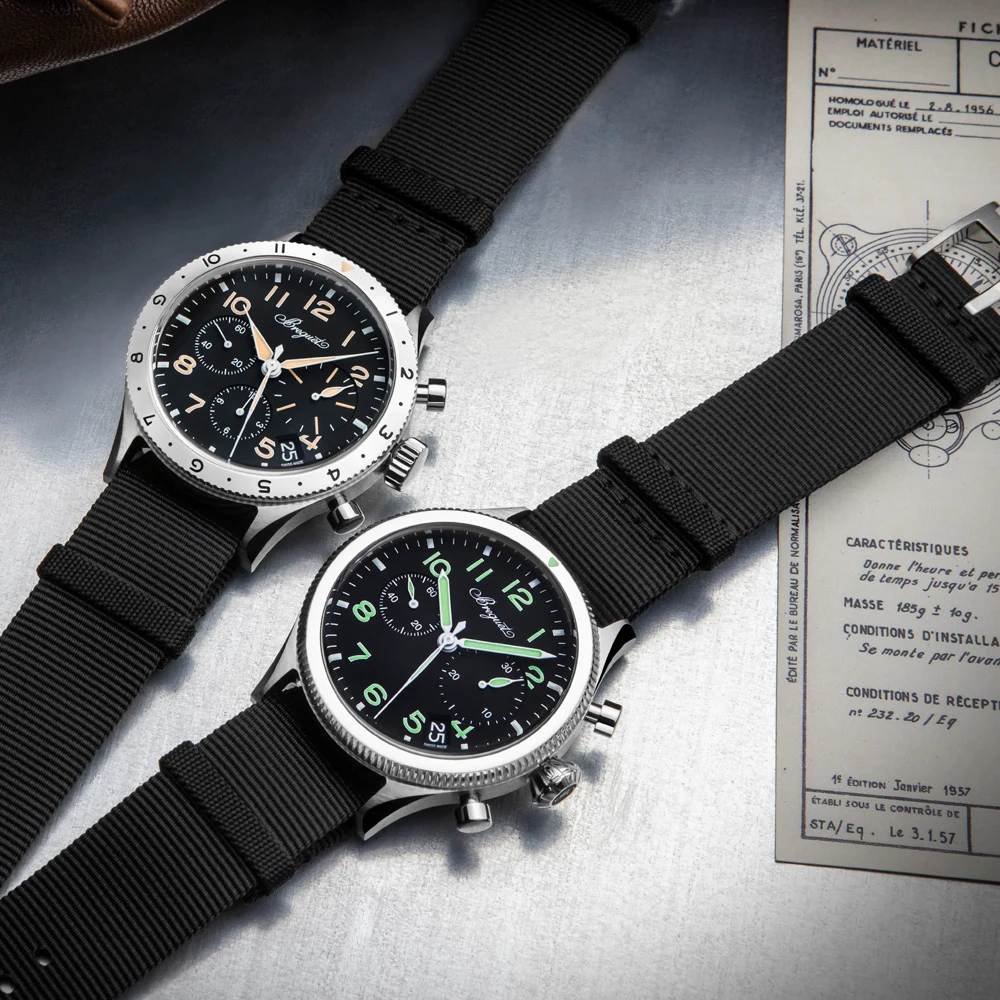
Image – Breguet Type 20 and Breguet Type XX
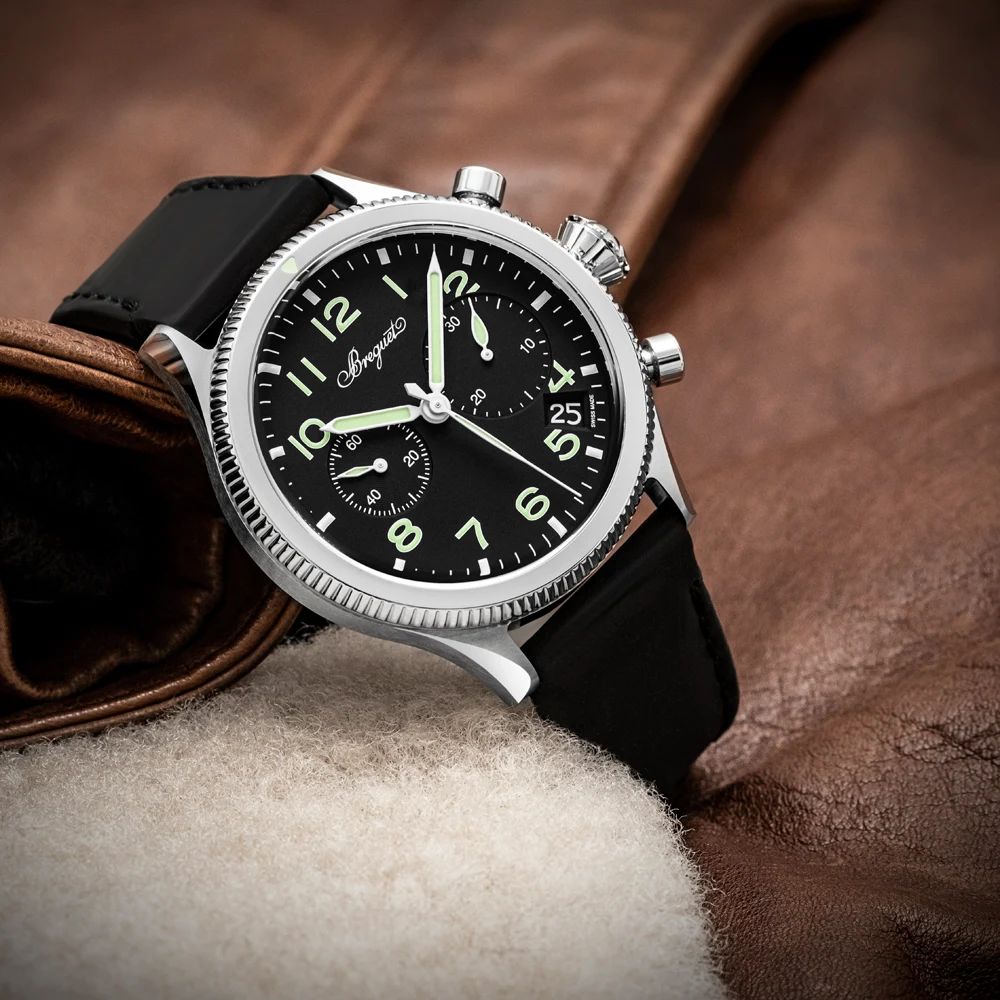
Image – Breguet Type 20 (2023)
The Type 20 and Type XX over the last 70 years
Peruse a few sepia-toned Breguet catalogues and you will notice that the design language has been consistent over the years. Syringe-style hour and minute hands, Arabic numerals denoting the hours and capstan-style pushpieces have always been part of the Type 20’s vernacular design.

Image – Breguet Type 20 ‘Armée de l’air (1955)
Historically, there are some design codes which distinguish military models from their civilian counterparts. For example, a fluted bezel with a lone triangular index at noon usually indicates the watch is intended for military use while the bezels fitted to the civillian models are generally smooth on their upper surface and marked with a combination of Arabic numerals for even-numbered values with crisp dots positioned in between. Likewise, military-spec references typically feature two registers while civilian models are endowed with three registers.

Image – Breguet Type 20 (2023)
Breguet Type 20 – continuous improvement
Breguet has always been a Maison that has continuously improved its products, making already excellent products even better. As part of its relentless drive for advancement, the firm has used an array of movements, including the hand-wound Valjoux 22 and the self-winding Breguet Caliber 582 which is based on the Lemania 1350 with the addition of a flyback function. The Maison has also created high-frequency 5 Hz movements and worked with silicium, a low-friction, lightweight material (see later)

Image – Valjoux 22 (first used in 1952)
Throughout its life, the Type 20 has been housed in an array of case materials, including steel, titanium, gold and platinum.

Image – Breguet Type 20 (2023)
Distilling all of these facts reveals two reoccurring themes when it comes to the Type 20. Firstly, while the dials and cases may vary in terms of colours and materials, they have all remained true to the styling of the 1953 reference. Indeed, appraise the appearance of the first three generations of the Type 20 and the family likeness is clear to see. This also serves to validate the wisdom underpinning the original design.

Secondly, the evolution of the Type 20 demonstrates that Breguet has never been complacent over the last 70 years. It has pursued progress with discreet zeal. Yes, the Type 20 is a hugely popular model, attracting legions of admirers, but the prestigious marque has never rested on its laurels, choosing to seek advancement for the benefit of horophiles.
With this in mind, Breguet recently unveiled the fourth generation Type 20 chronographs and this will be the focus of my attention hereafter.

Image – Breguet Type XX
Breguet Type 20 Chronographe 2057 – military specification
The arrival of the new Breguet Type 20 Chronographe 2057 marks a new era, the advent of the fourth generation of the Type 20/ Type XX watches. It is joined by its civilian-specification counterpart, the Breguet Type XX Chronographe 2067 (see later).
As previously mentioned, the military specification includes unique elements that differentiate them from the civilian counterparts, differences that Breguet has perpetuated with the advent of the fourth generation watches.

Type 20 Chronographe 2057 – dial
The luminescent syringe-style hour and minute hands are back and collaborate with plump Arabic numerals, articulating the time clearly. The hands and hour markers are presented in mint green, while the minute track is endowed with succinct white markings. The central sweep seconds hand has a curvaceous profile that surpasses the merely functional.

Consistent with its antecedents, the Breguet Type 20 Chronographe 2057 is a two-register design. A 30-minute chronograph counter is positioned at 3 o’clock, while a small seconds dial is located opposite at 9 o’clock.
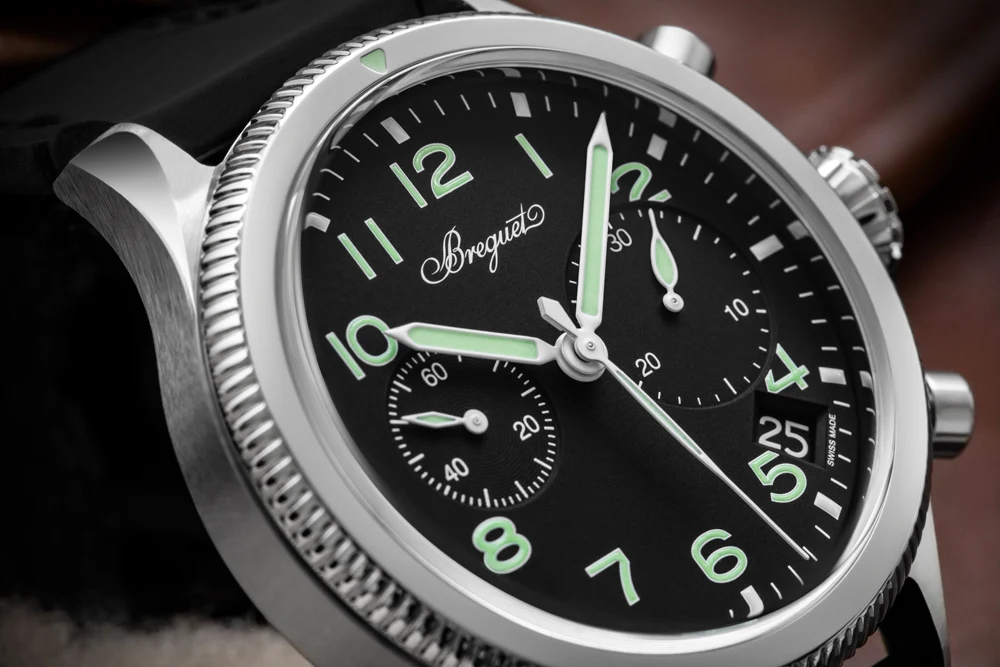
The date is shown between 4 and 5 o’clock. White numerals are presented atop a black disc, with the colour of the disc matching the main dialscape as horological etiquette dictates. The country of origin is positioned neatly adjacent the aperture, a delightful touch which I think is an inspired move by the brand.
Type 20 Chronographe 2057 – case
Housed in a 42 mm stainless steel case, the Breguet Type 20 Chronographe 2057, once again, respects the past with its fluted bezel and oversized, trapezoidal-shaped crown. The pushpieces are capstan-style upholding Type 20 tradition.
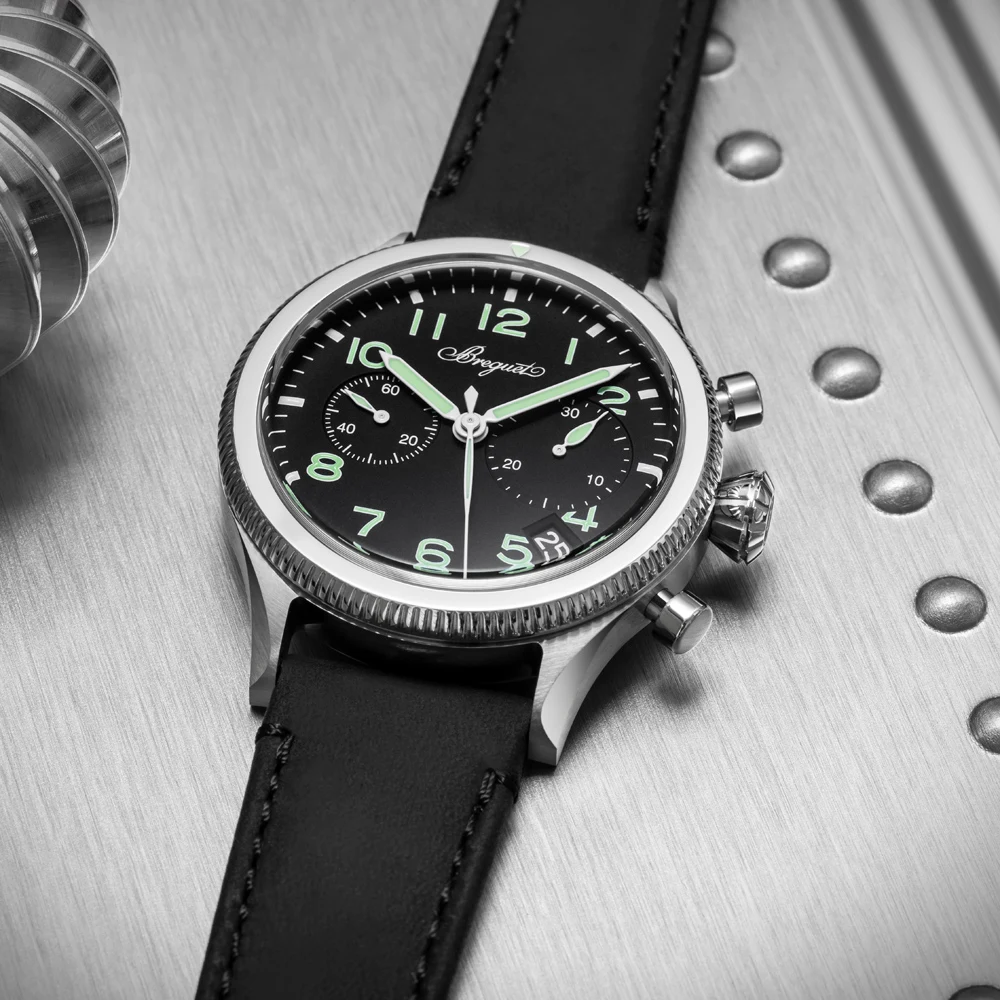
While the Type 20 is a ‘tool watch’, originally intended to be purely a functional instrument, its appearance has always hit the sweet spot. Recently, while attending the product launch of the fourth-generation models in Paris, I handled the Type 20 Chrongraphe, noting the smooth complexion of its case, its chamfered lugs and the exquisite interplay of polished and satin-finished surfaces. Despite being a practical watch, Breguet has not stinted on luxury and refinement.

Historically, the Breguet Type 20 was fitted with a solid caseback. However, no doubt mindful that most watch fanatics are horological voyeurs, keen to see a naked movement, Breguet has chosen to equip this new Type 20 with an exhibition caseback. Personally speaking, I think it was a wise decision on the brand’s part as this movement deserves to be seen.
The watch is supplied with two interchangeable straps, one in calfskin and a second NATO-style fabric item. A user-friendly system, positioned to the rear, allows the wearer to readily swap straps without the need for tools.
Type 20 Chronographe 2057 – Caliber 7281
The most observant Breguet devotees may notice the Type 20 Chronographe 2057 is fitted with the Caliber 7281, which is slightly different from the Caliber 728 used within the civilian-spec Type XX Chronographe 2067. These differences primarily relate to the counters fitted to each dial. The civilian specification model has a 15-minute register at 3 o’clock and 12-hour register at 6 o’clock.

Image – Calibre 7281 fitted to the Breguet Type 20
However, essentially both movements are near identical. The Caliber 7281/ Caliber 728 are self-winding movements and feature a blackened openworked oscillating mass, designed to resemble ‘an aircraft wing’.

Image – Calibre 728 fitted to the Breguet Type XX
Column wheel and vertical clutch
The fully integrated movement unites a column wheel with a vertical coupling, an arrangement beloved by watch aficionados. While attending the launch event in Paris, I was able to get acquainted with the Breguet Type 20. I found that when I pressed the pushpiece at 2 o’clock, the central chronograph seconds hand commenced its journey without any hint of stuttering or hesitation. Moreover, whilst pressing said pushpiece, my index finger was able to discern a smooth, buttery action.

Flyback
A nod to Type 20 tradition, the watch is equipped with a flyback function or ‘retour en vol’. Like a regular chronograph, pressing the pushpiece at 2 o’clock starts/stops the chronograph, while the pushpiece at 4 o’clock resets to zero. However, where the flyback proffers additional functionality is that, assuming the chronograph is running, the wearer can press the pushpiece at 4 o’ clock and in one simple step, the chronograph will stop, reset and restart. This feature makes timing consecutive events easier and less prone to human error.

Image – Breguet Type XX (2023)
High-frequency movement
Whereas most watches have a frequency of 2.5 Hz, 3 Hz or 4 Hz, the balance at the heart of the Caliber 728 has a frequency of 36,000 vph (5 Hz). The higher cadence makes the watch less susceptible to minor shocks which could impair precision. Moreover, the movement is less prone to positional influences when worn.
At this juncture, you may be wondering why other brands do not offer 5 Hz movements. Basically, when producing a 5 Hz movement, there are several technical obstacles that need to be surmounted. Firstly, there is the matter of wear and greater consumption of lubricants. Furthermore, high-frequency movements usually quaff energy, resulting in a reduced power-reserve.

Silicium
Needless to say, Breguet has embraced innovation to address said obstacles. The hairspring, the pallet lever horns and escape wheel are all made of silicium. This material is friction-free, obviating the need for lubricants. Furthermore, it is light, hence the assortiment sips energy, manifest with the movements impressive 60-hour power reserve.
Additional benefits of silicium are that it is not liable to corrode, it’s not sensitive to the influence of magnetic fields and it augments precision.
Additional details
The column wheel is dressed in black DLC, conferring contrast with the neighbouring silver-toned bridges.

Breguet has equipped both the Caliber 728 and Caliber 7281 with a variable inertia balance. Unlike an index-regulated balance, the effective length of the hairspring remains constant and the rate is altered by adjusting timing screws fitted to the balance wheel, thereby altering the moment of inertia. By adopting this approach, the regulation is less likely to alter if the watch suffers minor shocks. Moreover, Breguet has recessed the timing screws within the rim of the balance wheel which mitigates air turbulence, thereby further aiding precision.
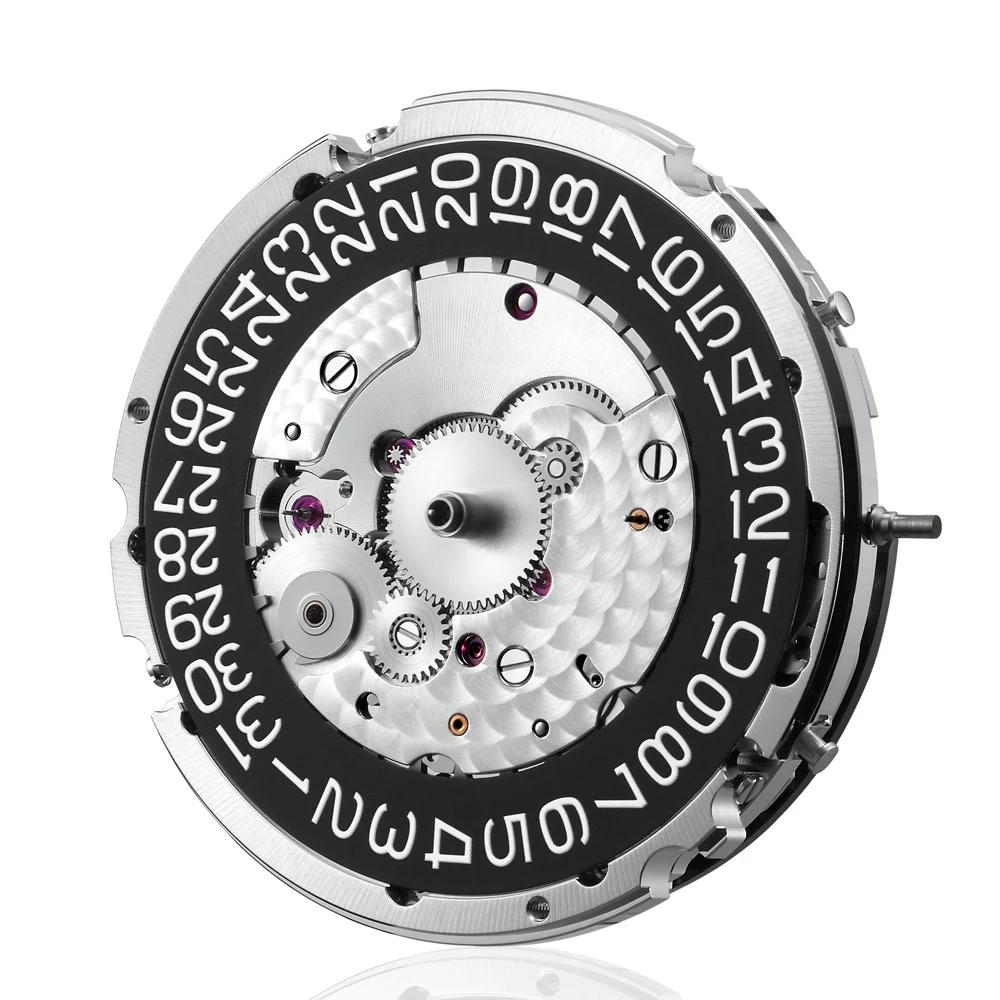
As you may expect, the finishing is exemplary. The bridges are adorned with a sunburst motif while snailing, bevelling, circular graining, etc vie with one another, eager to stir a purist’s soul.
Breguet Type XX Chronographe 2067 – civilian specification
As previously stated, both the Type 20 Chronographe 2057 and Type XX Chronographe 2067 share much in common. So how does the civilian version differ?

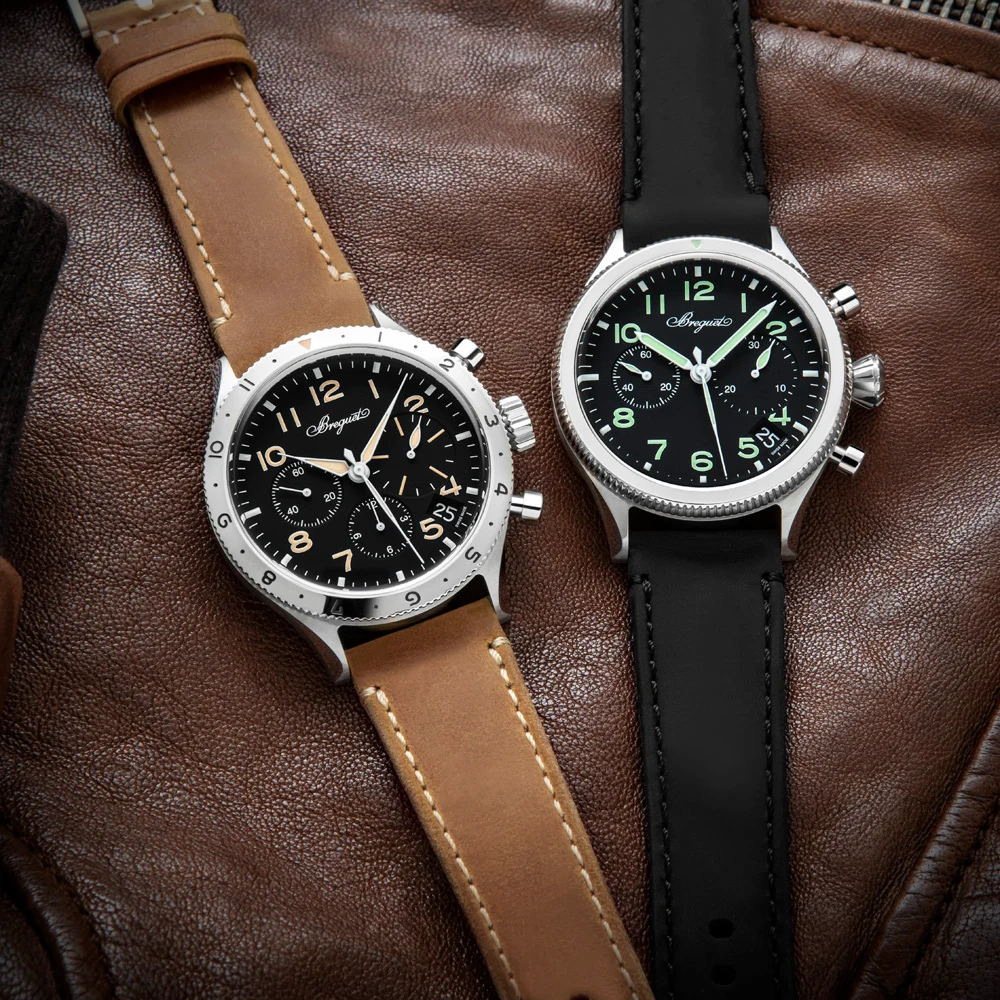
Firstly, ivory-toned hands and numerals supplant the mint green items fitted to the military specification model. With the 2067, the counter at 3 o’clock measures 15-minute periods not 30-minute periods and there is an additional 12-hour register at 6 o’clock.
Secondly, the bezel features Arabic numerals and an ivory-toned triangular index at noon. The crown is also a different design, appearing more cylindrical in form.

Breguet Type 20 and Breguet Type XX – closing remarks
I’m mindful that some individuals have voiced concerns on social media channels about the date indication on these watches. While I concede ‘that you can’t please all of the people all of the time’, personally speaking, I love the watch. In fact, I like the position and design of the date window with its ‘Swiss Made’ caption, located nearby. Furthermore, I like the convenience a date indication provides.
Yes, I am a devout Breguet disciple, but I can still recognise when a watch is a ‘hit or a miss’. In my opinion, the Breguet Type 20 and the Breguet Type XX are unequivocally ‘hits’ and I would dearly love to acquire my very own Breguet Type 20 one day, wife permitting.
While I make no secret of the fact that I am a fan of Abraham-Louis Breguet, I am also an admirer of the modern-day firm. It respects the legacy of the eponymous genius but dares to pursue progress and continues to invent new answers to questions many brands are yet to ask.
Further reading
Breguet Type 20 and Breguet Type XX Chronographs – technical specifications
- Model: Breguet Type 20 Chronographe 2057
- Reference: 2057ST/92/3WU
- Case: stainless steel, diameter 42 mm, height 14.1 mm, water resistance 10 ATM (100m); sapphire crystal to the front and exhibition case back.
- Functions: hours, minutes, small seconds, date, flyback chronograph
- Movement: Caliber 7281, self-winding movement, frequency 36,000 vph (5 Hz), 39 jewels, power reserve = 60 hours, 339 components
- Strap: a set of two interchangeable straps (1 x calfskin and 1 x NATO fabric)
- Price: £16,400 (RRP as of 11.7.2023)

- Model: Breguet Type XX Chronographe 2067
- Reference: 2067ST/92/3WU
- Case: stainless steel, diameter 42 mm, height 14.1 mm, water resistance 10 ATM (100m); sapphire crystal to the front and exhibition case back.
- Functions: hours, minutes, small seconds, date, flyback chronograph
- Movement: Caliber 728, self-winding movement, frequency 36,000 vph (5 Hz), 39 jewels, power reserve = 60 hours, 339 components
- Strap: a set of two interchangeable straps (1 x calfskin and 1 x NATO fabric)
- Price: £16,400 (RRP as of 11.7.2023)
