
Chopard L.U.C Flying T Twin Perpetual Watch Review
The Chopard L.U.C Flying T Twin Perpetual is packed with an array of complications including a flying tourbillon, perpetual calendar and large date display. Housed in a 40.5 mm Ethical 18-carat yellow gold case, the model is blessed with a becoming hand-guilloché dial and superbly finished automatic micro-rotor movement. The watch comes with COSC certification as well as the added peace of mind afforded by the prestigious Poinçon de Genève hallmark.

Image – ©Fédéral Studio
Chopard Manufacture established in 1996
Chopard was founded in 1860; however, it was not until 1996 that it became a fully-fledged Manufacture, producing its own in-house movements. Within the watchsphere, there are some companies that have been making in-house movements since the 19th century, hence by comparison Chopard Manufacture is young. But from the outset Chopard Manufacture has always made highly impressive mechanisms.
The company’s inaugural movement, the L.U.C Calibre 96.01-L, featured a micro-rotor, an alternative to the ubiquitous full-size oscillating mass. The micro-rotor remains the preserve of just a few watch brands as it presents various technical challenges that need to be surmounted. These challenges have thwarted the ambitions of several brands, but not Chopard. Since the release of its first movement, the micro-rotor has become a signature dish for the company.

Image – ©Fédéral Studio
Chopard in-house movements – tradition and innovation
Over the years, Chopard has shown a deep respect for watchmaking traditions, often imbuing surfaces with peerless finishing, skilfully imparted by time-served hands. Conversely, the company has also shown a penchant for innovation. For example, in 2009, Chopard produced the L.U.C Calibre 02-12-L, a tourbillon movement endowed with a silicium escapement.
Other examples of the Swiss marque’s ingenuity include models featuring ‘Quattro technology’, a term used to describe a movement with four barrels. It has also produced calibres equipped with delightful details such as a ‘Variner’ variable-inertia balance, Philips Terminal curve, etc.

Chopard in-house movements – certifications
Karl Friedrich-Scheufele, co-president of Chopard, is an avid collector of historical clocks and watches. It is this personal passion that has led to Scheufele’s unwavering pursuit of product excellence, a feat he has clearly achieved. All L.U.C calibres equipped with a seconds function are chronometer tested by COSC (Contrôle Officiel Suisse des Chronomètres), providing independent assurance of their timekeeping talents.
Some L.U.C watches bear the Fleurier Quality Foundation label, others are punched with the coveted Poinçon de Genève. Both forms of certification are rigorously and independently administered. In 2010, Chopard released the L.U.C Triple Certification Tourbillon incorporating the L.U.C Calibre 02.13, certified by COSC and bearing the hallmarks of both the Fleurier Quality Foundation and the Poinçon de Genève, a world first.
Chopard – Grand Prix d’Horlogerie de Genève success
In 2016, the company unveiled the L.U.C Full Strike, the brand’s first minute repeater. Once again, the Swiss marque demonstrated its capacity for invention, eschewing the twin gongs traditionally found within a minute repeater and supplanting them with a ‘Chopard-patented monobloc sapphire’. The sound emanating from this chiming watch is one of the finest I have ever heard and clearly I am not alone in my opinion as the watch was awarded the ‘Aiguille d’Or’ at the 2017 edition of the GPHG (Grand Prix d’Horlogerie de Genève).
Chopard is no stranger to GPHG prize-winning success. It has amassed numerous trophies over the years. Last year, the company was awarded the ‘Eco-Innovation’ Prize, for the L.U.C Qualité Fleurier, a model housed in the company’s proprietary premium stainless steel.

Chopard L.U.C – extraordinary
Among watchmaking’s old guard, Chopard Manufacture may be a fresh-faced 29 year-old, but its impressive body of work is nothing short of extraordinary. Indeed, in my opinion, several L.U.C creations are comparable, if not superior, to rival timepieces produced by watchmaking’s so-called ‘holy trinity’.
Having set the scene, I now wish to focus on a new model from the brand, the Chopard L.U.C Flying T Twin Perpetual. This watch features two high complications, a flying tourbillon and a minute repeater. It is also blessed with a gorgeous hand-guilloché dial, COSC-certified and is hallmarked with the Poinçon de Genève. Without further ado, allow me to guide you around this latest exemplar of Haute Horlogerie.
Chopard L.U.C Flying T Twin Perpetual – dial
In recent years, Chopard has shown a penchant for ‘Forest Green’ dials. One example that springs to mind is the Chopard L.U.C XPS 1860 Officer Reference 161242-0001, a model that pairs the verdant vista with Ethical 18-carat yellow gold, a colour combination that it now repeats with the L.U.C Flying T Twin Perpetual.

Image – ©Fédéral Studio
While this model is new, it does not abandon the tried and tested design language brand devotees have come to love. Dauphine fusée hour and minute hands, formed of ethical yellow gold, join forces with faceted indexes to convey the prevailing time. A month and leap-year indicator reside at 3 o’clock, while a day and day/night indicator are positioned opposite at 9 o’clock.
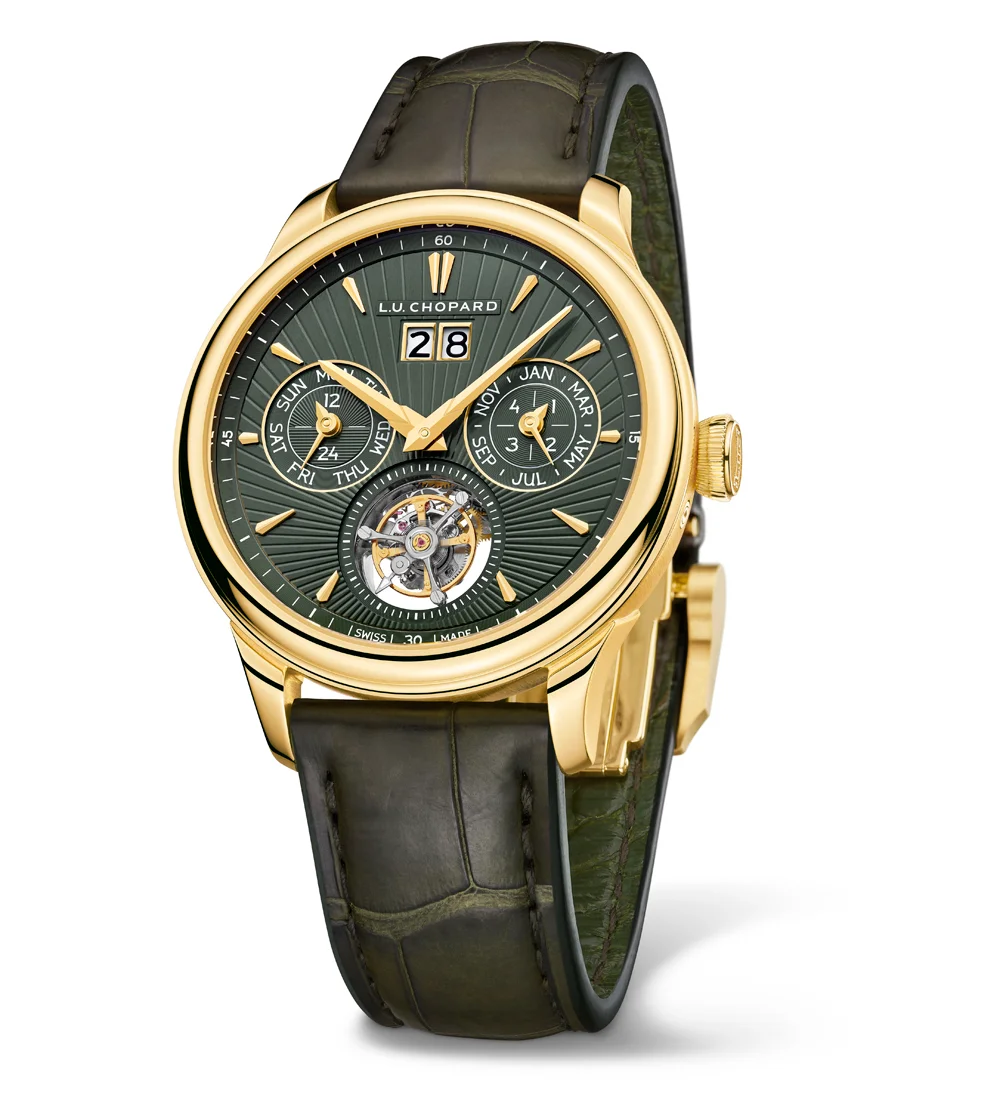
At the base of the dial, a large aperture plays host to the flying tourbillon (a feature I will return to later). A small seconds hand is affixed to the tourbillon cage and collaborates with a neat track to impart meaning.
In the northern region of the dial, just below 12 o’clock, two rectangular apertures reveal the date. This large date indication employs two date discs, one for tens and the other for units, both working in concert to express meaning in a highly legible format.
A crisp minute track, featuring succinct white markings, with Arabic numerals at the cardinal points, fringes the dial. A hand-guilloché dial is yet another exquisite detail. Chopard has chosen to uphold the centuries-old tradition of imbuing a dial with patterns using a rose-engine lathe; however, on this occasion, it has added a modern twist by endowing the central dial area with a contemporary sunburst motif. In addition, the various tracks are snailed and the day/night indicator is adorned with two contrasting patterns, denoting the time of day.
The Chopard L.U.C Flying T Twin Perpetual has a long inventory of functions, including a perpetual calendar. This complication has the mechanical intelligence to identify whether a month contains 28, 29, 30 or 31 days, advancing to ‘1’ when appropriate. Assuming the watch is kept wound, the date will not require adjustment until 2100. Despite displaying numerous indications, the dial does not feel cluttered and remains simple to read.
Chopard L.U.C Flying T Twin Perpetual – case
At the heart of the Chopard L.U.C Flying T Twin Perpetual sits an automatic movement, the L.U.C Calibre 96.36-L. Composed of 319 components and housing much complexity, this watch measures a mere 40.5 mm in diameter with a modest case thickness of 11.63 mm. These dimensions make the watch ideally sized for the majority of would-be wearers.
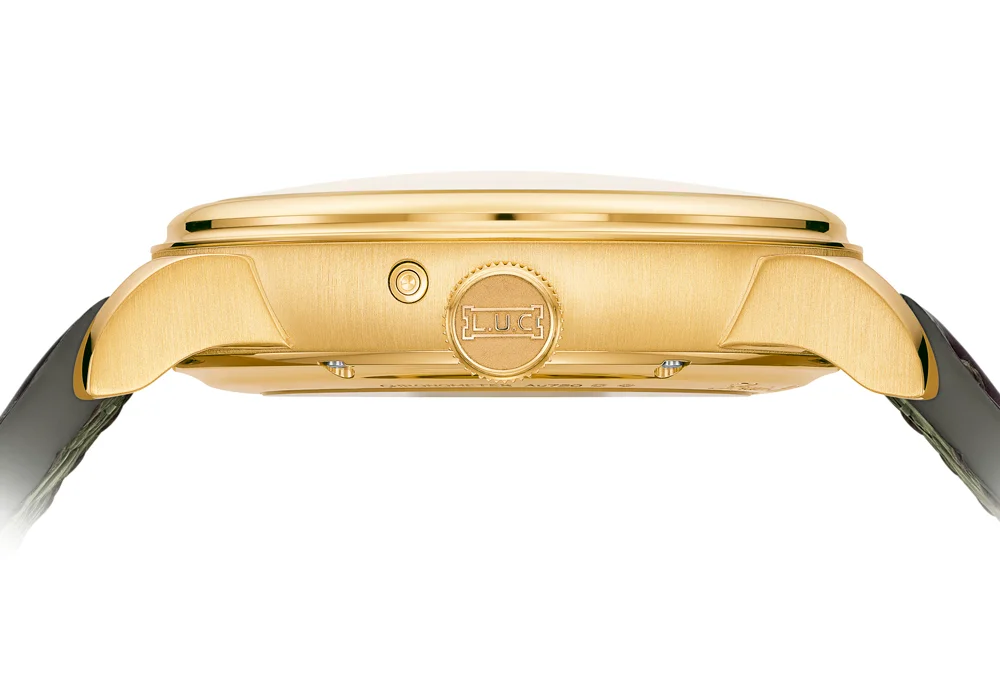
The bezel and caseback are highly polished, while the ‘case middle and interhorn space’ feature a vertical satin-brushed finish. Once again, this approach is consistent with the design language employed on other L.U.C models.
Described as having a ‘bassiné’ profile, the case diameter tapers as it nears the caseback, conferring an elegant mien. The crown is fluted and curved, granting ease of manipulation.
For the first time in Chopard history, the family firm has equipped this new model with an interchangeable strap system. This watch comes with two straps, one in alligator leather and a second in calfskin, but the company states ‘each Chopard boutique will offer an assortment of additional straps in a variety of textures and colours’. This user-friendly feature should win friends with fashionistas seeking to pair their watch to their chosen ensemble.

To the rear of the case, a pane of sapphire crystal affords sight of the L.U.C Calibre 96.36-L.
Chopard L.U.C Calibre 96.36-L
As its name implies, the Chopard L.U.C Flying T Twin Perpetual is equipped with a flying tourbillon. In 1801, Abraham-Louis Breguet patented the tourbillon, a mechanism that ameliorates the adverse influence of gravity on the behaviour of the regulating organ. The escapement and regulating organ reside in a cage that rotates 360° every one, four or six minutes, countering positional errors. Originally conceived for the pocket watch, it has since been adapted for wristwatch use and is designed to enhance chronometric performance.
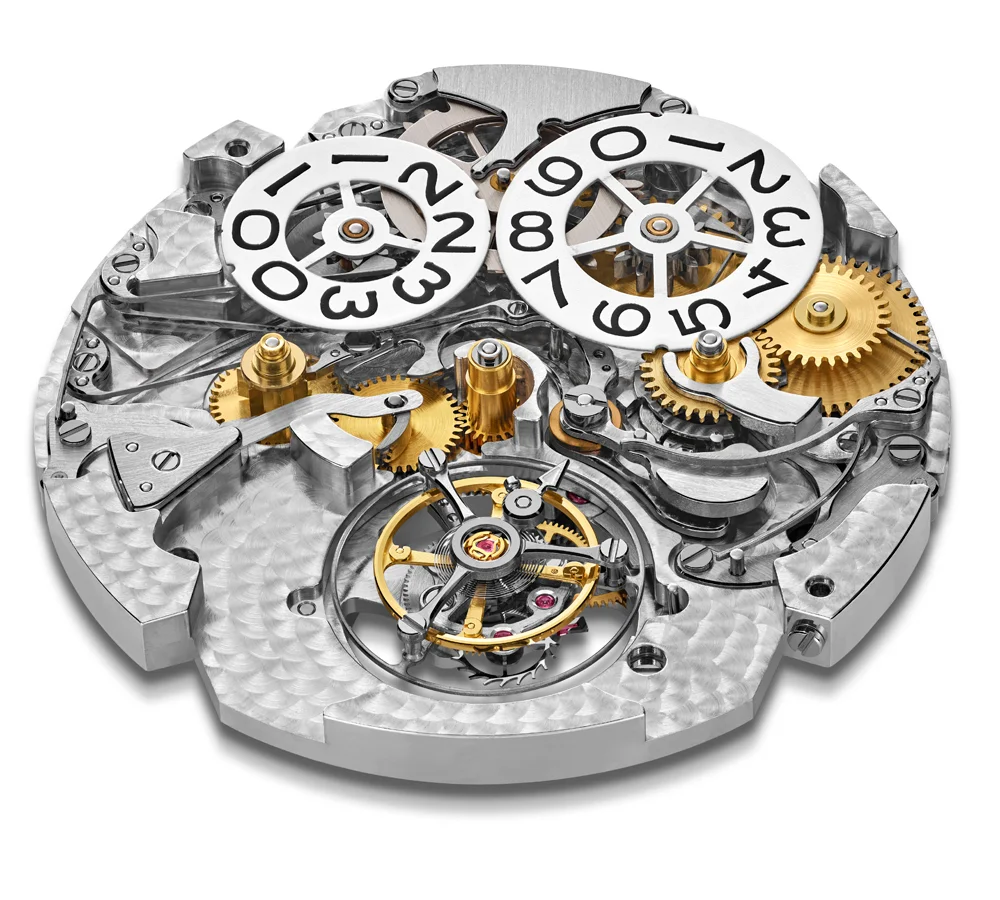
In 1920, German watchmaker, Alfred Helwig conceived the ‘flying tourbillon’. Unlike Breguet’s invention, where the tourbillon is supported by an upper and lower bridge, Helwig’s flying tourbillon eschews the upper bridge. With most would-be wearers selecting a tourbillon for the visual spectacle it provides, the act of removing obstructions that would otherwise mar the view, can only serve to enrich the spectacle of the balletic performance.
Without an upper-bridge hindering views, the wearer of the L.U.C Flying T Twin Perpetual is indulged with a dynamic scene where the balance wheel rotates to and fro, the hairspring pulses with life, the pallet lever chats to the escape wheel and the cage slowly pirouettes, making one revolution every minute.
The L.U.C Calibre 96.36-L is equipped with a variable inertia balance, a superior means of regulating the movement when compared with the ubiquitous index-regulated balance. With a variable inertia balance, the effective length of the balance spring remains constant and the rate is altered by adjusting the position of inertia weights affixed to the rim of the balance wheel.
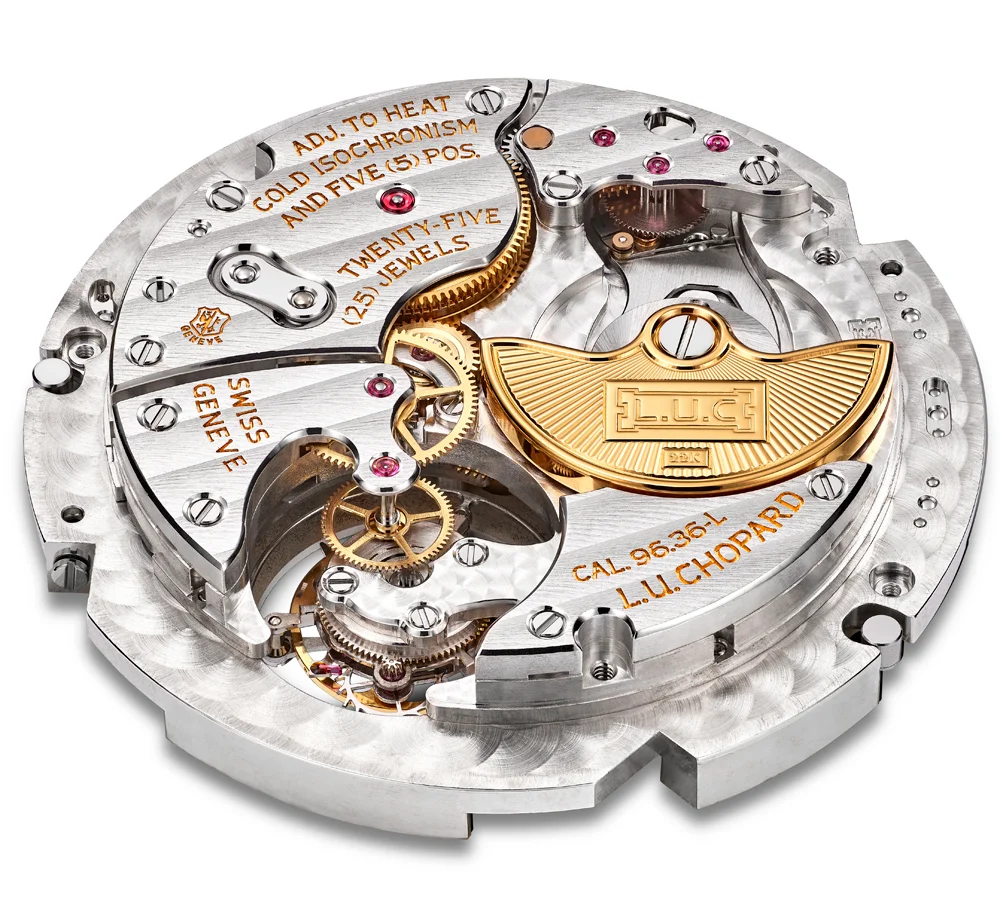
By opting for a variable inertia balance, Chopard has improved accuracy. Moreover, should the watch be subjected to a shock, it is less likely to require remedial regulation. The Manufacture has gone further by placing the inertia weights ‘inboard’ on the spokes of the balance wheel, mitigating air turbulence, further augmenting precision.
The movement features ‘Chopard Twin technology’, a term it uses to describe two stacked barrels. A 22-carat micro-rotor harvests energy from the natural motion of the wearer’s wrist. Assuming both mainsprings are fully tensioned, the movement will run autonomously for 65 hours. In addition to delivering an impressive power reserve, there is a further benefit of using Chopard Twin technology. The power from two barrels serving the escapement will have a tendency to be more linear when compared with a lone barrel, aiding rate stability.
Beyond its repertoire of functions and its chronometric talents (COSC-certified), the L.U.C Calibre 96.36-L is beautifully finished. In order to meet the requirements of the Poinçon de Genève, all signs of machining must be removed by applying various finishing techniques. To bear the ‘punch’ on the movement and case, a technical dossier must be presented to the accreditation body, detailing the specification of the watch, including the proposed finishing. Once agreed, TimeLab will conduct regular audits to ensure that the standards are being adhered to.
On this occasion, the mainplate is decorated with perlage, the bridges are adorned with Côtes de Genève and feature polished sinks. Cerclage, dressage, mirror-polishing and anglage are just some of the additional techniques employed. Even those surfaces that are not visible to the naked eye are finished to a no-comprise standard.
Chopard L.U.C Flying T Twin Perpetual – closing remarks
As you will no doubt have ascertained by now, the L.U.C Flying T Twin Perpetual is an exceptional timepiece. It’s not only blessed with a bewitching appearance but also brims with mechanical virtue, all backed up with the peace of mind of COSC and Poinçon de Genève certifications. Moreover, despite the long inventory of functions and the numerous parts within the case, the watch remains modestly sized.
Back in 1996, when Chopard Manufacture unveiled its inaugural movement, the L.U.C Calibre 96.01-L, it signalled to the watch collecting community that it was very serious about making in-house movements. Over subsequent years, the brand has reaffirmed again and again that it makes some of the finest expressions of Haute Horlogerie on the market today, something that has been recognised by the GPHG on several occasions.
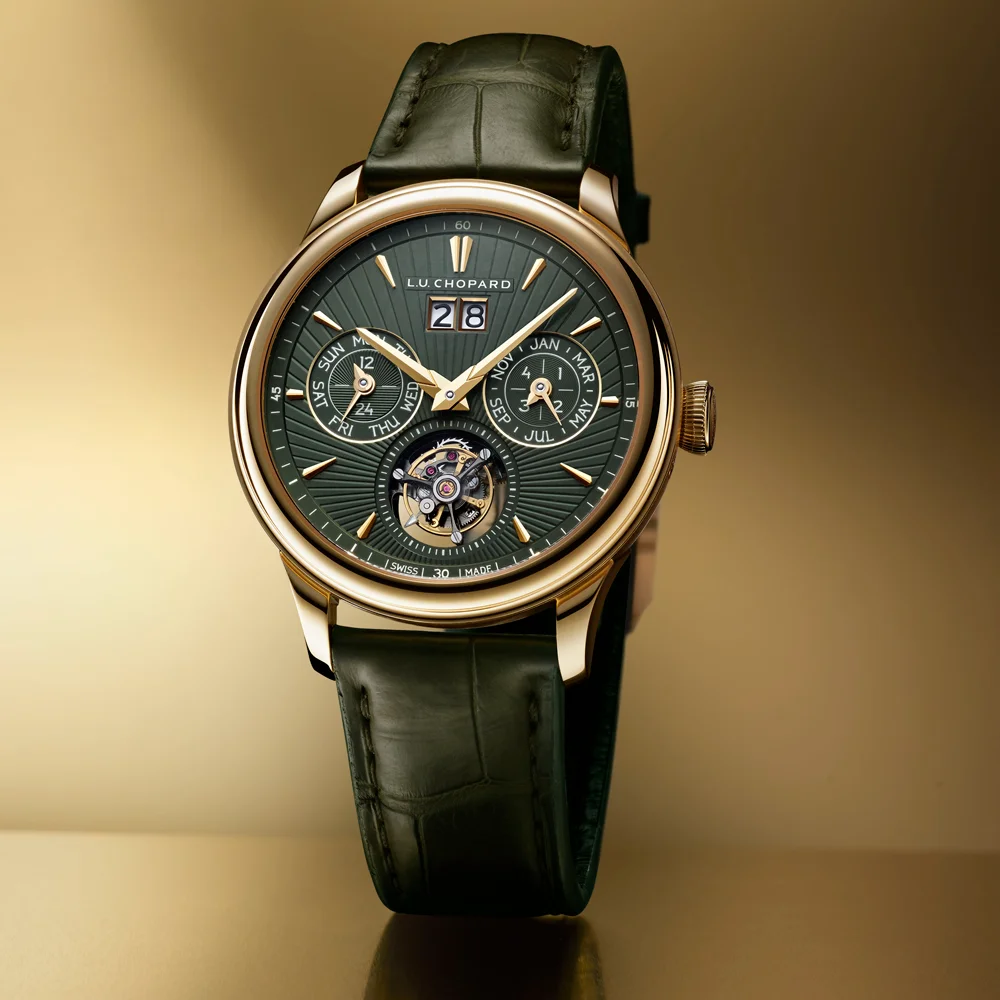
Image – ©Fédéral Studio
Chopard Manufacture may be just 29, but it has repeatedly demonstrated wisdom beyond its years and has achieved so much in its comparatively short life. The L.U.C Flying T Twin Perpetual is yet another example of horological greatness to emanate from the movement facility in Fleurier and demonstrates, once again, the Swiss brand’s unwavering pursuit of excellence.
Further reading
Technical specification
- Model: Chopard L.U.C Flying T Twin Perpetual
- Reference: 161989-0001
- Case: ethical 18-carat yellow gold, diameter 40.5 mm, height 11.63 mm, water resistance 3 ATM (30 metres) sapphire crystal to front, exhibition caseback
- Functions: hours, minutes, perpetual calendar, small seconds at 6 o’clock on the flying tourbillon carriage, 24-hour scale and day of the week at 9 o’clock, instantaneous display of the date through a twin-aperture display at 12 o’clock, stop-seconds function
- Movement: Calibre L.U.C 96.36-L, self-winding movement, frequency 25,200 vph (3.5 Hz), 25 jewels, power reserve 65 hours, certified-chronometer (COSC)
- Strap: Interchangeable strap in green alligator leather with cognac-toned alligator leather lining and tone-on-tone stitching; or beige grained calfskin with tone-on-tone stitching. Fitted with a folding clasp in 18-carat yellow gold.
- Price on application