
Chopard L’Heure du Diamant Moonphase Watch Review
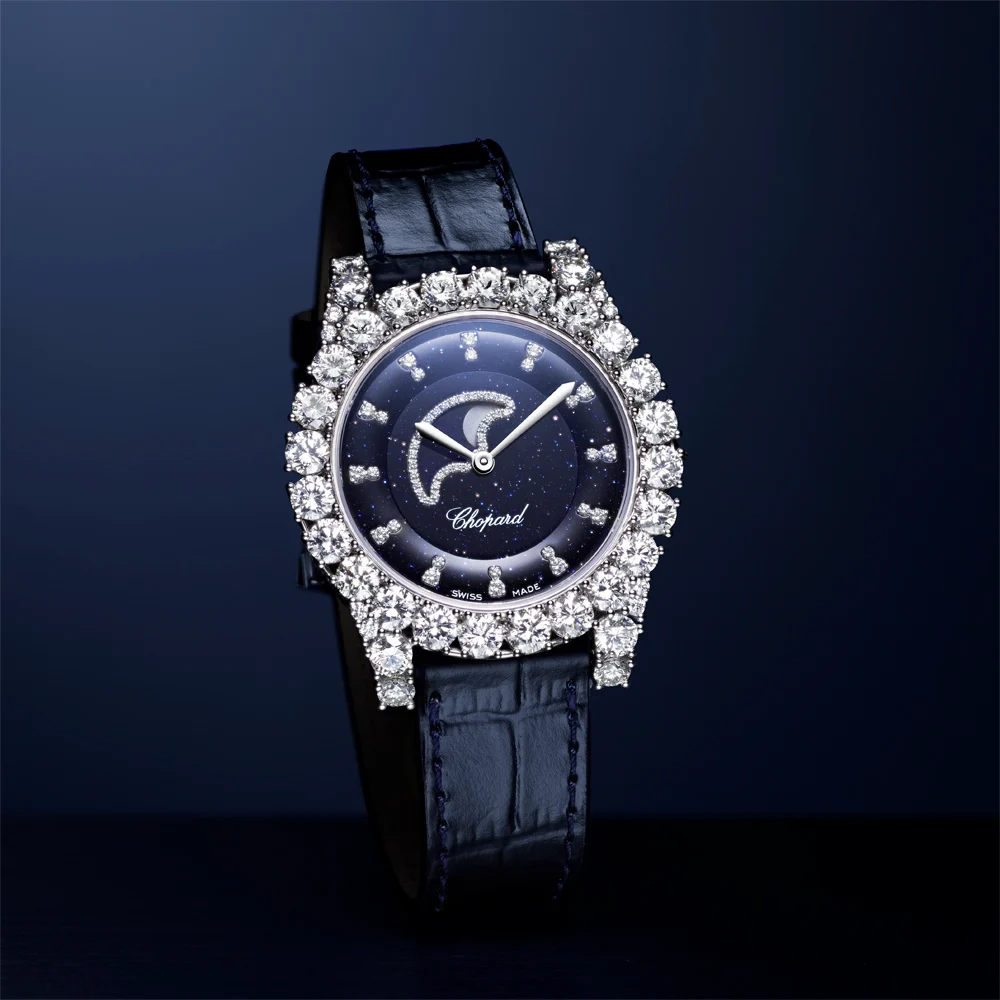
The Chopard L’Heure du Diamant Moonphase unites two notable areas of expertise synonymous with the luxury marque, namely jewellery and watches. The dial is formed of midnight blue aventurine glass. It also incorporates a large crescent-shaped aperture and is enlivened with the judicious application of briolette-cut and baguette-cut diamonds. US-based wordsmith, Meehna Goldsmith, talks about moon phases and humankind’s fascination with the wise lunar body before exploring this latest creation from the Maison headquartered in Geneva.
The moon phase complication
Probably most people see the moon phase complication on a watch as contributing to the aesthetics of the dial, a striking image that draws in the eye. In most cases, the moon phase isn’t even set accurately as it can be a bit tricky to line up with the time and date. However, that burnished golden orb lighting up our night sky has played a big part in the history of civilisation.
The significance of the moon phase to humankind
From the prehistoric era, humans used the moon to measure time, tracking its ~29.5 cycle and marking it on bones and stones. In addition, since the lunar cycle closely approximates the menstrual cycle, it led to the connection between the moon and fertility. Although a misconception, wolves are thought to howl at the moon.
During ancient civilisations, the Babylonians developed detailed lunar calendars and linked the moon phases to astrology. They were also responsible for the concept of the lunar month, using it for divination.
Likewise, the Egyptians kept track of lunar phases for religious festivals. Interestingly, although the Chinese lunar calendar goes back over 3,000 years, it’s still relevant today and marks festivals such as the Lunar New Year and Mid-Autumn Festival. Developing a very accurate lunar calendar, the Mayans and Aztecs also incorporated moon phases into ritual life and astronomy.
A lot of religions look to the moon to mark important cultural events. In Islam, its calendar is based purely on the lunar cycle, with months beginning with a new moon and holidays such as Ramadan set by sightings of the moon. Judaism looks to the moon to delineate months, while holidays like Passover align with full moons. Meanwhile, Christianity celebrates Easter on the Sunday after the first full moon of the equinox, while Buddhism follows the lunar calendar to celebrate the festival Vesak and Hinduism the holiday Diwali, both of which occur on full or new moons.
The moon also figures prominently in science and astronomy. During Greek and Roman times, astronomers Hipparchus and Ptolemy studied the moon’s phases and its orbits. And, of course there’s Galileo who, with his improved telescope, plotted the moon’s phases and identified its surface features. He dispelled the myth that the moon wasn’t a smooth sphere but rather reflected the sunlight.
In modern times, the moon remains as enchanting as it is useful. Some farmers and fishermen employ moon phase calendars to schedule planting or fishing. Due to gravitational effects seen during new and full moons, moon phases are linked to tidal patterns. You might not know that the moon’s phases are also taken into consideration when planning lunar missions, which usually occur during the first quarter to full phase for optimal lighting conditions. Some gardeners even practice what’s called ‘gardening by the moon’, setting their crops according to lunar phases.
Chopard L’Heure du Diamant Moonphase – aventurine dial
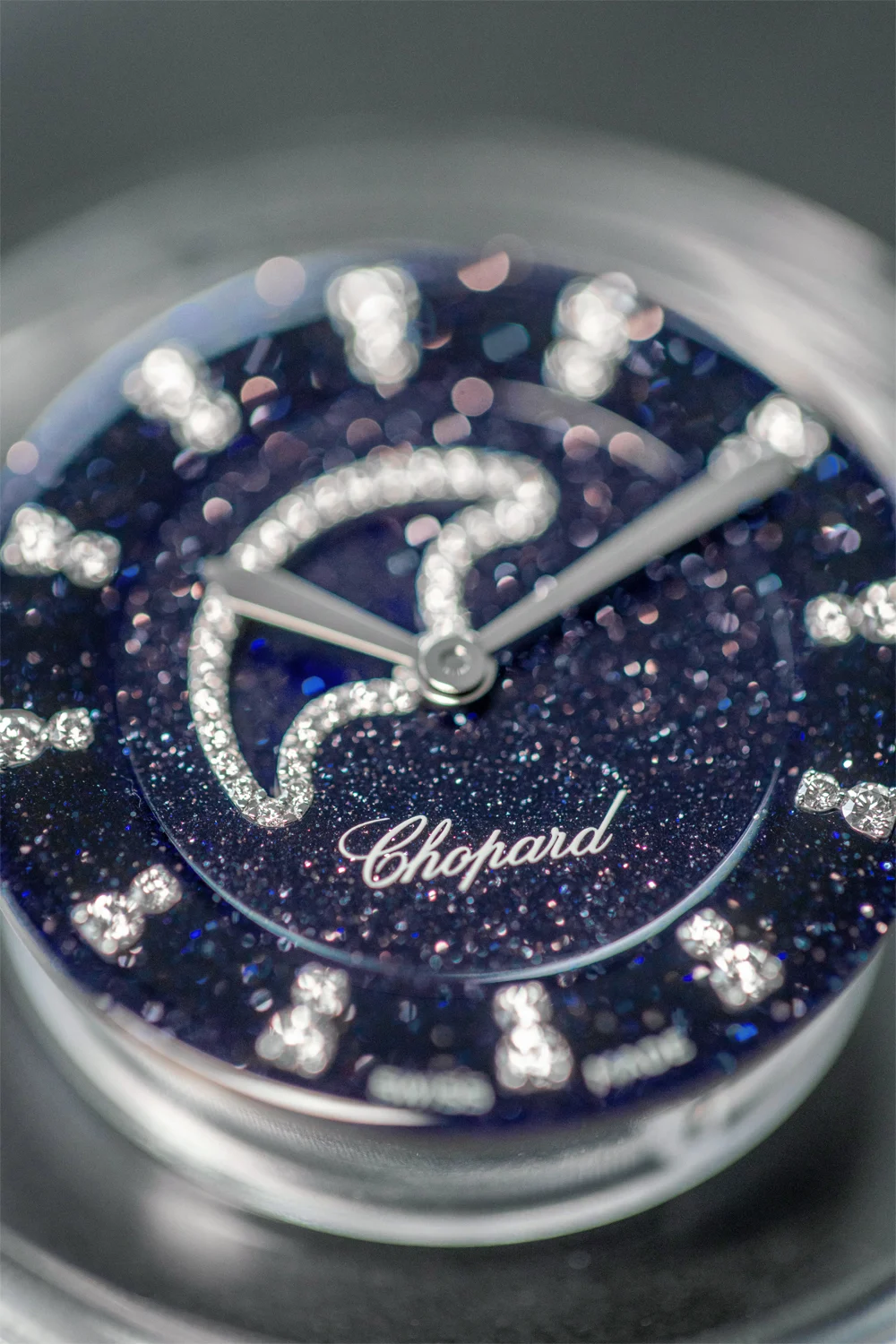
Chopard takes the romance and lore of the moon phase and, for the first time, shoots it into orbit on the L’Heure du Diamant collection with the introduction of the L’Heure du Diamant timepiece Moon Phase. Composed of aventurine glass, the moon phase disc marks the moon’s movement in the cosmos with remarkable accuracy. Aristotle would be proud to know that there’s just a mere 57.2 seconds of difference between two lunar cycles. When calibrated properly and the movement kept continuously running, that means it will only show a one-day difference from the actual moon’s path in 122 years. While there are people leading the charge to biohack our biology and increase longevity, this interval will certainly last a lifetime.
Like many wonderful discoveries, such as the polio vaccine, aventurine glass was also the result of an accident. Legend has it that an artisan in the 17th century working in a Murano glassmaking workshop accidentally dropped copper filings into his molten glass, resulting in a beautiful new composition called aventurine. Appropriately named after the Italian word for ‘chance’, which is peravventura, this material has proved a popular choice within Chopard’s L’Heure du Diamant collection.
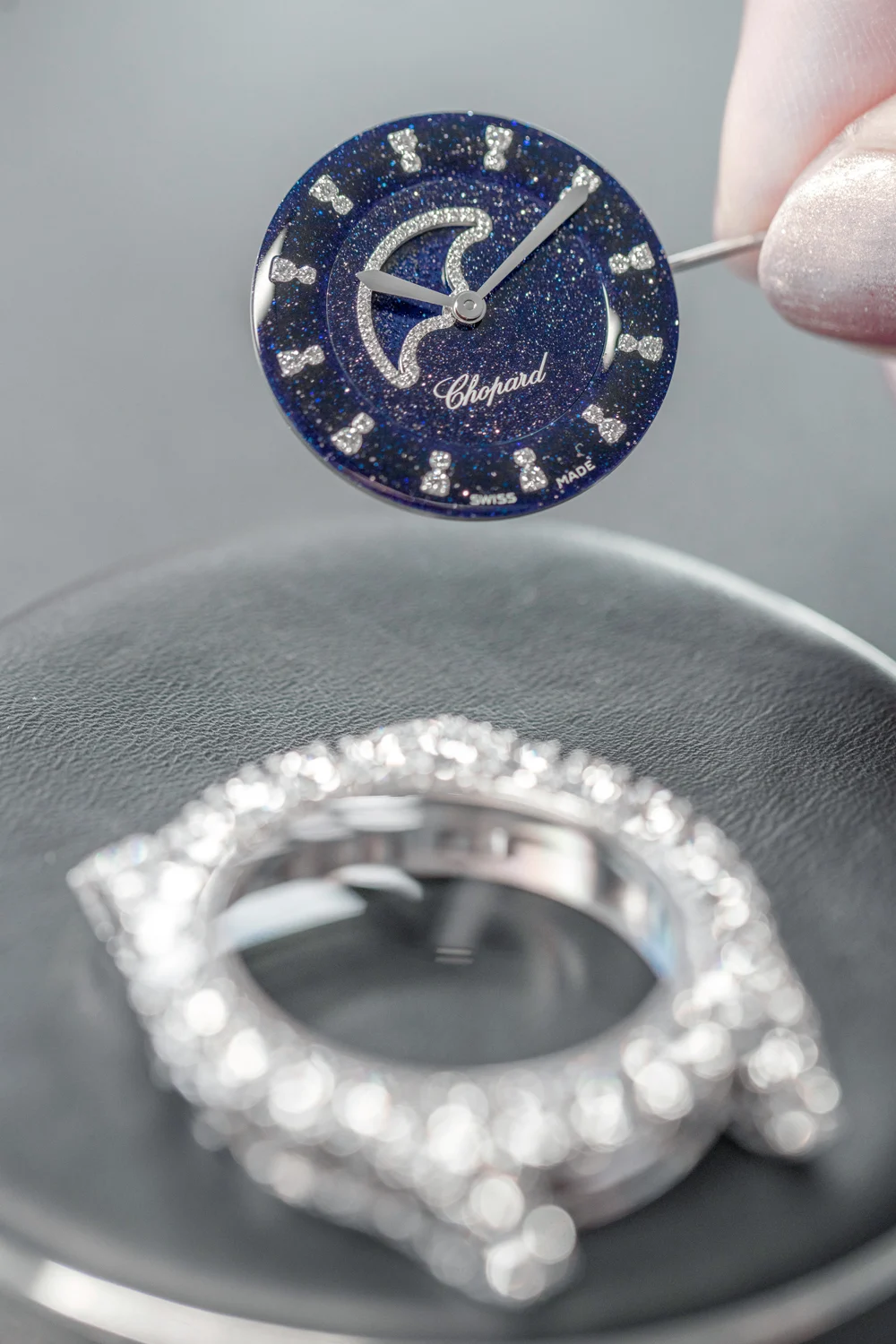
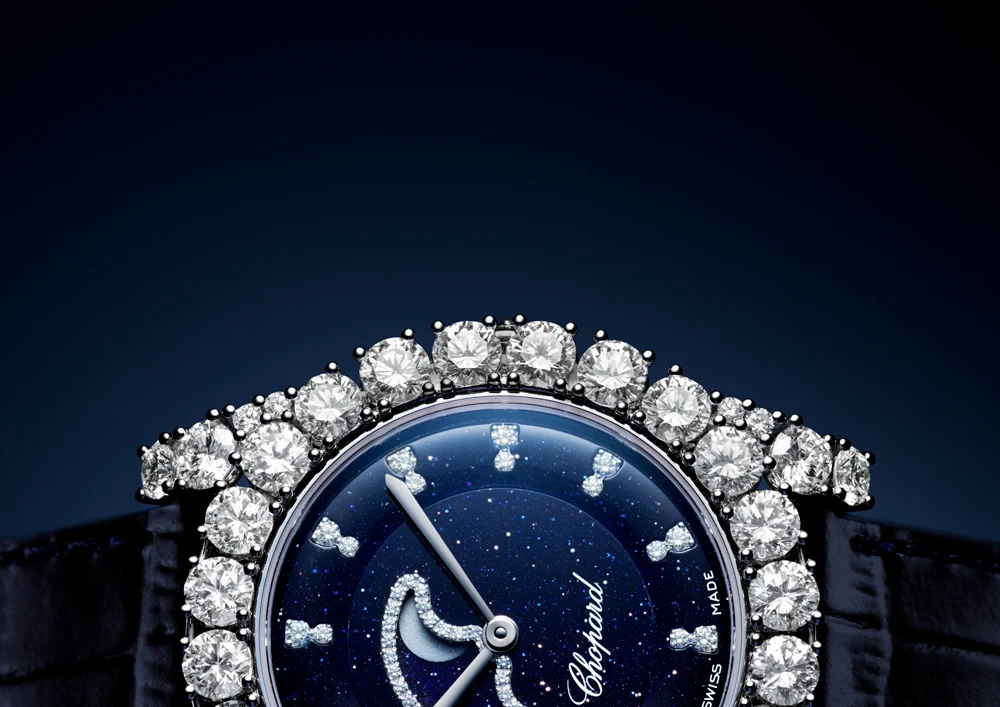
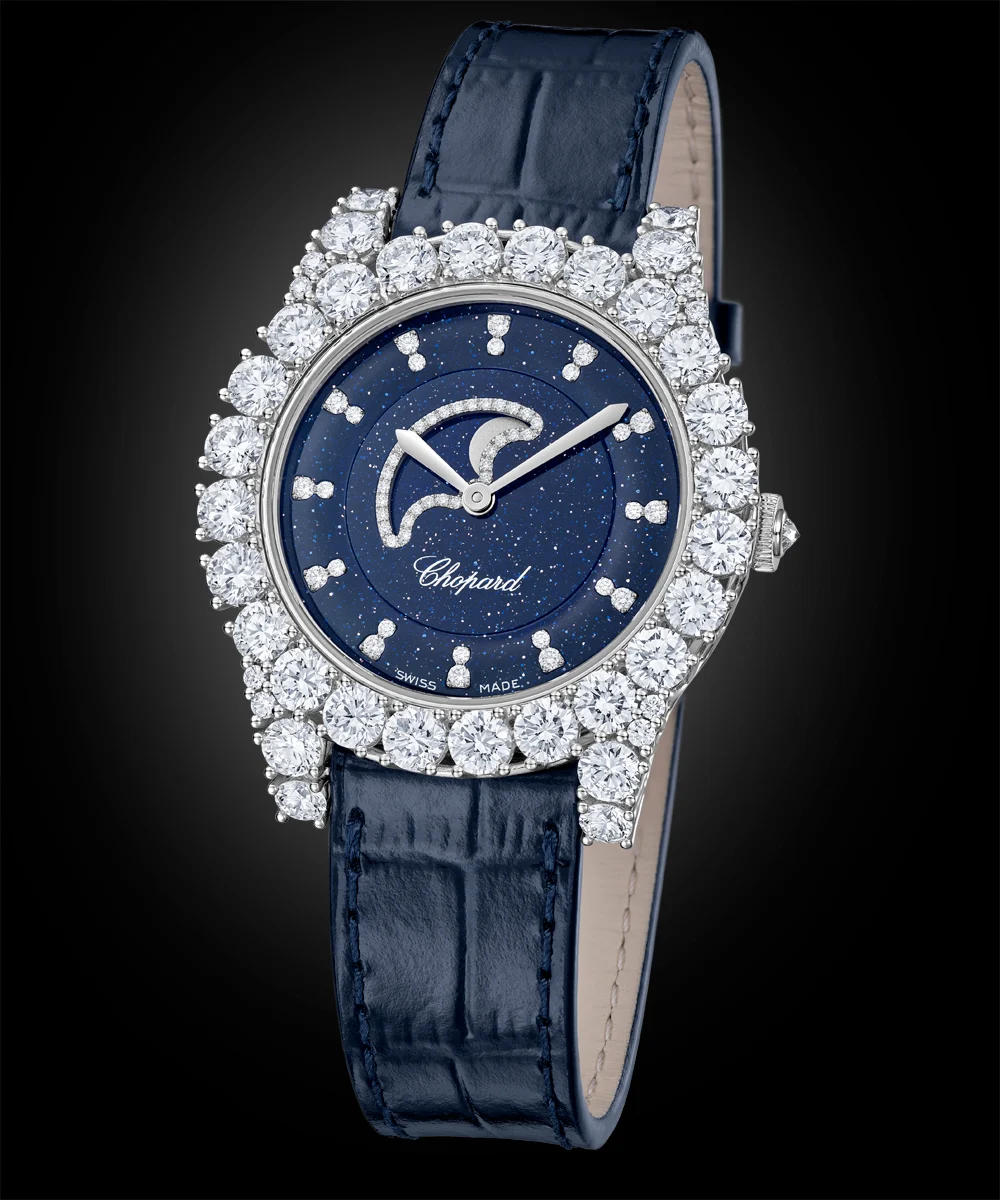
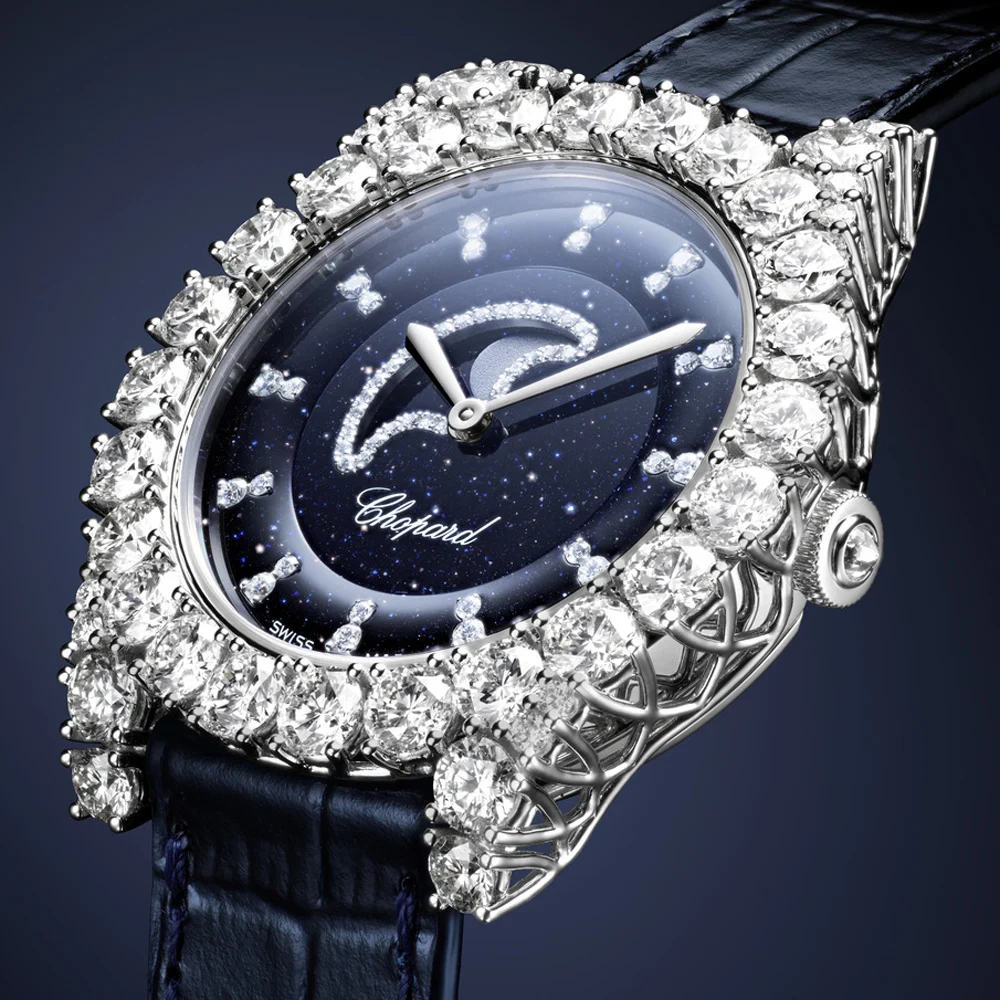
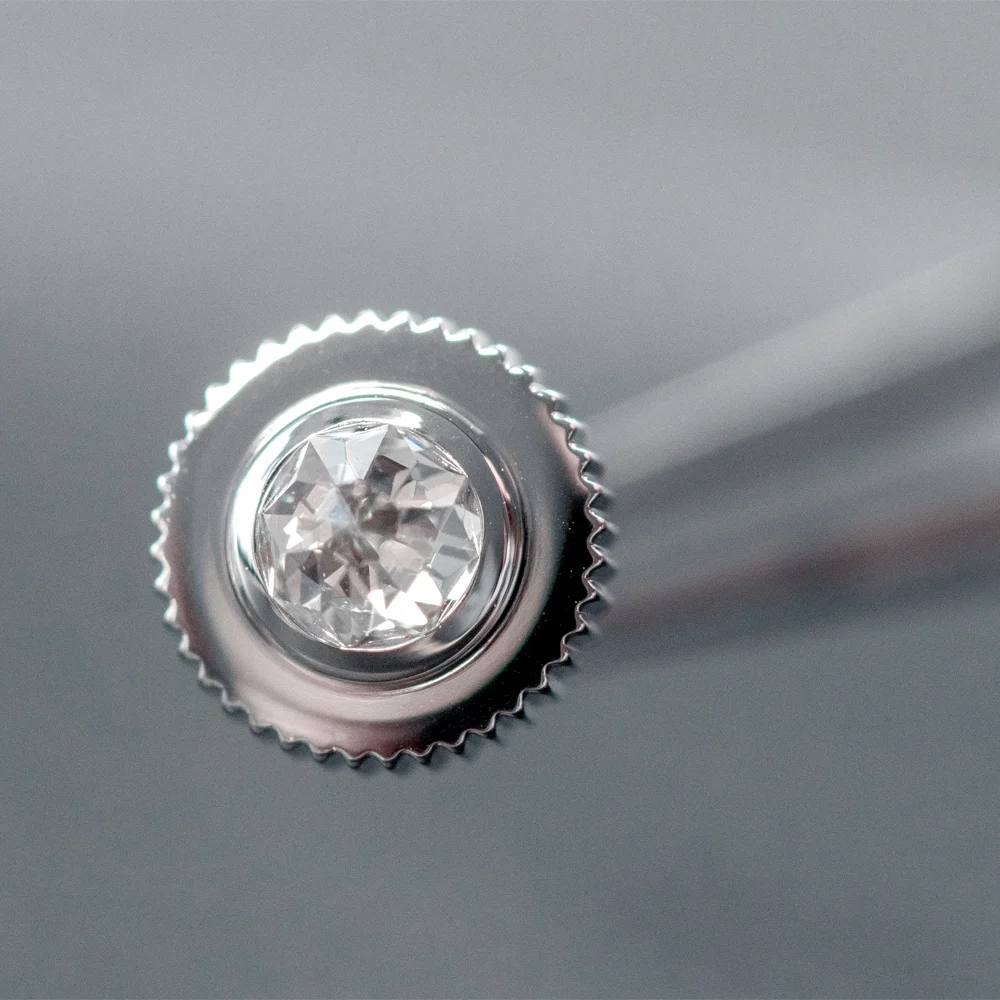
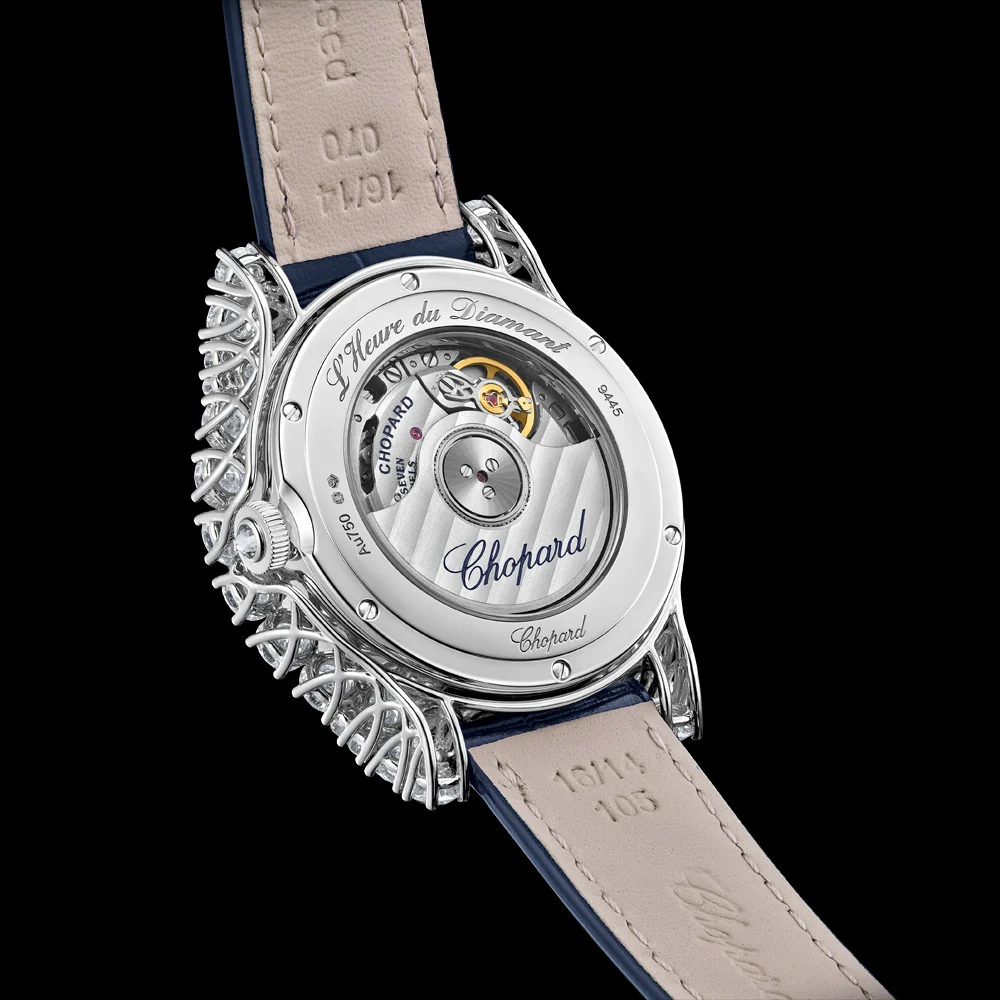
In addition to the moon phase disc, the dial also uses blue aventurine glass, highlighted by diamonds surrounding the moon phase and punctuating the hour indices. Rhodium-plated cone-shaped hour and minute hands mark terrestrial time. Floating around the dial like a burst of celestial light, diamonds add a twinkly brilliance to the composition. Diamonds on the bezel and lugs also add to the heavenly display, while a briolette-cut diamond accents the setting in the crown.
Chopard L’Heure du Diamant Moonphase – gem-setting
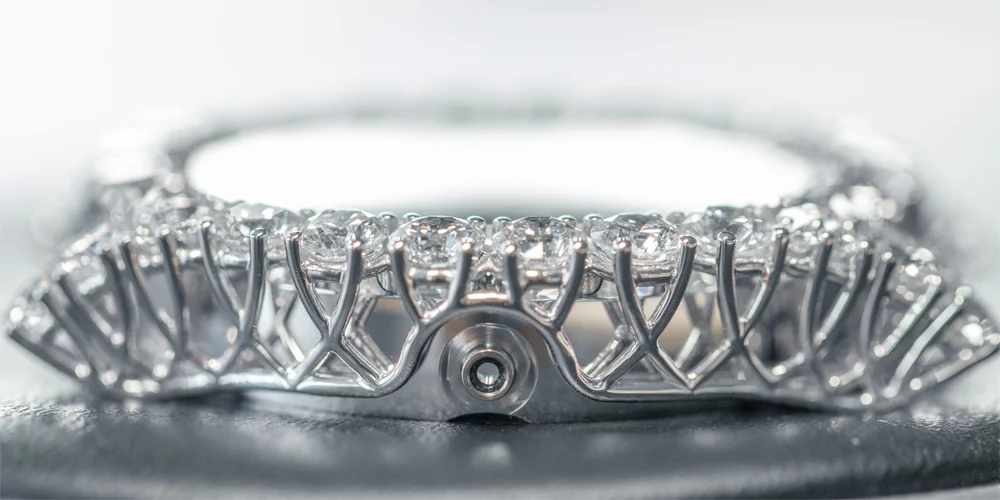
The gem setting technique is one that Chopard uniquely developed within its Manufacture. Referred to as crown setting, V-shaped prongs underneath resemble a lacework, hugging the diamonds and allowing for a full-blown light show on top that isn’t disturbed by visible prongs. Karl Scheufele was responsible for creating the V-shaped prongs.
Chopard L’Heure du Diamant Moonphase – case & movement
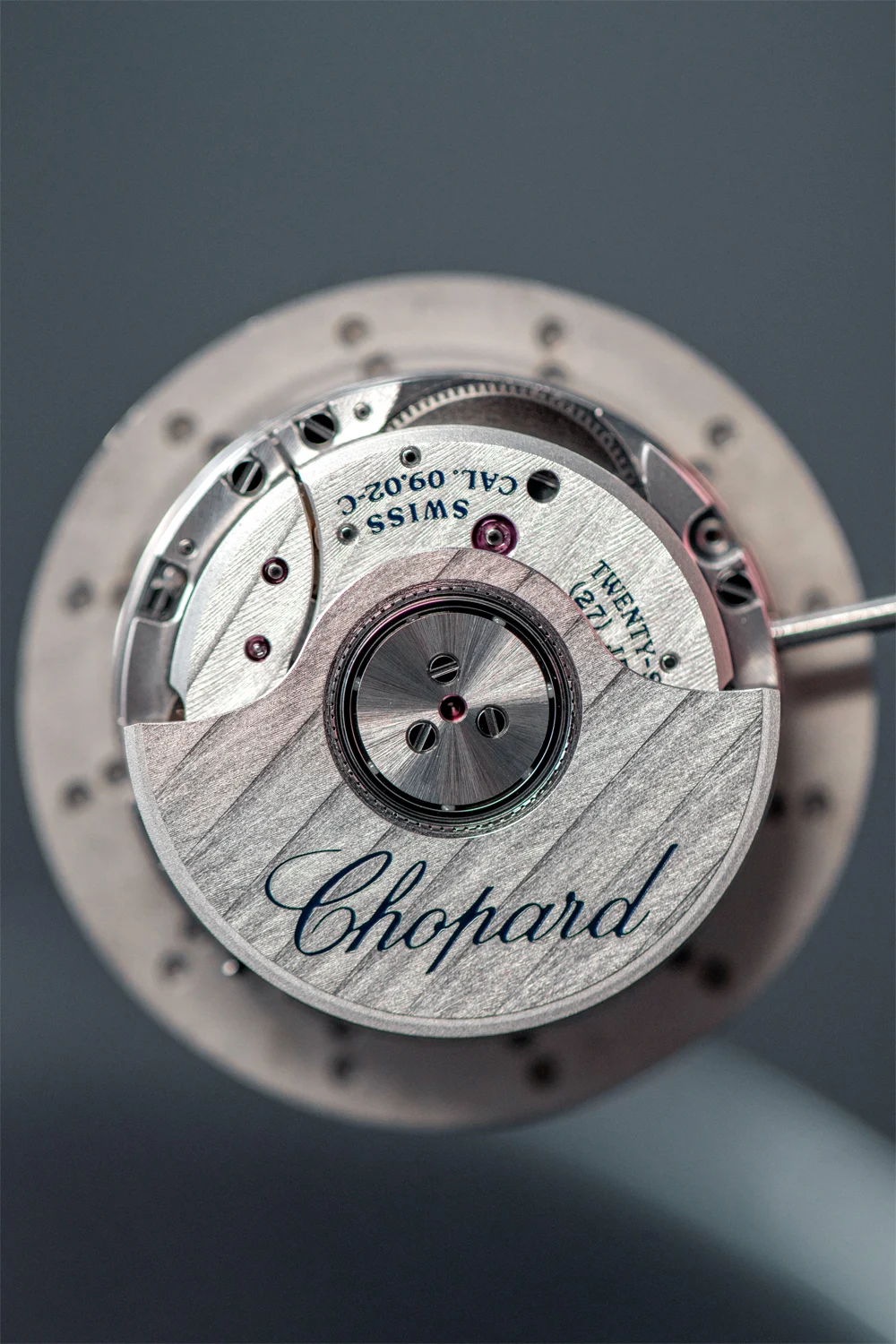
The Chopard L’Heure du Diamant Moonphase, housed in ethical 18-carat white gold, measures 35.75 mm in diameter with a thickness of 9.60 mm. The case plays host to a new Chopard self-winding movement, the Calibre 09.02-C, with a 42-hour time reserve. While women’s watches often use repurposed movements designed for men’s watches, this one sits snugly into the case. It incorporates 169 components and measures a well-proportioned 20.40 mm by 4.60 mm. A navy-blue alligator leather strap with an 18-carat buckle set with diamonds, secures the portrait to the wrist.
Chopard L’Heure du Diamant Moonphase – a captivating addition to the family
Inspired by 1960s modernism interpreted by Chopard, the L’Heure du Diamant collection also includes necklaces, bracelets and rings. The imaginative L’Heure du Diamant Moonphase timepiece is a captivating addition to the family, one that pays tribute to the moon and the vastness of our universe while capturing the passing of time on earth.
Further reading
https://www.chopard.com/en-gb/
Technical specification
- Model: Chopard L’Heure du Diamant Moonphase
- Reference: 139445-1001
- Case: Ethical 18-carat white gold, diameter 35.75 mm, height 9.60 mm, water resistance 3 ATM (30 metres), sapphire crystal to front and exhibition case back
- Functions: hours, minutes, moon phases
- Movement: Chopard Calibre 09.02-C, self-winding movement, frequency 25,200 vph (3.5 Hz), 27 jewels, power reserve 42 hours
- Price: £93,200 (RRP as of 2.5.2025)