
Corum Golden Bridge Serpent Watch Review
The Corum Golden Bridge Serpent is a unique piece that fuses métiers d’art with esteemed watchmaker Vincent Calabrese’s linear movement concept. The hand-wound movement stands centre stage, dressed in noble metal and packed with mechanical virtue. Angus Davies begins by discussing Corum’s history before venturing into this latest reptile-themed exemplar of Haute Horlogerie.
Corum – breaking with convention
Should you choose to walk down the high street of any provincial town and peruse the watches on display in a number of jewellers’ windows, you will note that most timepieces are round. This is no accident; ’round sells’. There are companies who choose to venture off-piste and embrace alternative forms but this increases the risk of failure, much to the consternation of the bean counters. Quite simply, only the courageous shun ’round’.

Back in 1955, René Bannwart and his uncle Gaston Ries created a new watch brand, Corum. From the outset they chose to embark on their own path to greatness, conceiving watches that did not subscribe to the accountant’s beloved ‘safe’ model. For example, in 1958, the company made the ‘Chinese Hat’. Inspired by the straw conical hats worn in Asia, this design represented a significant departure from the ubiquitous round watch. Two years later, the Maison unveiled the Admiral, a square watch with a depiction of a sailboat engraved on its rear surface.
In 1964, Corum released a round model but, once again, it broke with convention. Aptly named the ‘Coin Watch’, the timepiece consisted of a genuine, gold $20 Double Eagle coin that had been invisibly cut and hollowed-out in order to house an ultra-thin movement.
Golden Bridge watch
Some years later, the non-conformist brand was receptive when it learned of a novel idea for a watch masterminded by Vincent Calabrese, a self-taught watchmaker (1977).
Vincent, a son of Naples, was inspired by an incident a few years prior to the creation of the Golden Bridge. He had a wealthy client who owned a 200 year-old Breguet which had been dropped and then subsequently run over by a car. Mindful that the repair would be costly, the client tasked Calabrese with restoring the case of the watch to its former condition but leaving the movement untouched, keen to mitigate the cost of repair. This felt like sacrilege to the Italian, after all, it was crafted by one of the greatest watchmakers of all time. Nevertheless, Vincent duly acceded to his request and the Breguet’s exterior was revived.
Reflecting on this incident, Calabrese sought to create an entirely new watch to his own design where the movement was the star of the show. He conceived a timepiece featuring a linear, single-bridge movement formed of gold and the seeds of a great idea began to grow.
Calabrese selected the noble metal primarily for its aesthetic appearance. One of the least reactive metals, gold does not require plating, promising to retain its showroom-fresh condition for decades to come. However, gold is especially soft, making it vulnerable to damage should a watchmaker have a momentary lapse in concentration.
There was also the matter of glazing. Plexiglas was the material of choice for many watches at this time; however, Corum had other ideas. It worked with a specialist company, Seitz, who produced the expansive sapphire crystal windows, affording views of the ingenious movement. Brimming with innovative ideas, the inaugural Golden Bridge was unveiled in 1980.
The watch industry often uses the terms ‘iconic’, ‘legendary’ and ‘groundbreaking’ with little justification; however, with the Golden Bridge, its ingenious movement design, unusual form and innovative use of sapphire crystal made this watch deserving of each of the aforementioned superlatives.
Corum Golden Bridge Serpent – the look
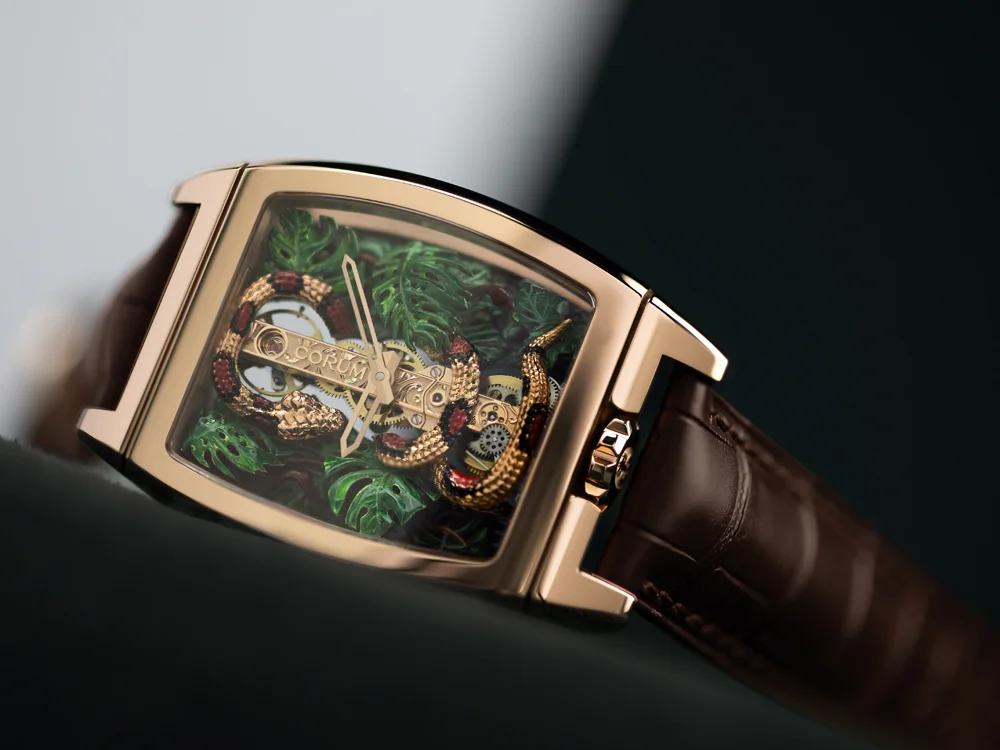
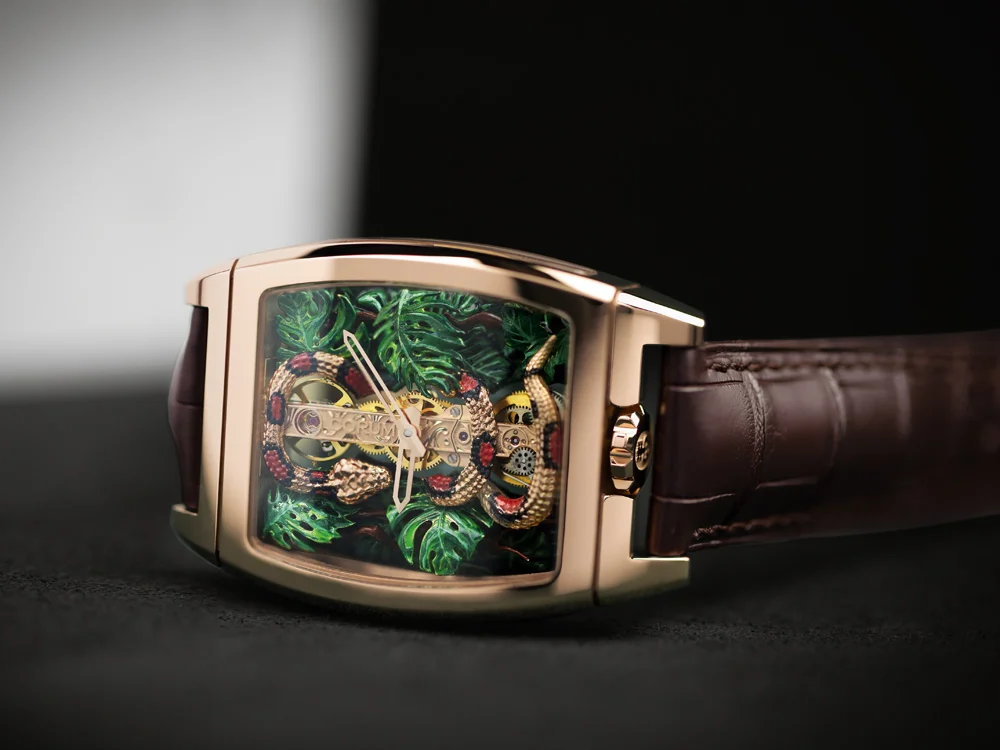
Last year, the Maison headquartered in La Chaux-de-Fonds unveiled a pièce unique based on Calabrese’s Golden Bridge concept. Nestling within a tonneau-shaped case, the hand-wound movement, Calibre CO 113, runs from north to south. The openworked golden hands eschew luminescent treatment and are executed in openworked form.

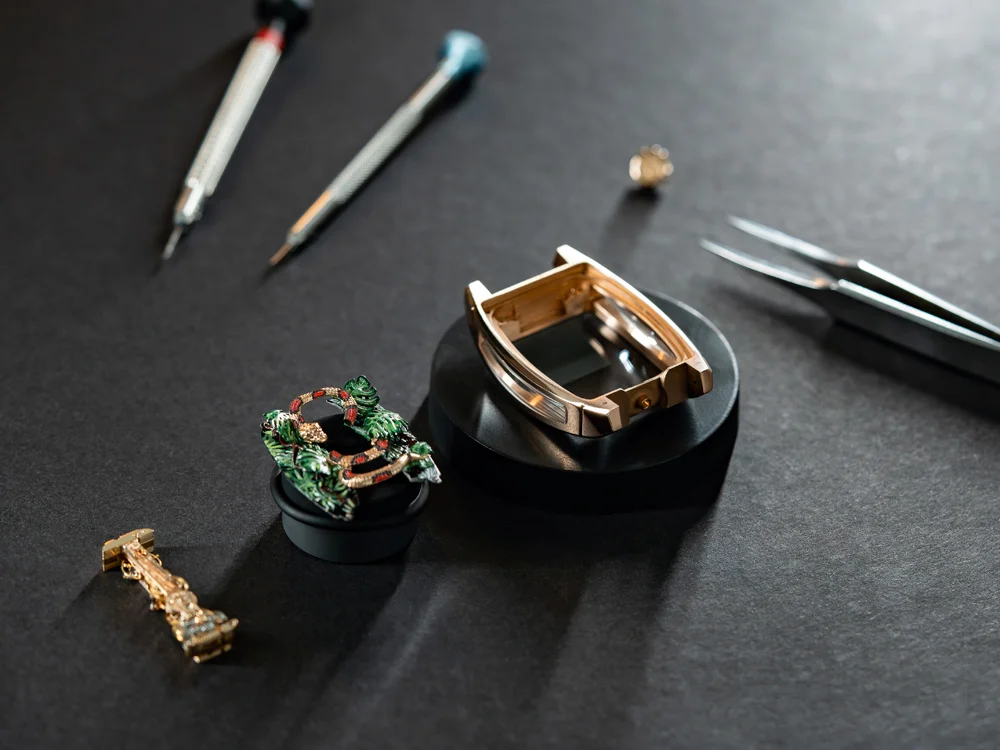
The hands rotate above a jungle scene encompassing leaves and vines, all formed of 18-carat gold, skilfully hand-painted in an array of verdant hues. The eponymous serpent threads its body through the viridescent foliage, wrapping its torso around the Golden Bridge CO 113 movement. Once again, gold abounds, with the serpent’s skin hand-sculpted with numerous scales. Again, in common with the hand-sculpted leaves and vines, the serpent is painstakingly painted with coloured markings. The blend of black, gold and red hues imbues the reptile-themed dial with an almost photorealistic quality. Corum states that ‘the artistic work requires nearly a hundred hours of meticulous work, from design to micro-sculpture, then painting, to bring this unique creation to life’. Having held the watch in my left hand with a loupe to my eye, I see little reason to doubt the brand’s stated tally of hours.
Corum Golden Bridge Serpent – the case
Upholding Golden Bridge tradition, the Serpent features four panes of sapphire crystal: one front, one rear and two gracing the case flanks. This extensive use of clear glazing allows the watch to drink in light, bathing the micro-sculpture and movement with a brilliant glow.
Measuring 34 mm x 51 mm with a thickness of 11 mm, the Corum Golden Bridge Serpent is generously proportioned, granting sufficient room for each dial element to breathe. Indeed, nothing looks squashed and everything appears optimally sized to indicate the time, showcase the métiers d’art and allow the movement to shine.

While some early iterations of the Golden Bridge featured an innovative crown mounted to the rear, the crown gracing the Serpent resides between the southernmost lugs. This approach confers ease of adjustment and ensures the watch-head comfortably nuzzles the wrist.
Corum Golden Bridge CO 113 movement
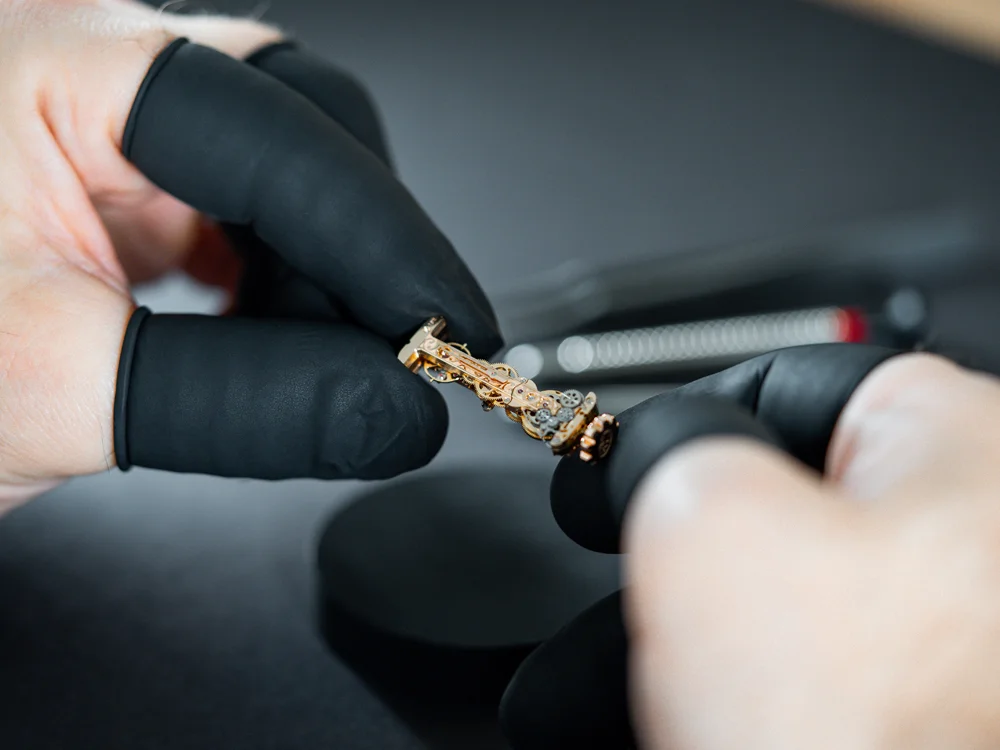
But ultimately, just as Calabrese intended, all roads lead back to the movement. Presented on a north-south axis, the Golden Bridge is a marvel of micro-engineering. Comprising 190 components, the linear movement architecture begins at 6 o’clock where the keyless works engages with the ratchet wheel, tensioning the barrel. Surprisingly, despite its diminutive proportions, the barrel confers a useful power reserve of 40 hours.
Allow your eyes to meander northwards and you will observe the engraved bridge with the maker’s name presented in relief. Note the teeth of the gear train wheels peeping out from the sides of the bridge and the various jewels punctuating the golden structure. Eventually, you will reach the balance. It’s not a ubiquitous index-regulated balance but rather a superior variable-inertia balance.
With a Swiss lever escapement, the balance spring is affixed to the balance staff with a collet at one end, while the outer coil is attached to the stud at the opposite end. Most watches in the jewellers’ window feature an index-regulated balance where the rate is altered by adjusting the effective length of the balance spring. With this means of regulation, the balance spring passes between two curb pins affixed to a ‘raquette’. Moving the raquette towards or away from the stud alters the effective length of the balance spring, causing the watch to run faster or slower.
In contrast, the balance spring found on a variable inertia balance is fixed. The rate is altered by adjusting weights affixed to the rim of the balance wheel, altering the moment of inertia, making the watch run faster or slower as required. Regulating a variable-inertia balance is more time-consuming; however, it proffers superior precision, is less susceptible to positional influence and should the watch be subjected to a shock, it is less likely to require remedial regulation. The mechanical integrity of this watch is beyond question.
Corum Golden Bridge Serpent – closing remarks
By virtue of its design, the Corum Golden Bridge is esoteric. It can trace its origins to a time when few brands dared to stray from the ’round sells’ strategy, a time when the Swiss watch industry was in the midst of the so-called ‘quartz crisis’ and a time that pre-dated the independent watch scene now familiar to legions of horophiles. Against this backdrop, Calabrese and Corum showed great courage when creating the inaugural Golden Bridge of 1980. Today, the legend of the Golden Bridge shines brightly, vindicating their fearless decision.
In this latest iteration, the Serpent draws on the talents of some highly accomplished artisans with its fusion of sculpture and hand-painting. But it is not merely an object of beauty, it celebrates watchmaking with its ingenious arrangement of wheels, an openworked barrel that packs a punch and a variable-inertia balance that promises superior performance.
The Corum Golden Bridge Serpent is a remarkable fusion of artistic crafts and a pièce unique, making it a rare sight seldom seen in the wild.
Further reading
https://www.corum-watches.com/
Technical specifications
- Model: Corum Golden Bridge Serpent
- Case: 18K rose gold 5N, dimensions 34.00 mm x 51.00 mm, thickness 11.00 m, water resistance 3 ATM (30 m), sapphire crystals to the front, sides and caseback.
- Functions: hours, minutes.
- Movement: CO 113 movement, hand-wound movement, frequency 28,800 vph (4 Hz), 19 jewels, power reserve 40 hours.
- Strap: brown alligator strap with 18K rose gold 5N triple-blade folding clasp.
- Price on application
- Pièce unique