
Cyrus Klepcys DICE Racing (Part Two)
The Cyrus Klepcys DICE Racing is the latest iteration of the Swiss brand’s ‘Double Independent Chronograph Evolution’ mechanism. In the second instalment of this two-part feature, Angus Davies continues his detailed examination of the new watch. He also chats to Jean-François Mojon and Walter Ribaga, two men instrumental to the model’s success.

Cyrus Klepcys DICE Racing – Grade 5 titanium
The inaugural version of the Klepcys DICE was encased in Grade 5 titanium and dressed in a stealthy coat of black DLC or presented in a naked version of the lightweight alloy. The latest Klepcys DICE Racing model upholds this tradition. Walter Ribaga explained the reasons for using this expensive alloy:
“Grade 5 titanium has very interesting properties. Besides its lightness, it is hypoallergenic and, unlike Grade 2 titanium, it can be polished. Traditionally, our Klepcys case is both polished and satin-finished.”
Grade 5 titanium is an alloy comprising 90% titanium, 6% aluminium and 4% vanadium. The unit cost of this alloy is greater than that of Grade 2 titanium but is far stronger and, as Walter eluded, Grade 5 titanium can be polished.

Cyrus entrusts the making of the DICE case to a specialist firm. Unlike stainless steel which can be simply stamped to shape, Grade 5 titanium must be milled using a CNC (Computer Numerical Control) machine, a far costlier method of case production.
The hardness of Grade 5 titanium causes milling tools to wear more readily, necessitating replacement and causing downtime, both these factors again heighten cost. Furthermore, when contrasted with steel or gold, the milling times are longer. This is because Grade 5 titanium can be damaged by excessive heat, necessitating slower machining speeds and further heightening costs.
These days, an increasing number of watch brands treat Grade 5 titanium with the same reverence as noble metals such as gold and platinum. The lightweight material is luxurious and expensive. The use of Grade 5 titanium for the Klepcys DICE models again demonstrates that Cyrus doesn’t countenance the notion of penny-pinching when there are useful wearer benefits on offer.

Cyrus Klepcys DICE Racing – forged carbon
The name ‘Racing’ for many individuals evokes thoughts of race cars slipstreaming one another, wheel-to-wheel action and precisely clipping apexes, all in the pursuit of podium glory. Ultimately, it is the speed that determines success or failure. The esoteric domain of Formula One has led many teams to use carbon fibre, a strong material that is incredibly light, a prerequisite for any competitive ‘race package’.

Carbon fibres are made from ‘precursors’ such as polyacrylonitrile (PAN) and rayon. These fibres are chemically treated, heated, stretched and subsequently carbonised to create high-strength fibres. These are bundled together and categorised by the number of fibres they contain. Those materials with the greatest number are typically the strongest. The carbon fibres are then woven into different patterns depending on the intended use. In Formula One, the fibres are aligned parallel to one another in order to deliver maximum strength (lengthwise). Parts are made using bespoke moulds. Depending on the part needed, 5-10 layers of pre-impregnated (with resin) carbon fibre are placed within the mould, subjected to vacuum treatment, debulking (removing any trapped air) and then heated. Thereafter, the lightweight material is cured in an autoclave where it is subjected to a number of temperature/press cycles.

In terms of the Cyrus Klepcys DICE Racing, the bezel is made from forged carbon. Once again, this material is light, but the production method imbues it with a very different appearance to that of woven carbon fibre. With forged carbon, strands of carbon fibre are precisely cut and weighed. The desired amount is then placed in a compression mould.
This mould is incredibly expensive to produce and, in this instance, has been made specifically for the Klepcys DICE bezel. A precise volume of resin is added to the mould and thereafter everything is subjected to colossal pressure.
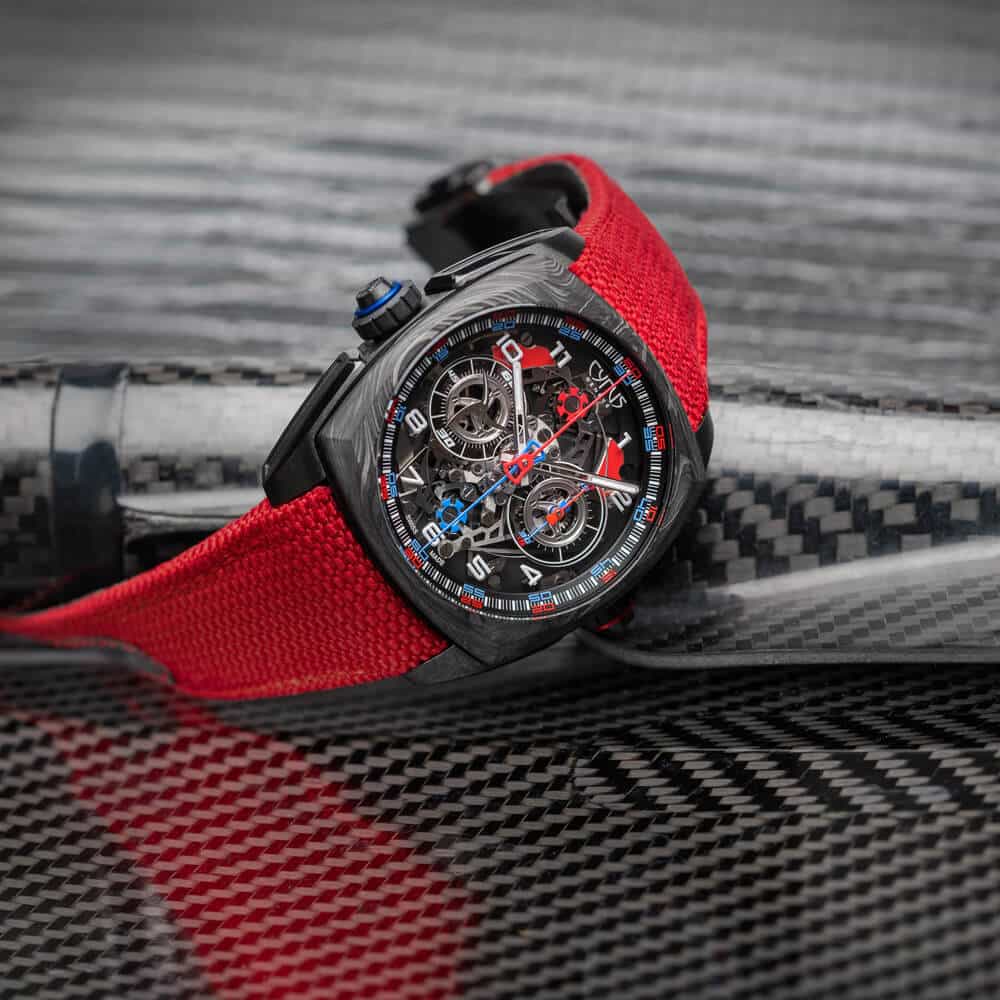
Unlike carbon fibre sheets which have a uniform, woven appearance, forged carbon looks very different. Each forged bezel features a random, monochromatic pattern. The appearance of each bezel is unique, conferring a welcome note of exclusivity.
Cyrus Klepcys DICE Racing – the case
The Cyrus Klepcys DICE Racing measures 42 mm in diameter (excluding the crowns) and has a thickness of 16.5 mm. Consistent with other Cyrus models, it features a twin-crown design, but with each crown incorporating a monopusher. The crown at 3 o’clock is used for setting the time indications, manually energising the mainspring and allowing the wearer to start, stop and reset the red-toned chronograph. The crown at 9 o’clock, purely controls the operation of the blued-toned chronograph. Everything proves simple, intuitive and eminently neat.
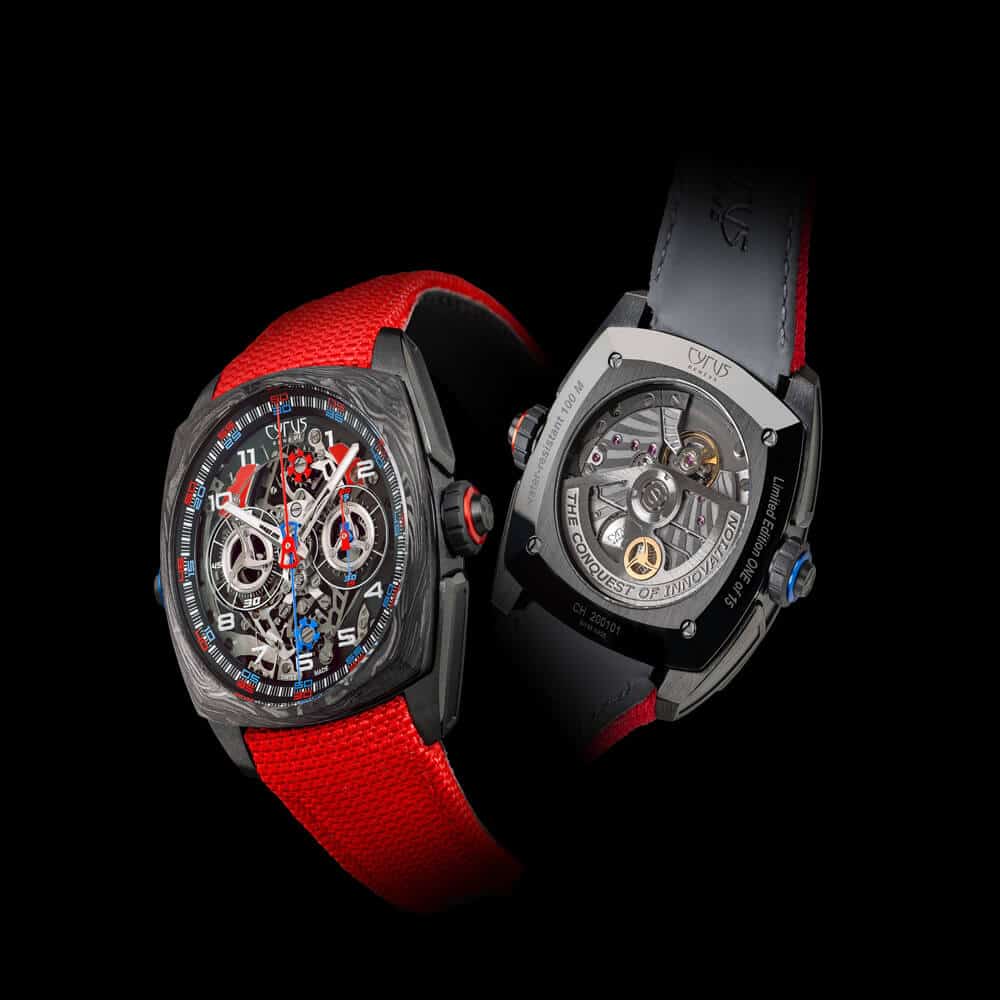
The monopushers clearly fulfil their functional duties and contribute to the clean case design. I asked Jean-François Mojon to elaborate further on the rationale for employing the model’s monopusher system:
“Yes, the system is neater and undoubtedly one pushpiece per chronograph is much less confusing. In addition, by incorporating a monopusher within each crown, the resultant appearance is more elegant and consistent with Cyrus’s distinctive twin crown design language.”
Appraising the case in detail, one is struck by the profusion of contours, lines and angles. The main body of the case is tonneau-shaped, while the bezel is four-sided and encompasses arcing lines. The sides of the lugs step away from the caseband and incorporate small recesses. To the rear of the watch, the caseback has faceted edges that ergonomically caress the wrist. A pane of sapphire crystal to the rear affords sight of the self-winding movement. Cyrus has delivered a symmetrical composition with each case element beautifully considered. The resultant model is clearly the product of protracted thought.

A red Cordura fabric strap reinforces the motorsport theme, eliciting thoughts of racing passions and red-hot exhausts. Paired with a folding clasp (matching the case material), the strap encircles the wrist snugly and securely while contributing to the model’s sporty character. I asked Walter Ribaga to provide more details about the strap:
“For this new model, we wanted a new type of strap. We chose Cordura fabric as it is a durable material and available in a wide choice of colours. Also, in addition to the Cordura strap, each model comes with a traditional soft rubber strap.”

Cyrus Klepcys DICE Racing – Calibre CYR718
At the heart of the Klepcys DICE Racing sits the Calibre CYR718. This Manufacture self-winding movement is composed of 443 components, of which 218 correspond to the chronograph module. Beyond its capacity to time two independent events, the movement is rich in detail. Cyrus faced several technical challenges when developing the Klepcys DICE as Jean Jean-François Mojon explained:
“The main challenge was to avoid any influence from one mechanism to another. We also had to find a way of displaying each indication that would be clear and legible.”

The movement doesn’t work behind the scenes but stands centre stage, revealing numerous gestures that not only serve a functional purpose but deliver a high quotient of horological theatre. This is made possible because the movement is inverted with both column wheels presented front of house. Again, Jean-François was able to proffer additional details:
“Of course, the aesthetics were an important consideration when designing the movement. That’s the reason why the column wheels are positioned at 12 and 6 o’clock, to deliver the symmetry along this axis. This imposed constraints in terms of movement design which we had to surmount.”
While the two chronograph seconds hands are positioned 180° apart, there will inevitably be times when the red hand passes over the blue hand. What is the gap between both hands? Could the hands potentially touch one another? Again, Jean-François kindly answered:
“The gap between both second hands is 0.35mm, which is greater than normal in order to ensure no collision occurs.”

Beyond the functional aspects of the calibre CYR718, Cyrus has also expended much effort on its finishing. Indeed, the automatic movement is imbued with numerous examples of refined finishing, befitting a contemporary exemplar of Haute Horlogerie.
Consistent with the avant-garde styling of the watch, the bridges shun Côtes de Genève motif, typical of traditional timepieces. Instead, they feature grey anthracite NAC galvanic treatment, decorated with an embossed sunray pattern, and encompass satin and microbeaded finishing.

The oscillating mass is partially openworked, enlivened with a sunray motif and features an 18K 4N gold medallion appointed with the brand’s helix logo. The movement is endowed with two microbeaded mainplates and the ratchet wheel is snailed. Cyrus has juxtaposed grey and black hues and imbued the movement with refined, albeit neoteric, finishing.
Cyrus Klepcys DICE Racing – closing thoughts
When Cyrus unveiled the inaugural Klepcys DICE, it was not only new but groundbreaking. Prior to its arrival, the chronograph, the flyback and the rattrapante were the only chronograph options in town. When the DICE arrived, it combined the functionality of two wholly independent chronographs, conveniently packaged in one case.

As this article hopefully demonstrates, creating the DICE wasn’t without its obstacles. However, those achievements worthy of note inevitably require challenges to be surmounted. It’s this kind of mindset that has led to humans being able to walk on the moon and discover cures for various ailments. Speaking to Walter and Jean-François, the motto ‘Conquest of Innovation’ is more than a marketing slogan, it’s a state of mind; a philosophy that has delivered a new genre of timepiece, rich in detail and produced to the most exacting standards.

Further reading
Technical specifications
- Model: Cyrus Klepcys DICE Racing
- Reference: 539.508.TTC.A (polished titanium/ carbon fibre) / 539.508.DDC.A (black DLC titanium/carbon fibre)
- Case: Diameter 42mm; height 16.5mm; water resistance 10ATM (100 metres); sapphire crystal to the front and an exhibition case back
- Functions: Central hours and minutes; small seconds at 9 o’clock; 30-minute counter of the double independent chronograph at 3 o’clock; double hands in red and blue; two central chronograph hands; red hand resets-to-zero at 12 o’clock; blue hand resets at 6 o’clock
- Movement: Calibre CYR718; self-winding movement; frequency 28,800VpH (4Hz); 51 jewels; power reserve = 60 hours
- Strap: Red Cordura fabric strap with a folding clasp matching the case material, customised with the Cyrus logo. Also comes supplied with an additional black rubber strap
- Price on application
- Limited Edition: 15 pieces in each case version