
DOXA SUB 200 T.GRAPH II Watch Review
Unlike the majority of divers’ watches, the DOXA SUB 200 T.GRAPH II is equipped with a chronograph. An evolution of a model that was first launched in 1969, the impressive blend of legibility, robustness and wearability, not to mention water resistance to 200 metres, makes this timepiece a practical and handsome ownership proposition.
The universal appeal of divers’ watches
In 1894, John Barbour founded his eponymous company in South Shields, England and began producing wax jackets. These were originally designed to shield dockworkers, fishermen and sailors from torrential rains and bitter winds. The brand’s garments have since become a popular choice for individuals who appreciate the appearance and practicality of a wax jacket. Indeed, the Barbour is no longer the preserve of those who face the wrath of the North Sea – its appeal is universal.
In a similar vein, divers’ watches were originally made for professionals, both civilian and military. Their functionality would later see them being used by amateur divers. It is this history that has shaped the look, proportions and specifications of many divers’ watches on sale today. These days, divers’ watches are often purchased by people who seldom use a snorkel and mask; they simply appreciate the looks and practicality this horological genre offers. Step forward, DOXA, a Swiss watch brand with a proud history of making divers’ watches.

DOXA – founded in 1884
DOXA was founded in 1884; however, it wasn’t until the early 1960s that the company first explored making divers’ watches. Working with Claude Wesley, a famous diver at the time, the Swiss marque began conducting trials in Lake Neuchâtel, experimenting with different dial hues. The objective was clear: to find the best dial colour for underwater use. After exhaustive research, DOXA established that ‘bright orange proved ideal for divers’.
Having worked closely with Jacques-Yves Cousteau, the famous oceanographer and diver, DOXA, in 1967, unveiled the ‘first professional-grade diver’s watch for the public, featuring a patented rotating bezel and an iconic orange dial’. This initial watch was named the SUB 300 and its bright orange dial became instantly recognisable among the diving fraternity. Thereafter, DOXA became known as a specialist in the making of divers’ watches.
Over subsequent years, DOXA has released additional models, some capable of operating at profound depths. Moreover, the brand has since gone on to create watches in different sizes, encased in a variety of materials and has even experimented with an array of dial colours. These days, DOXA has an impressive back catalogue which it frequently revisits, creating ‘animations’ of former classics.

DOXA SUB 200 T.GRAPH II – introduction
In 1969, DOXA released the SUB 200 T.GRAPH, a professional dive watch equipped with a chronograph movement (see later). Recently, the company has reimagined this former classic, unveiling the new DOXA SUB 200 T.GRAPH II.
Slightly smaller than its forebear of 1969 and equipped with a modern-day movement, the new DOXA SUB 200 T.GRAPH II is not merely for intrepid divers. On the contrary, it will undoubtedly appeal to many individuals who will appreciate its legibility, robustness, water resistance and distinctive looks.

DOXA SUB 200 T.GRAPH II – dial
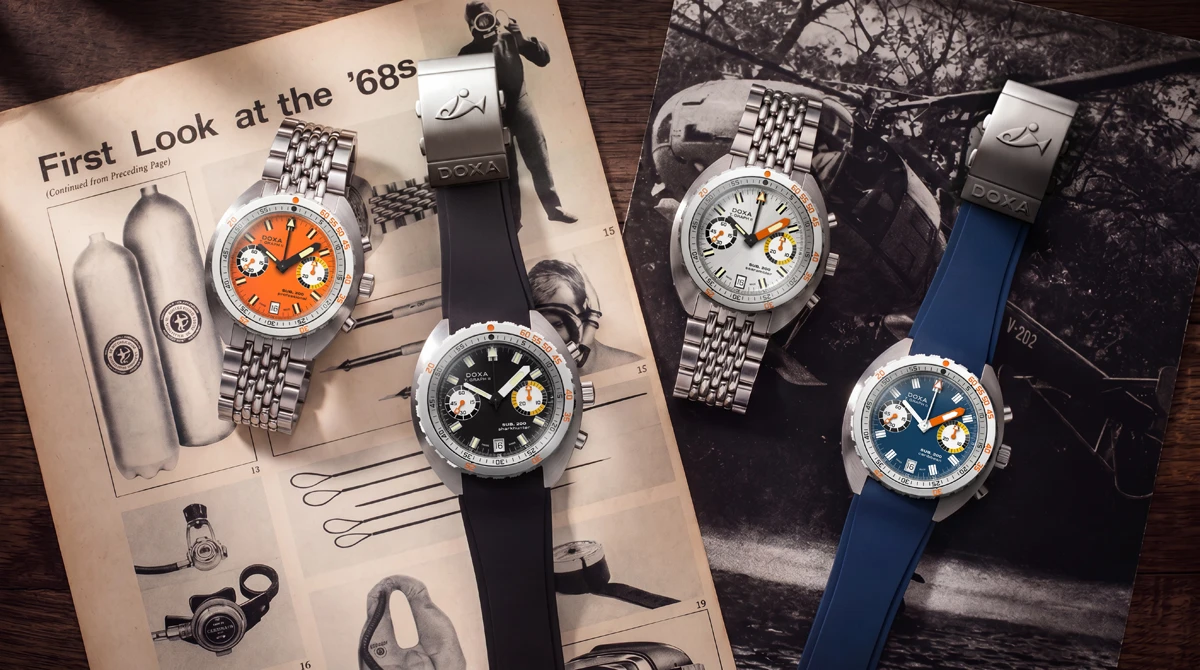
The DOXA SUB 200 T.GRAPH II is offered in the same three colours that were employed on the 1969 version – Professional orange, Searambler sunburst silver and Sharkhunter black – as well as a further option – Caribbean blue. This colour has previously been seen on other models, but it is the first time it has appeared on a SUB 200 T.GRAPH.

Beneath the waves, tracking minutes is more important than observing the hours. With its vast experience, DOXA has chosen to present the minutes with an oversized hand and, save for the Sharkhunter option, dress it in a bright shade of orange. Both the hands and indices are liberally coated with Super-LumiNova, aiding readability in dim light conditions. A minute track encircles the edge of the dial, while a date indication resides at 6 o’clock.

Unusually, the DOXA SUB 200 T.GRAPH II is endowed with a chronograph, a rare complication for a divers’ watch, and sports two counters on its dial: a 30-minute chronograph register at 3 o’clock and a small seconds indication at 9 o’clock. The hands gracing the subdials, as well as the tracks encircling them, differ, thereby aiding intelligibility. The central chronograph seconds hand is equipped with a prominent triangular tip, lined in lume and fringed with a contrasting border.

Whether used on land or in the sea, during the day or at night, every element of the DOXA SUB 200 T.GRAPH II has been cleverly optimised to deliver maximum legibility.

DOXA SUB 200 T.GRAPH II – case
The new watch is a smidgen smaller than the 1969 original, now measuring 42 mm in diameter (previously 43 mm) with a thickness of 14.6 mm (previously 15.15 mm). By slightly reducing the model’s dimensions, the SUB 200 T.GRAPH II should suit a greater number of wrists. But traditionalists should not fret, the model still retains the distinctive cushion-shaped case and, despite the size reduction, it still proves eminently simple to read.

Upholding divers’ watch convention, the SUB 200 T.GRAPH II is fitted with a unidirectional, dual-scale bezel and features a solid caseback. The watch can be specified with a rubber strap or a stainless steel ‘beads of rice’ bracelet. Both of these options come with a folding clasp and a wetsuit extension.

DOXA SUB 200 T.GRAPH II – movement
In 2019, DOXA released the SUB 200 T.GRAPH (Reference 805.10.351.10), a limited edition of 300 pieces. It was equipped with an historic Valjoux 7734, a hand-wound movement widely admired by watch obsessives.
This new SUB 200 T.GRAPH II is fitted with a modern Sellita SW510 automatic movement. Where the Valjoux had a frequency of 2.5 Hz, the Sellita has a cadence of 4 Hz, granting superior precision. Moreover, the power reserve of the Sellita is approximately 56 hours, surpassing that of the Valjoux (circa 45 hours). While nostalgic types may look to the past, there is no escaping that, on paper, the Sellita SW510 automatic movement delivers advancement.
Closing remarks
On occasion, I have ventured into ocean waters wearing a snorkel and mask, sometimes using breathing apparatus; however, these days, thoughts of coastal pollution dissuade me from swimming in the sea. Yet, despite this, of the few timepieces I own, most of them are divers’ watches. Some horophiles will call me a ‘desk diver’, but I don’t care.

I am attracted to these subaquatic instruments not because I wish to emulate Monsieur Cousteau, but rather because of their many attributes. Indeed, they tend to be simple to read, robust and are usefully water-resistant, making them ideal for daily wear. Equally, I appreciate the utilitarian appearance of a divers’ watch and the honesty they proffer. The SUB 200 T.GRAPH II delivers all of these qualities in spades while also offering the benefits of a chronograph. What’s not to like?
Further reading
Technical specification
- Model: DOXA 200 T.GRAPH II
- Case: stainless steel, diameter 42.00 mm x 44.50 mm, thickness 14.60 mm, water resistance 20 ATM (200 metres), sapphire crystal to front, solid screw-in caseback.
- Functions: Hours, minutes, seconds, date and chronograph
- Movement: Sellita SW510, self-winding, frequency 28,800 vph, power reserve 56 hours
- Strap/bracelet: rubber strap or stainless steel ‘beads of rice’ bracelet. Supplied with a folding clasp with wetsuit extension
- Price – rubber strap: £3,650 (RRP as of 18.9.2026)
- Price – beads of rice bracelet: £3,690 (RRP as of 18.9.2026)