
Doxa SUB 250T GMT Watch Review
The Doxa SUB 250T GMT unites the brand’s underwater capabilities with the capacity to see the local time and home time simultaneously. Offered in a choice of nine colours, this latest model, with its customary Doxa robustness, should also prove an attractive proposition for landlubbers. US-based Meehna Goldsmith begins by discussing the evolution of divers’ watches, including Doxa’s involvement, before exploring this new subaquatic timepiece.

An underwater world yet to be explored
We live on a magnificent orb called Earth, rotating in the Milky Way galaxy. Humans, by their very nature, are explorers, curious to discover and understand this planet. While we live our lives on land, there is a whole other world below sea level. In fact, the ocean makes up about 71% of the Earth’s surface and contains its biggest ecosystem composed of 99% of all habitable space in the world. And yet, only 5% of the ocean has been explored. It teems with mystery and the vast unknown, beckoning like a Siren call.

According to the Smithsonian, humans first began exploring Earth between 1.8 and 2 million years ago when they migrated out of Africa into Asia. By comparison, underwater exploration is a relatively new interdisciplinary science. In 1851, a waterproof pocket watch was revealed in London at the Great Exhibition of the Works of Industry of Nations, while 1865 saw the first underwater breathing apparatus presented by Benoît Rouquayrol and Auguste Denayrouse. However, the tools to safely discover the depths for any significant length of time weren’t invented until the 20th century. For instance, the first purpose-built dive watches only arrived on the scene in the 1930s, while Jacques Cousteau and Émile Gagnan didn’t perfect their Aqua Lung until 1942 (patented in 1945).
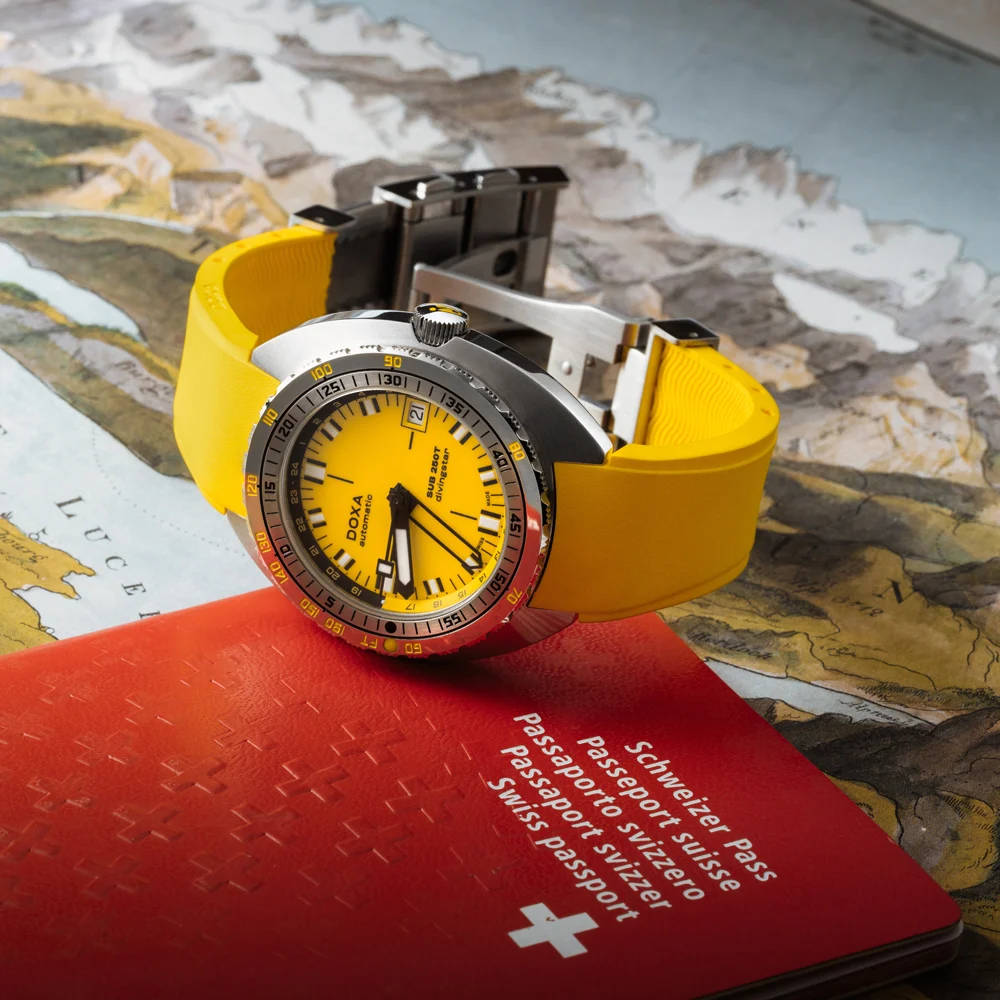
Doxa – specialist divers’ watches
The dive watch is popular among divers and landlubbers alike and many brands contribute their own renditions. But there are a few that embraced the category and became specialists in the genre. Doxa is a brand that has spent over 50 years perfecting the dive watch. In 1964, the head of development for Doxa, Urs Eschle, decided to create a dive watch for the hobbyist at a friendly price point. Prior to this, dive watches remained the provenance of professional divers and were an expensive niche.

Eschle worked with professional divers Claude Wesly as well as legend Jacques Cousteau to bring his vision to fruition. After three years in development, Doxa debuted the SUB 300 and SUB 300T at Baselworld in 1967. These watches were resistant to a depth of 300 metres and introduced the first patented unidirectional rotating bezel engraved with the US Navy’s no-compression dive calculating marks. In addition, Doxa inaugurated its now iconic bright orange dial, which was chosen after testing different colours for visibility in Lake Neuchâtel.

Doxa SUB 250T GMT – recalling the SUB 750T GMT from 2006
When it comes to functionality and durability, Doxa SUBs are engineered to withstand the most punishing of environments underwater, but given their robust specs they are also trusty companions to take on land and air adventures. Nearly 20 years ago, in September 2005, Doxa outfitted a SUB with a GMT function named the SUB 750T GMT, which added extra functionality for travellers and explorers above sea level. Doxa has since phased out the GMT function on its SUBs, but fans have been clamouring for an encore. Heeding the call, Doxa unveils the new SUB 250T GMT during Geneva Watch Week 2025.

Doxa SUB 250T GMT – ultra-legible dial and a highly wearable 40 mm case
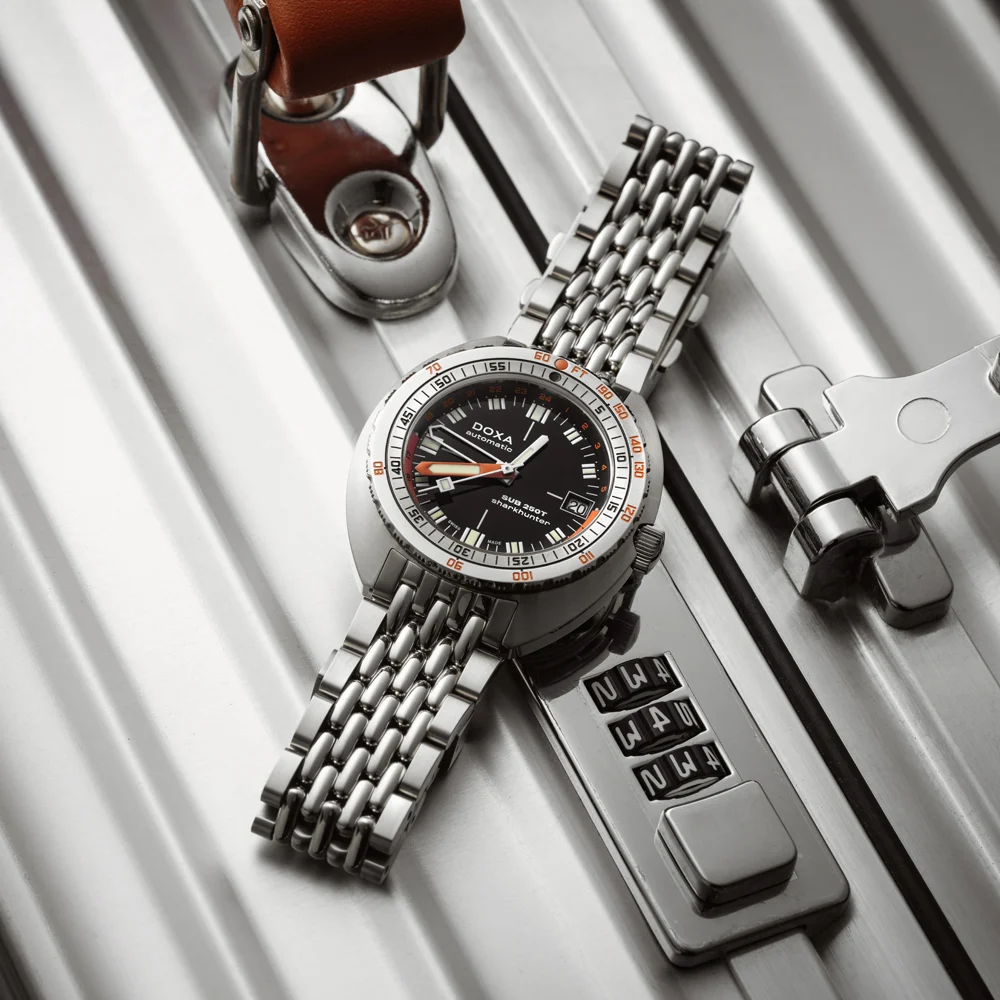
Housed in a 40 mm stainless steel case, the stylish SUB 250T GMT features hours, minutes, seconds, a date window at 3 o’clock and the aforementioned GMT function. Of course, it also includes the design elements that have come to define a Doxa dive watch: the patented unidirectional bezel with diving scales, a screw-down crown and water resistance to 25 ATM (250 meters/~820 feet). The dial also features Doxa’s checkerboard indexes and an oversized minute hand (when compared with the hour hand), as minutes are more important when timing dives. The painted indexes and hands, including the skeletonized GMT indicator, all get the Super-LumiNova treatment for functionality in low-light conditions.
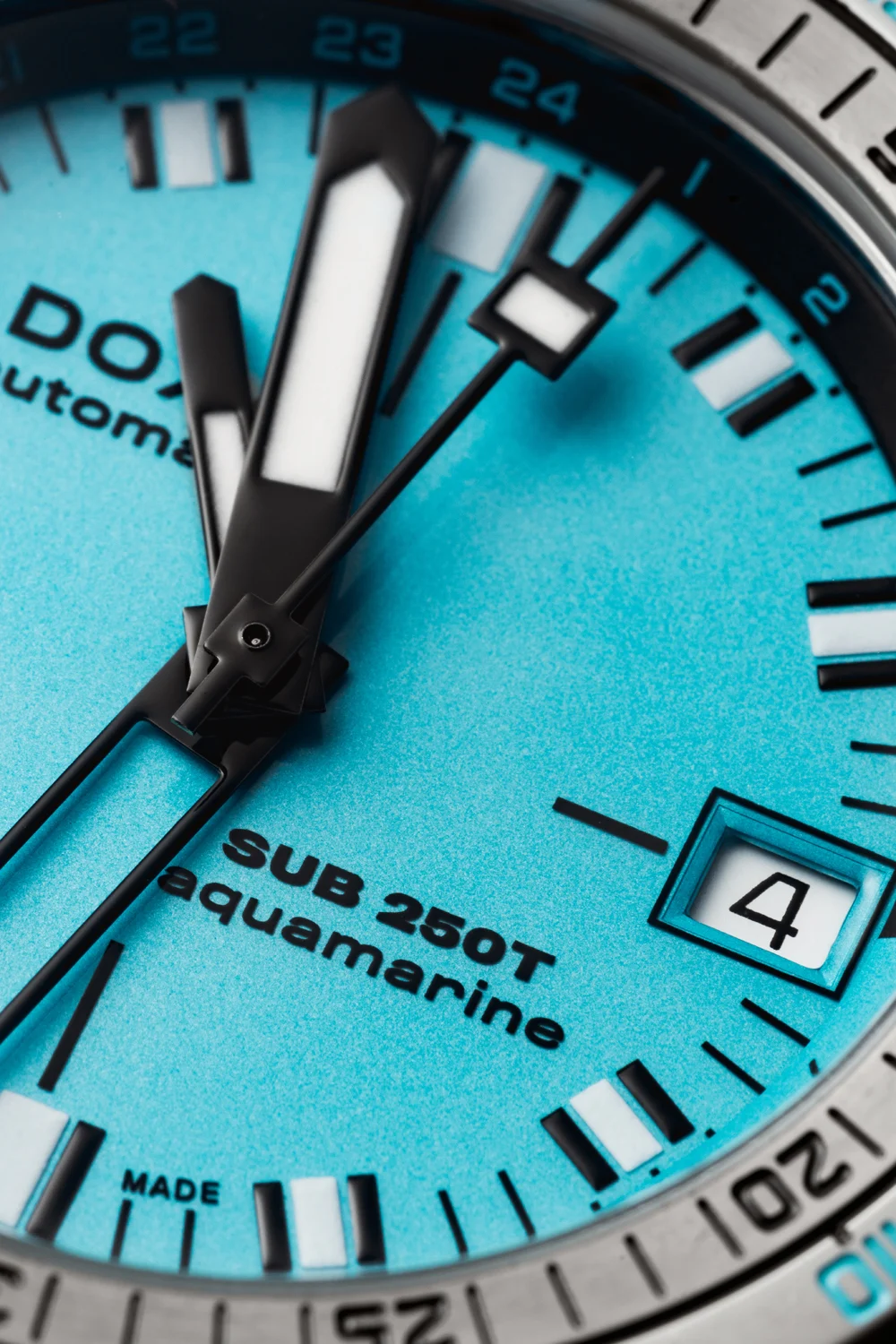

The SUB 250T GMT comes in all nine Doxa signature colours, including Doxa orange and spanning the spectrum from yellow and turquoise, to green, silver, white, navy and black, so there’s an option to fulfil all tastes. In addition, Doxa is releasing a special vintage Sharkhunter edition of the SUB 250T GMT with a gradient dial (the first time for Doxa), a tribute to the earlier Sharkhunter models that were distinguished by their all-white hands – bringing a total of 18 new references to the collection. The SUB 250T GMT straps to the wrist with either a FKM rubber strap, matching the dial colour, or the Doxa stainless steel ‘beads of rice’ bracelet. Befitting a dive watch, the strap and bracelet incorporate a folding clasp with diving suit extension.
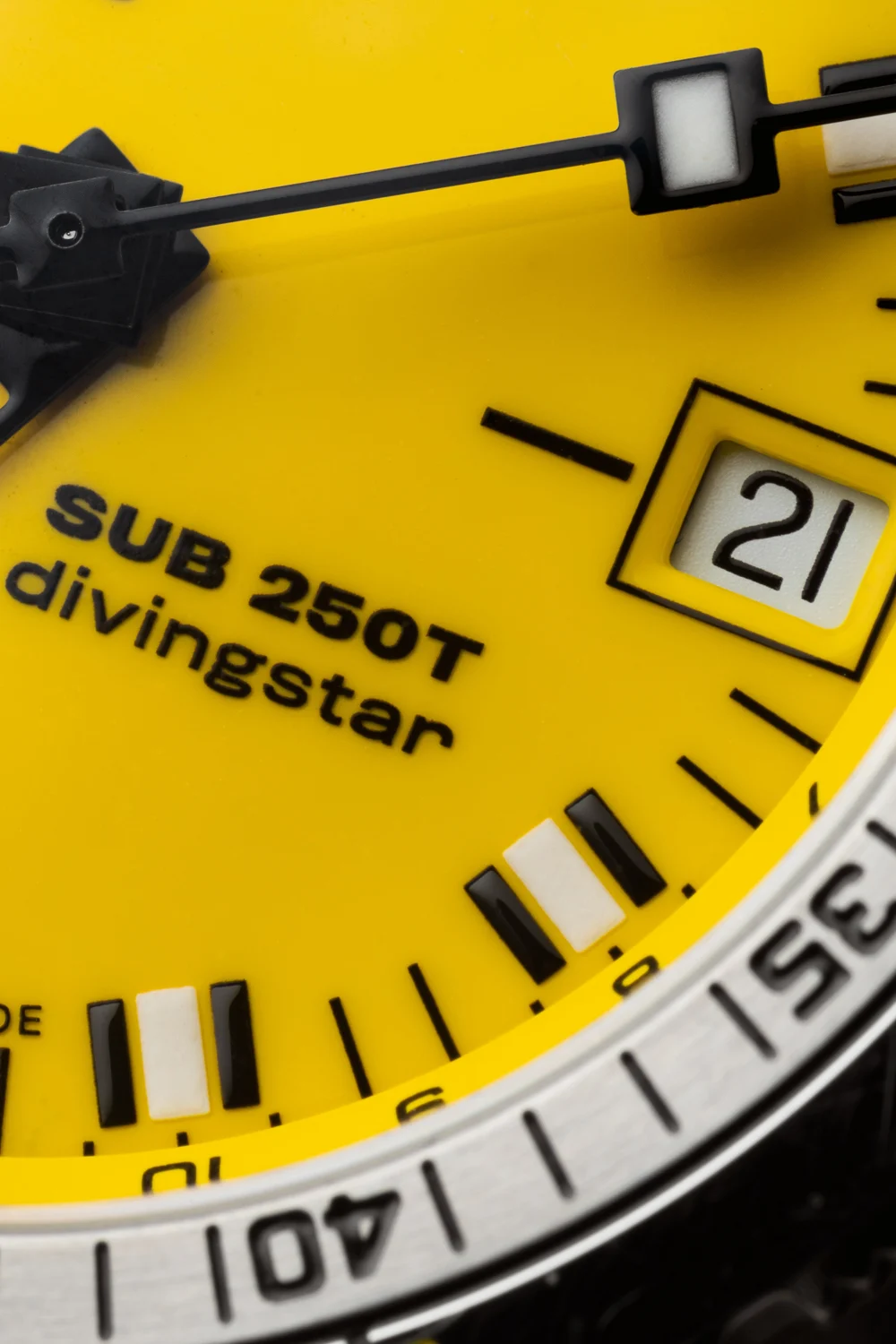
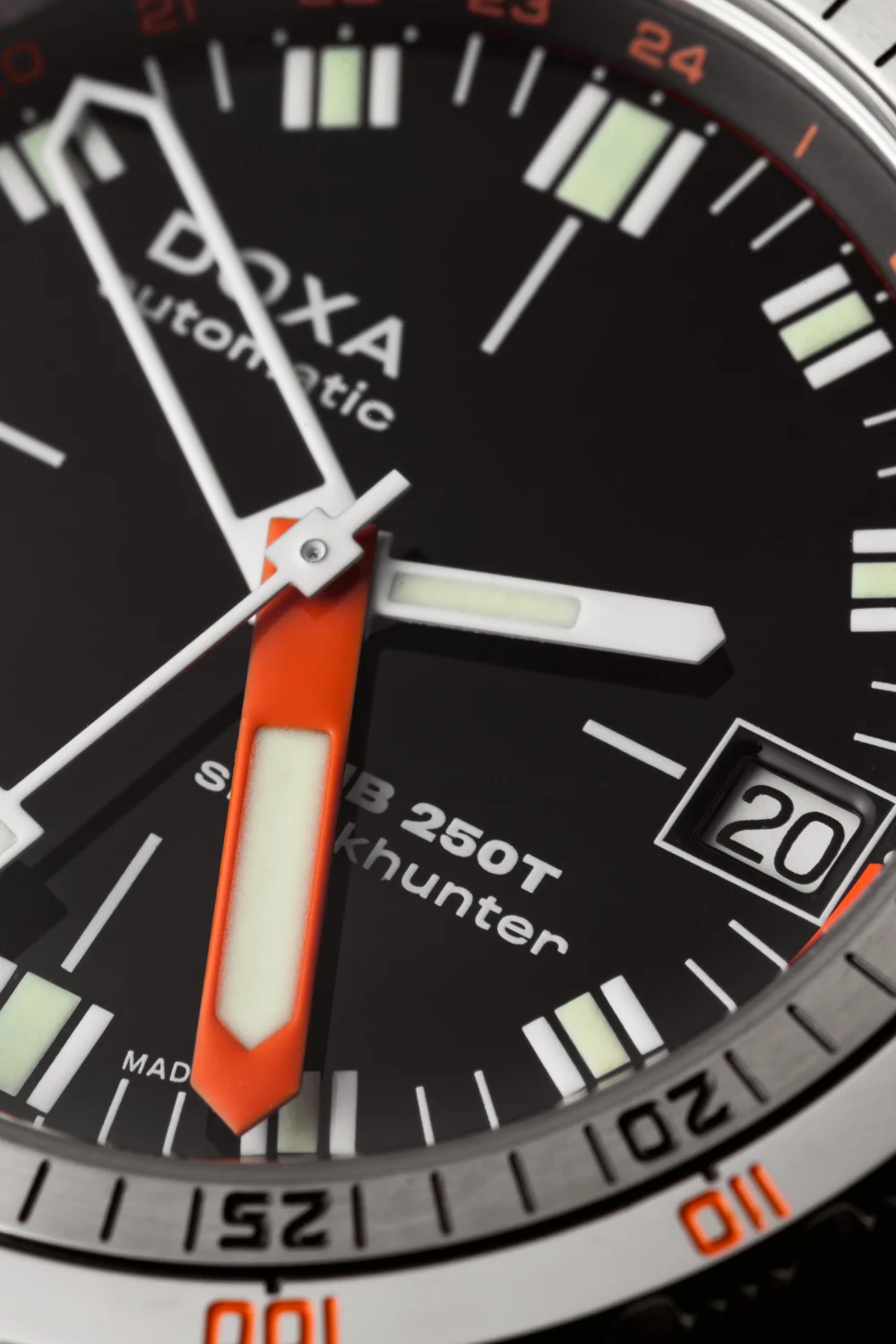
No matter the superior construction of a dive watch, it’s only as good as the reliability and precision of the movement. In this instance, Doxa has equipped the SUB 250T GMT with a Swiss movement with a healthy 50-hour power reserve that is dressed up with Doxa’s characteristic finishing, although the decoration isn’t visible due to the screw-in caseback.
Doxa SUB 250T GMT – closing remarks
With the SUB 250T GMT, Doxa brings back the dual time zone function to its dive watches. It’s a perfect pairing that will suit the sports and diving enthusiast, while also catering to globetrotters and those who need to track more than one time zone. In other words, the Doxa SUB 250T GMT is the ideal companion for Earthlings wherever they may be: land, sea or air.
Further reading
Technical specification
- Model: Doxa SUB 250T GMT
- Case: stainless steel, dimensions 40 mm x 42.90 mm, height 10.85 mm, water resistance 25 ATM (250 metres), sapphire crystal to front and solid case back
- Functions: hours, minutes, central sweep seconds, dual time zone
- Movement: Swiss mechanical self-winding movement, frequency 28,800 vph (4 Hz), power reserve 50 hours
- Price: FKM rubber strap – CHF 2,350 (RRP as of 26.3.2025)
- Price: ‘Beads of rice’ bracelet – CHF 2,390 (RRP as of 26.3.2025)