
Glashütte Original Senator Chronometer
The Glashütte Original Senator Chronometer is inspired by the marine chronometers of the late 19th century. It is made in the German watchmaking heartland, Glashütte. After his recent hands-on experience, Angus Davies explains how this modern-day timepiece sidesteps flamboyant colours, excessive branding or any other form of unnecessary exuberance. On the contrary, it is wonderfully legible, exquisitely made and a seemly exemplar of tasteful understatement.

In 1707, one of the worst maritime incidents in history occurred when four ships crashed into rocks off the Isles of Scilly, leading to the loss of approximately 2000 lives. At the time ‘Britain ruled the waves’ and had colonies dotted around the globe, hence the safe navigation of the seas was of huge importance. The Isles of Scilly tragedy led the British Parliament to pass the Longitude Act of 1714 and establish the Board of Longitude. A substantial prize of £20,000 was offered for a method of determining longitude within 30 nautical miles.
John Harrison (1693 – 1776), an English clockmaker embarked on his own personal journey to solve the longitude problem. He invented the first marine chronometer, the H1 (circa 1735). It proved to be a successful means of measuring longitude, albeit it did not fully meet the demands of the Board of Longitude. A partial award was made and Harrison was tasked to work on an improved clock. Over the years, Harrison would create the H2, H3 and ultimately the H4 marine chronometers, with each release delivering superior precision.
The desire to determine longitude was not merely the preserve of the British. The Swiss clockmaker, Ferdinand Berthoud, who worked in Paris, also strived to solve the longitude problem. No doubt he was attracted by the prizes on offer from the British and the French governments to ascertain longitude while at sea. Berthoud wrote his ‘Memoir on the principles of construction of a marine clock’ and submitted it in early 1761 while simultaneously making his first marine clock, No.1. Two years later, in 1763, Berthoud was appointed by Louis XV, the King of France, to look at Harrison’s H4, however, the Englishman refused to show him his marine chronometer. In 1765, Berthoud completed two further marine clocks, the aptly named No.2 and No.3.
The German Empire was founded in 1871 and thereafter became increasingly engaged in international trade. As a consequence of this, the German Navy became more important, hence the demand for marine chronometers grew. Historically, Germany imported English marine chronometers, however, everything changed in 1886 when Germany’s first marine chronometer was produced in Glashütte. It was sent for testing at the German Naval Observatory, Hamburg. Over the years, the town in Saxony, now famous for watchmaking, continued refining its marine chronometers and today they are held in high esteem.
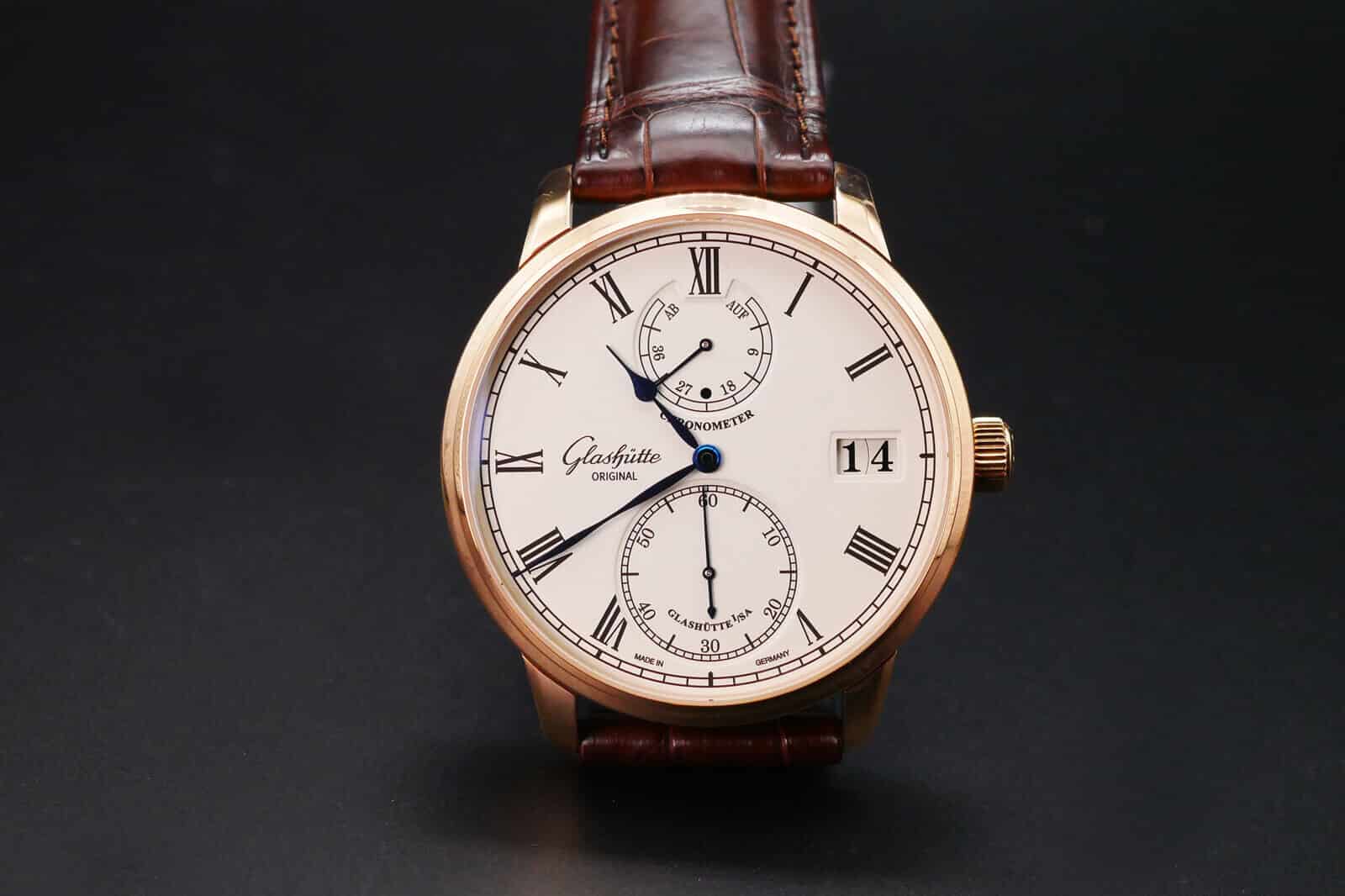
Although marine chronometers were superseded by alternative navigational aids, including today’s GPS systems, highly-precise chronometers for land-based use remain very desirable.
Glashütte Original are well-versed in making accurate and beautifully executed chronometers. For a timepiece to be termed a ‘chronometer’, it should be tested by a suitable certification body. The Glashütte Original Senator Chronometer has been tested by the German Calibration Service and is duly certified as a chronometer. In this feature, I explore its specification in detail.
The dial
The dial is silver-grained lacquer and appears light cream in colour, imbuing the dialscape with a slightly aged, vintage appearance. In addition, its velvety texture features small sparkling inclusions, albeit in a reassuringly understated way. Glashütte Original make the dials at its own specialist facility in Pforzheim before sending them to the firm’s Manufactory in Glashütte.

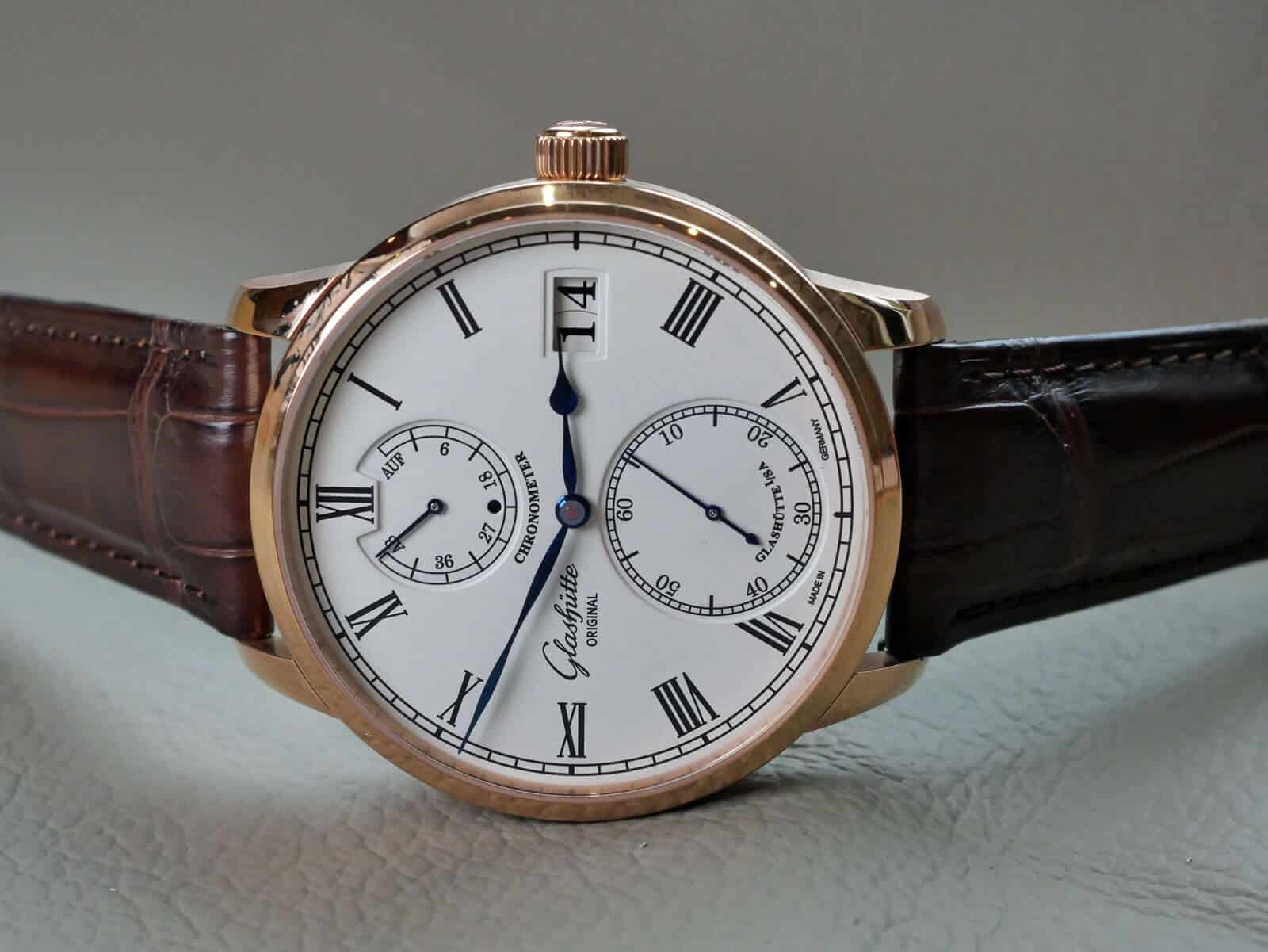
Thermally-blued poire-style hour and minute hands enunciate the time with a notable degree of style. The indexes are elongated Roman numerals, contributing to the overall perception of elegance. A power-reserve indicator is located below noon, while a small seconds display is positioned opposite at 6 o’clock. Both of these latter indications are recessed, enriching the sumptuous feel of the dial. A small aperture, discretely set within the power-reserve indicator, conveys whether the prevailing time is day or night.

Glashütte Original is a master of the large date display, or as they at the brand’s Manufactory, ‘Panorama Date’. The tens and the units are shown on two separate expansive discs which augment the legibility of the display. The date mechanism cleverly orchestrates the rotation of the discs. When viewing the display through a loupe, a faint line between the discs can be seen. This line is so fine, it is barely perceptible. Both discs appear to be on one level. With many large date displays, brands have the tendency to present each disc value with a frame, however, because of its refined execution, the Glashütte Original Senator Chronometer shuns this window-style approach. This is certainly one of the neatest large date displays I have seen.
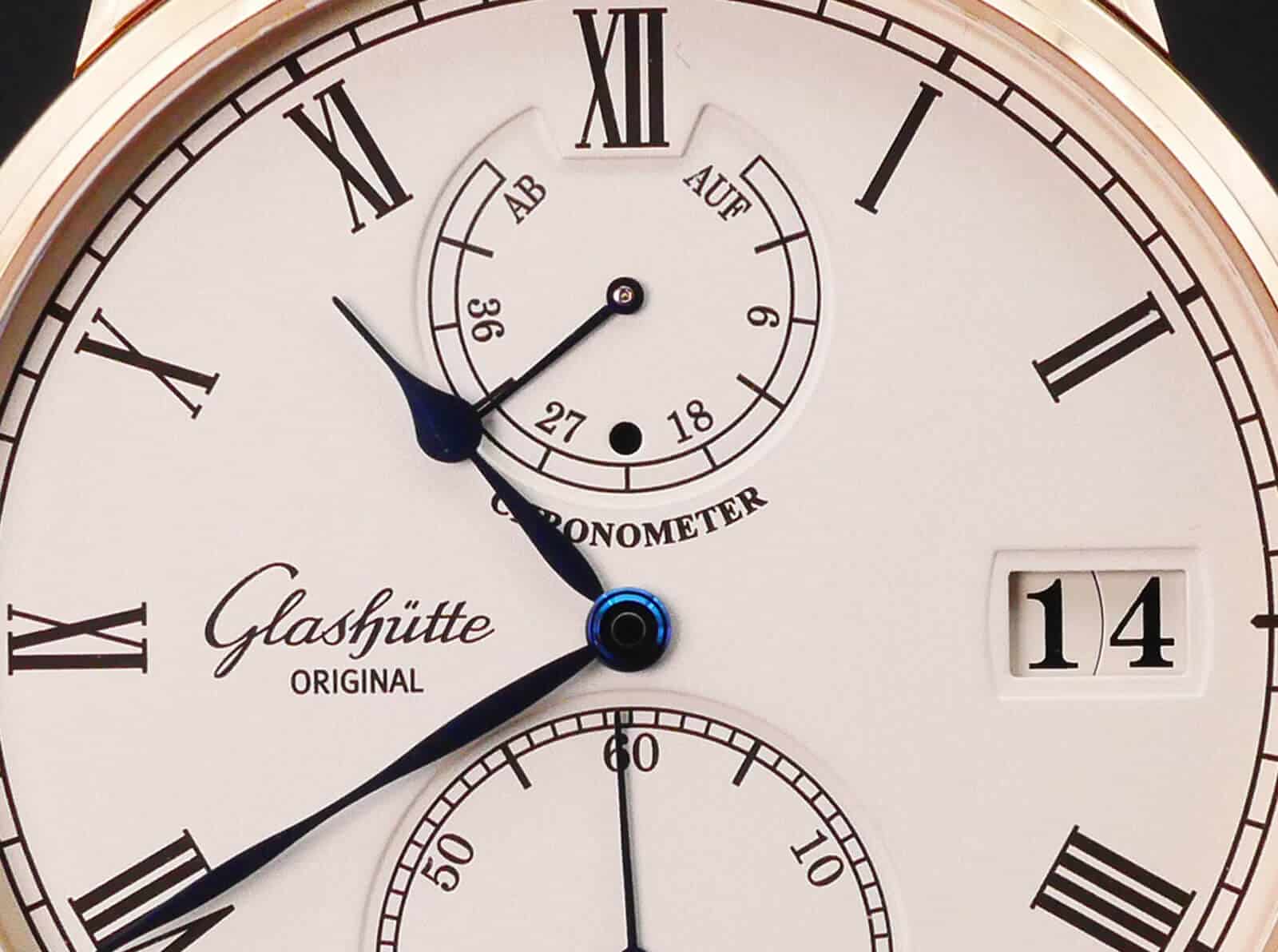
The date window features a stepped aperture. This is one of many subtle details which demonstrates the thoroughness to the brand’s approach. The previously mentioned small seconds display is framed with a chemin de fer and features a thermally blued hand. Normally, when the crown is pulled out, the hacking facility halts the seconds and it only recommences once the crown is pushed home. This common approach is usurped by the Glashütte Original Senator Chronometer. When the crown is pulled out, the seconds hand moves to ’60’ and the minute hand advances to the next marking on the minute scale. After the crown is pushed home, the seconds hand recommences its journey immediately. This allows the wearer to ‘set the time precisely to the second’, a requirement of the German chronometer standard.
A chemin de fer encircles the whole horological vista and, along with the indexes and numerals, it is laser-engraved and subsequently galvanised in black. Everything looks sharp and wonderfully refined.
The case
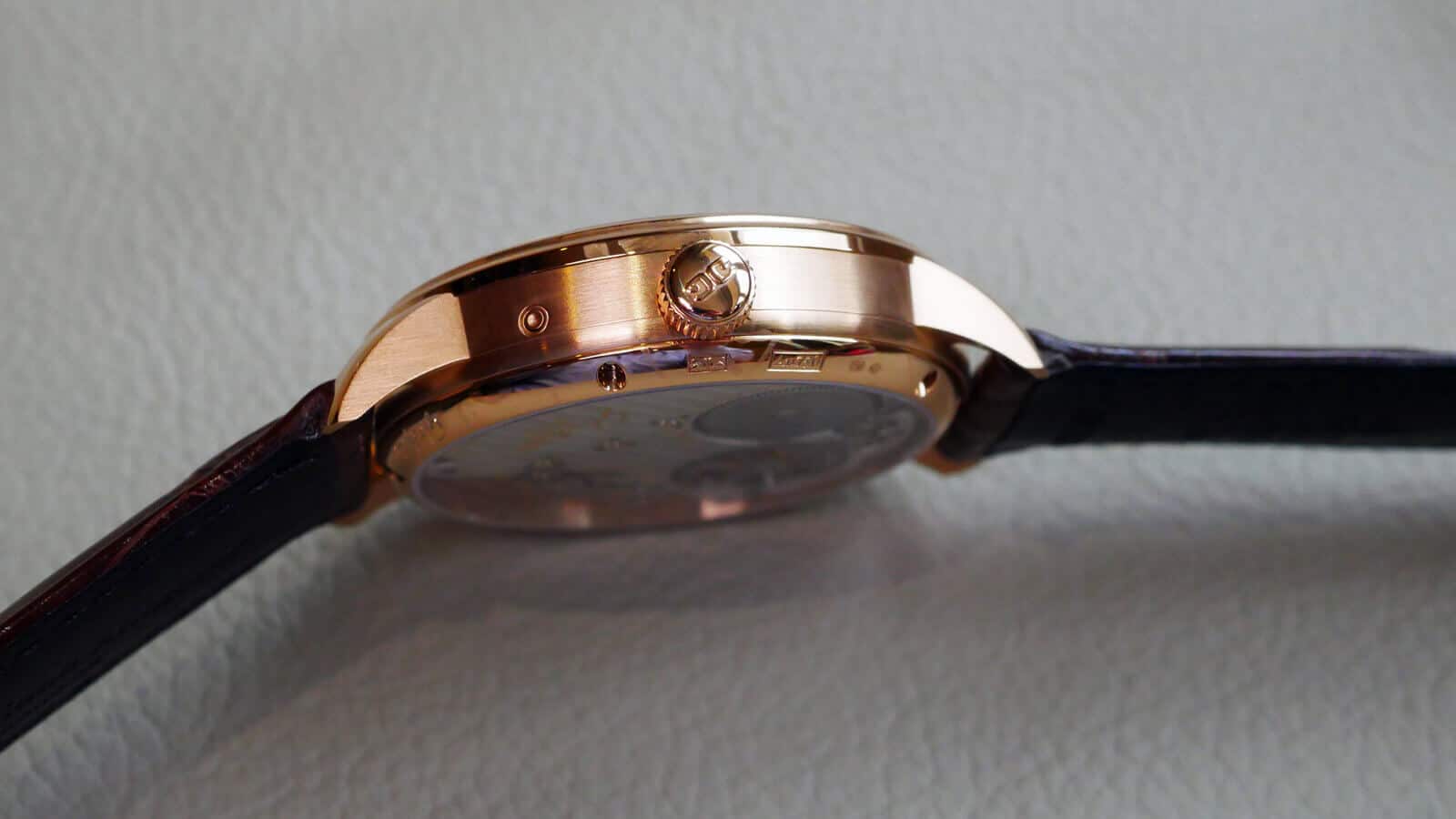
The Glashütte Original Senator Chronometer is housed in an 18-carat red gold case, measuring 42mm in diameter. The bezel, caseback and upper lug surfaces are highly polished, while the caseband and underside of the lugs are satin-brushed. Glashütte Original has judged the ratio between polished and satin-brushed surfaces to perfection.
A corrector is recessed within the caseband at 4 o’clock, allowing the date to be rapidly adjusted.
My press sample was presented on a dark brown Louisiana alligator leather strap paired with a folding clasp. The German marque also offers a pin buckle option which provides a £1600 saving, however, the clasp would still be my preferred choice.
To the rear of the watch, a pane of sapphire crystal affords sight of the hand-wound Calibre 58-01 movement. This is a movement that deserves to be seen as its exquisite execution is a feast for the eyes.
The movement
While many watch buyers favour automatic movements, there is nothing quite like the joy of owning a hand-wound timepiece. Every day, for just a few brief moments, the wearer is able to escape the hubbub of daily life and focus solely on turning the crown between forefinger and thumb. Indeed, energising the mainspring proves a cathartic experience that brings respite from life’s frenetic tempo.
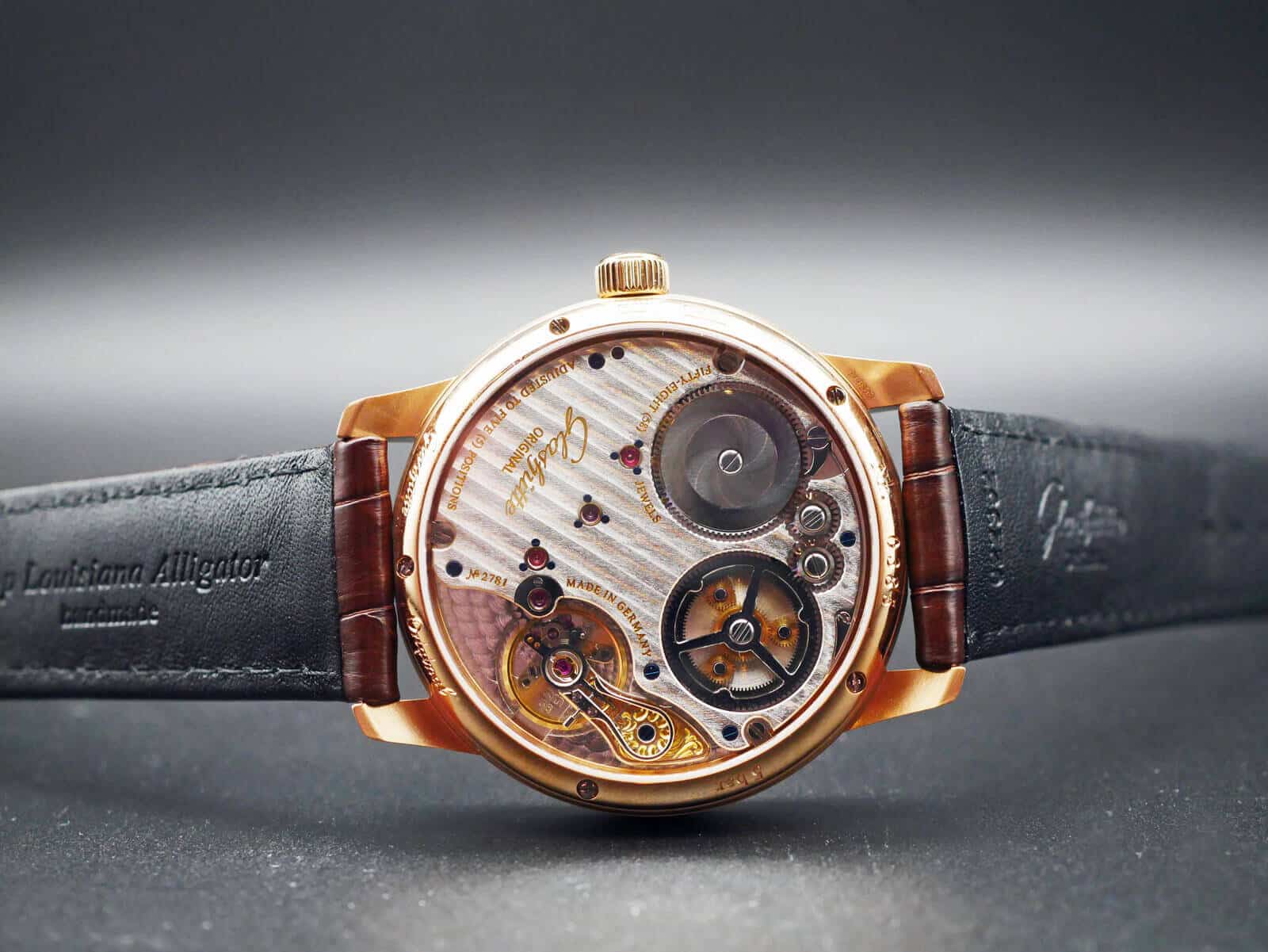
Upholding Glashütte tradition, the Calibre 58-01 is endowed with a three-quarter plate, unlike most Swiss watches which often employ numerous bridges. By fitting a three-quarter plate, the construction of the movement is more stable.
The three-quarter plate features a number of screwed chatons. This tradition can trace its origins to a time when real rubies were used as bearings. Sometimes when a ruby was pushed into a drilled hole it would break, proving a costly problem. Gold chatons provided the solution and consisted of lining the drilled hole with gold so that when the ruby was pushed into the hole the soft gold would accommodate the jewel without breaking it.
Today, the rubies used within the watch industry are artificial, similar in composition to the sapphire crystal, albeit red, and they are now made to precise tolerances. For this reason, chatons are no longer needed, however, they continue to be found on the finest watches and demonstrate an impressive degree of horological rectitude. In some instances, the chaton is held with two or three screws augmenting the overall allure. When mounted, the chatons should sit perfectly flush with the neighbouring surfaces of the three-quarter plate.

The ratchet wheel is embellished with 2-band snailing, while a planetary gear is positioned adjacent, driving the power-reserve indicator.
A hand-engraved balance cock is located next to the three-quarter plate and features a swan neck regulator. Unlike a simple index-adjuster, the swan neck regulator provides the means to alter the effective length of the hairspring more precisely, courtesy of a small screw. The balance is fitted with 18 screws, a traditional detail much loved by purists.
Beneath the balance, a sea of perlage can be seen while the three-quarter plate is embellished with Glashütte ribbing. Polished and thermally blued screws abound and the edges of the three-quarter plate are bevelled. Everything is distilled to a highly refined conclusion.
Despite this timepiece having a classical feel, the frequency of the balance is modern. Oscillating at 28,800 vph (4Hz), the cadence promises superior accuracy and shock resistance than a traditional frequency of 2.5Hz or 3Hz. The movement contains 58 jewels and, assuming the watch is fully wound, it will run autonomously for 44 hours 40 minutes.
Closing remarks
The dial is rich with subtle details, yet nothing inhibits readability. Indeed, the dial of the Senator Chronometer is a paragon of legibility. The epidermis of the dial evinces a subtle shimmer, courtesy of its silver-grainé finish. It proves impossible to capture with a camera but can be seen with the naked eye at close-quarters. There is a myriad of exquisite dial details, such as the blued poire-style hour and minute hands, however, it is the Panorama Date which appeals to me the most. Put simply, this latter indication is one of the neatest large date displays I have seen.
Measuring 42mm in diameter, the case is a very wearable size and the short, arcing lugs help the strap to envelop the wrist.
However, all roads lead me to the hand-wound Calibre 58.01 movement. It is beautifully appointed and once again demonstrates that the Manufactory makes watches of the highest order.
Returning to the marine chronometers of the 18th century, they were functional, highly-precise horological instruments intended for navigation. This delightful creation from Glashütte Original shares these attributes but is dressed in the finest clothes and blessed with prepossessing looks. It is a sublime watch that I would dearly love to own and, to date, it is one of my favourite watches to come from the watchmaking enclave of Glashütte.
Further reading
https://www.glashuette-original.com/
Technical specifications
- Model: Glashütte Original Senator Chronometer
- Reference: 1-58-01-02-05-30
- Case: 18-carat red gold; diameter 42 mm; height 12.47mm; water resistance 5ATM (50m); sapphire crystal to the front and exhibition case back.
- Functions: Hours, minutes; small seconds; stop-second/reset mechanism with minute detent; Panorama Date; power-reserve indicator; day/night indicator
- Movement: Calibre 58-01; hand-wound movement; frequency 28,800 vph (4Hz); 58 jewels; power reserve 44 hours 40 minutes
- Strap: Brown Louisiana alligator strap presented on an 18-carat red gold folding clasp
- Price: £22,800 (RRP as at 11.3.2021)