
Grönefeld 1941 Grönograaf
The Grönefeld 1941 Grönograaf is a chronograph with a difference. It features a centrifugal governor, a mechanism typically found on a minute repeater, but ingeniously employed on this high-end creation. With its gorgeous looks and no-compromise finishing, it was perhaps inevitable that the ‘Horological Brothers’ would scoop more silverware at GPHG 2022.

Oldenzaal
Oldenzaal, a town located in the Netherlands, close to the German border, is a picture-perfect place where streets are lined with pristine buildings, many of which feature Dutch bell gable roofs. There’s a square filled with cafés and a quaint church, St. Plechelmus, with a chiming clock. It is unquestionably a beautiful place, but what makes this modestly sized town special to any self-respecting horophile is that it is home to Bart and Tim Grönefeld. These charismatic brothers are two of the greatest watchmaking talents on the planet.
Bart and Tim Grönefeld
Following in the footsteps of their father and grandfather, who were both watchmakers, Bart and Tim chose to pursue a career in horology at a young age. They began honing their skills in the Netherlands before travelling to Switzerland where they eventually worked on high complications, including minute repeaters and tourbillons.

Unsurprisingly, having been born in Oldenzaal, the brothers eventually returned to the Dutch idyll. Initially, in 1998, the ‘Horological Brothers’ founded ‘Quality Watch Service in Netherlands’ and thereafter, in 2004, established their own eponymous Maison.
Grönefeld GTM06
The Dutch duo have never shied away from making technically challenging watches. Indeed, the firm’s inaugural model, the Grönefeld GTM06 was a one-minute tourbillon with a minute repeater. With the release of this model, the Horological Brothers showed they were ambitious and immensely talented.
Grönefeld Parallax Tourbillon – GPHG 2014
I freely admit that I’m a fan of the brothers’ work and I am clearly not alone. Grönefeld won the ‘Tourbillon Watch Prize’ for its Parallax Tourbillon at the prestigious GPHG in 2014. Two years later, it picked up another GPHG trophy, the ‘Men’s Watch Prize’. I suspect the duo will take home a lot more silverware in the future.

Bell gable bridges
In my opinion, Grönefeld makes handsome watches and has shown a penchant for employing interesting dial hues. Unusually, the mainplate and the distinctive ‘bell gable’ bridges are always executed in stainless steel. This material is more difficult to work with, however, it promises longevity and obviates the need for plating. Each square millimetre of every Grönefeld movement is refined to the highest order. Lastly, the two siblings have been innovative, creating watches that sidestep the conventional.
Grönefeld 1941 Grönograaf – GPHG 2022
Now, Bart and Tim’s capacity for blue-sky thinking has, once again, delivered a new chronograph, the Grönefeld 1941 Grönograaf, that is very different. With most chronographs, the action of pressing the pushpiece at 4 o’clock, initiates the ‘return to zero’ sequence. This inevitably creates huge forces that can scar hammers and bend hands. Therefore, the ingenious Horological Brothers have looked to the minute repeater and adapted the centrifugal governor, typically associated with this complication, and employed it on their new chronograph. So, when the pushpiece at 4 o’clock is actuated on the Grönograaf, the hands reset gently, the speed of their motion controlled by the centrifugal governor, conferring a far gentler action on associated parts.
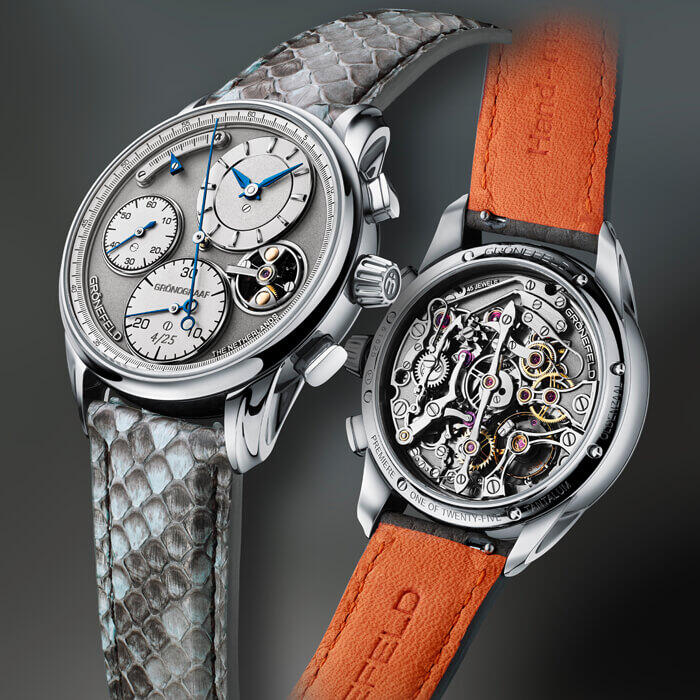
Another delightful touch with the Grönefeld 1941 Grönograaf is how the central chronograph seconds hand resets to zero. Basically, depending on the position of the heart-shaped cams, the central chronograph seconds will glide clockwise/anti-clockwise as it returns to zero.
Since being launched on the 7th of July 2022, the Grönefeld 1941 Grönograaf has proved a box-office sensation with all of the initial tantalum models being sold. Moreover, the Horological Brothers did it again scooping the ‘Chronograph prize’ at GPHG 2022.
The brand’s press release
Grönefeld 1941 Grönograaf
It was perhaps inevitable that Bart Grönefeld, would follow in the footsteps of his forefathers and become a watchmaker. Having completed his studies at the technical school in his home town of Oldenzaal, Bart enrolled at the school for watch technicians in Rotterdam. Already passionate about watchmaking, Bart’s fascination for horology grew exponentially when he attended WOSTEP in Neuchâtel, Switzerland. It was here that his teacher, Mr Antoine Simonin, showed the young man various pocket watches equipped with different complications. One particular pocket watch that Bart saw, featured steel bridges, a detail that provided the inspiration for Grönefeld’s distinctive stainless-steel bridges.

Similarly, Tim Grönefeld’s exposure to complications began at watchmaking school and was further heightened working on various complications in Le Locle. Again, it was Tim’s exposure to complex mechanisms that served to heighten his fascination with classical watchmaking.
Since 2008, Bart and Tim, ‘The Horological Brothers’, have produced a variety of unique mechanisms including a tourbillon minute repeater, a jumping seconds, a flying tourbillon with hacking seconds, etc… Their own unique take on classical watchmaking led to them winning two prestigious GPHG prizes: ‘Best Tourbillon’ for the Parallax model in 2014 and the ‘Best Men’s Watch’ for the 1941 Remontoire in 2016.
However, while both brothers have produced a number of different watches endowed with a variety of complications, they had never made a chronograph… until now.
The 1941 Grönograaf is the latest creation to be conceived in Oldenzaal. It is a classical chronograph, but consistent with the Grönefeld ethos, it incorporates several ingenious details.
A purist’s movement
Unlike mass-produced cam-actuated chronographs, the 1941 Grönograaf features a classical configuration, namely a column-wheel and lateral coupling, a combination synonymous with high-end watchmaking. The calibre G-04 is a symphony of 408 parts and a wonderful exemplar of no-compromise watchmaking.

Mindful that chronograph movements are often subject to harsh forces that can sometimes scar hammers and bend hands, The Horological Brothers conceived a less aggressive system, a ‘soft reset’ mechanism. A centrifugal governor, positioned at 4 o’clock, typically seen on minute repeaters, slows down the reset function, thereby proving kinder to components while delivering a fascinating spectacle in the process. The governor includes two solid gold weights.
Depending on the position of the heart-shaped cams for the counter hands, the relevant minutes and seconds hands rotate clockwise or counter clockwise, heightening the sense of mechanical theatre. The 30-minute counter, located at 6 o’clock, features an instantaneous jumping minutes’.
The ruby jewelled hammers lessen the impact when returning to zero. The keyless works features a conical winding pinion and crown-wheel, delivering a smooth winding action. Every detail is intended to augment refinement. The variable inertia balance mitigates positional influence and offers superior rate stability. The Philips terminal overcoil enhances isochronism, effectively causing the balance spring to breathe more concentrically.
The mainplate is embellished with spotting, while the bridges are formed of stainless steel, polished by hand. Moreover, the bridges have micro-blasted centres, circular graining on the top and feature various engravings in relief. The heart-shaped cams, the elongated chronograph bridge, the gold chatons and the screw-heads are embellished with black polishing, performed in the traditional way using diamond paste on a tin plate. Consistent with earlier Grönefeld watches, the finishing is worthy of the term ‘Haute Horlogerie’. Indeed, everything is reassuringly Grönefeld.
The 1941 case, now in tantalum
In 2016, Bart and Tim released the 1941 Remontoire, honouring their father, Sjef, by referencing the year of his birth. The 1941 case, measuring 39.5mm, was subsequently used for the Principia automatic and the Decennium Tourbillon and has won favour with many watch collectors.
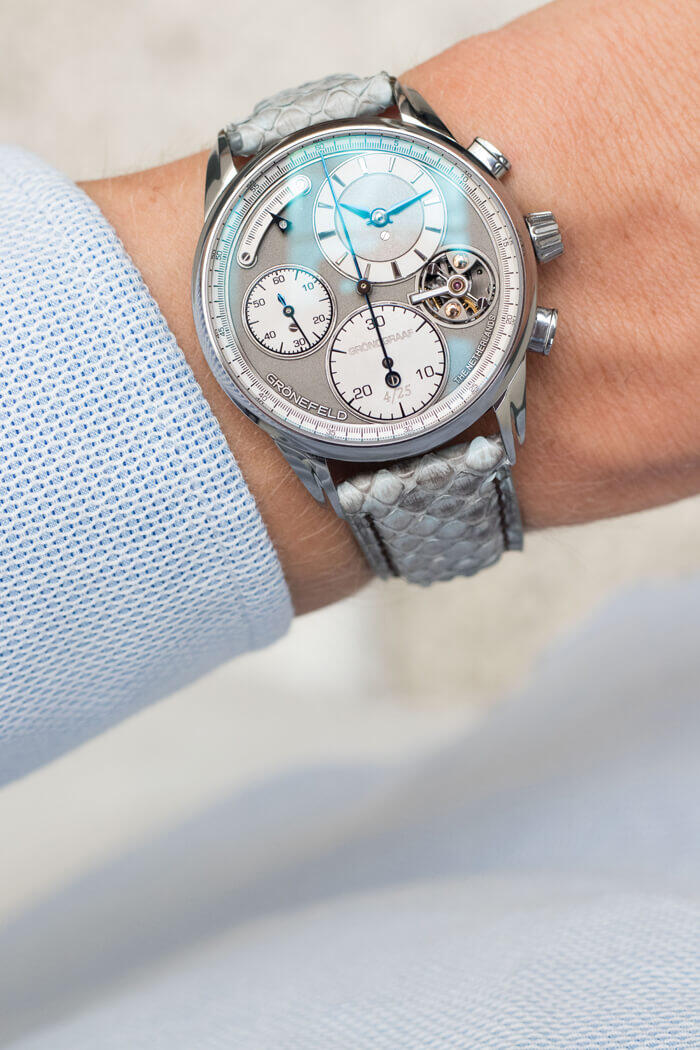
The sinuously shaped 1941 returns, albeit it is a smidgen larger, measuring 40mm in diameter. However, most notably, the case for the inaugural models, a limited edition of 25 pieces, is formed of the rare metal, tantalum. This material is hard, corrosion resistant, bioinert and exhibits a lustrous, blue-grey gleam. Tantalum is more than twice as dense as stainless steel, heavier than palladium and slightly lighter than gold.
The dial – a Dutch masterpiece
The hours and minutes are shown on an off-centre dial, a detail that first appeared on the 1896 One Hertz and later on the Parallax tourbillon. The time is expressed with Lancette hands and the hours are denoted with crisp, trapezoidal indexes. The hands are flame-blued steel, upholding watchmaking tradition, while the centres are mirror polished.
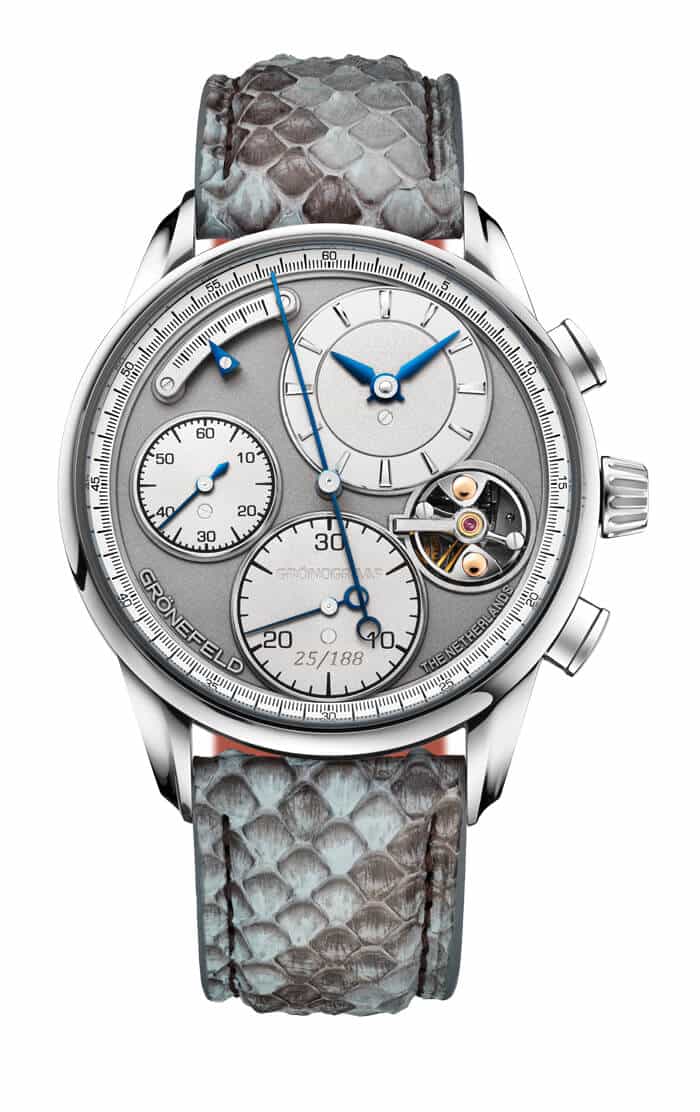
As stated earlier, the centrifugal governor sits at 4 o’clock. When the reset to zero pusher is pressed, the governor bursts into life, not only serving a functional role but delivering a wonderful animated performance.
A 30-minute counter, located at the base of the dial, features a Breguet-style hand. The instantaneous jumping minutes facilitates ease of read-off. A subsidiary seconds display resides at 9 o’clock, while a power reserve indicator, positioned above, is equipped with a pointer, seemingly floating adjacent a track, conveying the status of the mainspring. The central chronograph seconds hand subscribes to the classical Breguet-style and converses with a crisply-marked track positioned on the rehaut, proclaiming the elapsed seconds in an intelligible format.
The ‘Premiere Edition’ of the 1941 Grönograaf will be encased in tantalum and limited to just 25 pieces. Thereafter, Grönefeld will release 188 pieces in stainless steel.
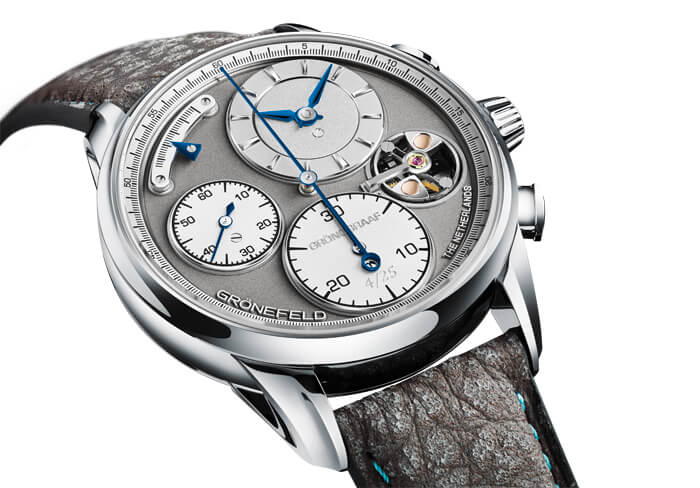
The 1941 Grönograaf is the distillation of three generations of watchmaking know-how, of the professional journeys of both Horological Brothers and the manifestation of their extraordinary passion for horology.
Further reading