
Henschke Hill of Grace Shiraz
Philip Day discusses Henschke Hill of Grace Shiraz, fine wine from the Eden Valley region, located in the Barossa, South Australia. The company has an impressive 147 year history, remains under the control of the founding family and dates back almost as far as Australian viticulture itself.
Henschke is a 147 year old, family-owned, fifth generation Australian winery, with the sixth generation now being introduced to the business. The vineyards located in Keyneton, in South Australia’s Eden Valley, date back to the 1860s, which is almost as far back as Australian viticulture itself. The first family vines were planted in the early 1860s in Keyneton by Johann Christian Henschke, a migrant from Silesia. It’s currently run by the dynamic winemaker and viticulturist pairing of husband and wife team Stephen and Prue Henschke.
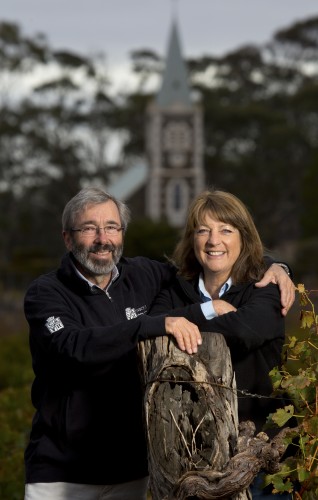
Stephen and Prue Henschke
Henschke, is the name of both the vineyard and the wine that has so enthralled lovers of red wine. Its leading portfolio wine is ‘Hill of Grace’, which has become one of the stellar, superior Australian flagship wines, which is frequently bought by many to celebrate special occasions and commemorate significant life-changing events, like the year a child was born, or year of marriage for example.
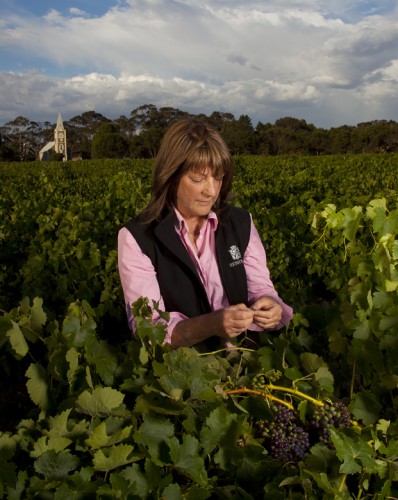
‘Hill of Grace’ is surely one of the most evocative names in the world of wine. It is a translation of the German ‘Gnadenberg’, both the name of a region in Silesia, and that given to the lovely Lutheran Church across the road from the Hill of Grace vineyard.
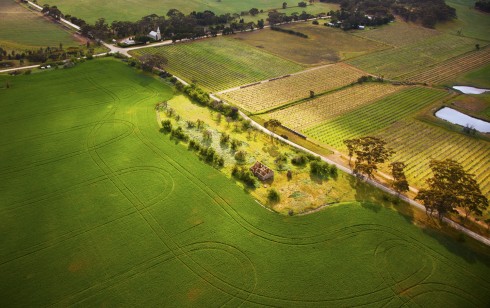
Hill of Grace – Aerial shot
It was launched with the 1958 vintage, the quality of which firmly established the name Henschke with wine cognoscenti internationally.
History
The story of the Henschkes in Australia began with a mid-19th-century influx of Lutherans escaping religious persecution in Silesia (an area that is now part of south-west Poland). On arrival in South Australia, they like dozens of other families, made their way to the Adelaide Hills where Johann Christian Henschke became one of the founding fathers of Lobethal, before re-settling near Bethany in the Barossa Valley. He then purchased land at Keyneton in the higher Eden Valley, relatively cooler than the Barossa Valley floor.
In 1860 the Henschkes, their kin and several of the other families got together and built themselves a beautiful stone church, naming it ‘Gnadenberg’ as a reminder of a place the community had left far behind. In the same year, just in front of the church, fellow Lutheran Nicolaus Stanitzki planted a vineyard he called ‘Hill of Grace’, the English translation of ‘Gnadenberg’.
In 1868 Johann Christian Henschke produced his first vintage of about 300 gallons of wine. In 1891 Johann’s son Paul Gotthard Henschke purchased the Hill of Grace vineyard from the Stanitzki family.
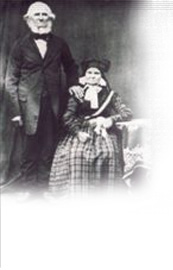
First Generation
– Johann Christian Henschke & Dorothea Elisabeth Schmidt circa 1870
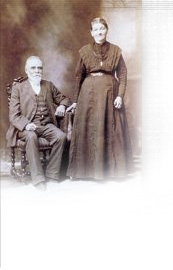
Second Generation
– Paul Gotthard Henschke & Johanne Mathilde Schulz
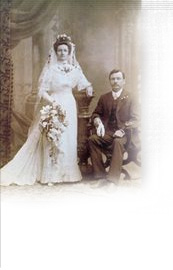
Third Generation
– Paul Alfred Henschke & Johanne Ida Selma Stanitzki circa 1907
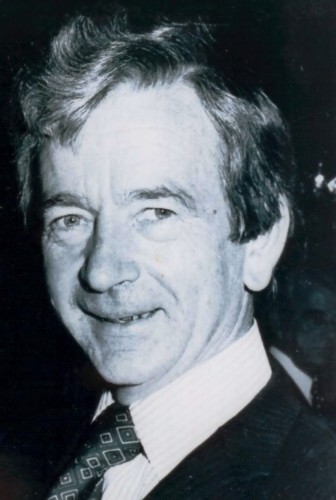
Fourth Generation – Cyril Henschke circa 1976
In 1979, the current owners Stephen and Prue Henschke took over the running of the winery following the passing of Stephen’s father Cyril. Their children will become the sixth generation to have custody of some of Australia’s oldest vines, many of which are up to 150 years old.
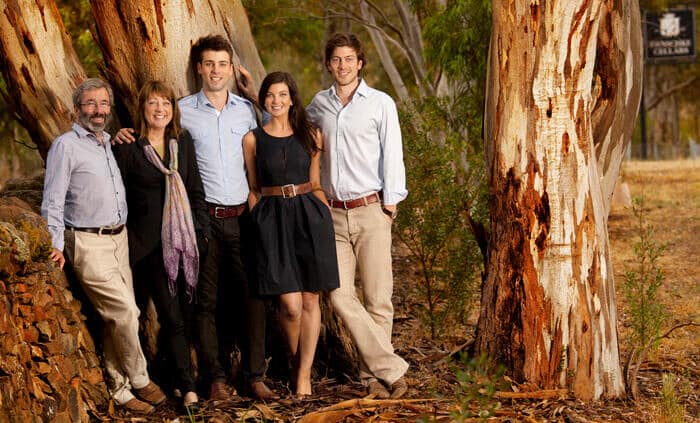
Fifth and sixth generations – Stephen, Prue, Andreas, Justine & Johann
| Appellation | Henschke: Hill of Grace Shiraz (single vineyard bottling)
|
| Owner | Stephen and Prue Henschke
|
| Planted acreage | Hill of Grace vineyard around 8 hectares (19.7 acres) of which around 4 hectares (9.88 acres) are Shiraz.
Total vineyard area: 105 hectares (Eden Valley & Adelaide Hills) |
| Grape varieties | Riesling, Gewürztraminer, Sauvignon Blanc, Semillon, Pinot Gris, Chardonnay, Pinot Noir, Tempranillo, Cabernet Sauvignon, Shiraz, Muscat Blanc, Nebbiolo, Barbera, Grenache, Mataro (Mourvèdre), Viognier, Cabernet Franc and Merlot. |
| Wines produced |
Henscke also produces a wide range of other wines:
|
| Terroir | The vineyard boasts five different soil types, planted on alluvial, sandy loams interspersed with gravels over red clay.
|
| Production | Information not available
|
| Top Vintages Produced
(Henschke Hill of Grace) |
1958, 1959, 1961, 1962, 1963, 1965, 1980, 1981, 1982, 1983, 1984, 1985, 1986, 1987, 1988, 1989, 1990, 1991, 1992, 1993, 1994, 1995, 1996, 1997, 1998, 1999, 2001, 2002, 2003, 2004, 2005, 2006, 2007, 2008, 2009, 2010. |
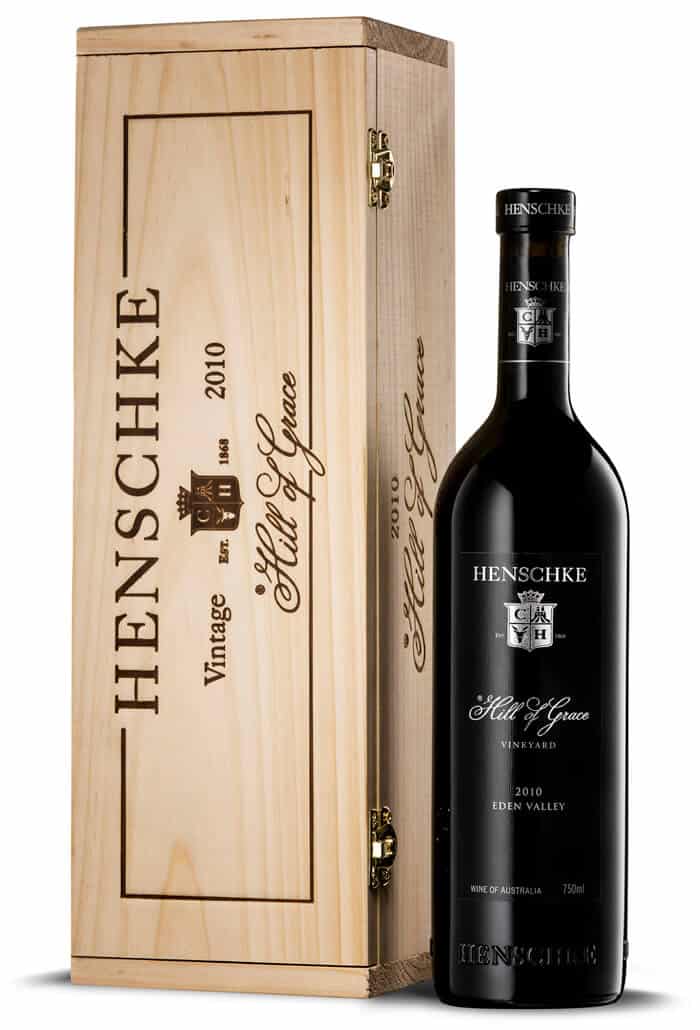
Henschke Hill of Grace Shiraz (Eden Valley) 2010
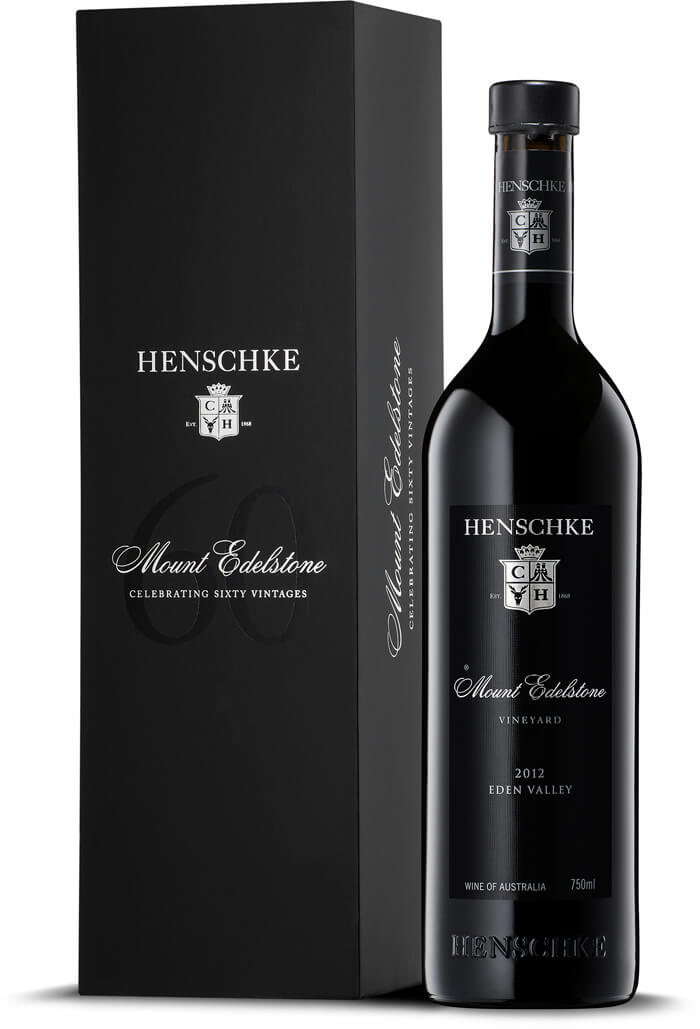
Henschke Mount Edelstone Shiraz (Eden Valley) 2012
Viticulture
Prue Henschke began using organic techniques in the 1980s, before it was considered common-place, in order to improve soil health, reduce erosion, improve water holding capacity of the soil and control weeds with the use of herbicides. She has supplemented this with biodynamic practices since 2005 to recycle all the winery waste products and to apply biodynamic compost along vine rows to improve soil health, soil carbon and vine health. She has also been a pioneer in incorporating native grasses and native flowering plants into the vineyard to attract predatory insects and eliminate the use of insecticides.
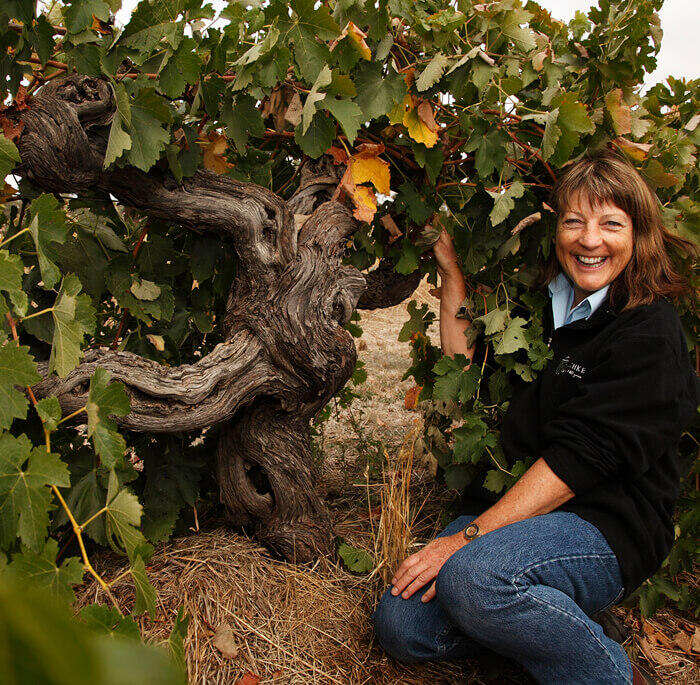
Hill of Grace, the most famous vineyard, is 4 hectares of old vine shiraz featuring five different soil types, including the celebrated ‘Grandfather vines’ dating back some 155 years.
The grapes from the vines that commonly go into the Hill of Grace Shiraz blend originate from six distinct Shiraz blocks:
- Grandfathers (0.69 hectares/1.7 acres planted in 1860)
- Post Office Block 1 (0.51 hectares/1.26 acres planted in 1910)
- Post Office Block 2 (0.57 hectares/1.4 acres planted in 1965)
- Church Block (0.74 hectares/1.82 acres planted in 1952)
- House Block (1.08 hectares planted in 1951)
- Windmill Block (0.88 hectares/2.66 acres in 1956).
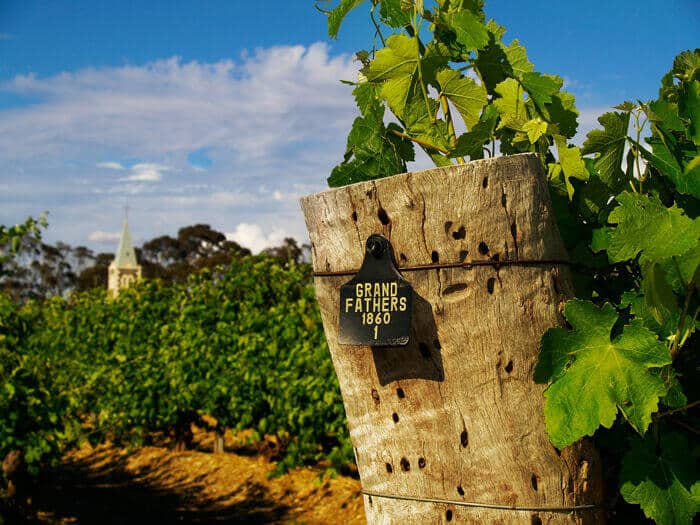
Hill of Grace Grandfathers Block
There is also a seventh block of Shiraz from a mass selection Prue carried out in 1986 in the Grandfather vines to find the best genetic material, which was planted in 1989 and is known as Post Office Block 3. This one day may form part of Hill of Grace, but currently wine from this block is being released as the Hill of Roses Shiraz.
Henschke Lenswood Vineyard
Based on the Henschkes’ experiments over time, the trellis style used in the vineyard has been changed from the traditional single-wire ‘umbrella’ to ‘VSP’ (vertical shoot positioned) and ‘Scott Henry’ (a dual wire, split canopy system, eponymously named after Scott Henry Oregon winemaker and retired aerospace engineer, who developed it) to improve fruit quality and yield from potentially over-vigorous vines, which would otherwise produce masses of foliage rather than bunches of grapes. Additionally the vineyard is planted east to west in order that the face of the vine rows get the northern sun.
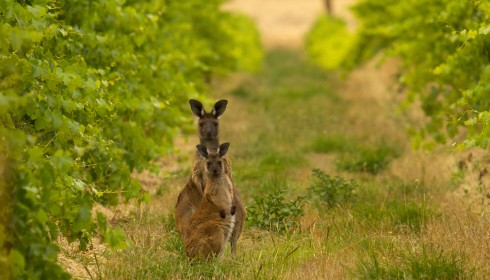
One of the biggest problems facing organic growers has been how to control the growth of under-row weeds, which, in conventional vineyards, is accomplished by the use of chemical herbicides. To achieve the same aim, in the winter the grass is mown around the base of the vines and a permanent sward of straw mulch is spread under the vines, further deterring weed growth while helping to maintain soil moisture and encourage beneficial insects.
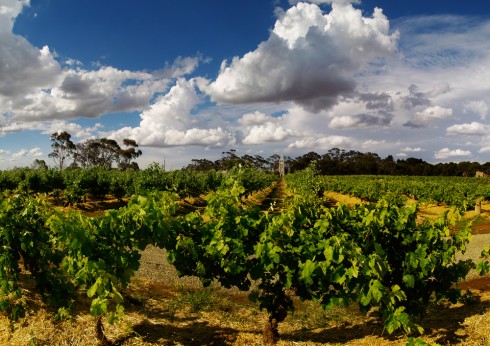
Hill of Grace
Other sustainable/organic/biodynamic practices the Henschkes employ include: no longer dodging the vines following a schedule of organic sprays; making use of recycled water from winery effluent dams; recycling stalks and skins in a compost pad and making use of recycled plastic fence posts instead of chemically treated wood, which can be a source of soil contamination.
Biodynamic Horn Manure (BD500) is employed as a soil conditioner which is obtained, when required, from one of the growers that Henschke use, who also have dairy cattle and a plentiful supply of manure.
Under the guidance of viticulturist Prue Henschke, the vineyard currently combines sustainable wine growing, organics and biodynamic practices to deliver an integrated system. Minimal chemical input in the vineyard is a strong part of Henschke’s viticultural management and is achieved thanks to an integrated pest management programme, which predicts any possible disease pressure.
Yield estimates are carried out in early summer, and cropping levels are kept in check by bunch thinning at veraison (the onset of ripening denoted by a change of colour of the grape berries.)
Viniculture
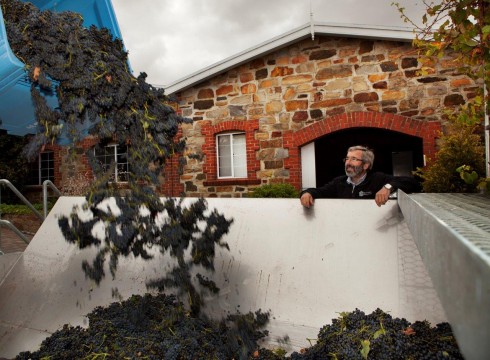
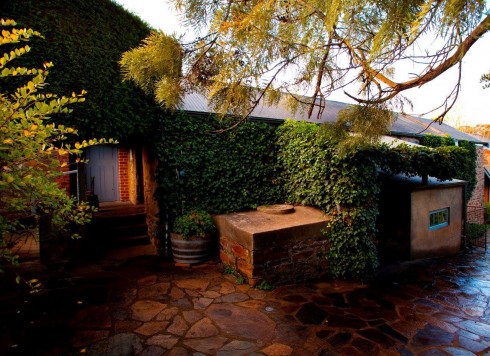
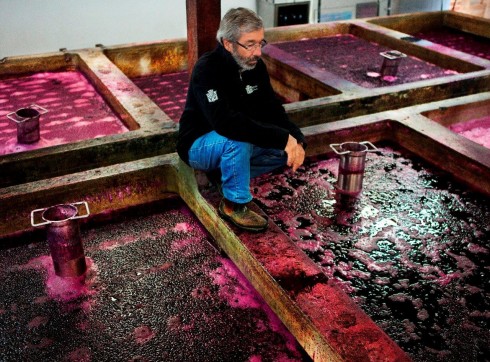
It’s not just the vineyards that have history: the winery itself also dates back to the 1860s. Traditional and ‘natural’ winemaking practices are predominantly those employed by the Henschkes. Once the fruit has attained optimal maturity, the hand-picked red wines are fermented in open-top fermenters with the cap submerged by boards. The submerged cap aids the gentle extraction of softer, silkier tannins. Unlike some biodynamic practitioners, cultured yeasts are used but there is minimal racking, no fining and minimal filtration. Towards the end of the fermentation process, the reds are transferred to American and French oak barrels, where they are allowed to undergo malolactic fermentation and mature for some time (two years in the case of Hill of Grace).

The main shift away from traditional practices is the use of screw-caps instead of corks, due to the high level of leakage, random oxidation, crumbling corks and TCA. Stephen Henschke explains: ‘With screw-caps you encapsulate the wine as the winemaker intended the wine to be, and therefore the winemaker cannot blame the bad wine due to cork. We shifted to screw-caps from 1996 with 10% in caps and 90% still in cork. The bottles with screw caps sold so fast that we shifted to screw-caps fully in 2002.’ Since 2005 100% of ‘Hill of Grace’ is sold either with screw-cap, or more recently under the new innovative glass Vinolok.
Henschke Hill of Grace 2010 Vines of Radiance
In the news
- March 2014
The Henschke family vows to commission a new piece every year to honour the inspirational wine. On releasing the 2009 vintage of Hill of Grace to the global market in 2014, Stephen and Prue Henschke invited popular Australian poet Rupert McCall to write an ode to the wine, ‘Vines of Resilience’ to pay homage to the pioneers who planted the Hill of Grace vineyard in the 1860s.
In the inaugural Hill of Grace ‘artwork’ McCall also toasted the still existing original plantings, affectionately known as ‘the Grandfathers’.
- April 2015
To share an insider’s view of the latest vintage of Hill of Grace, the 2010, the Henschke family asked celebrated Barossan artist Rod Schubert to capture the essence of their ancestor vines in ‘a year graced by Radiance’. An image of Schubert’s triptych is included in each timber gift box of 2010 Hill of Grace. Limited edition prints are available for purchase from the winery.
- May 2015
‘Back in 1981, you could pick up a bottle of Henschke Hill of Grace 1977 for $5.70. Last week the newest vintage of the fabled Hill of Grace shiraz went on sale for $699.’ (The Australian, 15 May, 2015)
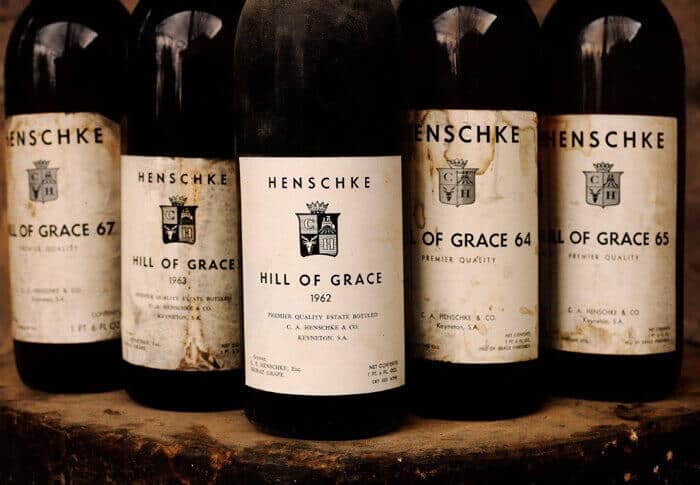
Vintage Hill of Grace
Contact details
Address: C A Henschke & Co PO Box 100 Keyneton S.A. 5353 Australia.
T: +61 (0)8 8564 8223
F: +61 (0)8 8564 8294
E: info@henschke.com.au
Facebook: https://www.facebook.com/HenschkeWines
Twitter: https://twitter.com/henschkewines
References
- https://www.Henschke.com.au
- https://www.australiasfirstfamiliesofwine.com.au
- https://www.winecompanion.com.au/wineries/south-australia/eden-valley/henschke
- https://www.wineanorak.com/barossa/henschke.htm
- https://www.wine-searcher.com/m/2014/12/10-things-every-wine-lover-should-know-about-henschke
- https://www.thewinedoctor.com/advisory/technicaltraining.shtml
- https://www.jancisrobinson.com/articles/divine-providence-henschkes-inheritance
- https://www.delhiwineclub.com/Interview/Henschke.
About the author
Philip Day is an early-retired academic in linguistics who has published many articles.
A North-Midlander (The Potteries) by birth, he currently lives close to the Lancashire Pennines which he regularly explores with his Patterdale terrier, Max.
In particular, he has a keen interest in European fine wines and good food and will be contributing further articles in the future for Escapementmagazine.com.