
Hermès Arceau Le Temps Voyageur
The Hermès Arceau Le Temps Voyageur is a worldtimer, however, it is markedly different from other models equipped with this complication. It features an ingenious display showing the ‘local time’ circumnavigating the central area of the dial when selecting the ‘local city’. For bleary-eyed globetrotters, this user-friendly system makes a strong case for acquisition. And, as you expect from Hermès, the model is incredibly stylish.
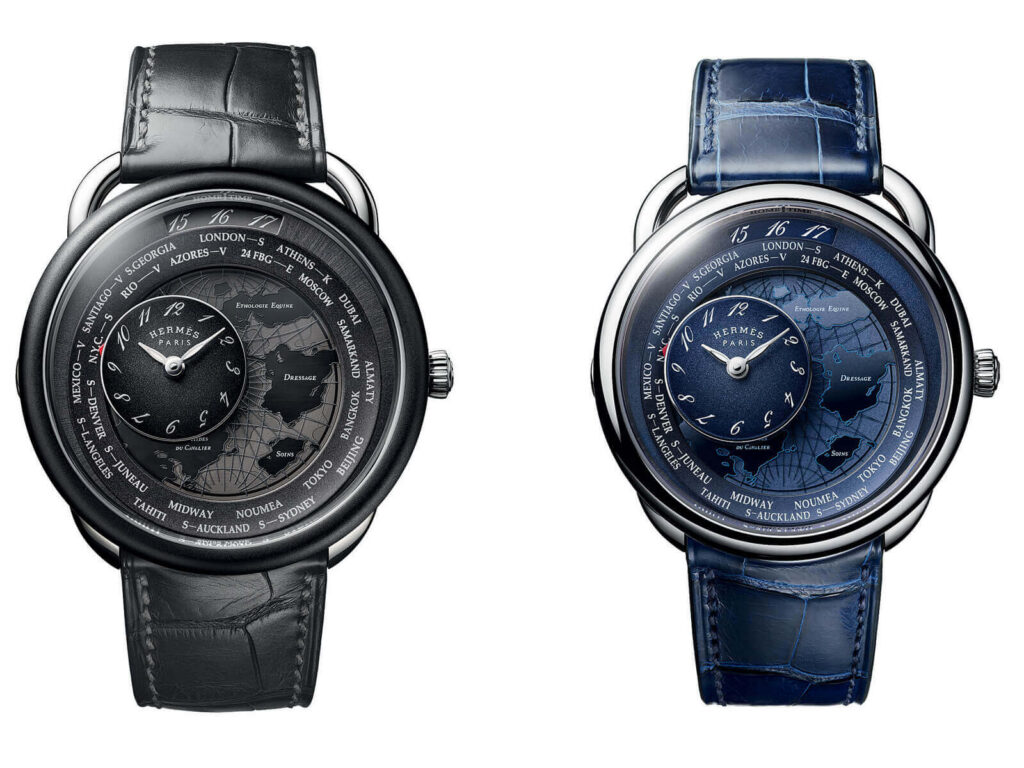
Image – Joel Von Allmen ©copyright
For a long time, humans used the sun to determine the time. Indeed, the norm was to set clocks at noon as the sun reached its highest position. Clearly, the longitude of a location would determine the prevailing time. This was not an issue until railways within the United States became a popular form of travel.
The problem was that each station along a route would base its timetables on its own ‘local time’, making scheduling incredibly difficult. Inevitably, miscalculations occurred, leading to railroad collisions, sometimes with grave consequences.
In 1884, the International Meridian Conference was held in Washington, DC. Various nations attended the conference and collectively agreed the longitude running through the Royal Observatory in Greenwich, London should be defined as the official prime meridian. The world was divided into 24 zones with each time zone expressed as GMT ± a specified number of hours. Not all locations adopted the system immediately, but today it is in widespread use. Nevertheless, there are some parts of the world where the local time is ‘offset’ eg Kolkata is GMT + 5:30.
In the early 20th century, with international travel becoming more popular, there was a growing need for watches to simultaneously display the time in different parts of the world. In 1931, Louis Cottier (1894-1966), a Swiss watchmaker from Carouge, Geneva conceived the first worldtimer. Its specification comprised of a city disc, marked with the names of prominent cities from around the globe, arranged on a track encircling the dial. Cottier’s clients included Patek Philippe, Rolex and Vacheron Constantin.
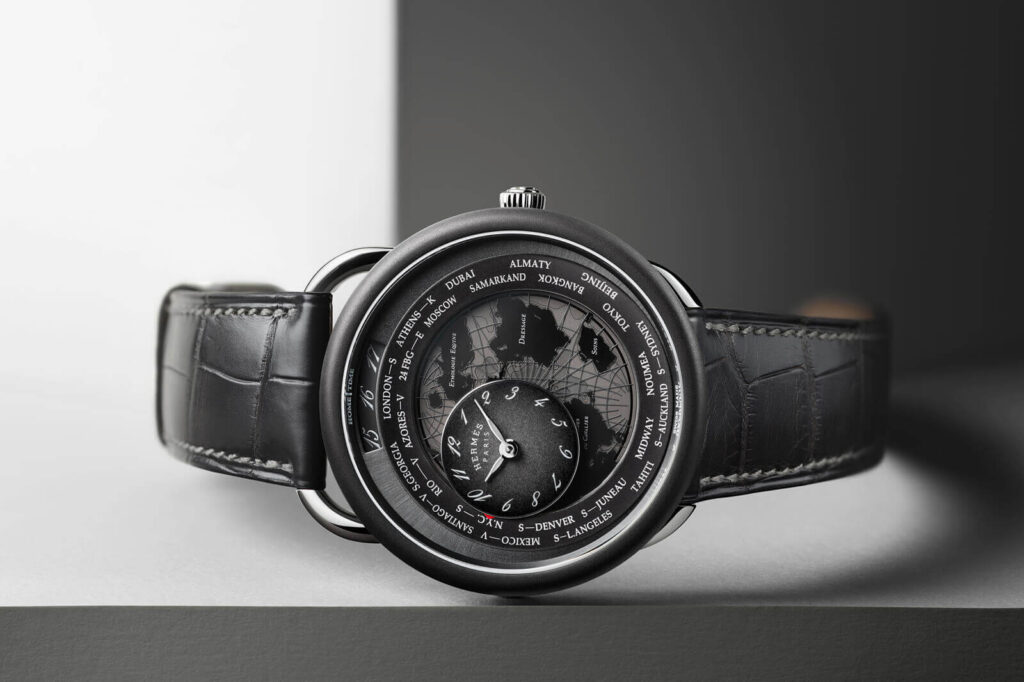
Image – Joel Von Allmen ©copyright
Now, Hermès has released a new timepiece at Watches & Wonders 2022 which provides a new and interesting take on the worldtimer complication. Like Cottier’s design, the Hermès Arceau Le Temps Voyageur features a city disc, marked with 24 time zones. However, the ‘local time’ is depicted on a small dial positioned in the central portion of the dial. An arrow near periphery of the dial points to the local city. If the wearer flies to another time zone, they merely need to press the pushpiece at 9 o’clock to advance the arrow to the appropriate city in order to display the ‘local time’. The ‘home time’ is shown at noon via an elongated aperture.
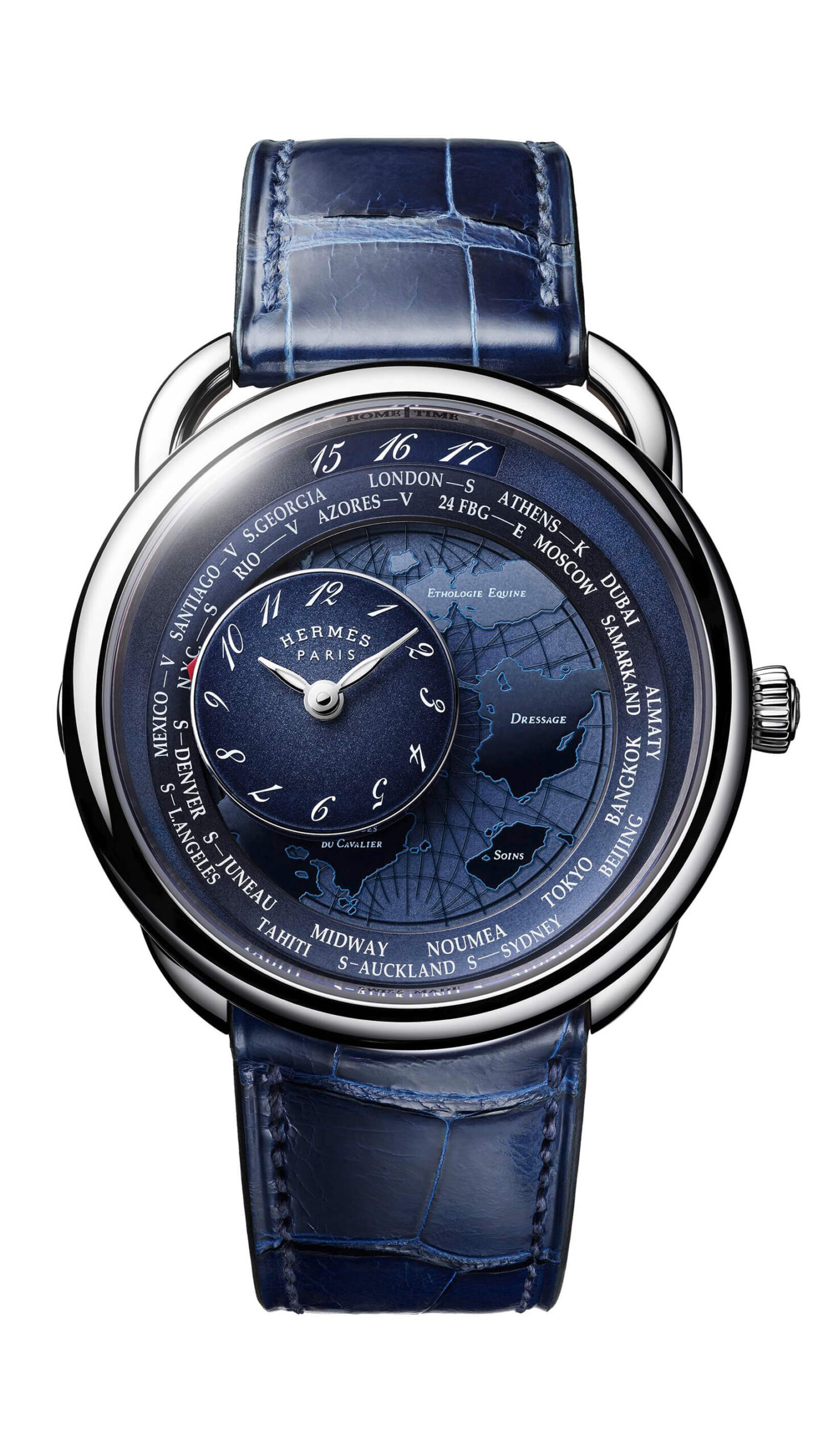
Hermès has always had a remarkable ability for creating watches that deliver a sense of theatre and the Hermès Arceau Le Temps Voyageur proves no exception. As the wearer presses the pushpiece at 9 o’clock and the aforementioned arrow points to the appropriate city, the whole of the dial moves. It is practical, but eminently stylish as well. As the local time display rotates, hugging the city disc, it seemingly floats above an intricate depiction of the ‘Planisphere d’un monde équestre’, a fantasy map conceived by Jérôme Colliard.
Interestingly, the luxury marque offers the Hermès Arceau Le Temps Voyageur in two very different variants. One model is housed in a 41mm case with an interhorn width of 21mm. The second model measures 38mm in diameter with an interhorn width of 20mm. Normally, the ‘bean counters’ would countermand such an idea while extolling the benefits of economies of scale. Thankfully, the creative types have triumphed.
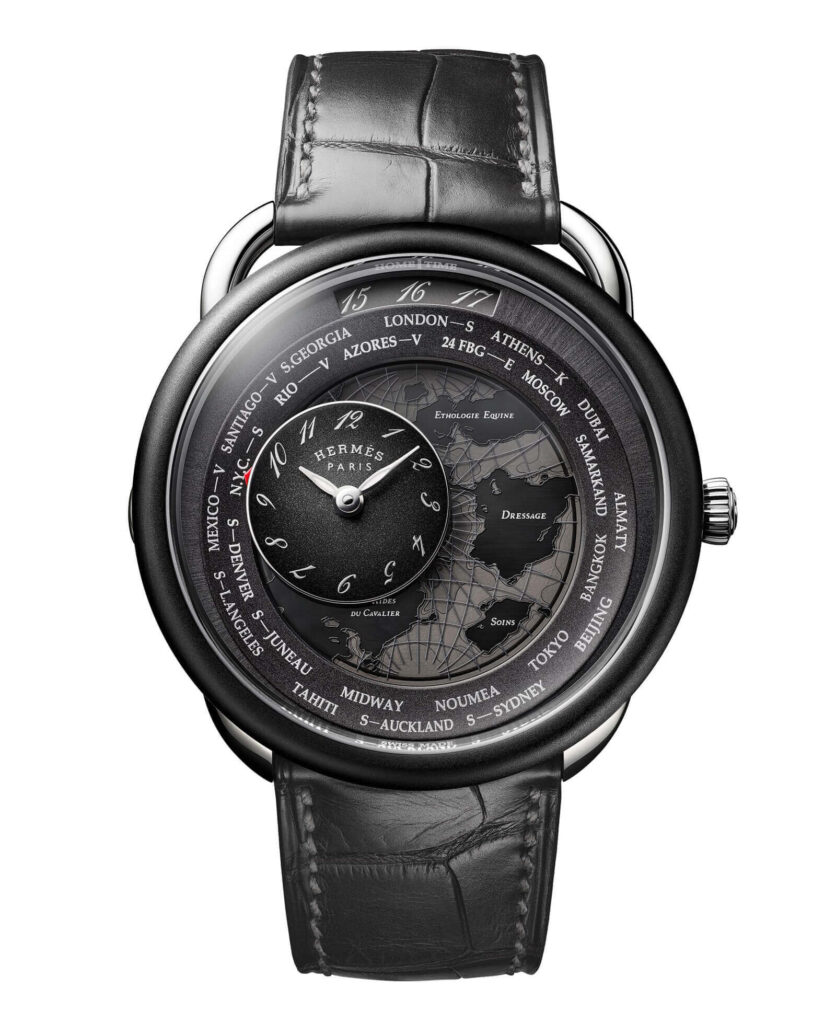
The 38mm model is available in a stainless steel case dressed in an elegant blue colour scheme, while the 41mm case is presented in platinum and paired with a bead-blasted matte black DLC-treated Grade 5 titanium bezel. This is certainly an unusual pairing as platinum is an incredibly dense metal, while titanium is known for its featherlight qualities. This latter model features a black and grey dial, matching the tones of the case. With these latest timepieces, Hermès upholds its reputation for delivering originality and extraordinary style.
The brand’s press release
The Arceau watch designed by Henri d’Origny in 1978 lends itself to a new expression of style and evokes the spirit of travel according to Hermès. Crafted in platinum and titanium or in steel, its round case with asymmetrical lugs reveals a singular reinterpretation by Hermès of classic Haute Horlogerie complications roaming across the hours of the world, as the “Travelling time” mechanism developed exclusively for Hermès provides a disc-type display of 24 time zones. The satellite gravitates on a fantasy map, imagined by Jérôme Colliard for the “Planisphère d’un monde équestre” silk scarf.
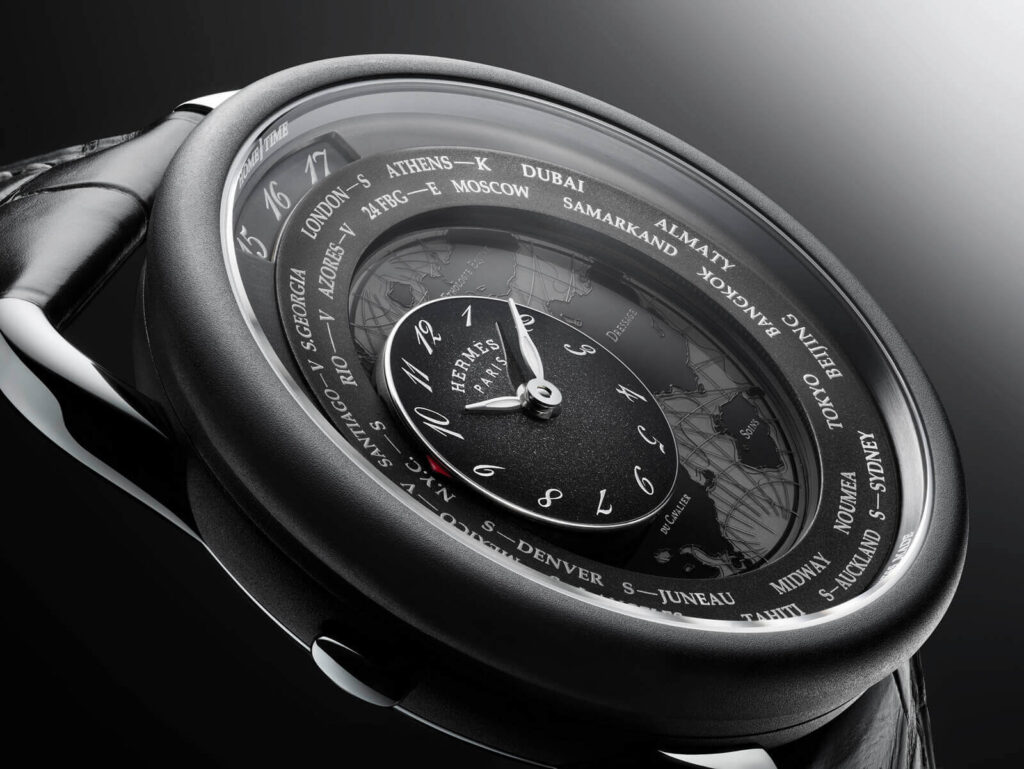
Image – Joel Von Allmen ©copyright
The mobile counter and the home time indication at 12 o’clock are driven by a 122-component module, measuring just 4.4 mm thick, which is integrated within the Hermès H1837 mechanical self-winding movement. The mechanism powers the hours, minutes and dual-time display with city indication. Two Arceau Le temps voyageur models – a 41mm-diameter platinum version with a matt black DLC-treated titanium bezel and a 38mm steel iteration – are fitted with alligator or Swift calfskin straps made in Hermès Horloger’s own workshops using the House’s long-established saddle-making and leather craftsmanship expertise.
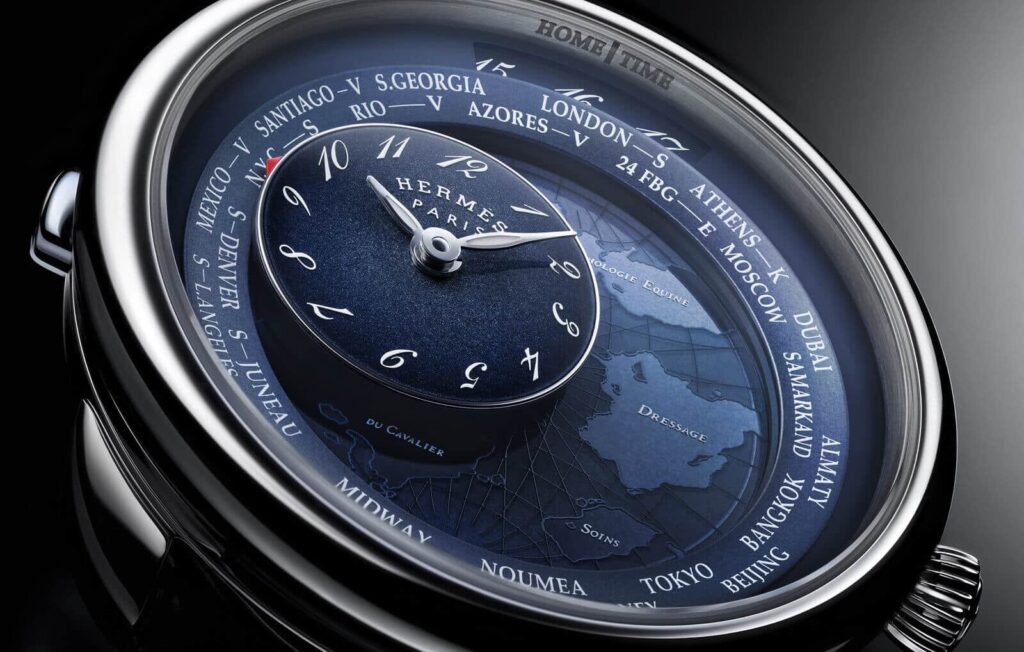
Image – Joel Von Allmen ©copyright
Further reading