
Heuer Monza Chronograph Watch Review
Angus Davies reviews the Heuer Monza Chronograph
Angus Davies feels nostalgic, looking back to 1976, an unusually hot summer in his native England. It was also the same year a unique timepiece was revealed for the first time, the Heuer Monza Chronograph CR2080.FC6375. Forty years later, this iconic watch has been reissued and its allure has not diminished.
Despite being only eight years old at the time, I can still vividly recall many aspects of 1976. One of my overriding memories was sitting on the back seat of my father’s new lavender blue Chrysler Alpine, travelling with my parents to Cornwall for our annual summer holiday. I remember the atypical sunshine and the high temperatures of that year. I have never forgotten suffering a combination of sunburn and sunstroke, making me a tad averse to sunbathing even to this day.
In 1976, Jack Heuer designed the first Heuer Monza chronograph to mark Niki Lauda’s first world championship with the iconic motor racing team, Ferrari. Lauda secured the title at Monza in September 1975.
I confess that, despite now being an obsessive fan of horology, I knew nothing about this watch at the time. Indeed, my overriding obsessions in 1976 were confectionery and Formula One, albeit I do recall the Heuer name gracing the nose of my favourite car, the Ferrari 312-T2.
During the Formula One season of 1976, I eagerly watched Lauda and James Hunt engage in wheel to wheel combat on television; I even acquired two Matchbox cars in order to re-enact all the overtaking sequences on my bedroom carpet.
Niki Lauda was leading the championship in 1976 when he infamously suffered injury whilst racing at the Nurburgring. Surprisingly, despite his near-fatal crash, he returned to competition only six weeks later at Monza. Ultimately, James Hunt narrowly beat Niki Lauda to the world championship that year at the final race of the season, at the infamous rain-soaked Japanese Grand Prix.
Niki Lauda is worthy of his iconic status, exhibiting huge bravery on several occasions. Moreover, his race-winning days continued after the set-backs of 1976 and he subsequently won the world championships in 1977 and 1984. Ironically, when Jack Heuer conceived the Monza timepiece, he could not have known that this watch would retain a timeless appeal and ultimately gain its iconic status within the annals of horology.
At Baselworld 2016, TAG Heuer unveiled a reissue of the 1976 model, capturing the essence of the original but with a few subtle enhancements.
The dial
The black sunray dial beautifully shimmers in available light without inhibiting ease of read-off. The lacquered hour and minute hands are predominantly creamy-white, except near their fulcrum where they assume a discreet black tone. A touch of nostalgia is provided by the ‘vintage’ luminescent hour markers which evince an orange emission in restricted light.

Crisp white markings encircle the extremities of the dial. Located on the inner flange, between noon and 3 o’clock, a red pulsometer scale is presented. In order to establish a pulse rate, the wearer actuates the chronograph on the first beat of the heart and stops the chronograph after sensing the 15th beat, e.g. If the chronograph is stopped after 10 seconds has elapsed, the patient’s heart rate is 90 beats per minute (shown on the flange at 2 o’clock).
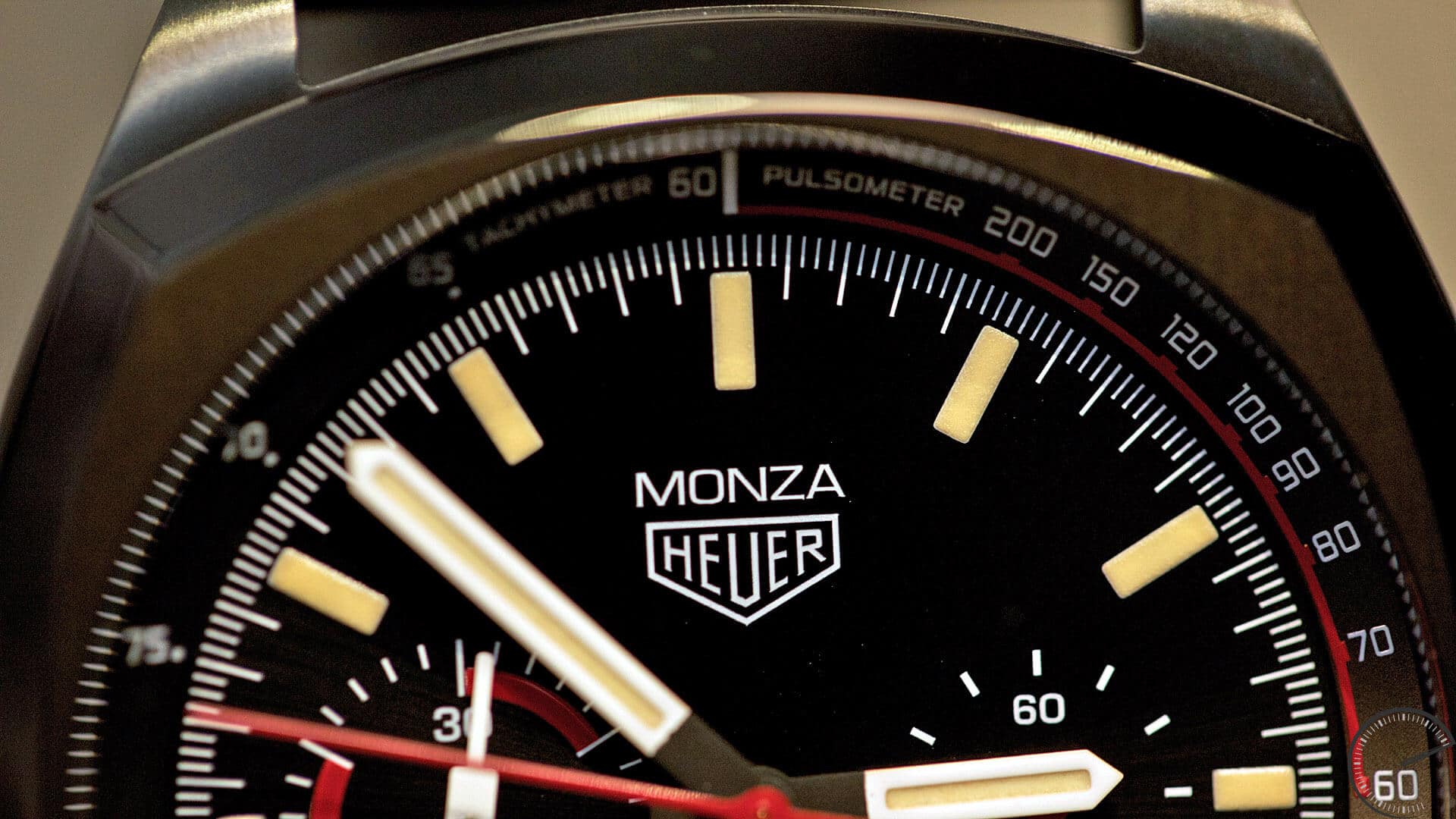
Positioned on the inner flange between 3 o’clock and noon is a tachymeter scale. This indication allows the chronograph hand to record the time taken for an object to cover a known distance and, by default, indicate the speed of the object e.g. a car travelling a mile in 30 seconds is travelling at 120 miles per hour (shown on the flange below 6 o’clock).
Whilst TAG Heuer has previously produced reissues of the 1976 Heuer Monza Chronograph, this latest version is the first time that the original combination of a pulsometer and tachymeter scale have appeared on a reissue of the model. Moreover, the original font employed on the 1976 model has also been used on this new reissue.
The bi-compax dial layout accords an agreeable balance. A small running seconds is positioned at 3 o’clock, whilst opposite a 30-minute chronograph register resides. A slender red central chronograph seconds hand delivers a tasteful quotient of passion to the colour scheme.
At 6 o’clock is a highly legible date display, with clearly defined black numerals, presented in a slender font and depicted on a brilliant white date disc. A white border frames the date aperture, conferring peerless delineation and aiding interpretation.
Jack Heuer was obsessed about the legibility of his watches. Indeed, in his autobiography, ‘The Times of My Life’, he discussed the design of his Carrera chronograph, another iconic watch inspired by motor-racing, saying ‘I wanted a dial that had a clear, clean design…’ and this certainly showed on both his original Carrera of 1963 and the Monza of 1976.
The case
The vast majority of watches are simply round. In itself this is no bad thing, however, when a watch eschews convention and embraces originality, sometimes the outcome can be incredible. And so it was with the advent of the Heuer Monza Chronograph of 1976.
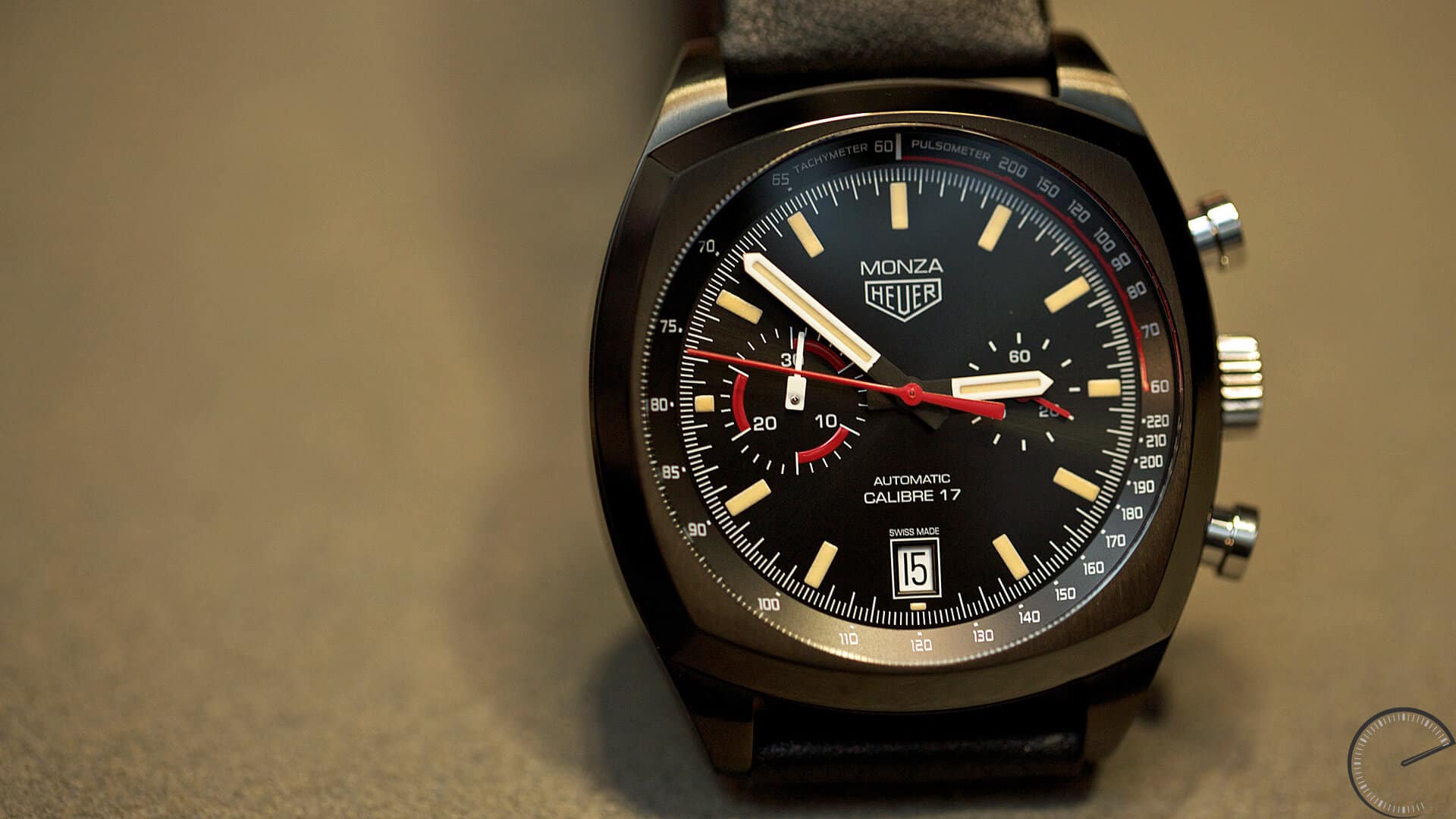
The coussin case of the Monza fuses square and round forms to produce a gorgeous cushion-shaped body that continues to look superb despite the passage of time. The scale of the watch has increased from the 39mm diameter of the original to 42mm, appealing to modern tastes.
While the case and bezel share the same black shade of the original, this latest model utilises grade 5 titanium and features a matt titanium carbide coating. By supplanting the steel construction of the original with grade 5 titanium, the watch is lighter and said to be ‘more shock resistant’.
In contrast to the shy, matt surface of the case and bezel, the crown and pushpieces smile brightly, courtesy of their polished steel surfaces. The crown is adorned with the Heuer logo, indulging the desires of traditionalists for period details. Moreover, the Monza rejects the current trend for exhibition case backs in favour of a solid, screw-on case back. The words ‘Monza’ and ‘Heuer’ are engraved on the back.
The highly textured calfskin ‘super racing’ strap is delivered in black and features a perforated motif, reminiscent of classic driving gloves of yesteryear. The traditional aesthetic of the strap is successfully paired with a contemporary black coated titanium clasp.
The movement
The self-winding TAG Heuer Calibre 17 will be familiar to followers of the brand, having already appeared in the Carrera Calibre 17 Chronograph. The frequency of the balance is 28,800 vph (4Hz), typical of a modern timepiece. This automatic movement contains 37 jewels and has a power reserve of 42 hours.
Owing to the solid caseback, I was unable to appraise the finish of the movement.
Closing remarks
There is often something wonderful about remembering events from the past. I vividly remember Niki Lauda at the height of his motor-racing career and despite my tender years at the time, I can still recall his prominent teeth and red Ferrari race suit. His prowess at the wheel of a Formula One car has since become legendary and distinguishes him as an iconic figure.
Aged eight years of age, I was unaware of the original Heuer Monza Chronograph at the time of its launch, however, as my passion for fine watches grew with the onset of maturity, I became very aware of its reputation.
This reissue of the Heuer Monza Chronograph is sympathetic to the original. After 40 years, the Monza still looks sharp and shows no signs of ageing. Its exceptional appearance and highly legible dial are deserving of the reverence in which this watch is held. Purists may lament over the growth in case dimensions and the move to a state of the art case material, however,in my opinion, these changes add to the appeal of this stunning timepiece.
Many watch companies talk of making ‘iconic’ timepieces, but only a few are actually deserving of the appellation. Moreover, watch brands seldom craft more than one iconic timepiece. It is therefore remarkable that Jack Heuer masterminded the creation of three iconic watches: the Carrera, Monaco and Monza. His passion for motor-racing and horology led to the creation of these exceptional octane-inspired chronographs, a fact which clearly should be forgotten.
Technical specification
- Model: Heuer Monza Chronograph
- Reference: CR2080.FC6375
- Case: Grade 5 titanium with black titanium carbide coating; diameter 42mm; water resistant to 10 bar (100 metres); sapphire crystal to front and solid screw-on case back.
- Functions: Hours; minutes; small seconds; date; chronograph.
- Movement: Calibre 17; self-winding movement; frequency 28,800 vph (4Hz); 37 jewels; power reserve 42 hours
- Strap: Black calfskin strap presented with a titanium clasp with black coating