
Stefan Johansson Växjö Mark IX “G” 41mm
It was somewhat surprising when Stefan first contacted me to introduce himself and his octane-inspired timepiece, the Stefan Johansson Växjö Mark IX “G” 41mm. My initial reaction was, “Stefan Johansson, the ex-F1 driver?”.

Stefan Johansson was a Formula One driver with Ferrari. He has been an Indycar driver and has won both the 12 hours of Sebring, twice with Porsche and Ferrari. Furthermore, he has won the 24 Heures du Mans with Porsche. He still participates in competitive motorsport.
It was somewhat surprising when Stefan first contacted me to introduce himself and his octane-inspired timepieces. My initial reaction was, “Stefan Johansson, the ex-F1 driver?”.
The adrenalin-fuelled, testosterone-charged world of motorsport seems far removed from the calm persona and tranquil environment required for watchmaking. However, it seems the Swedish racing driver has found two careers which enrich his life with their seemingly contradictory characters. Some would argue this Ying and Yang has provided the necessary balance to his life.
I have chatted to Stefan about his two lives and the apparent contradiction between the aggressive, impatience required on the track and the forbearance required to construct a timepiece. But, there are desired traits which are common to both occupations, in particular tenacity and attention to detail.
Launching a new watch brand is not for the faint-hearted and dogged determination is required to bring new timepieces to the market. Moreover, creating a watch requires fastidious obsession with the smallest of details, “How do the pushers feel?”,“Is the crown simple to adjust?”, “Is the dial legible in dim-light?”. These questions may seem obvious, but delivering applicable answers can be the difference between standing on the podium or resigned to a life as a back marker.
Stefan approaches watchmaking in a very different way to the rest of his competitors and this is exampled by how he tests his timepieces.
Testing watches is something ordinarily done in a laboratory. Watches will be tested in different positions and at different temperatures, often using sensitive microphones to measure the rate and amplitude.
Some quality controls necessitate simulating different activity levels of the wearer. For example, Fleurier Quality Foundation have a simulator which recreates the movements of a nycthemeral cycle. It alternates between calm, active and extremely active phases. I recently watched as the Fleuritest simulator emulated a man jogging on a running machine. The accuracy of the watch was monitored during all three cycles of the test.
Rate keeping of a wristwatch can be influenced by heat, vibration, positional angle and the activity level of the wearer. An automatic wristwatch may over or under wind the mainspring depending on the lifestyle of its keeper.
There is an alternative approach adopted by the Stefan Johansson Växjö brand. Stefan places his watches on his wrist or those of his friends who share the race track. The cockpit of a race car is hostile to both man and his cherished timepiece.
|
Mark VIII E One of the most popular models in the Stefan Johansson Växjö range. It features warning flags, typically used at racetracks, framing the dial. |
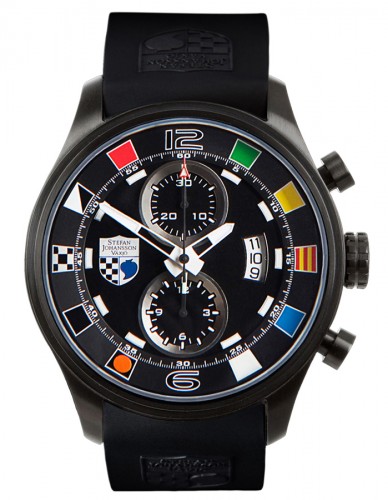
Cockpit temperatures can reach 71° C. The driver and his watch can experience 5g. The watch will be subject to rapid changes in altitude. Violent vibrations transmitted through the steering wheel, shake the drivers hands and subject the watch to extreme forces.
After the watch has been subjected to this ferocious foray in the cockpit, it is appraised. Only if Stefan is happy with the performance of the whole watch, not just the movement, will it progress to full scale production. He clearly has a name which retains a commercial worth and does not wish to tarnish this by producing inferior timepieces. Stefan Johansson’s name and reputation are very important to him.

My interest in Stefan, and his watchmaking brand, was heightened when I first saw the images of his products. A meeting in Geneva ensued and thereafter I knew there were several worthy watches from the Swede’s company, which I wished to review.
The first model I have elected to write about is the Stefan Johansson Växjö Mark IX “G” 41mm. It is one of several models from the brand, but caught my attention because of its blend of classical and modern details.
The dial
The silver dial has a cool, relaxed persona providing a calm canvas to present much information.
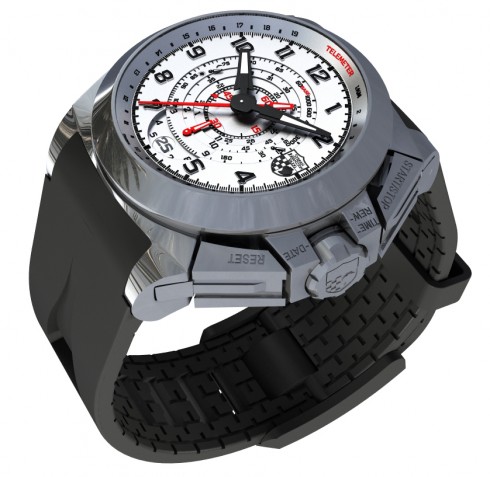
The hour and minute hands are black and detailed with Superluminova at their centres, enhancing legibility in fading light. Close examination reveals that they are layered creating a wonderful three dimensional quality. I cannot readily think of another brand which has employed this idea, albeit some attentive readers may enlighten me to the contrary.
The dial repeats the playful use of layering, employing a series of concentric circles arranged near the hub of the dial, presented at five different depths. They resemble steps, possibly a metaphor for the journey to the winners rostrum.
Applied Arabic numerals indicate the hours. They are black and outlined with Superluminova.
The chronograph function displays information using a red central seconds chronograph hand, a 60-minute chronograph counter at the centre of the dial and a 12 hour chronograph register at 6 o’clock.
A subsidiary seconds display is located at 3 o’clock, adjacent the brand’s logo. My ageing eyes find it a little small, although if I really needed to measure seconds, I would probably use the chronograph function.
At 6 o’clock within the aforementioned 12 hour chronograph counter, the date is presented in a round aperture.
At 9 o’clock, there is a 24-hour AM/PM register or, as some would say, a day/night indicator. It shares the same scale as the subsidiary seconds affording symmetry, I just wish it was slightly larger.
A tachymeter scale is located on the central stepped area of the dial, with a telemeter scale presented on the inner flange.
The case
A case diameter of 41mm ensures widespread appeal to potential purchasers of differing physical stature. It is neither too small for those of us who brush the clouds as we walk along the pavement, nor too large for those of slight build. However, those seeking a larger timepiece are well served, with a 45mm variant also available.
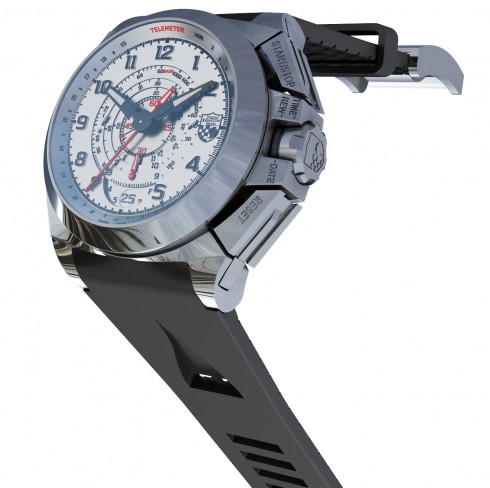
The stainless steel case is highly polished, gleaming and resplendent.
The chrono pushers beautifully integrate into the caseband, sitting flush. They do not protrude or risk snagging controls within the frantic environ of the cockpit. Their roles are conventional, with the pusher at 2 o’clock used for starting and stopping the chronograph and the pusher at 4 o’clock reserved for resetting the stop watch function. The pushers are labelled, reminiscent of the labels applied to the controls of a steering wheel found in a racing car.
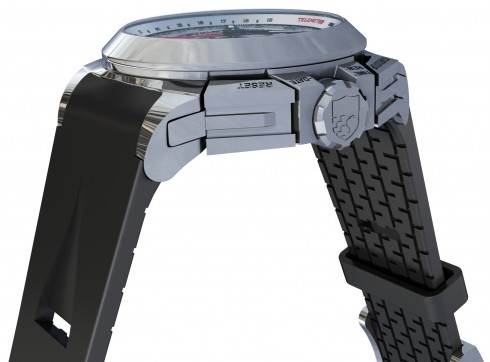
The crown is protected with adjacent shoulders, again these are labelled to aid the wearer.
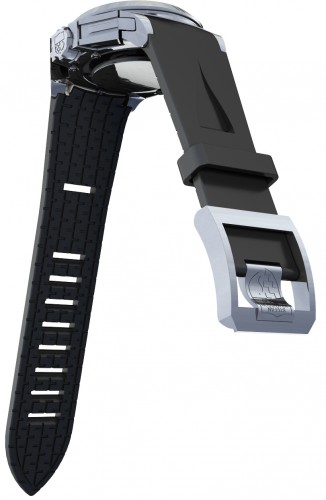
Short horns allow the strap to envelope all wrists, particularly ideal for those of diminutive build. Moreover, the black rubber strap is made from silcone and heat resistant rubber. It features a tread patten on its reverse to mitigate perspiration and enhance wearer comfort. Wearers are reminded of Stefan’s other passion in life with an opening on the strap inspired by “NACA ducts”, used to regulate the air intake on racing cars.
A sapphire caseback affords a view of the movement, allowing a glimpse of the horological engine within.
The caseback also features an engraved “chassis number”. Johansson never ceases to remind the wearer of the automotive links with the watch.
A self-winding Dubois-Depraz Calibre 2075 movement
A self-winding Dubois-Depraz Calibre 2075 movement features in this watch.
Dubois-Depraz is a manufacturer of movements located in the Jura Mountains, in the canton of Vaud in Switzerland. It is a well-respected maker of calibres and offers a broad range including perpetual calendars and repetition movements.
The specification of the Stefan Johansson Växjö Mark IX “G” 41mm is impressive with 53 rubies, 44 hours power reserve and custom made rotor in black PVD.
The rotor features the “Little-Leaf” design associated with Stefan. This has been his soubriquet throughout his career. His father was a racing driver and his nickname was “Leaf” because of the name of the village where he was brought up. The “Little-Leaf” design features on the brand’s logo.
Conclusion
I have met other drivers from the world of motorsport and the exclusive domain of Formula One. Whilst several openly admit a fascination with horology, few have the temperament or motivation to form their own watch company.
Stefan Johansson has taken a bold and brave step creating his own watches, however, he has proved, with his earlier models, that he has the capacity to triumph in the competitive world of watchmaking.
His testing regime may be unique, exposing his watches to the “Shake, Rattle and Roll” of high performance driving, but I suspect this watch will be one of several hits for this consummate individual.
Technical Specification
- Model: Stefan Johansson Växjö Mark IX “G” 41mm
- Reference: Mark IX G 29010
- Case: Stainless steel; diameter 41mm (also available in 45mm version); height 15mm; Water resistant to 5 bar (50 metres); sapphire crystal to front and rear.
- Functions: Hours; minutes; subsidiary seconds; date; day/night indicator; chronograph
- Movement: Dubois-Depraz Calibre 2075; self-winding; frequency 28,800 vph (4Hz); 53 jewels; power reserve 44 hours.
- Strap: Black strap made of silicone and heat resistant rubber with stainless steel pin buckle.