
Jaeger-LeCoultre Master Ultra Thin Power Reserve Watch Review
The Jaeger-LeCoultre Master Ultra Thin Power Reserve Reference Q137258J is a ‘new interpretation’ of a former design. Mark McArthur-Christie, a man with a passion for cars and watches, critiques this latest creation from the Manufacture in Le Sentier, eager to discover if it represents progress.

Great design
It is obvious that the new Citroën has fallen from the sky in as much as it appears at first sight as a superlative object. We must not forget that an object is the best messenger of a world above that of nature: one can easily see in an object at once a perfection and an absence of origin, a closure and a brilliance, a transformation of life into matter (matter is much more magical than life), and in a word a silence which belongs to the realm of fairy-tales. The D.S. – the “Goddess”…” Roland Barthes
I will happily fight anyone who disagrees that the 1967 Series 3 facelift Citroën DS is the most beautiful car ever built. When the original DS debuted at the 1955 Paris Motor Show, the best other manufacturers could offer were cars like the Vauxhall Cresta that resembled a mole and the Brooks Stevens-designed Gaylord Gladiator that looked like, well… you’d best Google it and see for yourself. Little wonder Barthes believed the DS appeared as though it had fallen from the heavens.
Flaminio Bertoni, who had already created the Traction Avant and turned the TPV into the 2CV, began work on the DS design back in 1938. He should have been declared ‘Venerable’ for the Traction Avant alone. His work on the 2CV should, were there any justice, have seen Pius XII elevate him to ‘Blessed’. The DS should have got him canonised, given a pension, the Légion d’honneur and the run of La Tour d’Argent’s wine cellars for life.
Paul Magès’ hydropneumatic suspension system that replaced springs with LHM fluid gave the car an utterly imperturbable ride and even let it sit on three wheels while you changed a puncture. The same system was so effective it later found its way into Rolls-Royce’s Silver Shadow. The headlights moved as you turned the wheel to follow the road. And the wheel itself – where other makers used a frowsy four-spoke solid design that hadn’t changed since the Model T, the DS had a single-spoke, tubular wheel intended to act as an (admittedly basic) impact-absorption aid.
For years, rumours circulated that a new DS was in development. Would it be an update to the remarkable magic-carpet C6, the nearest modern Citroën to the firm’s cars of old, but improved with even more innovative engineering? No one knew.
Change doesn’t always mean progress
Finally, in 2010, the waiting was over and Citroën launched the new DS. Called ‘DS3’ it was a small, 4-cylinder, conventionally-sprung hatchback based on the floorpan of the existing Citroën C3 shopping trolley. If Bertoni, Magès and Lefèbvre’s car was a goddess, the new DS3 had all the grace, elegance and show-stopping beauty of her office printer.
It is for this reason (along with so many other disappointments in the name of ‘progress’) that we are profoundly suspicious when a watch firm talks about ‘a new interpretation…’ of an already beautiful watch. When Jaeger-Lecoultre’s press release for the sainted Master Ultra Thin mentioned it, we were already reaching for a steadying whisky (any excuse, to be fair).

Jaeger-LeCoultre Master Ultra Thin – relax
Like the DS, the Ultra Thin has quite the heritage. Starting in 1907 with the Calibre 145, JLC’s slim watches have been through more incarnations than Dr Who. However, we needn’t have worried too much, because, despite the changes, this latest offering retains the old watch’s key characteristics of proportion, dial design and engineering.
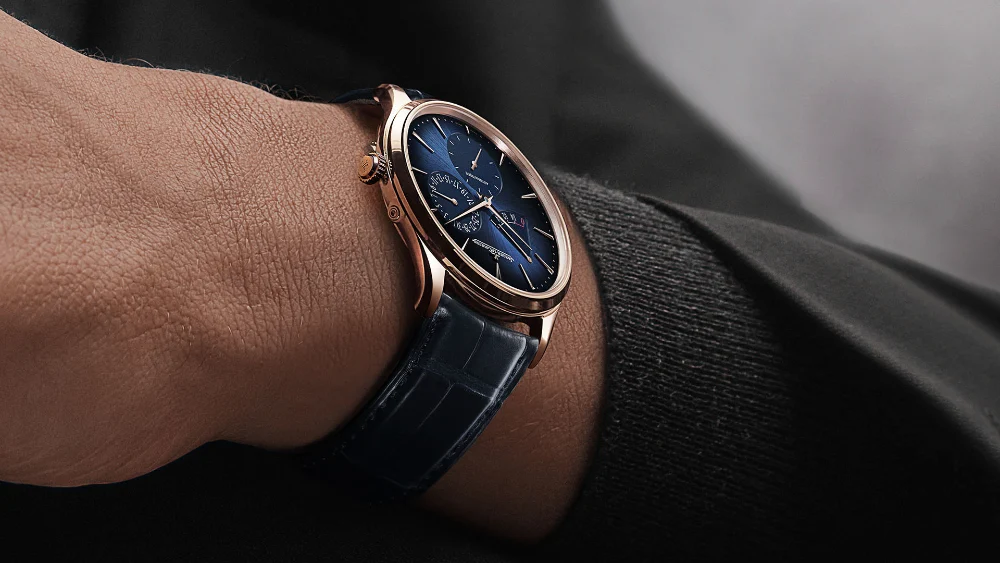
Jaeger-LeCoultre Master Ultra Thin Power Reserve – case
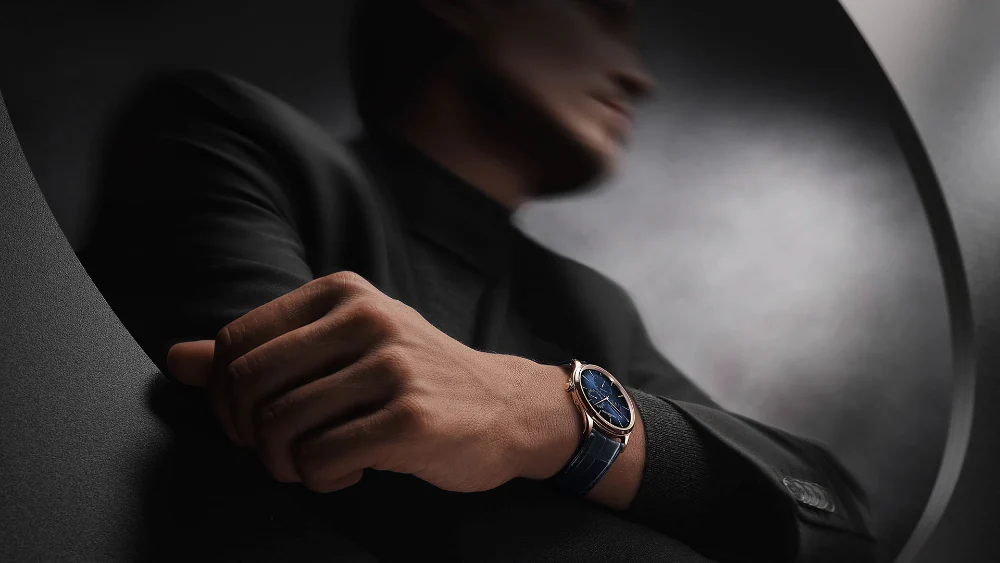
Thankfully, Jaeger-Lecoultre has shied away from the temptation of fattening up its watches, leaving the Master Ultra Thin’s case size at a wrist-friendly 39 mm and just a smidge under 9 mm thick. Could this perhaps be part of the move back to proper case sizes? The design has changed, albeit subtly. You’ll spot that the lugs are longer, slimmer and a little more curved.
The case material is Pink Gold 750/1000 (18 carat) and – as always – it’s good to see a screwed-on, rather than screwed-in caseback. Here, it’s held with four single-slot gold screws. No shearing on the caseback seal, and for those of us with OCD tendencies, it’ll always line up perfectly. Likewise, the bezel is held with four screws running through the case itself, avoiding any need for prying or twisting to remove it. And although you won’t want to go diving with your Ultra Thin, you don’t need to worry too much about the odd splash; the watch has a 5 bar water resistance rating. And all this despite being around 1 mm thinner than its predecessor.

Straps and spring bars
The case stays on your wrist courtesy of a blue alligator strap. We have to admit to slightly raised eyebrows at the quick release strap bars but have to assume that, as it’s JLC, it’ll be fine and won’t decide to quick release at the wrong moment. Even so, if QR straps aren’t your thing it would take just a minute or two to swap the QR bars for standard spring bars.
Jaeger-LeCoultre Master Ultra Thin Power Reserve – dial
Turning the watch over, you can see that the firm has carried the same principles of re-proportioning the case to the dial. It’s easier to read (not that the original was exactly a blizzard of complexity) with larger subdials, slightly longer hour markers (and a considerably slimmer 12 o’clock marker) and changes to the way the hands are finished.
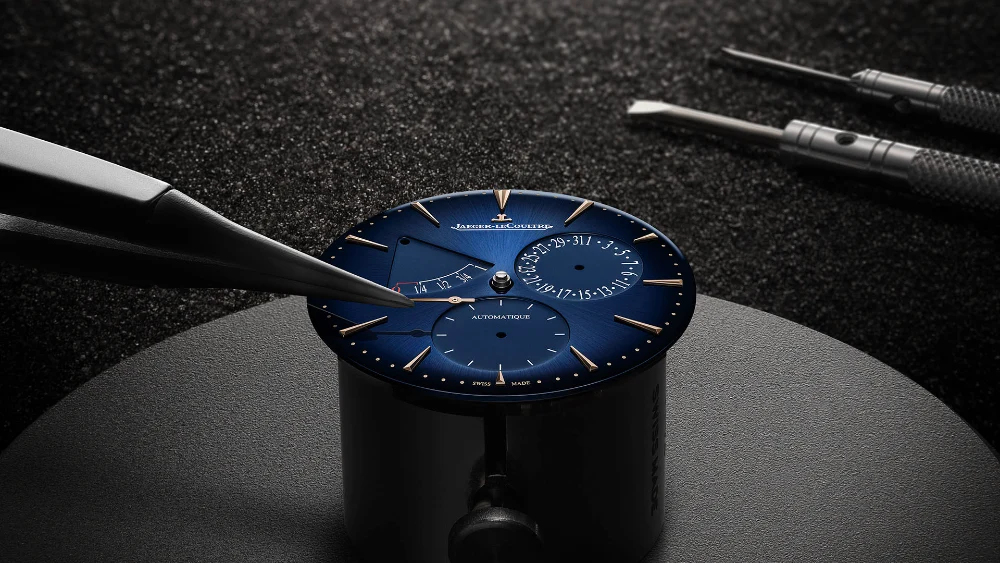
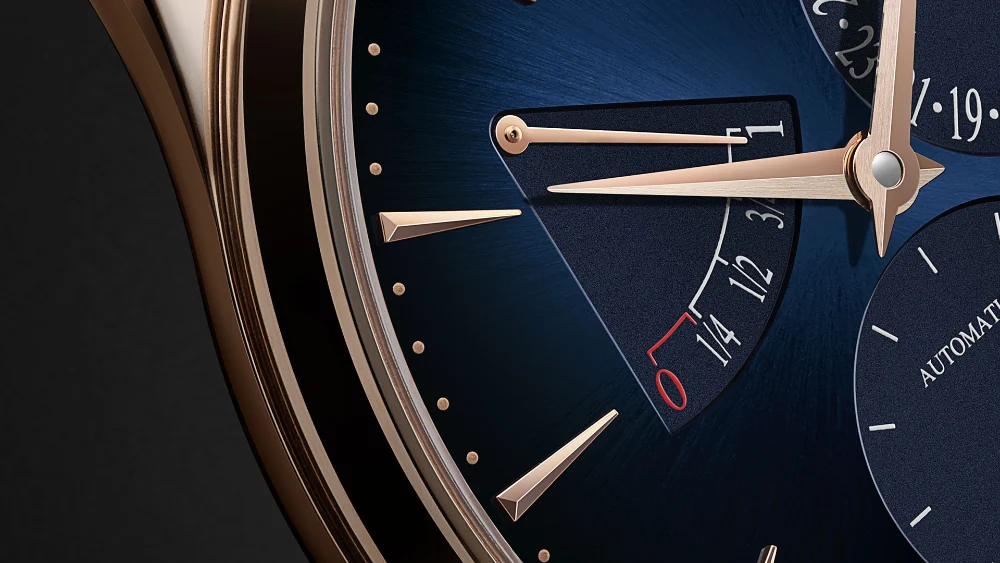
The subdials cover date, power reserve and small seconds and all use the same serifed typeface we’re accustomed to seeing from JLC. All the type is white with the exception of the ‘yikes, no juice’ red end of the power reserve indicator. It’s useful to see quickly if you need to give your wrist a shake and the red adds some colour to an otherwise blue/white/gold dial. There’s a switch to applied tiny gold dots to mark the minute track, too.
Time-telling remains simple despite a dial with a lot going on. That’s thanks partly to the overall design and proportions, but also to the unity of each element. As we’ve mentioned, numbered indications are in white, with minute and hour markers picking up the gold of the hands. And those hands come in for special treatment. It may not be immediately obvious from the pictures, but if you look closely you can see a different finish (polished and satin) on each facet of the Dauphine hands. And with the deep blue dial for contrast, you’ll not struggle to read the time even in low light (although there’s no lume).
Jaeger-LeCoultre Calibre 938
Inside the case there’s a bigger and more obvious change. There’s been a Jaeger LeCoultre power reserve indicator watch since the late 1940s with the Powermatic. As an aside, these are perhaps the best vintage JLC bargain you can buy – they’re daftly undervalued. The Calibre 938 with a power reserve indicator arrived in the early 2000s.
The movement once had a 43 hour power reserve but the firm has been quietly giving it a decoke and tune up with a new mainspring barrel, silicon components (which cut friction and remove the need for power-sapping oils) as well as a few more tweaks. All in all, that’s seen the reserve almost double to 70 hours, so you should be fine if you ever decide you don’t fancy wearing your Master Ultra Thin for a few days.
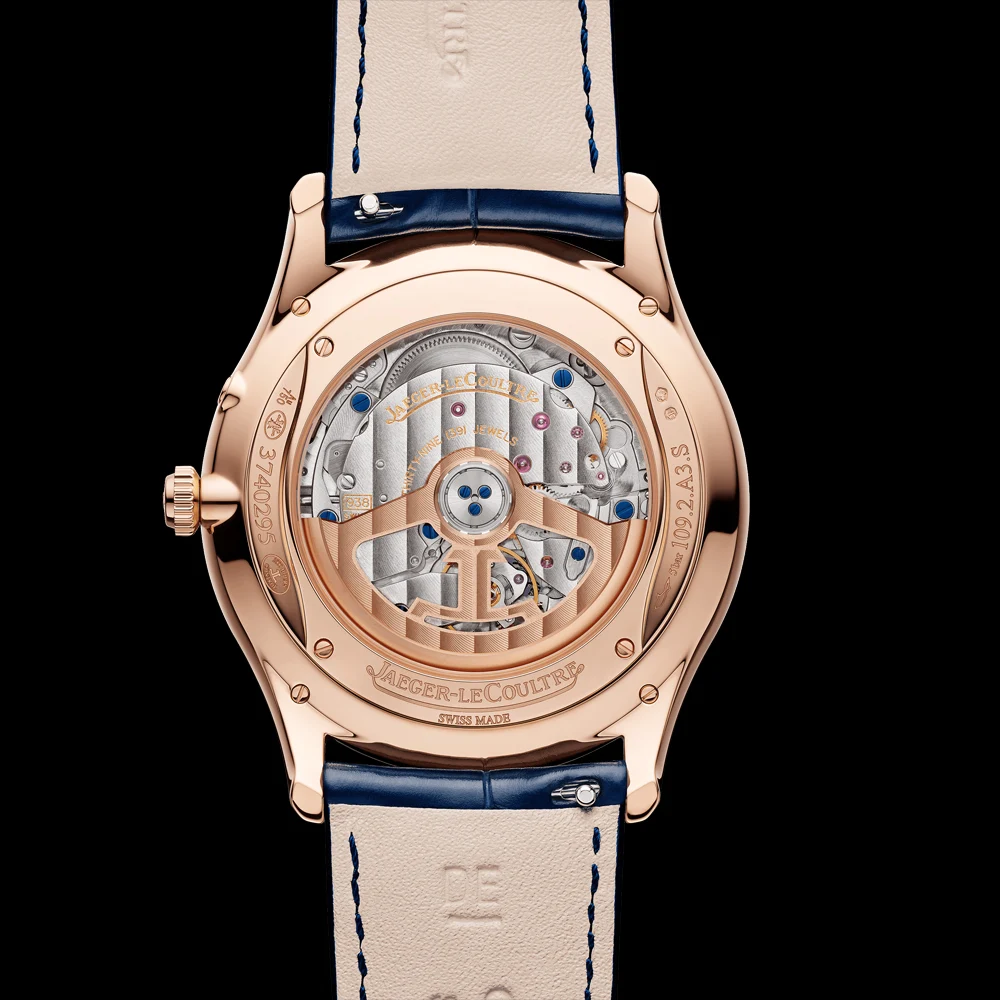
Surprisingly, despite all the work under the bonnet beefing up the engine, the calibre is still just 4.9 mm thick – around the size of one of those little erasers on the end of a pencil. Not shabby for a self-winding movement that’s telling you the time in hours, minutes and seconds with a date and a power reserve.
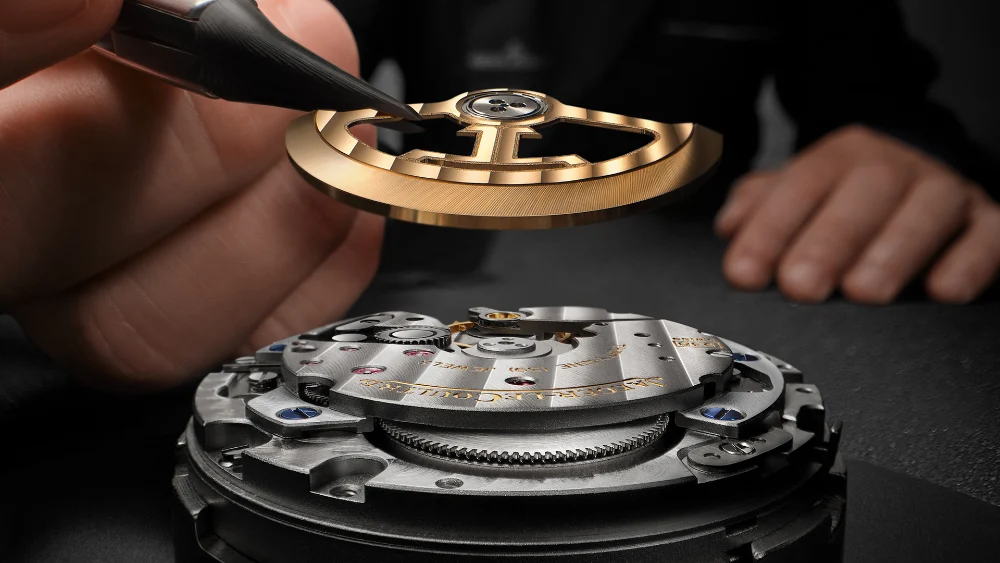
The Calibre 938 is, as you’d expect from JLC, a thing of well-finished beauty. Côtes de Genève on the bridges, thermally-blued screws for the plates with polished screwheads elsewhere, a mix of sweeping graining and polishing on the gold rotor, golden engraved text and circular graining on the baseplate. It’s worth turning your watch over just to enjoy it.
Jaeger-LeCoultre Master Ultra Thin Power Reserve – closing thoughts
At the moment, you’ll only be able to buy one from a JLC boutique and the watch only comes in 18ct pink gold. It’ll be interesting to see if the firm produces the same movement and case design but housed in stainless steel. That would make a very good-looking – and more affordable – watch indeed.
In the meantime, we’re relieved that the whisky can stay in the bottle. Jaeger LeCoultre has managed something where far too many others have failed – an update that’s both an engineering and aesthetic improvement on an earlier success. On reflection, stuff abstinence – that merits a toast to them – they deserve it. Sláinte!
Further reading
https://www.jaeger-lecoultre.com/
Technical specification
- Model: Jaeger-LeCoultre Master Ultra Thin Power Reserve
- Reference: Q137258J
- Case: 18-carat pink gold, diameter 39 mm, height 8.95 mm, water resistance 5 ATM (50 m), sapphire crystal to front and exhibition caseback
- Functions: hours, minutes, small seconds, power reserve indicator, date
- Movement: Calibre 938, self-winding movement, frequency 28,800 vph (4 Hz), contains 39 jewels, power reserve 70 hours
- Strap: blue alligator strap with 18-carat pink gold pin buckle
- Price: £20,400 (RRP as of 3.2.2024)