
Jaeger-LeCoultre Reverso Tribute Nonantième
The Jaeger-LeCoultre Reverso Tribute Nonantième marks the 90th anniversary of the legendary Reverso with an interesting design and several complications. The upper dial upholds the styling of the model’s forebears, however, flip the inner case over and you will discover a remarkable horological vista that has been conceived after some serious blue-sky thinking.

It is 90 years since Jaeger-LeCoultre created its legendary rectangular-shaped timepiece. The model was originally intended to fulfil the requirements of British army officers with a fondness for playing polo. Conventional timepieces were often damaged by a bothersome polo ball striking the watch’s dial-side glazing. Therefore, the Swiss Maison conceived an ingenious swivel case which allowed the wearer to flip over the inner case, shrouding the dial from view and, in so doing, protecting it.
While the watch was borne of a practical need, it immediately proved an aesthetic gem. Its Art Deco design included horizontal lines, termed ‘brancards’, positioned above and below the dial. This aesthetic element, along with the overall case design, has led to the watch becoming a revered classic with commensurate recognition among watch aficionados.
For a significant proportion of its life, the Reverso was a time only model with a solid caseback. Today, this latter surface is frequently employed as a canvas for artistic expression using the mediums of engraving, enamelling and gem-setting.

Since the early 1990s, the Manufacture has offered the Reverso with an exhibition caseback, setting aside the original reason for the watch’s creation. Moreover, Jaeger-LeCoultre chose to showcase its watchmaking prowess by releasing various complications, including high complications.
Despite this being a new direction for the Reverso, it must be remembered that the Maison has always possessed remarkable virtuosity when it comes to making complicated movements.
Over the last 30 years, the Swiss marque has offered the Reverso with an array of complications, including the chronograph, grand date, perpetual calendar, tourbillon and minute repeater. Remarkably, the Swiss brand has produced over 50 different movements, a feat that is beyond the capabilities of most other watch companies.
At this juncture, my thoughts stray to the role of the product development team. Imagine for a moment, the 90-year anniversary of the Reverso is looming and you are tasked with conceiving something new. What more can you offer that has not been done before? Well, one section of the aforementioned team masterminded the recently unveiled Reverso Hybris Mechanica Calibre 185, a watch with four faces and 11 complications.

Another talented group, no doubt also engaged in a period of blue-sky thinking, conceived this watch, the Jaeger-LeCoultre Reverso Tribute Nonantième.
Presented in a generously proportioned pink gold case, the model looks quintessentially Reverso, subscribing to the iconic model’s popular design language. Dauphine-style hour and minute hands converse with faceted applied batons, both presented in a matching golden hue.
A small seconds display dwells in the southern hemisphere of the dial, while at its heart is a moon phase indication, imparting meaning in poetic form. A grand date display sits in the upper region of the dial and employs two white discs to proclaim the date. The silver-toned dial surface features a sunray motif and is framed with a chemin de fer.
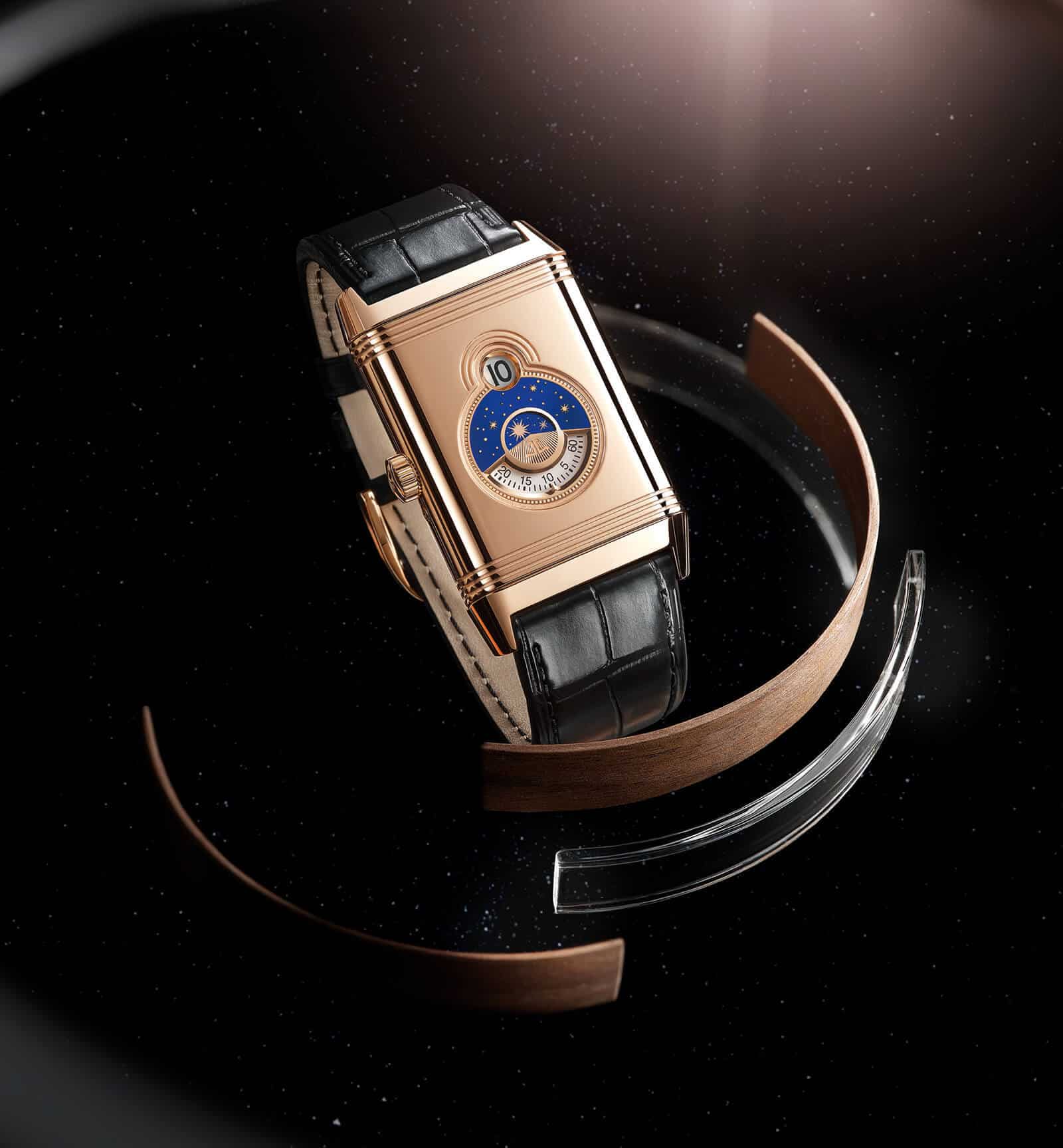
However, flip over the inner case and you will be caught off guard. An irregular-shaped figure of eight immediately arrests the onlooker’s attention. A circular aperture sits on high, revealing a semi-jumping hour in black numerals atop a white disc. This display slightly overlaps a blue lacquered depiction of the night sky. In the lower portion of this nocturnal-themed scene is a small aperture revealing a rotating day/night indicator. Lastly, an arcing minute display is located below all other indications and features a rotating track.
The hour and minute displays, positioned to the front and rear, are synchronised. Needless to say, the Jaeger-LeCoultre Reverso Tribute Nonantième is equipped with a new movement, the hand-wound Calibre 826 masterminded by the company’s brilliant engineers.
My only question is, what will Jaeger-LeCoultre conceive next?
The brand’s press release
Ninety years ago, Jaeger-LeCoultre created the Reverso, an ingenious solution for polo players who wished to protect the glass of their watches while playing matches. With its swivelling case and distinctive Art Deco lines, it was to become a classic of 20th-century design. The Maison soon began to introduce new aesthetic variations of the Reverso but, for the first 60 years of its life, no mechanical complications were introduced; the Reverso remained a simple, time-only watch.
In 1991, 60 years after the Reverso’s creation, Jaeger-LeCoultre presented the Reverso Soixantième. With power reserve and date displays, it was the first Reverso with complications and the first with a sapphire crystal caseback, providing a window onto the mechanical treasure within. Although the Reverso case and its shaped movement had not initially been designed for complications, the Soixantième revealed its full potential, unleashing a sequence of pieces that gave new visual expression to the great watchmaking complications.

In 2021, nine decades after the Reverso was born, Jaeger-LeCoultre presents the latest episode in this story: the Reverso Tribute Nonantième, which gives a completely new visual expression to an alliance of several classical complications.
Reverso Writes a New Chapter in the Story of Complications
The launch of the Soixantième in 1991 had coincided with the rebirth of complicated watchmaking that followed the quartz crisis. Jaeger-LeCoultre’s long and distinguished history as a creator of high complications provided its engineers and designers with an exceptionally rich archive from which to learn, and develop new calibres. Nevertheless, the Manufacture’s goal of creating six new Reverso models within the decade, each incorporating one of the great classical complications, was very ambitious – not least, given the particular challenges posed by rectangular movements, which dictate a different architecture from that of round movements.

The Soixantième was followed in 1993 by the Reverso Tourbillon – the Manufacture’s first wristwatch tourbillon. In 1994, Jaeger-LeCoultre released the Reverso Répétition Minutes, the first time the Maison had miniaturised a minute repeater for a wristwatch, and the world’s first rectangular minute repeater movement. In 1996, La Grande Maison introduced the Reverso Chronographe Rétrograde, with an intricate display on the reverse side that solved the problem of how to arrange the chronograph counters within a rectangular frame. This was followed two years later by the Reverso Géographique and, coinciding with the Millennium, the Reverso Quantième Perpétuel.
In 2001, Jaeger-LeCoultre marked the completion of another decade in the Reverso story with the Septantième. Its movement, Calibre 879, offered an 8-day power reserve – almost unheard-of at the time. And now, nine decades after the Reverso was born, La Grande Maison introduces a new alliance of complications.
The Reverso Tribute Nonantième
The front dial of the Nonantième exudes refinement and elegance. The pink gold case with its signature gadroons frames a silvered, sunray-brushed dial with applied golden indexes and Dauphine hands. In the lower half of the dial, a moonphase display is set within the circle formed by the small seconds counter. Beneath 12 o’clock is a large date display, framed by an applied filet of pink gold that echoes the rectangular shape of the dial and case.

The classically elegant aesthetic of the front dial gives no hint of the surprise concealed on the reverse side of the watch. Flipping the case over reveals an entirely new visual expression of some of watchmaking’s most familiar complications. Dramatic and captivating, it is unlike anything seen on a Reverso before.
The solid pink-gold caseback is dominated by two round apertures of different sizes, arranged like a figure-eight and encircled by gadroons that echo the rectilinear gadroons on the upper and lower edges of the case. The small upper aperture displays a semi-jumping digital hour indication. Seen for the first time in a Reverso, this complication recalls digital displays developed by the Manufacture for wristwatches in the 1930s.
In the large aperture below the hour, minutes are displayed on a rotating disc that is partially concealed by a three-quarter plate lacquered in vivid blue – in the Atelier des Métiers Rares® – and sprinkled with tiny golden stars to depict the night sky. Within a small circle at the centre, an applied golden sun and moon, pass above a horizon, to indicate night and day. In the semi-circle below the horizon, a JL logo is set on a sunray-pattern background.
As is the case for all complicated Reverso models, Jaeger-LeCoultre’s engineers developed an entirely new, manually wound movement for the Nonantième, Calibre 826. Comprising 230 components and showing the same time on both faces of the watch, it offers a power reserve of 42 hours.
The Reverso Tribute Nonantième is offered in a limited edition of 190 pieces, available exclusively at Jaeger-LeCoultre boutiques.
Further reading