
Judith Borowski of NOMOS Glashütte
Angus Davies chats to Judith Borowski of NOMOS Glashütte, eager to learn more about the brand, its products and its extraordinary success.

In January 1990, just two months after the fall of the Berlin Wall, Roland Schwertner founded NOMOS, a watch company located in Glashütte. Roland was not a watchmaker by trade, however, he clearly had a vision for what he wanted NOMOS to become. His background in IT and photography served him well. Indeed, his former profession as a photographer no doubt gave him a well developed appreciation of aesthetics, something that is evident in the brand’s stylish creations.
Glashütte, a town within Saxony’s Ore Mountains, is the epicentre of German watchmaking. Despite NOMOS being comparatively young compared with some of its neighbours, its watchmaking expertise is very impressive. In 2005, the watch marque unveiled its first in-house movement and has gone on to release several in-house movements since. More remarkably, the German marque unveiled its ‘swing system’ to the world’s watch press in 2014. NOMOS employs the term ‘swing system’ to describe the escapement and regulating organ. Most brands choose to procure these parts from specialist companies in Switzerland, however, NOMOS has always chosen its own path to success, placing much value on its independence from third parties.
Today, the company has three production sites in Glashütte along with a sister company, Berlinerblau, based in Germany’s capital city. This latter firm is described by the brand as the ‘creative studio for the watchmaking company NOMOS Glashütte’. This in-house design facility is located in Kreuzberg, a vibrant part of the city much loved by artists and bohemians.
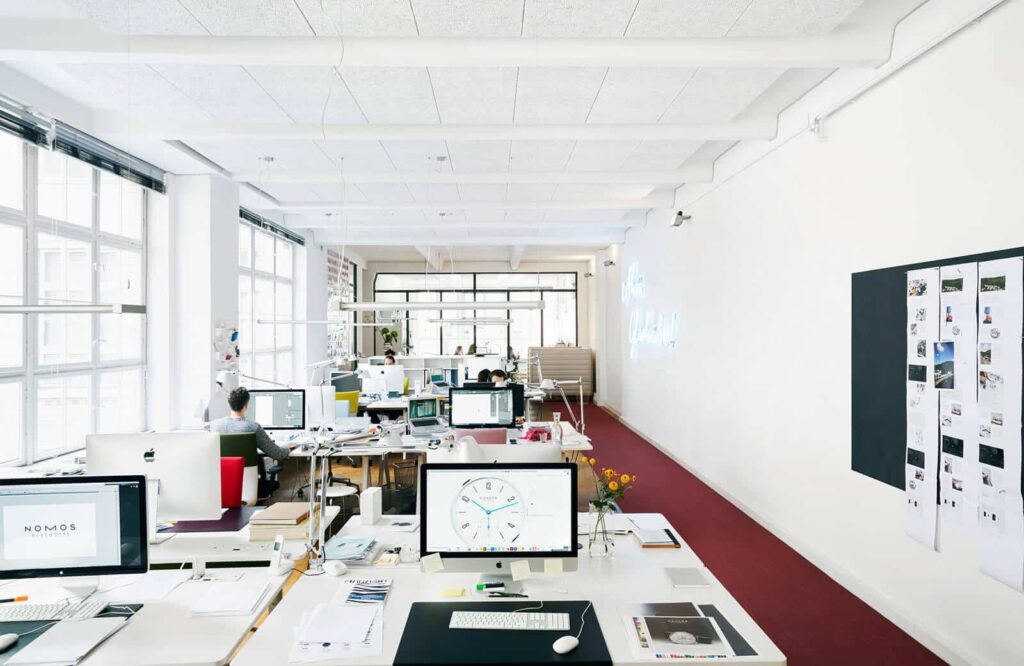
As NOMOS has grown, it has recruited more staff. According to the brand’s website, the firm has 200 employees at its three production sites. The majority, 180, work at our headquarters in Glashütte, where movements and wristwatches are manufactured. Around 20 NOMOS colleagues are spread across the locations in Berlin, New York, Hong Kong, Shanghai and Como in Italy.
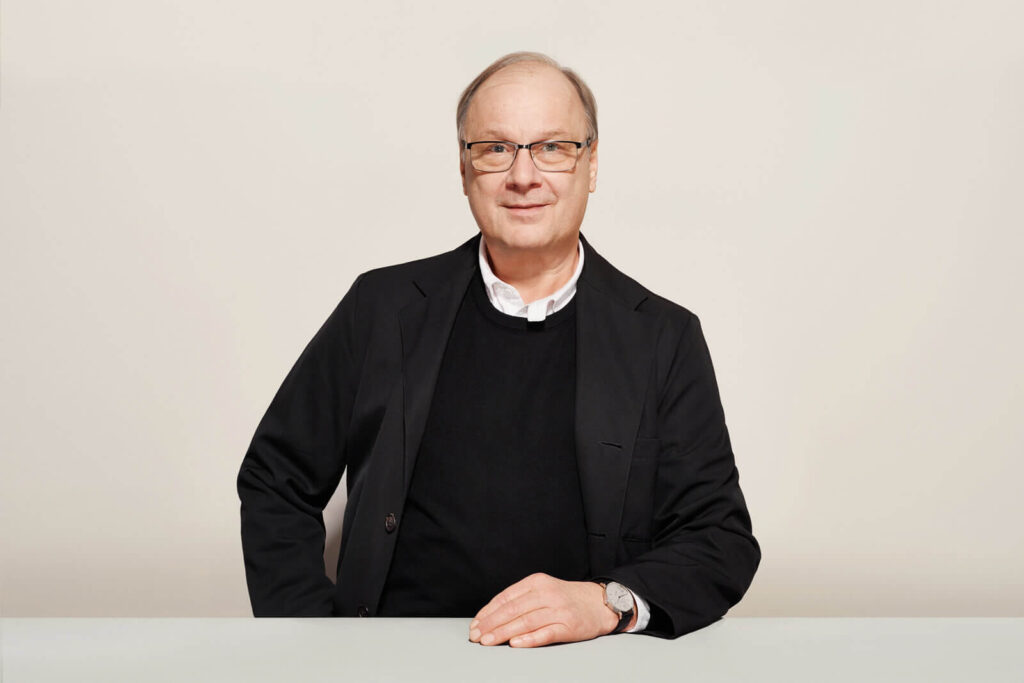
Judith Borowski joined the company in 2001 and has been a partner since 2004. She is a member of the management board and is responsible for the design and brand management at the watchmaking company.
Recently, I was granted the opportunity to ask Judith a few questions about her role as well as discover more about NOMOS Glashütte and Berlinerblau.
Interview with Judith Borowski of NOMOS Glashütte

Prior to the formation of NOMOS Glashütte, I believe Roland Schwertner worked in IT and was also a photographer. Do you know what attracted him to the watch industry? Moreover, what was your background and what led to you working at NOMOS Glashütte?
Before the fall of the Berlin Wall, when East Germany still existed, Roland Schwertner knew there were watchmakers in the West who always went misty-eyed whenever the name ‘Glashütte’ was mentioned. This place still had a celebrated reputation, even on the other side of the Iron Curtain. Roland Schwertner used to work as a consultant for a watch brand in Dusseldorf, West Germany. He also had relatives in the Ore Mountains and knew the area around Glashütte. When the Wall fell, he decided something needed to be done. He’s not just an entrepreneur, but an adventurer as well.
Lucky for us, Glashütte watchmaking expertise has survived various wars, the East German period and several generations. Without the rich tradition of this place, NOMOS Glashütte wouldn’t be where it is today. And perhaps, in turn, NOMOS has also enriched Glashütte’s history.

As for myself, prior to working for NOMOS Glashütte, I studied Criminology and Art Studies, among other things, and I was also a journalist.
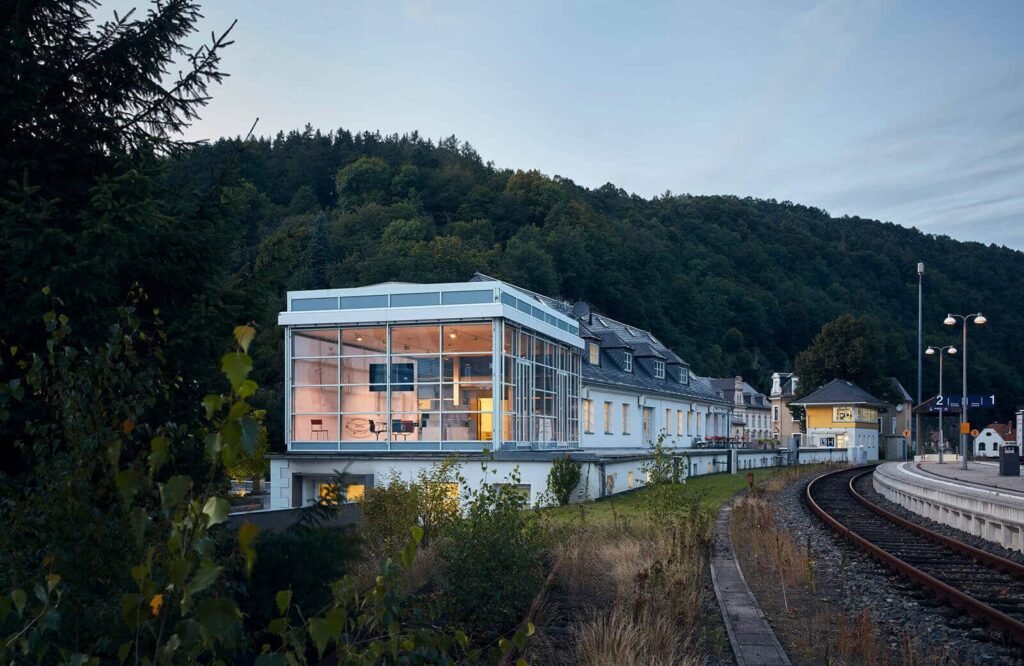
Having visited Glashütte, I know you have at least three production sites. Perhaps the most iconic of these sites is the former railway station. Is this where the NOMOS story began?
No, NOMOS acquired that site in 2005. With the launch of the first NOMOS calibre designed and developed in-house, our first automatic movement in the Tangomat model, we moved into this building. Basically, we needed space for production and the growing business.

I believe the first four models were the Orion, Tangente, Ludwig and Tetra and these were launched in 1992. These four models were designed by Susanne Günther. Can you provide some insight into why Susanne was selected for this role? Had she designed watches beforehand?
Susanne Günther is a graphic designer who Ronald Schwertner holds in very high regard. But it was about teamwork at the time: Other than Susanne, Christoph (a watchmaker), Roland (the founder) and later Michael (the artist and graphic designer for Tetra, 1993) were also involved in the early 90s. This is how the first small collection came into existence, as a group effort.
Our Tangente, however, also pays homage to a watch that had been around for about 100 years. The inspiration came from a formerly unsuccessful model—but, of course, it ended up looking completely different.

Today, the Tangente is the best-selling German watch. What do you think are the reasons for its success?
Tangente is an archetypal watch, an ideal timepiece that transcends generations and time, irrespective of type and gender. In my view, a very German design, but in a good sense—clean, unfussy, businesslike and flat, thanks to its slender calibre. It’s also very elegant. In addition to the design and the exceptional horological quality, which reflects the 175 years of Glashütte tradition, the price-performance ratio is also a factor in the great success of this watch. We often say: NOMOS is Tangente. This watch is like a logo, an emblem for our brand—it embodies our company.

The inaugural Tangente was equipped with an ETA movement. Thereafter, NOMOS created its first in-house movement, the hand-wound Alpha Calibre. This was a huge undertaking, however, it pales in comparison with the brand’s decision to make its own escapement, the so-called ‘swing system’. Ultimately, this was introduced in 2014, however, it must have been a huge financial undertaking. What made you embark on this course of action?
We wanted to be independent from third-party suppliers, we wanted to understand the most important component of the watch ourselves, its heart, and we wanted to be able to determine all the qualities ourselves. Plus, we wanted to grow, but when you’re dependent on supplies from third parties, this is only possible to a limited extent and can never be fully realised. The NOMOS swing system (as small as it is!) in fact represented a quantum leap for our brand. Only a few manufacturers worldwide are able to produce such things themselves.

If I’m honest, I didn’t associate the Tangente with having complications. However, I was clearly wrong as NOMOS has produced versions of the Tangente with complications such as a power reserve, a date and an ‘update’. Would you envisage the company offering more complications in the future?
Your impression isn’t wrong, complications aren’t the first concern for NOMOS, particularly, the Tangente. As a watch that accompanies you in everyday life, it isn’t a model that demands a complication. Tangente is perfect precisely because it is so simple and uncomplicated. The innovations you mention—the power reserve, date and updated date—are really useful features that serve the wearer. I don’t foresee any major complications, such as a perpetual calendar for Tangente or for NOMOS Glashütte either.

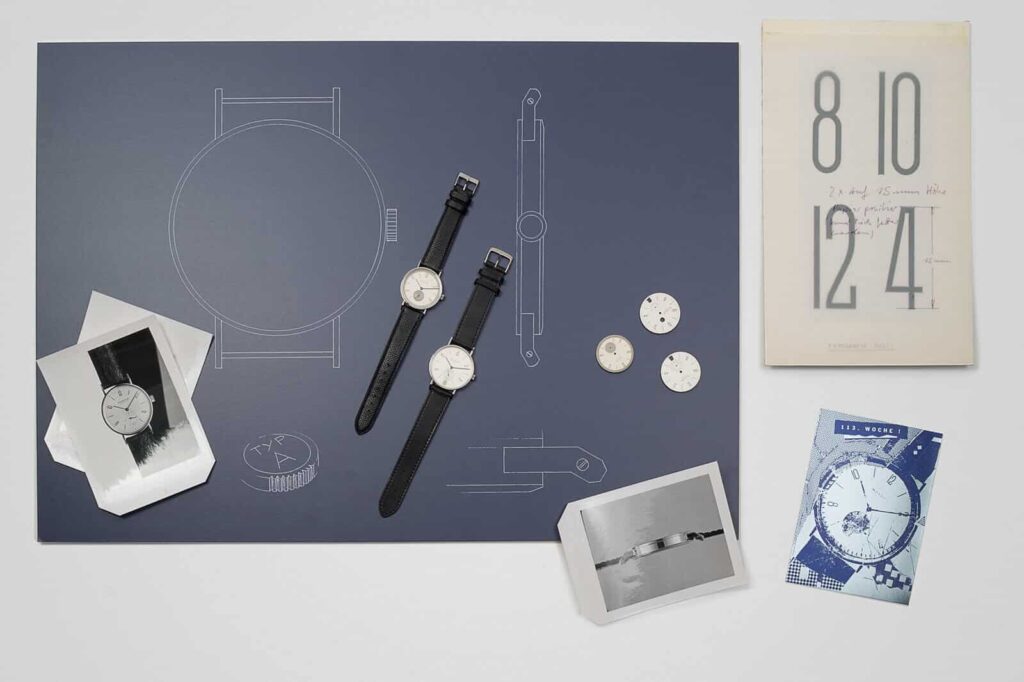
The typography employed on the Tangente is very distinctive. Some commentators describe it as Bauhaus-inspired, however, I believe it was the product of Susanne Gunther’s imagination. I assume this typeface is protected in some way. Have you applied it to any other models in addition to the Tangente?
Both are true. The typography is based on typefaces from the 20s. It is indeed Bauhaus-inspired, but we reworked the old design completely; Susanne and Michael were also involved in the Tangente typography.
We drew the numerals 2, 4, 8, 1 and 0 individually, so there was initially no complete set. We didn’t design the 3, 5 and other numbers until later. Likewise, it was the same with the date, which was a completely different task. We had to develop these numerals and place them within a small date window, ensuring they looked harmonious.
So, Susanne Günther, together with Michael Margos, adapted the typeface of old, significantly improved it and turned it into the Tangente typeface. In my view, this font is also very much responsible for the success of Tangente.
Yes, the Tangente typeface is protected. The typography of both Tetra and Ahoi is based on this font.
Would you consider developing a unique font for other models?
Not at the moment, no. Our library is vast, each NOMOS model has its own typography and we’re currently fostering our classics.
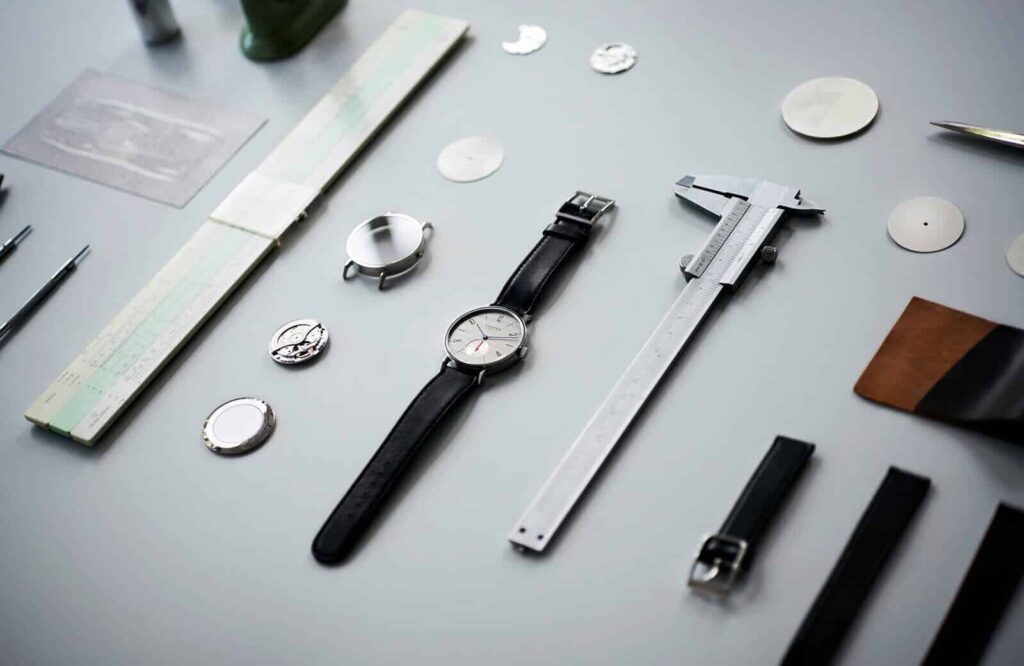
When I think of the Tangente, I inevitably think of white silver-plated dials and thermally blued hands. But the company has also produced many other colours such as ‘marine black’, ‘midnight blue’, ‘silvercut’ et al. What many readers probably don’t know is that in the past you have made brightly coloured and, sometimes, patterned dials such as ‘Capri’, ‘Rimini’, ‘Picknick’, ‘BBQ’ and ‘Rosemarie’. Do you envisage returning to such avant-garde dials?
The brightly coloured dials were only ever colourful forays for special models. For serial Tangente models, their colours would have been a little too striking: Watches like these are collectors’ items, made for individuals yearning a dial in their favourite colour. Interestingly, these watches have appreciated in value, sometimes quite considerably. Nevertheless, for the standard collection we prefer colours derived from the material—and colours that, like the watches and designs themselves, will last a lifetime.
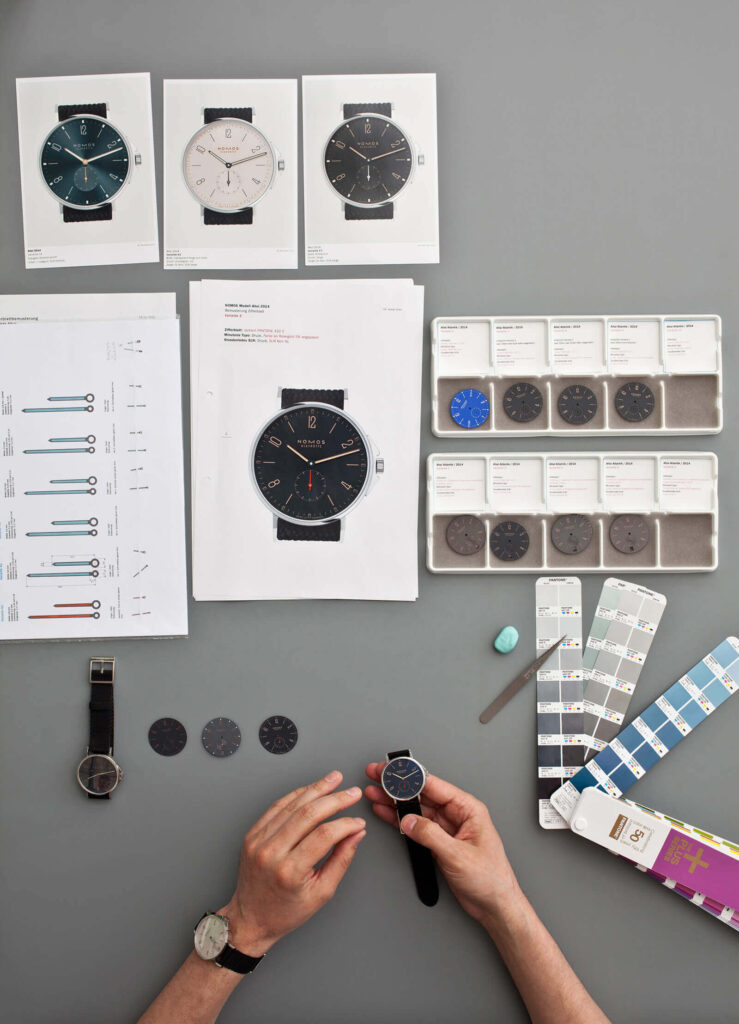
On today’s NOMOS models, the words ‘NOMOS’ and ‘Glashütte’ are positioned at the top of the dial and ‘Made in Germany’ is stated at the base of the dial. On some of the early models, the text was slightly different with ‘Glashütte SA’ positioned below the word ‘NOMOS’ and simply ‘Germany’ at the base of the dial. Can you provide some explanation for these changes?
The ‘SA’ stands for ‘Saxony’ and is actually part of our company name. But after we increased the vertical integration of the company, to the extent that our watches were ‘extremely Glashütte’, we chose to enlarge the place name on the dial, making it more visible. To make space for this, we dropped the ‘SA’ from the dial. ‘Made in Germany’ has superior recognition than merely stating ‘Germany’. It also just looked better positioned above six o’clock.

These days, NOMOS watches are designed at your Berlin offices. However, you’ve also engaged external designers such as Mark Braun and Werner Aisslinger. What are the advantages of being based in Berlin? And what are the reasons for using external designers when you clearly have a very talented team of in-house designers?
Berlin is a melting pot for the most talented designers, artists and other creatives. We find the best of the best here; they’re practically breaking down our doors. And everyone can find the inspiration they need here, too.
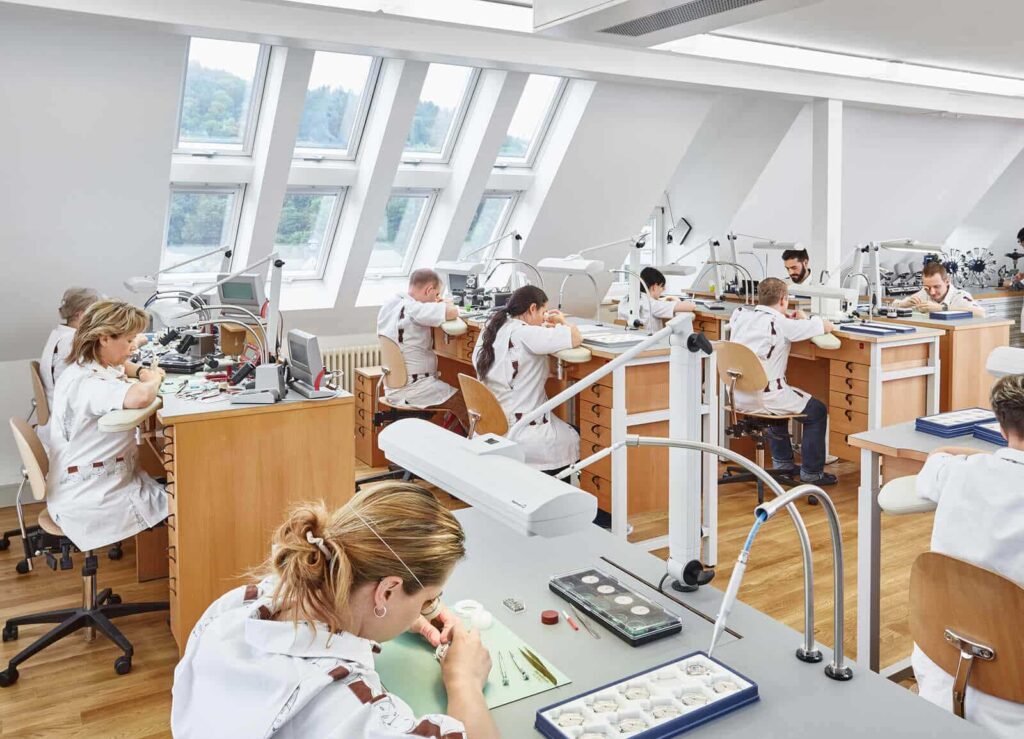
So, in Glashütte it’s the watchmakers, design engineers and regleurs who are exceptionally good and who have been plying their trade for generations; while in Berlin it’s the creatives. They complement each other well. And there’s also a good symbiosis of internal and external contributors at NOMOS Glashütte: The in-house knowledge, NOMOS’ empirical know-how, the close ties here between design and construction—with an added breath of fresh air from outside expertise every now and then. It’s great, actually. No, it’s ideal.

While I can’t imagine NOMOS signing-up celebrity ambassadors, the brand has become a popular choice among Germany’s political elite working in the German Bundestag. How do you feel about this?
I’m delighted. We’ve never pushed for this, but when German politicians like to wear a good watch made in Germany (and not one from China or Switzerland), that’s a good sign. It’s not necessarily one of pride, but it is a statement of solidarity and it’s a sign of how the wearer views our world. It’s also a statement of style consciousness and quality.
But I also believe that NOMOS Glashütte, in turn, shapes their view of the world: The beauty and clarity of our watches, the attitude of our brand—I think that looking at it every day also shapes the people who wear our watches a bit. I like the notion of NOMOS Glashütte getting involved in politics a tiny bit this way…

Do you ever marvel that when you released the inaugural Tangente, some 30 years later it would still be in huge demand?
I’m not surprised. But it makes me happy and I sometimes feel a bit humbled and grateful to Susanne Günther and co, as there’s no planning a success like this. You can only ever wish for a classic—whether you actually achieve that only becomes apparent many years later. Demand for the Tangente shows no signs of waning, quite the opposite. Indeed, it’s the NOMOS model that keeps going and going and going: how wonderful!

What are your aspirations for NOMOS Glashütte in the long term?
That we continue to make life much nicer and better with what we do: The lives of our coworkers, our suppliers, trade partners and, of course, our customers. That we can secure good jobs in Glashütte in the long run. And also that we manage to set a new standard in the world of watches, with beautiful, elegant automatic watches made in-house and in line with 175 years of Glashütte watchmaking tradition.
Closing remarks
Since NOMOS unveiled its inaugural collection in 1992, it has gained an enviable reputation for crafting products that deliver an impressive quality-price ratio. The brand’s ultra-thin, in-house movements are imbued with mechanical ingenuity, enriched with impressive finishing and promise extraordinary levels of accuracy.

Furthermore, with NOMOS, there is a confluence of style and quality that grants a notable degree of longevity. In terms of styling, the allure of Bauhaus has never faded. From the outset, NOMOS shrewdly chose to embrace the ‘form follows function’ design philosophy. Certainly, NOMOS Glashütte’s prowess for design is beyond reproach, manifest with the numerous design awards it has amassed over the years.
Judith is clearly able to attract very talented creatives, enticing them to work in the firm’s Berlin office. Despite being 200km apart, personnel in Berlin and Glashütte clearly work well together, creating watches for an increasing number of brand devotees.
All images are protected by copyright: NOMOS Glashütte
Further reading