
L. Leroy Osmior Bal du Temps Watch Review
Drawing on its vast expertise amassed over 240 years, L.Leroy recently launched the Osmior Bal du Temps at Geneva Watch Days 2025. This timepiece unites two high complications: a minute repeater and a tourbillon. Angus Davies looks at the origins of repeater watches before exploring this latest expression of Haute Horlogerie.

Image – L. Leroy Osmior Bal du Temps in platinum
L.Leroy depuis 1785
Basile-Charles Le Roy (1765-1839), at the tender age of 20, was declared a ‘Master Watchmaker’, a title that allowed him to open his own workshop and boutique in Paris. He was ably assisted by his father, Basile Le Roy (1731 – circa 1803) who was once apprenticed to the legendary Pierre Le Roy (1717-1785). Despite these latter men sharing the same surname, they weren’t related. With the opening of said workshop and boutique in 1785, a watchmaking dynasty was born.
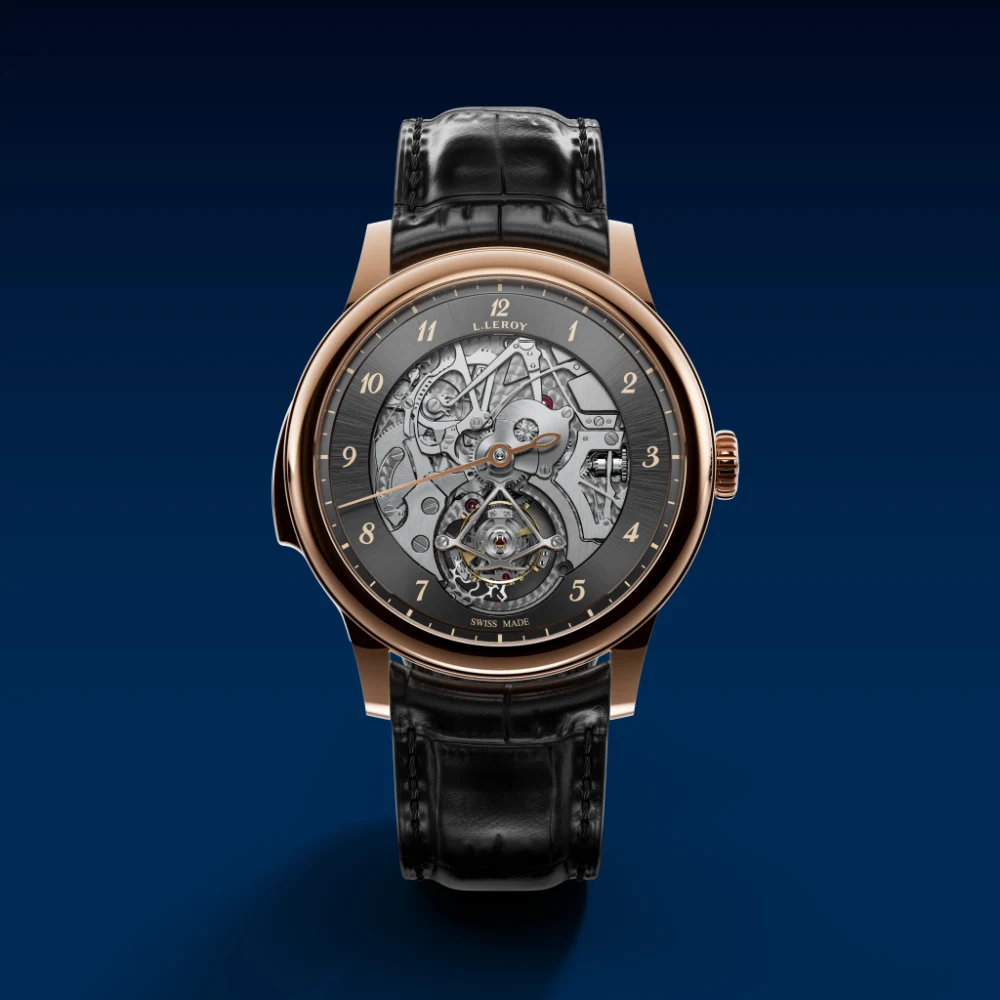
Image – L. Leroy Osmior Bal du Temps in 18k 5N red gold
Before electric street lights
To have achieved so much at a young age, Basile-Charles must have been a hardworking fellow. Nevertheless, it’s likely there were occasions when he strayed from his bench and chose to relax, strolling along the impressive boulevards of central Paris. However, when the nights drew in, or the mornings had yet to awake, he would undoubtedly have noticed that the street illumination was relatively poor. This was despite the city being famously named ‘La Ville-Lumière’ (‘The City of Light’) back in the 17th century (see later) and, interestingly, one of the first cities to illuminate its streets.
Early examples of street lighting took the form of iron-framed glass boxes containing lit tallow candles. Thereafter, these candles were superseded by oil lights before they were subsequently replaced by gas lighting. It was not until 1878 that the first electric street lights arrived in Paris. Successive forms of street lighting bathed central Paris in a nocturnal glow, aiding pedestrians and no doubt inhibiting criminal activity. However, its use in small towns and villages remained rare.
Once away from the glare of the city lights, those fortunate enough to own a pocket watch would have found it difficult to read the time, especially in a pre-lume era. The answer eventually came in the form of chiming watches which allowed the wearer to determine the prevailing time aurally.
Early repeater watches
Edward Barlow and Daniel Quare are both cited as being the inventor of the quarter repeater, albeit it was Quare who was eventually granted the patent in 1687. The quarter repeater indicated the hours and quarters on demand. Later, saw the arrival of the half-quarter repeater, chiming the hours and half-quarters. However, the ‘minute repeater’, a complication coveted by many of today’s horophiles did not arrive until around 1720 and is believed to have originated from Germany.
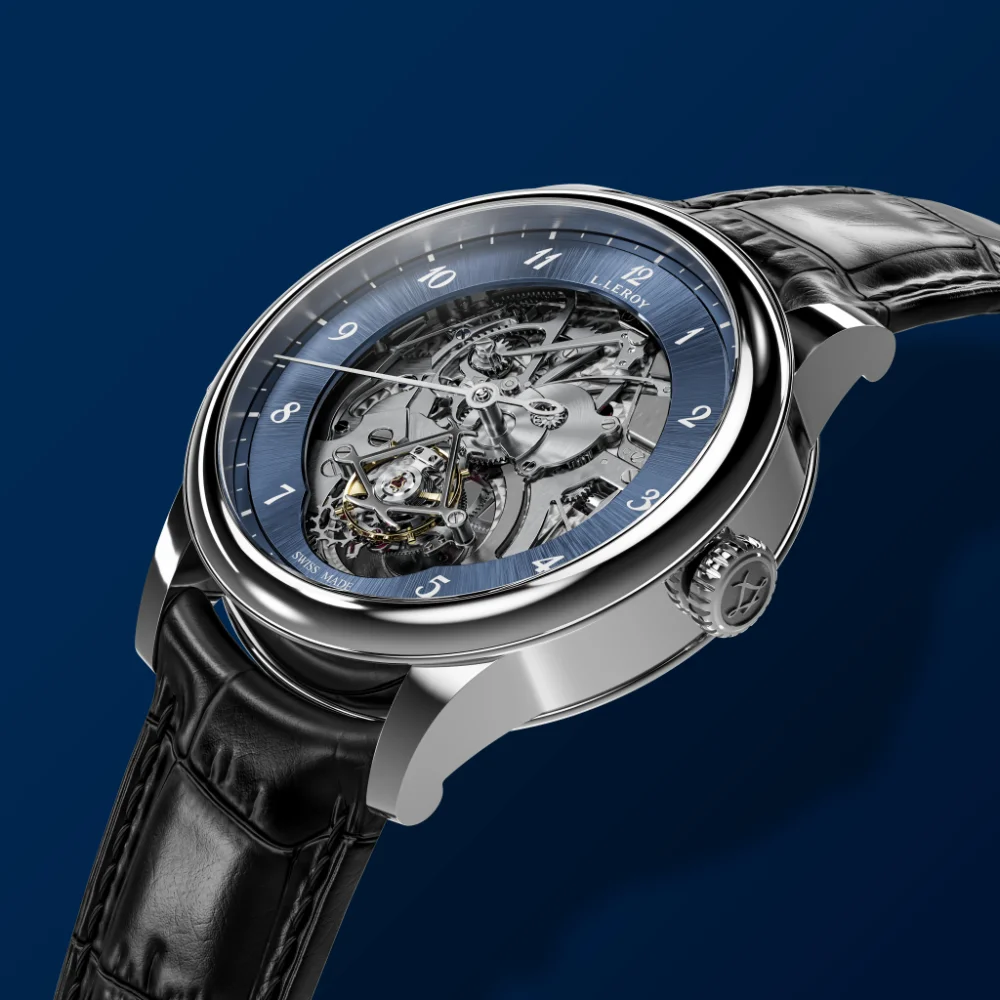
Image – L. Leroy Osmior Bal du Temps in platinum
The minute repeater
A minute repeater allows the wearer to actuate a chiming sequence, usually using a slide on the flank of the case. The aural indication of time commences with hours (low note), quarters (low and high notes) and minutes (high note). During the 18th century, the scarcity of street lighting made the minute repeater a highly practical complication; however, with the widespread adoption of electric street lighting, its usefulness has been somewhat diminished.
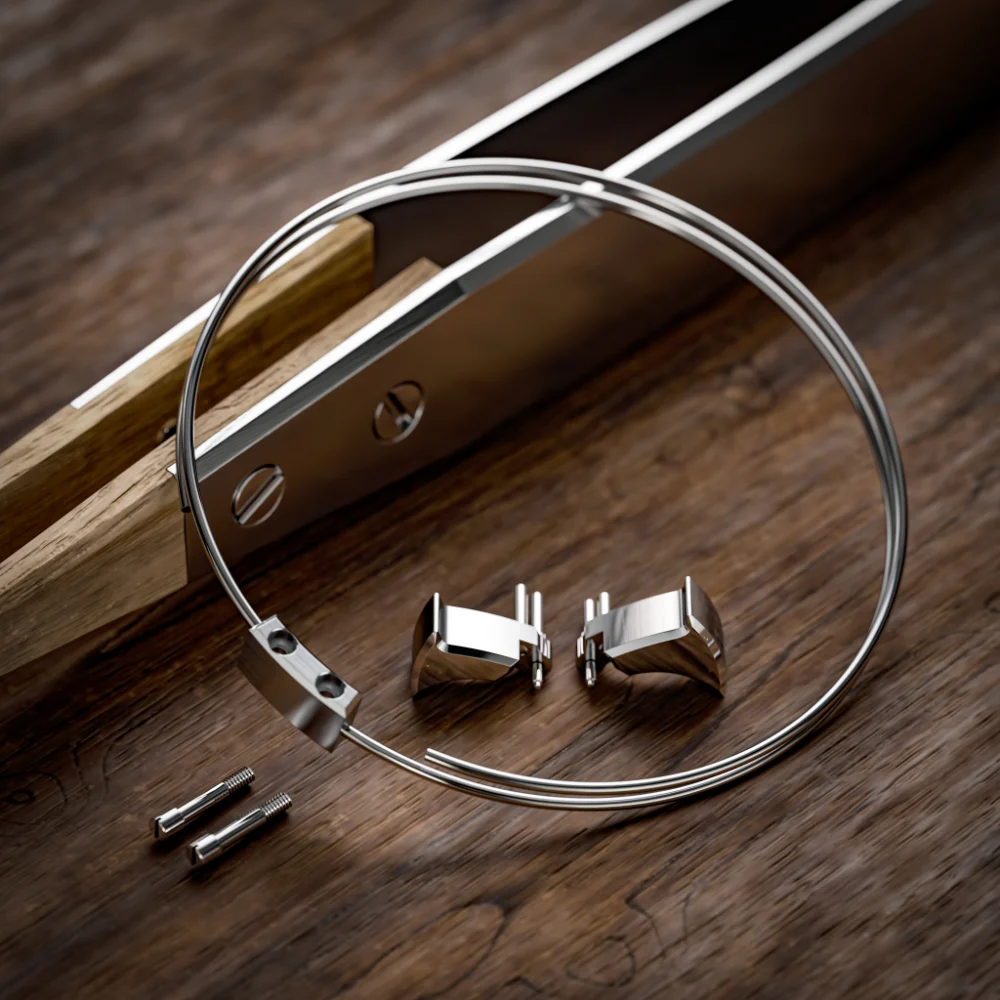
Nevertheless, a technically challenging complication to realise, the desirability of the minute repeater has never waned. The elaborate mechanism features two gongs that encircle the movement. These gongs are affixed to the mainplate or case with a ‘heel’ or ‘plot’ and are painstakingly crafted over several days. Shaped from wire using time-served hands, they are heated and then quenched. Once complete, their shape is refined with a file to achieve the optimal sound.

Three semicircular cams, termed snails, one for the hours, a second for the quarters and a third for the minutes are connected to the motion works. The snails engage with racks and wheels, informing the hammers how many times to strike the hours, quarters and minutes. Both hammers, slightly different in shape, take their turn to strike the hours and minutes. The quarters are announced using both hammers that alternate between low and high notes, with each strike spaced slightly apart.

To ensure the hammer strikes are optimally spaced apart, the movement features a centrifugal governor. This spins silently to avoid marring the exquisite chiming experience. Even the interior of the case is purposely designed to accentuate the sound, enriching the aural experience with a becoming tone and sufficient volume.
L. Leroy Osmior Bal du Temps – two high complications
Often termed a ‘high complication’, the crafting of a minute repeater necessitates the talents of a highly capable master watchmaker, not to mention an inordinate amount of time. In isolation the minute repeater’s allure is huge, but when combined with another high complication its appeal is immeasurable. Step forward the L.Leroy Osmior Bal du Temps. This exquisite timepiece is endowed with a minute repeater and a tourbillon, a horological double act destined to make any self-respecting horophile drool with delight.
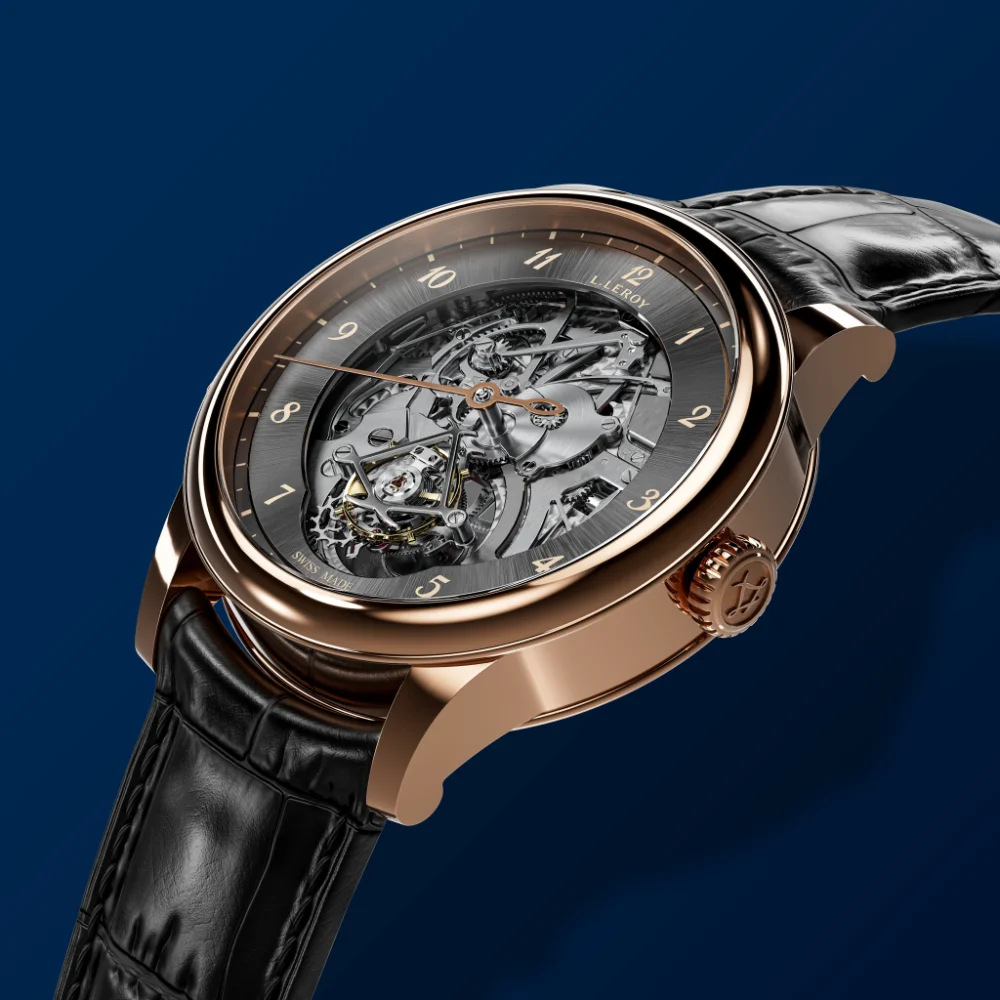
Image – L. Leroy Osmior Bal du Temps in 18k 5N red gold
Once again, there is a connection to Paris. The brainchild of Abraham-Louis Breguet (1747-1823), the tourbillon ameliorates the adverse effects of gravity on the rate of the balance. His invention involved placing the regulating organ and escapement within a rotating cage that revolved 360° over a period of 1, 4 or 6 minutes, negating any positional influence on the rate. At this juncture, some watch aficionados will be keen to point out that Breguet was born in Neuchâtel; however, he established his workshop Quai de l’Horloge in Paris in 1775, aged 28, a city where he would enjoy much commercial success.
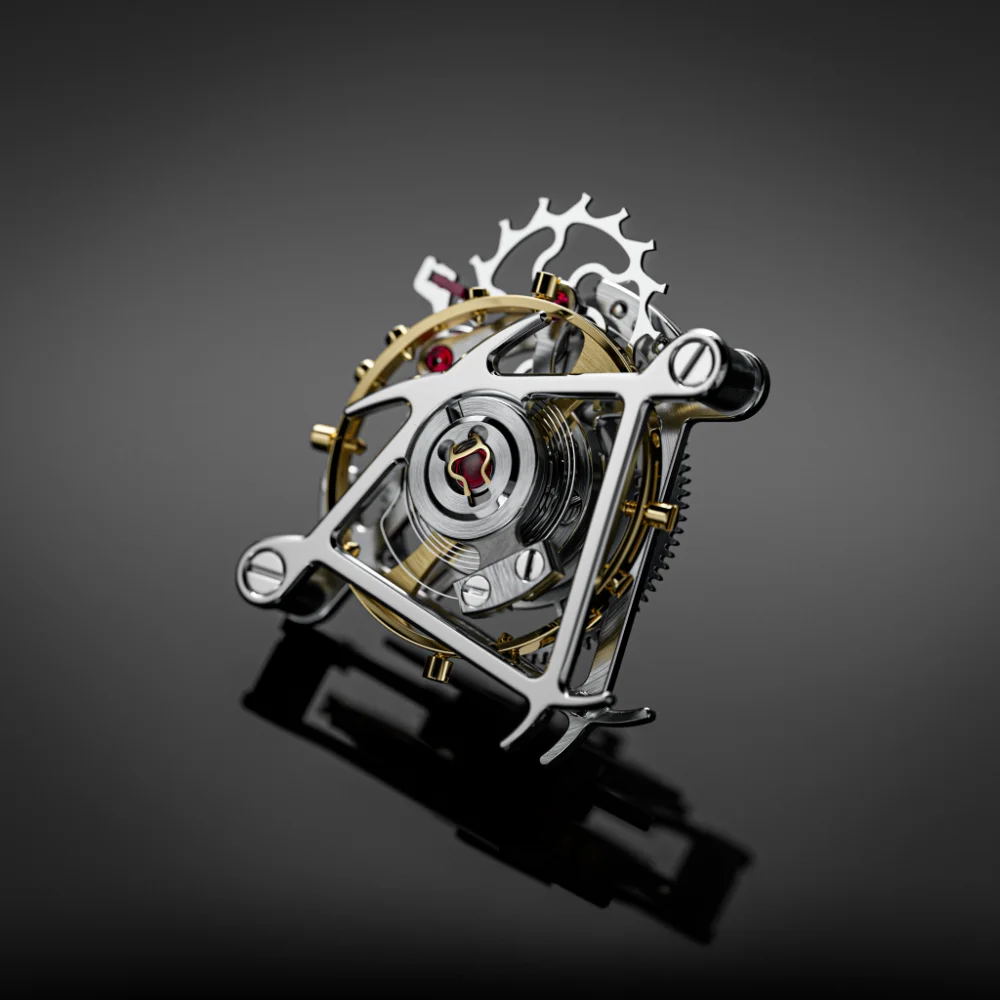
Clearly seeking to seduce the cognoscenti, L.Leroy has chosen to go further, equipping the Osmior Bal du Temps with a ‘flying tourbillon’ which makes one full rotation every 60 seconds.
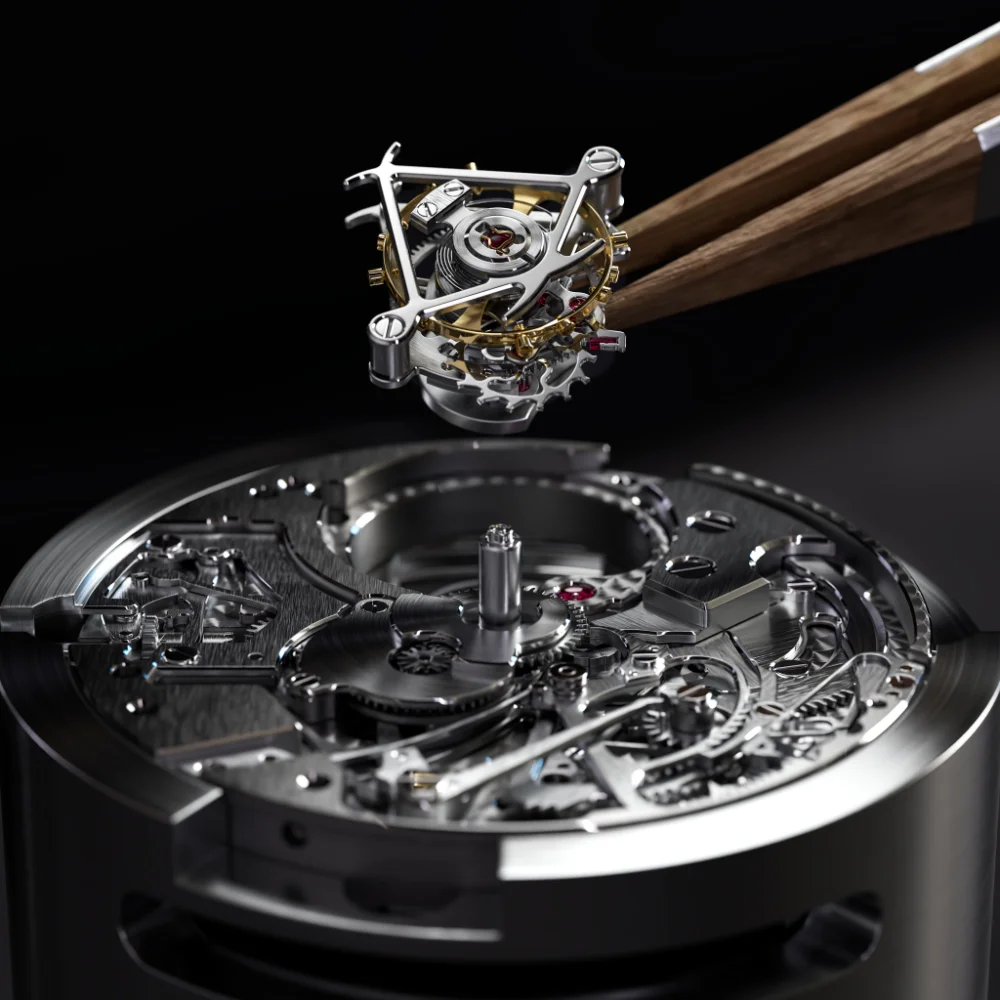
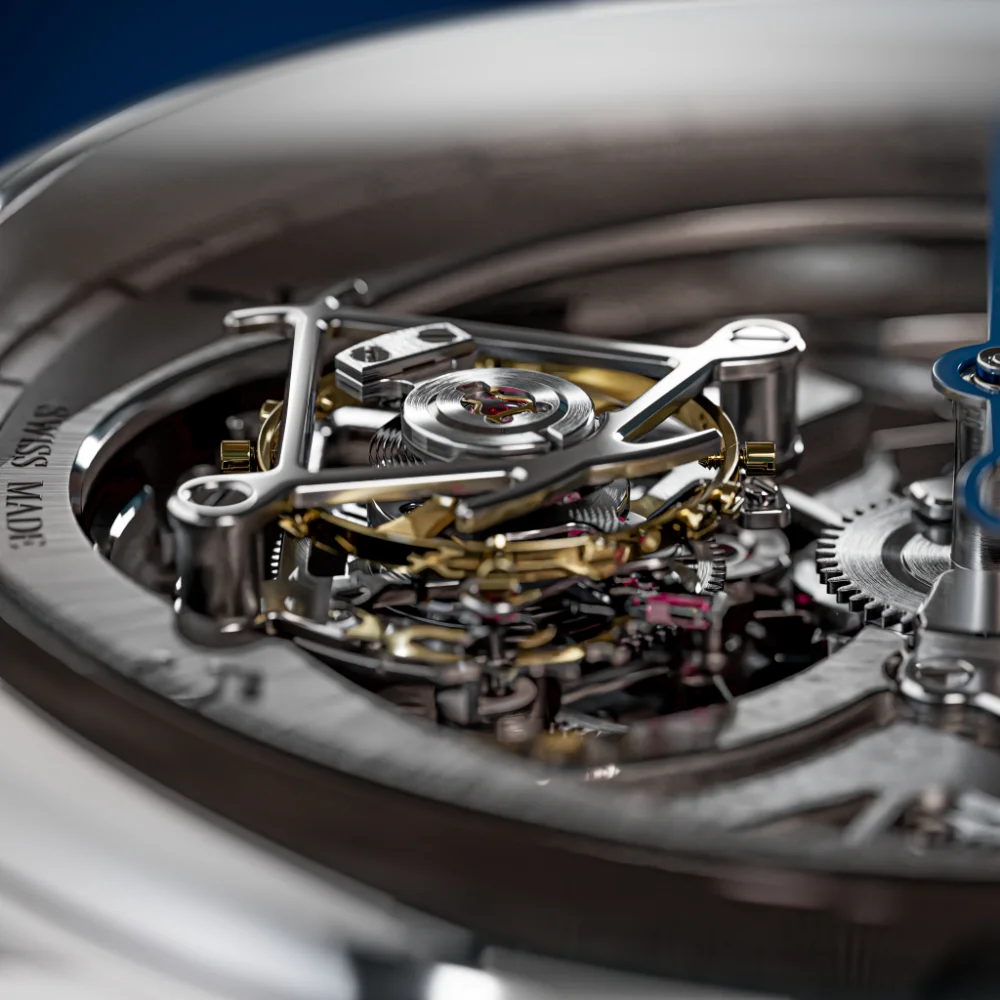
Conceived by Alfred Helwig in 1920, a teacher at the German School of Watchmaking in Glashütte, the flying tourbillon shares much in common with Breguet’s invention that was patented in 1801. However, the notable difference is that rather than the cage being supported by two bridges, one above and one below, the flying tourbillon eschews the upper bridge and is supported solely from underneath. A significant benefit of a flying tourbillon is that it allows the wearer to see more of the tourbillon in motion. Indeed, watch aficionados are indulged with a dynamic scene with the balance wheel oscillating to and fro, the balance spring pulsing with life and the pallet lever repeatedly kissing the escape wheel.
Beyond its mechanical complexity, the Osmior Bal du Temps is blessed with a prepossessing appearance and numerous refinements.
L. Leroy Osmior Bal du Temps – three variants
The Osmior Bal du Temps is offered in three case options: 18k 5N red gold, platinum or Grade 5 titanium. During Geneva Watch Days, I had the opportunity to handle the latter reference, which is the focus of my review hereafter.
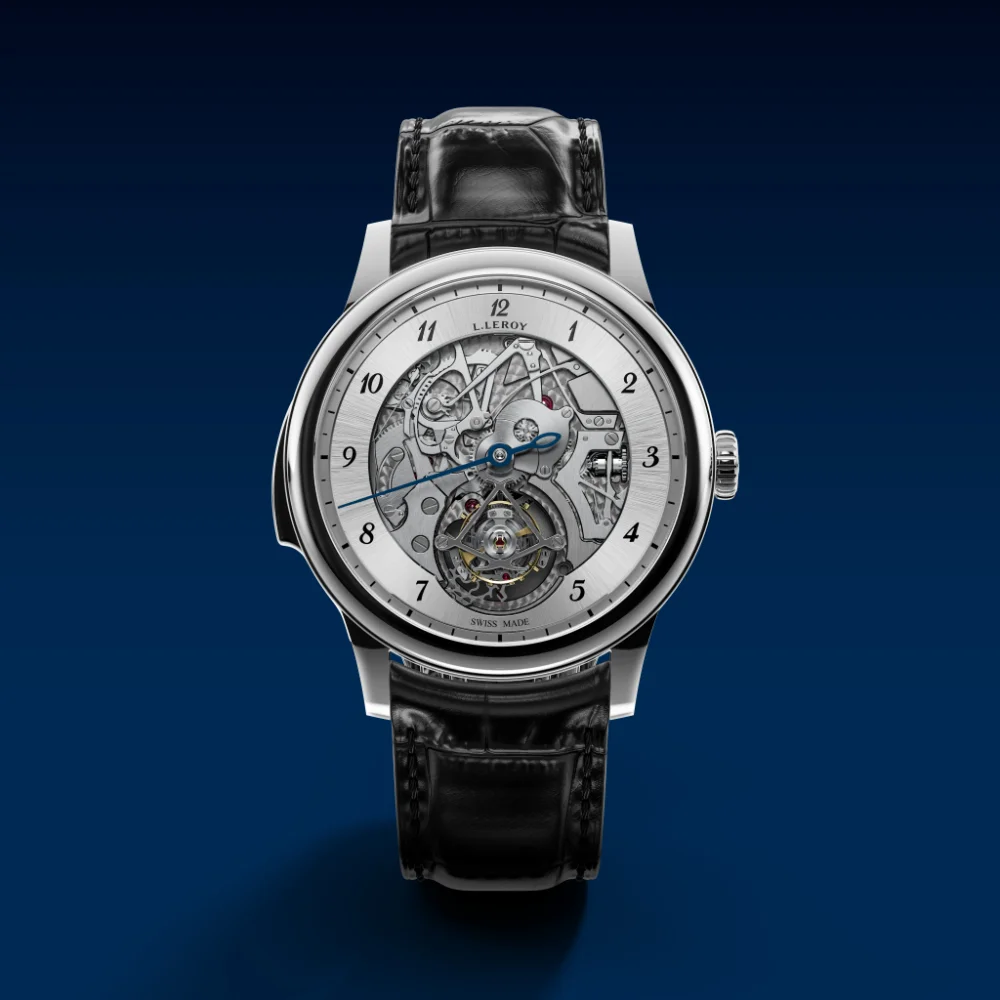
Image – L. Leroy Osmior Bal du Temps in Grade 5 titanium
Leroy Osmior Bal du Temps – dial
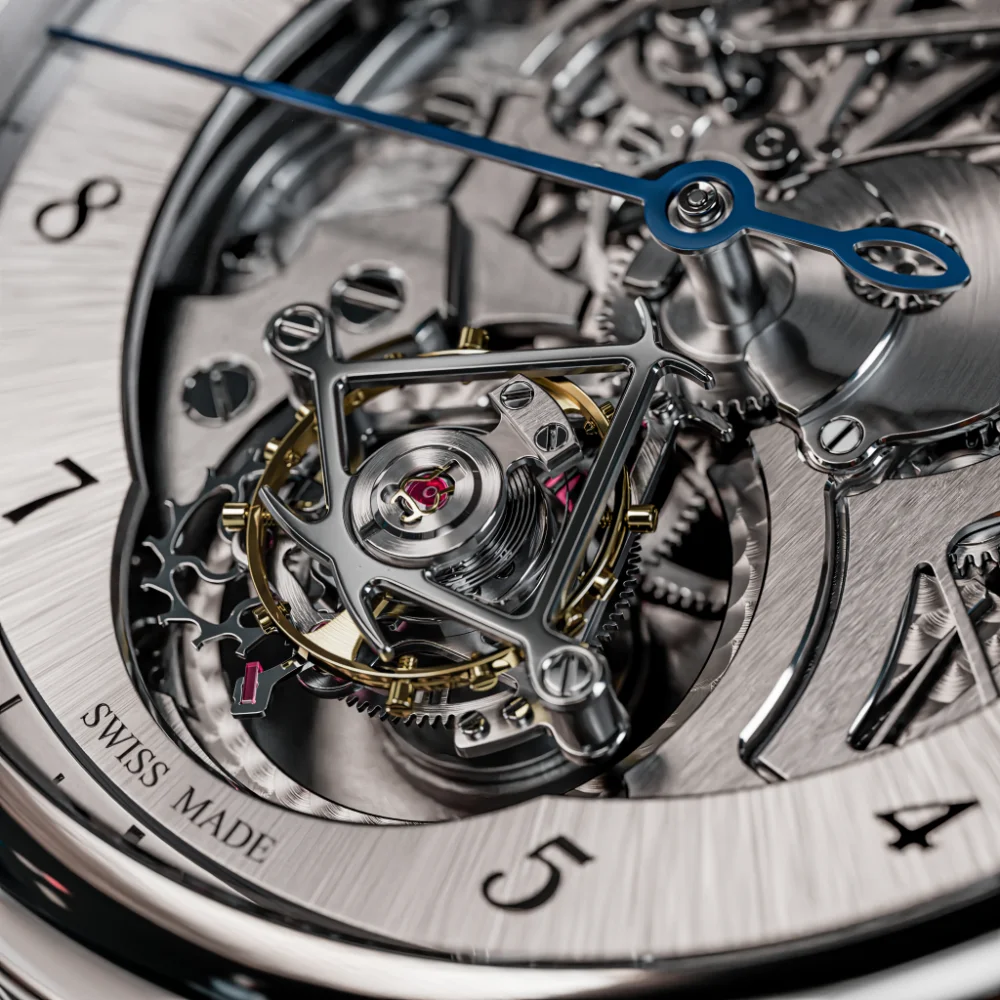
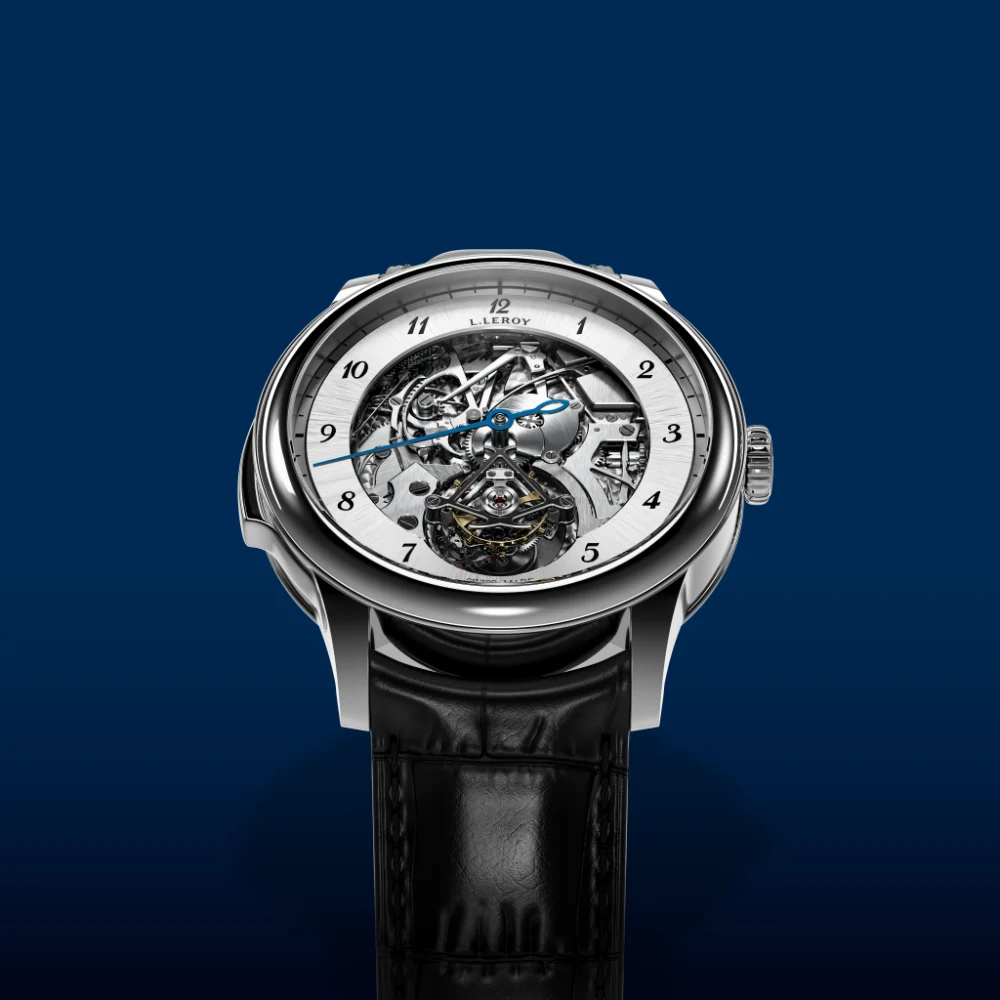
Set against a silver toned backdrop is a lone blue hand, indicating the hours and minutes. The hours are denoted with Arabic numerals, executed in a classical font. A neighbouring track, fringing the dial, features crisp markings denoting each 15-minute period. Should the wearer wish to hear the time, they merely need to push the slide on the left flank of the case upwards and the chiming sequence will commence its performance. As the chiming sequence takes place, the wearer is also indulged with views of the snails and racks performing their choreographed dance centre stage.

In the lower portion of the dial, located at 6 o’clock, the flying tourbillon perpetually pirouettes until the lone barrel is eventually depleted of energy. Consistent with its exalted execution, the Osmior Bal du Temps’s tourbillon cage is delightfully formed, echoing the shape of the Maison’s logo, ‘the interlaced Letter L’.
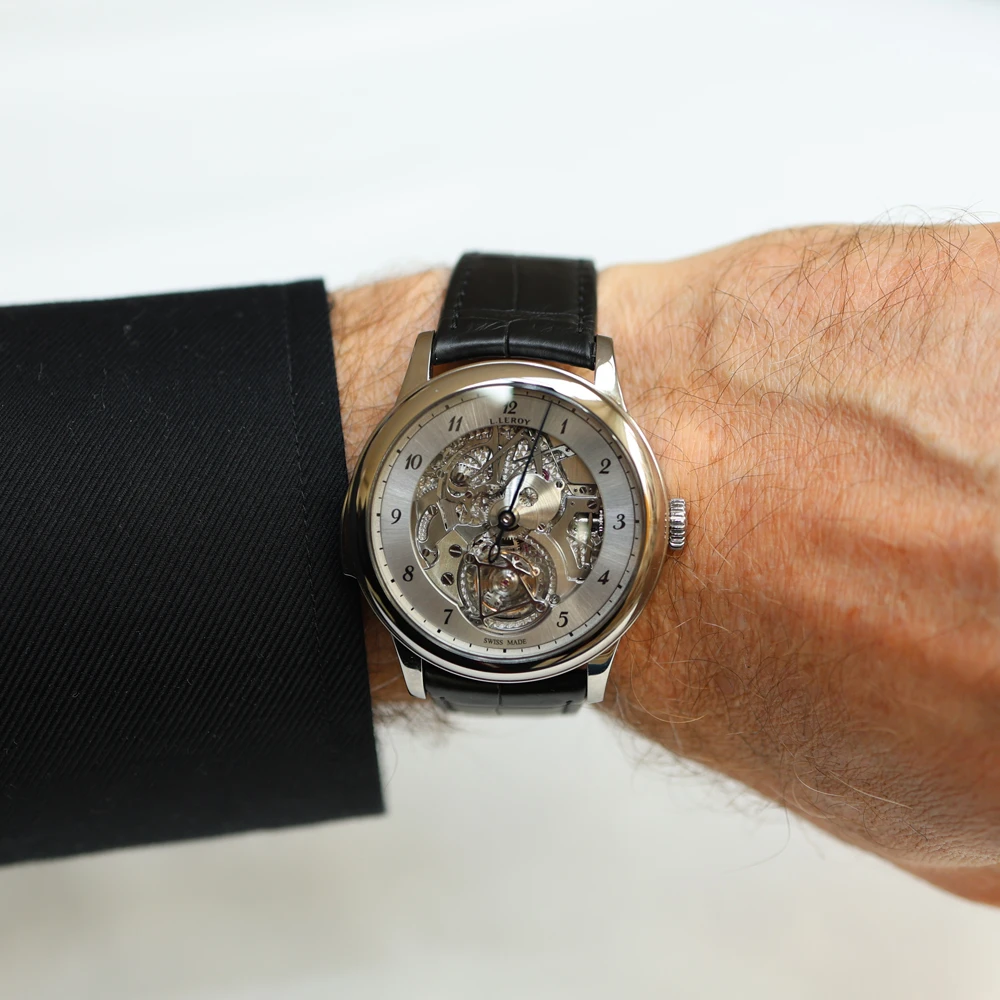
Beyond the dial’s many technical highlights there is a profusion of nuanced details, destined to deliver enduring delight. The hour track is enriched with a sunray motif. Numerous movement parts are revealed at the centre of the dial, including the crown wheel (part of the keyless works) and the hour wheel (part of the motion works). And yet, unlike many openworked dials, the lone blue hand remains eminently visible against the silver-toned backdrop.
L. Leroy Osmior Bal du Temps – case
Measuring 43 mm in diameter, the Grade 5 titanium case confers much wrist presence, while at the same time proving comfortably light. This alloy, widely used in the aerospace industry, is composed of 90% titanium, 6% aluminium and 4% vanadium. Grade 5 titanium is very strong, corrosion resistant and hypoallergenic. Due to its hardness, the alloy is difficult to machine, a factor which is reflected in the cost of production. Moreover, the hardness of the metal makes polishing more challenging. On this occasion, L.Leroy has expended a vast amount of time polishing the majority of case surfaces to a resplendent gleam.
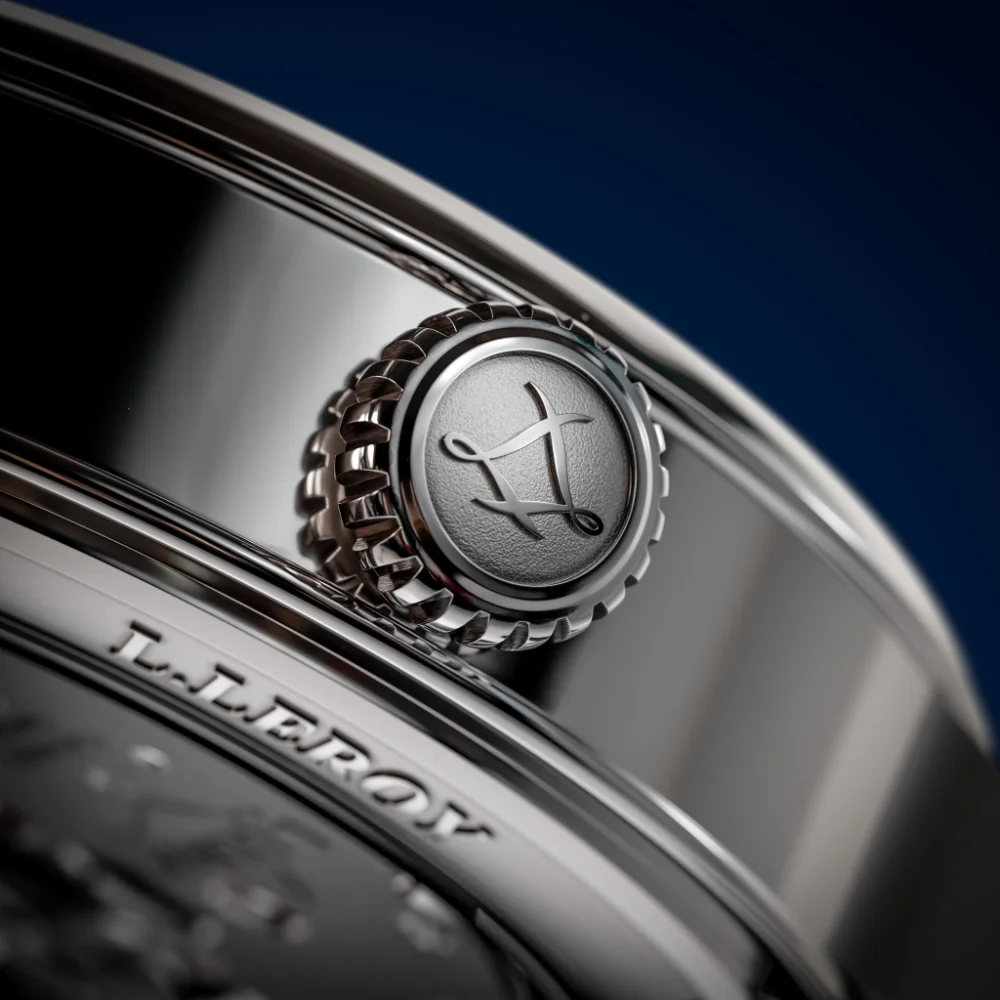
In common with most minute repeaters, the case interior is designed to accentuate the soundtrack. Ordinarily, watch brands demonstrate a minute repeater by placing it on a wooden box to amplify the chiming sequence. However, while attending Geneva Watch Days, my host from L.Leroy placed the Osmior Bal du Temps in his left hand, pushed the slide and delighted the assembled guests with a highly audible chiming performance. No wooden box or other resonating trickery was employed to produce the clearly audible striking of gongs.

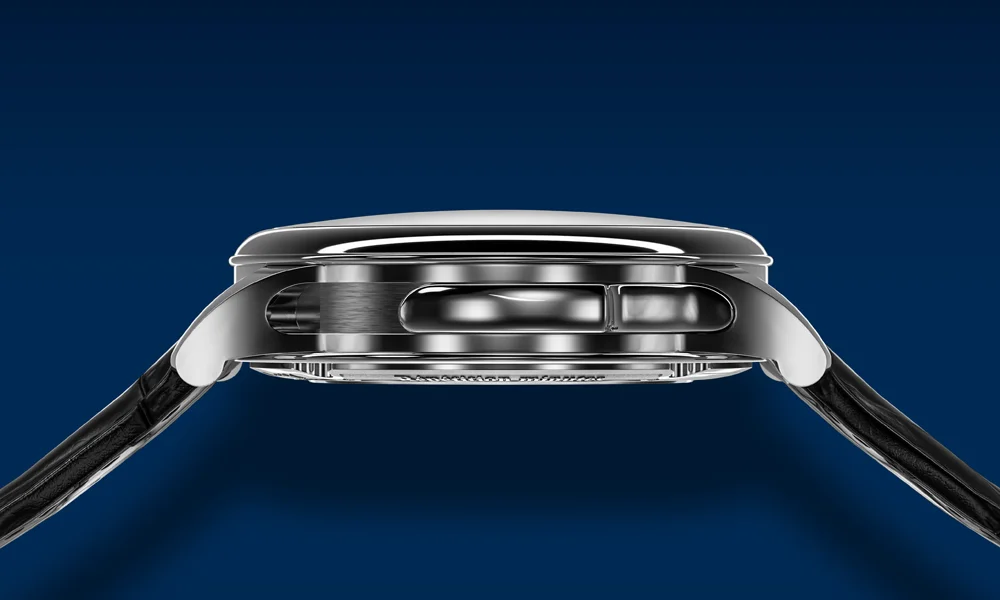
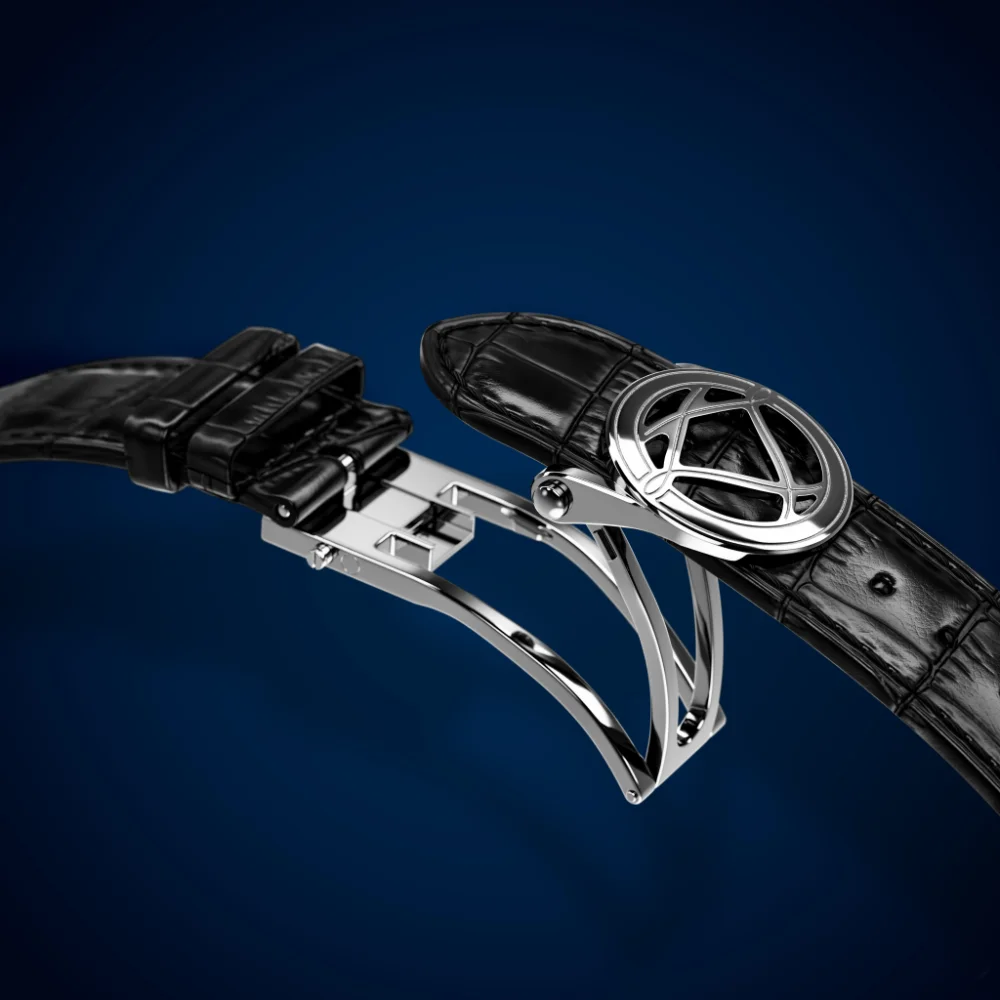
The lugs of the case arc downwards, inviting the strap to nuzzle the wrist, making the watch appear smaller than its stated dimensions. A pane of sapphire crystal grants sight of the hand-wound movement, the Calibre L601SQ. The Osmior Bal du Temps is presented on a black alligator leather strap, featuring large scales and tone-on-tone stitching. The strap and watch secure to the wrist with an openworked folding clasp endowed with the brand’s logo.
L. Leroy Osmior Bal du Temps – Calibre L601SQ
While I have already said much about the minute repeater and tourbillon, there are several additional attributes worth mentioning. Many watches equipped with a raquette or index-regulated balance, but the Calibre L601SQ is fitted with a variable-inertia balance. With this latter form of regulation, the effective length of the balance spring remains fixed and the rate is adjusted by altering the position of timing screws set in the rim of the balance wheel. The variable-inertia balance proves more time consuming to set up but the rate can be set more precisely. Moreover, minor shocks are less likely to require remedial regulation.
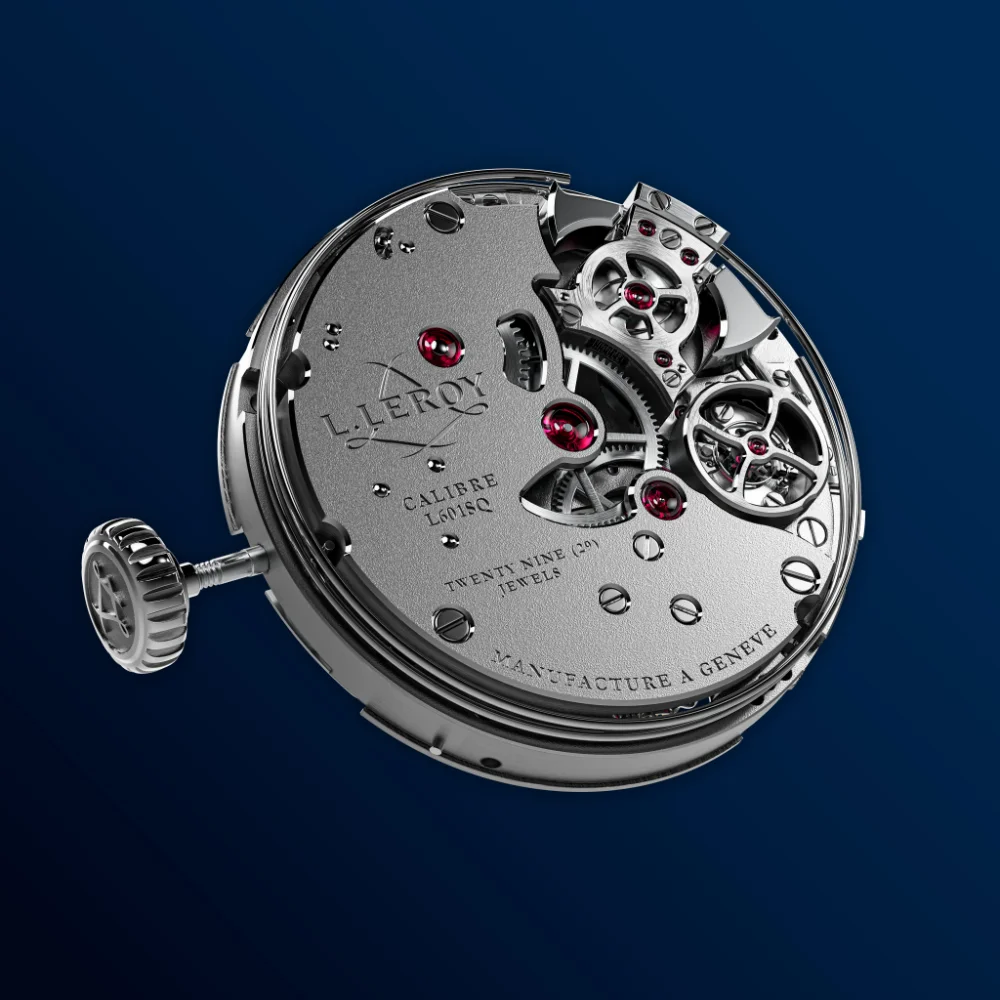
Often, watches feature numerous bridges affixed to the mainplate; however, L.Leroy has employed a three-quarter plate or single bridge. Fitting the three-quarter plate is more challenging and time-consuming but provides a more stable form of construction. Once again, L.Leroy’s quest for perfection comes to the fore.
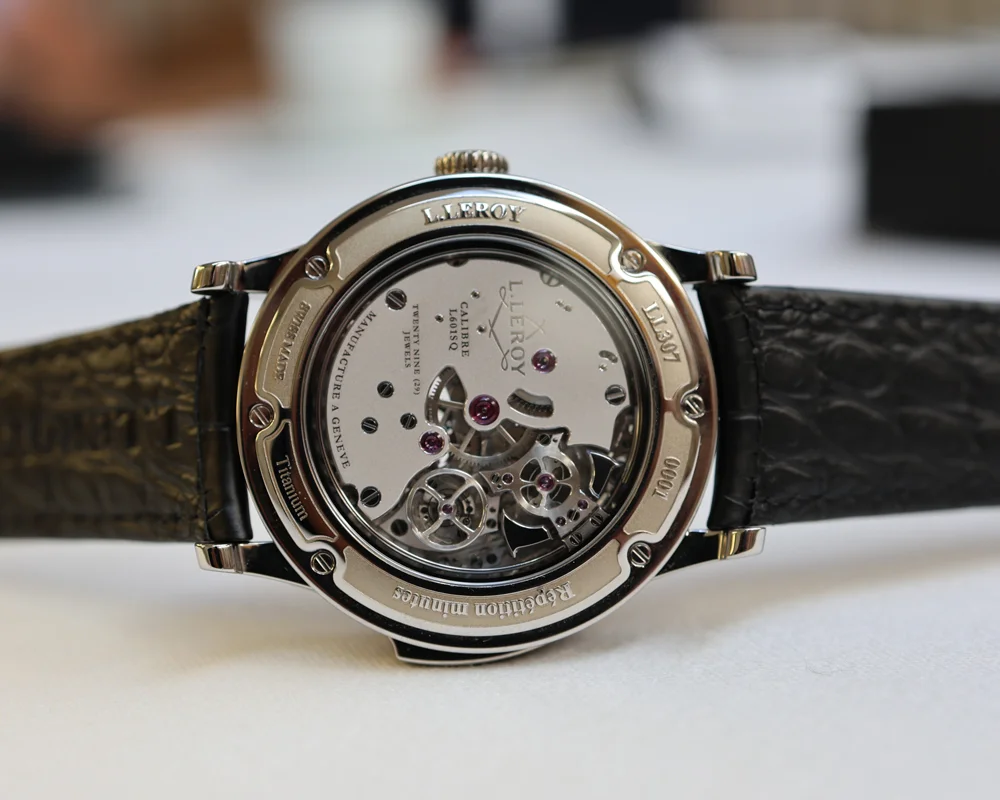
In the rarefied heights of Haute Horlogerie, peerless ‘finissage’ is of vital importance. The Osmior Bal du Temps does not disappoint in this regard. The rhodium-plated single bridge is presented with a frosted finish, the hammers are mirror-polished and include chamfered edges, the mainplate is adorned with perlage and the screw heads are also mirror-polished to a brilliant conclusion. Indeed, all of the 321 movement components are refined to the nth degree and assembled by hand in Geneva.
Closing remarks
During the 17th and 18th centuries, ‘The Enlightenment’, an intellectual movement, spread throughout Europe. It touched various aspects of life, including philosophy, politics and science. During the 18th century in particular, Paris became the epicentre of the Siècle des Lumières. Leading lights such as Diderot, Rousseau and Voltaire questioned long-held beliefs, placing emphasis on reason and evidence-based knowledge. This was probably the reason Paris became known as ‘the City of Light’ rather than the French capital’s early adoption of street lighting.
It is this political and economic climate that allowed Basile-Charles Leroy to establish his eponymous business, while the widespread lack of nocturnal illumination inspired great minds to conceive the minute repeater. Now celebrating its 240th anniversary, L.Leroy has crafted a remarkable timepiece with each element of its composition the product of much consideration. Indeed, the dial, the case and the movement unite to deliver a harmonious aesthetic, a mellifluous soundtrack and a symphony of finely decorated movement components. Having seen the Osmior Bal du Temps at close quarters and heard its dulcet tones, it has left me wondering what can we expect next from this historical Maison?
Further reading
Technical specification
- Model: L.Leroy Osmior Bal du Temps
- Reference: LL307/1
- Case: Grade 5 titanium, diameter 43 mm, height 13.8 mm, water resistance 3ATM (30 metres), sapphire crystal to front and exhibition case back
- Functions: hours and minutes with one hand, minute repeater and flying tourbillon
- Movement: Calibre L601SQ, hand-wound movement, frequency 21,600 vph (3 Hz), 29 jewels, power reserve 90 hours
- Strap: Black alligator leather strap featuring large scales on the upper part and small scales on the inner lining with tone-on-tone stitching. Round-shaped open-worked folding clasp bearing the brand’s interlaced double “L”, made from materials to match the case
- Price on application