
Laurent Lecamp of Montblanc Interview
At Watches & Wonders 2025, Angus Davies met Laurent Lecamp of Montblanc and seized the opportunity to enquire about the company’s various watches, including its über-desirable Minerva references. A self-confessed brand devotee, the Lancastrian strived to remain professional at all times during the interview, masking his penchant for the Maison’s snow-capped branded products.

Image – Laurent Lecamp of Montblanc
Montblanc, Hamburg
Many moons ago, I wrote for a golf magazine, sharing my thoughts on cars and watches. On one occasion, my editor tasked me with penning an article about Montblanc writing instruments. After making a few enquiries about the brand’s products, I was invited to visit the company’s HQ in Hamburg.

Image – Montblanc Haus
Touring the firm’s impressive manufacturing site proved fascinating. Most notably, I can still recall two things from the time I spent with the company. Firstly, I remember entering a specialist department where bespoke pens were skilfully crafted by hand with scant regard for time. The artisanal skills employed within this room were comparable with the finest exponents of Haute Horlogerie. Secondly, I recall visiting Montblanc Haus, a shrine to the art of writing with numerous historic references on display and various sepia-toned marketing materials preserved for posterity. Incidentally, since visiting the brand’s museum in 2014, it has relocated to far larger premises and is now open to the public.

My weakness for Montblanc
After leaving Hamburg, totally smitten with the company’s products, I succumbed to temptation and purchased my first Montblanc pen, a Starwalker fountain pen. Thereafter, I discovered the firm’s leather accessories and soon acquired a briefcase, along with business card and credit card holders. Eventually, another pen joined my collection of ‘snow cap’ branded products.
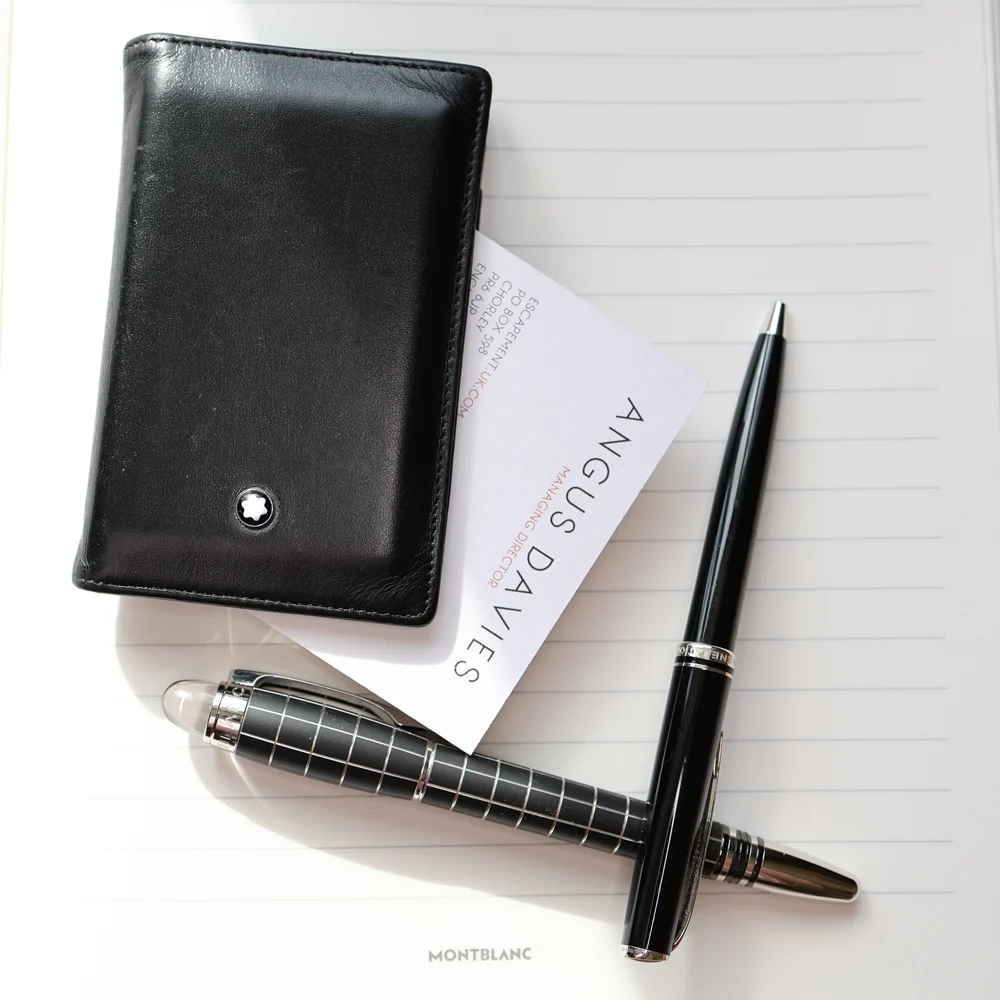
Image – the signs of a true fan
However, despite my admiration for the luxury marque and my unwavering love for horology, as yet I’ve never owned a Montblanc watch. Why? Well, despite my fondness for the firm’s Nicolas Rieussec chronographs, I have always yearned to own one of the company’s Minerva models.

Image – Montblanc 1858 The Unveiled Minerva Chronograph LE100 (Ident: 134281)
Based in Villeret, Minerva makes some of the finest chronographs on the market. Moreover, they stand comparison with the so-called ‘Holy Trinity of Watchmaking’, featuring movements imbued with sublime finishing and endowed with a plethora of traditional horological refinements. When it comes to my ‘must-have before I die’ wish list, the name ‘Minerva’ is written in bold capitals and underlined.
Laurent Lecamp of Montblanc – introduction
Recently, while attending Watches & Wonders 2025, I was offered the opportunity to meet Laurent Lecamp of Montblanc (Global Managing Director Watch Division, Writing Instruments and Accessories). Armed with a long list of questions, I entered the meeting room, endeavouring to always remain professional, hiding my secret yearning for the luxury marques’ products.
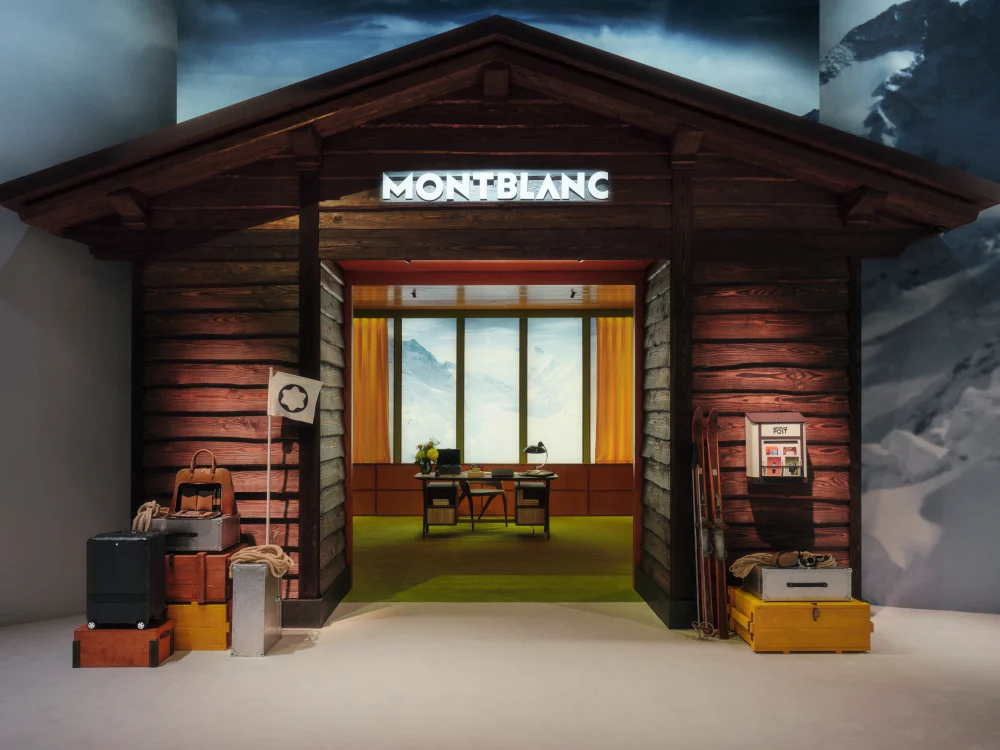
Image – The Montblanc booth at Watches & Wonders 2025
Laurent Lecamp of Montblanc – Q&A
Angus Davies (AD): Can you tell me about your background?
Laurent Lecamp (LL): I was born in France and have worked for several luxury brands, including LVMH, where I was involved with wines and spirits, and Carl F. Bucherer. I also established by own watch brand, Cyrus, in 2010 but ultimately sold my shares in 2014. In 2021, I joined Monthblanc as the Managing Director of the Watch Division; however, for just over a year, I also been in charge of writing instruments and accessories. Lastly, I also take care of Minerva.

Image – Laurent Lecamp of Montblanc
As well as performing my role at Montblanc, I’m a lecturer specialising in the luxury field, speaking at various business schools and universities. I recently wrote a paper on watchmaking and I’m now working on a paper about writing instruments.

Image – an exhibit within Montblanc Haus
Angus Davies (AD): I‘ve never visited your watch factories; however, I did visit your Hamburg site several years ago. At the time, the company made bespoke pens and clients were able to log in at a specific time and view their pen being worked on remotely. Do you still do that? And do you offer a similar service for watches?
Laurent Lecamp (LL): Absolutely. We have bespoke departments for watches and writing instruments. For the very high-end timepieces, you can view them being worked on in this way. We produce some extraordinary, limited edition pieces. For example, here on the booth, we have the Amundsen collection, comprising six writing instruments, including one example that costs €1.8 million. This was not made for a particular client but is unique and was crafted to demonstrate our savoir-faire. The writing instrument was made in a specific department with an artisan dedicated to its creation. Similarly, if you visit Manufacture Minerva, you can witness very high-end timepieces made in the same way.
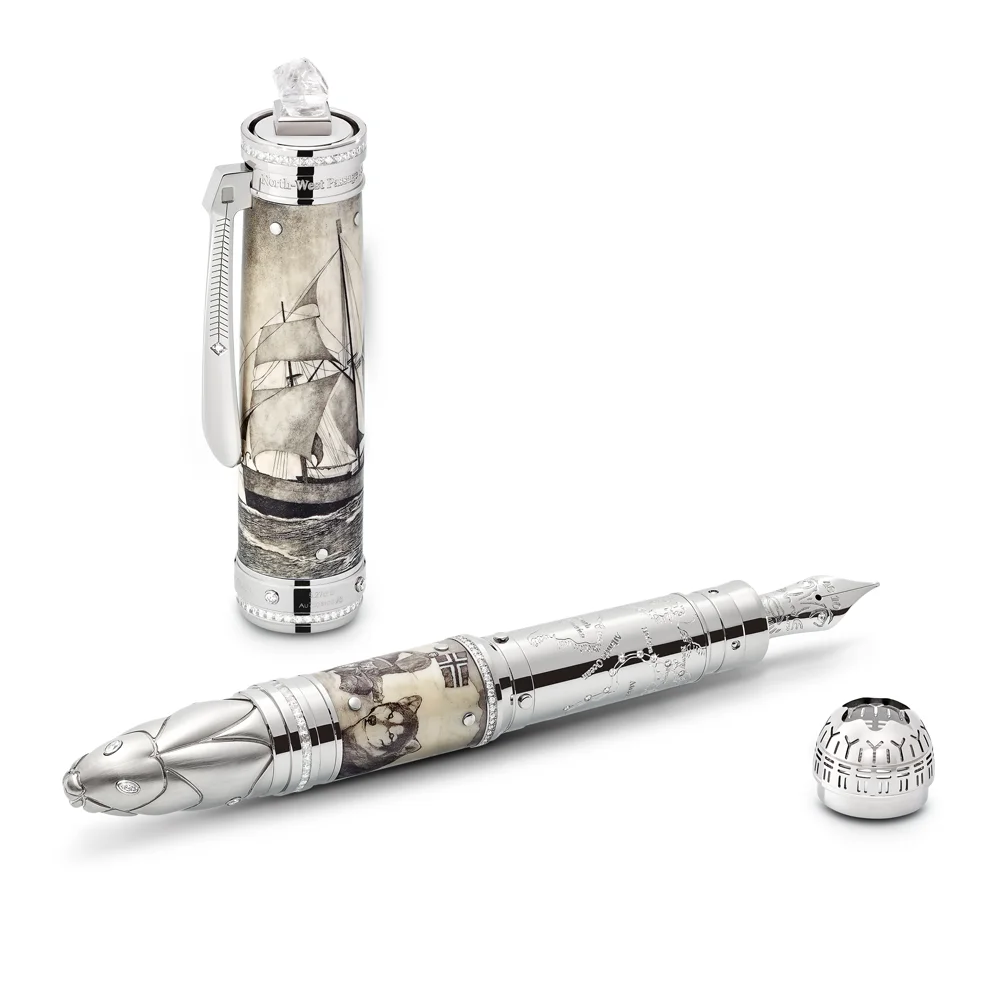
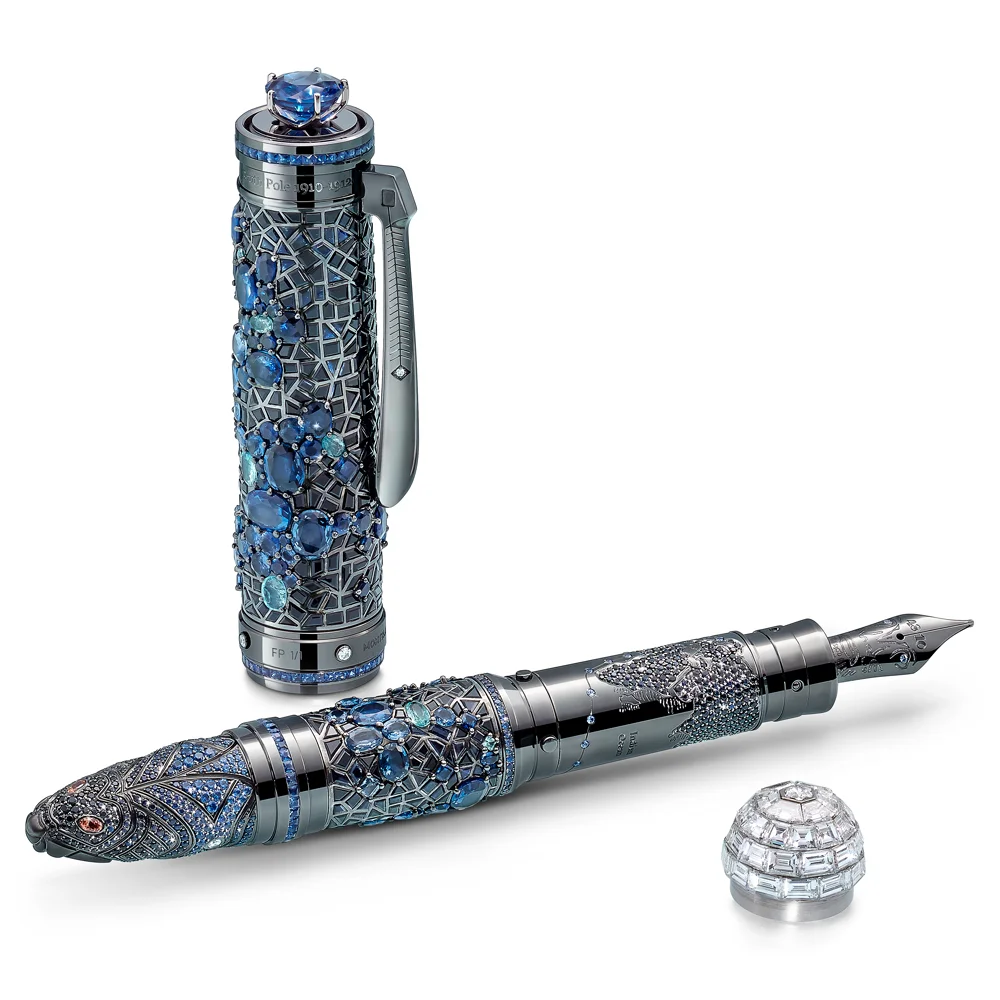
Image – writing instruments from the Montblanc Amundsen collection
AD: Montblanc offers an extensive array of luxury products, including watches, that are often sold via its own boutiques. This approach promises to ensure staff deliver consistently high levels of service. Are there any other areas, besides distribution, where different divisions of Montblanc collaborate?
LL: I think our cross-category approach is very good because it allows us to share knowledge and competencies from the different branches of our company. For example, writing instruments serve to inspire the creation of new watches and vice versa. Our Meisterstück Sfumato collection of leather goods led us to equip some watches with straps made from the same leather (Laurent points to a timepiece on his desk). If you look at the end of the strap, you will also see that it has a nib shape. I think this cross-category approach is very effective. It doesn’t merely lead to customers; it leads to fans who are happy to explore new products.
AD: With regard to the Iced Sea Collection, like many horophiles, I love the dials executed using the grate-boisé technique. Can you tell our readers what this technique involves, the challenges it presents and the amount of time it takes to create one dial?
LL: Yes, it’s incredibly labour-intensive. The dials for the Iced Sea collection take 30 days to make. Clearly, we produce hundreds of them at a time, but 30 days is necessary because there are numerous steps that require the dial to dry overnight before preparing for the next stage. All dials are produced in Switzerland, and they are the only glacier dials on the market today. If you look closely, the surface resembles the appearance of a glacier and the colours faithfully replicate those found in nature. Montblanc is the last brand in Switzerland to use grate-boisé, an old technique that endows the dial with a sense of depth without removing any material.

Image – Montblanc 1858 Geosphere 0 Oxygen Monte Rosa Limited Edition (Ident. 134018)
AD: I’ve read with much interest about the Montblanc ‘Zero Oxygen Technology’. Can you tell me a little bit about this know-how, including where the idea came from, the benefits it offers and the ease of servicing?
LL: We have a great ambassador, Reinhold Messner, who was the first person to climb Everest without supplementary oxygen. At the time, scientists said it was impossible. In 2022, inspired by his achievement, I discussed with him the idea of making a timepiece with no oxygen inside. When you climb to the summit of a mountain, temperatures change very quickly. For example, the temperature may suddenly drop 20°C, causing drops of condensate to form inside a watch.
However, with Zero Oxygen Technology, replacing oxygen with nitrogen prevents any fogging of the sapphire despite drastic changes in altitude. The absence of oxygen prevents oxidisation, hence components last longer and the watch also delivers superior precision over time. This also offers benefits for diving where temperatures at the surface are greater than those at depth, again causing the same issue, namely, drops appearing inside the case.
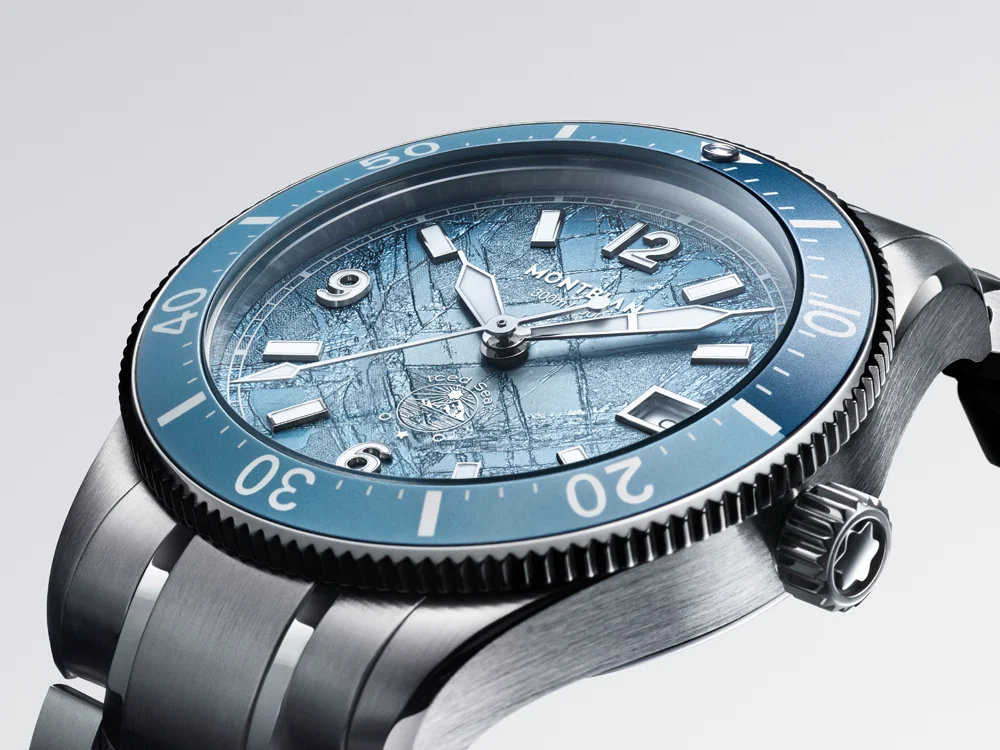
Image – Montblanc Iced Sea Automatic Date 0 Oxygen (Ident. 134022)
In terms of servicing, we have different service centres around the world which we have equipped with the means to service or repair Zero Oxygen pieces. These service centres include Brazil, Mexico City, the US, Hong Kong, Dubai, Hamburg, Switzerland ….. many places.
AD: Like many watch obsessives, I’m very fond of the Minerva models. Indeed, I particularly appreciate the traditional movement architecture such as the minimal bridges, the screwed balance and the refined finishing. This year, you have unveiled the new Montblanc 1858 Geosphere Annual Calendar Limited Edition. Is this the first Minerva annual calendar?
LL: It’s the first time that we’ve unveiled a complication other than a tourbillon or chronograph. Clearly, the chronograph is a classical complication synonymous with Minerva and we have also created the Exo Tourbillon and the Tourbillon Cylinderique, but the Annual Calendar is completely new. The watch has a world time display at 6 o’clock, featuring a 24-hour scale and a day/night indication (Laurent point’s to the watch). At the top of the dial, there is a big date display with both discs presented at the same level. A red arrow at the top of the dial points to the prevailing month and was inspired by a watch that Minerva developed for pilots in the 1920s. You will also see that the month display doesn’t say ‘July’ but ‘Minerva’, a reference to the date when Minerva was trademarked in 1887.

Image – Montblanc 1858 Geosphere Annual Calendar Limited Edition (Ident. 134027)
The date display will advance to ‘1’ automatically, except in February when the date must be manually advanced. With this movement, the wearer can adjust the date indication at midnight in either direction without fear of harming the mechanism. We have developed a safety system that blocks the date corrector at 2 o’clock, between 2100 hours to 0300 hours, preventing any harm coming to the movement. This system is very clever and was developed by our engineers. The resultant movement is extremely reliable and strong and is composed of 336 components, entirely made by hand. The architecture of the movement was inspired by a pocket watch movement created at the start of the 20th century. The design was patented in 1903 and this latest movement (Calibre MB M14.58) shares, more or less, the same architecture. We strive to build watches for the future based on our past.

Image – Montblanc Villeret Manufacture
AD: Can I ask you a little bit about the other watch you have in front of you? It looks like a traditional Minerva monopousher chronograph?
LL: It’s actually a rattrapante (a split-seconds chronograph) with a monopusher integrated within the crown for the chronograph and a pusher at 2 o’clock for the split-seconds chronograph. The burgundy dial with black counters first appeared on a Minerva model back in the 1930s. We decided to reinterpret the watch with our own in-house movement, something that wasn’t the case back then. We have also placed ‘Minerva’ on the dial.

Image – Montblanc 1858 Split Second Chronograph Limited Edition (Ident. 134029)
AD: Can I ask you a little bit about movement? Is it a double column-wheel design with a horizontal coupling?
LL: Yes, precisely. It comprises 287 components and the power-reserve is approximately 50 hours.

Image – Montblanc 1858 Split Second Chronograph Limited Edition (Ident. 134029)
AD: The bridges and mainplate are made from German silver (maillechort) which is very challenging to use. Some brands leave the alloy untreated; however, your company has chosen to rhodium-plate the metal. Can you tell me more about your approach?
LL: German silver is more costly to use, and you have to be careful not to leave fingerprints on it. Although it’s more difficult to work, it is less likely to oxidise and imbues the movement with superior quality. The reason we choose to rhodium-plate German silver is we do not want the look of the movement to change. We want to retain the warm, bright silvery appearance of the bridges and mainplate.

Image – Montblanc Manufacture Calibre MB M16.31
AD: Can you tell me how long it takes to assemble and regulate the watch?
LL: Each timepiece is assembled by one watchmaker and the time taken varies depending on the individual carrying out the task. If one watchmaker is away for three weeks, nobody will work on their piece. This is intentional as we want to develop the relationship between the end customer and the watchmaker. After the watch is assembled and regulated, the watchmaker will also be responsible for overseeing the aftersales of the watch. We find that collectors appreciate this approach.

Image – Montblanc Villeret Manufacture
Laurent Lecamp of Montblanc – closing remarks
During our conversation, I felt that I managed to hide my fondness for Montblanc and its portfolio of products very well. The Iced Sea collection and the new 1858 Geosphere Annual Calendar Limited Edition are very impressive, but of all the siblings I met in Geneva, it was the latest Minerva-branded rattrapante that I wanted to go home with. Named the Montblanc 1858 Split Second Chronograph Limited Edition, this burgundy beauty is a purist’s watch.

Image – Montblanc 1858 Split Second Chronograph Limited Edition (Ident. 134029)
Equipped with a rattrapante (split seconds chronograph), an ultra-desirable ‘high complication’ coveted by legions of horophiles, the specification of this watch is truly incredible. The balance wheel is large, with a diameter of 14.5 mm, and the moment of inertia is very high at 59 mg.cm²; characteristics that limit the influence of shocks. The balance wheel is also fitted with a ‘Phillip’s terminal curve’. This latter term refers to raising the outer coil of the balance spring and reducing its curvature, causing it to breathe more concentrically, thereby augmenting isochronism. Wherever you care to look, you simply discover more episodes of excellence.

Image – Montblanc Villeret Manufacture
Should you appraise the finishing of the Montblanc 1858 Split Second Chronograph Limited Edition, you will see perlage on the mainplate, Côtes de Genève, graining, anglage, mirror-polishing on the swan-neck, polished jewel and screw sinks, etc. This exquisite creation, crafted in Villeret, serves as a wonderful exemplar of Haute Horlogerie.

Image – Montblanc Villeret Manufacture
After concluding my conversation with Laurent Lecamp, I reflected on our meeting and wondered if my intention of remaining professionally poker-faced may have waned during our chat. In the most part, I like to think I maintained a degree of professionalism but suspect that on seeing the 1858 Split Second Chronograph, my devotion for the alluring star emblem came to the fore. I confess, like many Montblanc customers, I’m a fan. It’s a love affair that began in Hamburg several years ago and an opinion reinforced with the time I spent with Laurent Lecamp.

Image – Laurent Lecamp of Montblanc