
Louis Erard Excellence Petite Seconde Terracotta
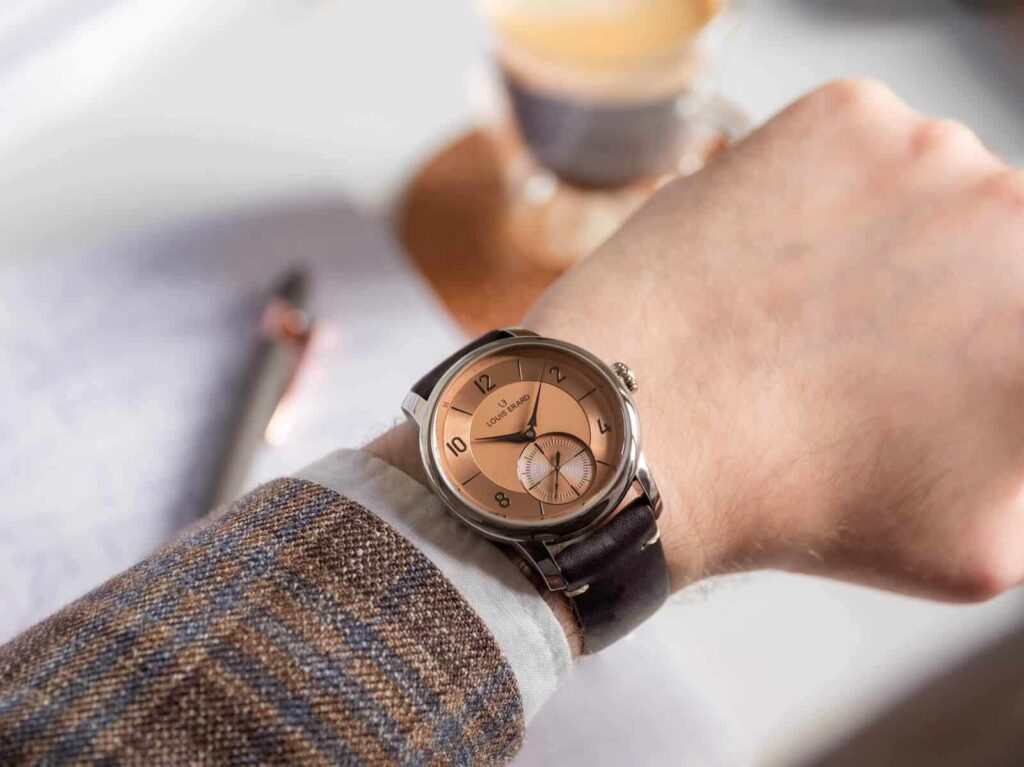
The Louis Erard Excellence Petite Seconde Terracotta shares much in common with the Louis Erard Excellence Triptyche Petite Seconde launched in 2020. However, the dial of this latest watch is inspired by the soil found in the Jura region, a combination of marl, clay and limestone which gives the local wine its distinctive character. Offered in a choice of 39mm and 42mm case options, this new model delivers remarkable value for money.
Founded in 1929, Louis Erard has a rich history of watchmaking. Nevertheless, despite the company’s impressive heritage, it is now in the midst of a particularly exciting period, both commercially and in terms of creativity. For example, the watch brand, based in Le Noirmont was nominated for three prestigious GPHG awards in 2021, an impressive feat by any measure.
The arrival of Manuel Emch in 2019, an industry veteran, has proved a fabulous catalyst for change. While Louis Erard is a team effort, Emch, formerly the President & CEO of Jaquet Droz, has brought a huge range of skills to the table. Indeed, he is known for his design prowess as well as his remarkable ability to deliver profitability for the benefit of investors.
Emch’s prowess at boosting the bottom line may suggest that he inflates watch prices to the detriment of horophiles, however, this is not the case. On the contrary, Emch has shown a remarkable knack for delivering much for comparatively little. Indeed, he has democratised many desirable features once beyond the financial grasp of many. Examples include Grade 5 titanium cases, Grand Feu enamel dials, hand-guilloché dials and stone dials (aventurine, lapis lazuli and malachite). But what about the prices? Well, they vary depending on the product specification, however, every watch retails for less than CHF 5,000.
Another facet of today’s Louis Erard paradigm is design. While the firm has produced a plethora of sublime watch designs internally, it has also not been afraid to engage with external contributors, including Eric Giroud, Alain Silberstein and, most recently, atelier oï, a Swiss-based design specialist. Quite simply, the Maison does not eschew style in the pursuit of penny-pinching.
At this juncture, cynical souls may smirk and question how the brand delivers such accessible pricing. Firstly, while some details are unique to a specific reference, other components are used on several different models, thereby delivering economies of scale. This is manifest with the automatic Sellita SW261-1 calibre, a movement that is widely employed across the brand’s collection. Moreover, this strategy also extends to some of the cases which are used, not just for one watch, but for several models. Even a particular crown may appear on a number of different references.
Secondly, there is the matter of managing supply and demand. In many cases, watch brands produce too many units, culminating in huge stocks being stored in both the brand’s factories as well as their authorised retailers. Holding stocks proves expensive for all concerned. Louis Erard limits the availability of some models to just 178 pieces. Indeed, such is the scarcity of some models they often attract premiums on the pre-owned market.
Thirdly, Louis Erard admits that it is willing to accept lower gross margins than its competitors. Suddenly, the brand’s business model begins to make sense.
In 2020, the Maison released the Excellence Triptych, a collection of three models, including a small seconds option, a regulator and a monopusher chronograph. While each of these models had different features/complications, the family likeness was clear to see. Each variant shared the same colourway and design language. Moreover, the Maison chose to honour its home, the Jura mountains, and ‘Art Sapin’, a derivation of Art Nouveau. The word ‘Sapin’ means ‘fir’, a coniferous tree widely encountered in the region. Close examination of the hands reveals they emulate the appearance of a fir tree. Likewise, the crown is endued with a grip adorned with fir tree-shaped recesses.
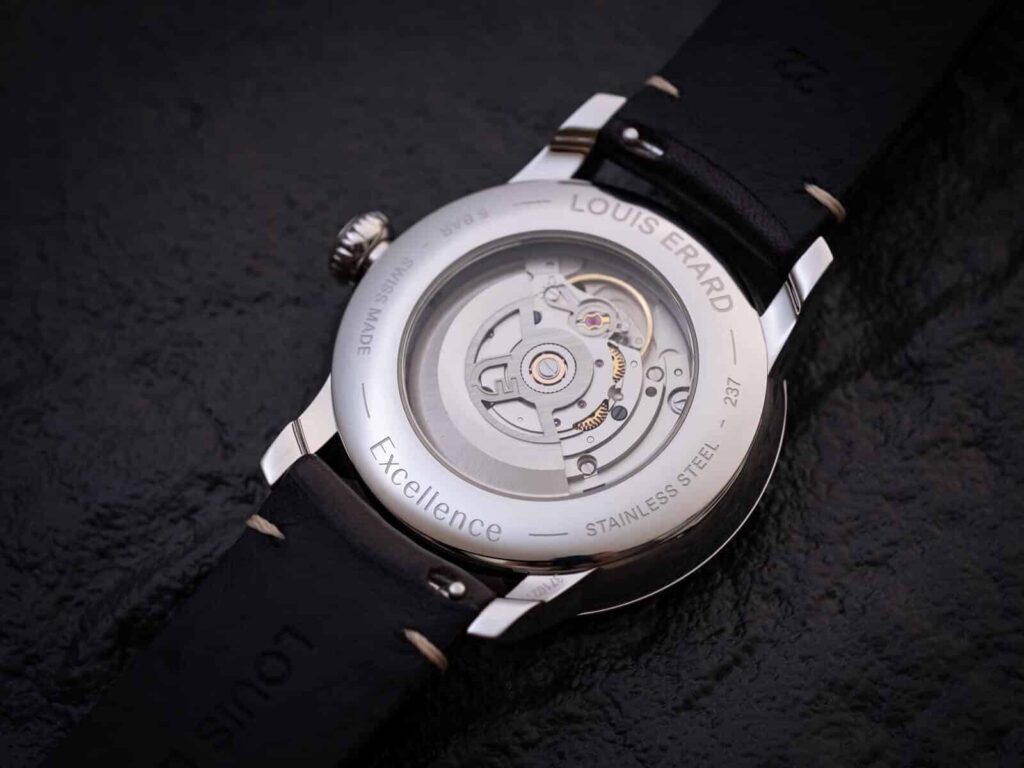
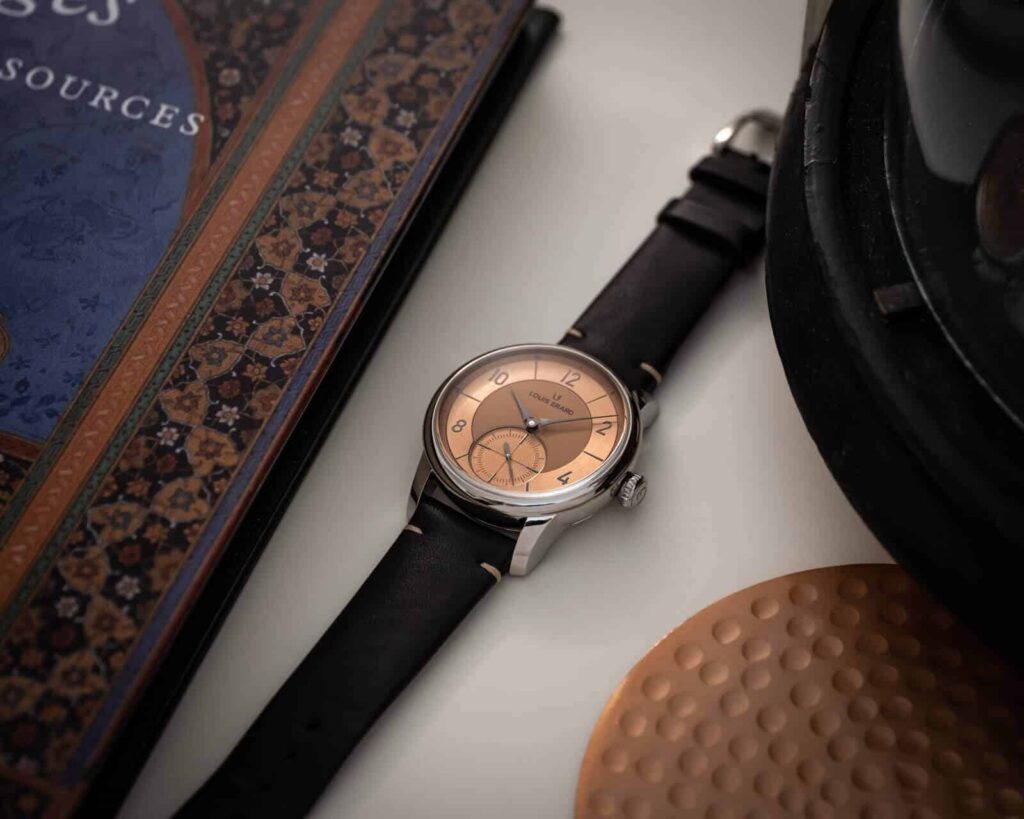
Now, the Maison has just unveiled a new Jura-inspired model, the Louis Erard Excellence Petite Seconde Terracotta. The Jura region is known for its soil, a combination of marl, clay and limestone which gives the local wine its distinctive character. The terracotta hue of this soil provided inspiration for this new model.
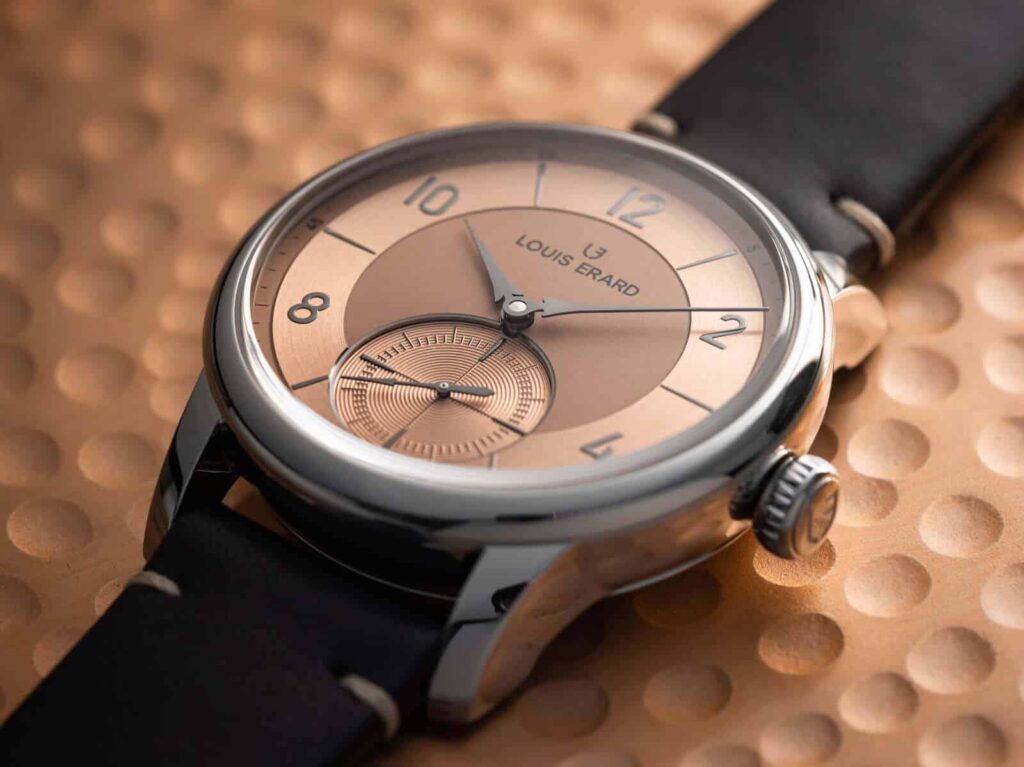
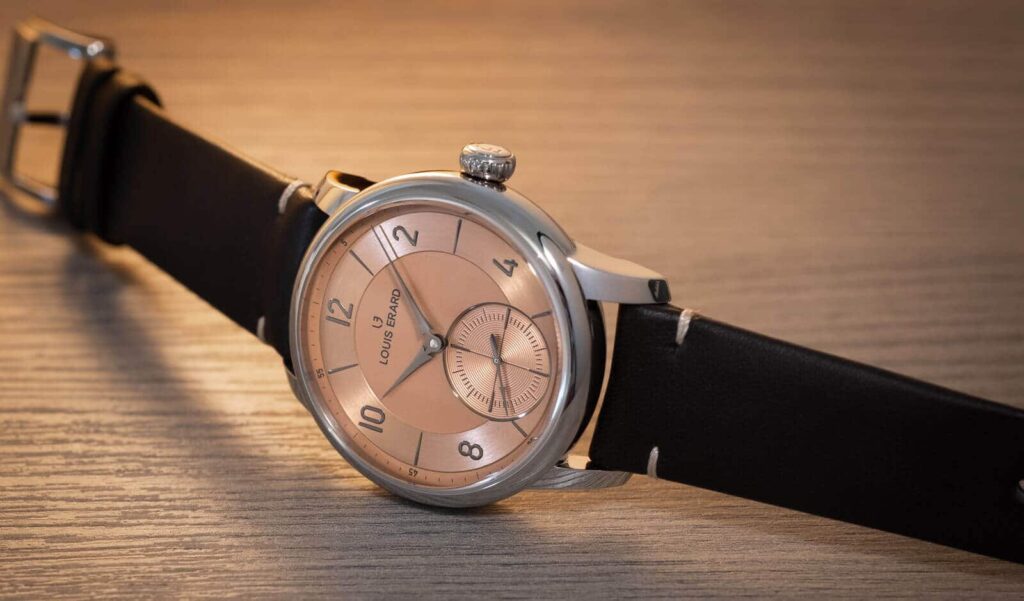
Horophiles will recognise the topography of the dial and case. They look identical to the Excellence Triptyche Petite Seconde. However, there are a few notable differences. Whereas, the former model of 2020 was only available in a 42mm stainless steel case, the new Louis Erard Excellence Petite Seconde Terracotta is available in a choice of 39mm and 42mm options. This latest model is endowed with anthracite fir tree hands (the former model had blued hands). However, the pièce de résistance has to be the terracotta dial.
Lastly, the price, once again, proves very accessible at CHF 1,950 (both models). In this instance, the watch is limited to approximately 100 pieces per year by reference. When a formula works, why change it?
The brand’s press release
Excellence Petite Seconde Terracotta – This time, Louis Erard kept both feet firmly planted on the ground. In the land of the Jura, where the house has its roots and from which it has drawn its inspiration for this natural-coloured version of the Excellence Petite Seconde model. With a first: case available in 39 mm, in addition to the traditional 42 mm.
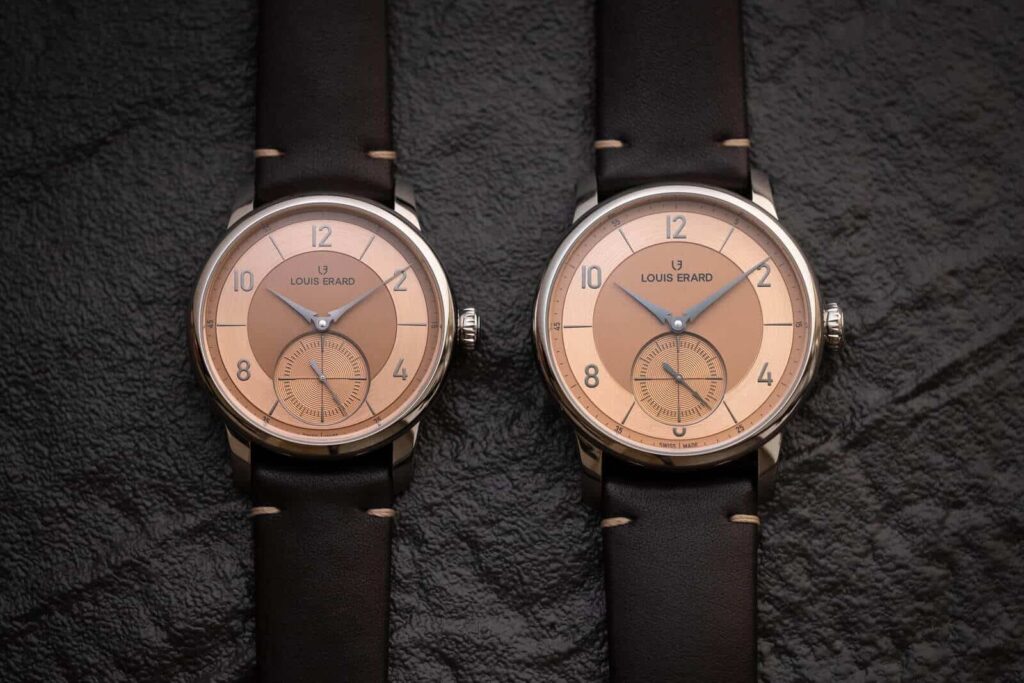
Natural colours. Matt textures. The new version of the Excellence Petite Seconde lives up to its name: Terracotta. A combination of the warmth of the south and the softness of a Franches-Montagnes trail, home of Louis Erard watches. A long-awaited evolution, the Excellence Petite Seconde Terracotta is available in two sizes, the traditional 42 mm case and its refined 39 mm counterpart. In a limited production of approximately 100 pieces per year by reference.

The model is in line with the natural materials used in the Excellence triptych, in particular the use of stone, aventurine, lapis lazuli and malachite dials. It is no longer a question of stone, but of earth, of terracotta. A choice reminiscent of certain classic creations of the 1950s, but in a very contemporary vintage rendering, which once again underlines Louis Erard’s desire to mix genres and make fine watchmaking accessible, under the artistic direction of Manuel Emch.

Variations of semitones and shades. No shine, no burst of light breaks the muffled accords. The monochrome dial brings out the subtleties of the design, contrasting the circular satin finish on the fine grain of the centre and minute track sections. Highlighting of the snailed seconds counter at 6 o’clock.
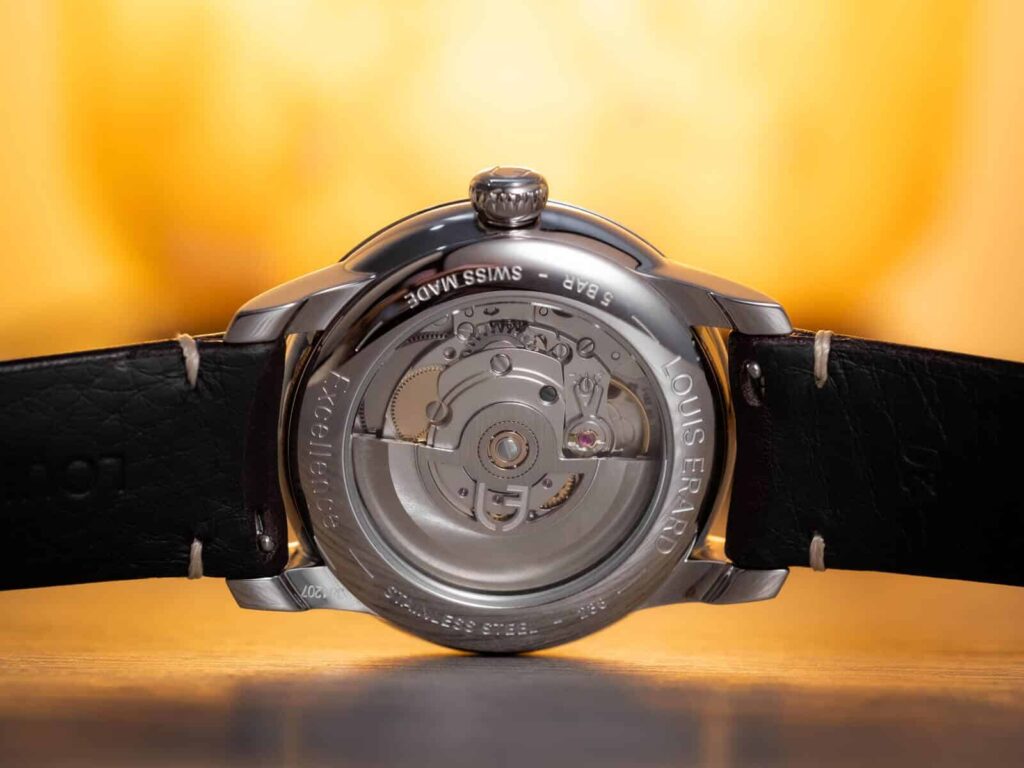
There is no highlighting neither on the hands, nor on the indexes, which cast their delicate shadows on the dial like a forest in the softness of a white sun. The signature fir tree hands are treated in anthracite grey and polished. Matching transfers and indexes, also in anthracite grey.
The watch is completed with a dark brown Baranil calf leather strap. With polished stainless steel pin buckle and functional catch spring bars enabling the strap to be changed quickly
Excellence Petite Seconde Terracotta, available in 42mm and 39mm. Retail price: CHF 1,950.
Further reading