
Louis Moinet COSMOPOLIS Watch Review
The Louis Moinet COSMOPOLIS is a pièce unique, housed in a 40.7 mm case formed of 18-carat 5N rose gold. What distinguishes this watch as truly exceptional is that its dial incorporates 12 meteorites, the ‘most meteorite inserts in a watch’, a fact certified by Guinness World Records™️. But beyond its headline-grabbing specification, this timepiece is the culmination of one man’s passion, collecting stones over a 20-year period and respectfully incorporating them within a wonderful exemplar of horological art. Angus Davies provides an insight into the fascinating world of Jean-Marie Schaller.

Louis Moinet (1768-1853) – the inventor of the chronograph
Louis Moinet (1768-1853) was a son of Bourges, a city located in central France. Famous for its cathedral, the Cathedral of Saint-Étienne, a UNESCO World Heritage site, the city also features quaint streets as well as delightful canals and waterways.

While Moinet travelled throughout his life, eager to develop his understanding of painting and sculpture, he eventually returned home, a place of beauty that would have inevitably inspired him to achieve great things. Indeed, his passion for art led him to become a teacher in the School of Fine Arts.
Most notably, Louis Moinet became a master watchmaker and went on to invent the first ever chronograph in 1816 (certified by Guinness World Records™️). His chronograph, the ‘compteur de tierces’, was able to measure a sixtieth of a second. In France at the time, a sixtieth of a second was termed a ‘tierce’, hence the chronograph’s name. Designed for measuring astronomical transits, Moinet’s chronograph was equipped with a high-frequency movement (30 Hz). In 2020, this chronograph was again recognised by Guinness World Records™️ as ‘the first high-frequency stopwatch’. Some 200 years after its creation, there are few mechanical chronographs able to match the mind-blowing cadence of the compteur de tierces.
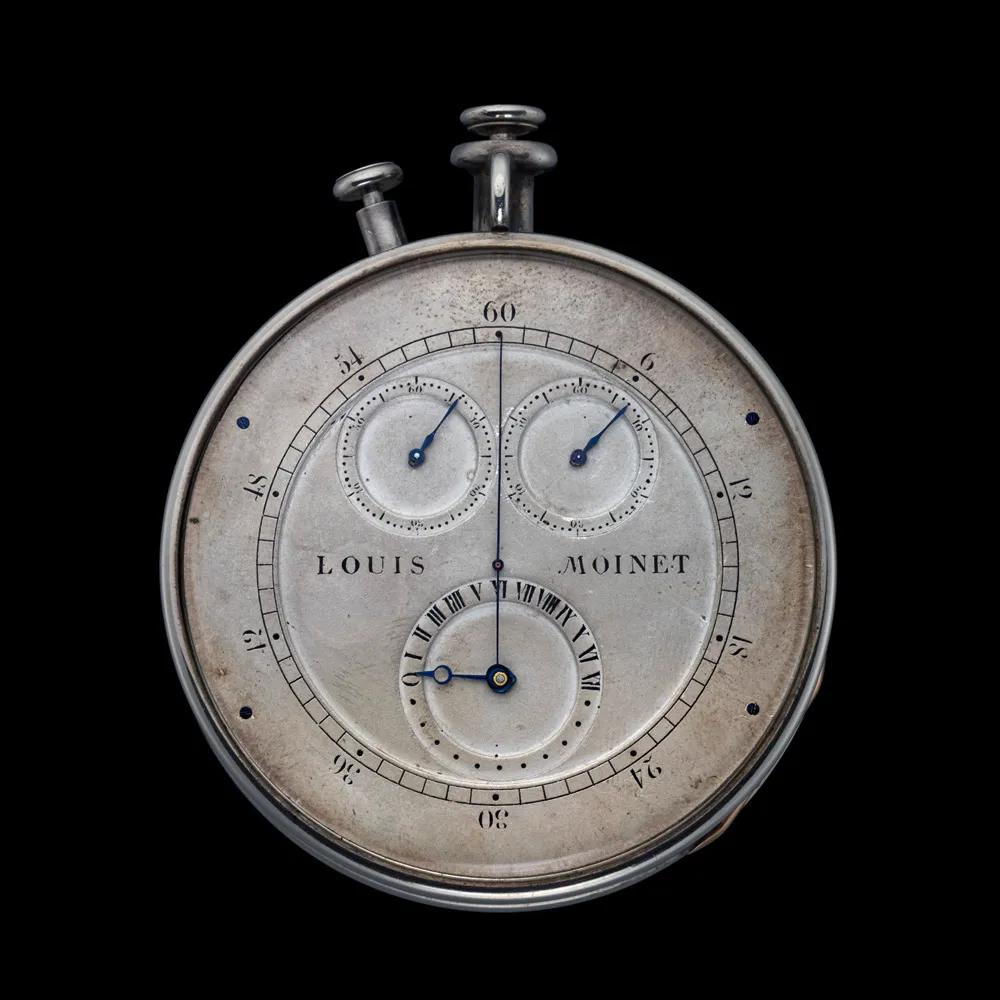

Moinet was a multi-talented individual, uniting his watchmaking talents with a well-developed sense of style. His blend of aesthetics and mechanics attracted a number of well-heeled patrons, including King George IV, Tsar Alexander 1 and Napoleon, to name but a few.

Later in life, Louis Moinet devoted many years to writing his famous Traité d’Horlogerie (1848). It seems Moinet was a highly creative individual, a free-thinker and a person who did not follow others but conceived his own ways of doing things.
Jean-Marie Schaller, CEO and Creative Director of Les Ateliers Louis Moinet
In 2000, Jean-Marie Schaller embarked on a journey to revive the name ‘Louis Moinet’ and perpetuate his legend, bringing it to the attention of a new generation of horophiles.
Schaller, the CEO and Creative Director of Les Ateliers Louis Moinet, is a veteran of the watch industry and, like Moinet, he’s also a man of passion with a fondness for painting and a profound love of design.

During his tenure as Creative Director, Schaller has designed some breathtaking watches, culminating in the Maison receiving a plethora of accolades, including several reddot design awards. When conceiving new models, Schaller has found inspiration from a variety of sources. From Jules Verne’s fictional works, rainforests, motorsport, dinosaurs, ‘Marvels of the World’, space and meteorites. He has repeatedly united intricate mechanisms with various expressions of métiers d’art.
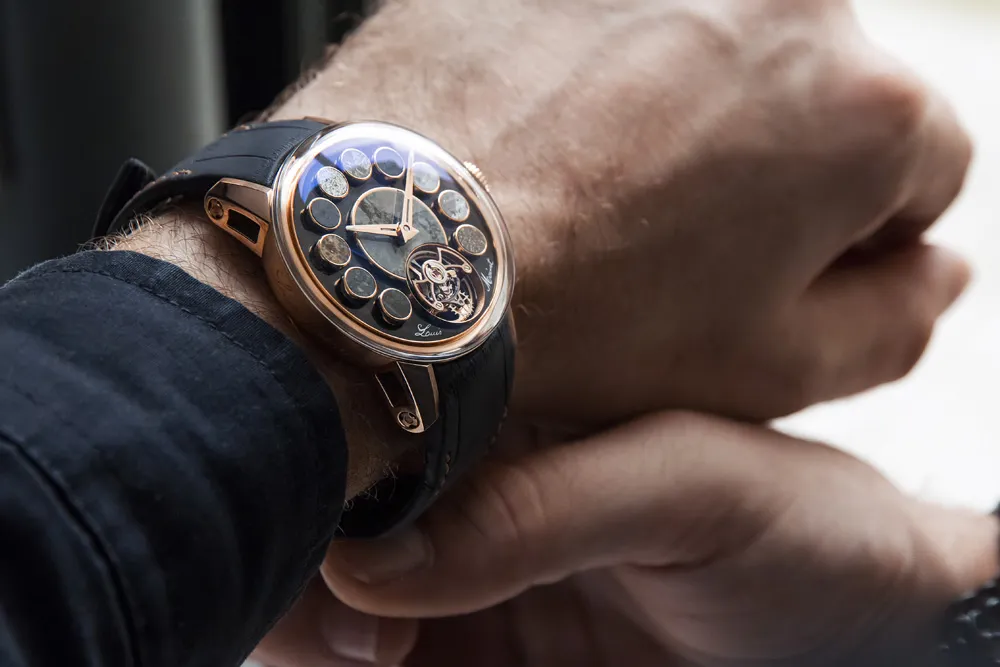
Schaller’s capacity for original thought is beyond question. However, his impressive back catalogue has, by default, made the task of surpassing his former successes, near impossible, or at least that’s what I thought. Now, there is a new watch to emanate from Les Ateliers Louis Moinet, the COSMOPOLIS and when I saw for the first time, I was utterly dumbfounded and simply blurted ‘Wow’! Allow me to elaborate.
Louis Moinet COSMOPOLIS – dial
Over the years, Schaller has used a variety of materials to adorn the dials of his timepieces. For example, Louis Moinet produced a chronograph incorporating counters dressed in petrified palm wood. On another occasion, the Maison released a ‘Jurassic Tourbillon’ endowed with a dial made of fossilised dinosaur bone. However, for me, the dial of the COSMOPOLIS transcends all previous Louis Moinet creations and is different from anything produced to date, including those watches made by rival brands.

Indeed, the originality of the Louis Moinet COSMOPOLIS has led to the firm receiving another title from Guinness World Records™️, this time for the ‘most meteorite inserts in a watch’. Now, there are three certificates from the record-breaking authority hanging on Mr Schaller’s office wall.

The hour and minute hands are golden, openworked, faceted and incorporate luminescent treatment. Unquestionably elegant and highly legible, they fulfil their functional purpose while playing a deferential role to the adjacent dial elements.
Ten discs curl around the dial, arcing from 8 o’clock to 4 o’clock. Each disc plays host to a meteorite and is framed with a fine golden circlet with everything sitting above a dark-grey dial epidermis. A lunar meteorite sits at the fulcrum of the dial. It is the pièce de resistance, the rarest of the stones used, found near Dhofar in Oman and endowed with a white-speckled interior.

The centrally positioned stone, once again, delineated from the main dial with a slender golden border, makes way for the flying tourbillon positioned on its southern edge. Resembling a Venn diagram, the gravity-defying mechanism sits in concert with the aforementioned stone.
In 1801, Abraham-Louis Breguet patented the ‘tourbillon’. He recognised that the influence of gravity could adversely affect the behaviour of the escapement and regulating organ. His solution was to place these components within a rotating cage, driven by the fourth wheel. As the cage rotated 360°, any positional error would be negated, thereby conferring superior chronometric performance. Incidentally, Louis Moinet was a close friend of Breguet and the two men worked together for several years (1815-1823).
The ‘flying tourbillon’ was invented in 1920 by German watchmaker, Alfred Helwig. At the time he worked as a teacher at the watchmaking school in Glashütte, Saxony. Like Breguet’s invention, the flying tourbillon countered the undesirable influence of gravity on the rate of a watch. However, Helwig’s invention eschewed the upper bridge typical of a tourbillon, instead supporting the cage solely from below. The resultant view of the cage rotating is not obstructed by an upper bar or bridge, allowing the wearer to see more of the escapement and regulating organ in motion.

The decision of Les Ateliers Louis Moinet to equip the COSMOPOLIS with a flying tourbillon was undoubtedly very shrewd. Not only can the wearer view the balance rotate to and fro and witness the escape wheel and pallet lever engage in conversation, they can also see the 12th meteorite, a black chrondite, positioned beneath the cage. The brand’s name is presented in cursive text, straddling the tourbillon aperture, effectively signing this artistic work.
While the Louis Moinet COSMOPOLIS encompasses 12 different meteorites, each with their own characteristics, the repeated use of golden circular frames serves to negate any potential dissonance, culminating in a harmonious mien.
Louis Moinet COSMOPOLIS – case
Having expended much effort on the composition of the dial, Schaller has sought to design a suitable case. He has clearly succeeded, the resultant case befits the dial while at the same time it doesn’t detract from the beauty presented centre-stage.

Measuring 40.7 mm in diameter, the case should suit the majority of wrist sizes. Formed of 18-carat 5N rose gold, it unites polished and satin-finished surfaces with a crisp distinction between the two.
The domed sapphire crystal coaxes light to flood the dial plane, accentuating the natural beauty of the meteorites. The lugs are openworked, contributing to the visual lightness of the composition.

To the rear of the watch, a pane of sapphire crystal affords sight of the hand-wound movement.
Calibre 135 – hand-wound movement
The movement is equipped with two barrels, with one barrel inverted and positioned atop its counterpart, a system known as ‘volte-face’. Moreover, assuming the barrels are fully wound, the watch will run autonomously for 96 hours.

The large bridge to the rear of the movement is adorned with circular Côtes de Genève, perlage, polished jewel and screw sinks as well as additional refined finishes befitting the term ‘Haute Horlogerie’.
Equipped with 26 jewels, the movement has a frequency of 28,800 vph (4 Hz).
Louis Moinet COSMOPOLIS – closing thoughts
There are many illustrious names listed in the annals of horology and Louis Moinet, a man of great standing, is one of them. His magnum opus was unquestionably the compteur de tierces, a chronograph that will forever be prized for its technical virtuosity and originality.
Thumbing the press release from Les Ateliers Louis Moinet relating to the COSMOPOLIS, the company refers to the watch as ‘the genesis of a magnum opus’. It’s a bold statement, but in my opinion, it’s Schaller’s greatest work to date, albeit you may have heard me say this before.
Louis Moinet COSMOPOLIS – a list of the meteorites used
- DHOFAR 461 – Moon (Oman)
- DHOFAR 1674 – Mars (Oman)
- ALLENDE – Meteorite shower (Mexico)
- ERG CHECH – Asteroid (Algeria)
- JBILET WINSELMAN– Asteroid (Morocco)
- ISHEYEVO – Asteroid (Russia)
- ALETAI ARMANTY – Asteroid (China)
- AGUAS ZARCAS– Meteorite shower (Costa Rica)
- GIBEON – Asteroid (Namibia)
- TOLUCA – Asteroid (Mexico)
- SAHARA 97093 – Asteroid (Sahara Desert)
- BLACK CHONDRITE L5 – Asteroid (Sahara Desert)
Further reading
Technical specifications
- Model: Louis Moinet COSMOPOLIS
- Reference: LM-135.50.CO
- Case: 18-carat 5N rose gold case, diameter 40.7 mm, water resistance 3 ATM (30 metres), domed sapphire crystal to front, sapphire caseback.
- Functions: hours, minutes, flying tourbillon
- Movement: Calibre 135, hand-wound movement; frequency 28,800 vph (4 Hz), 26 jewels, power reserve 96 hours.
- Strap: alligator leather strap paired with an 18-carat 5N rose gold folding clasp.
- Price: CHF 225,000 excluding taxes (RRP as of 21.9.2023)
- Limited Edition: pièce unique