
MeisterSinger Stratoscope
The MeisterSinger Stratoscope features a large, ultra-precise moon phase indication while its dial also pairs black and blue hues, emulating the appearance of the aurora borealis. Angus Davies enjoys a ‘hands-on’ experience with the watch and shares his thoughts herein.

Once again, MeisterSinger invites the public to view time in a broader, more philosophical sense. Its latest model, the Stratoscope features a large depiction of the moon, presented via a vast aperture in the northern region of the dial. Furthermore, the dial epidermis encompasses black and blue tones, designed to replicate the appearance of the aurora borealis. However, part of the charm of wearing a MeisterSinger is that it invites the wearer to view life differently.
Most children look at the moon and dream. Sadly, this sense of wonderment wanes with the onset of adolescence. As adults, the moon loses its significance, time creeps into our thoughts and stealthily becomes our master, governing our lives and dictating the tempo of our actions.
Thankfully, as maturity arrives, time no longer rules us, on the contrary, it provides greater opportunities for pleasurable experiences. Such delights, large or small, enrich our lives. A function of this shift is that we increasingly become reacquainted with our surroundings, the environment and the celestial bodies above. We rediscover our curiosity and, once again, view the world with a sense of awe and fascination.
The dial
The dial of the MeisterSinger Stratoscope is endowed with a large moon phase display featuring a ‘photorealistic image of the Earth’s natural satellite’. The depiction of the moon employs various grey tones and exhibits a slightly three-dimensional appearance.

It takes the moon 29 days, 12 hours, 44 minutes and 2.9 seconds to circumnavigate the Earth. Most watches equipped with a moon phase display truncate the moon’s cycle length to 29.5 days. By rounding this latter figure to just one decimal place, the dial indication is inevitably less accurate and, as a consequence, requires manual adjustment on a regular basis. MeisterSinger has calculated the moon’s cycle more precisely and state it ‘only requires a slight adjustment after 128 years’.
Beyond its technical merits, the moon phase ensnares the eyes, enlivens the heart and elicits thoughts of life beyond Earth’s borders.
Consistent with other MeisterSinger models, the time is indicated with a lone, needle-like hand. This hand converses with indexes, presented in two-digit form, along with crisp strokes positioned in between. Each stroke is spaced five minutes apart. In the world of MeisterSinger, there seems little justification to obsess over small intervals of time. Now I have a receding hairline and a paunch to validate my age, I share MeisterSinger’s point of you.
A circular aperture, positioned at 6 o’clock, reveals the date. Unusually, the jet black tones of the upper dial area transition into various shades of blue in the lower section of the dial. When designing the dial, the brand’s intention was to replicate the appearance of the aurora borealis. Personally speaking, I find the idiosyncratic dose of blue in the southern portion of the dial a refreshing deviation from the norm.

MeisterSinger has chosen to apply a liberal amount of luminescent treatment on the needle-shaped hand, the indexes and adjacent track as well as the depiction of the moon. The only indication that lacks any form of luminescence is the date indication.
I am always fascinated by watch design. Over the years, I have grown accustomed to seeing the dials of MeisterSinger models feature cursive text. It never seemed wrong or out of place. Now, with the advent of the MeisterSinger Stratoscope, the brand has employed a new form of typography. The words ‘Stratoscope’ and ‘Automatic’ are presented in block capitals sans serifs. The font is contemporary and clean, while the positioning of the text has been judged to perfection. In my opinion, the new typography looks more elegant.
The case
Measuring 43mm in diameter, the stainless steel case provides much wrist presence. Some watch buyers may yearn for a smaller case, however, the lugs sharply taper downwards, making the watch feel smaller when worn.

A benefit of the watch’s size is that it affords sufficient dial space to accommodate the large moon phase indicator. Indeed, the expansive dial area allocates sufficient room for each indication to appear legible.
The caseband and the vertical sides of the lugs are satin-brushed, while the remaining surfaces, including the crown, are highly polished. Blending two different finishes heightens production costs, but it also augments the sense of refinement. The result of this fastidious approach is that the watch looks more luxurious than its modest price would suggest.
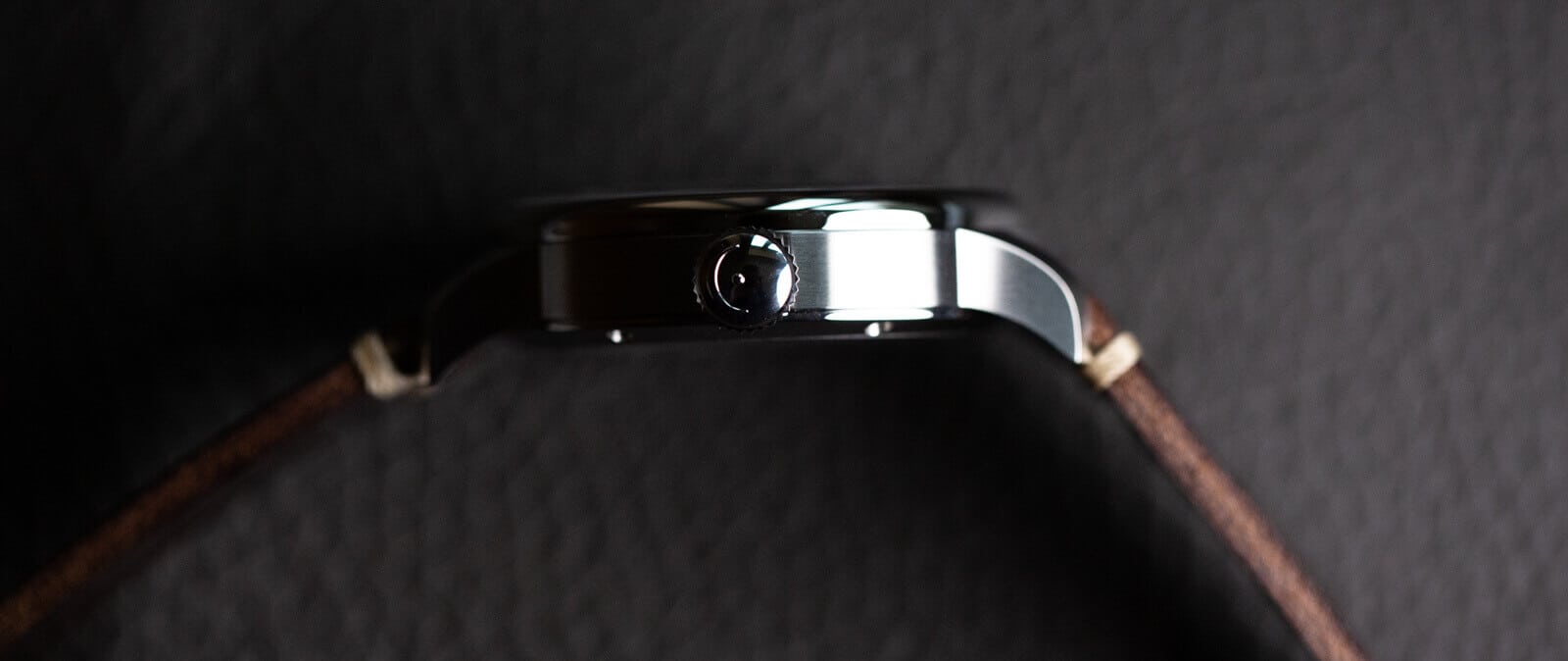
The caseback is retained with six screws and incorporates a pane of sapphire crystal affording sight of the watch’s self-winding movement. My press sample was supplied on a two-stitch vintage saddle leather strap in brown. It offers much tactile delight and endows the watch with a degree of casual charm. The watch is presented on a stainless steel folding clasp.
The movement
The MeisterSinger Stratoscope features the ‘MS Luna’ movement. It is based on a Sellita SW 220, an automatic calibre known for delivering precision and reliability.

Sellita is the biggest independent, family-run supplier of mechanical movements in Switzerland. It makes a diverse range of movements, each of which delivers a high quality-price ratio. Another strength of Sellita is that its movements are comparatively simple to repair and service, an important consideration when considering long-term ownership.
The balance has a frequency of 28,800 vph (4Hz) and the movement has a power reserve of 38 hours. The movement is fitted with a personalised rotor, engraved with the brand’s name and logo, and also features blued screws and colimaçon.
Closing remarks
The MeisterSinger Stratoscope is a highly wearable ownership proposition. It imparts time in a highly intelligible format, looks attractive and draws upon the expertise of an esteemed movement specialist.

By equipping its models with a single needle-like hand, the passage of time seems slower as the hand rotates at a more relaxed pace. Those aspiring owners concerned about readability can set aside their fears as there is no reason to worry. After a brief period of familiarisation, MeisterSinger’s one hand fits all approach proves logical and simple to interpret.
The ultra-precise large moon phase display is notably clear, while the liberal application of luminescent treatment ensures legibility is not diminished in dim light.
However, I return to my introduction, MeisterSinger make watches that provoke thought and encourage the wearer to contemplate the meaning of time and, indeed, life. By positioning a depiction of the moon in the northern hemisphere of the dial, the German brand has provided a catalyst for dreamers and romantics to engage in thought, a characteristic that promises lasting appeal.
Further reading
https://www.meistersinger.com/
Technical specification
- Model: MeisterSinger Stratoscope
- Case: Stainless steel; diameter 43 mm; sapphire crystal to front and exhibition case back
- Functions: Hours and minutes indicated with one hand; date; large central moon phase
- Movement: MS Luna, Sellita SW 220 base; self-winding movement; frequency 28,800 VpH (4Hz); power reserve 38 hours
- Stap: Brown two-stitch vintage saddle leather strap paired with a steel folding clasp.
- Price: £3690 (RRP as at 6.5.2021)