
Ming 20.11 Mosaic
The Ming 20.11 Mosaic is the latest creation from the prize-winning independent watch brand. Billed as the brand’s ‘flagship model’, there are a number of costly and technically challenging details to distinguish it as special. Moreover, based on the sales success of its forebears, this model will probably sell out very quickly.

For many small independent watch brands, distribution can prove a headache. Often retailers are reticent to use valuable space in a display cabinet for a relatively unknown brand. Indeed, the usual tendency is to favour tried and trusted names that enjoy notable brand awareness.
Some independent brands elect to market and sell their products online, direct to the consumer, albeit this can yield mixed results. However, this form of distribution has worked wonderfully for Ming, the ‘horological collective formed and fully funded by six enthusiasts’.
The firm released its first model, the Ming 17.01, in the summer of 2017. Housed in a grade 5 titanium case and endowed with a Sellita SW210-1 movement, the watch looked very different from many of its contemporaries. Offered for approximately $900, it came in two dial variants, each limited to 150 pieces. Personally speaking, I attribute the success of this model to its superb design, limited availability and value for money. Indeed, the inaugural models sold like the proverbial hotcakes.
Ming has repeated this success again and again. Whenever the firm has released a new model, the brand’s disciples have dived in en masse and devoured virtually all examples. In April this year, Ming unveiled the 17.09 and I asked guest contributor Carl Eady to write about the watch. When we published the feature in June, all the pieces had already been snapped up. Furthermore, in 2019, the brand received independent recognition, winning the GPHG ‘Horological Revelation’ prize for its 17.06 Copper model.
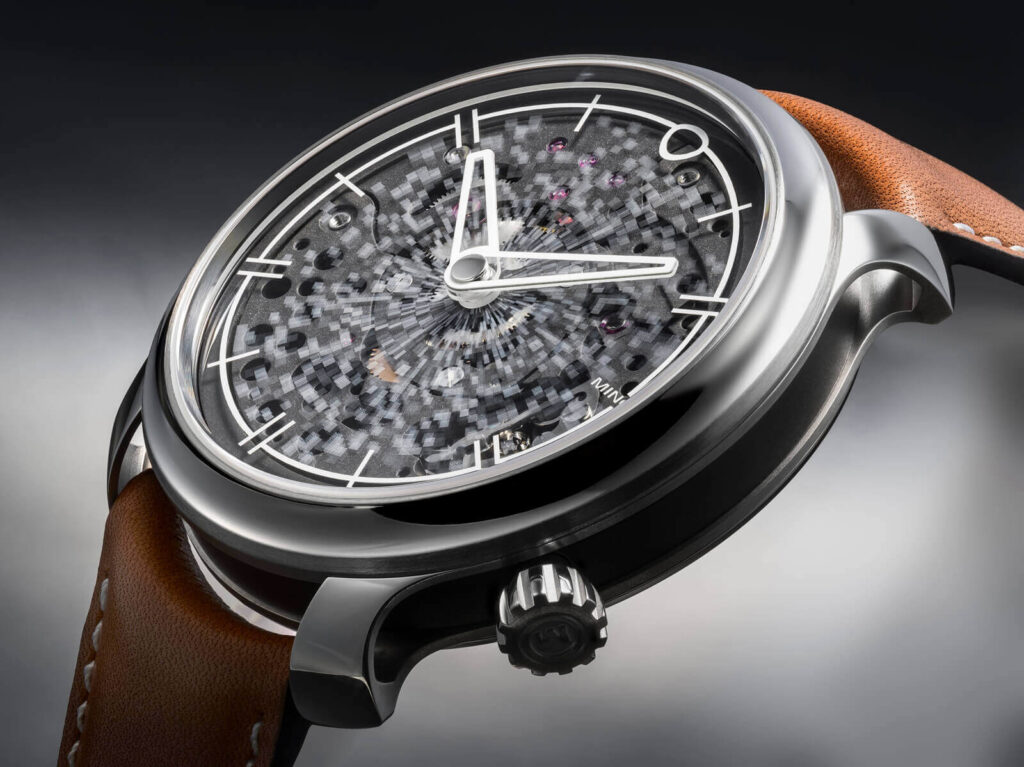
Now, the comparatively young brand has unveiled the Ming 20.11 Mosaic. Billed as its flagship model, this watch features a ‘mosaic dial’, resembling a chessboard. It is made of sapphire crystal suffused with numerous squares, applied with a ‘high-power femtosecond laser’.

Sapphire crystal is usually made using the Kyropoulous method where large alkali halide crystals are grown to form a giant boule. Ultimately, this boule is made into thin sapphire discs. The problem is that some of the sapphire may include imperfections and inclusions, hence only a proportion of the boule is usable. Also, when sapphire crystal is formed into thin components it has a tendency to crack, resulting in a high failure rate. Furthermore, by using the ‘high-power femtosecond laser’, any weaknesses in the sapphire such as inclusions will again result in the material shattering. Therefore, making such dials is not for the faint-hearted, albeit those dials that do pass muster exhibit a fabulous appearance and will remain perfectly safe once shrouded in a case.
Once again, Ming has used Grade 5 titanium for the case, another material which is not without its challenges. When milling Grade 5 titanium using a CNC machine, the alloy has a tendency to wear out tools more readily than other metals. Moreover, the milling speeds have to be reduced to avoid the alloy overheating and, by default, damaging the material. Quite simply, it costs more to mill Grade 5 titanium than steel or gold. The benefits of the material are that it is lightweight, corrosion-resistant and hypoallergenic.
Ming has a long history of working with movement specialist Schwarz Etienne. In some cases this has involved modifying Sellita movements, while on other occasions it has chosen a high-end Schwarz Etienne movement and specified various modifications. The Ming Cal.ASE 200.2 features a micro-rotor, a speciality of Schwarz Etienne. It is dressed in matte-black DLC coating and includes diamond-cut anglage.

Lastly, Ming upholds its reputation for luminescent detail. The Ming 20.11 Mosaic features sapphire crystal hands treated with HyCeram, a luminescent material. HyCeram also features on the indices adorning the sapphire dial.
Based on past experience, I don’t expect the watches will be around for long.
The brand’s press release
Last year, we previewed the MING Mosaic, a new 3D lasering process in sapphire crystal. Today it becomes production reality in our latest flagship: the 20.11 Mosaic.

All you can eat plus a whole chicken
We took everything we have in the design arsenal and threw it into our new flagship and daily wearer: it is the kind of watch you can and want to wear almost all of the time, but also projects something a little bit special. It debuts design tweaks reflecting our Special Projects Cave logo at 12, sapphire hands and Barenia leather straps. The Mosaic dial required a case with a bit more wrist presence, plus we wanted to address the numerous requests for bigger and used the larger, more intricate case from the 20.01 Concept Chronographs as a starting point.
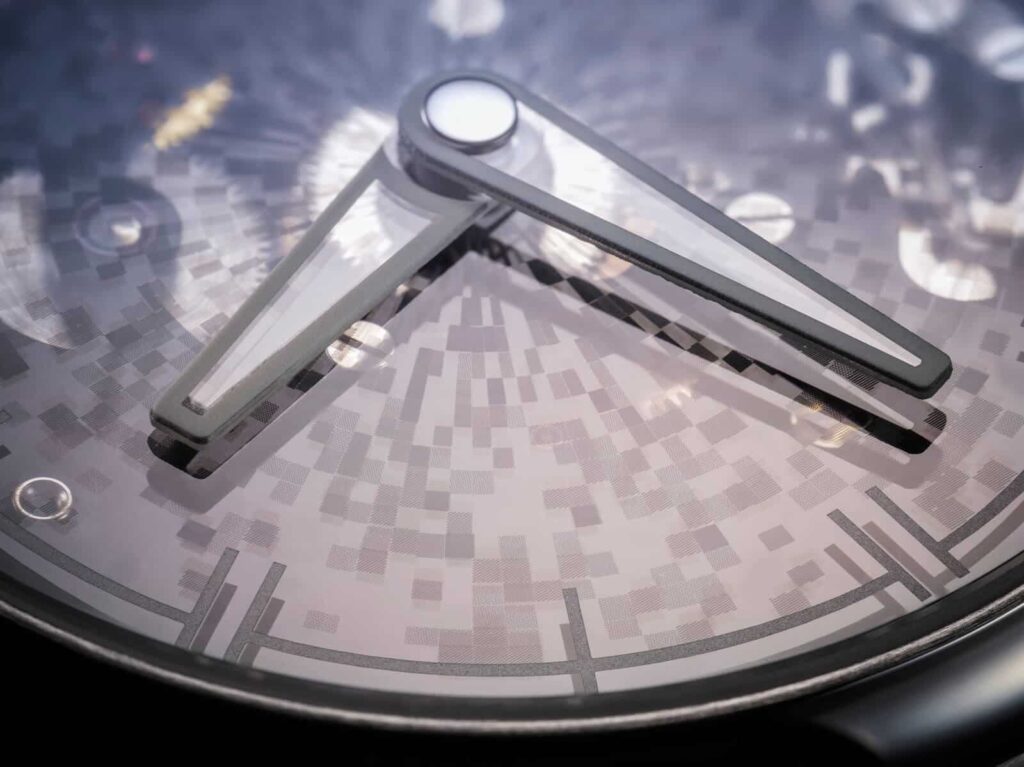
The Mosaic: a 3D chessboard
Of course, the star of the show is the Mosaic dial itself: 2,650 squares of varying opacity, each formed with a linear diffraction pattern and etched with a high-power femtosecond laser on three different levels within the sapphire crystal dial. This process was developed in collaboration with DM Surfaces SA of St. Imier and has been in the works for the better part of two years.
Actual production is tricky as the process is very sensitive to crystal quality and not all sapphire is equal. Tiny, near invisible inclusions within the crystal structure can cause the entire dial to shatter as a large amount of energy is being focused on a very small area during lasering. Though we use a 1.30mm thick optical grade crystal as the base blank; yield remains low and limits this dial to flagship applications only.
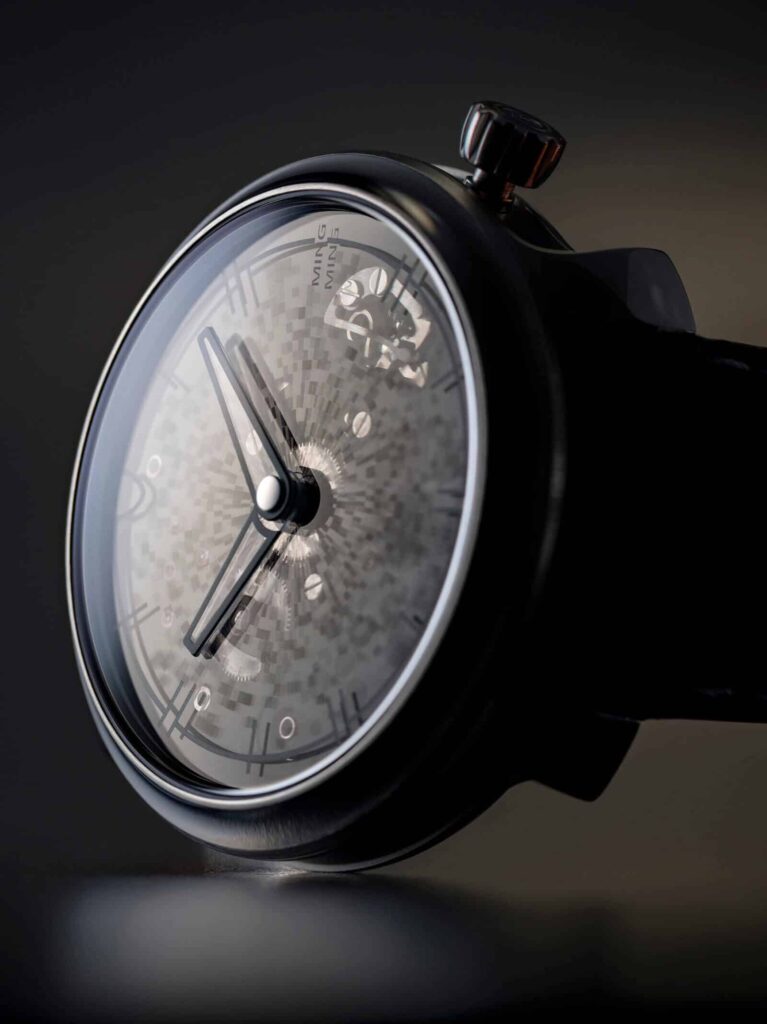
Depending on ambient light, the Mosaic can turn from invisible to a prominent chessboard and we chose to use a dark movement finish to provide a contrasting background, whilst adding visual texture. At night, light from the fully charged HyCeram in the sapphire dial will reflect off the Mosaic and result in a soft glow.
Micro-rotor, rebooted
The 20.11 is powered by the Schwarz-Etienne for MING Cal. ASE 200.2, with micro-rotor winding and a unique configuration previously seen in our 19.05. While we’ve retained the skeletonized bridges, the finishing is now matte-blasted with a black DLC coating and contrasting diamond-cut anglage. It has a power reserve of approximately 86 hours and is wound bidirectionally by a micro-rotor made of sintered tungsten. The signature MING skeletonized barrel cover allows for easy determination of the state of wind, and as with our other ASE powered watches, the movement is adjusted in five positions and tested for an extended period prior to delivery.

Attention to the little details
For the first time on any MING, we use sapphire crystal hands with HyCeram for legibility in all light conditions. The same HyCeram is used on the luminous indices of the dial sapphire. To add even more visual texture to the rear, the inner bezel surrounding the movement is made of titanium and machined with a Clous-de-Paris pattern and DLC coated.
The 20.11 is completed with a pair of handmade straps from Jean Rousseau Paris, a leather travel pouch by Studio Koji Sato, and a 700-lumen Nitecore LED torch for charging the HyCeram.
Availability, pricing and deliveries
The MING 20.11 is priced at CHF 14,500 with orders being taken on a deposit basis and deliveries commencing February 2022. A public batch of 50 watches will be offered, in addition to an existing customer batch that is time limited from 5 July to 9 July 2021. It will be available exclusively at www.ming.watch.
Further reading