
NOMOS Glashütte Calibre DUW 3001 (Part Two)
In the second instalment of his in-depth look at the NOMOS Glashütte Calibre DUW 3001, Angus Davies looks at the brand’s swing system and gear train, pointing out various details that distinguish this automatic movement as special.

Image – NOMOS Glashütte Calibre DUW 3001 rotor installation
How does a mechanical movement work?
By way of an introduction, it is important to explain how a mechanical watch movement functions. The ‘keyless works’ incorporating the crown, serves two roles. It is used to set the hands (motion works) as well as to energise the mainspring within the barrel. Generally speaking, when the crown is flush with the case (some watches have a screw-in crown) and is turned, the transmission wheel rotates, causing the ratchet wheel to turn. As the ratchet wheel rotates, it tensions or energises the mainspring within the barrel.
Automatic movements
An automatic movement is equipped with an oscillating mass, this movement also harnesses the motion of the wearer’s wrist, again tensioning the mainspring via its own dedicated train. Effectively, a second means of energising the mainspring.
The mainspring is designed to store significant amounts of energy. If the mainspring was allowed to unfurl without any form of control, this vast amount of energy could potentially harm delicate components within the movement and the time indicated would be incorrect. Moreover, the energy would soon dissipate and the watch would stop.
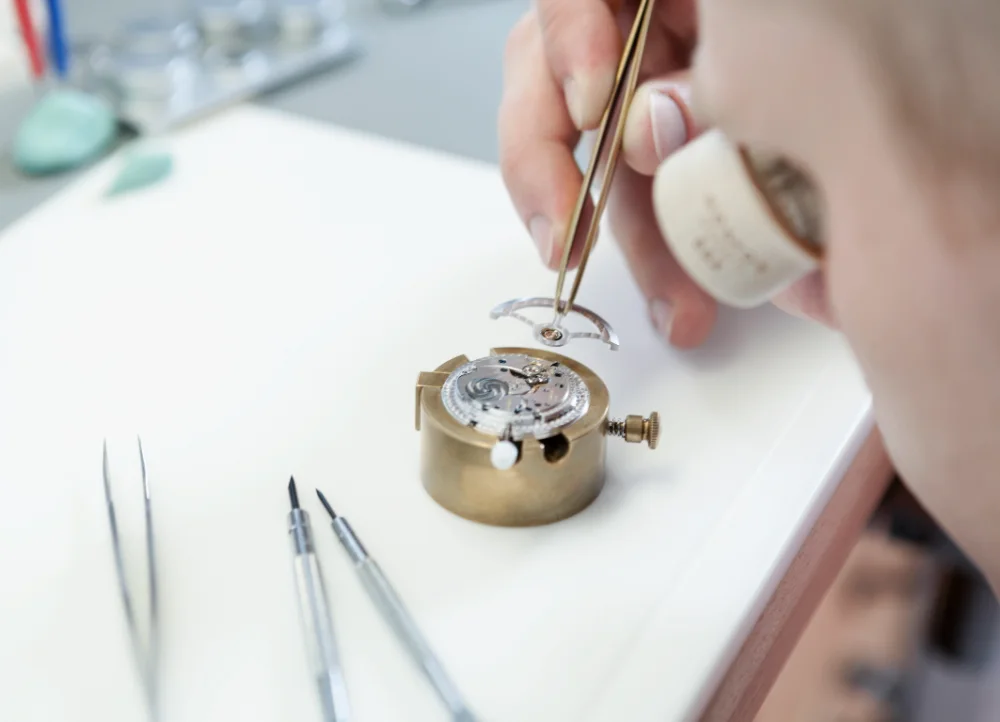
Image – NOMOS Glashütte Calibre DUW 3001 rotor installation
Gear trains
In order to control the energy held within the barrel, it is sent via a gear train. Employing a series of four wheels, the gear train acts a bit like an electrical transformer, stepping down the voltage to the desired level.
The fourth wheel of the gear train turns the escape wheel, part of the escapement. The escapement serves an impulse to the regulating organ which in turn allows the escapement to unlock, causing the hands to move a defined amount before locking again. It is this repeated locking and unlocking process that controls the ‘flow of time’.

Image – NOMOS Glashütte Calibre DUW 3001
NOMOS Glashütte Calibre DUW 3001 gear train
When NOMOS was designing the Calibre DUW 3001, it was eager to make a slender automatic movement with a thickness little more than a hand-wound calibre. As part of this process, NOMOS looked closely at the internal components within the watch.
One area where the watch brand identified a potential improvement related to the gear train. Working in collaboration with the Technical University of Dresden, NOMOS sought to develop a wholly new, more efficient gear train. Typically, with many watches, only about 80% of the energy from the barrel reaches the escapement. Engineers at NOMOS sought to increase this figure, looking closely at each wheel within the gear train, and reviewing the order, angle and number of teeth. The team of engineers also looked at the pressure applied by one tooth acting against another. The ultimate objective of this work was to increase the efficiency of the gear train.
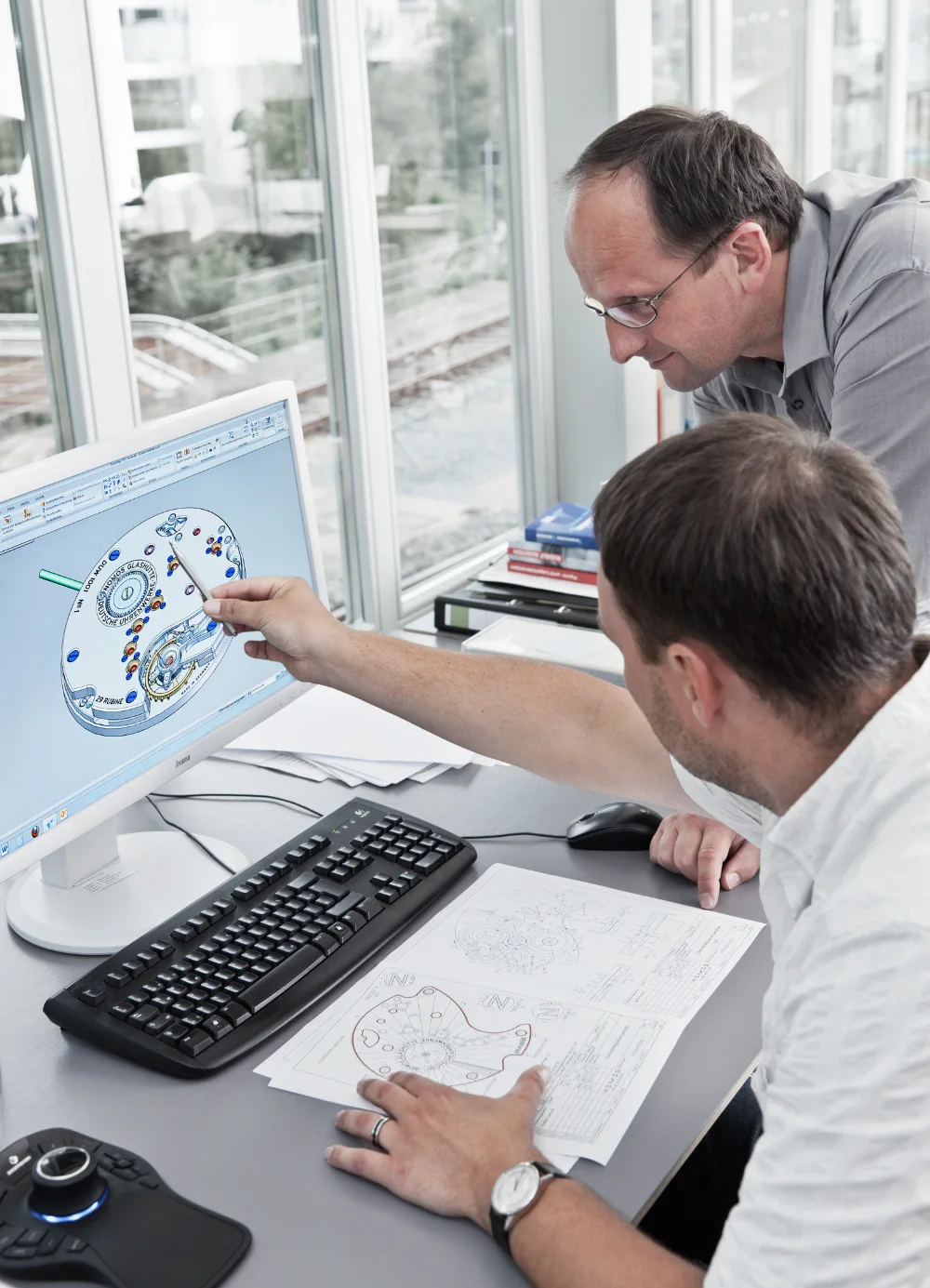
Image – NOMOS R&D
Recently, I chatted with two members of the NOMOS’s R&D department, Lutz Reichelt and Niclas Graetz and discussed the gear train in detail. The gentlemen explained that the ‘pressure angles’ of the teeth have a significant influence on efficiency. Ideally, only one tooth should be in mesh with the adjacent wheel. Moreover, any play between the teeth can cause the torque to fluctuate. As I listened intently, it became clear that the brand had looked extensively at every part of the gear train in the pursuit of advancement.
Having expended much time and effort, NOMOS has achieved a gear train efficiency of 94.2% with its Calibre DUW 3001. This has allowed the German watch brand to reduce the size of the mainspring, making the movement slimmer without decreasing the power reserve. Indeed, the Calibre DUW 3001 will run autonomously for up to 43 hours.
From the outset, the Calibre DUW 3001 had to be precise. Coupled with precision is the matter of rate stability. In a perfect world, once a movement has been regulated, the rate should not fluctuate irrespective of the energy within the barrel. However, in reality, this is seldom the case with the rate diminishing as the force from the barrel diminishes.
In order to deliver rate stability, some exemplars of Haute Horlogerie feature a constant force mechanism such as a fuseé and chain transmission, Geneva stopworks or a remontoir d’égalité. However, NOMOS’s egalitarian approach to pricing precludes using any of these expensive mechanisms.
Nevertheless, during my meeting with Lutz and Niclas, they explained that once fully wound, the torque supplying the escapement for the first 24 hours delivers a high degree of rate stability. As the Calibre DUW 3001 is automatic, the mainspring spends most of its time within this optimal range.
NOMOS swing system
Back in 2014, NOMOS surprised the watch world by releasing its own ‘swing system’, a term the brand uses to describe the escapement and regulating organ. NOMOS spent a total of 7 years and €11M developing its system.
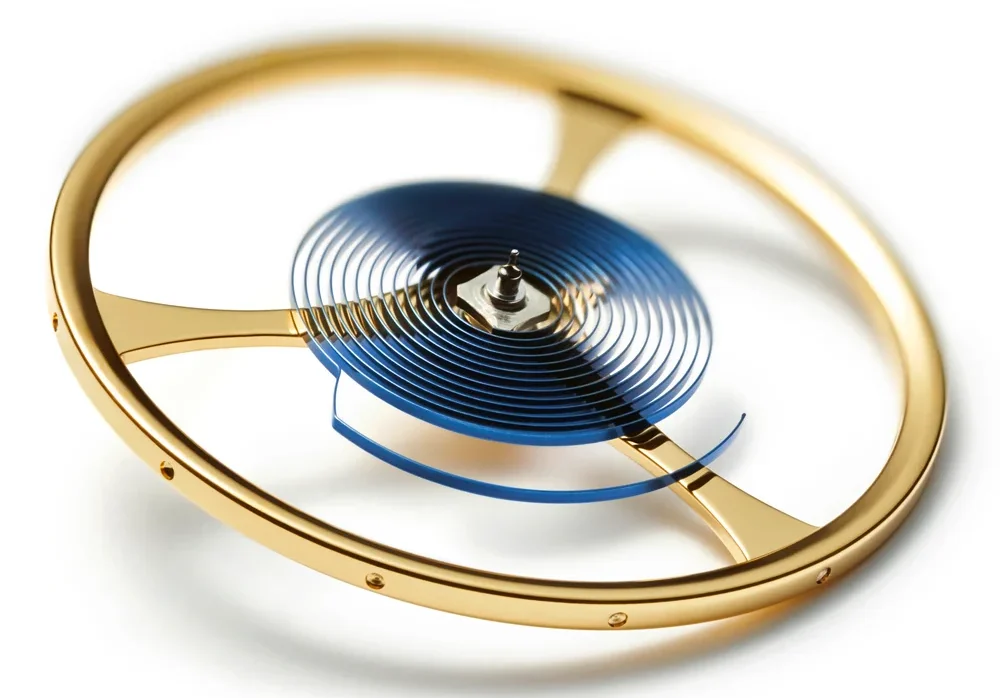
Image – NOMOS Glashütte balance wheel and balance spring. Note the incisions made in the rim of the balance wheel when poising (see later)
Comprising an escape wheel, pallet lever, balance wheel and balance spring as well as an array of tiny components, the swing system is incredibly challenging to make. The inherent complexity of this mechanism means that only a few specialist companies produce this assemblage of parts. Let’s look at some of the key components in closer detail.
The balance spring
The balance spring is an oscillator, acting in the same way as a pendulum within a grandfather clock. The material, number of ‘windings’ (coils), the spacing between the windings and the effective length of the balance spring determine its behaviour.

The balance spring, sitting at the heart of the swing system, is made of iron-nickel alloy. Its precise composition is a trade secret. The material is unaffected by fluctuations in temperature or the adverse influence of magnetism. The NOMOS balance spring is presented in a vivid shade of blue, a feature that distinguishes it from its rivals and a hue that sits in concert with adjacent tempered blue screws. The diameter of the balance spring must be absolutely uniform. To provide some context, a variation of 0.1 µm (one micron = 1000 mm) would lead to a rate variation of 100 seconds per day!
Classage and poising
The balance wheel is made of copper-nickel alloy and features three spokes. Like the balance spring, it is manufactured to exacting tolerances. However, there will still remain very small differences between each balance spring and each balance wheel. ‘Classage’ is a bit like horological matchmaking. It involves finding the best balance wheel for a particular balance spring.
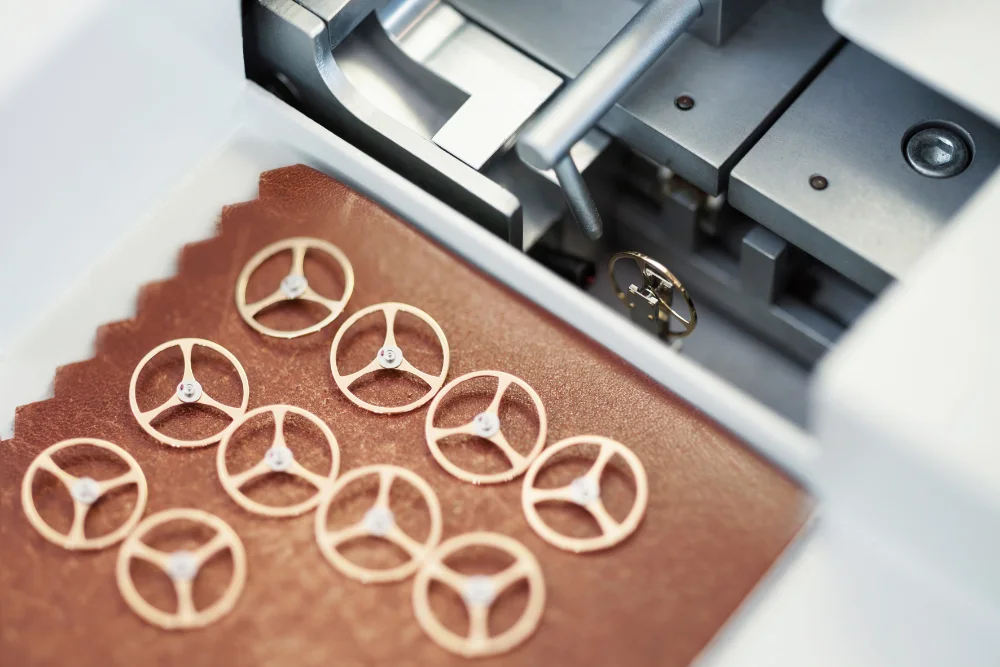
Image – poising the balance
‘Poising’ is similar to having a new car tyre fitted to a wheel rim and having it balanced. The tyre fitter seeks to ensure the wheel runs true, negating any imbalance by affixing weights to the rim of a wheel. The same principle applies in watchmaking, albeit rather than adding weights, mass is removed to ensure the inertia is consistent throughout.
NOMOS uses a cutting-edge dynamic poising machine that blows air onto the balance to determine any heavy spots. These are then removed by making small circular incisions in the rim of the balance wheel.
Inspecting the balance spring
The virol is attached using a laser, uniting the balance spring with the balance staff. At the opposite end of the balance spring, a stud secures it to the balance bridge. The balance spring is affixed with epoxy resin.
The balance spring is inspected using a microscope, ensuring it is flat and that all the coils are spaced the same distance apart. When the balance wheel oscillates, the balance spring should breathe concentrically.
An obsessive attention to detail
NOMOS has looked at the Calibre DUW 3001 with an almost obsessive attention to detail. For example, the firm has recently used MEMS technology to create the pallet lever. Its intricately shaped, openworked design eschews surplus material, reducing its overall mass, thereby mitigating energy consumption.
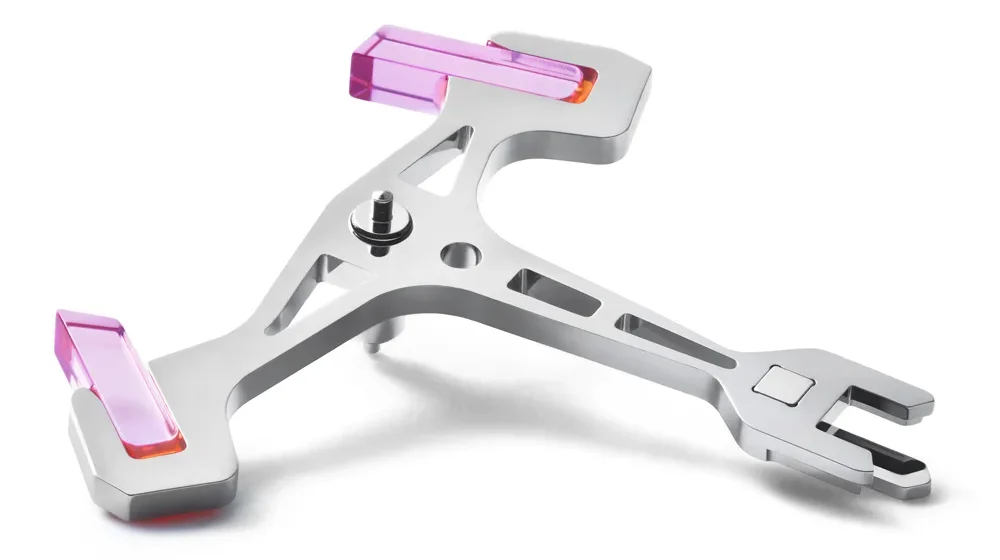
Image – latest pallet lever with openworked design
With some watches, a beat error necessitates removing the balance spring and reattaching it to the virol. However, with the swing system, the beat error can be addressed simply by moving the mobile stud. In one simple process, the watchmaker can achieve the desired ‘anchor symmetry’ without needing to remove the whole of the balance assembly. This approach should help mitigate future servicing costs.
The regulating organ is mounted on a balance bridge, secured at two points using tempered blue screws. This provides greater stability than using a balance cock (secured at one point).
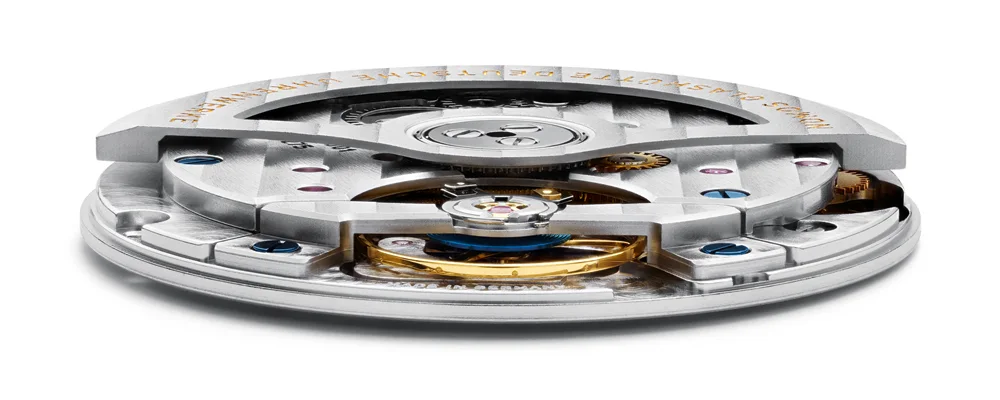
Image – note how the edge of the oscillating mass runs in a trottoir (channel) adjacent to the three-quarter plate
One of the bulkiest parts of an automatic watch is the oscillating mass, especially on its outer edge. NOMOS has created a ‘trottoir’, a channel encircling the three-quarter plate but positioned above the mainplate. This channel accommodates the thickest section of the oscillating mass. By taking this intelligent approach to the design of the movement, the German brand has reduced the overall height of the Calibre DUW 3001.
NOMOS Glashütte Calibre DUW 3001 – closing remarks
Not all movements are created the same. This is evident when appraising the Calibre DUW 3001.
In 2005, when NOMOS unveiled its inaugural in-house movement, the hand-wound Alpha Calibre, was highly impressive. Beautifully executed and with a thickness of just 2.6 mm, it is the perfect engine for a slender watch and continues to feature within several NOMOS models.

Image – NOMOS Glashütte Alpha Calibre – thickness = 2.6 mm
When NOMOS sought to create an automatic movement, it clearly wanted to perpetuate its reputation for elegant, slim watches. The Calibre DUW 3001 is the product of much consideration. It measures just 3.2 mm in height, a mere 0.6 mm more than the hand-wound Alpha Calibre, and proffers svelteness and convenience.

Image – NOMOS Glashütte Calibre DUW 3001 – thickness 3.2 mm
Moreover, the Calibre DUW 3001 is highly precise and made to last. Every aspect of its specification is the product of considered design and intelligent engineering.
And lastly, assuming you specify your NOMOS with a ‘sapphire crystal glass back’, you can admire the Calibre DUW 3001 at close quarters and reflect on its protracted creation.

Images – copyright: NOMOS Glashütte