
NOMOS Glashütte Tangente neomatik platinum gray
The NOMOS Glashütte Tangente neomatik platinum gray is the latest iteration of the German marque’s iconic model. Upholding the design language of the first Tangente, released in 1992, this model has never dated and continues to look fresh and tastefully understated. Angus Davies gets ‘hands-on’ with the latest version of this iconic timepiece from the NOMOS Manufactory in Saxony.

On the 9th of November 1989, the Berlin Wall was torn down and suddenly the future for many Germans looked much brighter. Indeed, with the advent of a new dawn, a feeling of optimism swept across the World. Clearly, this sense of optimism resonated with Roland Schwertner. In January 1990, just two months after the Berlin Wall came down, he founded his watch brand, NOMOS Glashütte.

Image: Copyright: NOMOS Glashütte
In 1992, the German marque released its inaugural models, a quartet of Bauhaus-inspired creations, including the Ludwig, Orion, Tangente and Tetra.
The Tangente, now celebrating its 30th anniversary, is the bestselling German watch. Despite the passage of time, it still looks fresh and yet it continues to respect the design codes of the original 1992 model. However, while this may imply the team in Glashütte have been twiddling their thumbs for many years, nothing could be further from the truth.
Beneath the Tangente’s dial sits much mechanical innovation. The inaugural Tangente was equipped with an ETA Peseaux 7001 hand-wound movement. However, in 2005, this Swiss movement was supplanted by the brand’s own in-house creation, the Alpha movement. Thereafter, the German marque unveiled its own in-house escapement, the ‘Swing System’ (2014) and an ultra-thin automatic movement, the Caliber DUW 3001 (2015).
Over the years, the Tangente has sired many variants, encompassing different dial hues and in some cases patterned dial options. Likewise, the Tangente range now includes divers’ watches and the ‘Update’, a model with an ingenious means of imparting the date. Quite simply, the company’s dedicated workforce continues to burn the midnight oil, eager to find new ways of delighting horophiles.
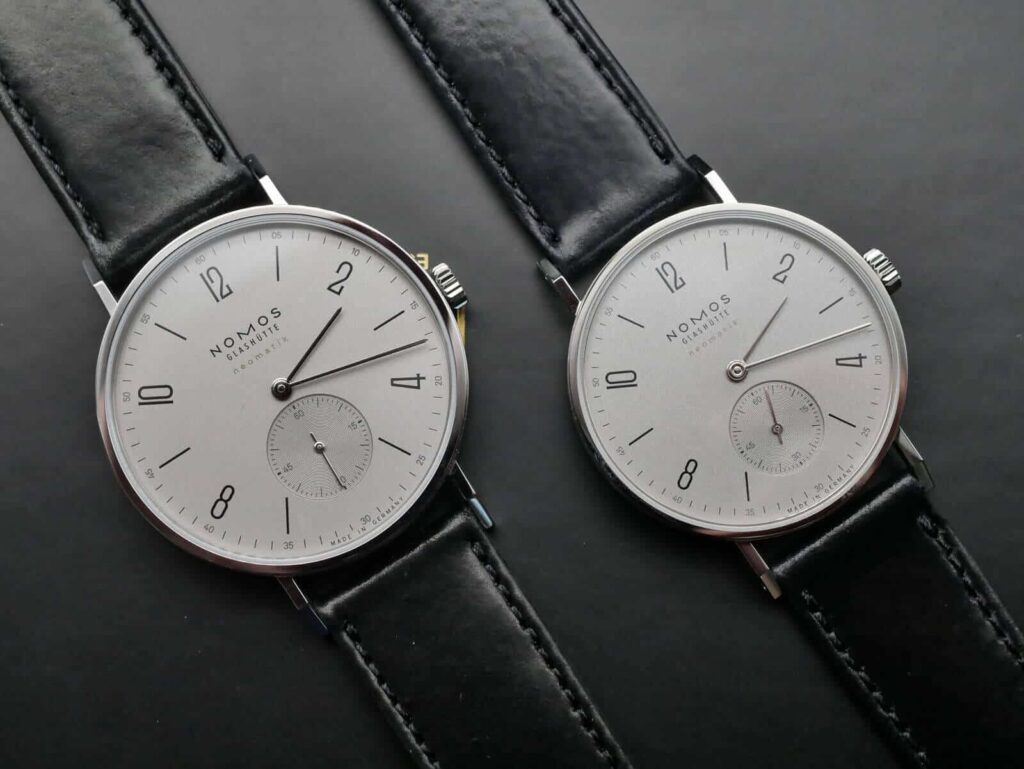
Now, there is a new addition to the brand’s Tangente collection, the NOMOS Glashütte Tangente neomatik platinum gray (the brand favours US-English). It’s a familiar recipe of hours, minutes and small seconds in a refreshingly unfussy case, powered by the ultra-thin Caliber DUW 3001. The watch comes in four versions, two models are housed in a 35mm case and two in a 38.5mm case. Furthermore, this new version comes with a choice of either a solid caseback or a sapphire caseback. NOMOS provided two examples of the model, 35mm and a 38.5mm, both of which were fitted with an exhibition caseback (Ref. 189 and Ref. 144, respectively).

Image: Copyright: NOMOS Glashütte
Personally, I gravitated towards the Tangente neomatik 39 platinum gray, primarily because its dimensions are better suited to my own physique, and it is this model which is the focus of my review.
The dial
This model’s name may suggest the dial is made of the most noble of precious metals. Certainly, there are a small number of watches out there that are equipped with platinum dials, however, these typically dwell in the rarefied heights of Haute Horlogerie with commensurate six-figure pricing. No, the NOMOS Glashütte Tangente neomatik platinum gray doesn’t have a solid platinum dial, its egalitarian pricing precludes this.

However, the German brand has not been duplicitous with the naming of its watch. The dial is plated with rhodium, one of six platinum-group metals, the others being ruthenium, palladium, osmium, iridium and, of course, platinum.
Interestingly, rhodium is widely used in the watch industry to treat movement mainplates and bridges. Indeed, the Saxony-based firm applies a layer of rhodium to the mainplate and three-quarter plate of the Caliber DUW 3001 in order to mitigate the possibility of corrosion.
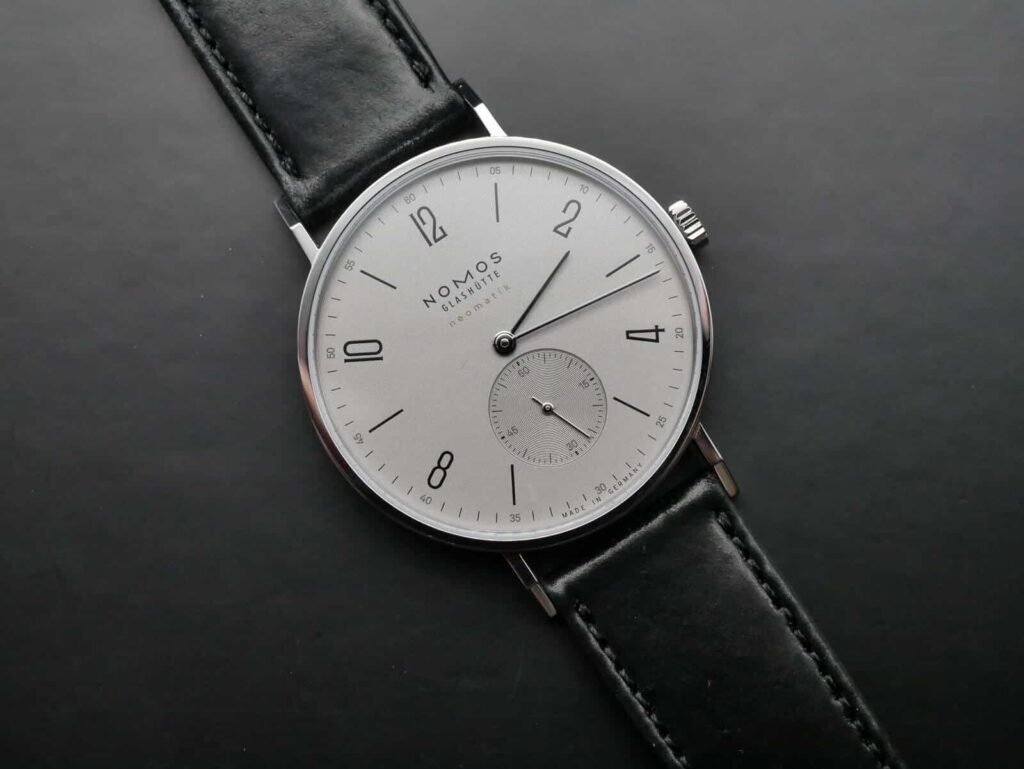
Returning to the dial, by treating it with rhodium, NOMOS has imbued it with a subtle and understated character. Described by the company as ‘gray’, the epidermis is far more complex than one word could possibly convey. Quiet and restrained, it becomes more animated in sunlight where the grey tones appear more metallic.

Image: Copyright: NOMOS Glashütte
The hour and minute hands subscribe to the ‘form follows function’ philosophy, enunciating meaning with extraordinary efficiency. However, beyond their clean appearance, they also prove elegant.
Consistent with historical Tangente models, the hour markers comprise of batons for the odd-numbered hours and Arabic numerals for the even-numbered hours. The typeface is unique to NOMOS and has been a feature on the Tangente ever since the release of the first model in 1992. Each hour marker is elongated, granting the display with an air of sophistication.

Image: Copyright: NOMOS Glashütte
Positioned below 12 o’clock, the brand’s moniker is shown in black text. While underneath, the word ‘neomatik’ is presented in a contrasting shade of gold.
Finally, a small seconds display sits in the lower portion of the dial. It’s slightly recessed and enlivened with snailing. It is probably the most flamboyant dial element, but rest assured everything remains seemly and notably NOMOS.
The case
The stainless steel case is a two-part design with the upper and lower sections meeting just above the crown. When appraising the style of the NOMOS Glashütte Tangente neomatik platinum gray, there is a reoccurring feeling of no-nonsense efficiency. The lugs are slender, angular and devoid of curves. They shun unnecessary flamboyance, retaining the strap securely and granting impressive levels of wearer comfort. Interestingly, when the 38.5mm case is affixed to the wrist, it appears larger than its stated diameter would suggest. I suspect the elongated lugs play a key role in this larger than reality trait.

While some watches have elaborately formed cases with arcing casebands and numerous bevelled edges, NOMOS favours a minimalist approach. For example, the upper and lower sections of the case, once combined, form a shallow cylinder with straight sides.

Image: Copyright: NOMOS Glashütte
The case is highly polished throughout, a surprising detail considering the brand’s penchant for refined understatement. Nevertheless, this version of the Tangente perpetuates the firm’s predilection for restrained styling.

Image: Copyright: NOMOS Glashütte
To the rear, the caseback features a pane of sapphire crystal, affording sight of the self-winding movement. The brand offers the option of a solid caseback, providing a suitable canvas for a personal engraving and a useful cost saving of £300.

Image: Copyright: NOMOS Glashütte
NOMOS is known for presenting its watches on Horween Genuine Shell Cordovan strap and the Ref. 144 proves no exception. The strap is paired with a steel pin buckle.
The movement – ultra-thin
In 2015, NOMOS unveiled the Caliber DUW 3001. This in-house self-winding movement was the first of the ‘neomatik’ series of calibers. Measuring just 3.2mm in height, the movement’s dimensions were more typical of a hand-wound movement.
Historically, ultra-thin calibers have been the preserve of Haute Horlogerie with commensurate pricing. However, consistent with its egalitarian mindset, NOMOS has democratised the ultra-thin genre.
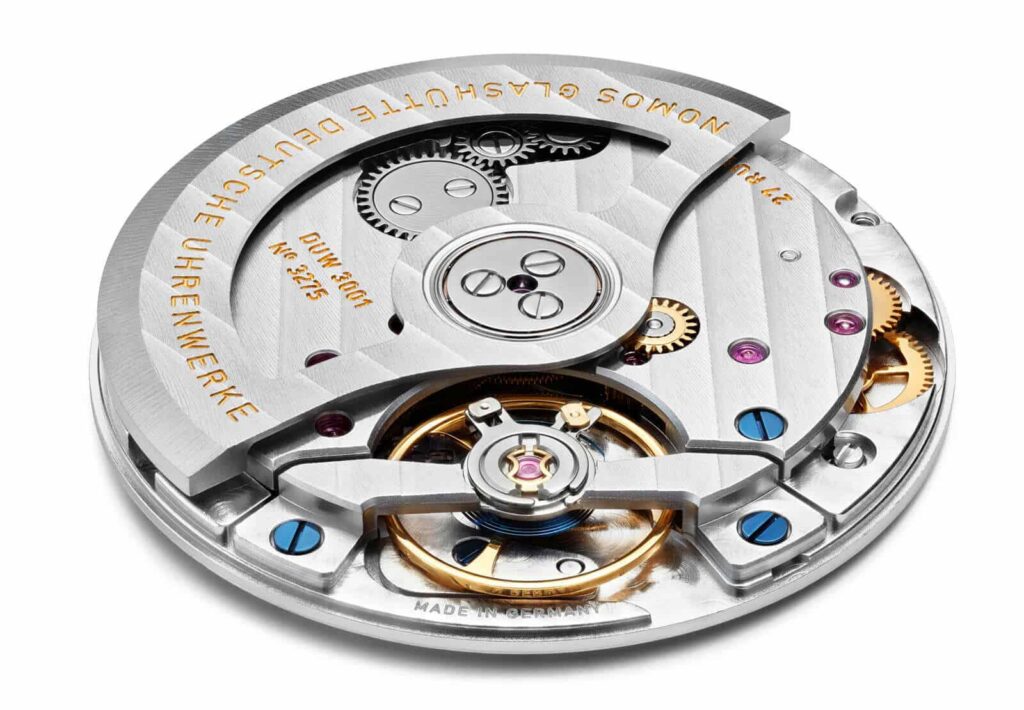
Image: Copyright: NOMOS Glashütte
Making an ultra-thin watch is incredibly complicated. It necessitates repositioning components so they sit on a similar plane while ensuring there is a sufficient degree of torsional rigidity. In some instances, NOMOS was able to simplify the role of several components, reducing the number of parts needed.

Image: Copyright: NOMOS Glashütte
NOMOS collaborated with the Technical University of Dresden, designing a new, more efficient, gear train. This resulted in less energy loss due to friction, thereby improving the calibre’s efficiency to a remarkable 94.2%. By optimising gear train efficiency, NOMOS was able to reduce the size of the mainspring, thereby allowing the brand to reduce the height of the calibre. Indeed, the Calber DUW 3001 has a power-reserve of up to 43 hours. The movement height of 3.2mm is a key reason for the model’s modest 6.9mm case thickness.
The movement – NOMOS swing system
A reoccurring theme with NOMOS is that it has always demonstrated an unwavering quest for independence. For example, in 2005, the brand released its first in-house movement, a feat that continues to elude many watch brands. However, in 2014, it surprised many industry observers when it released its proprietary ‘swing system’.

Image: Copyright: NOMOS Glashütte
The NOMOS swing system is the term the company uses to describe the escapement and regulating organ. Making these components proves the ultimate challenge for any watch brand as numerous technical obstacles have to be surmounted. It is for this reason that many brands look to specialist firms in Switzerland. However, there have been occasions when such components have been in short supply. NOMOS was determined to have its own system and, by default, have greater control over its destiny.
Again, working with the Technical University of Dresden, NOMOS spent an inordinate amount of time and money developing its swing system. A critical element within this assemblage of parts is the hairspring which sits within the balance wheel.
The hairspring is made of an alloy, however, all manufacturers of hairsprings remain tight-lipped regarding its composition. Indeed, it is always a closely guarded secret. This alloy, normally supplied on a reel in wire form, is passed over a series of rollers and through various dies in order to reduce its thickness. The diameter of the wire must be uniform as any variation will impair precision. Typically, a hairspring is just a few microns in thickness made to precise tolerances measured in nanometres.
Once the wire is the right thickness, it is cut into ‘blades’ and coiled. These coils are baked in an oven. Again, the temperature and cooking time are trade secrets.
There are infinitesimal differences between each hairspring and each balance wheel. They are paired together based on their individual characteristics. The spring is affixed to the balance wheel’s collet using a laser, the length of the hairspring is cut to length if required. The balance needs to be poised, similar to balancing the wheel of a car, fixing weights to the wheel rim as necessary. In this instance, the underside of the balance wheel’s rim is usually drilled.
The hairspring needs to breathe concentrically in order to deliver precision. A skilled worker will make manual adjustments using a microscope to ensure the hairspring breathes properly. Ultimately, the hairspring is joined to a stud using a laser and the stud is fitted to the balance bridge.

Image: Copyright: NOMOS Glashütte
As mentioned earlier, most companies purchase regulating organs from specialist third party companies, hence the NOMOS swing system is very unusual. Indeed, few watch brands have the necessary skills to make their own regulation organ. NOMOS has chosen to differentiate its hairspring by presenting it in a tempered blue finish.
The movement – interesting features
A characteristic of most Swiss watches is they comprise of a mainplate and numerous bridges placed on top. Various components such as the gear train, keyless works, etc sit in between the mainplate and bridges, effectively resembling a horological sandwich.

NOMOS subscribes to the Glashütte tradition of using a three-quarter plate instead of numerous bridges. By adopting this approach, the stability of the movement is improved. Similarly, the balance bridge is secured with two screws which proves more stable than a balance cock which is secured with just one screw.
The oscillating weight is partially openworked affording superior views of the decorated three-quarter plate, positioned below. Most of the mass and, therefore the bulk, is located to the edge of an oscillating weight. Cleverly, on the Caliber DUW 3001, this bulk is positioned beyond the edge of the three-quarter plate and sits within a ‘trottoir’, effectively a channel running around the perimeter of the movement. By adopting this approach, NOMOS has been able to minimise the thickness of the movement.
Despite the modest pricing of this watch, there are numerous examples of finissage in evidence. For instance, the mainplate is adorned with perlage. The three-quarter plate and balance bridge are embellished with Glashütte ribbing, a striped decoration similar in concept to Côtes de Genève. Subscribing to fine watchmaking practise, thermally blued screws abound.
Closing remarks
‘Form follows function’ is at the heart of NOMOS’s design language. The proclamation of time is clear and unequivocal, however, in making the dial clear, the overall aesthetic looks uncluttered, pure and timeless. Similar to many objects that subscribe to the ‘Bauhaus’ design philosophy, the styling of the Tangente has never dated over its 30-year lifespan.
The case is a simple, unfussy design that delivers an ergonomic union between the watch and its wearer. It may be highly polished, evincing a brilliant gleam, but it remains elegantly understated and plays a deferential role to the dial.
NOMOS is synonymous with affordability conjoined with quality. The movement shows no signs of penny-pinching with beautiful finishing in evidence and intelligent movement design. The brand’s technical credentials are clear to see. NOMOS produces in-house movements fitted with its very own swing system. This ingenious approach to movement design has delivered ultra-thin calibers, housed in slender, comfortable-to-wear watches.

Image: Copyright: NOMOS Glashütte
The watches that originate from the NOMOS Manufactory are timelessly stylish, technically superb and remarkably good value. However, NOMOS wearers themselves are never boastful or showy, they quietly enjoy the benefits of ownership in a typically unassuming way. Quite simply, NOMOS wearers are my kind of people.
Further reading
Technical specifications
- Model: NOMOS Glashütte Tangente neomatik 39 platinum gray
- Reference: 144
- Case: Stainless steel; diameter 38.5mm; height 7.1mm; water resistance 5ATM (200 metres); sapphire crystal to front; exhibition case back.
- Functions: hours; minutes; small seconds
- Movement: Calibre DUW 3001; automatic movement; 26 jewels; power reserve up to 43 hours.
- Strap: Horween Genuine Shell Corodovan, remborde, lug width 19mm, steel pin buckle
- Price: £2880 – Ref. 144 – sapphire caseback (RRP as at 19.3.2022)
- Price: £2580 – Ref. 143 – solid caseback (RRP as at 19.3.2022)
- Price: £2740 – Ref. 189 – 35mm – sapphire caseback (RRP as at 19.3.2022)
- Price: £2440 – Ref. 188 – 35mm – solid caseback (RRP as at 19.3.2022)