
Panerai Luminor BiTempo PAM01360
Both the Panerai Luminor BiTempo PAM01360 and its blue-faced sibling, the PAM01361 include a GMT function, displaying the local time and home time simultaneously. Each reference features a power-reserve indicator and a date display. Mark McArthur-Christie looks closely at these latest models from the Italian-Swiss marque.

Just imagine
Designing for Panerai must be a tough gig.
Designer, having reverently pushed The Boss’ office door open: “I’ve got an idea for a new case shape – I’m thinking of…”
Il Capo: “Neanche per sogno!” (Don’t even think about it!)
Designer: “Hey – how about a 36mm…”
Il Capo: “Scordatelo!” (Forget it!)
The designer goes back to her coffee and doodles ideas for a new square dial Radiomir in the margins of her CV.
Simplicity and function
There’s really only so much you could do with the Luminor and Radiomir – the Panerai mainstays – before things start going badly wrong. Both watch designs are, and always have been, about simplicity and function. After all, the Radiomir started out as a serious diving watch years before Richemont was even a twinkle in Johann Rupert’s eye. Mess with them at your peril. So congratulations to Panerai on its latest two-watch launch, the 1360 and 1361 GMT or ‘BiTempo’. As you’ll have spotted, these two new Luminor watches have an added GMT and power reserve. Brave stuff.

The P.9012 calibre
Mind you, these are not the Neuchâtel maker’s first GMT Luminor offerings, although most of the earlier models are powered by the cal. P.9011 movement (the direct descendent of the P.9001). Nor is it the first GMT with a power reserve indicator; that distinction goes to the PAM00335 Luminor GMT 10 Days. These latest watches run the much newer P.9012 calibre, the same engine that powered the BiTempo’s predecessor, the Luminor 1950 3 Day GMT. In case you’d spotted the likeness, that’s why the dial layout on this new watch is identical.

You can delegate all the hard work of winding to your cal. P.9012 and watch while it ticks cheerfully along at 28,800 vph (4Hz). Leave it in the watchbox and its Glucydur balance will keep spinning autonomously for 72 hours thanks to the movement’s two chunky mainspring barrels. It has 231 parts and 31 jewels, measures 6mm deep and is “executed entirely by Panerai”. Finishing is exactly what you’d expect from the firm; well-done and smart without being in any sense bling. Everything is brushed, the plates have anglage and the secure, double-mounted balance bridge contrasts with the snailing on its base. That balance bridge is worth a look on its own – it’s shaped almost like the profile of a bird in flight. Fortunately, the firm hasn’t hidden it behind a solid caseback so everything’s there to enjoy. Those twin barrels run in their own heavyweight jewelled bearings.
A GMT function
Complication-wise there’s the date (now in a bevelled-edge date window which we’ll be seeing more of on future watches), the GMT function on a central hand and a power reserve indicator sitting at 5 o’clock. There’s also a properly useful function that would be splendid to see on more watches – a zero-reset hack seconds. Pull out the crown (having moved the trademark securing lever) to set the time and the seconds hand stops and snaps back to 12 where it stays until you push the crown in again. No more waiting for the seconds to tick by as you try to catch the hand just as it reaches the top of the dial. And no more swearing when you miss the moment.
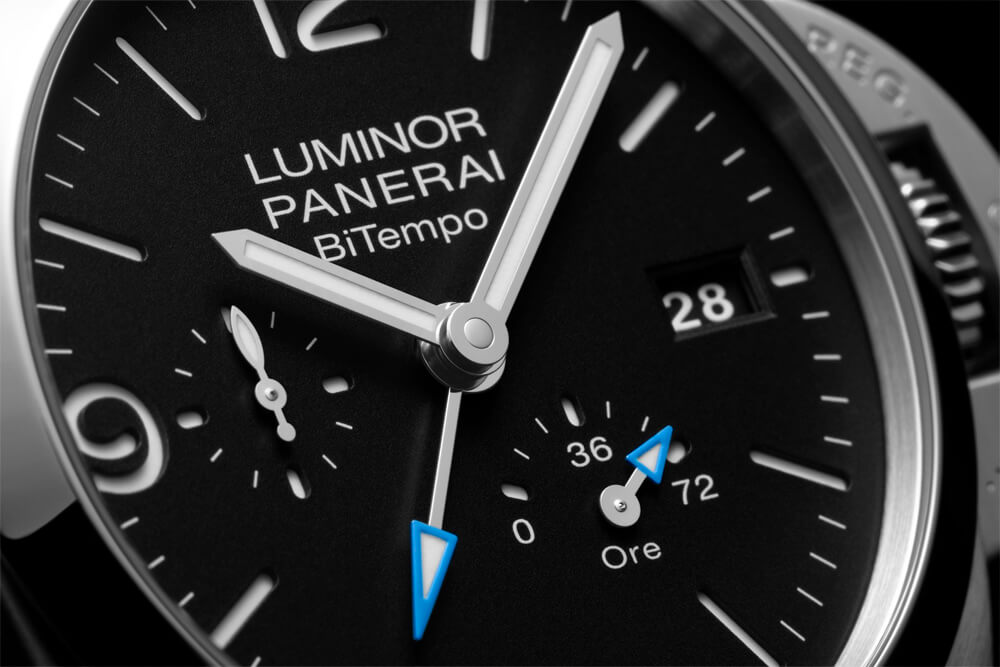
Talking of dials, although the two new models are mechanically identical they’re visually quite different. The Panerai Luminor BiTempo PAM01360 has a matte textured black dial while the 1361 comes with a blue sunburst dial (the firm calls it ‘sun-brushed’). You’ll recognise the dense black textured finish from the 1360’s stablemates. The 1361 manages the neat trick of being understated but still vibrant, especially when the light hits it.
But the stars of the show here are the GMT function and the power reserve indicator. Having a second timezone on your watch is properly useful, especially if you work across a couple of continents. It saves the constant ‘hang on, are they six or seven hours behind – and is that BST or GMT?’ and having to have worldtimebuddy.com on a bookmark. Just set the hand and leave it. The watch designer’s skill comes to the fore here; a GMT hand needs to be as simple to read at a quick scan as the main hour hand – but it needs to be different enough that you don’t get the two confused. With the ‘60 and ‘61, Panerai’s designer has done a fine job. There’s no way you’ll muddle the hands, both are perfectly clear. The main hour hand is a traditional baton, matching the minute hand. The GMT hand works as a separate arrow-tipped pointer. Everything’s beautifully clear at night too; the hour hand is lumed in SL bright green whereas the GMT hand is an electric blue.
As far as I can see, the only thing missing is any sort of day/night marker but isn’t that why the good Lord gave us common sense?
A power-reserve indicator
The power-reserve indicator, as a secondary function, gets its differentiation through both the shape of its hand (another arrow, unlike the Panerai long-oval seconds hand) and its colour – blue again. Turn the lights down and you’ll spot that the indicator scale runs from low power (blue) through to fully wound (green). Those of us who used to hold our Timexes over the bedside light and duck under the covers to see the lume will be very happy indeed.
But wait – what’s this?! A non-chronograph Luminor with a minute track?! What sort of devilment is this?! Actually, Panerai has once again been design-smart. Although the hour batons, numerals and even the cardinal points on the seconds dial are cut through the sandwich dial to allow the lume to shine through, they’ve neatly left the minute markers simply printed. Anything else would be just a bit too much.

The luxury house has considerately paired the dial colours and straps too, so where the Panerai Luminor BiTempo PAM01360 gets a black alligator strap, the strap affixed to the PAM01361 is blue. If you don’t fancy either of those options, your watch comes with a rubber strap so you can swap it over.
A practical ownership proposition
It’s always good when a maker is happy to involve owners practically. Here, they’re very happy to let you do a bit of fiddling with your new watch; you’ll find a tool in the box to change the straps and there’s a screwdriver so you can transfer the buckle from one to the other.
There’s already been plenty written about the Luminor case, so suffice it to say that both references offer more water resistance than you’ll need and will be sufficiently robust to survive whatever you throw at them. That’s one of the great things about a Panerai; they’re not watches you need to worry about or baby. In addition, these latest offerings, despite being undeniably luxurious are also as practical as can be. Each dial is sufficiently clear and large that you can read the time from the International Space Station without a telescope. And with either option, unless you’re a serial watch-swapper you’ll only have to wind it once a year (at worst) and the GMT function is about as useful as complications come. Both models have the potential to become long-time favourites with newbies, collectors and the legendary Paneristi.
Further reading
Technical specifications
- Model: Panerai Luminor BiTempo PAM01360
- Case: stainless steel, diameter 44 mm, water resistance 30ATM (300m), sapphire crystal to the front and exhibition case back.
- Functions: hours, minutes, small seconds, power-reserve, GMT 12 hours, stop seconds reset
- Movement: P.9012 caliber; self-winding movement, frequency 28,800 vph (4Hz), 31 jewels, power reserve 3 days, 231 components
- Strap: Alligator black, T/T, STD, 24/22, BA. Trapezoidal brushed steel buckle
- Price: £8,800 (RRP as of 20.10.2022)
- Model: Panerai Luminor BiTempo PAM01361
- Price: £8,800 (RRP as of 20.10.2022)