
Parmigiani Fleurier Tonda PF Chronograph Watch Review
The Parmigiani Fleurier Tonda PF Chronograph is a highly refined timepiece that’s rich in technical virtue. Moreover, it demonstrates the folly of chasing products solely for their overt branding. Angus Davies explains why, in his opinion, this exemplar of Haute Horlogerie is probably one of the finest chronographs currently on the market.

Parmgiani Fleurier watch
Thomas Jefferson, the 3rd President of the United States, once said, ‘all men are created equal and independent’. Over the years, the notion of equality has been repeatedly championed by the righteous. However, George Orwell, the English novelist, provided an alternative perspective in his book, Animal Farm (1945). He wrote ‘All animals are equal but some animals are more equal than others.’
I am reminded of Orwell’s words when I look at the Parmigiani Fleurier Tonda PF Chronograph. While all chronographs measure periods of elapsed time, they are certainly not equal.
The watch buying public has grown accustomed to low-cost chronographs. Mass produced cam-actuated and modular chronographs have democratised the complication. However, the finest chronographs are technically challenging to make. Indeed, the difference in performance between a low-cost option and a high-end expression of Haute Horlogerie is huge.
Recently, Parmigiani Fleurier unveiled three ‘regular’ models, the Tonda PF Micro Rotor, Tonda PF Chronograph and the Tonda PF Annual Calendar. Each of these models is offered in a choice of stainless steel (with platinum bezel) or 18-carat rose gold. In addition, the Maison also released the Tonda PF Split Seconds Chronograph, a limited-edition of 25 pieces produced to celebrate the firm’s 25th anniversary. This latter watch features a bracelet, case and dial all formed of platinum. Moreover, its movement includes a mainplate and bridges made of 18-carat rose gold. Lastly, purists are indulged with views of the movement, courtesy of an exhibition caseback, where exquisite finishing is presented and interior angles abound.
Platinum and steel watch case
In this instance, the focal point of my review is the Parmigiani Fleurier Tonda PF Chronograph in steel. Recently, I examined both case variants at close quarters. While the beauty of the 18-carat rose gold model is clear to see, I adore the marriage of a steel case with an exquisite platinum 950 hand-knurled bezel. The juxtaposing of steel with the ultimate noble metal is highly irregular but nevertheless, wonderful. Platinum exhibits a silvery-white tone and endows the habillage with a heightened sense of luxury.

Parmigiani Fleurier Tonda PF Chronograph dial
Devotees of Parmigiani Fleurier will immediately recognise the silhouette of the Delta-shaped hour and minute hands. They have been a regular feature on Tonda models for several years and have always enunciated the prevailing time with extraordinary efficiency and notable poise. However, in this instance, the hands are openworked imbuing the dial with an added dose of modernity. While the Parmigiani Fleurier Tonda PF Chronograph is sporty by definition, it possesses a degree of formality, making it an ideal complement to a black-tie ensemble. Consistent with the dignified character of the watch, the hands and indexes eschew any form of luminescence.

The indexes are hand-applied and rhodium-plated. They are endued with a faceted edge that slopes downwards towards the fulcrum of the dial. The central chronograph seconds hand again shuns any form of luminescent treatment and converses with a dark blue minute track, positioned on a lower level. Crisp, succinct markings are used to denote 1-second and ⅕-second intervals. The latter intervals match the frequency of the 5Hz movement (see later).
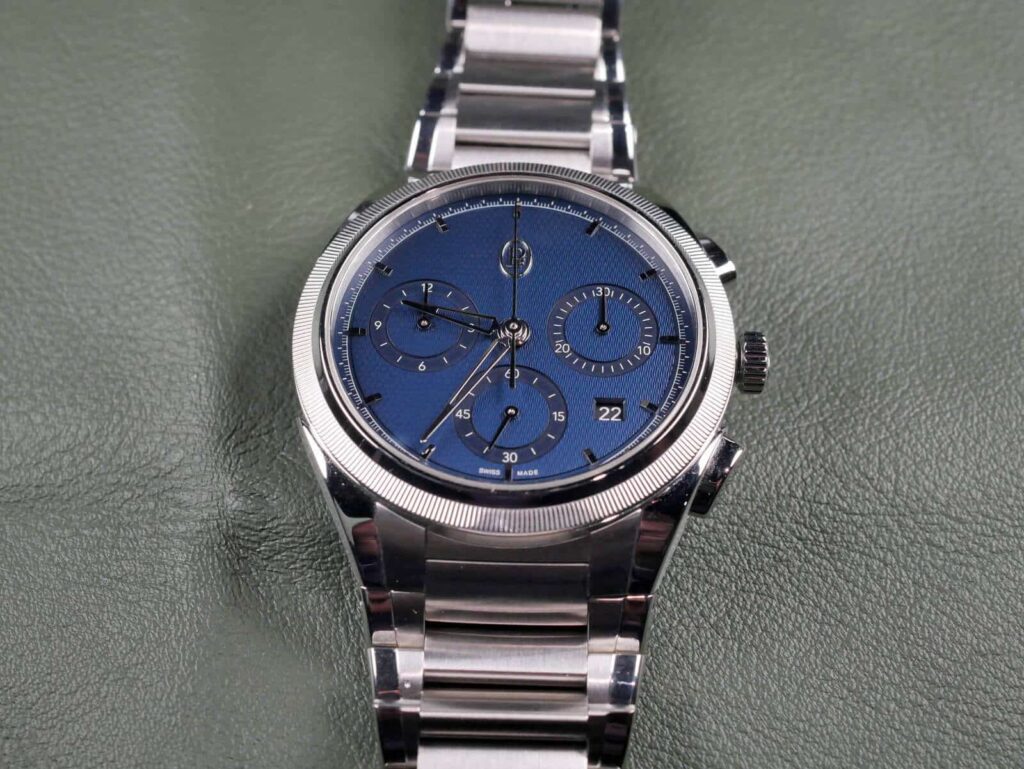
Parmigiani Fleurier has dressed the dial of this new timepiece with Grain d’Orge guilloché. It’s a form of decoration the Manufacture has used previously on both dials and rotors, however, in this instance, the scale of the pattern is remarkably small. Indeed, this fine dial adornment resembles the nap found on a suit with a high knot count. The decoration invites the wearer to sample its tactile delights only to frustrate inquisitive fingers with a pane of sapphire crystal.
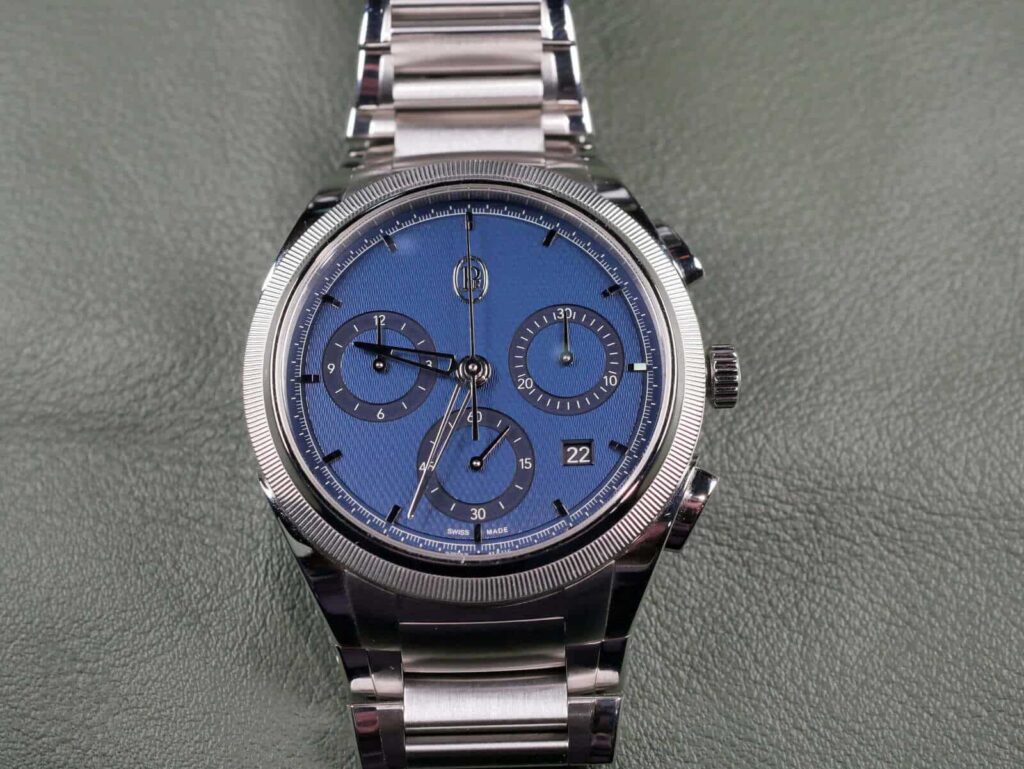
Three counters occupy the horological vista, a 30-minute register, a small seconds display and a 12-hour register. The diameter of each subdial is the same. Grain d’Orge guilloché makes a repeat performance, adorning the centre of each counter. While the main dial area is presented in mid-blue, the tracks encircling the counters are recessed, dark blue and feature Arabic numerals, all in the same font. Throughout the dial composition, all of the hands, irrespective of their purpose, are executed in silver-toned, rhodium-plated steel. While some chronographs employ vibrant shades, the Tonda PF Chronograph employs understated hues.
A date aperture is positioned adjacent to 4 o’clock. White numerals adorn a blue date disc which matches the hue of the main dial, thereby, conforming to horological etiquette.

Today, we live in a brand-obsessed world. A prominent logo or a name presented in bold form has become de rigeur. Unfortunately, in some cases, consumers fixate on the branding without giving due consideration to the merits of the product itself. Parmigiani Fleurier, a company familiar to the cognoscenti, has chosen to renounce overt branding. The brand’s initials, ‘P’ and ‘F’, positioned just below noon, are framed with an oval border, tasteful and understated. In fact, I suspect most prospective purchasers will identify the Tonda PF Chronograph not by a cartouche, but rather by its unique, classical appearance.
Parmigiani Fleurier Tonda PF Chronograph case
Measuring 42 mm in diameter, the stainless steel case is intricately formed. The lugs project slightly from the caseband before encircling the push pieces. Furthermore, the lugs are highly polished and are comprised of numerous parts. A mere lapse in concentration could mar the pristine appearance of a part, necessitating costly and time-consuming remedial work.

Throughout this composition, the brand has juxtaposed brushed and polished surfaces. For example, the tear-shaped push-pieces are highly polished but sit in close proximity to a satin-brushed caseband. Whenever two contrasting finishes are applied to a surface, it heightens production costs, albeit it is also indicative of quality. The 5-rows bracelet is beautifully formed and once again unites brushed and polished surfaces.
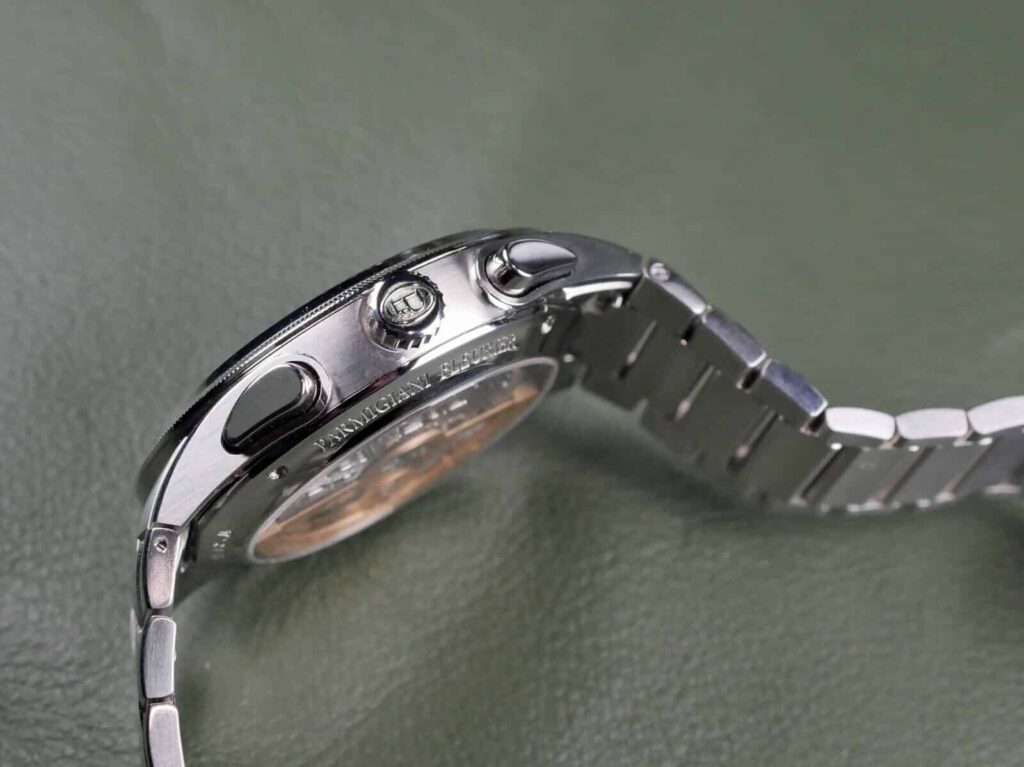
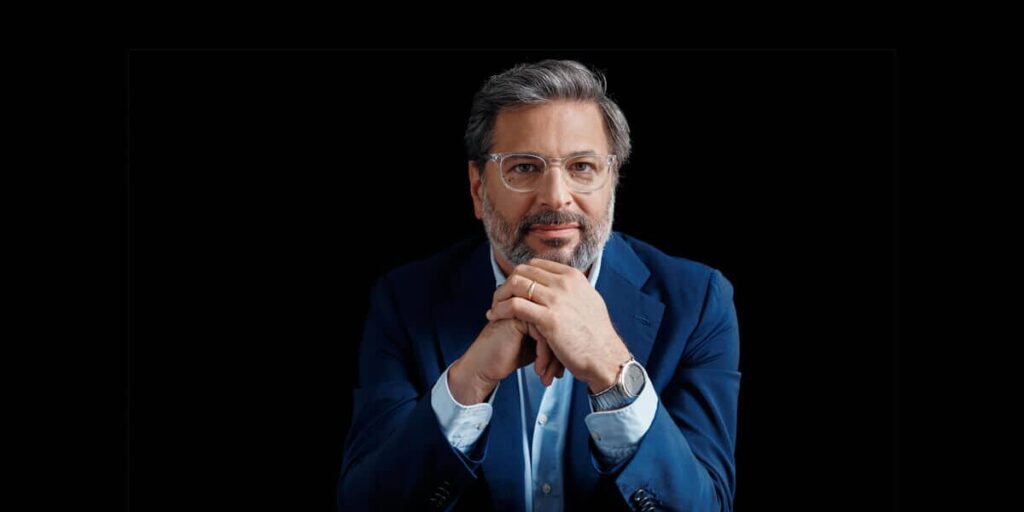
If the Maison had chosen to stamp components and present them in one finish, it would have delivered cost savings, however, the watch would not have resembled a Parmigiani Fleurier. Recently, I spoke to the company’s CEO, Guido Terreni, and during our conversation, it soon became obvious he would never countenance such penny-pinching.
Further soupçons of detail can be appreciated when viewed through a loupe. For example, positioned between the upper aspect of each lug and its flank, presented at 90°, there is a bevelled edge. This bevel emanates from the edge of the pushpiece closest to the crown and increases in width as it reaches the bracelet. This may sound like a tiny detail, but it will have been expensive to execute.
Parmigiani Fleurier has skilfully employed both CNC machines and hand craftsmanship. The final appearance is wonderfully cohesive and luxurious while the resultant tactility is reminiscent of the finest Italian silk.
Parmigiani Fleurier Caliber PF070
Sitting at the heart of the Parmigiani Fleurier Tonda PF Chronograph is the Caliber PF070, a fully integrated movement. Whereas a modular chronograph consists of a base movement with a chronograph module affixed on top, a fully integrated movement is purposely designed to be a chronograph from the outset. Typically, when a modular movement is actuated, it often causes the base movement to drag, leading to a drop in amplitude and, thereby, impairing precision. However, a fully integrated movement usually produces less ‘drag’.

Another exquisite detail found on this movement is that it features a column wheel rather than a comparatively pedestrian cam. The column wheel resembles a castellated tower. With each press of the pushpiece the column wheel rotates one step at a time. A finger drops between two pillars of the chronograph, activating the functions, namely start, stop and return to zero. The resultant feel is smoother than a cam-type mechanism. Column wheel mechanisms are typically more expensive than cam systems as they are engineered to infinitesimal tolerances rather than merely stamped. Indeed, in terms of quality, the column wheel is the ultimate expression of chronograph excellence and is usually accompanied by a deliciously sweet pushpiece action, free of any jarring.
When the chronograph is actuated its mechanism engages with the gear train. This temporary conversation employs a rocking pinion, lateral clutch or vertical clutch. The latter form of coupling is widely considered the preferred approach from a technical standpoint. The vertical clutch means the gears are always in mesh. When the chronograph is actuated, the central chronograph seconds hand commences its journey without any annoying pause or wobble. Additional benefits of the vertical coupling include reduced drag (see earlier) and, should the chronograph be allowed to run continuously, nominal wear.
The Parmigiani Fleurier Tonda PF Chronograph dwells on the highest plane. Indeed, it unites a fully integrated chronograph movement with a column-wheel and vertical coupling to glorious effect.
Caliber PF070 – high-frequency balance
Most ‘regular’ movements have a frequency of between 2.5 Hz and 4 Hz. However, some movements, such as the Caliber PF070, have a greater cadence. When ‘regular’ movements are subject to an impact, the smooth to and fro motion of the balance may be interrupted, adversely affecting precision. With a high-frequency balance, any shock to the balance will have less effect due to its greater cadence. Furthermore, when the regulating organ is temporarily out of specification due to an impact, a high cadence will ensure it returns to its isochronous rate more readily.
Another benefit of a watch featuring a high-frequency movement is that it is less prone to the influence of positional changes. In short, the ‘dynamic’ precision of the movement, when contrasted with ‘static’ precision (bench test), is superior with a high-frequency movement.

At this juncture, you may enquire why all movements do not have a high cadence. The reason is that they present several challenges which have to be overcome. Potential issues include greater wear, excessive lubricant consumption and, lastly, reduced autonomy.
Parmigiani Fleurier is no stranger to high-frequency movements. Indeed, having produced them for a number of years, all potential technical obstacles have been surmounted. For example, the power reserve of the Caliber PF070 is 65 hours, an impressive figure, especially given the cadence of the movement and the inclusion of a chronograph.
The Caliber PF070 has a frequency of 36,000 vph (5 Hz), a figure that contributes to the watch’s incredible precision. Moreover, its chronometric performance has been independently certified by COSC.
Caliber PF070 finissage
Parmigiani Fleurier painstakingly produces watches, often employing a significant quotient of hand craftsmanship. Interestingly, the company’s origins lie in the restoration of automata, clocks and watches. The company’s founder, Michel Parmigiani, a specialist in such restorations, pays close attention to the selection of materials, the design of components and the subsequent finishing of movements.

Where many brands view finishing as merely a form of adornment, Parmigiani Fleurier embellish surfaces with the primary intention of enhancing corrosion resistance and endowing surfaces with notable longevity. The Caliber PF070 proves to be no exception. The bridges are satin-finished, open-worked and feature hand-bevelled edges. The rim of the skeletonised oscillating weight is formed of 22-carat rose gold and includes polished and sandblasted surfaces.
With most mechanical watches, the rate is altered using an index-adjuster. Moving the index-adjuster towards or away from the stud, alters the effective length of the hairspring, making the movement run faster or slower.
However, the Caliber PF070 is fitted with a free-sprung balance. With this form of regulation, inertia weights fitted to the spokes of the balance wheel are rotated clockwise / counter-clockwise, altering the moment of inertia and, by default, the rate.
A free-sprung balance is superior to an index-adjusted balance as it is less susceptible to positional error and the rate stability is superior. Once again, the Swiss brand has selected the most elegant solution available.
Parmigiani Fleurier Tonda PF Chronograph – closing thoughts
The Parmigiani Fleurier Tonda PF Chronograph displays various indications in both an attractive and highly intelligible format. The blue dial is an artistic canvas encompassing contrasting shades, different depths and exquisite textures and is worthy of a gallery wall.
Such beauty is not restricted to the dial alone. The intricately formed bracelet merges with the case, fusing lines and contours while engaging wonderfully with prevailing light. Moreover, the integrated bracelet readily encircles the wrist, bestowing a congenial union with the wearer’s arm.
The Manufacture has produced a no-compromise self-winding movement, the Caliber PF070. Aside from its sublime finishing, the specification of this chronograph is of the highest order. Fully integrated, column-wheel and vertical coupling are highly desirable features that will sate the most discerning horophiles. Quite simply, chronographs don’t get better than this, perfectly illustrating that not all timepieces are equal.
Further reading
Technical specification
- Model: Parmigiani Fleurier Tonda PF Chronograph
- Reference: PFC915-1020001-100182
- Case: Diameter 42 mm; height 12.4 mm; water resistance 10 ATM (100 metres); sapphire crystal to front; exhibition case back.
- Functions: Hours; minutes; small seconds; date; chronograph
- Movement: PF070; self-winding movement; frequency 36,000 vph (5 Hz); 42 jewels; power reserve 65 hours; 315 components.
- Bracelet: Polished and satin-finished stainless steel bracelet with steel folding clasp
- Price: CHF 29,000 including VAT (RRP as of 18.11.2023)